

Comparing the best Subscription Billing Software for Small Business of 2026 includes 1. Chargebee 2. Stripe Billing 3. Recurly 4. Zoho Billing 5. Stax Bill 6. Maxio.
TL;DR
- Chargebee: Best all-around billing platform for B2B SaaS at $1M-$30M ARR. Smart dunning, RevRec, and a product catalog that handles usage-based pricing without a custom build.
- Stripe Billing: Best for SaaS teams with strong engineering and a preference for transaction-only pricing over monthly seats. Scale tier at 0.8% includes smart dunning.
- Recurly: Best for subscription businesses with a high volume of smaller accounts and B2C-style payment patterns. Dunning and account updater are native and strong.
- Zoho Billing: Best for small businesses already running the Zoho stack who want to add subscription billing without adding another vendor. Full dunning from $149/mo.
- Stax Bill: Best flat-fee option for small SaaS teams that process high volume and want predictable billing costs without a transaction percentage.
- Maxio: Best for teams approaching $5M-$10M ARR that need NRR waterfall reporting and multi-entity billing — a compact mention at this stage, core platform at the next.
At $500K to $10M ARR, the billing platform job changes. Failed-payment recovery is now a real revenue line. Your accountant is asking about deferred revenue schedules. And the free tiers you started on have either expired or started costing real money. Here are the six platforms that actually fit this band.
When SMB billing gets complicated
The billing complexity jump from $0 to $1M ARR is manageable. The jump from $1M to $5M ARR is not. Suddenly you have three pricing tiers, usage overages, annual contract renewals, mid-cycle upgrades, dunning workflows, and a bookkeeper asking where the deferred revenue is in the general ledger.
The platforms that fit this band are the ones that handle operational billing complexity without requiring a full-time billing engineer to maintain them. Chargebee, Recurly, and Stripe Billing’s Scale tier each land here for different reasons.
Best Subscription Billing Software for Small Business comparison: features, pricing and verdicts
| Tool | Best for | Starting price | Free trial | External rating |
|---|---|---|---|---|
Best all-around billing platform for B2B SaaS at $1M to $30M ARR | $599/mo (Performance) | Free Starter to $250K cumulative, then Performance | G2 4.4/5 (995 reviews) | |
Best for engineering-led SMBs with usage-based or hybrid pricing models | 0.8% per transaction (Scale) | Starts on 0.5% Starter, scales up | G2 4.4/5 (738 reviews) | |
Best for subscription businesses with high account volume and B2C payment patterns | $249/month | Contact for trial | G2 4.0/5 (205 reviews) | |
Best for small businesses on the Zoho ecosystem wanting subscription billing without adding a new vendor | $149/month (Standard) | Free plan (up to 20 subscriptions) | G2 4.3/5 (225 reviews) | |
Best flat-fee billing for high-volume SMBs that want predictable costs | $499/month | Demo available | Capterra 4.4/5 (117 reviews) | |
Best for fast-growing SaaS approaching $5M-$10M ARR with complex contract structures | $599/month | Demo only | G2 4.3/5 (829 reviews) |
How we chose these tools
We evaluated billing platforms for small business on six factors: dunning quality and failed-payment recovery rates, pricing transparency (no hidden overage fees), support quality at non-enterprise tier, RevRec availability, SaaS metrics reporting, and total cost of ownership at $2M-$5M ARR. Enterprise-only platforms like Zuora and Salesforce Revenue Cloud were excluded. Platforms with zero relevant SMB customer base (LemonSqueezy, Whop) were excluded.
How we weight subscription billing software for small business for the Topickz score
Every tool above is scored against the fixed rubric below and combined using these weights into the Topickz score on each card. The weights are set for subscription billing software for small business specifically, they are not copied from another category, and we publish them so you can see what moved a ranking and re-weight for your own priorities.
| Criterion | Weight | What we checked |
|---|---|---|
| Dunning and failed-payment recovery | 28% | At $2M ARR, a 1% improvement in payment recovery is $20K in annual revenue. We tested smart retry logic, account updater, and in-app recovery flows at each platform. |
| Pricing transparency and total cost | 22% | Hidden overage fees and opaque plan gating create budget surprises. We calculated real total cost including platform fee, transaction fee, and any required add-on seats at $2M ARR. |
| SaaS metrics and RevRec | 18% | At $2M-$5M ARR, board decks require MRR, NRR, and churn breakdowns. We checked whether these come native or require a separate analytics tool. |
| Subscription management depth | 15% | Plan changes, prorations, mid-cycle upgrades, and credit handling are daily operations. We tested each on a 50-customer dataset with mixed monthly and annual plans. |
| Support quality | 10% | Small SaaS teams cannot afford to debug billing edge cases alone. We tested response times and technical depth of support at the mid-tier plan for each platform. |
| Integration ecosystem | 7% | QuickBooks Online, Salesforce CRM, and HubSpot are the three most common integrations for SMB billing. We verified native connector quality for each. |
| Total | 100% |
Read the full TopickZ.com testing methodology for how we run each test, score every criterion, and combine them into a single rating.
Detailed reviews
Chargebee
Best all-around billing platform for B2B SaaS at $1M to $30M ARR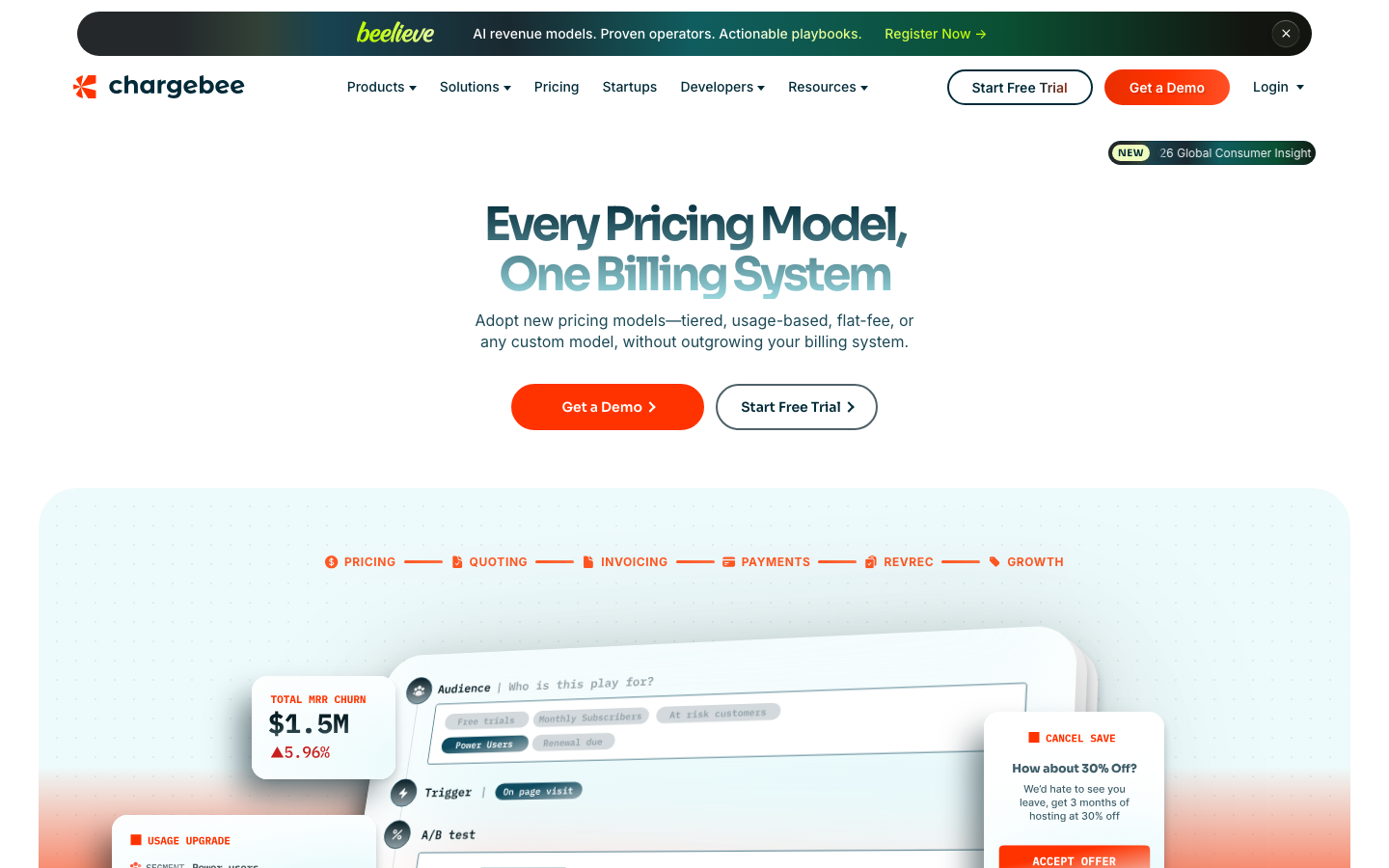
Screenshots of Chargebee 4 images
What's great
- Smart dunning with Chargebee Retention handles failed payments, cancellation deflection, and win-back sequences from a single interface with no extra tooling
- RevRec is available on the Performance plan at no extra seat charge — deferred revenue schedules pull from the same contract data as the invoices
- 995 G2 reviews is among the deepest operator feedback sets in this category; you can find a real customer who has been through your exact billing scenario
Watch-outs
- Performance tier at $599/month ($7,188/year) is a real jump for a team at $1M-$2M ARR; the math gets better as revenue grows but hurts at the low end
- Configuration is substantial; a clean product catalog, correct proration rules, and reliable dunning sequence typically takes 1-2 weeks to set up properly
- Multi-entity billing and offline payments are Enterprise-only; you will hit this wall if you operate in multiple legal entities
Chargebee is the right call for most B2B SaaS teams in the $1M-$10M ARR band. 995 G2 reviews at 4.4/5 with consistent praise for dunning quality and RevRec availability. The $599/month Performance plan is the real entry point for SMBs — the Starter free tier ends at $250K cumulative billing. At $3M ARR, $599/month is 0.24% of revenue; that math works. The gap is multi-entity support, which is Enterprise-only.
Pricing breakdown
| Plan | Price | Best for |
|---|---|---|
| Starter | Free to $250K cumulative billing | Early traction only |
| Performance | $7,188/yr ($599/mo) | $1M-$30M ARR, the real SMB tier |
| Enterprise | Custom quote | Multi-entity, $30M+ ARR |
What reviewers say about Chargebee
Recurring themes across ~995 G2 reviews (4.4/5), 2024-2026.
What reviewers praise
- Automated dunning and smart retries are the standout: reviewers report the follow-up emails and retry logic measurably cut involuntary churn without manual chasing.
- The customer self-service portal for managing subscriptions, upgrades, and cancellations is praised for removing day-to-day billing overhead from finance and support teams.
- Chargebee handles complex billing scenarios (multiple plans, proration, coupons, tiered pricing) that reviewers say would otherwise need heavy custom development.
- Broad integrations and a generally user-friendly interface make it straightforward to plug into existing CRM, accounting, and payment stacks.
What reviewers fault
- Analytics and reporting are the most common gap: reviewers say Chargebee shows billing and invoicing figures but not a full view of business health, with weak dashboards and limited customer segmentation.
- Pricing frustrates teams as they scale, with a sharp jump between tiers and revenue-based overage fees that several reviewers describe as a success tax.
- Customer support quality is a recurring complaint across G2, Capterra, and TrustRadius, with slow or unhelpful responses cited repeatedly.
- Customization is restricted in places, and some reviewers report a poor cancellation and refund experience, including being renewed after attempting to cancel.
Loading reviews…
Stripe Billing
Best for engineering-led SMBs with usage-based or hybrid pricing models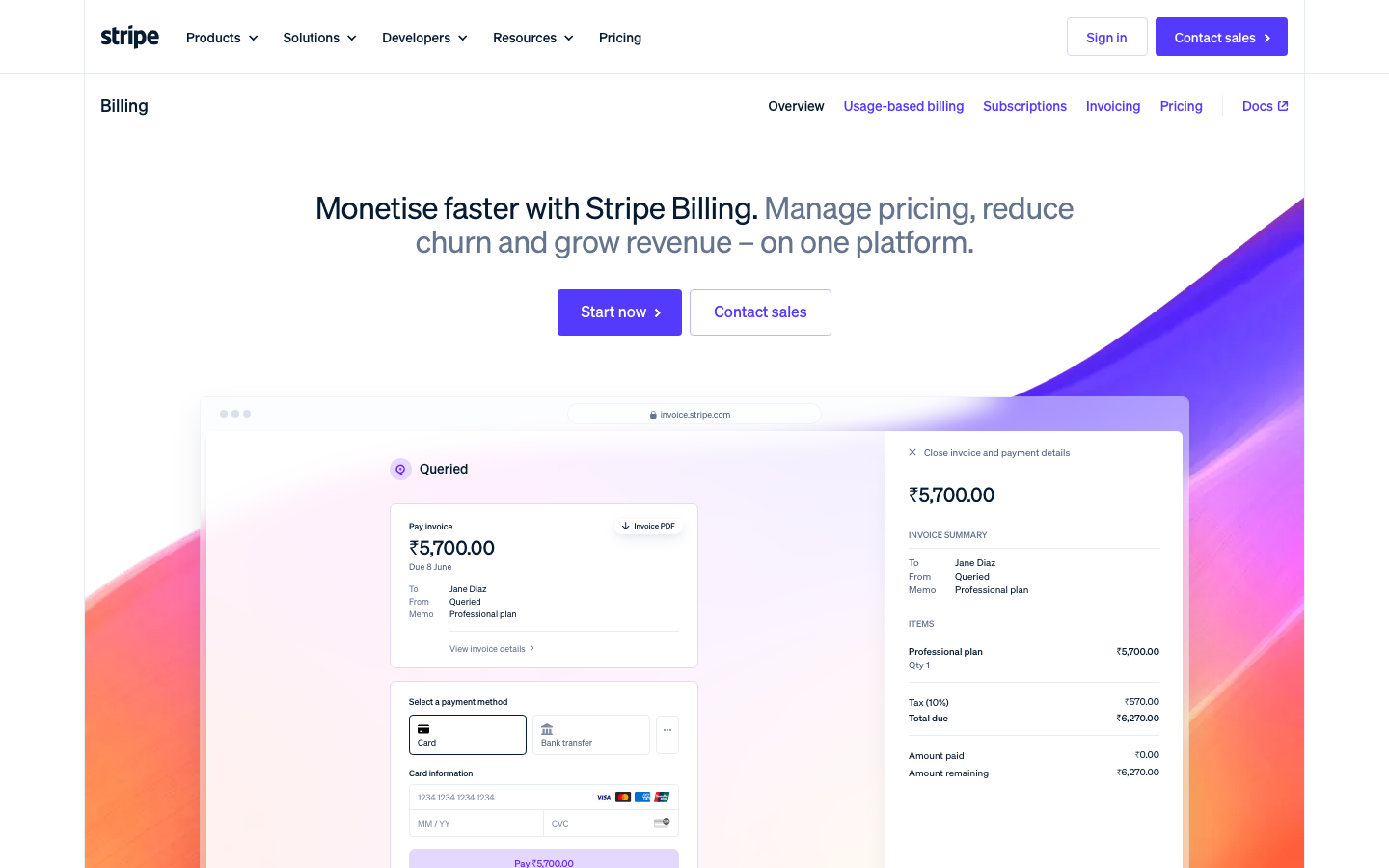
Screenshots of Stripe Billing 2 images
What's great
- Smart retry and adaptive dunning are included in the Scale tier at no additional seat cost — just the 0.8% per successful transaction
- API handles usage-based billing models (per-seat, per-event, tiered, with minimums) that most mid-market platforms require expensive add-ons to support
- At $5M ARR on the Scale tier, Stripe costs $40,000/year — expensive but avoids the single-vendor lock-in that comes with dedicated billing platforms
Watch-outs
- No native board-pack SaaS metrics; you need Stripe Sigma, ChartMogul, or a custom data warehouse to get MRR cohort analysis
- Revenue Recognition is a separate paid add-on; ASC 606 deferred revenue does not come standard even at the Scale tier
- Support becomes notably slower outside the custom pricing tier for billing-specific edge cases
Stripe Billing at the Scale tier (0.8%) is the right call for engineering-led SMBs that want billing flexibility without a fixed monthly seat. The cost at $5M ARR is $40K/year. That is more than Chargebee Performance but covers a wider set of pricing model configurations without custom engineering work. 738 G2 reviews at 4.4/5. The gap is reporting — you will need a separate analytics layer.
Pricing breakdown
| Plan | Price | Best for |
|---|---|---|
| Starter | 0.5% per transaction | Under $1M ARR or simple billing models |
| Scale | 0.8% per transaction | Smart dunning and complex pricing at $1M-$10M ARR |
| Revenue Recognition | Custom add-on | ASC 606 when your auditor asks for it |
What reviewers say about Stripe Billing
Recurring themes across ~738 G2 reviews (4.4/5), 2024-2026.
What reviewers praise
- The developer experience is the most-cited strength: clean documentation, a consistent well-designed API, and straightforward setup of subscriptions, invoices, and recurring flows without heavy custom engineering.
- Reviewers say Stripe Billing removes the pain of proration, failed-payment retries (Smart Retries), and dunning that previously required in-house code, so recurring revenue runs largely hands-off.
- Tax handling and multi-region compliance via Stripe Tax is repeatedly praised for collecting and remitting across jurisdictions that used to be a manual nightmare.
- Deep integration into the broader Stripe stack (Payments, Checkout, Connect) is called a genuine workflow saver, letting teams keep billing, payments, and payouts under one platform.
What reviewers fault
- Fees add up fast at scale: reviewers flag the per-transaction cut plus an additional percentage layered on top specifically for billing features, which gets expensive for high-volume businesses.
- Many billing essentials sit behind paywalled add-ons, and reviewers argue features they consider core to an online billing system cost extra.
- API rate limits (commonly cited around 100 read/write operations per second in live mode) are called a real growth constraint that B2B companies can hit.
- Reviewers say updating failed cards and generating self-serve payment-update links is clunky, and that out-of-the-box integration with non-Stripe systems could be smoother.
Loading reviews…
Recurly
Best for subscription businesses with high account volume and B2C payment patterns
Screenshots of Recurly 4 images
What's great
- Account Updater automatically refreshes expired card details before they trigger a failed payment — this alone can recover 1-3% of at-risk MRR without any manual intervention
- Native MRR waterfall, churn cohort, and subscriber lifecycle reports come standard at $249/month, with no separate analytics add-on needed
- Strong at high subscriber volume; the platform was designed for thousands of accounts, not dozens
Watch-outs
- G2 rating of 4.0/5 across 205 reviews is the lowest in this guide; pricing surprises and support delays are the most common complaints
- Enterprise B2B billing patterns (multi-year contracts, custom invoicing, offline payments) are weaker than Chargebee
- $249/month entry point is higher than Chargebee on paper, but Chargebee's free tier ended at $250K cumulative billing for most SMBs by now
Recurly earns its spot for small SaaS businesses with high subscriber counts and meaningful credit card churn. Account Updater alone is worth the $249/month if you have 500+ active subscribers on card payments. 205 G2 reviews at 4.0/5 — lower satisfaction than Chargebee but widely used in the $1M-$10M ARR band. The native MRR reporting means you are not piecing together board metrics from three different dashboards.
Pricing breakdown
| Plan | Price | Best for |
|---|---|---|
| Starter | $249/month | $1M-$10M ARR subscription businesses |
| Professional | Custom pricing | Higher volume, advanced analytics, dedicated support |
| Elite | Custom pricing | Enterprise-scale, multi-entity, full RevRec |
What reviewers say about Recurly
Recurring themes across ~205 G2 reviews (4.0/5), 2024-2026.
What reviewers praise
- Automated dunning and churn recovery draw the most praise, with reviewers crediting reliable retries and one-click payment updates for reducing failed-payment churn.
- Billing reliability is a recurring theme: Recurly charges on the right cycle consistently, and reviewers say that dependability offsets the cost.
- The ability to plug in and swap almost any payment gateway with minimal effort is called out as genuine flexibility.
- The interface is generally seen as user-friendly and support is described as responsive by higher-rated reviewers.
What reviewers fault
- Customization is limited: reviewers say editing invoices, changing line-item pricing or descriptions after issuance, and setting custom renewal notifications is harder than it should be.
- Handling price localization, tax-inclusive versus tax-exclusive setups, and pricing A/B tests is cumbersome, and documentation is described as scattered and inconsistent.
- Reporting lacks depth, especially dunning-email performance (open, click, and cohort-churn visibility), leaving teams without insight into what is working.
- Pricing is called expensive for startups and low-volume businesses (list starts around $1,200), and a few reviewers felt misled or overcharged by fine-print contract terms.
Loading reviews…
Zoho Billing
Best for small businesses on the Zoho ecosystem wanting subscription billing without adding a new vendor
What's great
- At $149/month for the Standard tier, it is the most affordable path to full subscription billing with dunning and multi-currency for a small business
- Native sync with Zoho Books, Zoho CRM, and Zoho Analytics means a single-vendor stack without middleware costs — a genuine advantage for existing Zoho One customers
- Multi-currency billing and automated tax handling for 50+ countries is included in the Standard tier at no extra cost
Watch-outs
- Limited payment gateway depth; advanced routing, fallback gateways, and smart retry logic are weaker than Chargebee or Recurly
- Weaker SaaS-specific metrics; MRR waterfall and NRR cohort analysis require Zoho Analytics, which is a separate subscription
- Community and support resources are smaller; fewer operators have documented their Zoho Billing implementations at the $2M-$5M ARR level
Zoho Billing makes sense for exactly one type of small business: teams already using Zoho CRM and Zoho Books who want to add subscription billing without adding a new vendor relationship, negotiating a new contract, or rebuilding integrations. 225 G2 reviews at 4.3/5. At $149/month, the Standard tier is the most cost-efficient billing platform in this guide for teams that already live in the Zoho ecosystem.
Pricing breakdown
| Plan | Price | Best for |
|---|---|---|
| Free | $0/month | Up to 20 active subscriptions |
| Basic | $49/month | Unlimited subscriptions, full dunning |
| Standard | $149/month | Advanced workflows, multi-currency, Zoho Analytics integration |
What reviewers say about Zoho Billing
Recurring themes across ~2,900 G2 reviews (4.1/5) and Capterra reviews (4.3/5), 2024-2026.
What reviewers praise
- Price-to-feature ratio is the most repeated compliment: reviewers say Zoho delivers lead scoring, workflow automation, and multi-currency support at a fraction of the cost of HubSpot or Salesforce.
- Depth of the Zoho ecosystem is consistently praised by teams already using Zoho Books, Zoho Desk, or Zoho Campaigns, who describe the cross-app data flow as a genuine alternative to buying multiple point solutions.
- The Canvas drag-and-drop UI builder, added in recent years, appears in newer positive reviews as a meaningful upgrade, letting non-technical admins redesign the record layout without code.
- Workflow automation breadth gets strong marks, with reviewers pointing to multi-condition rules, scheduled actions, and blueprint approval processes as features competitors lock behind enterprise tiers.
- Lead management tools including assignment rules, scoring, and conversion tracking are frequently cited as thorough and configurable for teams with defined sales processes.
What reviewers fault
- Customer support is the single most common complaint across G2 and Capterra, with reviewers on standard plans describing slow ticket responses, inconsistent answers, and difficulty escalating urgent issues.
- The learning curve is steep enough that multiple reviewers recommend hiring a Zoho consultant for initial setup, especially for automation, Deluge scripting, and module customization.
- The mobile app has reliability problems that appear consistently in recent reviews, including bugs that prevent notes from displaying, missed call logs, and crashes under poor connectivity.
- Integration with non-Zoho tools is frequently described as more friction than the docs suggest, with third-party connectors requiring Zapier workarounds or custom API work for stable two-way sync.
- The interface, despite recent improvements, is still called cluttered and overwhelming by first-time CRM buyers, and the density of settings can make routine tasks harder to find than in leaner tools.
Loading reviews…
Stax Bill
Best flat-fee billing for high-volume SMBs that want predictable costs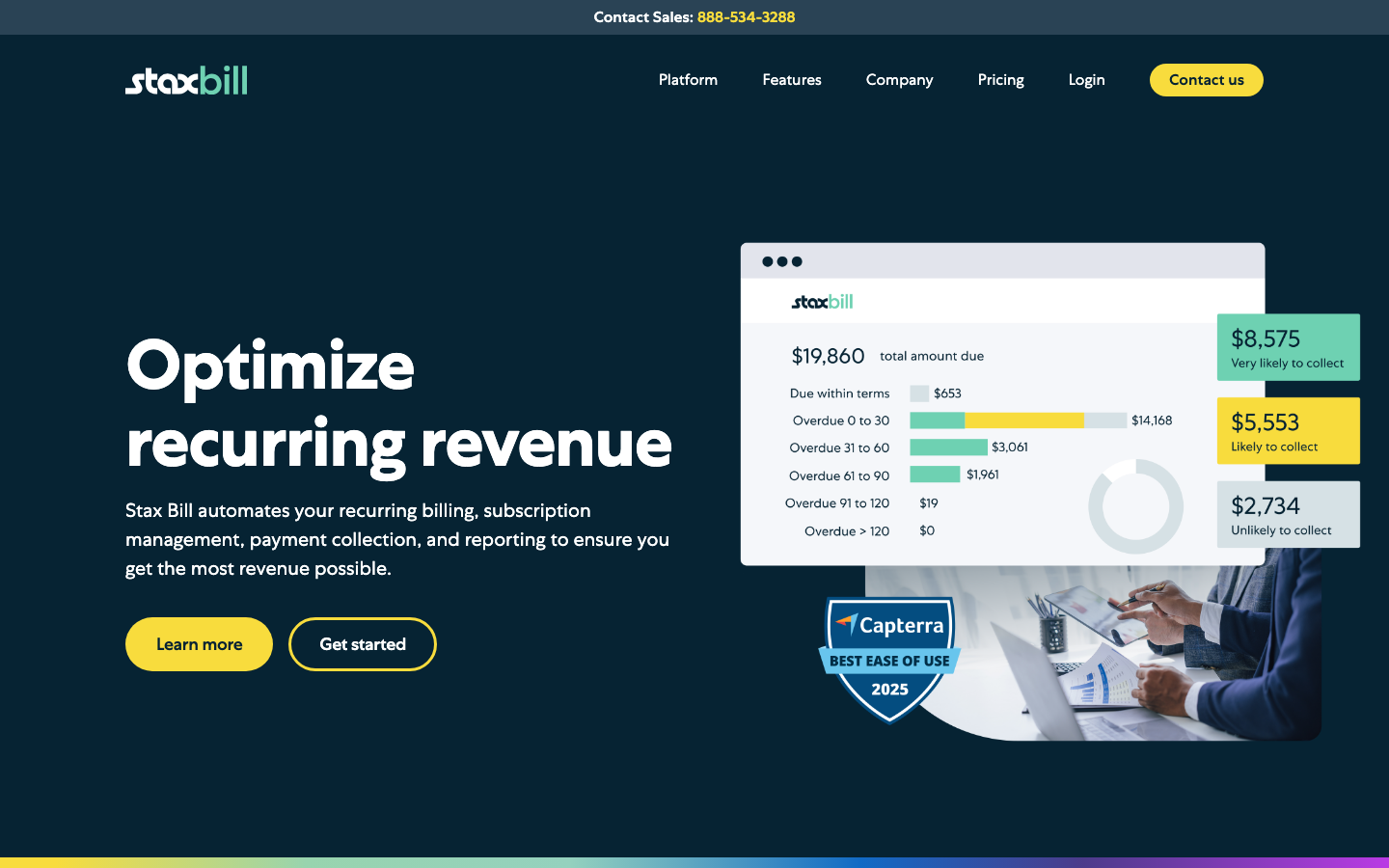
What's great
- Flat $499/month fee with no transaction percentage means cost is predictable regardless of billing volume — better economics than Chargebee past $800K ARR
- QuickBooks Online integration is one of the strongest in the category; journal entries sync automatically with no manual mapping required
- Customer portal is included at no extra cost, allowing subscribers to manage their own plans, payment methods, and invoice history
Watch-outs
- $499/month is expensive for small businesses under $500K ARR; the flat-fee break-even against Chargebee Performance is around $800K ARR
- SaaS metrics and RevRec reporting are not as polished as Chargebee or Recurly; board-pack metrics may still need an external layer
- Implementation can take 2-4 weeks and typically requires direct vendor support; not a tool you configure in a weekend
Stax Bill is the pick for a small SaaS business that has crossed $800K ARR, wants a flat billing cost, and already runs QuickBooks Online. 117 Capterra reviews at 4.4/5. The QBO sync is the best in class for teams that want invoices, recognized revenue, and deferred balances to appear in their accounting system automatically. Under $800K ARR the $499/month flat fee is too expensive relative to Chargebee’s percentage model.
Pricing breakdown
| Plan | Price | Best for |
|---|---|---|
| Standard | $499/month | $800K+ ARR teams on QuickBooks Online |
| Enterprise | Custom pricing | Higher volume, multi-entity, dedicated support |
What reviewers say about Stax Bill
Recurring themes across ~117 Capterra reviews (4.4/5), 2024-2026.
What reviewers praise
- Customer service is the most-praised strength, described as quick and stellar during setup and ongoing use.
- Reviewers value the deep per-subscription custom pricing options, which let them tailor plans to individual customers.
- Automated collections, card processing, and auto-updating of expired credit cards are called out as reliable, hands-off features.
- Ease of adding clients, emailing invoices directly, and tracking AP/AR is repeatedly mentioned as a practical day-to-day win.
What reviewers fault
- Pricing sits on the high side (Growth plan starts around $499/month billed annually), which reviewers flag for smaller operations.
- The interface is complex and slows noticeably at month-end, and simple tasks require a lot of employee training.
- Updating prices across active subscriptions is a real pain point, with some reviewers writing custom code because bulk price changes are not built in.
- Reporting is described as not configurable and only marginally useful, with weak support for cost-based accounting.
- The API is decent but uneven (only some changes trigger events), and SSO reportedly breaks the standard login flow.
Loading reviews…
Maxio
Best for fast-growing SaaS approaching $5M-$10M ARR with complex contract structures
What's great
- NRR waterfall, ARR bridge, and RevRec reports come standard — board-pack-ready SaaS metrics without a separate analytics vendor
- Handles multi-currency, multi-entity, and complex contract structures (annual ramp, professional services, one-time fees mixed with subscriptions) natively
- Strong at $5M-$100M ARR; many series B/C companies use Maxio as their permanent billing and RevRec platform through exit
Watch-outs
- Implementation typically requires 3-6 weeks and dedicated vendor support; not a self-serve setup
- $599/month minimum is high for teams under $2M ARR where Chargebee covers most of the same ground for less
- Some SMBs find the feature depth overwhelming; if you are not using advanced RevRec and contract management, you are paying for functionality you do not need
Maxio is listed here as a compact mention because it appears on most enterprise billing shortlists and the transition from an SMB platform to Maxio is common around $5M-$10M ARR. 829 G2 reviews at 4.3/5. If Chargebee’s RevRec module is not meeting the needs of your controller, Maxio is the next step up rather than a migration to Zuora or Salesforce Revenue Cloud. The full Maxio comparison is in our enterprise subscription billing guide .
Pricing breakdown
| Plan | Price | Best for |
|---|---|---|
| Entry | $599/month | $2M-$10M ARR with complex billing and RevRec needs |
| Growth | Custom pricing | $10M-$50M ARR multi-entity operations |
| Enterprise | Custom pricing | $50M+ ARR with full CPQ and revenue lifecycle |
What reviewers say about Maxio
Recurring themes across ~829 G2 reviews (4.3/5), 2024-2026.
What reviewers praise
- The SaaSOptics-side reporting and revenue-recognition depth is called a game changer, giving finance leaders the subscription metrics needed to make strategic decisions.
- Reviewers praise the automation of complex B2B subscription billing and rev-rec that would otherwise be manual and error-prone.
- It integrates well with accounting tools (QuickBooks, NetSuite) and handles complicated, sales-led subscription structures that simpler tools cannot.
- Bulk Excel uploads are repeatedly mentioned as a practical way to move large volumes of billing data efficiently.
What reviewers fault
- Support is the loudest complaint: slow response times, and reviewers note you often have to buy support hours in bulk, turning a one-hour config task into a four-figure expense.
- Implementation is long and heavy, with some small companies reporting onboarding that stretched past ten months.
- The interface is not intuitive and requires real training, worsened by a knowledge base that mixes SaaSOptics and Chargify material with no way to filter between them.
- Reporting flexibility and customization are limited, and reviewers say the API is poorly documented, forcing guesswork.
- Syncing data across a dual product-led and sales-led motion (plus CRM) gets complex, making product-catalog and pricing updates onerous.
Loading reviews…
Tools we considered but excluded
We evaluated more tools than the 6 you see above. These did not make the cut. Saying what we rejected, and why, is the editorial muscle most listicles skip.
- Zuora: Enterprise-only; minimum contract $30K-$50K/year and implementation of $100K+ is not viable for SMBs under $10M ARR
- Salesforce Revenue Cloud: Requires Sales Cloud Enterprise and dedicated Revenue Cloud architects; not practical below $10M ARR
- LemonSqueezy: MoR model is designed for indie SaaS and consumer purchases, not B2B subscription management at SMB scale
- Paddle: Best fit is pre-$300K ARR; the 5% fee becomes prohibitive for most SMBs past that point
Honorable mentions
Solid tools that did not crack the main list but are worth tracking, especially for niche use cases.
- Younium: Strong at B2B SaaS $1M-$10M ARR with usage-based and hybrid pricing models; fewer native integrations than Chargebee but stronger on contract management
- Billsby: Flat $35/mo fee works for very small subscription businesses; limited RevRec and SaaS analytics depth
The billing complexity jump from $0 to $1M ARR is manageable. The jump from $1M to $5M ARR is not.
At some point in this range, three things happen simultaneously. Your payment failure rate becomes a measurable revenue problem. Your accountant or CFO asks for deferred revenue schedules ahead of a board meeting. And the free or low-cost billing tier you started on either expired or is costing real money for what it provides.
The platforms in this guide are the ones that handle those three problems without requiring a full-time billing engineer to maintain them.
The right tool depends on which problem is most urgent
Failed-payment recovery: Recurly’s Account Updater and Chargebee’s smart dunning are the two best options. Recurly wins on card network integrations; Chargebee wins on B2B-specific cancellation recovery flows.
RevRec and deferred revenue: Chargebee RevRec is available on the Performance plan. Maxio includes it at a higher entry point. Stripe’s Revenue Recognition is a paid add-on. Recurly and Stax Bill lag here.
Cost predictability: Stax Bill at $499/month flat beats every percentage-based model at $800K+ ARR. Zoho Billing at $149/month is the most cost-efficient for Zoho-stack teams. Chargebee at $599/month is a fair price for the depth it provides past $2M ARR.
Total cost of ownership at $3M ARR
| Platform | Annual cost | Includes RevRec? | Includes SaaS metrics? |
|---|---|---|---|
| Chargebee Performance | $7,188 | Yes (add-on) | Partial |
| Stripe Billing Scale | $24,000 (0.8%) | No (add-on) | No |
| Recurly Starter | $2,988 | No | Yes |
| Zoho Billing Standard | $1,788 | No | Via Zoho Analytics |
| Stax Bill | $5,988 | No | Partial |
| Maxio Entry | $7,188 | Yes | Yes |
At $3M ARR, Chargebee and Maxio are comparable in cost but Maxio includes board-ready SaaS metrics natively. The call between them usually comes down to whether your team needs analyst-quality NRR waterfall reports today or in 12-18 months.
Migrating between platforms at this stage
Small SaaS companies almost always regret their first billing platform migration. It costs 4-8 weeks of engineering time, often corrupts historical subscription data, and almost never recovers the operational cost in less than 18 months.
The cleaner path is to pick the platform you would want at $10M ARR and start there. Chargebee and Maxio both scale to $100M+ ARR. Stripe Billing scales to any ARR but requires more engineering overhead. Recurly works well to $30M-$50M ARR.
Zoho Billing and Stax Bill have lower ceilings and may force a migration at scale.
For the full comparison across all 11 billing platforms including startup options, see our complete subscription billing guide .
Also relevant: Best Billing for Startups and Best Enterprise Subscription Billing .
Frequently asked questions
What is the best subscription billing software for a small SaaS company at $2M ARR?
Chargebee Performance is the consensus pick at $2M ARR. It covers dunning, RevRec, and multi-currency at $599/month — about 0.36% of ARR. If you are engineering-led and want transaction pricing over a monthly seat, Stripe Billing Scale tier at 0.8% is $16,000/year at $2M ARR, slightly more expensive but more flexible on pricing model complexity.
Is Recurly or Chargebee better for small businesses?
Chargebee for B2B SaaS with annual contracts and complex proration needs. Recurly for subscription businesses with high account volume, monthly billing cycles, and significant credit card churn where Account Updater recovery is a meaningful revenue line.
Does Zoho Billing integrate with QuickBooks?
Zoho Billing integrates natively with Zoho Books, not QuickBooks. For QuickBooks integration, Chargebee and Stax Bill both offer stronger native connectors.
At what ARR does the flat Stax Bill fee beat Chargebee's percentage model?
The break-even depends on your specific Chargebee plan, but roughly at $800K-$1M ARR. Below that, Chargebee's free Starter tier or the percentage-based Performance plan costs less. Above $1M ARR, Stax Bill's $499/month flat fee is better economics than Chargebee's percentage for high-volume billing.
Related helpful reads
Write a review
Posts to the page right away. Keep it real — no links or email addresses.