
Datadog is an Observability / monitoring & security platform by Datadog, Inc. This profile pulls together Datadog's ratings across the major review sites, its company and funding details, leadership, features, pricing, and the latest news, with every external source cited at the bottom.
About Datadog, Inc.
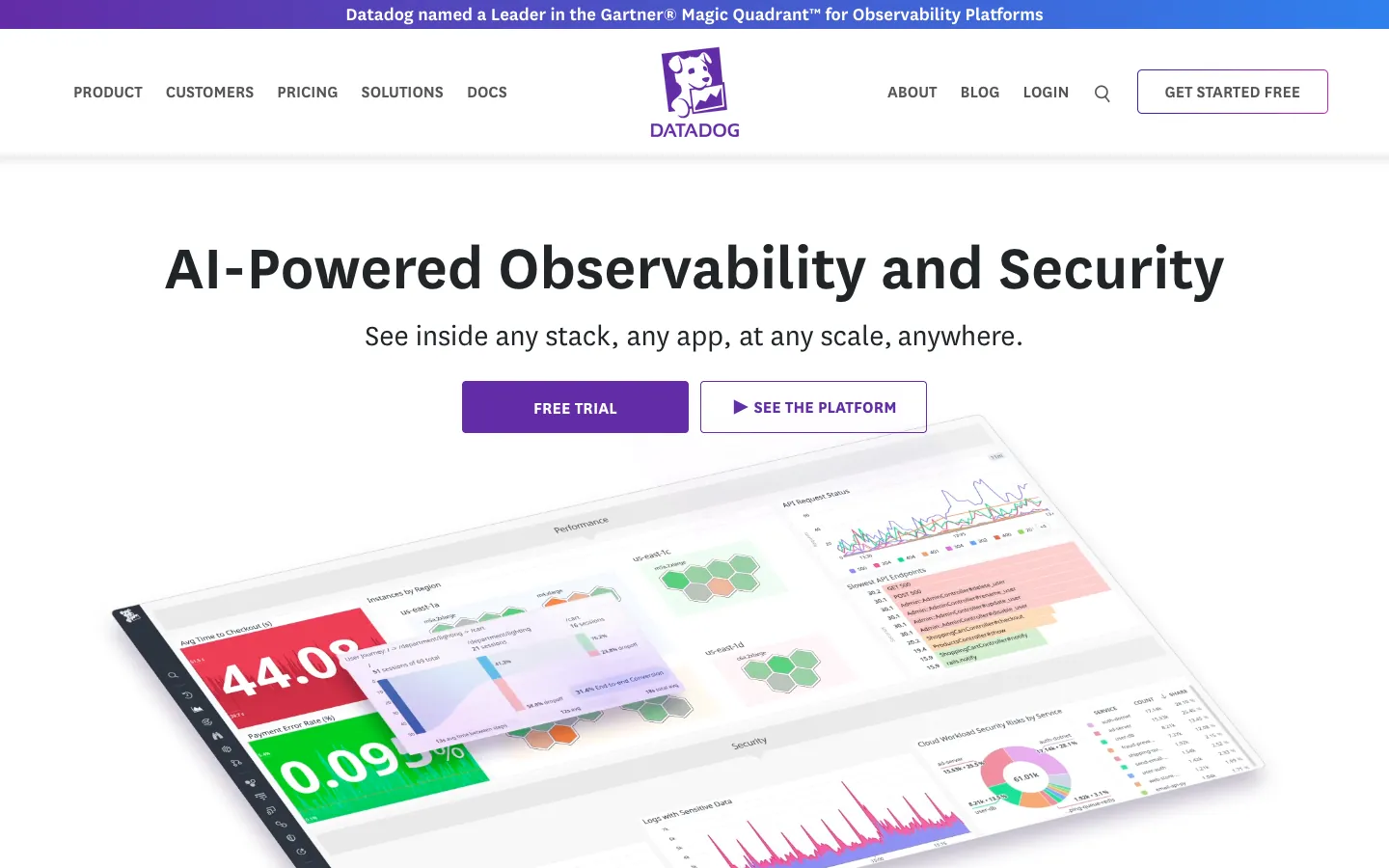
Datadog is a cloud monitoring and security platform that provides infrastructure monitoring, APM (application performance monitoring), log management, real user monitoring, synthetic testing, and security observability across cloud, hybrid, and on-premises environments. Founded in 2010 in New York City by Olivier Pomel and Alexis Le-Quoc, the company went public on NASDAQ under the ticker DDOG in September 2019 and reported approximately $2.68 billion in full-year fiscal 2025 revenue, up roughly 26% year over year. Datadog's platform ingests metrics, traces, and logs from more than 750 integrations and is used by more than 29,000 customers ranging from startups to the Fortune 500. The product is organized around a single unified data platform where every signal type shares the same tag-based query model.
| Category | Observability / monitoring & security platform |
| Company | Datadog, Inc. |
| Founded | 2010 |
| Headquarters | New York City, New York, US |
| Industry | Software Development · Cloud monitoring, observability & security |
| Team size | ~6,800 full-time (FY2025) |
| Ownership | Public, NASDAQ: DDOG (IPO September 2019) |
| Founder / CEO | Olivier Pomel and Alexis Le-Quoc (co-founders, 2010) |
| Specialties | Infrastructure monitoring, APM, log management, real user monitoring, synthetic testing, cloud security, network performance monitoring, CI/CD pipeline visibility |
| Website | datadoghq.com |
Find Datadog on: Wikipedia · Crunchbase · LinkedIn · G2 · Capterra · producthunt.com
Datadog ratings across the web
Aggregated from the major review platforms. Each links to the source.
Also rated: TrustRadius 8.5/10 (148).
Rating breakdown
Per-category scores from Capterra Datadog (285 reviews).
Who uses Datadog
Datadog reviews from Topickz readers
Reader-submitted and moderated. This is separate from the third-party scores above. Verified-buyer reviews are labeled.
Be the first to review Datadog. Your honest take helps the next buyer decide.
Review Datadog
Your honest take, in about two minutes. We verify each review before it publishes.
Review submitted. You're entered!
Your giveaway entry token:
Screenshot this token and keep it safe. We draw 10 winners every month and email them, so watch the inbox for the email you entered with. Your review is showing below now and goes live once our editors verify it. Terms.
What people say about Datadog
Our synthesis across 1,042 G2 reviews at 4.4/5 and 285 Capterra reviews at 4.6/5, plus Gartner Peer Insights and TrustRadius. No fabricated quotes, this is the consistent pattern across reviews and third-party analyses.
Most praised
- Breadth of coverage is the consistent standout: infrastructure metrics, APM traces, logs, RUM, and security signals all live in one platform with a unified tag-based query model that makes cross-correlation fast
- The integration library (750+ integrations) means most infrastructure components instrument in minutes, and the out-of-box dashboards for AWS, Kubernetes, and major databases save days of setup work
- Dashboards are flexible and production-quality enough to put in front of executives and on-call engineers alike, with templated variables and alert widgets that update in real time
Most cited complaints
- Pricing is the dominant complaint across every review platform: the per-host plus per-GB plus per-event model compounds fast, and teams frequently report bills that climbed 3-5x after scaling their infrastructure
- Log management in particular is seen as expensive relative to alternatives like Loki or OpenSearch; many teams filter logs aggressively just to control costs rather than ingesting everything
- The platform's breadth can be a double-edged sword: new users face a steep learning curve navigating dashboards, query language, and product surfaces, and onboarding without a dedicated internal champion often stalls
What we found testing it
What's great
- 450+ integrations and the most unified platform view across metrics, logs, traces, and security
- APM distributed tracing at $31/host/mo includes 1M indexed spans and 150GB ingested spans monthly
- Dashboard builder that engineering leaders and non-technical stakeholders both adopt without training
Watch-outs
- Billing model is a 12-module maze; a single team can hit $80K/month without realizing it until the invoice lands
- Proprietary agent creates migration friction; switching off Datadog means re-instrumenting your entire stack
- APM Enterprise at $40/host/mo required for Continuous Profiler, which most SRE teams actually need
Datadog funding & ownership
| Round | Amount | Date | Lead investor |
|---|---|---|---|
| Seed | $1.5M | 2011 | RTP Ventures |
| Series A | $6.2M | 2012 | RTP Ventures |
| Series B | $15M | 2014 | Index Ventures |
| Series C | $31M | 2015 | OpenView, ICONIQ Capital |
| Series D | $94.5M | 2016 | ICONIQ Capital, OpenView |
| Series E | $198M | 2019 | Alkeon Capital |
| IPO | ~$648M raised (NASDAQ: DDOG) | Sept 2019 | Public offering at $27/share |
Very low risk. Datadog is a profitable, publicly traded company on NASDAQ (DDOG) with approximately $2.68 billion in FY2025 revenue, more than 29,000 customers, and a usage-based revenue model that aligns closely with customer cloud spend. The company has posted GAAP profitability and maintains strong net revenue retention above 110%. Both co-founders remain in operating roles (Pomel as CEO, Le-Quoc as CTO), providing unusual continuity for a company of this size. The primary watch-item for buyers is bill shock: Datadog's per-host, per-GB, and per-event pricing can compound rapidly as infrastructure scales, and customers consistently flag surprise overages as the number-one pain point.
Datadog features & integrations
Security & compliance
| Standard | Availability |
|---|---|
| GDPR | Yes |
| HIPAA | Yes (Business Associate Agreement available on Enterprise) |
| SOC 2 Type II | Yes (SOC 2 Type II) |
| SSO / SAML | Yes (SAML SSO on all paid plans) |
Integrations: AWS, Google Cloud Platform, Microsoft Azure, Kubernetes, Docker, Slack, PagerDuty, GitHub, Terraform, and Jenkins.
Datadog leadership
Datadog pricing
| Plan | Price | Best for |
|---|---|---|
| Free | $0 | Up to 5 hosts, 1-day metric retention, core infrastructure monitoring; good for personal projects and evaluation |
| Pro | $15/host/mo (Infrastructure); add-on APM from $31/host/mo | Production teams needing full metric history, alerting, and core APM tracing |
| Enterprise | Custom (volume commitment) | Large orgs needing HIPAA, custom retention, dedicated support, advanced security products, and SAML SSO |
| Log Management | From $0.10/GB ingested + $1.70/GB/mo retained | Teams centralizing application and infrastructure logs; priced independently of host count |
The catch: Datadog's pricing is entirely usage-based and has several independent dimensions that stack: Infrastructure Monitoring is $15/host/mo (annual), APM adds $31/host/mo, Log Management charges per GB ingested and per GB retained separately, and synthetics, RUM, and security products each carry their own meters. A mid-size engineering team running 50 hosts with APM, logs, and RUM can easily land at $8,000-$15,000/mo without realizing it until the first invoice. The 14-day free trial and free tier (up to 5 hosts) are legitimate entry points, but any serious production deployment should use Datadog's pricing calculator and commit-based discounts, which typically run 20-25% below on-demand rates.
Datadog alternatives & where it appears
Featured in our guides
Datadog product changelog
What Datadog has actually shipped, summarized from its own release notes and dated. Not auto-generated, updated as part of our freshness checks.
- July 15, 2026
Bits AI general availability
Datadog announced Bits AI, its AI-powered observability assistant, is now generally available, allowing engineers to investigate incidents and query telemetry data through natural language.
Source - June 20, 2026
LLM Observability expanded
Datadog expanded its LLM Observability product with token cost tracking, latency breakdowns per model call, and prompt-level traces for popular AI frameworks including LangChain and OpenAI SDK.
Source - May 12, 2026
Kubernetes autoscaling workload monitoring
New dashboards and alerts for Kubernetes Vertical and Horizontal Pod Autoscaler shipped, giving platform teams visibility into scaling decisions and resource right-sizing recommendations.
Source - April 8, 2026
Q1 FY2026 earnings beat
Datadog reported Q1 FY2026 revenue of $762M, ahead of consensus estimates, with 29,200+ customers and continued growth in multi-product adoption, where customers using 8+ products now exceed 50% of ARR.
Source - February 18, 2026
Software Composition Analysis GA
Datadog's Software Composition Analysis (SCA) feature, which detects vulnerabilities in open-source dependencies at build and runtime, reached general availability across all paid tiers.
Source
Latest Datadog news
Auto-pulled from Google News, refreshed on each deploy. Headlines link to the source.
- 3,815 Shares in Datadog, Inc. $DDOG Bought by Baldwin Wealth Partners LLC MA - MarketBeatTue, 13 Oct 2026
- Why Is Datadog (DDOG) Stock Soaring Today - Yahoo FinanceSat, 10 Oct 2026
- Why Did PLTR, DT, DDOG Stocks Surge To 52-Week Highs Today? - TradingViewTue, 13 Oct 2026
- DDOG Stock Heads For Record Single-Day Drop Despite Q2 Earnings Beat, Raised Guidance - StocktwitsMon, 12 Oct 2026
- Datadog (DDOG) Jumps On CIBC Upgrade, Is The Stock Priced For Perfection? - Simply Wall StreetSat, 10 Oct 2026
- Datadog Sniffs At Buy Point. Wall Street Wags Its Tail. - Investor's Business DailyFri, 09 Oct 2026
Datadog FAQs
What does Datadog actually cost for a team of 20 engineers?
It depends heavily on what you turn on. A team running 30 hosts with Infrastructure Monitoring only at $15/host/mo is $450/mo. Add APM at $31/host/mo and you're at $1,380/mo before logs, RUM, or synthetics. Most engineering teams of that size with a reasonably instrumented stack land between $2,000 and $5,000/mo. Annual commitments reduce rates by 20-25%, and Datadog sales will negotiate on large committed spends.
Is Datadog worth it vs cheaper alternatives like Prometheus and Grafana?
Prometheus and Grafana are genuinely capable for metrics and dashboards at much lower direct cost, but they require a team to run the infrastructure, manage cardinality limits, handle alerting routing, and build integrations. Datadog's value is the managed service, the 750+ integrations, and the unified data model across metrics, traces, logs, and security. For teams where engineering time costs more than $5,000/mo, Datadog often wins on total cost. For cost-sensitive startups or teams with strong infra ops capability, the open-source stack is a real alternative.
Does Datadog offer a free tier?
Yes. The free tier covers up to 5 hosts with 1-day metric retention and core infrastructure dashboards. Log management includes 5 GB/day ingestion on free. The 14-day free trial unlocks the full Pro feature set without a credit card. Neither is sufficient for a real production environment, but both are genuine evaluation paths rather than feature-gated demos.
Is Datadog SOC 2 and HIPAA compliant?
Yes on both counts. Datadog holds SOC 2 Type II certification and GDPR compliance across its platform. HIPAA support (with a Business Associate Agreement) is available on Enterprise plans. SAML SSO is available on all paid tiers. Compliance documentation is available from Datadog's trust center at trust.datadoghq.com.
How does Datadog compare to New Relic or Dynatrace?
All three are full-stack observability platforms. New Relic moved to a user-plus-data pricing model which is simpler and often cheaper for data-heavy workloads; its interface is broadly comparable. Dynatrace emphasizes AI-driven root cause analysis and is generally preferred by larger enterprises with complex microservice architectures. Datadog wins on integration breadth, ecosystem momentum, and developer experience. The right choice usually comes down to your existing cloud investments, team size, and how much of the platform you actually plan to use.
Sources
Every external figure on this page traces to a public source, last collected on the dates shown.
- G2: Datadog reviews — rating 4.4/5, 1,042 reviews, read live (accessed 2026-08-30)
- Capterra: Datadog — rating 4.6/5, 285 reviews, sub-scores and demographics (accessed 2026-08-30)
- Gartner Peer Insights: APM & Observability — Datadog rated 4.3/5 across 320 ratings (accessed 2026-08-30)
- TrustRadius: Datadog — score 8.5/10, 148 reviews (accessed 2026-08-30)
- Datadog IR: Q1 FY2026 earnings — revenue, customer count, multi-product adoption metrics (accessed 2026-08-30)
- Wikipedia: Datadog — founding, founders, HQ, IPO history, product overview (accessed 2026-08-30)
- Crunchbase: Datadog — funding rounds, investors, IPO details (accessed 2026-08-30)
- Datadog pricing page — per-host, per-GB, and per-product pricing tiers, verified (accessed 2026-08-30)