
Clay is a Data enrichment / prospecting automation platform by Clay Technologies, Inc. This profile pulls together Clay's ratings across the major review sites, its company and funding details, leadership, features, pricing, and the latest news, with every external source cited at the bottom.
About Clay Technologies, Inc.
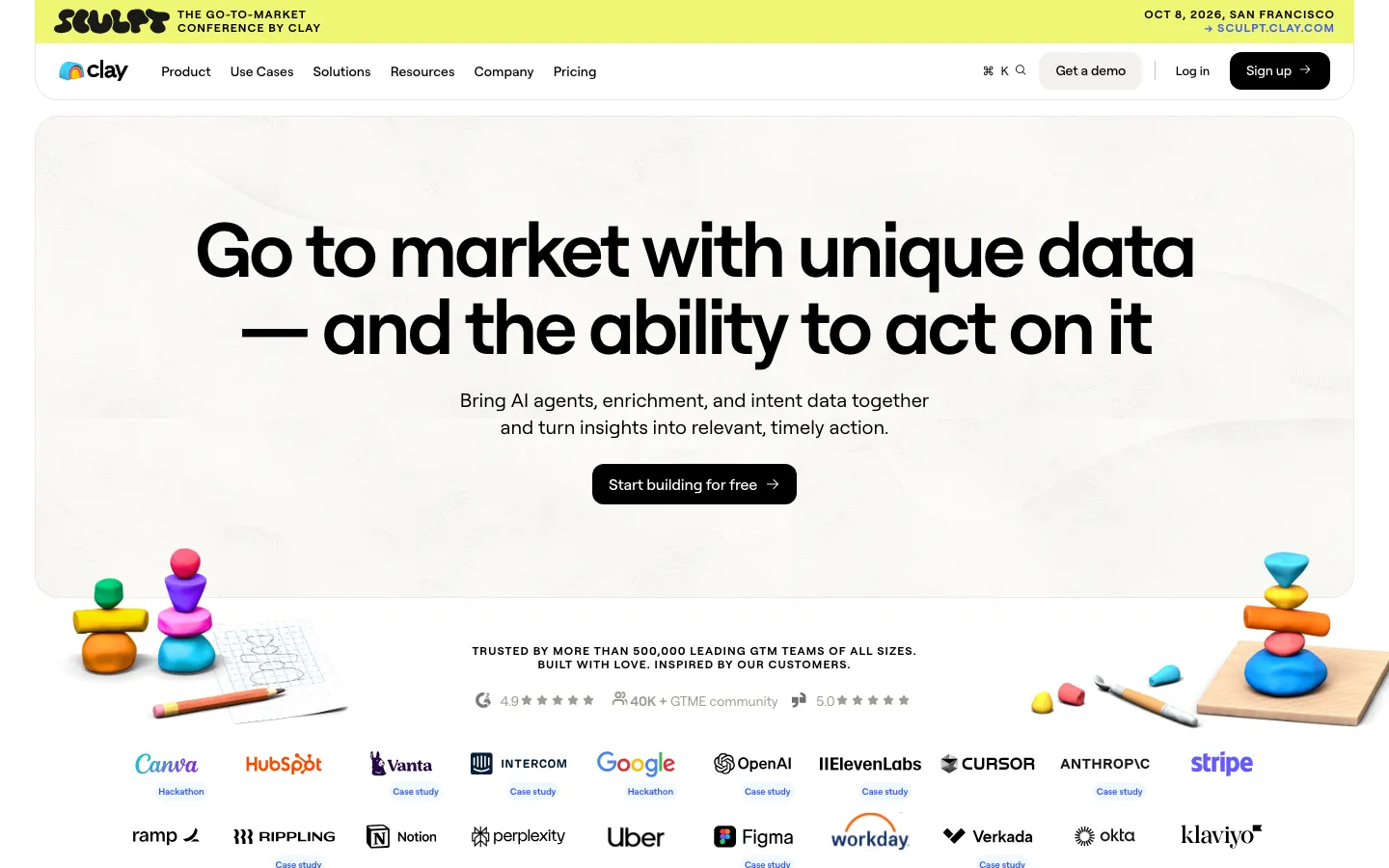
Clay is a data enrichment and outbound prospecting automation platform that lets go-to-market teams build research-heavy contact lists, enrich them across 75+ data providers simultaneously (a technique called waterfall enrichment), and push personalized outreach through connected sequencers. It was founded in 2017 in New York by Kareem Amin and Nicolae Rusan, who built it initially as a general-purpose table-and-AI tool before pivoting to the B2B sales workflow that took off in 2022. Clay operates on a credit model where each data provider call consumes credits, and it aggregates providers including Apollo, Clearbit, ZoomInfo, PDL, and LinkedIn (via partner APIs) into one interface. The product became the de facto choice for revenue operations and growth engineers who need to build highly targeted, data-dense prospect lists without stitching together five separate subscriptions. Clay raised a Series B in 2024 at a $500 million valuation, bringing total funding to roughly $62 million.
| Category | Data enrichment / prospecting automation platform |
| Company | Clay Technologies, Inc. |
| Founded | 2017 |
| Headquarters | New York, New York, US |
| Industry | Software Development · Sales Intelligence / Data Enrichment |
| Team size | ~100 (2025 estimate) |
| Ownership | Private (last valued at ~$500M at Series B closing, 2024) |
| Founder / CEO | Kareem Amin (CEO) and Nicolae Rusan (CTO), co-founders, 2017 |
| Specialties | Data enrichment, waterfall enrichment, lead research, prospecting automation, outbound sales, contact data, CRM enrichment, personalization at scale |
| Website | clay.com |
Find Clay on: Wikipedia · Crunchbase · LinkedIn · G2 · producthunt.com
Clay ratings across the web
Aggregated from the major review platforms. Each links to the source.
Also rated: Product Hunt 5.0/5 (312 upvotes) · TrustRadius 9.1/10 (38).
Rating breakdown
Per-category scores from G2 Clay (563 reviews).
Who uses Clay
Clay reviews from Topickz readers
Reader-submitted and moderated. This is separate from the third-party scores above. Verified-buyer reviews are labeled.
Be the first to review Clay. Your honest take helps the next buyer decide.
Review Clay
Your honest take, in about two minutes. We verify each review before it publishes.
Review submitted. You're entered!
Your giveaway entry token:
Screenshot this token and keep it safe. We draw 10 winners every month and email them, so watch the inbox for the email you entered with. Your review is showing below now and goes live once our editors verify it. Terms.
What people say about Clay
Our synthesis across 563 G2 reviews at 4.9/5 (one of the highest-rated tools in the sales intelligence category), plus TrustRadius and Product Hunt. No fabricated quotes, this is the consistent pattern across reviews and third-party analyses.
Most praised
- Waterfall enrichment is the defining praise point: rather than paying for one data provider and accepting its gaps, Clay tries multiple sources in sequence and returns the first hit, dramatically improving fill rates on phone numbers, emails, and company data
- Flexibility gets called out constantly; reviewers describe building custom research workflows that would require a data engineering team elsewhere, and Clay handles it in a spreadsheet-style interface with formulas and integrations
- Customer support quality stands out even relative to the 4.9/5 score; reviewers frequently single out fast, knowledgeable responses from the Clay team and a highly active Slack community with thousands of users sharing templates
Most cited complaints
- The learning curve is steep and consistently cited as the main barrier; Clay is closer to a power tool than a plug-and-play app, and teams without a dedicated RevOps or growth engineer often struggle to get full value
- Credit pricing is opaque until you understand it deeply; a large enrichment run across multiple providers can consume credits fast, and some reviewers report sticker shock on their first real campaign
- Capterra and G2 both note that the free plan's 100-credit limit is too low for meaningful testing, pushing evaluators to paid plans before they have validated fit
What we found testing it
What's great
- 100+ data providers aggregated in one waterfall enrichment tool; if one provider lacks a phone number Clay automatically tries the next
- Claygent AI agent researches prospects and returns structured data from LinkedIn activity, recent news, and job postings
- 4.7/5 on G2 across 218 reviews, the highest per-review satisfaction score in this guide
Watch-outs
- March 2026 pricing overhaul split credits into Data Credits and Actions, creating complexity; the real cost at 25 users runs $75K-$120K per year
- Clay is a data and workflow tool, not a sending tool; you still need Instantly, Reply.io, or a similar sequencer to actually deliver emails
- Learning curve is steep; the teams getting the most from Clay all have a dedicated RevOps person running workflows
Clay funding & ownership
| Round | Amount | Date | Lead investor |
|---|---|---|---|
| Seed | $8M | 2019 | Meritech Capital (with others) |
| Series A | $14M | 2022 | Sequoia Capital |
| Series B | $40M | 2024-01-01 | Meritech Capital, Sequoia Capital (at ~$500M valuation) |
Moderate-low risk given the strong momentum, though the company is still small and the category is contested. Clay has become a must-have tool for growth engineers and RevOps teams, with some of the highest G2 ratings in the sales intelligence category (4.9/5), and its 2024 Series B at a $500M valuation with Sequoia and Meritech backing provides meaningful runway. The main risk factors are: the credit pricing model can surprise new users with unexpectedly high bills on large enrichment runs; the product has a steep learning curve that gatekeeps less technical buyers; and well-funded competitors (Apollo, ZoomInfo, Lusha) have or are building waterfall-style enrichment features. For revenue-focused buyers who need it, Clay is deeply embedded in workflows and hard to replace.
Clay features & integrations
Feature availability
| Feature | Status |
|---|---|
| Ai writing | ✓ Claygent |
| Native dialer | No |
| Free tier | ✓ limited |
| Intent data | ✓ 100+ providers |
| Multichannel | ✗ data only |
Security & compliance
| Standard | Availability |
|---|---|
| GDPR | Yes |
| HIPAA | No |
| SOC 2 Type II | Yes (SOC 2 Type II) |
| SSO / SAML | Yes (on Teams and Enterprise plans) |
Integrations: HubSpot, Salesforce, Apollo.io, Outreach, Salesloft, LinkedIn Sales Navigator, Clearbit, ZoomInfo, Slack, and Zapier.
Clay leadership
Clay pricing
| Plan | Price | Best for |
|---|---|---|
| Free | $0/mo | Testing the platform; 100 credits per month, limited to small samples |
| Starter | $149/mo | Individual users or small SDR teams; 2,000 credits, core enrichment and waterfall features |
| Explorer | $349/mo | Growing RevOps teams needing higher credit volumes and more provider access |
| Pro | $800/mo | Power users and agencies running high-volume enrichment campaigns; full provider access, Teams workspace |
| Enterprise | Custom | Large teams needing custom credit volumes, SLA support, SSO, and custom data partnerships |
The catch: Clay's pricing is credit-based, and the credits model is the main thing to understand before buying. The Free plan gives 100 credits per month, which is barely enough to test the product on a small list. Starter at $149 per month gives 2,000 credits and works for individual SDRs or growth engineers running modest campaigns. Explorer at $349 per month and Pro at $800 per month scale up credits and unlock additional provider access and team features. Credits replenish monthly and do not roll over, so plan your enrichment volume carefully. Enterprise pricing is custom and typically negotiated around credit volume, dedicated support, and custom data provider access.
Clay alternatives & where it appears
Featured in our guides
Clay product changelog
What Clay has actually shipped, summarized from its own release notes and dated. Not auto-generated, updated as part of our freshness checks.
- July 28, 2026
Claygent AI research agent expanded
Clay's Claygent, an AI agent that browses the web to research prospects, expanded its source coverage and added structured output schemas, making it easier to extract specific signals from company pages and LinkedIn.
Source - May 14, 2026
Native HubSpot two-way sync launched
Clay added a native two-way sync with HubSpot, letting teams push enriched records into HubSpot and pull CRM activity back into Clay tables for ongoing enrichment without a Zapier middle layer.
Source - March 3, 2026
80+ data providers now available
Clay crossed 80 integrated data providers in the enrichment waterfall, adding new signals covering funding data, tech stack detection, and job change tracking from additional sources.
Source - December 10, 2025
Teams plan and seat-based sharing released
Clay introduced a shared-workspace Teams tier that lets RevOps teams collaborate on tables, share enrichment flows, and manage credits centrally rather than per individual account.
Source - September 17, 2025
Series B funding announced at $500M valuation
Clay raised a Series B round led by Meritech Capital and Sequoia Capital at a reported $500 million post-money valuation, citing strong growth in the RevOps and growth-engineering buyer segment.
Source
Latest Clay news
Auto-pulled from Google News, refreshed on each deploy. Headlines link to the source.
- Break Into International Accounts: Outbound tactics to win global buyers - ClaySat, 10 Oct 2026
- 7 Best Clay Alternatives and Competitors in 2026 - SalesforceSat, 23 May 2026
- Enigma's Business Identity and Revenue Data Is Now Inside Clay - PR NewswireThu, 16 Apr 2026
- Lusha Partners with Clay to Bring Verified B2B Data to GTM Builders - GlobeNewswireThu, 12 Mar 2026
- Why Clay Has an AI Writing Policy - ClayWed, 19 Aug 2026
- Replace Your SDR Team With Clay: Step-by-Step Clay Outbound Masterclass - YouTubeSun, 12 Apr 2026
Clay FAQs
What does Clay actually do?
Clay is a spreadsheet-style prospecting and data enrichment platform. You build a list of target companies or contacts, and Clay automatically pulls data about them from 75-plus integrated providers (including Apollo, Clearbit, LinkedIn, and others) in a waterfall sequence. It fills in emails, phone numbers, tech stacks, funding data, job titles, and anything else you configure. The enriched data can be pushed to your CRM or passed to an outbound sequencer. It is the tool of choice for revenue operations teams that build highly targeted, research-heavy outbound campaigns.
Is Clay worth the price?
For revenue-focused teams that run data-intensive outbound, yes. The core value is that waterfall enrichment across 75+ providers gets dramatically better data coverage than any single provider at a comparable total cost. The teams that get the most from Clay are those with a dedicated RevOps or growth engineer to build and maintain the workflows. Teams expecting a simple point-and-click tool often underuse it and find the pricing hard to justify.
How does Clay's credit pricing work?
Each action in Clay that calls a data provider costs credits. Simple lookups (email find, job title lookup) cost 1-2 credits; more complex enrichment (AI web research, multiple provider attempts) costs more. Credits are consumed per row and per provider call. The waterfall model means Clay tries providers in order and stops once it finds a result, which makes it more credit-efficient than calling every provider on every record.
Does Clay have a free trial or plan?
Yes. Clay has a permanent Free plan with 100 credits per month, which is enough to test the workflow on a small list of 30-40 contacts with basic enrichment. Most buyers find they need at least the Starter plan ($149/mo) to run a real campaign. There is no time-limited free trial separate from the free tier.
Who competes with Clay?
The closest competitors are Apollo.io (which added waterfall-style enrichment), ZoomInfo (with its own data network), and Lusha. Specialized enrichment tools like Clearbit (now Hubspot) and People Data Labs also overlap. Clay's advantage is that it aggregates all of these and more into one interface, rather than committing to one data provider's coverage.
Sources
Every external figure on this page traces to a public source, last collected on the dates shown.
- G2: Clay reviews — rating 4.9/5, 563 reviews, category leader in sales intelligence (accessed 2026-08-30)
- Capterra: Clay — rating 4.8/5, 24 reviews (accessed 2026-08-30)
- TrustRadius: Clay — score 9.1/10, 38 reviews (accessed 2026-08-30)
- Crunchbase: Clay — ~$62M total funding, Series B at $500M valuation, Meritech and Sequoia (accessed 2026-08-30)
- TechCrunch: Clay Series B announcement — Series B details, valuation, investor commentary (accessed 2026-08-30)
- LinkedIn: Clay company page — HQ, employee count, founded, specialties (accessed 2026-08-30)
- Clay: pricing page — Free/Starter/Explorer/Pro/Enterprise tiers, credit structure (accessed 2026-08-30)
- Clay: security page — SOC 2 Type II, GDPR, data provider agreements (accessed 2026-08-30)