
Stripe is a Payments infrastructure / developer-first payment processing by Stripe, Inc. This profile pulls together Stripe's ratings across the major review sites, its company and funding details, leadership, features, pricing, and the latest news, with every external source cited at the bottom.
About Stripe, Inc.
Stripe is a technology company that builds economic infrastructure for the internet: its core product is a set of APIs that let businesses accept and manage online payments, and over time it has expanded to cover billing, revenue recognition, fraud prevention, business banking, corporate cards, and tax compliance. It was co-founded in 2010 by brothers Patrick Collison (CEO) and John Collison (President) in San Francisco; Patrick was 21 years old at launch. Stripe is incorporated in the US and has operational headquarters in both San Francisco and Dublin, Ireland, reflecting its Irish founders' ties. The company processes hundreds of billions of dollars in payment volume annually and serves businesses ranging from early-stage startups to large enterprises including Amazon, Salesforce, Shopify, and Lyft. As of its 2023 secondary share sale, Stripe was valued at approximately $65 billion after a period of carrying a peak valuation of $95 billion in 2021. Stripe had raised approximately $9.4 billion in total funding as of mid-2026 and employed around 8,000 people globally.
| Category | Payments infrastructure / developer-first payment processing |
| Company | Stripe, Inc. |
| Founded | 2010 |
| Headquarters | San Francisco, California, US / Dublin, Ireland (dual HQ) |
| Industry | Software Development · Financial Technology / Payments Infrastructure |
| Team size | ~8,000 full-time (2024) |
| Ownership | Private; VC-backed (~$9.4B total funding, last known valuation ~$65B) |
| Founder / CEO | Patrick Collison and John Collison (brothers, co-founders, 2010) |
| Specialties | Payment processing, billing and subscriptions, fraud prevention, revenue recognition, business banking, corporate cards, tax automation, payment APIs |
| Website | stripe.com |
Find Stripe on: Wikipedia · Crunchbase · LinkedIn · G2 · Capterra · producthunt.com
Stripe ratings across the web
Aggregated from the major review platforms. Each links to the source.
Also rated: TrustRadius 8.3/10 (415).
Rating breakdown
Per-category scores from Capterra Stripe (3,300+ reviews).
Who uses Stripe
Stripe reviews from Topickz readers
Reader-submitted and moderated. This is separate from the third-party scores above. Verified-buyer reviews are labeled.
Be the first to review Stripe. Your honest take helps the next buyer decide.
Review Stripe
Your honest take, in about two minutes. We verify each review before it publishes.
Review submitted. You're entered!
Your giveaway entry token:
Screenshot this token and keep it safe. We draw 10 winners every month and email them, so watch the inbox for the email you entered with. Your review is showing below now and goes live once our editors verify it. Terms.
What people say about Stripe
Our synthesis across 1,900+ G2 reviews at 4.4/5 and 3,300+ Capterra reviews at 4.7/5, plus TrustRadius and extensive developer community discussion on Hacker News and Reddit. No fabricated quotes, this is the consistent pattern across reviews and third-party analyses.
Most praised
- Developer experience is the most cited strength by a wide margin: Stripe's API documentation, SDKs, and Stripe CLI are described as the gold standard for payments infrastructure, making integration fast and debugging straightforward
- The dashboard is praised by non-technical finance and operations users as genuinely readable: transaction data, payout timing, dispute management, and revenue reporting are accessible without needing to read code or contact support
- Stripe Billing for SaaS subscription management is repeatedly called the best available product for handling trial logic, proration, metered billing, and dunning in one place without custom engineering
Most cited complaints
- Account holds and fund freezes are the most complained-about risk: Stripe's fraud prevention model occasionally flags legitimate businesses (especially new accounts or unusual transaction patterns) for account holds with little warning and slow support resolution, which is an existential problem for a business's cash flow
- Standard processing fees (2.9% + 30¢) add up at volume; reviewers at high-GMV businesses say they negotiated lower rates or left for Braintree or Adyen once monthly volume crossed a threshold where the fee difference justified the integration cost
- Customer support at the non-enterprise tier is email-only and can be slow; several reviewers describe taking 3-5 business days to resolve disputes or reconcile payout discrepancies, which is stressful when money is involved
What we found testing it
What's great
- 0.5-0.8% per recurring charge is the most transparent pricing in the segment; no monthly platform fee until you need advanced dunning
- Widest native payment method coverage (135+ countries, 40+ payment methods) in a single integration; no separate gateway contracts
- Meter API for usage-based billing handles real-time event ingestion at millions of events per second, the only billing engine that genuinely scales to enterprise usage volumes without re-engineering
Watch-outs
- SaaS-specific metrics (NRR, GRR, ARR waterfall, cohort churn) require external tooling or Stripe Sigma queries; not a reporting platform
- ASC 606 revenue recognition is manual or requires a third-party integration; the billing engine does not automate deferred revenue schedules
- Support is developer-documentation-first; getting a human on ASC 606 edge cases can take 48+ hours via ticketing
Stripe funding & ownership
| Round | Amount | Date | Lead investor |
|---|---|---|---|
| Seed | $2M | 2011 | Peter Thiel, Elon Musk, Sequoia Capital, Andreessen Horowitz |
| Series A | $18M | Feb 2012 | Sequoia Capital, General Catalyst, Redpoint |
| Series B | $80M | Jul 2014 | Founders Fund, Sequoia Capital |
| Series C | $100M | Dec 2015 | Visa, American Express, Kleiner Perkins |
| Series D | $150M | Nov 2016 | General Catalyst, CapitalG (Google) |
| Series G | $250M | Sep 2019 | Sequoia Capital, Andreessen Horowitz, General Catalyst |
| Series H | $600M | Mar 2021 | Allianz X, Axa, Baillie Gifford (at $95B valuation) |
| Secondary / recapitalization | $6.5B | Mar 2023 | Goldman Sachs, Andreessen Horowitz, Sequoia Capital (at $50B valuation, later revised to $65B) |
Very low risk for the product; the open question is long-run exit path. Stripe is deeply embedded in the global internet economy and processes more payment volume than any developer-first alternative. An estimated $1 trillion+ in total payment volume passes through Stripe annually. The company has repeatedly said it is in no rush to IPO, but at a $65 billion valuation with $9.4 billion raised, an eventual public listing or large secondary market remains the likely outcome. The more relevant buyer risk is pricing: Stripe charges 2.9% + 30 cents for standard card processing, and while that is competitive for low volume, enterprise-scale businesses often negotiate lower rates directly or find Braintree (PayPal) or Adyen cheaper. The platform risk is lock-in: Stripe's API is clean but migrating billing, subscription logic, and webhook integrations to another provider is a multi-quarter engineering project.
Stripe features & integrations
Security & compliance
| Standard | Availability |
|---|---|
| GDPR | Yes |
| HIPAA | Yes (available with BAA for specific configurations) |
| SOC 2 Type II | Yes (SOC 2 Type II) |
| SSO / SAML | Yes (SSO available on enterprise plans) |
Integrations: Shopify, WooCommerce, QuickBooks Online, Xero, Salesforce, HubSpot, Zapier, NetSuite, Chargebee, and Recurly.
Stripe leadership
Stripe pricing
| Plan | Price | Best for |
|---|---|---|
| Standard (no monthly fee) | 2.9% + 30¢ per card charge | Startups and SMBs: simple checkout, subscriptions, invoicing; no upfront cost |
| Custom (negotiated) | Volume-based discount from standard rates | Businesses processing $1M+ monthly who negotiate interchange-plus or flat-rate pricing directly with Stripe |
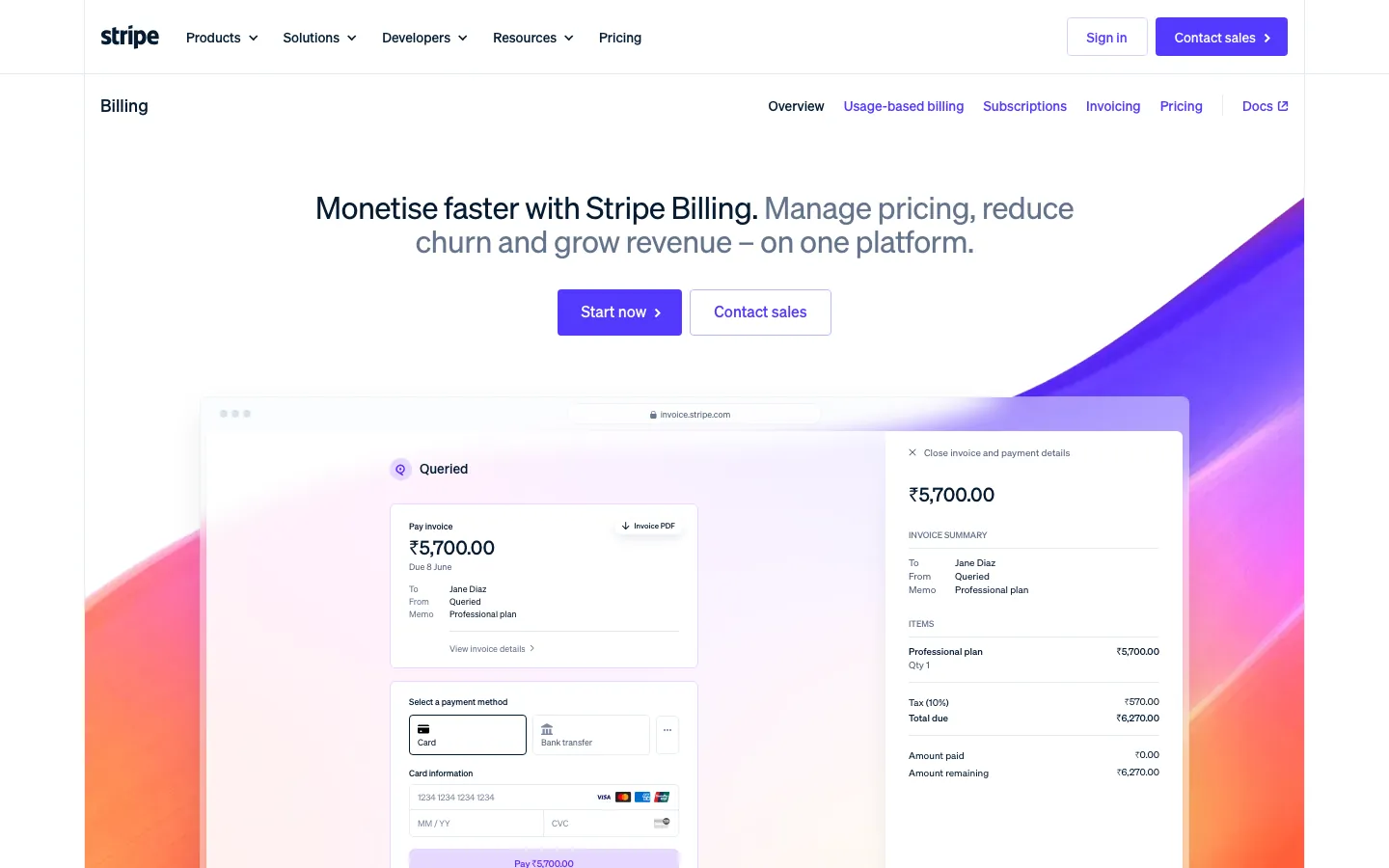
| Stripe Billing (add-on) | 0.5% on recurring revenue (Starter) or 0.8% (Scale) | SaaS and subscription businesses needing trial management, proration, dunning, and metered billing |
| Stripe Connect (marketplace) | 0.25% per payout + standard processing | Platforms and marketplaces that need to split and route payments to connected accounts (gig economy, SaaS platforms) |
The catch: Stripe has no monthly platform fee, which makes it look free until you process real volume. At 2.9% + 30c per successful card charge, a $50,000/month GMV business pays roughly $1,470/month in processing fees. International cards add 1.5%, currency conversion adds another 1%, and manual payment methods (ACH, SEPA) have separate rate cards. Stripe Billing (for subscriptions) adds 0.5-0.8% on top for its automation layer. This is competitive at low volume; at $500K+ monthly GMV, the math on negotiating or switching providers changes materially.
Stripe alternatives & where it appears
Featured in our guides
Stripe product changelog
What Stripe has actually shipped, summarized from its own release notes and dated. Not auto-generated, updated as part of our freshness checks.
- August 18, 2026
Stripe Tax expanded to 50+ countries
Stripe expanded its automated sales tax and VAT calculation and remittance tool to additional markets in Southeast Asia and Latin America, covering over 50 countries with automatic filing support.
Source - July 22, 2026
Stablecoin payments beta launched
Stripe launched a beta allowing businesses to accept USDC and other regulated stablecoin payments through the standard Stripe API, targeting cross-border payouts in emerging markets.
Source - June 10, 2026
Stripe Billing AI-powered dunning
Stripe Billing added AI-powered smart retries for failed subscription payments, optimizing retry timing based on card network signals to recover more failed transactions automatically.
Source - May 1, 2026
Revenue and Finance Automation suite rebrand
Stripe consolidated its Billing, Tax, Revenue Recognition, and Reporting products under the Revenue and Finance Automation suite branding, making the product's scope clearer to finance teams.
Source - March 14, 2026
Stripe Connect enhanced for marketplace compliance
Stripe updated Connect's onboarding and identity verification flows to meet expanded KYC requirements across the EU and UK following updated financial services regulations.
Source
Latest Stripe news
Auto-pulled from Google News, refreshed on each deploy. Headlines link to the source.
- FedEx and Stripe team up on SMB financing - The PaypersMon, 12 Oct 2026
- Stripe swallows Parafin - Payments DiveThu, 01 Oct 2026
- Meta Plans Stablecoin Integration, Eyeing Stripe as Key Partner - CoinMarketCapSat, 10 Oct 2026
- Scoop: Stripe says "the singularity" has begun - AxiosWed, 19 Aug 2026
- Stripe Pairs FedEx Logistics Data with Capital, Extends Stablecoin Cards Offering, and Joins AI Agent Rules Initiative - Crowdfund InsiderFri, 09 Oct 2026
- FedEx Dataworks and Stripe partner to make funding more accessible to SMBs (FDX:NYSE) - Seeking AlphaTue, 06 Oct 2026
Stripe FAQs
How much does Stripe charge per transaction?
Stripe's standard rate is 2.9% + 30 cents per successful card charge for domestic cards in the US. International cards add a 1.5% fee on top. ACH direct debit is 0.8% capped at $5. Stripe Billing for subscription management adds 0.5% on monthly recurring revenue (Starter tier) or 0.8% (Scale tier). Businesses processing large volumes can negotiate custom rates directly with Stripe.
Is Stripe good for SaaS companies?
Yes, Stripe is widely considered the default payments choice for SaaS companies, specifically because of Stripe Billing's subscription management, trial logic, proration, and dunning automation. The API-first design maps naturally to how SaaS engineering teams build. The trade-off at scale is cost: the 0.5-0.8% Billing fee on MRR adds up, and some SaaS companies at $5M+ ARR evaluate Maxio (formerly SaaSOptics) or Chargebee as the billing layer with Stripe as the payment processor underneath.
Who founded Stripe?
Stripe was co-founded in 2010 by Patrick Collison and John Collison, two brothers from County Tipperary, Ireland. Patrick (CEO) was 21 at launch; John (President) was 19. They had previously sold a startup called Auctomatic to Live Current Media for $5 million in 2008, which funded their early Stripe work.
Is Stripe a public company?
No. As of 2026 Stripe remains private. It was last valued at approximately $65 billion in 2023, following a period where its 2021 peak valuation was $95 billion. Patrick Collison has stated publicly that Stripe is in no rush to IPO, and the company has enough capital on its balance sheet to operate independently. An eventual public listing remains speculated but not announced.
Is Stripe PCI and SOC 2 compliant?
Yes. Stripe is a PCI DSS Level 1 certified service provider, the highest level of payment card industry compliance. It also holds SOC 2 Type II certification, supports GDPR, and offers HIPAA BAAs for specific configurations. Using Stripe's hosted payment fields (Stripe Elements or Stripe Checkout) shifts the bulk of PCI scope away from the merchant.
Sources
Every external figure on this page traces to a public source, last collected on the dates shown.
- G2: Stripe reviews — rating 4.4/5, 1,900+ reviews (accessed 2026-08-30)
- Capterra: Stripe — rating 4.7/5, 3,300+ reviews, sub-scores, demographics (accessed 2026-08-30)
- TrustRadius: Stripe — score 8.3/10, 415+ reviews (accessed 2026-08-30)
- Wikipedia: Stripe, Inc. — founding, founders, valuation history, payment volume, funding rounds (accessed 2026-08-30)
- Crunchbase: Stripe — ~$9.4B total funding, full funding round history, investors (accessed 2026-08-30)
- LinkedIn: Stripe company page — employee count ~8,000, HQ, specialties (accessed 2026-08-30)
- Stripe pricing page — standard rate 2.9% + 30c, Billing add-on 0.5%/0.8%, international card fees (accessed 2026-08-30)
- Stripe newsroom: 2023 recapitalization — $6.5B secondary raise at $50B valuation (later revised to $65B) (accessed 2026-08-30)