
Asana is a Project management / work management platform by Asana, Inc. This profile pulls together Asana's ratings across the major review sites, its company and funding details, leadership, features, pricing, and the latest news, with every external source cited at the bottom.
About Asana, Inc.
Asana is a work management platform that lets teams plan, organize, and track work from individual tasks through to cross-functional programs and portfolios. It was co-founded in 2008 by Dustin Moskovitz (a Facebook co-founder) and Justin Rosenstein (a former Google and Facebook engineer) in San Francisco, and opened publicly in 2012 after an extended private beta. Asana went public via a direct listing on the New York Stock Exchange under the ticker ASAN in September 2020. The company reported approximately $723 million in revenue for fiscal year 2025 (ending January 31, 2025) and serves over 150,000 paying organizations across more than 190 countries. The product spans task and project views including list, board, timeline (Gantt), calendar, and portfolio, and has expanded to include workflow automation, goals tracking, and AI-powered features under the Asana Intelligence umbrella.
| Category | Project management / work management platform |
| Company | Asana, Inc. |
| Founded | 2008 |
| Headquarters | San Francisco, California, US |
| Industry | Software Development · Project Management / Work Management Software |
| Team size | ~3,600 full-time (Jan 31, 2025) |
| Ownership | Public, NYSE: ASAN (direct listing September 2020) |
| Founder / CEO | Dustin Moskovitz and Justin Rosenstein (co-founders, 2008) |
| Specialties | Project management, task management, workflow automation, team collaboration, goal tracking, portfolio management, cross-functional work planning |
| Website | asana.com |
Find Asana on: Wikipedia · Crunchbase · LinkedIn · G2 · Capterra · producthunt.com
Asana ratings across the web
Aggregated from the major review platforms. Each links to the source.
Also rated: TrustRadius 8.4/10 (1,900).
Rating breakdown
Per-category scores from Capterra Asana (13,000+ reviews).
Who uses Asana
Asana reviews from Topickz readers
Reader-submitted and moderated. This is separate from the third-party scores above. Verified-buyer reviews are labeled.
Be the first to review Asana. Your honest take helps the next buyer decide.
Review Asana
Your honest take, in about two minutes. We verify each review before it publishes.
Review submitted. You're entered!
Your giveaway entry token:
Screenshot this token and keep it safe. We draw 10 winners every month and email them, so watch the inbox for the email you entered with. Your review is showing below now and goes live once our editors verify it. Terms.
What people say about Asana
Our synthesis across 10,500+ G2 reviews at 4.4/5 and 13,000+ Capterra reviews at 4.5/5 (over 90% positive sentiment), plus Gartner and TrustRadius. No fabricated quotes, this is the consistent pattern across reviews and third-party analyses.
Most praised
- The multiple project views (list, board, timeline, calendar) in one tool is the most cited strength; teams say the ability to switch perspectives without duplicating data eliminates a class of status-update meetings
- Cross-team visibility into who is working on what, and whether projects are on track, comes up repeatedly in positive reviews from operations and program managers who previously coordinated via shared spreadsheets
- Onboarding experience is considered best-in-class among work management tools; the free tier, onboarding flows, and Asana Academy make it easy for non-technical team members to get productive within a day
Most cited complaints
- Pricing friction is the top complaint: meaningful features like timeline view, custom rules, and AI capabilities sit behind the Business plan at $24.99/seat/mo, making the free and Starter tiers feel artificially constrained for teams that need them
- Subtask handling gets criticized consistently: subtasks do not surface cleanly in parent project views, which creates confusion on complex projects with nested dependencies and requires workarounds that undercut the clean UX
- No native time tracking and weak native reporting are recurring gaps; teams needing time-to-completion data or custom dashboards need third-party integrations, which adds cost and a sync layer
What we found testing it
What's great
- Strong cross-team adoption; non-technical ops and marketing people ramp in under a week without training sessions
- Workload view at the Advanced tier ($24.99) shows who is over-capacity across all projects before the deadline slips, not after
- 300+ native integrations plus a first-class API; Slack, Jira, Salesforce, and Tableau all work without Zapier middleware
Watch-outs
- Free tier caps at 2 users for full collaboration; team-sized use requires Starter at $10.99/user/mo, which surprises buyers who came from Notion's more generous free tier
- Multiple assignees on a single task are not natively supported, a persistent G2 complaint that sends shared-ownership workflows to workarounds
- Advanced tier at $24.99 is where real reporting and portfolio visibility live; many teams land on Starter only to find they need Advanced four months later
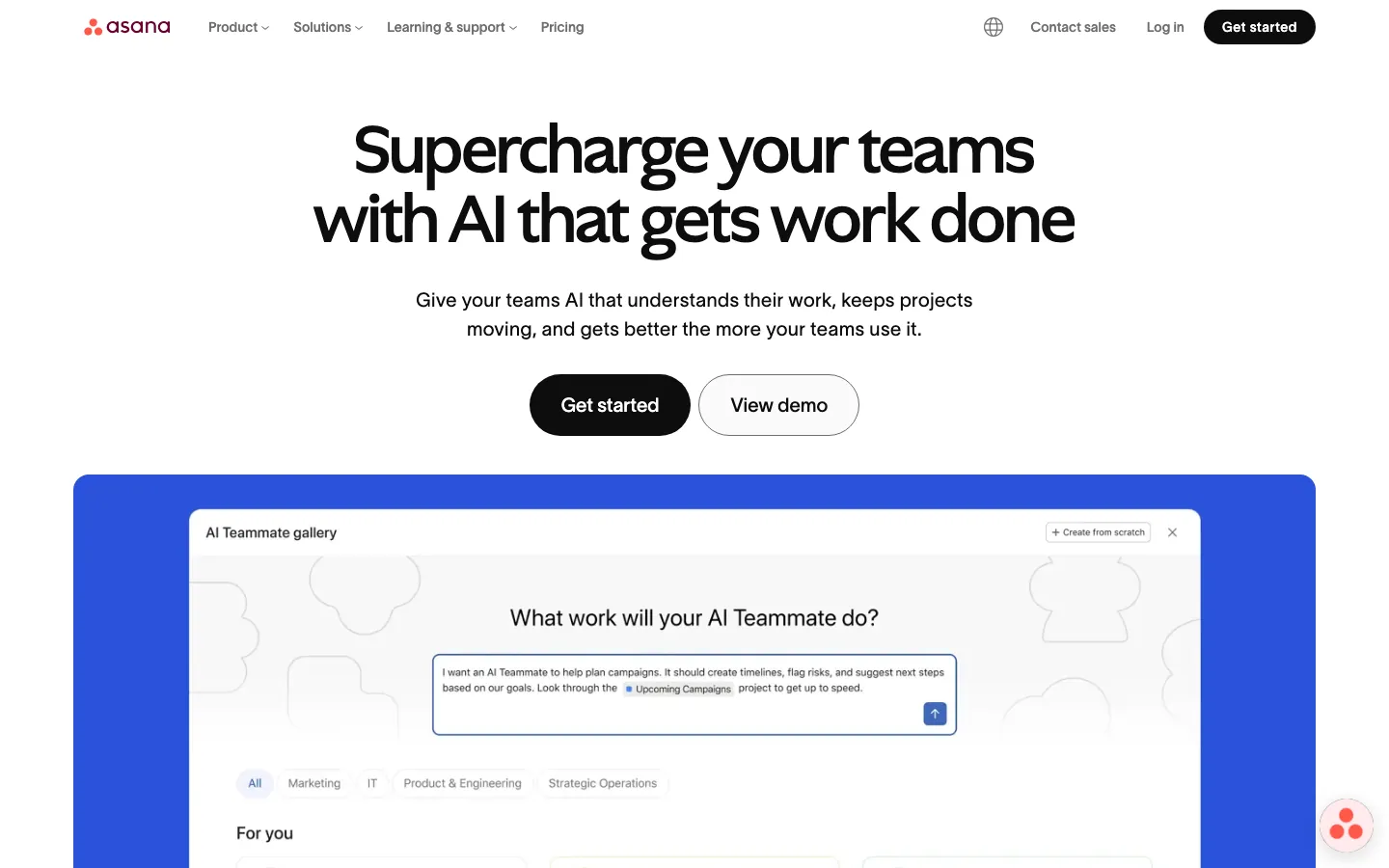
Asana funding & ownership
| Round | Amount | Date | Lead investor |
|---|---|---|---|
| Seed | $1.2M | 2009 | Benchmark Capital, Peter Thiel |
| Series A | $9M | 2010 | Benchmark Capital |
| Series B | $28M | Mar 2012 | Andreessen Horowitz, Benchmark Capital |
| Series C | $50M | Dec 2014 | Generation Investment Management |
| Series D | $75M | Oct 2016 | Founders Fund |
| Series E | $75M | Nov 2018 | 8VC, Generation Investment Management |
| Series F | $150M | Feb 2019 | Generation Investment Management |
| Direct Listing (NYSE: ASAN) | N/A (no capital raised) | Sep 2020 | Direct listing at reference price $21/share |
Low risk. Asana is a publicly traded company (NYSE: ASAN) with approximately $723 million in FY2025 revenue and over 150,000 paying organizations. Its co-founder CEO Dustin Moskovitz controls a significant share of voting power, giving the company long-term strategic stability. Asana has not yet achieved GAAP profitability but has been trending toward it; free cash flow turned positive in FY2024 and the company carries a healthy cash reserve. The main risk for buyers is not viability but value: at $24.99/seat/mo for Business (where most AI features live), Asana is meaningfully more expensive than tools like Monday.com or ClickUp on a per-seat basis, and the ROI case requires teams to adopt the platform broadly to realize the workflow benefits.
Asana features & integrations
Feature availability
| Feature | Status |
|---|---|
| AI assist | Starter+ |
| Free tier | ✓ 2-user cap |
| Gantt charts | Starter+ |
| Portfolios | Advanced+ |
| Workload view | Advanced+ |
Security & compliance
| Standard | Availability |
|---|---|
| GDPR | Yes |
| HIPAA | Yes (Business and Enterprise plans, with BAA) |
| SOC 2 Type II | Yes (SOC 2 Type II) |
| SSO / SAML | Yes (Google SSO free; SAML on Business and Enterprise) |
Integrations: Slack, Microsoft Teams, Google Workspace, Salesforce, HubSpot, Zoom, Zapier, Jira, Figma, and Tableau.
Asana leadership
Asana pricing
| Plan | Price | Best for |
|---|---|---|
| Free | $0 | Teams up to 10 users; unlimited tasks and projects, list and board views, basic integrations |
| Starter | $10.99/seat/mo (annual) | Growing teams needing timeline view, workflow rules (250/mo), reporting dashboards |
| Advanced | $24.99/seat/mo (annual) | Cross-functional teams needing portfolios, goals, workload management, unlimited automations, AI features |
| Enterprise / Enterprise+ | Custom | Large organizations needing advanced security, SAML SSO, data residency, priority support, and custom contract terms |
The catch: Asana's free plan is real and generous at 10 users, but most cross-functional teams hit its ceiling when they need timeline (Gantt) view or workflow automation. The Starter plan at $10.99/seat/mo unlocks those but caps automations at 250 actions per month, which is a real limit for any marketing or ops team with repetitive processes. Business at $24.99/seat/mo removes those caps and adds portfolios, goals, and AI features. A 15-person team on Business pays about $4,500 per year; confirm what you actually need before assuming Business is required, because many teams overestimate how many seats use advanced features.
Asana alternatives & where it appears
Head-to-head comparisons
Featured in our guides
Asana product changelog
What Asana has actually shipped, summarized from its own release notes and dated. Not auto-generated, updated as part of our freshness checks.
- August 12, 2026
Asana AI Studio expansion
Asana expanded AI Studio, its no-code workflow automation builder with AI capabilities, to all Business and Enterprise plans globally, enabling teams to build AI-powered handoffs and conditional logic without engineering support.
Source - June 25, 2026
Smart Summaries for projects
Asana rolled out Smart Summaries, using Asana Intelligence to auto-generate project status reports from task data, reducing the time managers spend writing weekly updates.
Source - May 28, 2026
FY2026 Q1 earnings: $197M revenue
Asana reported Q1 FY2026 revenue of approximately $197 million, up 10% year over year, with continued growth in enterprise customers paying over $100K annually.
Source - April 15, 2026
Portfolios and Workload enhanced
Asana updated its Portfolio and Workload views with real-time capacity indicators and AI-generated risk flags when projects trend off-schedule, giving program managers earlier warning signals.
Source - February 10, 2026
Asana Intelligence goals alignment
A new Goals AI feature links individual task completion to top-level company objectives automatically, allowing executives to see bottleneck impact on strategic goals without manual rollup.
Source
Latest Asana news
Auto-pulled from Google News, refreshed on each deploy. Headlines link to the source.
- Is Asana’s (ASAN) New AI-Savvy Board Tilted More Toward Innovation or Control? - Yahoo FinanceSat, 10 Oct 2026
- Asana Shares Slid Even Though Sales Rose - Simply Wall StreetSat, 10 Oct 2026
- A director proposes selling 18,021 Asana (ASAN) shares, valued at about $178K. - Stock TitanFri, 09 Oct 2026
- 3 Unprofitable Stocks Walking a Fine Line - StockStoryMon, 12 Oct 2026
- 10 Essential Project Management Tools for Startups - Small Business TrendsSat, 10 Oct 2026
- Asana Announces Fourth Quarter and Fiscal Year 2026 Results - AsanaMon, 02 Mar 2026
Asana FAQs
Is Asana free?
Yes, the free plan supports up to 10 users with unlimited tasks, projects, and messages, plus list and board views. It does not include timeline (Gantt) view, workflow automation rules, or advanced reporting. Teams needing those features move to the Starter plan at $10.99/seat/mo billed annually.
Who founded Asana?
Asana was co-founded in 2008 by Dustin Moskovitz and Justin Rosenstein. Moskovitz previously co-founded Facebook and remains Asana's CEO. Rosenstein was an engineering lead at Google (where he helped build Google Drive) and Facebook (where he co-created the Like button).
Is Asana a public company?
Yes. Asana listed directly on the New York Stock Exchange under the ticker ASAN in September 2020 without a traditional IPO. The company reported approximately $723 million in revenue for FY2025 (ending January 2025), serving over 150,000 paying organizations.
How does Asana compare to Monday.com and ClickUp?
Asana has better cross-project program management and a cleaner interface for non-technical teams. Monday.com is often considered more visually flexible and has stronger native CRM features. ClickUp bundles more features (including docs, time tracking, and whiteboards) at a lower per-seat price but has a steeper learning curve. For organizations that need Salesforce or HubSpot integration depth and enterprise security, Asana is the most mature option.
Is Asana HIPAA compliant?
Yes, on Business and Enterprise plans with a signed Business Associate Agreement (BAA) from Asana. The free and Starter plans are not HIPAA compliant. Healthcare organizations should confirm current BAA terms directly with Asana before deploying.
Sources
Every external figure on this page traces to a public source, last collected on the dates shown.
- G2: Asana reviews — rating 4.4/5, 10,500+ reviews (accessed 2026-08-30)
- Capterra: Asana — rating 4.5/5, 13,000+ reviews, sub-scores, demographics (accessed 2026-08-30)
- TrustRadius: Asana — score 8.4/10, 1,900+ reviews (accessed 2026-08-30)
- Asana Investor Relations: FY2025 annual results — FY2025 revenue ~$723M, 150,000+ paying orgs, employee count (accessed 2026-08-30)
- SEC: Asana Form 10-K (FY2025) — revenue, employee count, geographic expansion, direct listing history (accessed 2026-08-30)
- Wikipedia: Asana (software) — founding, founders, direct listing, product history (accessed 2026-08-30)
- Crunchbase: Asana — funding rounds, investors, $453M total pre-listing (accessed 2026-08-30)
- Asana pricing page — current plan prices: Free $0, Starter $10.99, Advanced $24.99, Enterprise custom (accessed 2026-08-30)