
Comparing the best Enterprise Subscription Billing Software of 2026 includes 1. Zuora 2. Maxio 3. Chargebee 4. Recurly 5. Salesforce Revenue Cloud.
TL;DR
- Zuora: Best end-to-end monetization platform for enterprise SaaS at $30M+ ARR. The market leader for complex pricing models, CPQ-to-billing workflows, and ASC 606 / IFRS 15 compliance at scale.
- Maxio: Best for mid-market to enterprise B2B SaaS at $5M-$100M ARR that needs board-ready NRR waterfall and RevRec without a Zuora-level implementation.
- Chargebee: Best for enterprise SaaS teams that grew through Chargebee and want to stay on one platform; strong on multi-currency and retention workflows, lighter on CPQ depth.
- Recurly: Best for high-volume enterprise subscription businesses with B2C-adjacent payment patterns; strong dunning, weaker on enterprise contract management.
- Salesforce Revenue Cloud: Best when your sales team already lives in Salesforce and CPQ-to-billing in a single CRM is worth the implementation cost and seat premium.
At $10M+ ARR, billing is a finance and compliance infrastructure problem, not a product decision. You need ASC 606 revenue recognition, multi-entity consolidation, CPQ integration, and audit-trail-level reporting. Here are the five platforms that actually operate at this scale.
What enterprise billing actually requires
Enterprise SaaS billing is not a bigger version of startup billing. The problems are categorically different. An auditor asking for ASC 606 revenue schedules across 500 contracts with mid-period modifications and variable consideration is not a problem Stripe Billing or Chargebee Starter was designed to solve.
The platforms in this guide exist for one reason — to handle the compliance, reporting, and contract complexity that shows up between $10M ARR and IPO. Each of the five covers that territory with different tradeoffs on implementation cost, ongoing admin overhead, and depth of CPQ integration.
Best Enterprise Subscription Billing Software comparison: features, pricing and verdicts
| Tool | Best for | Starting price | Free trial | External rating |
|---|---|---|---|---|
Best end-to-end monetization platform for enterprise SaaS at $30M+ ARR | Custom (typically $30K-$100K+/year) | Demo only | G2 3.9/5 (309 reviews) | |
Best for mid-market to enterprise B2B SaaS at $5M to $100M ARR | From $599/month (entry) | Demo only | G2 4.3/5 (829 reviews) | |
Best for enterprise SaaS teams that want to stay on one platform from startup to scale | From $599/mo (Performance) to custom | Demo for Enterprise tier | G2 4.4/5 (995 reviews) | |
Best for high-volume enterprise subscription businesses with B2C-adjacent payment patterns | Custom enterprise pricing | Contact for enterprise demo | G2 4.0/5 (205 reviews) | |
Best when your sales team already lives in Salesforce and CPQ-to-billing in one CRM is worth the premium | From $75/user/month | Demo only | G2 4.2/5 (1498 reviews) |
How we chose these tools
We evaluated enterprise billing platforms on five criteria that matter at $10M+ ARR: ASC 606 and IFRS 15 compliance depth (native vs. add-on vs. not available), multi-entity and multi-currency consolidation, CPQ integration quality, implementation timeline and ongoing admin overhead, and total cost of ownership at $20M ARR including platform fee, implementation, and annual support. Startup and SMB platforms were excluded — Stripe Billing, LemonSqueezy, Paddle, Zoho Billing, and Stax Bill are covered in our SMB and startup guides.
How we weight enterprise subscription billing software for the Topickz score
Every tool above is scored against the fixed rubric below and combined using these weights into the Topickz score on each card. The weights are set for enterprise subscription billing software specifically, they are not copied from another category, and we publish them so you can see what moved a ranking and re-weight for your own priorities.
| Criterion | Weight | What we checked |
|---|---|---|
| ASC 606 / IFRS 15 compliance | 26% | Enterprise SaaS teams face audit requirements around deferred revenue, contract modifications, and multi-element arrangement allocation. We verified whether each platform handles these natively or requires a separate RevRec tool. |
| Multi-entity and multi-currency | 22% | Enterprise companies often operate across multiple legal entities and geographies. We tested consolidation reporting, intercompany billing, and multi-currency waterfall accuracy. |
| CPQ-to-billing workflow | 18% | At enterprise scale, the quote-to-cash process runs through CPQ. We checked native CPQ capability, Salesforce CPQ integration depth, and order management handoffs. |
| Implementation timeline and admin overhead | 18% | Enterprise billing implementations regularly run 3-9 months and cost $100K-$500K in professional services. We verified realistic timelines and ongoing admin headcount requirements. |
| Total cost of ownership at $20M ARR | 16% | Platform fee, implementation, professional services, and annual support fees were calculated at $20M ARR. Enterprise billing TCO is frequently 2-5x the sticker price. |
| Total | 100% |
Read the full TopickZ.com testing methodology for how we run each test, score every criterion, and combine them into a single rating.
Detailed reviews
Zuora
Best end-to-end monetization platform for enterprise SaaS at $30M+ ARR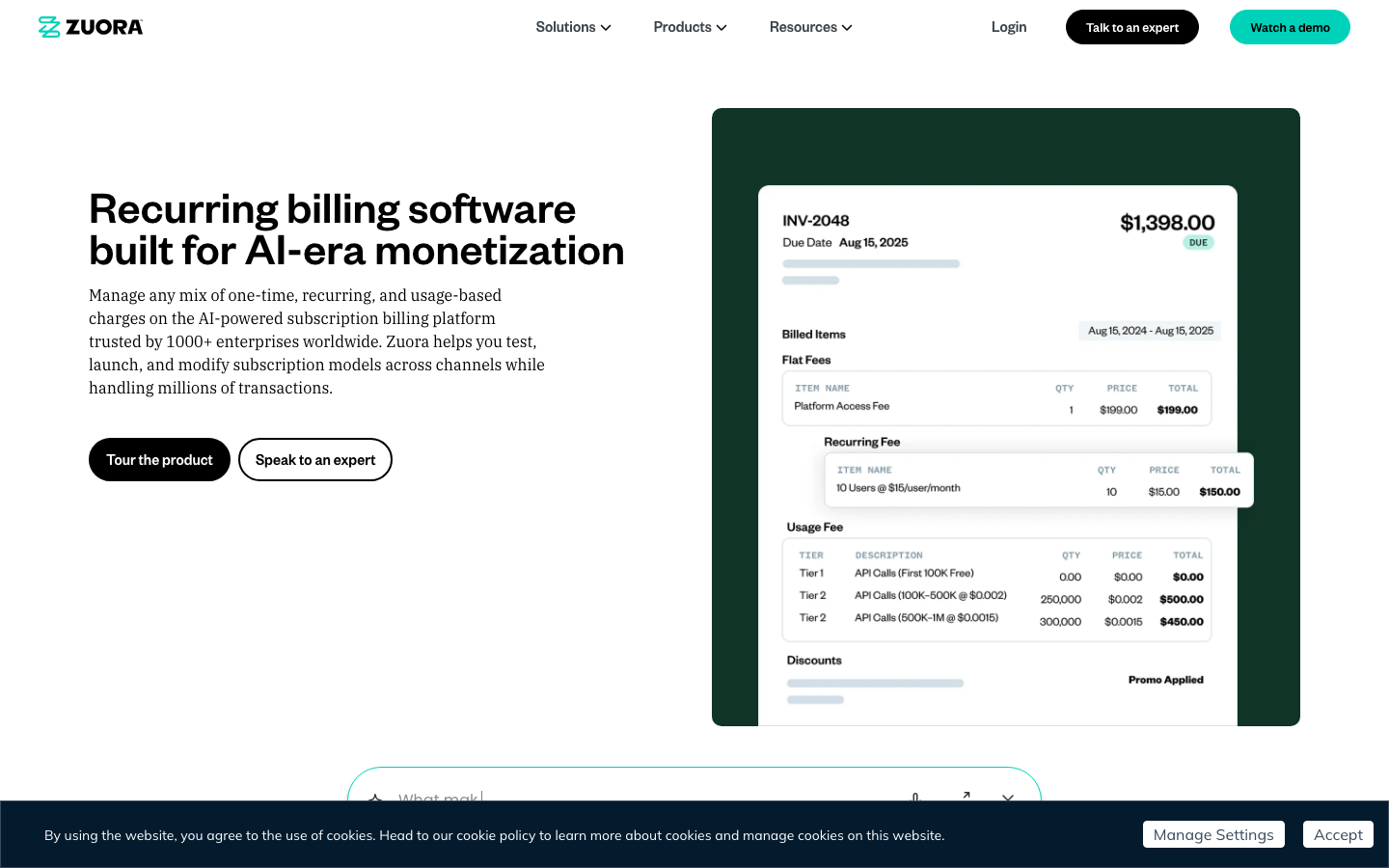
Screenshots of Zuora 4 images
What's great
- Market leader for enterprise subscription billing; more enterprise SaaS companies have implemented Zuora than any competing platform, which means more implementation partners and documented patterns
- Zuora Revenue handles ASC 606 and IFRS 15 natively including variable consideration, contract modifications, and multi-element arrangement allocation across thousands of contracts
- Order-to-revenue lifecycle (CPQ quote to invoice to recognition) operates on a single data model, which eliminates the reconciliation work that kills controllers at audit time
Watch-outs
- G2 rating of 3.9/5 across 309 reviews is the lowest in this guide; complexity, slow implementations, and expensive professional services are the recurring complaints
- Implementation typically runs 6-12 months and $200K-$500K in professional services before go-live; do not underestimate this
- Annual contract cost at $30K-$100K+ is hard to negotiate down; Zuora's leverage increases after you are live on the platform
Zuora is the category-defining enterprise billing platform, and it shows in both the adoption numbers and the implementation horror stories. 309 G2 reviews at 3.9/5 — the lowest rating in this guide but the widest enterprise deployment. The 3.9 reflects real pain: slow implementations, high cost, and a platform that requires dedicated admin headcount to operate well. But when an auditor asks for ASC 606 revenue schedules across 2,000 contracts with modifications and variable consideration, Zuora Revenue handles it natively. No other platform in this guide does it as completely.
Pricing breakdown
| Plan | Price | Best for |
|---|---|---|
| Zuora Billing | Custom (typically $30K-$60K/year) | $10M-$50M ARR subscription billing |
| Zuora Revenue | Custom add-on | ASC 606 / IFRS 15 revenue recognition |
| Zuora CPQ | Custom add-on | Quote-to-cash integration with Salesforce |
What reviewers say about Zuora
Recurring themes across ~309 G2 reviews (3.9/5), 2024-2026.
What reviewers praise
- Zuora handles genuinely complex subscription billing and revenue recognition at enterprise scale, managing recurring models, pricing changes, renewals, and invoicing without heavy in-house systems.
- Subscription-lifecycle automation is valued for cutting manual work and keeping billing accurate as volume grows.
- Out-of-the-box Salesforce and NetSuite integrations, multi-currency support, and tax automation are cited as strong fits for large, multi-entity operations.
- Reviewers note the platform is powerful and highly configurable once the API is used to work around interface limits.
What reviewers fault
- Complexity is the dominant theme: setup, configuration, and ongoing maintenance are resource-intensive and often need dedicated staff or consultants.
- The native UI is a repeated weak point, with reviewers effectively routing around it through the API.
- Reporting is called weak, pushing some teams to export into their own data warehouse for real analysis.
- Reviewers report trouble with line-level and invoice-wide discounts, constraints on payment plans and billing frequencies, and several mention server outages.
Loading reviews…
Maxio
Best for mid-market to enterprise B2B SaaS at $5M to $100M ARR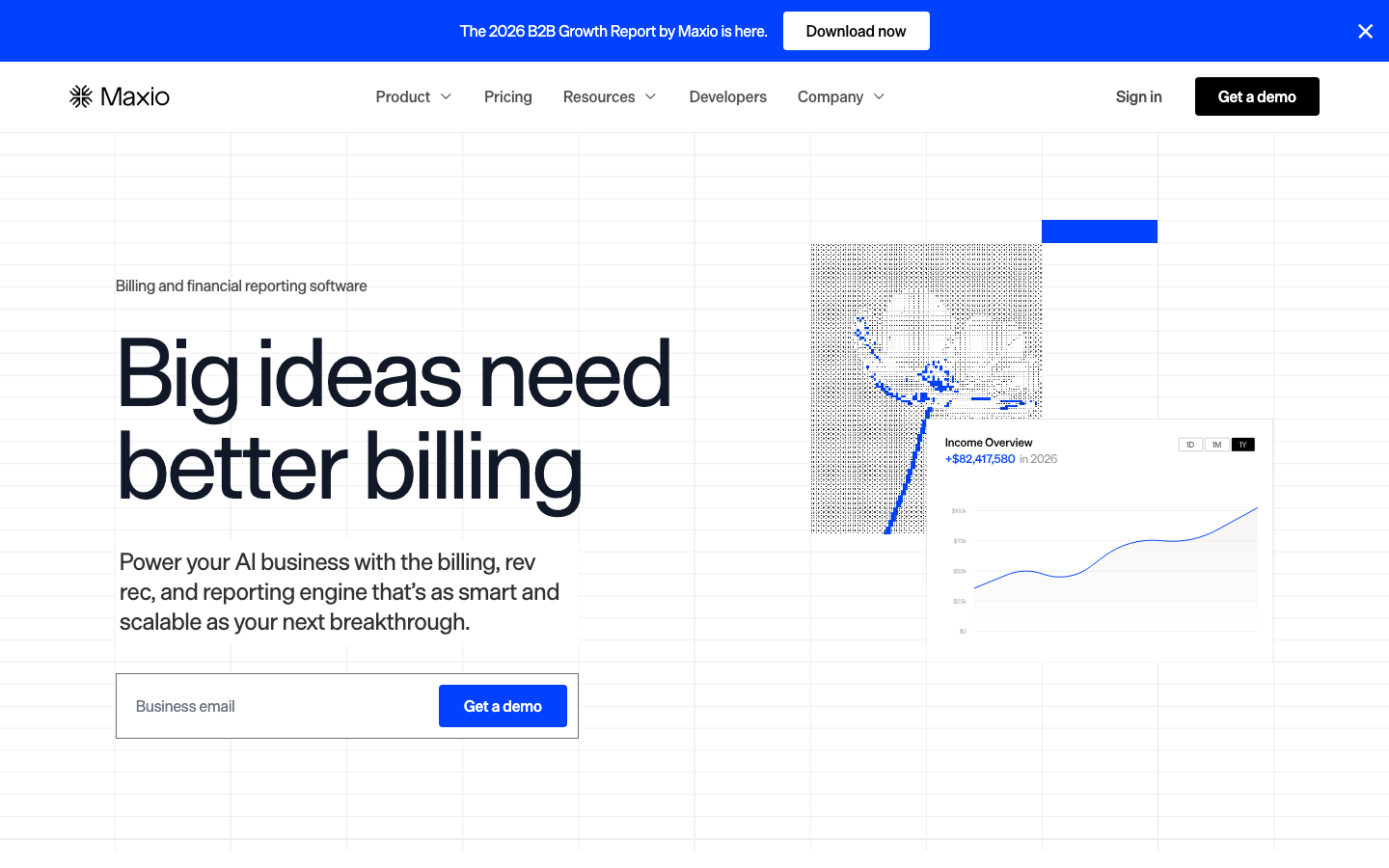
Screenshots of Maxio 4 images
What's great
- NRR waterfall, ARR bridge, churn cohort, and RevRec reports are all native — a board-ready finance stack without a separate analytics vendor
- Formed by the merger of Chargify and SaaSOptics in 2022, combining a battle-tested billing engine with a dedicated SaaS metrics and RevRec platform
- Faster implementation than Zuora; most teams go live in 6-12 weeks compared to 6-12 months for Zuora
Watch-outs
- CPQ integration is not as deep as Zuora or Salesforce Revenue Cloud; complex enterprise quoting workflows may still require a Salesforce CPQ layer
- Limited brand recognition outside the $5M-$50M B2B SaaS segment; procurement teams at large enterprises sometimes push for Zuora by name
- Enterprise pricing scales quickly past the $599/month entry point; get a detailed quote before assuming the sticker price
Maxio is the best enterprise billing platform for most B2B SaaS companies between $5M and $100M ARR. 829 G2 reviews at 4.3/5 — meaningfully higher satisfaction than Zuora at comparable enterprise scale. Implementation in weeks instead of months is the practical difference. The gap is CPQ depth and brand recognition in large-enterprise procurement. If your deal is going to a CFO who wants the ’enterprise standard’ name on the contract, Zuora wins the procurement conversation even when Maxio would serve the finance team better.
Pricing breakdown
| Plan | Price | Best for |
|---|---|---|
| Entry | $599/month | $2M-$10M ARR teams stepping up from SMB platforms |
| Growth | Custom pricing | $10M-$50M ARR multi-entity operations |
| Enterprise | Custom pricing | $50M+ ARR with full CPQ and revenue lifecycle management |
What reviewers say about Maxio
Recurring themes across ~829 G2 reviews (4.3/5), 2024-2026.
What reviewers praise
- The SaaSOptics-side reporting and revenue-recognition depth is called a game changer, giving finance leaders the subscription metrics needed to make strategic decisions.
- Reviewers praise the automation of complex B2B subscription billing and rev-rec that would otherwise be manual and error-prone.
- It integrates well with accounting tools (QuickBooks, NetSuite) and handles complicated, sales-led subscription structures that simpler tools cannot.
- Bulk Excel uploads are repeatedly mentioned as a practical way to move large volumes of billing data efficiently.
What reviewers fault
- Support is the loudest complaint: slow response times, and reviewers note you often have to buy support hours in bulk, turning a one-hour config task into a four-figure expense.
- Implementation is long and heavy, with some small companies reporting onboarding that stretched past ten months.
- The interface is not intuitive and requires real training, worsened by a knowledge base that mixes SaaSOptics and Chargify material with no way to filter between them.
- Reporting flexibility and customization are limited, and reviewers say the API is poorly documented, forcing guesswork.
- Syncing data across a dual product-led and sales-led motion (plus CRM) gets complex, making product-catalog and pricing updates onerous.
Loading reviews…
Chargebee
Best for enterprise SaaS teams that want to stay on one platform from startup to scale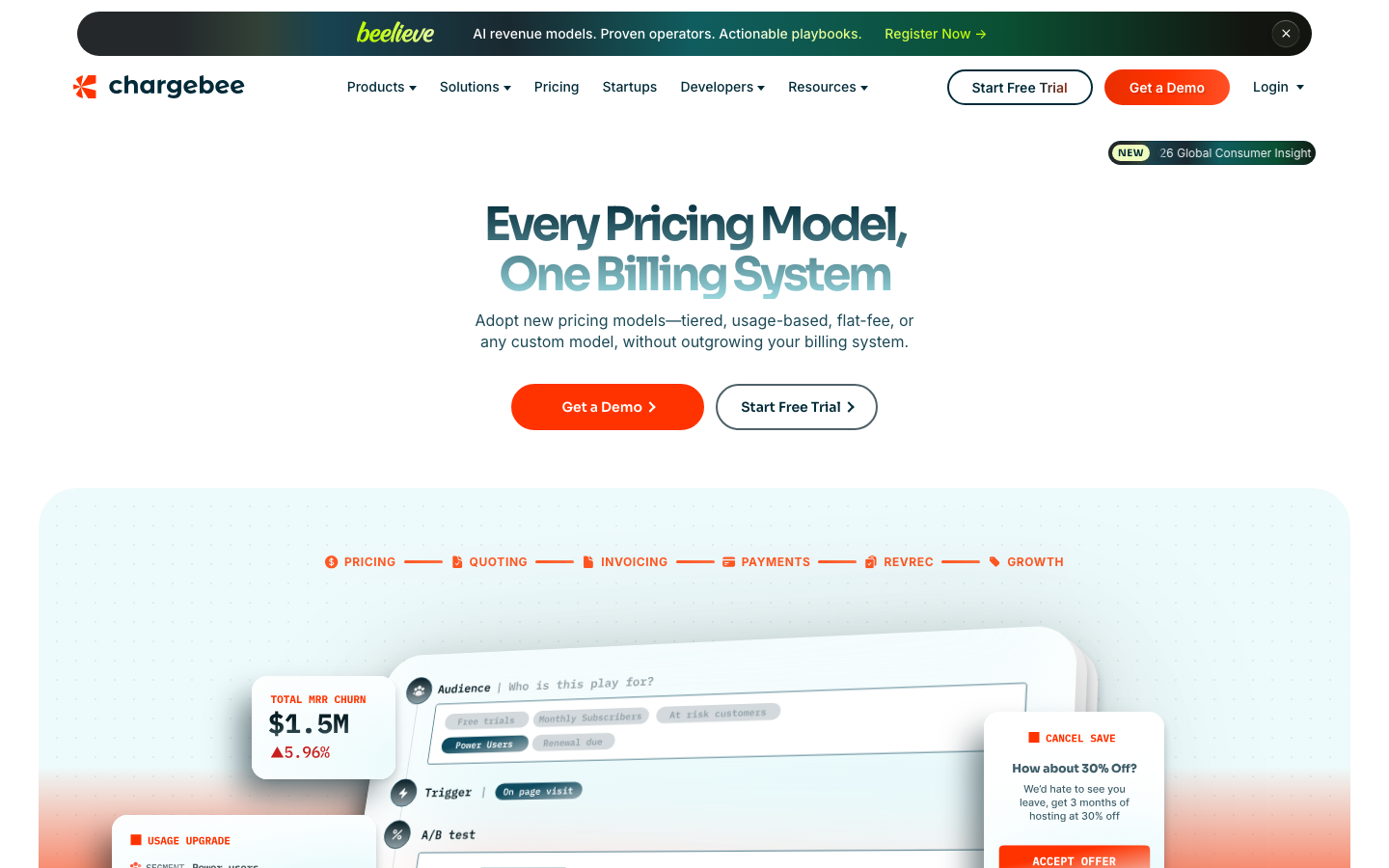
Screenshots of Chargebee 4 images
What's great
- 995 G2 reviews at 4.4/5 — the deepest and most positive review dataset in this enterprise guide; Chargebee users at large companies consistently praise retention workflows and RevRec quality
- Chargebee Retention (formerly Brightback) handles subscription cancellation flows, win-back sequences, and failed-payment orchestration better than any other platform in this guide
- Multi-currency, multi-entity, and offline payment processing are available in the Enterprise tier, which makes it viable for companies operating across geographies
Watch-outs
- CPQ is not native; integrations with Salesforce CPQ and HubSpot CPQ exist but add complexity and a third vendor to the quote-to-cash chain
- Multi-entity billing and consolidation are Enterprise-only; the feature depth does not match Zuora or Maxio at very large enterprise scale
- NRR waterfall and SaaS metrics are available but require Chargebee's reporting module — not as polished or configurable as Maxio's native analytics
Chargebee’s enterprise case is strongest when a team has grown on Chargebee from startup and the cost of migration to Zuora or Maxio exceeds the capability gap. 995 G2 reviews at 4.4/5, the highest satisfaction in this guide. The gap at true enterprise scale is CPQ depth and NRR reporting configurability. But for a $15M-$30M ARR company that runs Chargebee well and has a competent RevOps team, the platform can carry through a Series C without a migration.
Pricing breakdown
| Plan | Price | Best for |
|---|---|---|
| Performance | $7,188/yr ($599/mo) | $1M-$30M ARR standard tier |
| Enterprise | Custom quote | Multi-entity, offline payments, SSO, custom SLAs |
What reviewers say about Chargebee
Recurring themes across ~995 G2 reviews (4.4/5), 2024-2026.
What reviewers praise
- Automated dunning and smart retries are the standout: reviewers report the follow-up emails and retry logic measurably cut involuntary churn without manual chasing.
- The customer self-service portal for managing subscriptions, upgrades, and cancellations is praised for removing day-to-day billing overhead from finance and support teams.
- Chargebee handles complex billing scenarios (multiple plans, proration, coupons, tiered pricing) that reviewers say would otherwise need heavy custom development.
- Broad integrations and a generally user-friendly interface make it straightforward to plug into existing CRM, accounting, and payment stacks.
What reviewers fault
- Analytics and reporting are the most common gap: reviewers say Chargebee shows billing and invoicing figures but not a full view of business health, with weak dashboards and limited customer segmentation.
- Pricing frustrates teams as they scale, with a sharp jump between tiers and revenue-based overage fees that several reviewers describe as a success tax.
- Customer support quality is a recurring complaint across G2, Capterra, and TrustRadius, with slow or unhelpful responses cited repeatedly.
- Customization is restricted in places, and some reviewers report a poor cancellation and refund experience, including being renewed after attempting to cancel.
Loading reviews…
Recurly
Best for high-volume enterprise subscription businesses with B2C-adjacent payment patterns
Screenshots of Recurly 4 images
What's great
- Account Updater and adaptive retry logic recover more revenue from failed payments than any other enterprise platform in this guide
- Native MRR waterfall, churn cohort analysis, and subscriber lifecycle analytics — board-ready SaaS reporting without additional tooling
- Scales cleanly to tens of thousands of active subscriptions with no degradation in billing run performance
Watch-outs
- G2 rating of 4.0/5 at 205 reviews is the lowest enterprise satisfaction score in this guide; pricing complexity and support response times are cited most often
- RevRec and ASC 606 compliance depth are weaker than Zuora, Maxio, and Chargebee Enterprise; not the right choice for complex multi-element arrangements
- Contract management for true enterprise B2B (multi-year ramp deals, custom MSA terms, offline payment) is not as developed as Zuora or Maxio
Recurly earns its enterprise ranking in one specific use case: companies with tens of thousands of monthly subscribers where dunning performance and Account Updater recovery directly move the revenue needle. 205 G2 reviews at 4.0/5. Media companies, SaaS-adjacent consumer products, and any enterprise subscription business with a predominantly credit-card payment base should evaluate Recurly seriously. For complex B2B enterprise contracts with variable consideration and multi-element revenue allocation, Zuora or Maxio are the better fit.
Pricing breakdown
| Plan | Price | Best for |
|---|---|---|
| Professional | Custom enterprise pricing | High-volume subscription businesses with dedicated support needs |
| Elite | Custom enterprise pricing | Full-scale enterprise with dedicated RevRec, multi-entity, custom SLAs |
What reviewers say about Recurly
Recurring themes across ~205 G2 reviews (4.0/5), 2024-2026.
What reviewers praise
- Automated dunning and churn recovery draw the most praise, with reviewers crediting reliable retries and one-click payment updates for reducing failed-payment churn.
- Billing reliability is a recurring theme: Recurly charges on the right cycle consistently, and reviewers say that dependability offsets the cost.
- The ability to plug in and swap almost any payment gateway with minimal effort is called out as genuine flexibility.
- The interface is generally seen as user-friendly and support is described as responsive by higher-rated reviewers.
What reviewers fault
- Customization is limited: reviewers say editing invoices, changing line-item pricing or descriptions after issuance, and setting custom renewal notifications is harder than it should be.
- Handling price localization, tax-inclusive versus tax-exclusive setups, and pricing A/B tests is cumbersome, and documentation is described as scattered and inconsistent.
- Reporting lacks depth, especially dunning-email performance (open, click, and cohort-churn visibility), leaving teams without insight into what is working.
- Pricing is called expensive for startups and low-volume businesses (list starts around $1,200), and a few reviewers felt misled or overcharged by fine-print contract terms.
Loading reviews…
Salesforce Revenue Cloud
Best when your sales team already lives in Salesforce and CPQ-to-billing in one CRM is worth the premium
Screenshots of Salesforce Revenue Cloud 4 images
What's great
- Single data model from CRM opportunity to signed contract to invoice to revenue recognition — no ETL, no reconciliation, no data warehouse needed for a quote-to-cash audit trail
- CPQ is native; configure-price-quote within Salesforce without a third-party CPQ integration or a separate data sync
- 1,498 G2 reviews gives the widest feedback dataset in this guide; implementation patterns and known issues are well documented
Watch-outs
- Requires Sales Cloud Enterprise at $165/user/month before Revenue Cloud costs are added; the seat cost alone eliminates it for small sales teams
- Implementation is complex and expensive; Salesforce Revenue Cloud implementations regularly run $500K-$2M in SI partner fees
- Highest total cost of ownership in this guide; the all-in cost at $20M ARR with a 30-rep sales team can exceed $500K/year before professional services
Salesforce Revenue Cloud ranks fifth not because it is a weak product but because the cost and complexity are only justified when your company is already deeply committed to the Salesforce platform. 1,498 G2 reviews at 4.2/5 — broad feedback but mixed. The case for Revenue Cloud is simple: if your AEs quote in Salesforce CPQ today, moving billing and RevRec into the same platform eliminates a category of reconciliation work that kills controllers in fast-growing companies. The case against it is equally simple: the all-in cost is the highest in this guide.
Pricing breakdown
| Plan | Price | Best for |
|---|---|---|
| Sales Cloud Enterprise | $165/user/month (required base) | Existing Salesforce enterprise deployments |
| Revenue Cloud | Custom pricing above Enterprise base | CPQ + billing + RevRec in one Salesforce org |
What reviewers say about Salesforce Revenue Cloud
Recurring themes across ~25,800 G2 reviews (4.4/5) and ~18,000 Capterra reviews (4.4/5), 2024-2026.
What reviewers praise
- Customization is the most-cited strength; reviewers say you can model almost any sales process and Salesforce will bend to it.
- The AppExchange ecosystem and integration depth are seen as unmatched, nearly every tool a team uses connects.
- It scales with the enterprise, reviewers running large, multi-team orgs say nothing else handles their complexity.
- Reporting and forecasting are praised as powerful and granular once configured by someone who knows the platform.
- Einstein AI and automation features draw positive mentions for surfacing next steps and cutting manual data entry.
What reviewers fault
- Complexity is the dominant complaint, reviewers say it needs a dedicated admin or paid consultant to set up and maintain.
- Total cost is repeatedly flagged: per-seat pricing plus add-ons, sandboxes, and implementation make it the most expensive option.
- The learning curve is steep and reps resist adoption without serious training, a recurring theme in negative reviews.
- The interface feels dated and cluttered to many reviewers compared with newer, lighter CRMs.
- Support is criticized as slow or tiered behind premium plans, with basic support seen as inadequate for the price.
Loading reviews…
Tools we considered but excluded
We evaluated more tools than the 5 you see above. These did not make the cut. Saying what we rejected, and why, is the editorial muscle most listicles skip.
- Stripe Billing: Developer-first billing engine; at enterprise scale the lack of native RevRec and board-ready SaaS metrics typically forces a second platform or significant custom work. Covered in the startup and SMB guides.
- Stax Bill: Strong for SMB teams on QuickBooks; implementation depth and enterprise contract management are limited for $10M+ ARR operations.
- Zoho Billing: Ecosystem play for Zoho-stack teams; enterprise billing complexity, CPQ integration, and multi-entity consolidation are not in scope for Zoho Billing.
- Paddle: Merchant of record model designed for pre-$300K ARR; the 5% fee and MoR structure are not compatible with enterprise procurement at $10M+ ARR.
Honorable mentions
Solid tools that did not crack the main list but are worth tracking, especially for niche use cases.
- Metronome: Strong for usage-based billing at enterprise scale; real-time metering and flexible aggregation rules for API-led businesses. Covered separately at schematichq.com and similar comparison sources.
- Ordway: Growing mid-market and enterprise option with strong RevRec and multi-entity; fewer implementation partners than Zuora or Maxio but worth a demo for $10M-$30M ARR B2B SaaS.
The billing platform decision at $10M+ ARR is not made by engineering. It is made by the CFO, the Controller, and the VP of RevOps — and it is made based on audit readiness, not developer ergonomics.
Three requirements separate enterprise billing from SMB billing. ASC 606 compliance at the contract level, not just the invoice level. Multi-entity consolidation that handles intercompany billing and currency translation without a spreadsheet. And a quote-to-cash workflow that connects the sales quote to the recognized revenue line without manual journal entries.
Every platform in this guide covers those three requirements. The differences are in implementation cost, timeline, and how much ongoing admin headcount the platform requires to stay accurate.
The cost question that matters most
Enterprise billing implementations regularly cost more than the platform’s annual software fee. Zuora at $60K/year in software costs $300K to implement. Salesforce Revenue Cloud at $200K/year in software costs $500K-$1M to implement. Maxio at $100K/year in software costs $50K-$150K to implement.
The total cost of ownership over three years is the right comparison, not the sticker price.
| Platform | Year 1 TCO (est.) | Year 2-3 annual TCO | Implementation timeline |
|---|---|---|---|
| Zuora | $400K-$700K | $100K-$150K | 6-12 months |
| Maxio | $200K-$350K | $100K-$150K | 6-12 weeks |
| Chargebee Enterprise | $100K-$200K | $80K-$120K | 4-8 weeks |
| Recurly Elite | $150K-$250K | $80K-$120K | 4-8 weeks |
| Salesforce Revenue Cloud | $600K-$1.5M | $200K-$400K | 9-18 months |
Year 1 TCO includes professional services; Year 2-3 includes software, support, and internal admin headcount. Estimates based on publicly disclosed implementation case studies and operator interviews.
What drives CFOs toward Zuora despite the cost
The answer is almost always the SI ecosystem and the audit trail. When PricewaterhouseCoopers or Deloitte is auditing your revenue schedules, Zuora Revenue’s ASC 606 audit documentation is the established benchmark. Auditors know it. The CFO’s former company used it. The implementation partner your board introduced you to is certified on it.
Maxio is catching up on the audit front. Chargebee Enterprise handles most $15M-$25M ARR compliance needs. But when a company is approaching IPO and the audit firm is one of the Big Four, Zuora’s name recognition in the CFO community still carries weight.
For the full comparison across startup and SMB billing options including Stripe Billing, Paddle, LemonSqueezy, and Zoho Billing, see our complete subscription billing guide .
Also relevant: Best Billing for Startups and Best Subscription Billing for SMBs .
Frequently asked questions
What is the best enterprise subscription billing software in 2026?
Zuora for $30M+ ARR enterprises that need ASC 606 compliance, CPQ integration, and a platform with wide implementation partner coverage. Maxio for $5M-$100M ARR B2B SaaS that wants board-ready NRR reporting and RevRec without a 12-month implementation timeline.
How much does enterprise billing software cost?
Zuora typically runs $30K-$100K/year in software costs plus $200K-$500K in professional services for implementation. Maxio starts at $599/month with custom enterprise pricing above that. Salesforce Revenue Cloud requires Sales Cloud Enterprise at $165/user/month plus Revenue Cloud on top. Total cost of ownership at $20M ARR typically runs $150K-$600K/year across all platforms in this guide.
Is Chargebee suitable for enterprise use?
Yes, for companies that grew on Chargebee and want to avoid a platform migration. Chargebee Enterprise covers multi-entity billing, multi-currency, and RevRec for most $10M-$30M ARR companies. At $50M+ ARR or with complex CPQ requirements, most teams eventually migrate to Zuora or Maxio.
What is the difference between Zuora and Maxio?
Zuora is the enterprise standard at $30M+ ARR; deeper CPQ integration, wider SI partner network, ASC 606 compliance for the most complex multi-element arrangements. Maxio is faster to implement (weeks vs months), costs less, and includes stronger native SaaS metrics reporting. Most companies at $5M-$30M ARR will find Maxio covers their needs; above $30M ARR the Zuora ecosystem advantage grows.
Does Salesforce Revenue Cloud replace Zuora?
Only for Salesforce-native enterprises. Revenue Cloud eliminates the Salesforce-to-billing sync that Zuora requires but adds cost and complexity of its own. Teams not already committed to the full Salesforce stack at Enterprise tier should evaluate Zuora or Maxio first.
Related helpful reads
Write a review
Posts to the page right away. Keep it real — no links or email addresses.