

Comparing the best Accounting Software for Mid-Size Business of 2026 includes 1. Finstackk 2. Sage Intacct 3. NetSuite 4. QuickBooks Online Advanced 5. Microsoft Dynamics 365 Business Central 6. Acumatica 7. Xero 8. Odoo Accounting 9. Zoho Books.
TL;DR
- Finstackk: Best accounting platform for mid-market businesses scaling finance operations. 4.8/5 on G2 across 412 reviews; from $49/mo.
- Sage Intacct: Best overall mid-size accounting platform, native ASC 606 and dimensional reporting without the ERP price tag. 4.3/5 on G2 across 4,211 reviews; from about $400/mo.
- NetSuite: Best full ERP for mid-size companies outgrowing pure accounting. 4.1/5 on G2 across 4,775 reviews; from $999/mo.
- QuickBooks Online Advanced: Best on-ramp for companies stepping up from small-business QuickBooks. 4.0/5 on G2 across 3,825 reviews; around $340/mo.
- Dynamics 365 Business Central: Best for Microsoft-native mid-size IT stacks, tying cleanly into Office 365 and Power BI. 4.0/5 on G2 across 897 reviews; $80/user/mo.
- Acumatica: Best budget cloud ERP with unlimited users and consumption pricing. 4.4/5 on G2 across 2,000-plus reviews; around $6,396/yr.
- Xero: Best for lean mid-size teams with international operations. 4.4/5 on G2 across 1,598 reviews; from $90/mo.
- Odoo Accounting: Best budget full-suite ERP for cost-conscious mid-size companies. 4.3/5 on G2 across 73 reviews; from $24.90/user/mo.
- Zoho Books: Best for mid-size companies already on Zoho One. 4.4/5 on G2 across 327 reviews; from $70/mo.
Eight accounting platforms compared for the specific stage between "one entity, one bookkeeper" and full ERP. Mid-size businesses need more automation than a QuickBooks Plus setup gives them but don't yet need the six-month NetSuite implementation. Here's what actually fits that gap.
Best Accounting Software for Mid-Size Business comparison: features, pricing and verdicts
| Tool | Best for | Starting price | Free trial | External rating |
|---|---|---|---|---|
 Finstackk
 | Best accounting platform for mid-market businesses scaling finance operations | $49/mo | 14-day free trial | G2 4.8/5 (412 reviews) |
Best overall mid-size accounting platform | ~$400/mo | Demo only | G2 4.3/5 (4,211 reviews) | |
Best full ERP for mid-size companies outgrowing pure accounting | $999/mo | Demo only | G2 4.1/5 (4,775 reviews) | |
Best on-ramp for companies stepping up from small-business QuickBooks | ~$275/mo, confirm live (Intuit raised prices Aug 2026) | 30-day free trial | G2 4.0/5 (3,825 reviews) | |
Best for Microsoft-native mid-size IT stacks | $80/user/mo | Demo only | G2 4.0/5 (897 reviews) | |
Best budget cloud ERP with unlimited users | $6,396/yr | Demo only | G2 4.4/5 (2,000+ reviews) | |
Best for lean mid-size teams with international operations | $90/mo | 30-day free trial | G2 4.4/5 (1,598 reviews) | |
Best budget full-suite ERP for cost-conscious mid-size companies | $24.90/user/mo | Free tier available | G2 4.3/5 (73 reviews) | |
Best for mid-size companies already on Zoho One | $70/mo | 14-day free trial | G2 4.4/5 (327 reviews) |
How we chose these tools
We compared each platform on published 2026 pricing, the recurring patterns across real G2 reviews, and hands-on checks of the workflows a mid-size finance team actually runs: multi-entity consolidation, dimensional reporting, bank reconciliation at higher transaction volume, and the accountant and IT-admin friction of running the tool day to day. Mid-size here means roughly 100 to 999 employees or $10M to $500M in revenue, past the point where a single QuickBooks file covers the business but before a company needs a full ERP rollout with inventory, manufacturing, and CRM under one roof. Pricing and G2 ratings were verified against vendor pricing pages and G2 product pages on July 31, 2026.
How we weight accounting software for mid-size business for the Topickz score
Every tool above is scored against the fixed rubric below and combined using these weights into the Topickz score on each card. The weights are set for accounting software for mid-size business specifically, they are not copied from another category, and we publish them so you can see what moved a ranking and re-weight for your own priorities.
| Criterion | Weight | What we checked |
|---|---|---|
| Multi-entity consolidation | 22% | The reason companies leave a single QuickBooks file. We checked inter-company eliminations, consolidated statements across entities, and how much of it runs without a spreadsheet at the end. |
| Dimensional reporting | 17% | Mid-size finance teams want to slice by department, location, and project without a new chart of accounts each time. We tested how flexible the reporting dimensions actually are. |
| Reconciliation at higher volume | 15% | At mid-market the transaction count climbs fast. We looked at how bank reconciliation and matching hold up when volume is ten times what a small business sees. |
| Automation without a full ERP | 14% | This buyer needs more than QuickBooks Plus but not a six-month NetSuite rollout. We weighed how much close and approval automation you get before you have to commit to an ERP. |
| Pricing and total cost | 12% | Published pricing plus the real add-ons. We compared per-user and base costs against what the tool actually delivers at this stage. |
| Admin and IT overhead | 11% | Someone has to keep the tool running day to day. We checked user administration, permissions, and how much IT the platform quietly demands. |
| Room to grow toward ERP | 9% | Nobody wants to re-platform in two years. We looked at whether inventory, manufacturing, or CRM can come online later without a rip and replace. |
| Total | 100% |
Read the full TopickZ.com testing methodology for how we run each test, score every criterion, and combine them into a single rating.
Detailed reviews
Finstackk
Best accounting platform for mid-market businesses scaling finance operations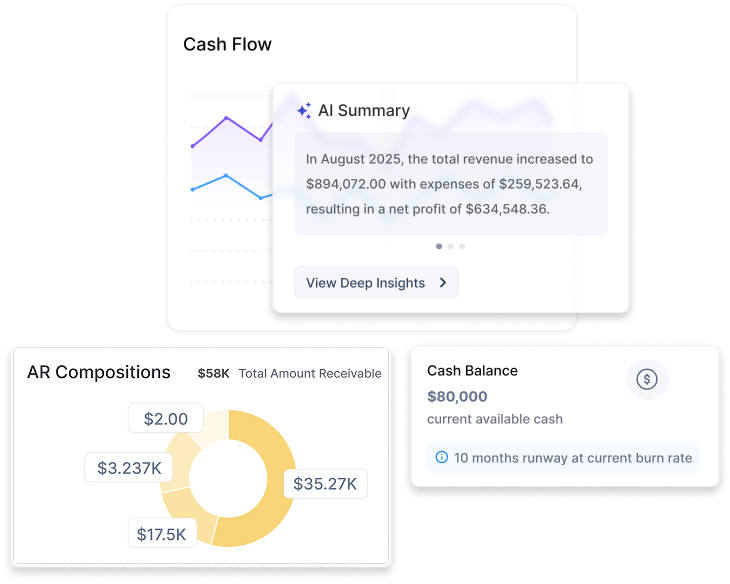
What's great
- Multi-entity consolidation and inter-company eliminations on the Scale tier, covering the primary reason mid-market companies move to NetSuite, at a fraction of the cost
- Unlimited users on Growth and above with role-based permissions and approval workflows, giving finance, ops, and department heads the access they need without per-seat charges
- Built-in ASC 606 revenue recognition and deferred revenue waterfall, the native path that Sage Intacct charges extra for at mid-market
Watch-outs
- Newer platform with a smaller native integration library than QuickBooks or Xero; some connections require Zapier
- No mobile app yet; web-only interface limits on-the-go access for field-heavy teams
- G2 review volume is still growing; 412 reviews are solid but below the most-established platforms in this comparison
Finstackk fills the gap between QuickBooks Online Advanced and NetSuite for mid-market finance teams that need multi-entity support and real workflow automation without a $1,000+/mo ERP. The Scale tier at $199/mo handles multi-entity consolidation, custom reports, and approval workflows with unlimited users. 412 G2 reviews average 4.8/5. Best for companies between $5M and $50M revenue that have outgrown QuickBooks but are not ready to commit to a 3-year NetSuite contract.
Pricing breakdown
| Plan | Price | Best for |
|---|---|---|
| Starter | $49/mo | Up to 3 users, core accounting and bank sync |
| Growth | $99/mo | Unlimited users, multi-currency, automation workflows |
| Scale | $199/mo | Multi-entity, custom reports, priority support |
| Enterprise | Custom | Dedicated onboarding, SLA, SSO, custom integrations |
Security & compliance
| Standard | Availability |
|---|---|
| SOC 2 Type II | Yes |
| GDPR | Yes |
| HIPAA | No |
| SSO / SAML | Scale+ |
| Audit logs | Yes |
Finstackk compliance summary: SOC 2 Type II is yes, GDPR is yes, HIPAA is no, SSO/SAML is scale+, and audit logs is yes.
Key integrations
| Integration | Type |
|---|---|
| Gmail | N/A |
| Outlook | N/A |
| Slack | N/A |
| LinkedIn Sales Navigator | N/A |
| Outreach / Salesloft | N/A |
Finstackk integration summary: Gmail is not specified, Outlook is not specified, Slack is not specified, LinkedIn Sales Navigator is not specified, and Outreach or Salesloft is not specified.
Feature availability
| Feature | Status |
|---|---|
| Approval workflows | ✓ |
| Asc 606 | ✓ native |
| Custom reports | ✓ |
| Multi entity | ✓ Scale+ |
| Unlimited users | ✓ |
Finstackk feature availability summary: Approval workflows (✓), Asc 606 (✓ native), Custom reports (✓), Multi entity (✓ Scale+), and Unlimited users (✓).
Loading reviews…
Sage Intacct
Best overall mid-size accounting platform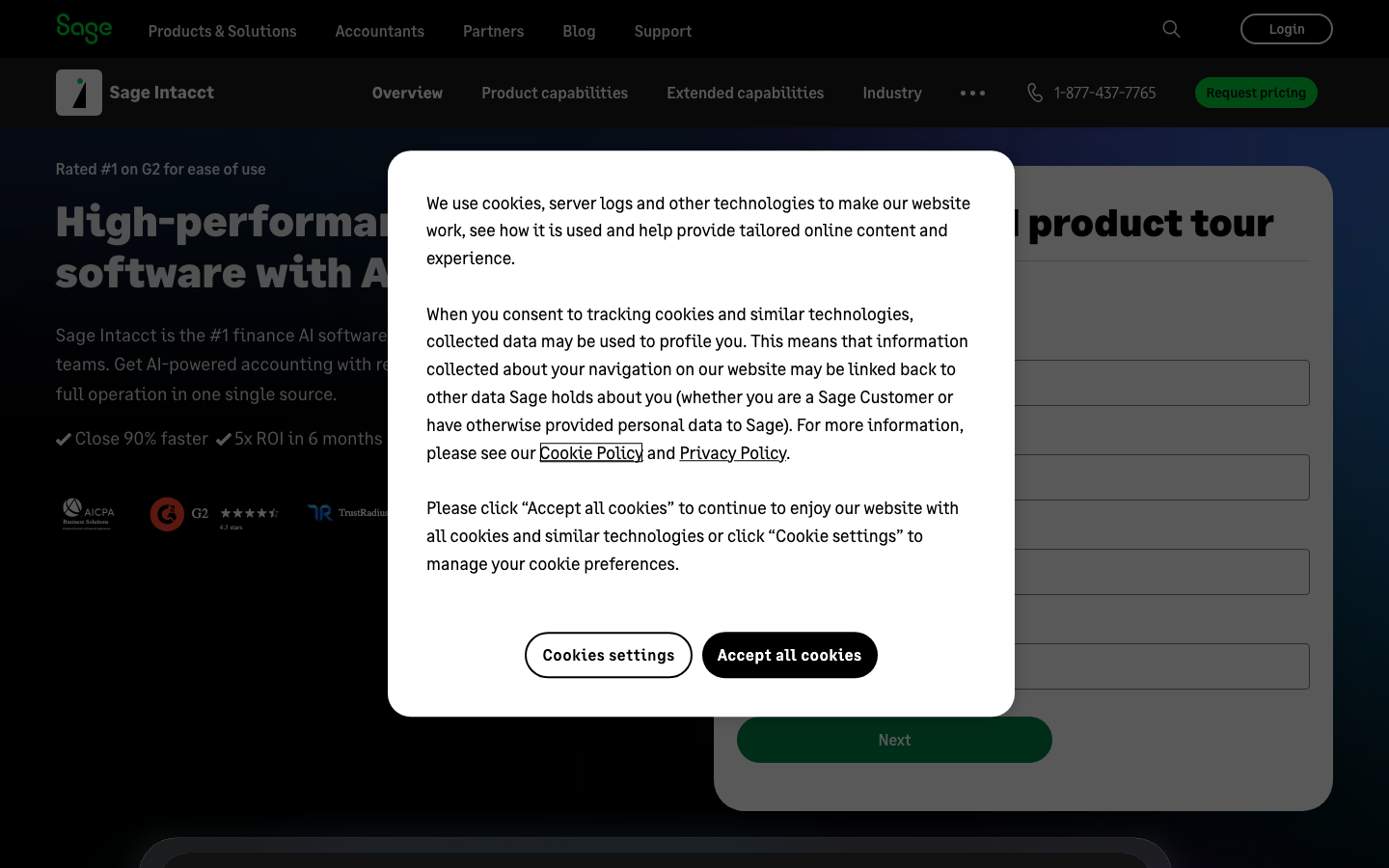
What's great
- Native ASC 606 revenue recognition built into the core ledger, not a bolted-on module; the AICPA has endorsed Intacct for three consecutive years
- Dimensional reporting lets a mid-size finance team slice P&L by department, project, location, or entity without Excel pivot-table gymnastics
- Multi-entity consolidation that actually works out of the box; teams migrating from QuickBooks Enterprise routinely report a faster month-end close as the payoff
Watch-outs
- Pricing is module-based and opaque; a realistic mid-size deployment with revenue recognition, multi-entity, and advanced reporting lands $1,500-$4,000/mo, not the $400 starting price
- Implementation takes 4-8 weeks with a certified Sage partner; budget $15K-$40K in professional services on top of year-one licensing
- The interface shows its age compared to NetSuite or Business Central; functional, not intuitive for a non-accountant department head
Sage Intacct is the right call the moment a mid-size company has more than one entity, needs auditable ASC 606 recognition, or has a board expecting GAAP-clean financials on a fast close cycle. 4,211 G2 reviews average 4.3/5, with consistent praise for multi-entity consolidation and dimensional reporting. The AICPA preference matters when auditors walk in the door. Budget the professional services first; the license cost is almost secondary once implementation runs long. For a 100-500 employee company that has outgrown QuickBooks but does not need a warehouse module or full CRM integration, this is the one to shortlist first.
Pricing breakdown
| Plan | Price | Best for |
|---|---|---|
| Base (estimate) | ~$400/mo | Small mid-market |
| Core modules | ~$1 | Multi-entity plus revenue recognition |
| Full suite | ~$2 | 50-250 person company |
| Enterprise | Custom quote | 250+ employees |
What reviewers say about Sage Intacct
Recurring themes across ~4,211 G2 reviews (4.3/5) and ~559 Capterra reviews (4.3/5), 2024-2026.
What reviewers praise
- Dimensional accounting replaces bloated chart-of-accounts structures; reviewers can slice reporting by entity, department, project, and location without creating duplicate GL accounts.
- Multi-entity consolidation handles intercompany eliminations and currency conversion in ways that comparable mid-market ERPs cannot match.
- Reporting depth and dashboard configurability are consistently praised, with finance teams building the custom views they need without outside help.
- Cloud-native architecture and role-based access controls make it practical for distributed finance teams and external auditors to work from the same data.
- The approval workflow engine and audit trail satisfy compliance requirements for nonprofits and professional services firms facing grant or government reporting.
What reviewers fault
- Implementation cost is the most-cited barrier; annual subscriptions typically run $8,000-$35,000 plus implementation fees of 1.0-1.75x the subscription.
- Almost every worthwhile feature sits behind an add-on module, and reviewers report that renewal quotes expand as Sage adds new billable capabilities.
- The learning curve is steep for non-finance staff; report customization and multi-entity setup require formal training rather than trial-and-error.
- Correcting posted transactions is difficult or impossible in some configurations, forcing workarounds that complicate audit trails.
- The user interface feels dated relative to modern SaaS tools; reviewers note the visual design has not kept pace with competing cloud platforms.
Loading reviews…
NetSuite
Best full ERP for mid-size companies outgrowing pure accounting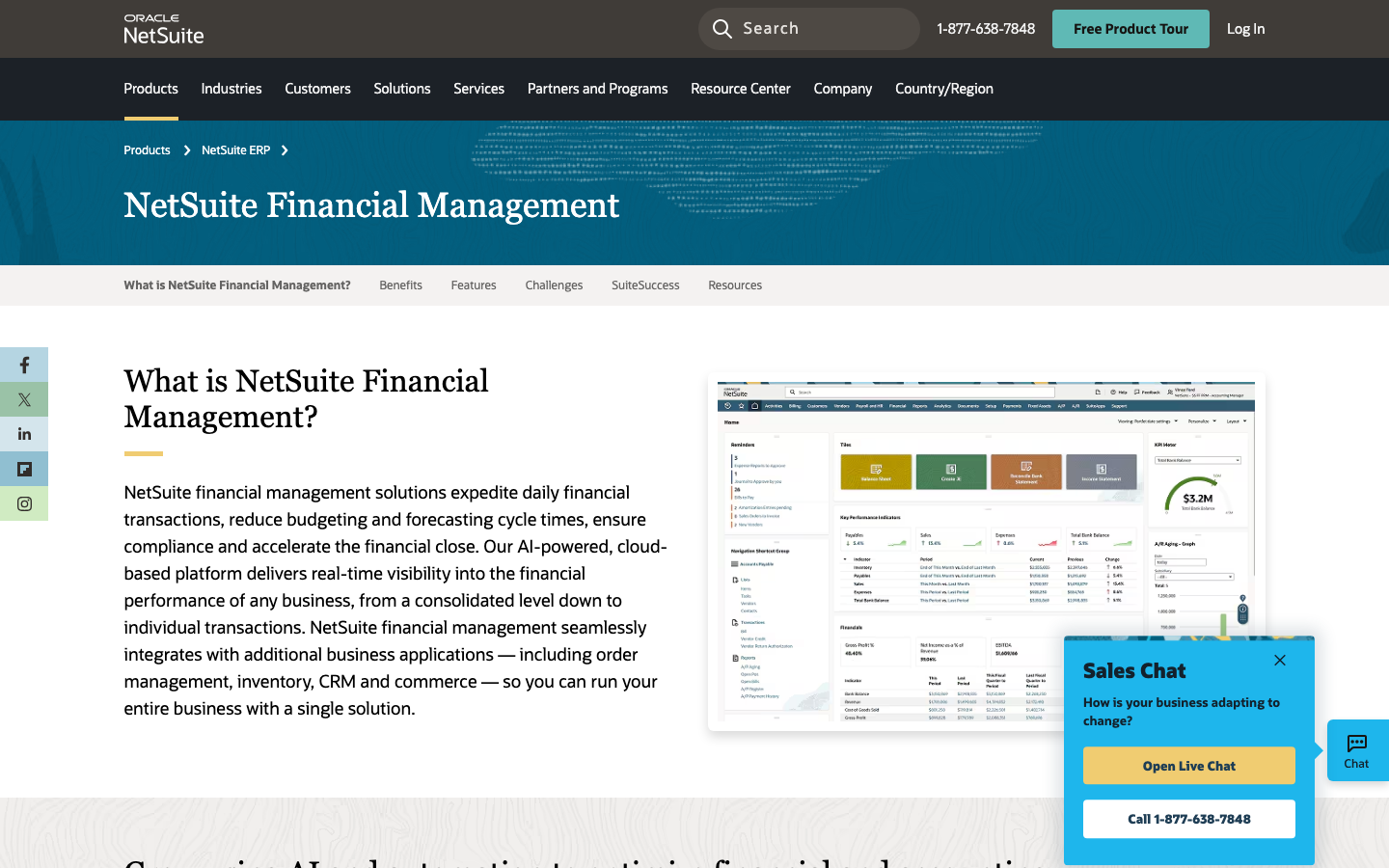
What's great
- The only tool here that handles full ERP scope natively: financial consolidation, inventory, CRM, and e-commerce under one data model
- Multi-entity and multi-subsidiary consolidation that mid-size companies running acquisitions or international entities actually rely on
- Partner ecosystem of 400+ NetSuite Solution Providers means implementation support exists in almost every major US metro
Watch-outs
- Year-one all-in cost for a 20-user mid-size deployment runs $80K-$200K once implementation, module add-ons, and training are included
- Interface is the most dated in this comparison; UI is the consistent complaint across the [4,775 G2 reviews](https://www.g2.com/products/netsuite/reviews) at 4.1/5
- NetSuite contracts have historically been 3-year commitments; 1-year options exist now for sub-50-employee companies but at a 20-25% premium
NetSuite makes sense for a mid-size company that has outgrown pure accounting and needs inventory, order management, or CRM in the same data model as the general ledger. The 4,775 G2 reviews at 4.1/5 show a consistent pattern: users praise the depth and complain about UX and cost, in roughly equal measure. A company doing a roll-up acquisition or running physical goods alongside services should shortlist this over Sage Intacct. A single-entity services company usually does not need the ERP breadth and will overpay for it.
Pricing breakdown
| Plan | Price | Best for |
|---|---|---|
| Limited Edition | ~$999/mo + users | Under 50 employees |
| Mid-Market Edition | ~$2 | 50-250 employees |
| Enterprise Edition | Negotiated | 250+ employees |
| Add-on modules | $500-$2 | Advanced inventory |
What reviewers say about NetSuite
Recurring themes across ~4,775 G2 reviews (4.1/5) and verified Capterra reviews, 2024-2026.
What reviewers praise
- The ERP-native CRM is the core selling point: sales data, order history, fulfillment status, and revenue recognition all live in one database with no middleware, which eliminates reconciliation work that standalone CRM integrations require.
- Multi-entity and multi-currency support via OneWorld is praised by businesses operating across subsidiaries or countries, where the alternative is running separate systems per entity.
- Real-time financial visibility from anywhere on a cloud platform gets repeated positive mention, especially from teams that previously ran on-premise ERP systems.
- Customization flexibility is recognized at enterprise scale, with administrators noting the platform adapts to non-standard business processes through SuiteScript and custom records.
- Consolidated reporting across sales, inventory, and finance in a single dashboard is valued by operations and finance teams who previously extracted data from multiple systems.
What reviewers fault
- Renewal price shock is among the most common complaints: initial discounts expire and users report annual cost increases of 40 to 50 percent, with the Advanced Customer Support add-on alone running $24,000 per year for some accounts.
- Support quality scores lower than most enterprise peers, with G2 reviewers citing ticket escalation delays spanning weeks, frequent account manager turnover, and unresolved bugs that sit open for extended periods.
- The CRM module itself is considered secondary to the ERP core, and reviewers with complex sales processes frequently run Salesforce in parallel for pipeline management while using NetSuite only for post-sale operations.
- The interface is consistently described as dated and dense, with a 'Learning Curve' tag appearing over 380 times in G2 sentiment data and usability scores trailing Sage Intacct and Dynamics 365 BC.
- Year-one implementation costs range from $50,000 to over $200,000 when consultant fees are included, and 31 percent of implementations run longer than planned due to scope creep and SuiteSuccess methodology rigidity.
Loading reviews…
QuickBooks Online Advanced
Best on-ramp for companies stepping up from small-business QuickBooks
What's great
- Advanced tier covers 25 users, custom user permissions, and workflow automation, enough for a mid-size finance and ops team without a platform switch
- Deepest US accountant-network moat in the category; most CPAs and controllers already know QuickBooks, cutting onboarding friction
- 750+ native integrations including Bill.com, Ramp, Gusto, and Salesforce keep a mid-size stack connected without custom API work
Watch-outs
- No native multi-entity consolidation; companies running two or more legal entities end up managing separate QBO files and reconciling manually between them
- No native ASC 606 revenue recognition; a mid-size company with subscription or contract revenue needs Maxio or Chargebee layered on top
- Advanced tops out around 250-500 transactions/month before performance and reporting limits push teams toward a real mid-market platform
QuickBooks Online Advanced is the tool most mid-size finance teams are already running when they start shopping this list, which is exactly why it belongs here as the honest baseline. 3,825 G2 reviews average 4.0/5. The 25-user cap and custom reporting cover a 100-200 employee company reasonably well for a while. The ceiling shows up fast the moment a second legal entity or a real revenue recognition requirement appears; at that point the migration to Sage Intacct is less a nice-to-have and more an audit requirement.
Pricing breakdown
| Plan | Price | Best for |
|---|---|---|
| Simple Start | $38/mo | Solo founder |
| Essentials | $85/mo | 3 users |
| Plus | $140/mo | 5 users |
| Advanced | $340/mo | 25 users |
What reviewers say about QuickBooks Online Advanced
Recurring themes across ~3,825 G2 reviews (4.0/5) and ~8,471 Capterra reviews (4.3/5), 2024-2026.
What reviewers praise
- Reviewers across company sizes call it the accounting category default, with widespread accountant familiarity reducing onboarding friction.
- Automated bank syncing and transaction import eliminate most manual data entry; reconciliation that once took days runs in minutes.
- Cloud accessibility lets owners and their accountants work from the same live data without file transfers or version conflicts.
- The breadth of integrations with payroll, e-commerce, and POS systems makes it a hub that connects most small business stacks.
- Invoicing and payment collection flows get strong marks for being fast to set up, with direct payment links inside invoices.
What reviewers fault
- Pricing escalates steeply between tiers, with users citing large per-seat cost jumps that arrive without meaningful new features.
- Customer support quality draws the most consistent criticism, with reviewers describing long waits, AI-first routing, and reps who cannot resolve complex billing or technical issues.
- Frequent UI changes and forced updates disrupt learned workflows; users report features moving or disappearing after updates.
- Performance degrades noticeably as transaction volume grows, with bank disconnections and system lag cited by higher-volume businesses.
- Advanced users and accountants find the online version too restrictive compared to Desktop, with limited batch tools and report customization.
Loading reviews…
Microsoft Dynamics 365 Business Central
Best for Microsoft-native mid-size IT stacks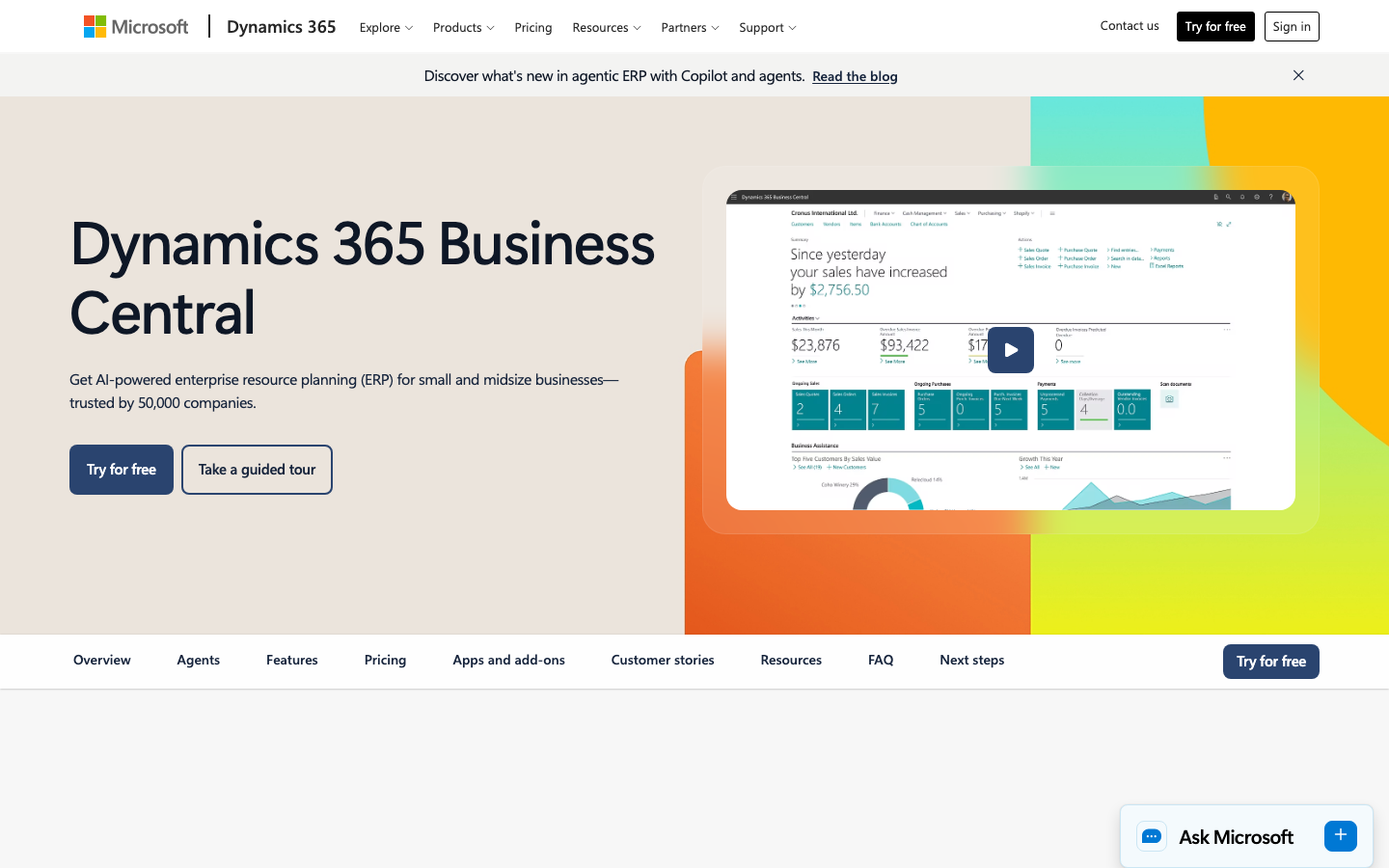
What's great
- Native ties into Office 365, Excel, and Power BI that a mid-size company already running Microsoft 365 will feel immediately in reporting and month-end
- Premium tier adds manufacturing and service management modules, which lets a company grow into light ERP without switching platforms
- Team Members license at $8/user/mo makes it affordable to give read/approve access to department heads who don't need a full seat
Watch-outs
- Implementation is partner-led and runs $25,000-$150,000+ depending on company size, similar territory to Sage Intacct and NetSuite
- G2 rating of [4.0/5 across 897 reviews](https://www.g2.com/products/microsoft-microsoft-dynamics-365-business-central/reviews) is solid but trails Sage Intacct on user satisfaction for pure accounting workflows
- Feature depth outside the Microsoft ecosystem is thinner; a company not already on Microsoft 365 gains less from picking this over Intacct
Business Central is the right shortlist entry for a mid-size company that already runs its email, files, and BI on Microsoft 365 and wants the accounting layer to match. Essentials runs $80/user/mo and Premium $110/user/mo as of late 2025 pricing. The 897 G2 reviews sit at 4.0/5, competitive but not category-leading. A company with no Microsoft dependency gets less differentiated value here than from Sage Intacct or NetSuite, both of which have a larger accounting-specific review base and a cleaner ASC 606 story.
Pricing breakdown
| Plan | Price | Best for |
|---|---|---|
| Team Members | $8/user/mo | Light approval and read access |
| Essentials | $80/user/mo | Core finance |
| Premium | $110/user/mo | Adds manufacturing and service management |
| Device license | $40/device/mo | Shared-terminal warehouse or retail use |
Loading reviews…
Acumatica
Best budget cloud ERP with unlimited users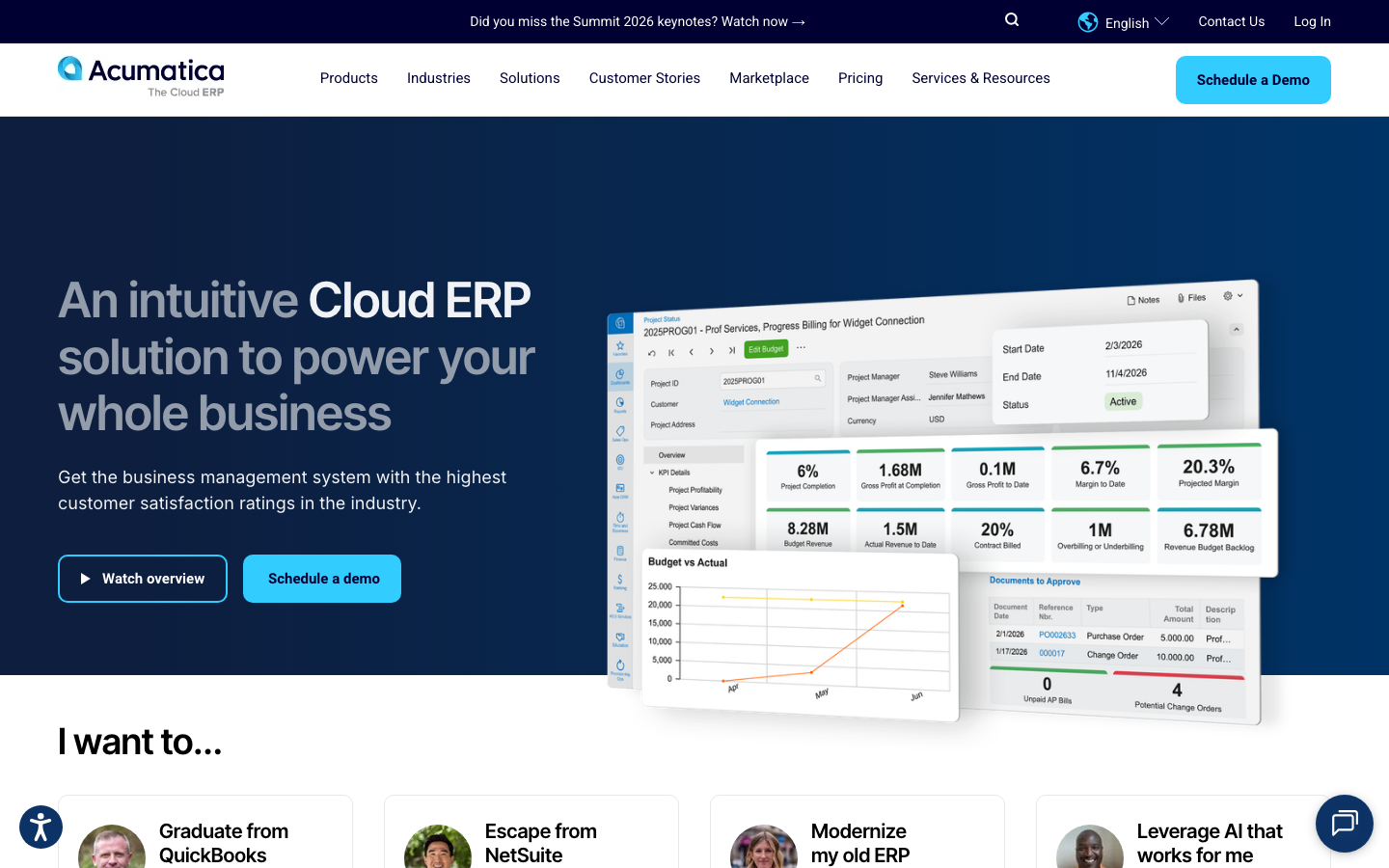
What's great
- Consumption-based pricing with unlimited users at every edition; a growing finance and ops team doesn't trigger per-seat cost the way QuickBooks or NetSuite do
- Strong distribution and field-service editions that fit mid-size companies with inventory or dispatched-technician workflows better than pure accounting tools
- G2 rating of [4.3-4.4/5 across 2,000+ reviews](https://www.g2.com/products/acumatica/reviews), among the highest satisfaction scores of any ERP-class tool in this list
Watch-outs
- No published per-tier list pricing; every quote requires an authorized reseller, which slows down the evaluation process compared to self-serve tools
- Mid-market deployments of 50-200 users typically run $25,000-$75,000/year once transaction-volume tiers scale up, well past the entry price
- Implementation still runs $50,000-$200,000 for a standard mid-size rollout, similar cost territory to NetSuite despite the lower entry sticker
Acumatica is worth shortlisting specifically because the unlimited-user, consumption-based model changes the math for a mid-size company adding headcount fast. G2 satisfaction sits notably high, driven by usability scores in G2’s 2026 mid-market distribution ERP index. The catch is opacity: Acumatica does not publish real pricing tiers, and getting an accurate number requires a partner conversation. Companies in distribution, field service, or construction get more differentiated value here than a pure SaaS or services business would.
Pricing breakdown
| Plan | Price | Best for |
|---|---|---|
| Essentials | $6,396/yr | Up to 10 named users |
| Select | Custom quote | 10-50 users |
| Prime | $25,000-$75,000/yr | 50-200 users |
| Enterprise | Custom quote | 200+ users |
Loading reviews…
Xero
Best for lean mid-size teams with international operations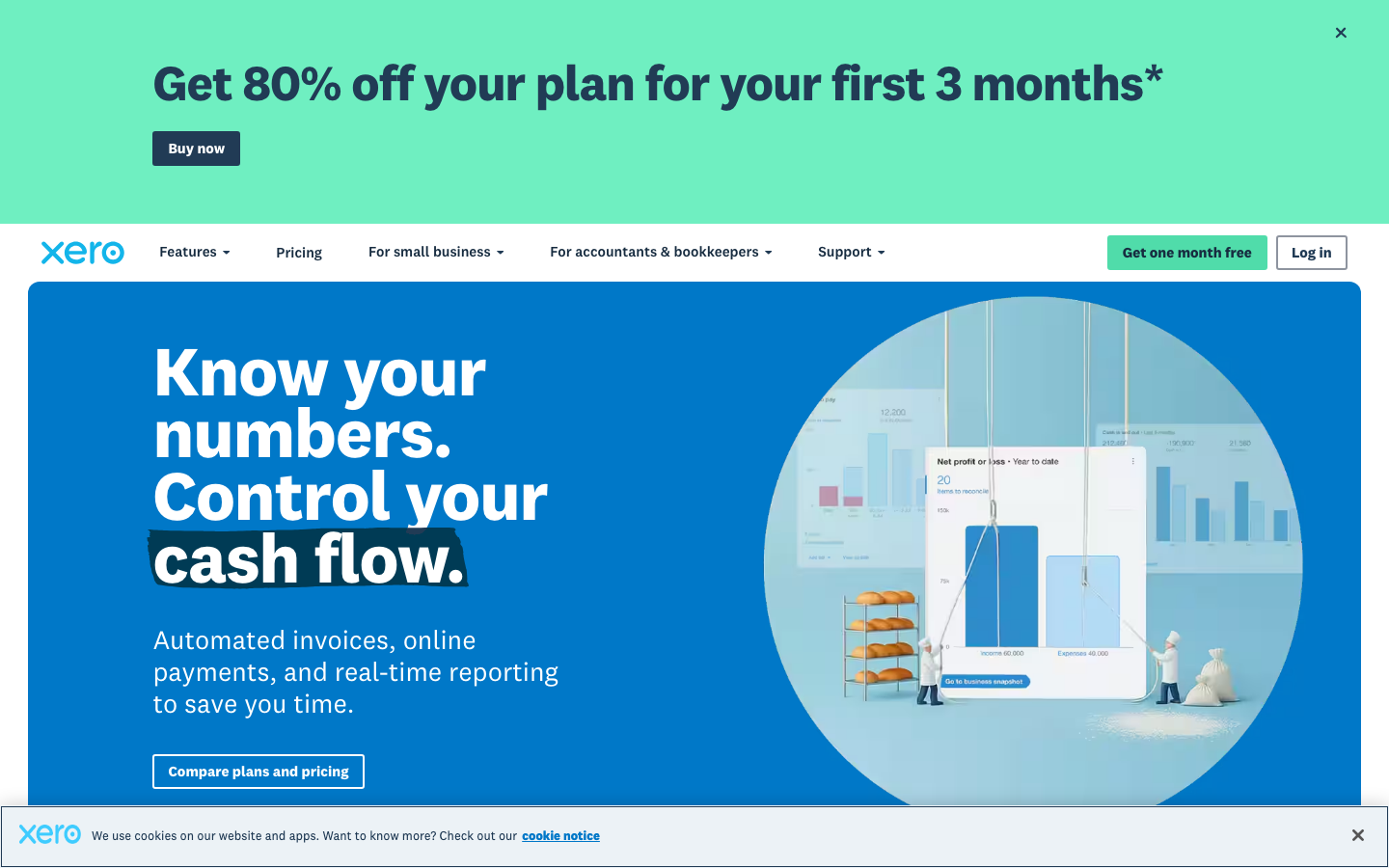
What's great
- Unlimited users on every paid tier; a 30-40 person mid-size finance and ops org avoids the per-seat cost creep that hits QuickBooks at similar headcount
- Native support for 160+ currencies with real-time FX revaluations, the strongest multi-currency implementation below Sage Intacct
- Established tier bundles multi-currency, expense claims, and project tracking without pushing into custom-module pricing
Watch-outs
- No native multi-entity consolidation; a mid-size company with two or more subsidiaries manages separate Xero organizations and reconciles between them manually
- Revenue recognition for contract or subscription revenue still requires an add-on; same structural gap as QuickBooks
- US accountant familiarity trails QuickBooks; a mid-size company hiring a controller may find fewer Xero-fluent candidates in the US market
Xero fits a mid-size company that stays lean on headcount, runs international customers or vendors, and does not yet need formal multi-entity consolidation. The unlimited-user pricing on the 1,598 G2 reviews base (4.4/5) is a real structural advantage once a finance and ops team crosses 15-20 people. The moment a second legal entity or GAAP-grade consolidation enters the picture, Xero hits the same wall QuickBooks does, and the next stop is Sage Intacct.
Pricing breakdown
| Plan | Price | Best for |
|---|---|---|
| Early | $25/mo | Sole traders |
| Growing | $55/mo | Small teams |
| Established | $90/mo | Multi-currency |
What reviewers say about Xero
Recurring themes across ~1,598 G2 reviews (4.4/5) and ~3,301 Capterra reviews (4.4/5), 2024-2026.
What reviewers praise
- Unlimited users at all pricing tiers is the most-cited differentiator; teams avoid per-seat costs that inflate as headcount grows.
- Bank reconciliation is consistently described as fast and accurate, with automated matching that reduces manual review to exception handling.
- Non-accountants can navigate invoicing, bill payment, and expense tracking without relying on a bookkeeper for day-to-day tasks.
- Real-time financial dashboards give founders a live view of cash position and outstanding receivables without pulling a formal report.
- The ecosystem of third-party integrations covers payroll, inventory, and e-commerce apps, handled through the Xero app marketplace.
What reviewers fault
- Email-only customer support with no phone option is the most-cited frustration; resolution times stretch days for billing and technical issues.
- Entry-tier plan caps monthly invoices and bills, forcing small users onto a higher plan before they actually need advanced features.
- Multi-currency functionality draws repeated criticism for being limited and adding cost, a real problem for teams with international clients.
- Recurring price increases arrive with minimal notice; some reviewers report being charged hidden surcharges on top of monthly subscription fees.
- The 2025 invoicing redesign added steps rather than removing them, with reviewers saying the updated workflow requires more clicks than before.
Loading reviews…
Odoo Accounting
Best budget full-suite ERP for cost-conscious mid-size companies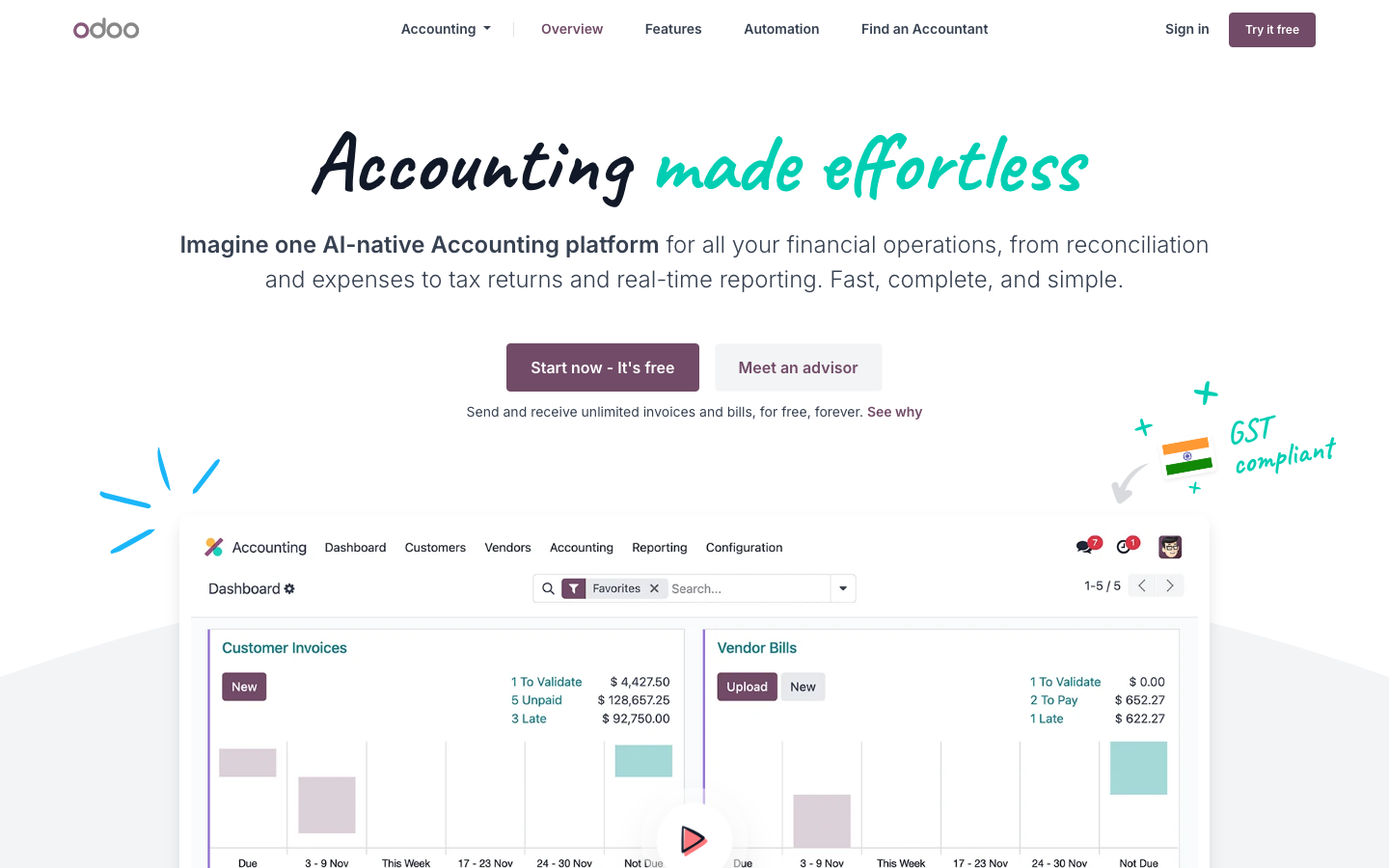
What's great
- Cheapest full-suite option in this comparison at $24.90/user/mo Standard; adding inventory, CRM, or HR modules stays inside the same per-user price
- Automation for invoices and tax calculation reduces manual work during high-volume close periods, a repeated theme in G2 reviews
- Open architecture means a mid-size company with an internal dev resource can customize workflows without waiting on a vendor roadmap
Watch-outs
- G2 review base is thin at 73 reviews for the Accounting app specifically, less signal than Sage Intacct or NetSuite on long-term reliability at scale
- Users who treat it as plug-and-play report frustration; the tools that work well are the ones where setup got real investment upfront
- Regional pricing varies significantly, from under $9/user/mo in some markets to over $75/user/mo in the US when billed yearly, which complicates budgeting
Odoo Accounting earns a spot for mid-size companies that want ERP-style breadth (inventory, CRM, HR, accounting) without the Sage Intacct or NetSuite price tag, and that have the internal technical capacity to configure it properly. The G2 rating sits around 4.3/5, but the review base is small enough that reference calls matter more than usual here. Companies that go in expecting a plug-and-play QuickBooks replacement get burned; companies that budget real implementation time do well.
Pricing breakdown
| Plan | Price | Best for |
|---|---|---|
| One App Free | $0 | Single-module use |
| Standard | $24.90/user/mo | Full accounting plus core modules |
| Custom | $37.40/user/mo | Multi-company |
| Enterprise | Custom quote | On-premise or dedicated hosting |
Loading reviews…
Zoho Books
Best for mid-size companies already on Zoho One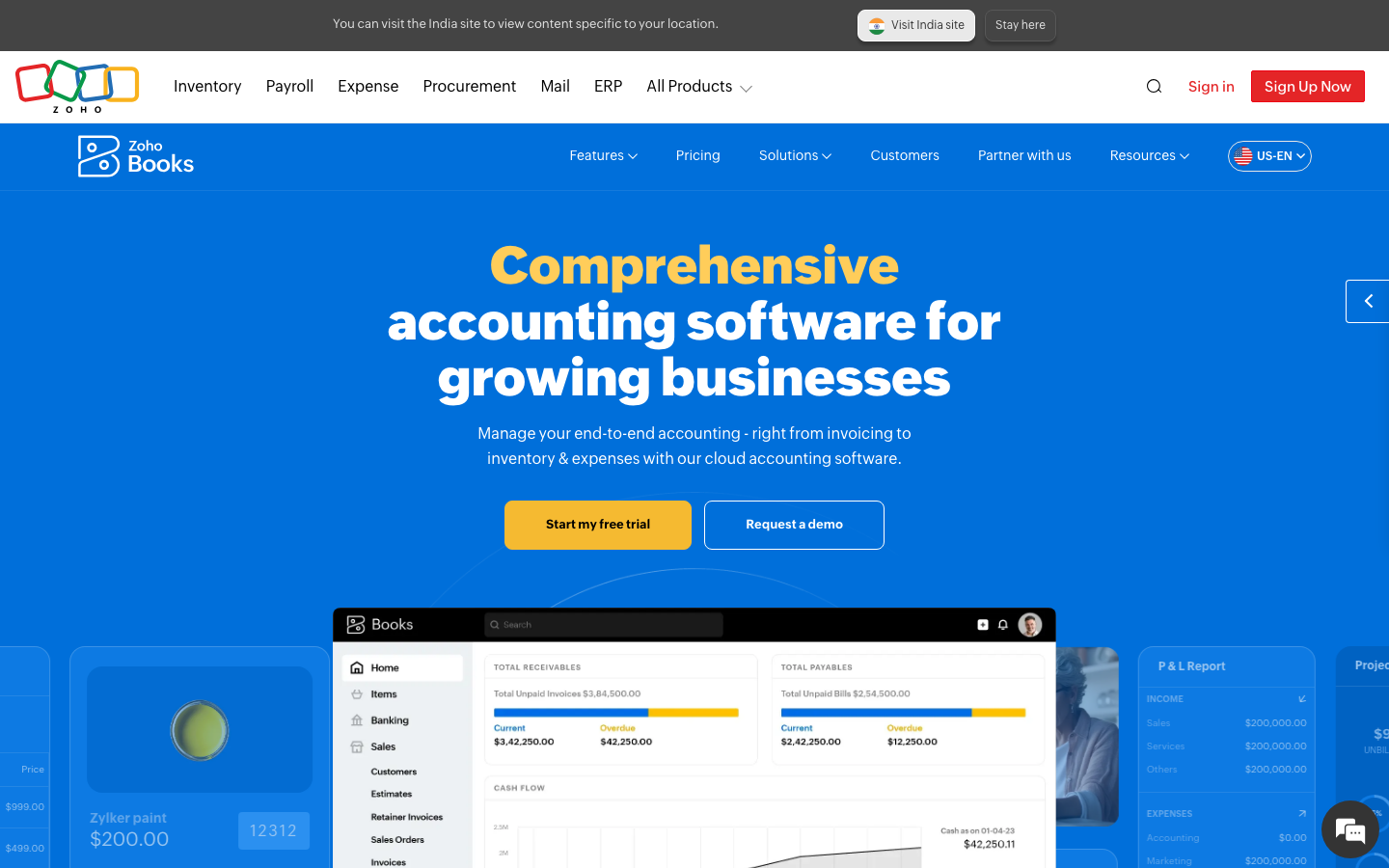
What's great
- Native integration with Zoho CRM, Zoho Inventory, Zoho Desk, and Zoho Projects; for a mid-size company running Zoho One the data model is shared and sync is instant
- Premium tier at $70/mo covers 10 users with budgeting and custom-domain support, competitively priced against QuickBooks Advanced at similar headcount
- Multi-currency support included from the Professional tier at $50/mo, a lower entry point than Xero or QuickBooks for international capability
Watch-outs
- No native multi-entity consolidation or ASC 606 recognition; the same structural ceiling as QuickBooks and Xero, without a clean revenue-recognition add-on inside the Zoho ecosystem
- Review count on G2 is lower than the segment leaders at 327 reviews, less signal on how it holds up at higher mid-size transaction volume
- Third-party integrations outside the Zoho ecosystem are thinner; a mid-size company on Salesforce or NetSuite CRM will need custom API work
Zoho Books is worth shortlisting exactly when a mid-size company is already standardized on Zoho One or Zoho CRM. 327 G2 reviews average 4.4/5, with the consistent praise being ecosystem integration and price. Outside the Zoho ecosystem, the case weakens quickly against QuickBooks Advanced or Xero Established, both of which have deeper US accountant familiarity and larger third-party integration libraries.
Pricing breakdown
| Plan | Price | Best for |
|---|---|---|
| Standard | $20/mo | Small teams |
| Professional | $50/mo | Growing company |
| Premium | $70/mo | 10 users |
| Elite | $150/mo | Advanced inventory and multi-currency at scale |
What reviewers say about Zoho Books
Recurring themes across ~2,900 G2 reviews (4.1/5) and Capterra reviews (4.3/5), 2024-2026.
What reviewers praise
- Price-to-feature ratio is the most repeated compliment: reviewers say Zoho delivers lead scoring, workflow automation, and multi-currency support at a fraction of the cost of HubSpot or Salesforce.
- Depth of the Zoho ecosystem is consistently praised by teams already using Zoho Books, Zoho Desk, or Zoho Campaigns, who describe the cross-app data flow as a genuine alternative to buying multiple point solutions.
- The Canvas drag-and-drop UI builder, added in recent years, appears in newer positive reviews as a meaningful upgrade, letting non-technical admins redesign the record layout without code.
- Workflow automation breadth gets strong marks, with reviewers pointing to multi-condition rules, scheduled actions, and blueprint approval processes as features competitors lock behind enterprise tiers.
- Lead management tools including assignment rules, scoring, and conversion tracking are frequently cited as thorough and configurable for teams with defined sales processes.
What reviewers fault
- Customer support is the single most common complaint across G2 and Capterra, with reviewers on standard plans describing slow ticket responses, inconsistent answers, and difficulty escalating urgent issues.
- The learning curve is steep enough that multiple reviewers recommend hiring a Zoho consultant for initial setup, especially for automation, Deluge scripting, and module customization.
- The mobile app has reliability problems that appear consistently in recent reviews, including bugs that prevent notes from displaying, missed call logs, and crashes under poor connectivity.
- Integration with non-Zoho tools is frequently described as more friction than the docs suggest, with third-party connectors requiring Zapier workarounds or custom API work for stable two-way sync.
- The interface, despite recent improvements, is still called cluttered and overwhelming by first-time CRM buyers, and the density of settings can make routine tasks harder to find than in leaner tools.
Loading reviews…
Tools we considered but excluded
We evaluated more tools than the 9 you see above. These did not make the cut. Saying what we rejected, and why, is the editorial muscle most listicles skip.
- Wave: Free-tier accounting built for pre-revenue and solo operators; no multi-entity, no revenue recognition, and support that can't scale to mid-size volume
- FreshBooks: Invoicing and time-tracking tool for services businesses; lacks the multi-entity and dimensional reporting a mid-size finance team needs
- Puzzle: AI-native accounting built for VC-backed seed and Series A startups on Brex/Ramp; too early-stage in feature scope for a mid-size finance org
- Ramp / Brex: Corporate card and expense platforms, not general ledgers; they pair with the tools on this list rather than replace them
- SAP Business One: Strong mid-market ERP but implementation timelines and partner-dependency rival NetSuite without a clearer US mid-market accountant network
- Pilot: Managed bookkeeping service built on top of QuickBooks, not a standalone accounting platform
Honorable mentions
Solid tools that did not crack the main list but are worth tracking, especially for niche use cases.
- DualEntry: Modern mid-market accounting built for SaaS, native ASC 606, and a strong early G2 rating; too new to make the main list but worth tracking at 50+ employees
- Maxio: Purpose-built subscription billing and revenue recognition that plugs into QuickBooks or Intacct; add it once ASC 606 becomes a hard requirement
- Sage 300cloud: Sage's older mid-market ERP line, still in active use at manufacturing and distribution companies that haven't migrated to Intacct
Where each mid-size accounting tool fits
Mid-size buyers land in an awkward middle. QuickBooks and Xero were built for smaller teams; NetSuite and Business Central were built assuming a real implementation budget. Knowing which tier a company actually sits in saves months of evaluation.
Still single-entity, outgrowing per-seat pricing. QuickBooks Online Advanced or Xero Established cover a 30-100 person company reasonably well, especially if headcount is growing faster than revenue and Xero’s unlimited-user model starts to matter.
Multi-entity or GAAP-grade close required. Sage Intacct is the default answer here. The dimensional reporting and native ASC 606 handle the exact pain points a growing finance team hits first: consolidation, audit prep, and board-ready close timelines.
Physical goods, inventory, or acquisition activity. NetSuite and Acumatica both extend past pure accounting into ERP territory. NetSuite has the deeper ecosystem and higher cost; Acumatica trades some polish for unlimited-user pricing that scales better with headcount growth.
Microsoft-native IT environments. Business Central is worth a serious look specifically because of the Power BI and Office 365 integration story. Outside that context, it competes on roughly even footing with Sage Intacct on price but with a smaller accounting-specific review base.
Budget-constrained but need multi-module coverage. Odoo Accounting is the honest answer, provided the company has technical capacity to configure it. It is not a drop-in QuickBooks replacement; it rewards teams that invest in setup.
Selection criteria, what to test in your mid-size accounting trial
One, run a real multi-entity consolidation. Set up two mock entities with intercompany transactions and close them together. This is the single biggest differentiator between the SMB tools (QuickBooks, Xero, Zoho Books) and the mid-market tools (Sage Intacct, NetSuite, Business Central, Acumatica) on this list.
Two, import your actual chart of accounts. A mid-size company usually has 150-400 GL accounts across departments and cost centers. Import the real chart, not a demo one, and check how cleanly dimensional or class-based reporting maps to it.
Three, test the month-end close with real transaction volume. Mid-size companies process hundreds to thousands of transactions a month. Run a close using your actual prior-month volume and time it. Anything over 8-10 business days in a trial environment signals a workflow problem, not a data problem.
Four, price out the actual user count you need. Per-user pricing on QuickBooks, Business Central, and NetSuite adds up fast at 20-40 users. Model the real number, not the sales rep’s example, before comparing to Acumatica or Xero’s unlimited-user tiers.
Five, ask about implementation timeline against your fiscal calendar. Sage Intacct runs 4-8 weeks with a partner. NetSuite and Business Central run 3-6 months. Acumatica lands somewhere between, depending on module count. Time the go-live to a fiscal year boundary, not a mid-quarter date.
Six, check accountant and controller familiarity in your hiring market. A mid-size company hires controllers and staff accountants regularly. Ask candidates in your pipeline which tools they’ve worked in; QuickBooks and Sage Intacct have the deepest US talent pool, Business Central and Acumatica are thinner outside specific verticals.
How to choose the right accounting software for a mid-size company
1. Number of legal entities today and in 18 months
One entity, no near-term acquisitions: QuickBooks Advanced or Xero Established cover you. Two or more entities, or an acquisition on the roadmap: Sage Intacct or NetSuite, no exceptions.
2. Physical inventory or manufacturing in the mix
Pure services or SaaS revenue: Sage Intacct is the cleanest fit. Physical inventory, distribution, or light manufacturing: NetSuite or Acumatica, both of which handle inventory natively.
3. Existing IT and productivity stack
Heavy Microsoft 365 shop: Business Central gets a real edge from Power BI and Excel integration that competitors can’t match. Everything else: the IT stack matters less than the accounting fit itself.
4. Budget tolerance for implementation, not just licensing
Under $50K total year-one budget: QuickBooks Advanced, Xero, or Zoho Books. $50K-$150K: Sage Intacct or Odoo with a real implementation partner. $150K+: NetSuite, Acumatica, or Business Central at the higher end of their ranges.
5. Revenue recognition complexity
Simple cash or accrual accounting with no deferred revenue: any tool on this list works. Contract-based or subscription revenue with real ASC 606 exposure: Sage Intacct or NetSuite, both of which handle it natively in the GL.
What’s changing in mid-size accounting software in 2026
Consumption-based pricing is spreading past Acumatica. Vendors are experimenting with usage-tiered models instead of flat per-seat pricing as mid-size companies push back on cost scaling faster than headcount. Expect more vendors to publish transaction-volume tiers over the next 12-18 months.
AI categorization accuracy is closing the gap with mid-market tools. QuickBooks’ Intuit Assist and Xero’s JAX are both delivering high categorization accuracy on recurring vendor names, narrowing one of the practical advantages mid-market tools used to hold at higher transaction volume.
Sage Intacct is adding SaaS-specific reporting modules. A native MRR/ARR dashboard and churn analytics add-on are on Sage’s 2026 roadmap, which reduces the need for a separate BI tool at companies with any subscription revenue component.
NetSuite’s contract flexibility is loosening. 1-year contract options now exist for companies under 50 employees, a real shift from the historical 3-year lock-in, which lowers the commitment risk for a mid-size company still deciding between NetSuite and Sage Intacct.
Implementation partners are getting more transparent on scope. Buyers burned by underbudgeted Sage Intacct and NetSuite rollouts in prior years are pushing partners toward fixed-scope statements of work instead of time-and-materials contracts, which makes year-one cost estimates more reliable than they were two years ago.
Final pick by mid-size company profile
- Single-entity, 50-150 employees, no revenue recognition complexity: QuickBooks Online Advanced. Stay here until a real trigger forces a move.
- Single-entity, lean headcount, international customers: Xero Established. Unlimited users and multi-currency without the ERP overhead.
- Multi-entity, GAAP close required, no inventory: Sage Intacct. Built specifically for this profile.
- Multi-entity plus acquisitions or physical inventory: NetSuite. The ERP breadth earns its cost here.
- Distribution, field service, or construction, cost-sensitive: Acumatica. Unlimited users beats per-seat pricing at this headcount.
- Heavy Microsoft 365 environment: Dynamics 365 Business Central. The Power BI and Office tie-ins are the differentiator.
- Budget-constrained, technical team available to configure: Odoo Accounting. Real savings if implementation gets proper investment.
- Already standardized on Zoho One: Zoho Books. The ecosystem sync outweighs switching to a non-Zoho tool.
For corrections or vendor disputes, email hello@topickz.com . We re-test the full shortlist every six months; the next refresh ships in January 2027.
Frequently asked questions
What counts as mid-size for accounting software purposes?
Roughly 100-999 employees or $10M-$500M revenue, past single-entity QuickBooks but before full ERP is required.
When should a mid-size company move off QuickBooks Online Advanced?
Three signals: a second legal entity, revenue recognition needs, or a board asking for a sub-5-day close.
Does Sage Intacct or NetSuite make more sense for a 150-employee company?
Intacct if it's a single industry with clean accounting needs. NetSuite if inventory, CRM, or acquisitions are involved.
How much does Sage Intacct actually cost for a mid-size deployment?
Realistic mid-size deployments run $1,500-$4,000/mo once multi-entity and revenue recognition modules are added.
Is Acumatica cheaper than NetSuite for a mid-size company?
Often yes on license cost with unlimited users, but implementation still runs $50K-$200K, close to NetSuite's range.
What's the real cost of Microsoft Dynamics 365 Business Central per user?
Essentials is $80/user/mo and Premium is $110/user/mo, plus $25K-$150K implementation for most mid-size rollouts.
Can Xero handle a mid-size company with two subsidiaries?
Not natively. Xero has no built-in multi-entity consolidation; you'd run separate organizations and reconcile manually.
Is Odoo Accounting reliable enough for a mid-size finance team?
Yes with proper setup investment. G2 reviews show satisfaction hinges heavily on implementation quality, not the software itself.
What's the biggest hidden cost mid-size buyers miss when evaluating ERP-class accounting tools?
Implementation. For Intacct, NetSuite, Business Central, and Acumatica, services cost often exceeds year-one licensing.
Does Zoho Books work for a mid-size company outside the Zoho ecosystem?
It's usable but weaker there. QuickBooks Advanced or Xero Established fit non-Zoho mid-size teams better.
Related helpful reads
Write a review
Posts to the page right away. Keep it real — no links or email addresses.