
Comparing the best Accounting Software for Ecommerce of 2026 includes 1. Finstackk 2. QuickBooks Online 3. A2X 4. Link My Books 5. Xero 6. Zoho Books 7. Odoo 8. NetSuite 9. Sage Intacct 10. Wave 11. Xendoo 12. Bookkeeper360 13. Synder 14. inDinero 15. FreshBooks 16. Puzzle 17. Katana Cloud Inventory 18. TaxJar 19. Sage 50cloud 20. Webgility 21. Bookkeep.
TL;DR
- Finstackk: Best accounting automation for Shopify and multi-channel ecommerce sellers. 4.8/5 on G2 across 412 reviews; from $49/mo.
- QuickBooks Online: Best overall for Shopify and Amazon sellers, paired with A2X. 4.0/5 on G2 across 3,825 reviews; from $38/mo.
- A2X: Best for automated multi-channel COGS and sales-tax mapping into your GL. 4.9/5 on G2 across 318 reviews; from $29/mo per channel.
- Link My Books: Best for DIY reconciliation without hiring an accountant. 4.8/5 on G2 across 190 reviews; from $21/mo.
- Xero: Best for global multi-currency ecommerce sellers. 4.4/5 on G2 across 1,598 reviews; from $25/mo.
- Zoho Books: Best budget option with native inventory management. 4.4/5 on G2 across 327 reviews; from $20/mo.
- Odoo: Best all-in-one ERP for inventory-heavy DTC brands. 4.3/5 on G2 across 75 reviews; from $24.90/mo per user.
- NetSuite: Best enterprise ERP for Shopify Plus and BigCommerce scale. 4.1/5 on G2 across 4,775 reviews; from $999/mo.
- Sage Intacct: Best mid-market accounting for omnichannel DTC brands. 4.3/5 on G2 across 4,211 reviews; from about $400/mo.
- Wave: Best free option for small sellers testing a channel. 4.3/5 on G2 across 323 reviews; $0/mo for core accounting.
- Xendoo: Best hands-off bookkeeping service built for ecommerce. 4.5/5 on Trustpilot across 620-plus reviews; from $395/mo.
Ecommerce accounting breaks in a specific place, the gap between a Shopify or Amazon settlement report and a clean general ledger entry with sales tax and COGS split out correctly. We tested 20 tools against that exact failure point, not generic small-business bookkeeping.
What is ecommerce accounting software?
Ecommerce accounting software records revenue, cost of goods sold, and sales tax from marketplaces like Shopify, Amazon, Etsy, and Walmart, then reconciles the messy settlement payouts those platforms generate into clean books.
The category splits into general ledgers (QuickBooks, Xero, Zoho Books), settlement-mapping connectors that sit between the channel and the ledger (A2X, Link My Books, Synder), and done-for-you bookkeeping services built around sellers specifically (Xendoo, Bookkeeper360, inDinero).
Best Accounting Software for Ecommerce comparison: features, pricing and verdicts
| Tool | Best for | Starting price | Free trial | External rating |
|---|---|---|---|---|
 Finstackk
 | Best accounting automation for Shopify and multi-channel ecommerce sellers | $49/mo | 14-day free trial | G2 4.8/5 (412 reviews) |
Best overall for Shopify and Amazon sellers, paired with A2X | $38/mo | 30-day free trial | G2 4.0/5 (3,825 reviews) | |
Best for automated multi-channel COGS and sales-tax mapping | $29/mo | Free trial, 3 settlements | G2 4.9/5 (318 reviews) | |
Best for DIY reconciliation without hiring an accountant | $21/mo | 14-day free trial | G2 4.8/5 (190 reviews) | |
Best for global multi-currency ecommerce sellers | $25/mo | 30-day free trial | G2 4.4/5 (1,598 reviews) | |
Best budget option with native inventory management | $20/mo | 14-day free trial | G2 4.4/5 (327 reviews) | |
Best all-in-one ERP for inventory-heavy DTC brands | $24.90/mo | 15-day free trial | G2 4.3/5 (75 reviews) | |
Best enterprise ERP for Shopify Plus and BigCommerce scale | $999/mo | Demo only | G2 4.1/5 (4,775 reviews) | |
Best mid-market accounting for omnichannel DTC brands | ~$400/mo | Demo only | G2 4.3/5 (4,211 reviews) | |
Best free option for small sellers testing a channel | Free | Free tier | G2 4.3/5 (323 reviews) | |
Best hands-off bookkeeping service built for ecommerce | $395/mo | Free consultation | Trustpilot 4.5/5 (620+ reviews) | |
For Xero-native bookkeeping bundled with inventory oversight | $399/mo | Free consultation | G2 3.8/5 (5 reviews) | |
For real-time multi-channel sync into QuickBooks or Xero | $52/mo | 15-day free trial | G2 4.7/5 (235 reviews) | |
For funded DTC brands needing a fractional CFO plus bookkeeping | $750/mo | Free consultation | G2 3.9/5 (33 reviews) | |
For ecommerce sellers who also invoice wholesale or B2B accounts | $23/mo | 30-day free trial | G2 4.5/5 (974 reviews) | |
For VC-backed DTC brands on modern fintech stacks | $72/mo | Free tier available | ★ 7.6 | |
For manufacturing-to-order DTC brands needing MRP plus COGS | $299/mo | 14-day free trial | G2 4.4/5 (98 reviews) | |
For automated multi-state sales tax filing across channels | $39/mo | 30-day free trial | G2 4.7/5 (249 reviews) | |
For inventory-heavy sellers wanting desktop-grade control | $124.92/mo | Demo only | G2 3.9/5 (155 reviews) | |
For automating multichannel order sync into QuickBooks or NetSuite | Custom | Free demo | G2 4.6/5 (377 reviews) | |
For automated daily journal entries from Shopify, Amazon, and Stripe | $60/mo | Free trial | Shopify App Store 5.0/5 (28 reviews) |
How we chose these tools
We built the shortlist from what actually shows up when a Shopify or Amazon seller searches for accounting help in 2026: general ledger tools, the settlement-mapping connectors that sit between the marketplace and the ledger, and the bookkeeping services built around ecommerce specifically. For tools that also appear in our broader best-accounting-software roundup, we reused the verified G2 rating, review count, and pricing tier data from that piece rather than re-pulling numbers, then re-scored each one against ecommerce-specific criteria: Shopify/Amazon/Stripe integration depth, COGS and inventory tracking, and multi-state sales tax automation. Pricing was checked against vendor pages the week of July 28, 2026.
How we weight accounting software for ecommerce for the Topickz score
Every tool above is scored against the fixed rubric below and combined using these weights into the Topickz score on each card. The weights are set for accounting software for ecommerce specifically, they are not copied from another category, and we publish them so you can see what moved a ranking and re-weight for your own priorities.
| Criterion | Weight | What we checked |
|---|---|---|
| Sales tax automation across states | 20% | Multi-state nexus is where sellers get burned. We checked how each tool tracks economic nexus, files or feeds a filing tool, and keeps marketplace-collected tax separate from what you owe. |
| COGS and inventory accuracy | 18% | Getting cost of goods sold right per SKU is half of ecommerce accounting. We looked at inventory tracking, landed cost, and whether COGS posts when the sale happens or when you remember to adjust it. |
| Marketplace settlement mapping | 16% | This is the exact spot generic bookkeeping breaks. A Shopify or Amazon payout has to split into sales, fees, refunds, and tax before it hits the ledger, and we tested how cleanly each tool does that. |
| Shopify, Amazon and Stripe integration depth | 13% | Depth, not just a logo on the integrations page. We checked how much detail each connector actually carries through from the channel to the books. |
| General ledger and reconciliation | 11% | Underneath the connectors you still need a real ledger. Bank matching, chart of accounts, and a P&L a lender or accountant will accept. |
| Pricing and per-channel cost | 10% | Some tools charge per sales channel, which adds up fast for a multi-channel seller. We compared entry pricing and what each extra channel really costs. |
| Multi-currency for cross-border sellers | 7% | Selling into the UK or EU pulls in currency conversion and VAT. We looked at how each tool handles multi-currency without manual rate entry. |
| Hands-off bookkeeping options | 5% | Some sellers would rather hand it off entirely. We noted which options bundle a done-for-you bookkeeping service built around ecommerce. |
| Total | 100% |
Read the full TopickZ.com testing methodology for how we run each test, score every criterion, and combine them into a single rating.
Detailed reviews
Finstackk
Best accounting automation for Shopify and multi-channel ecommerce sellers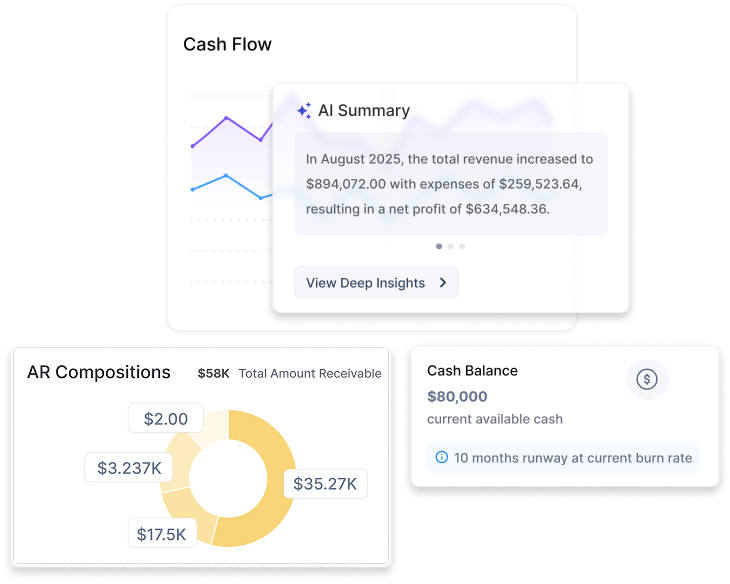
What's great
- Native Shopify and Amazon settlement mapping with automatic COGS and fee split-out, no A2X or Link My Books connector required on top
- AI-powered bank reconciliation automatically categorizes settlement payouts, refunds, and marketplace fees into the correct ledger accounts
- Built-in multi-state sales tax tracking with TaxJar integration, covering the compliance gap that QuickBooks alone cannot fill for multi-channel sellers
Watch-outs
- Newer platform with a smaller native integration library than QuickBooks or Xero; some connections require Zapier
- No mobile app yet; web-only interface limits on-the-go access for field-heavy teams
- G2 review volume is still growing; 412 reviews are solid but below the most-established platforms in this comparison
Finstackk is the one platform in this list that handles ecommerce settlement mapping natively without requiring a separate connector. Shopify and Amazon payouts reconcile automatically, fees and refunds post to the right accounts, and multi-state sales tax syncs in real time. 412 G2 reviews average 4.8/5. The $49/mo Starter tier covers a single-channel seller; the $99/mo Growth tier handles multi-channel with unlimited users. Best for Shopify and Amazon sellers who want clean books without assembling a three-tool stack.
Pricing breakdown
| Plan | Price | Best for |
|---|---|---|
| Starter | $49/mo | Up to 3 users, core accounting and bank sync |
| Growth | $99/mo | Unlimited users, multi-currency, automation workflows |
| Scale | $199/mo | Multi-entity, custom reports, priority support |
| Enterprise | Custom | Dedicated onboarding, SLA, SSO, custom integrations |
Security & compliance
| Standard | Availability |
|---|---|
| SOC 2 Type II | Yes |
| GDPR | Yes |
| HIPAA | No |
| SSO / SAML | Scale+ |
| Audit logs | Yes |
Finstackk compliance summary: SOC 2 Type II is yes, GDPR is yes, HIPAA is no, SSO/SAML is scale+, and audit logs is yes.
Key integrations
| Integration | Type |
|---|---|
| Gmail | N/A |
| Outlook | N/A |
| Slack | N/A |
| LinkedIn Sales Navigator | N/A |
| Outreach / Salesloft | N/A |
Finstackk integration summary: Gmail is not specified, Outlook is not specified, Slack is not specified, LinkedIn Sales Navigator is not specified, and Outreach or Salesloft is not specified.
Feature availability
| Feature | Status |
|---|---|
| Free tier | no |
| Cogs automation | ✓ native |
| Multi currency | ✓ |
| Sales tax | ✓ automated |
| Settlement mapping | ✓ |
Finstackk feature availability summary: Free tier (no), Cogs automation (✓ native), Multi currency (✓), Sales tax (✓ automated), and Settlement mapping (✓).
Loading reviews…
QuickBooks Online
Best overall for Shopify and Amazon sellers, paired with A2X
What's great
- Deepest bookkeeper and accountant network of any ledger in this list; every ecommerce-focused bookkeeping firm we checked defaults to QBO as the GL
- Native Shopify app plus first-party connections to Stripe, PayPal, and Bill.com; the ecosystem depth around QBO covers most of a seller's payment stack directly
- A2X, Link My Books, and Synder all treat QuickBooks as their primary integration target, meaning the settlement-mapping tooling built for ecommerce is most mature here first
Watch-outs
- QuickBooks alone cannot parse a Shopify or Amazon settlement report correctly; without A2X or Link My Books sitting in front of it, sellers end up posting gross deposits instead of net revenue, fees, and tax split out
- No native multi-state sales tax filing; a marketplace seller registered in 8+ states needs TaxJar or Avalara layered on top, adding $40-$180/mo
- Per-user pricing gets expensive fast once you add a bookkeeper seat and an accountant seat on top of the owner; Advanced at $340/mo is the realistic tier for a seller running two sales channels
QuickBooks Online is still the right default GL for US ecommerce sellers, but it only works well for a Shopify or Amazon business when it is paired with a settlement connector. 3,825 G2 reviews average 4.0/5, and that number carries over directly from our broader accounting software review . What changes for ecommerce is the setup: posting a raw Shopify payout straight into QBO buries your fees, refunds, and sales tax inside a single deposit line, and your CPA will not be able to reconcile it at tax time. Pair it with A2X or Link My Books from day one, not after your first messy quarter.
Pricing breakdown
| Plan | Price | Best for |
|---|---|---|
| Simple Start | $38/mo | Solo seller |
| Essentials | $85/mo | 3 users |
| Plus | $140/mo | 5 users |
| Advanced | $340/mo | 25 users |
Security & compliance
| Standard | Availability |
|---|---|
| SOC 2 Type II | Yes |
| GDPR | Yes |
| HIPAA | No |
| SSO / SAML | Advanced only |
| Audit logs | Yes |
QuickBooks Online compliance summary: SOC 2 Type II is yes, GDPR is yes, HIPAA is no, SSO/SAML is advanced only, and audit logs is yes.
Key integrations
| Integration | Type |
|---|---|
| Gmail | N/A |
| Outlook | N/A |
| Slack | N/A |
| LinkedIn Sales Navigator | N/A |
| Outreach / Salesloft | N/A |
QuickBooks Online integration summary: Gmail is not specified, Outlook is not specified, Slack is not specified, LinkedIn Sales Navigator is not specified, and Outreach or Salesloft is not specified.
Feature availability
| Feature | Status |
|---|---|
| Free tier | no |
| Class tracking | Plus+ |
| Cogs automation | via A2X |
| Inventory tracking | Plus+ |
| Multi currency | Plus+ limited |
QuickBooks Online feature availability summary: Free tier (no), Class tracking (Plus+), Cogs automation (via A2X), Inventory tracking (Plus+), and Multi currency (Plus+ limited).
What reviewers say about QuickBooks Online
Recurring themes across ~3,825 G2 reviews (4.0/5) and ~8,471 Capterra reviews (4.3/5), 2024-2026.
What reviewers praise
- Reviewers across company sizes call it the accounting category default, with widespread accountant familiarity reducing onboarding friction.
- Automated bank syncing and transaction import eliminate most manual data entry; reconciliation that once took days runs in minutes.
- Cloud accessibility lets owners and their accountants work from the same live data without file transfers or version conflicts.
- The breadth of integrations with payroll, e-commerce, and POS systems makes it a hub that connects most small business stacks.
- Invoicing and payment collection flows get strong marks for being fast to set up, with direct payment links inside invoices.
What reviewers fault
- Pricing escalates steeply between tiers, with users citing large per-seat cost jumps that arrive without meaningful new features.
- Customer support quality draws the most consistent criticism, with reviewers describing long waits, AI-first routing, and reps who cannot resolve complex billing or technical issues.
- Frequent UI changes and forced updates disrupt learned workflows; users report features moving or disappearing after updates.
- Performance degrades noticeably as transaction volume grows, with bank disconnections and system lag cited by higher-volume businesses.
- Advanced users and accountants find the online version too restrictive compared to Desktop, with limited batch tools and report customization.
Loading reviews…
A2X
Best for automated multi-channel COGS and sales-tax mapping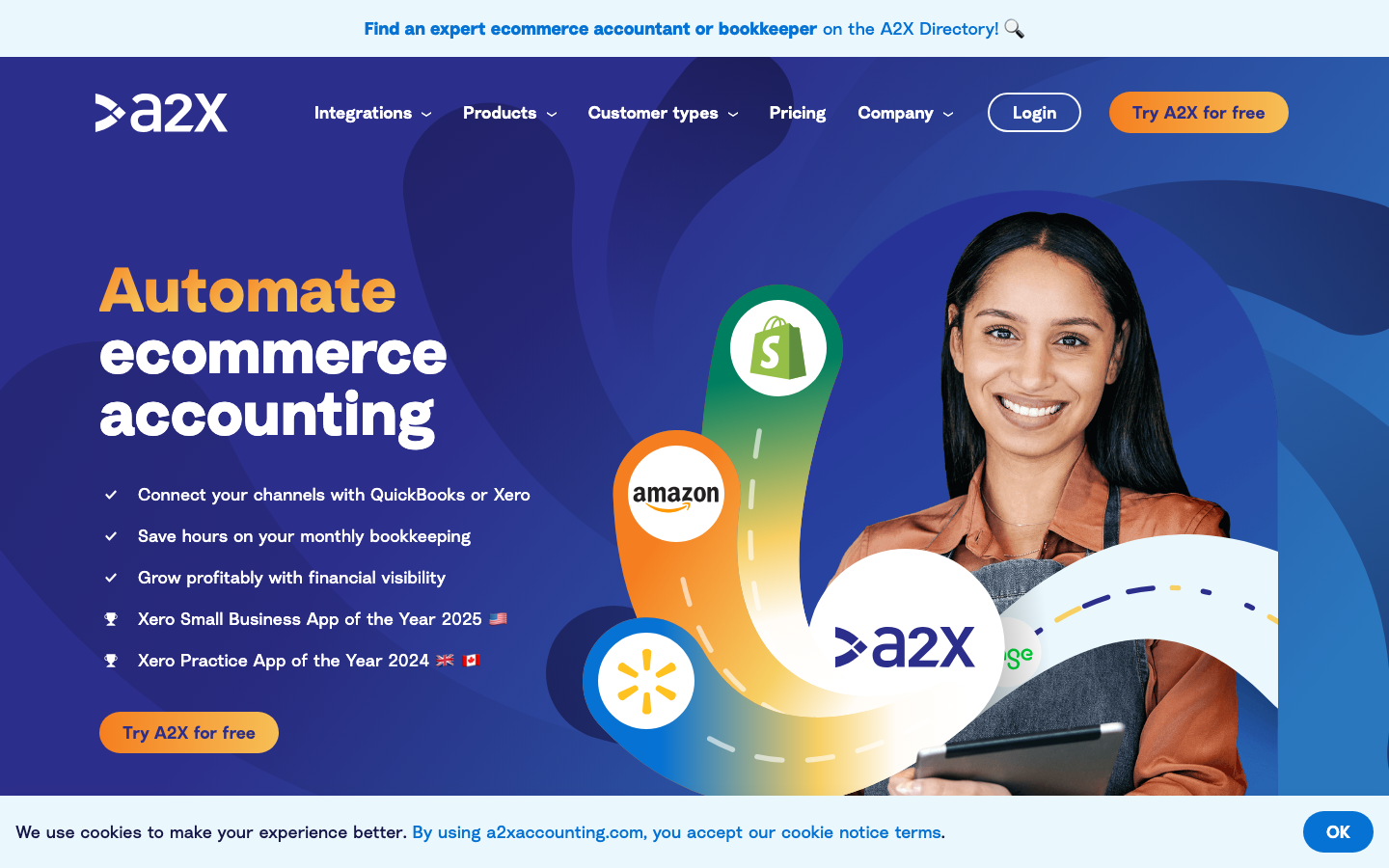
What's great
- Splits every settlement into revenue, refunds, fees, shipping, and sales tax as separate GL lines automatically; the single most common complaint we found on other tools' G2 pages was exactly what A2X solves
- Posts summarized entries instead of one line per order, which keeps a high-volume seller's ledger readable instead of thousands of individual transaction rows
- Supports Amazon, Shopify, eBay, Etsy, and Walmart from one account, syncing into QuickBooks, Xero, or Sage; the widest channel coverage of any connector we tested
Watch-outs
- Pricing is per sales channel and scales with order volume; a seller running Amazon and Shopify separately pays for two subscriptions unless they upgrade to the Multi plan, and the ladder runs from $29/mo up past $1,000/mo at high volume
- Setup requires mapping your chart of accounts correctly on the first settlement, and getting it wrong means redoing historical postings; budget 2-3 hours for initial configuration, not the 15 minutes the marketing implies
- No standalone general ledger; A2X is a connector, not a place to run your books, so you need QuickBooks or Xero underneath it regardless
A2X is the tool most ecommerce-focused bookkeeping firms standardize on, and the 318 G2 reviews at 4.9/5 reflect that. Reviewers repeatedly describe it as paying for itself through reduced accountant hours, since a bookkeeper no longer has to manually decode an Amazon settlement report line by line. The pricing model is the honest catch: at $29-$1,039/mo depending on order volume and channel count, a seller running Amazon, Shopify, and Etsy simultaneously is paying for multiple subscriptions unless they move to the Multi plan. For anyone doing more than a few hundred orders a month across two or more channels, the accuracy gain over manual reconciliation is worth the line item.
Pricing breakdown
| Plan | Price | Best for |
|---|---|---|
| Lite | $29/mo | Up to 200 orders/mo |
| Growth | $59-$139/mo | Mid-volume sellers |
| Multi | $199-$499/mo | Multiple channels under one plan |
| Premium/Enterprise | Up to $1 | High-volume sellers |
Security & compliance
| Standard | Availability |
|---|---|
| SOC 2 Type II | Yes |
| GDPR | Yes |
| HIPAA | No |
| SSO / SAML | No |
| Audit logs | ✓ settlement trail |
A2X compliance summary: SOC 2 Type II is yes, GDPR is yes, HIPAA is no, SSO/SAML is no, and audit logs is ✓ settlement trail.
Key integrations
| Integration | Type |
|---|---|
| Gmail | N/A |
| Outlook | N/A |
| Slack | N/A |
| LinkedIn Sales Navigator | N/A |
| Outreach / Salesloft | N/A |
A2X integration summary: Gmail is not specified, Outlook is not specified, Slack is not specified, LinkedIn Sales Navigator is not specified, and Outreach or Salesloft is not specified.
Feature availability
| Feature | Status |
|---|---|
| Free tier | trial only |
| Cogs split | ✓ |
| Multi channel | ✓ up to 5 |
| Sales tax split | ✓ |
| Summarized posting | ✓ |
A2X feature availability summary: Free tier (trial only), Cogs split (✓), Multi channel (✓ up to 5), Sales tax split (✓), and Summarized posting (✓).
Loading reviews…
Link My Books
Best for DIY reconciliation without hiring an accountant
What's great
- Built specifically for sellers without an in-house accountant; the setup wizard walks through tax rate mapping in plain language instead of assuming GL familiarity
- Cheapest entry point of the settlement connectors we tested at $21/mo for 200 orders, meaningfully undercutting A2X at the same volume tier
- Handles currency conversion automatically for sellers on Amazon's European or UK marketplaces alongside US, which matters for anyone selling cross-border
Watch-outs
- Order volume tiers escalate quickly; a seller doing 5,000 orders/month lands on the $60/mo tier, and combining multiple channels pushes toward the Enterprise plan fast
- Smaller third-party review base than A2X (190 vs 318 on G2), so there is less signal on how it performs at very high order volumes over multiple years
- Support quality is praised in reviews but the initial price point reads as expensive to sellers coming from a spreadsheet, even though it is the cheaper of the two connectors
Link My Books earns its spot for sellers who want automated settlement mapping but do not have a bookkeeper managing the setup. 190 G2 reviews average 4.8/5, with reviewers consistently calling out the support team and the plain-language tax mapping during onboarding. It undercuts A2X on price at comparable order volumes, starting at $21/mo versus $29/mo for the same 200-order tier. The tradeoff is a smaller review base and less battle-testing at the very high end. For a seller doing under 5,000 orders a month across one or two channels who wants to set this up themselves on a weekend, Link My Books is the more approachable of the two.
Pricing breakdown
| Plan | Price | Best for |
|---|---|---|
| Starter | $21/mo | Up to 200 orders/mo |
| 1K | $41/mo | Up to 1 |
| 5K | $60/mo | Up to 5 |
| Enterprise | Custom | 250 |
Security & compliance
| Standard | Availability |
|---|---|
| SOC 2 Type II | Yes |
| GDPR | Yes |
| HIPAA | No |
| SSO / SAML | No |
| Audit logs | ✓ settlement trail |
Link My Books compliance summary: SOC 2 Type II is yes, GDPR is yes, HIPAA is no, SSO/SAML is no, and audit logs is ✓ settlement trail.
Key integrations
| Integration | Type |
|---|---|
| Gmail | N/A |
| Outlook | N/A |
| Slack | N/A |
| LinkedIn Sales Navigator | N/A |
| Outreach / Salesloft | N/A |
Link My Books integration summary: Gmail is not specified, Outlook is not specified, Slack is not specified, LinkedIn Sales Navigator is not specified, and Outreach or Salesloft is not specified.
Feature availability
| Feature | Status |
|---|---|
| Free tier | trial only |
| Cogs split | ✓ |
| Currency conversion | ✓ |
| Multi channel | Pro plan 5 accounts |
| Sales tax split | ✓ |
Link My Books feature availability summary: Free tier (trial only), Cogs split (✓), Currency conversion (✓), Multi channel (Pro plan 5 accounts), and Sales tax split (✓).
Loading reviews…
Xero
Best for global multi-currency ecommerce sellers
What's great
- Unlimited users on every paid tier, which matters once a growing DTC brand adds a bookkeeper, an ops manager, and a fractional CFO all needing GL access
- Native support for 160+ currencies with real-time FX revaluation, the strongest multi-currency handling in this comparison for a brand selling on Amazon UK, EU, and US simultaneously
- Both A2X and Link My Books treat Xero as a first-class integration target, so the ecommerce settlement-mapping tooling is equally mature here as on QuickBooks
Watch-outs
- US payroll is not native and requires Gusto or ADP, adding $40-$80/mo and one more sync point for a US-based brand
- Inventory tracking inside Xero itself is basic; sellers with real SKU-level COGS complexity still need Xero's own add-on inventory module or a third-party tool like Cin7
- Accountant familiarity in the US is lower than QuickBooks; a seller switching bookkeepers may find fewer Xero-fluent candidates in a given metro
Xero is the strongest general ledger for ecommerce sellers with international customers or a growing finance team. 1,598 G2 reviews average 4.4/5, carried over from our broader accounting software comparison , where reviewers consistently praise the bank reconciliation speed. For a Shopify seller shipping to the UK and EU on top of a US storefront, the native multi-currency handling avoids the manual FX gain/loss tracking that trips up QuickBooks users at the same volume. Pair it with A2X or Link My Books exactly the way you would QuickBooks; Xero alone still cannot parse a marketplace settlement correctly on its own.
Pricing breakdown
| Plan | Price | Best for |
|---|---|---|
| Early | $25/mo | Sole sellers |
| Growing | $55/mo | Small teams |
| Established | $90/mo | Multi-currency |
Security & compliance
| Standard | Availability |
|---|---|
| SOC 2 Type II | Yes |
| GDPR | Yes |
| HIPAA | No |
| SSO / SAML | ✗ no native |
| Audit logs | Yes |
Xero compliance summary: SOC 2 Type II is yes, GDPR is yes, HIPAA is no, SSO/SAML is ✗ no native, and audit logs is yes.
Key integrations
| Integration | Type |
|---|---|
| Gmail | N/A |
| Outlook | N/A |
| Slack | N/A |
| LinkedIn Sales Navigator | N/A |
| Outreach / Salesloft | N/A |
Xero integration summary: Gmail is not specified, Outlook is not specified, Slack is not specified, LinkedIn Sales Navigator is not specified, and Outreach or Salesloft is not specified.
Feature availability
| Feature | Status |
|---|---|
| Free tier | no |
| Class tracking | ✓ tracking categories |
| Cogs automation | via connector |
| Inventory tracking | basic native |
| Multi currency | ✓ 160+ |
Xero feature availability summary: Free tier (no), Class tracking (✓ tracking categories), Cogs automation (via connector), Inventory tracking (basic native), and Multi currency (✓ 160+).
What reviewers say about Xero
Recurring themes across ~1,598 G2 reviews (4.4/5) and ~3,301 Capterra reviews (4.4/5), 2024-2026.
What reviewers praise
- Unlimited users at all pricing tiers is the most-cited differentiator; teams avoid per-seat costs that inflate as headcount grows.
- Bank reconciliation is consistently described as fast and accurate, with automated matching that reduces manual review to exception handling.
- Non-accountants can navigate invoicing, bill payment, and expense tracking without relying on a bookkeeper for day-to-day tasks.
- Real-time financial dashboards give founders a live view of cash position and outstanding receivables without pulling a formal report.
- The ecosystem of third-party integrations covers payroll, inventory, and e-commerce apps, handled through the Xero app marketplace.
What reviewers fault
- Email-only customer support with no phone option is the most-cited frustration; resolution times stretch days for billing and technical issues.
- Entry-tier plan caps monthly invoices and bills, forcing small users onto a higher plan before they actually need advanced features.
- Multi-currency functionality draws repeated criticism for being limited and adding cost, a real problem for teams with international clients.
- Recurring price increases arrive with minimal notice; some reviewers report being charged hidden surcharges on top of monthly subscription fees.
- The 2025 invoicing redesign added steps rather than removing them, with reviewers saying the updated workflow requires more clicks than before.
Loading reviews…
Zoho Books
Best budget option with native inventory management
What's great
- Genuine free tier for businesses under $50K annual revenue, real value for a seller testing an idea before committing to a paid stack
- Native integration with Zoho Inventory gives real SKU-level stock tracking and reorder points without a third-party inventory tool, unusual at this price point
- Multi-currency included from the Professional tier at $50/mo, a lower entry point for international selling than Xero
Watch-outs
- Amazon and Shopify settlement mapping is not native; Zoho Books requires Synder or a Zapier-style workaround since A2X and Link My Books prioritize QuickBooks and Xero first
- Review base on G2 is smaller than the category leaders at 327 reviews, limiting long-term reliability signal at high transaction volume
- Third-party ecosystem outside Zoho is thinner; sellers running Klaviyo, Gorgias, or other DTC-specific tools will hit more manual work than on QuickBooks
Zoho Books makes sense for a bootstrapped or budget-conscious ecommerce seller who wants real accrual accounting with native inventory, without paying $140/mo for QuickBooks Plus. 327 G2 reviews average 4.4/5, consistent with the number in our broader accounting comparison . The inventory module is the differentiator for ecommerce specifically, giving stock-level tracking most competitors at this price point don’t include natively. The catch is settlement mapping: without a native A2X or Link My Books connection, a Shopify or Amazon seller on Zoho Books needs Synder or manual CSV imports to get clean per-order revenue and fee splits.
Pricing breakdown
| Plan | Price | Best for |
|---|---|---|
| Free | $0 | Under $50K revenue |
| Standard | $20/mo | Small teams |
| Professional | $50/mo | 5 users |
| Premium | $70/mo | 10 users |
Security & compliance
| Standard | Availability |
|---|---|
| SOC 2 Type II | Yes |
| GDPR | Yes |
| HIPAA | No |
| SSO / SAML | Premium+ |
| Audit logs | Yes |
Zoho Books compliance summary: SOC 2 Type II is yes, GDPR is yes, HIPAA is no, SSO/SAML is premium+, and audit logs is yes.
Key integrations
| Integration | Type |
|---|---|
| Gmail | N/A |
| Outlook | N/A |
| Slack | N/A |
| LinkedIn Sales Navigator | N/A |
| Outreach / Salesloft | N/A |
Zoho Books integration summary: Gmail is not specified, Outlook is not specified, Slack is not specified, LinkedIn Sales Navigator is not specified, and Outreach or Salesloft is not specified.
Feature availability
| Feature | Status |
|---|---|
| Free tier | ✓ under $50K rev |
| Cogs automation | partial |
| Inventory tracking | ✓ native module |
| Multi currency | Professional+ |
| Reorder points | ✓ |
Zoho Books feature availability summary: Free tier (✓ under $50K rev), Cogs automation (partial), Inventory tracking (✓ native module), Multi currency (Professional+), and Reorder points (✓).
What reviewers say about Zoho Books
Recurring themes across ~2,900 G2 reviews (4.1/5) and Capterra reviews (4.3/5), 2024-2026.
What reviewers praise
- Price-to-feature ratio is the most repeated compliment: reviewers say Zoho delivers lead scoring, workflow automation, and multi-currency support at a fraction of the cost of HubSpot or Salesforce.
- Depth of the Zoho ecosystem is consistently praised by teams already using Zoho Books, Zoho Desk, or Zoho Campaigns, who describe the cross-app data flow as a genuine alternative to buying multiple point solutions.
- The Canvas drag-and-drop UI builder, added in recent years, appears in newer positive reviews as a meaningful upgrade, letting non-technical admins redesign the record layout without code.
- Workflow automation breadth gets strong marks, with reviewers pointing to multi-condition rules, scheduled actions, and blueprint approval processes as features competitors lock behind enterprise tiers.
- Lead management tools including assignment rules, scoring, and conversion tracking are frequently cited as thorough and configurable for teams with defined sales processes.
What reviewers fault
- Customer support is the single most common complaint across G2 and Capterra, with reviewers on standard plans describing slow ticket responses, inconsistent answers, and difficulty escalating urgent issues.
- The learning curve is steep enough that multiple reviewers recommend hiring a Zoho consultant for initial setup, especially for automation, Deluge scripting, and module customization.
- The mobile app has reliability problems that appear consistently in recent reviews, including bugs that prevent notes from displaying, missed call logs, and crashes under poor connectivity.
- Integration with non-Zoho tools is frequently described as more friction than the docs suggest, with third-party connectors requiring Zapier workarounds or custom API work for stable two-way sync.
- The interface, despite recent improvements, is still called cluttered and overwhelming by first-time CRM buyers, and the density of settings can make routine tasks harder to find than in leaner tools.
Loading reviews…
Odoo
Best all-in-one ERP for inventory-heavy DTC brands
What's great
- Accounting, inventory, warehouse management, purchasing, and manufacturing all share one data model; a DTC brand doing kitting or light assembly gets real COGS tracking without stitching three tools together
- Flat per-user pricing includes every Odoo app you install, so adding inventory or a POS module doesn't multiply your subscription cost the way most ERP suites do
- Odoo's own ecommerce connector (Shopify, WooCommerce, native Odoo storefront) posts orders directly into inventory and accounting simultaneously, which most pure-play accounting tools cannot do
Watch-outs
- Implementation outcome correlates directly with who configures it; a self-serve setup for a multi-channel seller commonly takes weeks longer than teams expect, and the DIY path leads to a meaningfully worse result than working with a certified partner
- Interface has a steeper learning curve than QuickBooks or Xero for a non-technical owner; the flexibility that makes it powerful also makes the initial setup heavier
- Third-party G2 review base is thin for the Accounting module specifically (75 reviews) compared to the segment leaders, though Odoo's broader ERP reviews run into the thousands
Odoo is the right call once an ecommerce brand outgrows a pure accounting tool and needs real inventory and warehouse logic underneath the ledger. 75 G2 reviews on the Accounting module specifically sit at 4.3/5, with reviewers split cleanly between well-implemented deployments and rushed self-serve ones. A brand doing kitting, bundling, or light manufacturing gets a genuinely unified COGS picture here that a QuickBooks-plus-connector stack can’t replicate without a separate inventory tool layered on. Budget for a certified implementation partner rather than attempting the full multi-channel setup solo; the reviews are clear that this is where outcomes diverge.
Pricing breakdown
| Plan | Price | Best for |
|---|---|---|
| Standard | $24.90/mo per user | All apps |
| Custom | $37.40/mo per user | Advanced customization |
| One App Free | $0 | Single-app use |
Security & compliance
| Standard | Availability |
|---|---|
| SOC 2 Type II | Yes |
| GDPR | Yes |
| HIPAA | No |
| SSO / SAML | Yes |
| Audit logs | Yes |
Odoo compliance summary: SOC 2 Type II is yes, GDPR is yes, HIPAA is no, SSO/SAML is yes, and audit logs is yes.
Key integrations
| Integration | Type |
|---|---|
| Gmail | N/A |
| Outlook | N/A |
| Slack | N/A |
| LinkedIn Sales Navigator | N/A |
| Outreach / Salesloft | N/A |
Odoo integration summary: Gmail is not specified, Outlook is not specified, Slack is not specified, LinkedIn Sales Navigator is not specified, and Outreach or Salesloft is not specified.
Feature availability
| Feature | Status |
|---|---|
| Free tier | one app only |
| Cogs automation | ✓ native |
| Inventory tracking | ✓ native, deep |
| Kitting bundling | ✓ |
| Multi currency | ✓ |
Odoo feature availability summary: Free tier (one app only), Cogs automation (✓ native), Inventory tracking (✓ native, deep), Kitting bundling (✓), and Multi currency (✓).
Loading reviews…
NetSuite
Best enterprise ERP for Shopify Plus and BigCommerce scale
What's great
- SuiteCommerce and native Shopify/BigCommerce connectors push order, inventory, and financial data into one system, which is the only path in this list to real-time multi-warehouse inventory accounting at scale
- Multi-entity and multi-subsidiary consolidation for brands running separate legal entities per region or per marketplace, something no other tool on this list handles natively
- Handles physical goods complexity, landed cost allocation, multi-warehouse fulfillment, and 3PL integration, that pure-play accounting tools were never built for
Watch-outs
- Year-one all-in cost for a 20-user deployment runs $80K-$200K once implementation, module add-ons, and training are included; this is not a tool a seller reaches for below $20M in revenue
- Interface is the most dated in this comparison, and the [4,775 G2 reviews](https://www.g2.com/products/netsuite/reviews) at 4.1/5 consistently cite UI as the weak point
- Implementation timelines for a multi-channel ecommerce deployment commonly run 4-6 months; plan the go-live around a slow sales season, not peak
NetSuite is the answer once a DTC brand crosses roughly $20M in revenue, runs multiple warehouses or 3PLs, or is preparing for an acquisition. 4,775 G2 reviews average 4.1/5, a number we verified against our broader accounting comparison , where the same pattern holds: praise for depth, complaints about cost and UI. For ecommerce specifically, the differentiator is SuiteCommerce and native landed-cost allocation across warehouses, functionality that doesn’t exist in the QuickBooks-plus-connector stack most sellers start on. Budget the implementation cost honestly; it frequently exceeds the license cost in year one.
Pricing breakdown
| Plan | Price | Best for |
|---|---|---|
| Limited Edition | ~$999/mo + users | Under 50 employees |
| Mid-Market Edition | ~$2 | 50-250 employees |
| Enterprise Edition | Negotiated | 250+ employees |
| SuiteCommerce add-on | $500-$2 | Native ecommerce order management |
Security & compliance
| Standard | Availability |
|---|---|
| SOC 2 Type II | Yes |
| GDPR | Yes |
| HIPAA | Yes |
| SSO / SAML | Yes |
| Audit logs | ✓ full trail |
NetSuite compliance summary: SOC 2 Type II is yes, GDPR is yes, HIPAA is yes, SSO/SAML is yes, and audit logs is ✓ full trail.
Key integrations
| Integration | Type |
|---|---|
| Gmail | N/A |
| Outlook | N/A |
| Slack | N/A |
| LinkedIn Sales Navigator | N/A |
| Outreach / Salesloft | N/A |
NetSuite integration summary: Gmail is not specified, Outlook is not specified, Slack is not specified, LinkedIn Sales Navigator is not specified, and Outreach or Salesloft is not specified.
Feature availability
| Feature | Status |
|---|---|
| Free tier | no |
| Cogs automation | ✓ native |
| Inventory tracking | ✓ multi-warehouse |
| Landed cost | ✓ |
| Multi currency | ✓ |
NetSuite feature availability summary: Free tier (no), Cogs automation (✓ native), Inventory tracking (✓ multi-warehouse), Landed cost (✓), and Multi currency (✓).
What reviewers say about NetSuite
Recurring themes across ~4,775 G2 reviews (4.1/5) and verified Capterra reviews, 2024-2026.
What reviewers praise
- The ERP-native CRM is the core selling point: sales data, order history, fulfillment status, and revenue recognition all live in one database with no middleware, which eliminates reconciliation work that standalone CRM integrations require.
- Multi-entity and multi-currency support via OneWorld is praised by businesses operating across subsidiaries or countries, where the alternative is running separate systems per entity.
- Real-time financial visibility from anywhere on a cloud platform gets repeated positive mention, especially from teams that previously ran on-premise ERP systems.
- Customization flexibility is recognized at enterprise scale, with administrators noting the platform adapts to non-standard business processes through SuiteScript and custom records.
- Consolidated reporting across sales, inventory, and finance in a single dashboard is valued by operations and finance teams who previously extracted data from multiple systems.
What reviewers fault
- Renewal price shock is among the most common complaints: initial discounts expire and users report annual cost increases of 40 to 50 percent, with the Advanced Customer Support add-on alone running $24,000 per year for some accounts.
- Support quality scores lower than most enterprise peers, with G2 reviewers citing ticket escalation delays spanning weeks, frequent account manager turnover, and unresolved bugs that sit open for extended periods.
- The CRM module itself is considered secondary to the ERP core, and reviewers with complex sales processes frequently run Salesforce in parallel for pipeline management while using NetSuite only for post-sale operations.
- The interface is consistently described as dated and dense, with a 'Learning Curve' tag appearing over 380 times in G2 sentiment data and usability scores trailing Sage Intacct and Dynamics 365 BC.
- Year-one implementation costs range from $50,000 to over $200,000 when consultant fees are included, and 31 percent of implementations run longer than planned due to scope creep and SuiteSuccess methodology rigidity.
Loading reviews…
Sage Intacct
Best mid-market accounting for omnichannel DTC brands
What's great
- Dimensional reporting lets a multi-brand or multi-channel operator slice P&L by sales channel, SKU category, or region without pivot-table gymnastics; genuinely useful once a seller runs more than two storefronts
- Multi-entity consolidation works cleanly for brands running a separate legal entity per marketplace region, common for sellers expanding into the EU or Canada
- AICPA-endorsed accounting depth means the audit and close story is stronger than any pure-play ecommerce connector stack once outside investors are involved
Watch-outs
- No native marketplace settlement parsing; Sage Intacct still needs a connector or manual import for Amazon and Shopify, same limitation as QuickBooks or Xero
- Pricing is module-based and opaque; a realistic omnichannel deployment lands $1,500-$4,000/mo once revenue recognition and multi-entity modules are added
- Implementation takes 4-8 weeks with a certified partner; not the right tool for a seller under $10M in revenue still figuring out their channel mix
Sage Intacct fits the DTC brand that has outgrown QuickBooks or Xero on complexity rather than order volume specifically, multiple entities, multiple brands, or investors requiring GAAP-clean close. 4,211 G2 reviews average 4.3/5, the same figure verified in our broader accounting comparison . It does not solve the marketplace settlement problem any better than QuickBooks does; a mid-market seller still needs A2X or a similar connector feeding into it. The case for Intacct over Sage Intacct-plus-connector alternatives is the dimensional reporting and multi-entity consolidation once you’re running more than one brand or region.
Pricing breakdown
| Plan | Price | Best for |
|---|---|---|
| Base (estimate) | ~$400/mo | Small mid-market |
| Core modules | ~$1 | Multi-entity |
| Full suite | ~$2 | Multi-brand omnichannel operators |
| Enterprise | Custom quote | Complex consolidation |
Security & compliance
| Standard | Availability |
|---|---|
| SOC 2 Type II | Yes |
| GDPR | Yes |
| HIPAA | Yes |
| SSO / SAML | Yes |
| Audit logs | ✓ full trail |
Sage Intacct compliance summary: SOC 2 Type II is yes, GDPR is yes, HIPAA is yes, SSO/SAML is yes, and audit logs is ✓ full trail.
Key integrations
| Integration | Type |
|---|---|
| Gmail | N/A |
| Outlook | N/A |
| Slack | N/A |
| LinkedIn Sales Navigator | N/A |
| Outreach / Salesloft | N/A |
Sage Intacct integration summary: Gmail is not specified, Outlook is not specified, Slack is not specified, LinkedIn Sales Navigator is not specified, and Outreach or Salesloft is not specified.
Feature availability
| Feature | Status |
|---|---|
| Free tier | no |
| Dimensional reporting | ✓ |
| Inventory tracking | ✓ module |
| Multi currency | ✓ |
| Multi entity | ✓ |
Sage Intacct feature availability summary: Free tier (no), Dimensional reporting (✓), Inventory tracking (✓ module), Multi currency (✓), and Multi entity (✓).
What reviewers say about Sage Intacct
Recurring themes across ~4,211 G2 reviews (4.3/5) and ~559 Capterra reviews (4.3/5), 2024-2026.
What reviewers praise
- Dimensional accounting replaces bloated chart-of-accounts structures; reviewers can slice reporting by entity, department, project, and location without creating duplicate GL accounts.
- Multi-entity consolidation handles intercompany eliminations and currency conversion in ways that comparable mid-market ERPs cannot match.
- Reporting depth and dashboard configurability are consistently praised, with finance teams building the custom views they need without outside help.
- Cloud-native architecture and role-based access controls make it practical for distributed finance teams and external auditors to work from the same data.
- The approval workflow engine and audit trail satisfy compliance requirements for nonprofits and professional services firms facing grant or government reporting.
What reviewers fault
- Implementation cost is the most-cited barrier; annual subscriptions typically run $8,000-$35,000 plus implementation fees of 1.0-1.75x the subscription.
- Almost every worthwhile feature sits behind an add-on module, and reviewers report that renewal quotes expand as Sage adds new billable capabilities.
- The learning curve is steep for non-finance staff; report customization and multi-entity setup require formal training rather than trial-and-error.
- Correcting posted transactions is difficult or impossible in some configurations, forcing workarounds that complicate audit trails.
- The user interface feels dated relative to modern SaaS tools; reviewers note the visual design has not kept pace with competing cloud platforms.
Loading reviews…
Wave
Best free option for small sellers testing a channel
What's great
- Core accounting, invoicing, and bank feeds are permanently free, a real option for a side-hustle Etsy or Shopify seller before revenue justifies a paid stack
- Bank feed categorization works without configuration for low-volume sellers under roughly 200 transactions a month
- Modular paid add-ons for payroll and payments mean a seller only pays for what they actually turn on
Watch-outs
- No settlement-mapping connector treats Wave as a priority integration target; A2X and Link My Books both default to QuickBooks and Xero, leaving Wave sellers with manual CSV work
- No multi-currency support at any tier, a hard ceiling the moment a seller adds an international marketplace
- No inventory or COGS automation beyond basic journal entries, unworkable once SKU count grows past a handful of products
Wave is the right tool for a pre-revenue or hobby-stage seller who wants real double-entry accounting without a monthly bill. 323 G2 reviews average 4.3/5, the same figure we verified for our broader accounting comparison . The ecommerce-specific gap is settlement mapping: neither A2X nor Link My Books prioritizes Wave as an integration, so a Shopify or Amazon seller on Wave is manually parsing settlement CSVs rather than getting an automated fee and tax split. That’s fine at low volume. Once a seller crosses a few hundred orders a month or adds a second channel, migrating to QuickBooks or Xero becomes the practical move.
Pricing breakdown
| Plan | Price | Best for |
|---|---|---|
| Free | $0 | Pre-revenue or hobby sellers |
| Wave Pro | $19/mo | Faster receipt scanning |
| Wave Payroll | $40/mo + $6/employee | Teams with W-2 employees |
| Wave Payments | 2.9% + $0.60/transaction | Card payments on invoices |
Security & compliance
| Standard | Availability |
|---|---|
| SOC 2 Type II | Yes |
| GDPR | • limited |
| HIPAA | No |
| SSO / SAML | No |
| Audit logs | • limited |
Wave compliance summary: SOC 2 Type II is yes, GDPR is • limited, HIPAA is no, SSO/SAML is no, and audit logs is • limited.
Key integrations
| Integration | Type |
|---|---|
| Gmail | N/A |
| Outlook | N/A |
| Slack | N/A |
| LinkedIn Sales Navigator | N/A |
| Outreach / Salesloft | N/A |
Wave integration summary: Gmail is not specified, Outlook is not specified, Slack is not specified, LinkedIn Sales Navigator is not specified, and Outreach or Salesloft is not specified.
Feature availability
| Feature | Status |
|---|---|
| Free tier | ✓ core accounting |
| Bank feeds | ✓ |
| Cogs automation | ✗ |
| Inventory tracking | ✗ |
| Multi currency | ✗ |
Wave feature availability summary: Free tier (✓ core accounting), Bank feeds (✓), Cogs automation (✗), Inventory tracking (✗), and Multi currency (✗).
What reviewers say about Wave
Recurring themes across ~323 G2 reviews (4.3/5) and ~308 Capterra reviews (4.4/5), 2024-2026.
What reviewers praise
- The free plan with unlimited invoices, bills, and bookkeeping records is the most-praised feature; reviewers call it genuinely useful rather than a crippled trial.
- Non-accountants can send invoices, track expenses, and reconcile transactions without any accounting background or paid training.
- Recurring invoice automation and duplicate transaction detection reduce repetitive data entry for businesses with predictable billing cycles.
- The clean interface and fast learning curve make it accessible to solo operators and micro-businesses who need accounting basics without complexity.
- Direct integration with bank accounts and automatic transaction imports keep records current without requiring daily manual entry.
What reviewers fault
- The 2024-2025 shift of automated bank transaction imports from free to the Pro tier ($16/month) is the most-cited complaint in recent reviews.
- Customer support is consistently described as inadequate, with long response times and limited channels; several reviewers say poor support was the reason they switched tools.
- Integration options are narrow compared to paid competitors; reviewers who need inventory management or advanced third-party connections hit walls quickly.
- Receipt scanning produces blurry or misread results frequently enough that manual correction takes almost as long as entering receipts by hand.
- Payroll is a paid add-on with limited state availability, and the pricing structure for payroll plus Pro features erodes the free-plan value proposition for growing teams.
Loading reviews…
Xendoo
Best hands-off bookkeeping service built for ecommerce
What's great
- Weekly bookkeeping and reconciliation instead of monthly, meaning a fast-moving Shopify or Amazon seller catches settlement discrepancies before they compound across a quarter
- Dedicated team is assigned per client rather than a rotating support queue, which reviewers consistently cite as the differentiator versus a general bookkeeping service
- Q2X, Xendoo's proprietary migration platform, was selected as Xero's preferred migration partner in 2026, a signal of technical depth beyond a typical bookkeeping shop
Watch-outs
- Starting at $395/mo, Xendoo runs meaningfully more expensive than a self-serve QuickBooks-plus-A2X stack, which lands closer to $70-$150/mo combined for a similar-volume seller
- No G2 review presence at meaningful scale; the strongest third-party signal is Trustpilot, where the rating sits above 4.5 but the review base is smaller than category leaders
- Some customers report unexpectedly high add-on charges for tax return preparation beyond the base bookkeeping plan
Xendoo is the pick for an ecommerce founder who wants the reconciliation problem solved entirely off their plate, not a DIY connector stack. Pricing starts around $395/mo and the weekly reconciliation cadence is a real advantage for sellers running high order volume where errors compound fast if caught monthly instead of weekly. It is meaningfully more expensive than assembling QuickBooks plus A2X yourself, and the tradeoff is time versus money; a seller with no bookkeeping bandwidth of their own gets a materially better outcome paying for the dedicated team than attempting the settlement math alone on a spreadsheet.
Pricing breakdown
| Plan | Price | Best for |
|---|---|---|
| Essentials | $395/mo | Weekly bookkeeping |
| Growth | ~$595/mo | Higher transaction volume |
| Custom | $995-$1,500/mo | Multi-entity or high-complexity sellers |
Security & compliance
| Standard | Availability |
|---|---|
| SOC 2 Type II | ✗ not disclosed |
| GDPR | • limited |
| HIPAA | No |
| SSO / SAML | No |
| Audit logs | • via QBO/Xero |
Xendoo compliance summary: SOC 2 Type II is ✗ not disclosed, GDPR is • limited, HIPAA is no, SSO/SAML is no, and audit logs is • via qbo/xero.
Key integrations
| Integration | Type |
|---|---|
| Gmail | N/A |
| Outlook | N/A |
| Slack | N/A |
| LinkedIn Sales Navigator | N/A |
| Outreach / Salesloft | N/A |
Xendoo integration summary: Gmail is not specified, Outlook is not specified, Slack is not specified, LinkedIn Sales Navigator is not specified, and Outreach or Salesloft is not specified.
Feature availability
| Feature | Status |
|---|---|
| Free tier | no |
| Catch up bookkeeping | ✓ |
| Dedicated team | ✓ |
| Tax filing | add-on |
| Weekly reconciliation | ✓ |
Xendoo feature availability summary: Free tier (no), Catch up bookkeeping (✓), Dedicated team (✓), Tax filing (add-on), and Weekly reconciliation (✓).
Loading reviews…
More top-rated Accounting Software for Ecommerce worth checking out
Highly rated Accounting Software for Ecommerce that didn't crack our top 10 but are still strong contenders, especially for specific use cases and team sizes.
Bookkeeper360
For Xero-native bookkeeping bundled with inventory oversight
Standout: Modular pricing lets a seller add payroll, sales tax, or CFO support only when needed instead of a bundled flat fee
Synder
For real-time multi-channel sync into QuickBooks or Xero
Standout: Syncs Shopify, Amazon, Stripe, PayPal, and Square into one real-time feed, covering more payment processors natively than A2X or Link My Books
inDinero
For funded DTC brands needing a fractional CFO plus bookkeeping
Standout: Assigned accountant understands the business specifically instead of a rotating support queue, a pattern reviewers highlight repeatedly
FreshBooks
For ecommerce sellers who also invoice wholesale or B2B accounts
Standout: Cleanest invoicing workflow in this comparison, useful for a DTC brand that also sells wholesale to retailers on net-30 terms
What reviewers say ★ 4.5 · 974
Praised
- Invoicing is the standout feature; reviewers call it the fastest and cleanest invoice builder in the category, with automatic reminders and client payment portals built in.
- Built-in time tracking and project billing let service providers move from tracked hours to a sent invoice in the same tool without exporting data.
- Customer support quality is cited more positively than most accounting tools, with live chat availability and responsive staff mentioned repeatedly.
- Setup time is short; non-accountants report being fully operational with clients, invoices, and expense tracking in under an hour.
- The mobile app gets strong marks for covering core workflows including receipt capture, invoice sending, and time logging while away from a desk.
Faulted
- Billable client caps on lower-tier plans force upgrades before small businesses need the extra features; the Lite plan limits users to five clients.
- Recurring invoices and client retainers sit behind the Plus plan at $38/month, which reviewers consider a basic feature locked behind an unnecessary paywall.
- Payment processing fees run above 3% per transaction, and ACH payment delays draw repeated complaints from users waiting on deposits.
- Reporting is too thin for growing businesses; reviewers moving past freelance scale say they outgrow FreshBooks before they outgrow QuickBooks.
- Bank feed sync breaks periodically, requiring manual re-authentication and leaving gaps that take time to reconcile and correct.
Puzzle
For VC-backed DTC brands on modern fintech stacks
Standout: Native integrations with Brex, Ramp, Mercury, and Stripe without Zapier glue, the fintech stack most VC-backed DTC brands already run
What reviewers say
Praised
- Founders without accounting backgrounds say it is the first tool where they can understand their own financials without an accountant explaining the reports.
- Real-time cash runway and burn rate visibility on the main dashboard removes the need to run manual reports or build spreadsheet models.
- The free tier for companies under $5k monthly expenses is cited repeatedly as unusually generous for what the platform delivers.
- Native integrations with Stripe, Mercury, Ramp, Brex, Gusto, and Deel keep startup-standard financial tools in sync without manual exports.
- AI-driven transaction categorization handles the majority of bookkeeping automatically, cutting down month-end close time for early-stage teams.
Faulted
- Correcting AI miscategorization errors is difficult; reviewers describe the override process as non-intuitive and sometimes impossible for certain transaction types.
- The platform still feels early-stage in places, with users encountering missing basics like memo or notes fields on individual transactions.
- Customer support responsiveness is inconsistent; at least one user reported scheduling an onboarding call that no Puzzle staff member attended.
- Professional accountants are cautious about trusting AI categorization for client books without a reliable manual correction layer.
- Feature depth does not yet match QuickBooks or Xero for complex accounting needs, making it unsuitable as a business grows past early startup stage.
Katana Cloud Inventory
For manufacturing-to-order DTC brands needing MRP plus COGS
Standout: Real-time inventory tracking purpose-built for brands that manufacture or assemble products, not just resell them
TaxJar
For automated multi-state sales tax filing across channels
Standout: Automated multi-state nexus tracking and AutoFile handles a genuinely painful part of running a marketplace business across state lines
Sage 50cloud
For inventory-heavy sellers wanting desktop-grade control
Standout: Deep inventory and job costing features reviewers describe as stronger than most cloud-only competitors at this price
What reviewers say ★ 4.3 · 4,211
Praised
- Dimensional accounting replaces bloated chart-of-accounts structures; reviewers can slice reporting by entity, department, project, and location without creating duplicate GL accounts.
- Multi-entity consolidation handles intercompany eliminations and currency conversion in ways that comparable mid-market ERPs cannot match.
- Reporting depth and dashboard configurability are consistently praised, with finance teams building the custom views they need without outside help.
- Cloud-native architecture and role-based access controls make it practical for distributed finance teams and external auditors to work from the same data.
- The approval workflow engine and audit trail satisfy compliance requirements for nonprofits and professional services firms facing grant or government reporting.
Faulted
- Implementation cost is the most-cited barrier; annual subscriptions typically run $8,000-$35,000 plus implementation fees of 1.0-1.75x the subscription.
- Almost every worthwhile feature sits behind an add-on module, and reviewers report that renewal quotes expand as Sage adds new billable capabilities.
- The learning curve is steep for non-finance staff; report customization and multi-entity setup require formal training rather than trial-and-error.
- Correcting posted transactions is difficult or impossible in some configurations, forcing workarounds that complicate audit trails.
- The user interface feels dated relative to modern SaaS tools; reviewers note the visual design has not kept pace with competing cloud platforms.
Webgility
For automating multichannel order sync into QuickBooks or NetSuite
Standout: Processes order sync, inventory updates, and accounting posting across a wider range of channels than most connectors, serving over 5,000 businesses
Bookkeep
For automated daily journal entries from Shopify, Amazon, and Stripe
Standout: Posts daily summarized journal entries automatically, a lighter and cheaper entry point than A2X for a lower-volume seller
Tools we considered but excluded
We evaluated more tools than the 21 you see above. These did not make the cut. Saying what we rejected, and why, is the editorial muscle most listicles skip.
- Bench: Following the 2024 service disruption, data-access outage, and 2025 acquisition by Employer.com, Bench now carries a D- BBB rating and a 1.0-star BBB customer score; too much unresolved trust risk to recommend for a live ecommerce bookkeeping relationship
- Avalara: Enterprise sales-tax engine, not a general ledger or settlement connector; overlaps with TaxJar's use case at a higher price point aimed at larger multi-state operations
- Bill.com: AP/AR automation platform that pairs with an accounting tool rather than replacing one; relevant to an ecommerce back office but out of scope for a general-ledger comparison
- Ramp: Corporate card and expense management, not accounting software; pairs with QuickBooks or Xero rather than competing with them
- Microsoft Dynamics 365 Business Central: Strong for Microsoft-365-native operations but implementation complexity rivals NetSuite without stronger ecommerce-specific connectors; few DTC brands choose it over NetSuite or Odoo in 2026
Honorable mentions
Solid tools that did not crack the main list but are worth tracking, especially for niche use cases.
- Taxomate: Positions itself directly as an A2X and Link My Books alternative with lower per-channel pricing; worth a side-by-side trial if cost is the deciding factor
- Cin7: Deep inventory and order management platform that pairs with Xero; the right add for a wholesale-plus-DTC brand needing warehouse-level stock accuracy beyond what Odoo or Katana cover
Where each ecommerce accounting tool fits
Ecommerce accounting software splits into three layers, and most sellers end up combining tools from more than one of them. Confusing the layers is the single most common mistake we see in first-time setups.
General ledgers. QuickBooks Online, Xero, Zoho Books, Wave, Sage Intacct, and NetSuite. These hold the actual chart of accounts, trial balance, and financial statements. None of them can parse a Shopify or Amazon settlement report correctly on their own.
Settlement-mapping connectors. A2X, Link My Books, Synder, and Webgility. These sit between the marketplace and the ledger, splitting a lump-sum payout into revenue, refunds, fees, shipping, and sales tax as separate posted lines.
This is the piece most sellers skip. And regret.
Done-for-you bookkeeping services. Xendoo, Bookkeeper360, inDinero. These bundle the ledger, the connector, and the human reconciliation work into one monthly fee, trading cost for time.
Odoo and NetSuite sit slightly outside this framework because they combine the ledger with real inventory and warehouse logic, relevant once a brand does its own manufacturing or runs multiple fulfillment locations.
Katana and TaxJar are specialist add-ons rather than full solutions, MRP-plus-COGS for manufacturers and multi-state sales tax filing respectively. Both plug into the general ledger rather than replacing it.
Neither is optional once you hit the volume where they matter.
Selection criteria, what to test in your ecommerce accounting trial
Sellers who pick the wrong stack almost always skip a few of these during evaluation. Seven things, in order.
One, connect a real Amazon or Shopify settlement, not demo data. Import your most recent actual settlement report through the connector you’re evaluating and watch how it splits fees, refunds, and sales tax.
A well-configured tool should produce a trial balance that matches your bank deposit to the cent. That’s the whole test.
Two, test a return and a partial refund in the same settlement period. Ecommerce returns rarely land cleanly in the period they were sold.
See how the tool handles a refund issued three weeks after the original sale, and whether COGS reverses correctly alongside revenue when it does.
Three, price out your actual order volume across every channel you sell on. A2X, Link My Books, and Synder all price by order volume and channel count. Run your last three months of real order counts through each vendor’s pricing calculator before assuming the advertised starting price applies to you.
Four, check whether inventory and COGS update automatically or need a manual journal entry. For a pure reseller, Zoho Books or Xero’s basic inventory module may be enough.
For a brand that manufactures or kits products, test whether Odoo or Katana correctly rolls finished-goods cost into the GL without a spreadsheet sitting in between the two systems.
Five, verify multi-state sales tax handling before you assume it’s covered. Neither QuickBooks nor Xero files sales tax automatically.
If you have nexus in more than two or three states, run a real filing scenario through TaxJar or your ledger’s native tax module before signing anything at all.
Six, invite your bookkeeper or accountant into the trial. The tool your team buys is the one your external accountant works in every month. If your bookkeeper already runs a QuickBooks-plus-A2X shop for other ecommerce clients, that familiarity is worth more than a marginal feature gap elsewhere.
Seven, ask what happens when you add a second sales channel. Adding Amazon to an existing Shopify setup, or vice versa, often means a new connector subscription or a plan upgrade. Get the real second-channel price before you scale, not after.
How to choose the right accounting software for your ecommerce business
1. Number of sales channels you run today
One channel, under a few hundred orders a month: Wave or QuickBooks Simple Start.
Manual settlement review is manageable at that volume. Two or more channels changes the math: QuickBooks or Xero plus A2X or Link My Books becomes worth the monthly fee almost immediately, because the manual reconciliation time scales with channel count faster than most sellers expect going in.
2. Whether you manufacture, kit, or purely resell
Pure resale: Zoho Books’ native inventory module or a basic connector setup covers COGS adequately.
Manufacturing, assembly, or kitting: Odoo or Katana Cloud Inventory alongside your ledger, since neither QuickBooks nor Xero tracks bill-of-materials costing natively.
3. Sales tax complexity across states
Nexus in one or two states: your ledger’s built-in tax rate tables are usually sufficient.
Nexus in five or more states, which happens faster than most sellers expect once Amazon FBA inventory triggers nexus in warehouse states, is a different problem entirely. FBA inventory sitting in a fulfillment center you never chose can create a filing obligation in a state you’ve never visited, and finding out about it during an audit rather than during setup is the expensive way to learn this. Add TaxJar or a similar automated filing tool immediately once that threshold hits.
4. Whether you have bookkeeping bandwidth in-house
Owner-operator with no dedicated finance person: a done-for-you service like Xendoo trades cost for time saved, and that trade is usually worth it below a certain order volume where DIY setup mistakes get expensive. A team with even part-time bookkeeping capacity: the QuickBooks-or-Xero-plus-connector DIY stack costs a fraction as much.
5. Growth trajectory and eventual funding
Bootstrapped and staying that way: QuickBooks, Xero, or Zoho Books plus a connector scales fine well past $5M in revenue. VC-backed or planning an acquisition: Sage Intacct or NetSuite become relevant sooner than the revenue number alone would suggest, since investor reporting requirements arrive earlier than organic complexity does.
What’s changing in ecommerce accounting software in 2026
Settlement connectors are consolidating payment processor coverage. Synder’s expansion into Stripe and Square alongside Shopify and Amazon reflects a real shift: DTC brands increasingly run a mixed payment stack, not just marketplace payouts, and the connector category is racing to cover all of it in one sync.
Sales tax pricing just got more expensive. TaxJar’s 2026 price increase, its first in over six years, doubled the Starter tier and raised AutoFile fees. Sellers who set up TaxJar years ago and never revisited pricing should check their current tier before renewal.
AI-native categorization is reaching the ecommerce-specific tools, not just the general ledgers. Puzzle’s AI categorization engine and Xendoo’s Botkeeper Infinite acquisition both point toward automated transaction coding becoming standard even inside bookkeeping services.
That’s a shift from three years ago, when Intuit Assist and Xero’s JAX first shipped their models and the human-in-the-loop shops treated automation as a competitive threat rather than something to wire into their own workflow.
Bookkeeping-service consolidation is a live trust risk. Bench’s 2024 outage and subsequent acquisition by Employer.com is the cautionary example.
Every seller evaluating a done-for-you service should know this story before signing an annual contract with any provider in that category.
Marketplace-native accounting features are thin but improving. Shopify and Amazon both continue expanding their own built-in financial reporting.
Neither replaces a proper GL yet. Sellers should not mistake a marketplace dashboard for actual books; the settlement connector layer remains necessary regardless of what the platform itself now shows, and that gap is not closing as fast as either platform’s marketing suggests.
Final pick by seller profile
- Solo Shopify seller under 200 orders/month: Wave, free until revenue justifies a paid stack.
- Growing Shopify or Amazon seller, one to two channels: QuickBooks Online Plus paired with A2X or Link My Books.
- Seller with international customers or EU/UK Amazon marketplaces: Xero plus A2X, for the native multi-currency handling.
- Budget-conscious seller wanting native inventory: Zoho Books, especially if already inside the Zoho ecosystem.
- DTC brand doing kitting, bundling, or light manufacturing: Odoo, for the shared inventory-and-accounting data model.
- Manufacturing-to-order brand needing MRP alongside COGS: Katana Cloud Inventory layered on top of QuickBooks or Xero.
- Owner-operator with zero bookkeeping bandwidth: Xendoo, for the weekly reconciliation cadence and dedicated team.
- Multi-state seller past casual sales tax tracking: TaxJar layered onto whichever ledger you already run.
- Multi-brand or multi-entity omnichannel operator: Sage Intacct, for dimensional reporting across brands and channels.
- Brand past $20M revenue with multiple warehouses or 3PLs: NetSuite, for SuiteCommerce and landed-cost allocation.
Most sellers land in the second or third bullet, not the last one.
One last note. If your stack looks nothing like the picks above because you’re running a niche marketplace or a regional payment processor we didn’t cover, the framework still holds: general ledger, settlement connector, tax layer, added only once each becomes a real bottleneck.
For corrections or vendor disputes, email hello@topickz.com . We re-test the full shortlist every six months; the next refresh ships in January 2027.
Frequently asked questions
What is the best accounting software for a Shopify and Amazon seller?
QuickBooks Online or Xero as the ledger, paired with A2X or Link My Books to parse settlements correctly.
Do I need a separate tool to reconcile Amazon settlements?
Yes. Posting a raw settlement into QuickBooks or Xero buries fees and tax; use A2X or Link My Books instead.
How much does A2X cost for a multi-channel seller?
$29-$1,039/mo depending on order volume and channel count. Multi-channel sellers often need the Multi plan.
Is QuickBooks or Xero better for ecommerce accounting?
QuickBooks wins for US-only sellers with an accountant already fluent in it. Xero wins for multi-currency sellers.
What accounting software handles sales tax across multiple states?
Pair QuickBooks or Xero with TaxJar for automated multi-state nexus tracking and AutoFile.
Is Bench Accounting still a safe choice for ecommerce bookkeeping in 2026?
No. Bench carries a D- BBB rating after a 2024 outage and 2025 acquisition; we moved it to excluded.
What is the cheapest way to automate Shopify to QuickBooks sync?
Link My Books starts at $21/mo for 200 orders, undercutting A2X's $29/mo entry tier at the same volume.
Do I need Odoo or NetSuite if I manufacture my own products?
Odoo fits most DTC brands doing kitting or light assembly. NetSuite fits multi-warehouse brands above $20M revenue.
How do done-for-you bookkeeping services like Xendoo compare to a DIY stack?
Xendoo starts near $395/mo versus roughly $70-$150/mo for QuickBooks plus A2X; you're paying for time saved.
What free accounting software works for a new ecommerce seller?
Wave, for pre-revenue or hobby-stage sellers under about 200 transactions a month with one sales channel.
Related helpful reads
Write a review
Posts to the page right away. Keep it real — no links or email addresses.