Sales has more tooling, more data and more AI than at any point in its history, and reps are somehow selling less than ever. The average rep now spends about two hours a day on the actual job. Everything else on this page traces back to that one number: why the sales day got eaten, why buyers are pulling away from reps, and what the data says actually wins deals in 2026.
We pulled together 100+ sales statistics from primary studies, named surveys and analyzed call/email/opportunity datasets, not from other stat roundups. Every figure below is cited to its original source with a publication date where one was disclosed.
A transparency note: we didn’t run these studies ourselves. This page aggregates and organizes third-party data that’s already public on the web, so you can see the current sales benchmarks in one place instead of hunting through a dozen vendor blogs. We link every stat back to where it came from, and the collapsible section below explains our sourcing bar in full.
What’s inside
- Key takeaways
- How reps actually spend their time
- Prospecting and cold calling
- Cold email and written outreach
- Follow-up speed and response timing
- Sales cycle length
- Win rates and quota attainment
- CRM adoption and data quality
- The sales tech stack
- AI in sales
- B2B buyer behavior and the buying committee
- Sales enablement and coaching
- Referrals and social selling
- Pipeline and forecasting
- What these sales statistics mean for 2026
How we compiled this, our sources and method
What this page is. A curated, cited roundup of third-party sales statistics published mostly in 2025 and 2026. The Topickz research desk collected, checked and organized these figures. We did not run these studies ourselves, and we never present another firm’s data as our own.
Sourcing bar. Every stat links to a source and, where disclosed, the month it was published. We prioritized primary sources: the survey, call/email dataset or opportunity analysis that first reported the figure, over secondary blogs that merely repeat it.
A note on blocked fetches. Gartner and McKinsey both return a 403 to automated fetch tools. Where we cite them, we cross-confirmed the headline figure against the publisher’s own press-release title or URL slug (Gartner titles every sales survey release with the exact percentage in the URL), and flagged it so you can verify the body copy yourself before quoting it further.
Where sources disagree. A few of the biggest numbers in this space conflict across publishers, mostly because of sample differences or sequential survey waves. We flag every conflict inline rather than silently picking the more dramatic figure.
Freshness. We update this page as new research is published. This is a living page, not a one-time snapshot.
Disclaimer. This is general market analysis, not advice on any specific vendor. Topickz may earn affiliate commissions from some tools we cover, and commissions never influence our data or analysis. See our editorial standards and affiliate disclosure .
Key takeaways
- Reps spend just 2 hours a day actively selling, with 60% of the week going to admin, internal meetings and tool-switching instead. (Salesforce, State of Sales , 2026; HubSpot, Sales Trends Report , 2025)
- The average B2B win rate fell from 29% (2024) to 19% (2025) across 655,000 tracked opportunities and $48 billion of pipeline. (Ebsta x Pavilion, 2025 GTM Benchmarks Report )
- 67% of B2B buyers want a completely rep-free purchasing experience, and 45% used an AI tool during their most recent purchase. (Gartner , March 2026)
- It takes 344 cold emails to land a single meeting, and reply rates above 10% are considered the gold standard. (Gong Labs , 2025)
- Only 1 of 114 companies tested responded to a new lead within 5 minutes by email; the average email response time was nearly 12 hours. (Workato, Lead Response Time Study , 2026)
- Sellers who frequently use AI generate 77% more revenue than non-users, across 7.1 million analyzed opportunities. (Gong Labs , 2025)
How reps actually spend their time
- 60% of a sales rep’s week goes to non-selling work: admin, internal meetings, data entry and research. (Salesforce, State of Sales Report , 2026)
- 2 hours a day is all the average rep spends on active selling. (HubSpot, 2025 Sales Trends Report )
- 1 hour a day goes to pure administrative work for the average rep. (HubSpot, 2025 Sales Trends Report )
- 8 tools is the average number a seller now uses just to close one deal, and 42% of reps say they feel overwhelmed by their own stack. (Salesforce, State of Sales Report , 2026)
- 13 hours a week (about 2.5 hours a day) is how much time the average sales manager spends coaching reps. (Highspot, State of Sales Enablement Report , 2025, n=350 GTM professionals)
- 98% of sales professionals edit AI-generated text before they send it, so “AI writes it” and “AI sends it unedited” are not the same thing. (HubSpot, The State of AI in Sales , 2024, n=600+)
Prospecting and cold calling
- 2.3% is the average cold-calling success rate industry-wide in 2025. (Cognism, State of Cold Calling 2025 )
- 93 seconds is the average cold call length in 2025, up from 83 seconds in 2024. (Cognism, State of Cold Calling 2025 )
- 65.6% of connected cold calls turn into an actual conversation, based on 41,936 connected calls. (Cognism, State of Cold Calling 2025 )
- It takes 3 attempts on average to connect with a prospect, and 93% of all conversations happen by the third attempt, 98%+ by the fifth. (Cognism, State of Cold Calling 2025 )
- Tuesday, 10–11 a.m. and 2–3 p.m. is the best day/time window for cold calling based on connect-rate data. (Cognism, State of Cold Calling 2025 )
- Opening a cold call with “How’ve you been?” instead of a standard opener lifts meeting-booking rate 6.6x. (Gong Labs )
- Opening with “Did I catch you at a bad time?” makes a rep 40% less likely to book the meeting. (Gong Labs )
- Stating the reason for the call upfront lifts cold-call success 2.1x, and successful calls use the word “we” 65% more than unsuccessful ones. (Gong Labs )
- Gong’s original 43% talking / 57% listening “golden ratio” is still cited widely, but across 326,000 calls analyzed in 2025 the market average has drifted to 60% talk time, with even closed-won calls running 57% talk time versus 62% on lost deals. (Gong Labs, talk-to-listen study )
Conflict flag: treat the 2016-vintage “43/57” ratio as historical reference only; Gong’s own 2025 re-analysis is the current benchmark.
Cold email and written outreach
- 28 million+ cold emails were analyzed by Gong Labs in 2025; top-performing reps get 4.2x more replies than average reps. (Gong Labs , 2025)
- 10%+ reply rate is the “gold standard” cold-email benchmark, and top reps see 2.1x higher open rates than average. (Gong Labs , 2025)
- Pitching too early in a cold email cuts reply rates by 57%. (Gong Labs , 2025)
- 344 cold emails is what the average rep must send to land a single meeting. (Gong Labs , 2025)
- 100 words or fewer, in 3–4 sentences, is the email length that gets the highest reply rates. (Gong Labs , 2025)
- 0.59% is the reply rate on the first email in a sequence, based on 7.5 million+ tracked emails; 58.6% of all replies actually come from follow-ups (steps 2–6). (Belkins, 2025 proprietary study )
- Across 46,000+ tracked calls, 50% of appointments booked came from email versus 33.6% from cold calling. (Belkins, 2025 )
Follow-up speed and response timing
- The average email response time to a new B2B lead is 11 hours 54 minutes, across 114 companies tested. (Workato, Lead Response Time Study , 2026)
- Only 1 of 114 companies tested responded to a lead by email within the “golden” 5-minute window. (Workato , 2026)
- Average phone response time was 14 hours 29 minutes, and 0 of 114 companies called back within 5 minutes. (Workato , 2026)
- Companies using lead-routing tools respond in 3 hours 32 minutes on average, versus nearly 13 hours for companies without one. (Workato , 2026)
- Nearly 1 in 5 companies tested never responded to the lead by email at all, and only 31% responded by phone in any timeframe. (Workato , 2026)
Sales cycle length
- Deals that close within 50 days win at a 47% rate, versus roughly 20% for deals that drag past that mark, based on 655,000 opportunities and $48 billion of pipeline. (Ebsta x Pavilion, 2025 GTM Benchmarks Report )
- Delayed deals see win rates fall by 113%, while early decision-maker involvement lifts win rate by 55%. (Ebsta x Pavilion )
- 34% of revenue teams report an average sales cycle of one to two full quarters, the single most common bracket. (Outreach, 2025 Sales Data Report )
- Deals over $10K that include a live meeting close 32 days faster on average than those that don’t. (Outreach, 2025 Sales Data Report )
Win rates and quota attainment
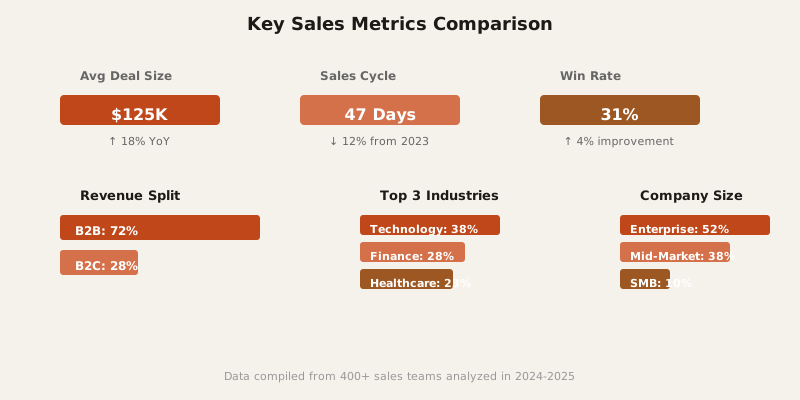
- The average B2B win rate fell to 19% in 2025, down from 29% in 2024. (Ebsta x Pavilion , n=655,000 opportunities)
- Only 13% of sales teams hit a 40%+ win rate in 2025; most cluster in the 16–30% band. (Outreach, 2025 Sales Data Report )
- Only 27% of sales reps report consistently hitting quota, even though 91% say win rates are stable or improving year over year. (HubSpot, 2025 Sales Trends Report ; HubSpot, State of Sales Report )
- Reps who effectively partner with AI tools are 3.7x more likely to meet quota. (Gartner, cited in Salesforce State of Sales Report , 2026)
- Top-performing sales orgs generate 2.7x more prospecting conversions and 1.8x more quality outcomes than the rest, based on 488 buyers and 489 outbound sellers surveyed. (RAIN Group )
- Win rate jumps 30% on enterprise deals when a sales engineer delivers the demo or answers technical questions directly. (Gong Labs , 2025)
Conflict flag: win-rate benchmarks vary by methodology. Ebsta x Pavilion’s 19% (2025, largest sample) is the figure to lead with; Outreach’s platform data and older ~21% (2023-vintage) figures still circulate but reflect different populations.
CRM adoption and data quality
- 73% of U.S. businesses used CRM software in 2024, rising to 94% among tech companies versus 71% of small businesses. (Freshworks, 2024 survey , n=600)
- Businesses that adopted a CRM saw sales revenue increase 21–30%, and CRM users are 86% more likely to exceed their sales goals than non-users. (Freshworks , 2024)
- A CRM saves employees 5–10 hours a week and shortens the average sales cycle by 8–14 days. (Freshworks , 2024)
- 65% of businesses now use a CRM with built-in generative AI, and 81% plan to increase their CRM budget over the next year. (Freshworks , 2024)
- 37% of CRM users say they’ve directly lost revenue because of poor data quality, and 76% say less than half of their CRM data is accurate and complete. (Validity, State of CRM Data Management , 2025, n=602)
- 78% of salespeople say their CRM is effective at improving alignment between sales and marketing. (HubSpot, 2025 Sales Trends Report )
The sales tech stack
- 8 tools is the average number sellers juggle just to close a single deal, and 42% of reps say they’re overwhelmed by tool sprawl. (Salesforce, State of Sales Report , 2026)
- Companies running a unified sales enablement platform are 42% more likely to improve win rates than those on disconnected tools. (Highspot, State of Sales Enablement Report , 2025)
- 29% of companies still run their go-to-market motion on multiple disconnected tools, and 55% say they’re unable to effectively drive go-to-market initiatives with their current stack. (Highspot , 2025)
AI in sales
- 94% of sales leaders using AI agents say those agents are now essential to keep up with business demands; 88% of reps say AI increases their odds of hitting targets, and 85% say it frees them up for higher-value work. (Salesforce, State of Sales Report , 2026)
- 82% of reps say AI is giving them new career growth opportunities, while 40% of reps on usage-based pricing models cite revenue forecasting as their top AI-era challenge. (Salesforce , 2026)
- 43% of sales professionals now use AI at work in some form, and 47% use generative AI tools like ChatGPT specifically. (HubSpot, The State of AI in Sales , 2024, n=600+)
- 36% of sales pros use AI for forecasting, lead scoring or pipeline analysis, and 98% edit AI-generated content before sending it. (HubSpot , 2024)
- 31% of chief sales officers cite difficulty proving AI ROI as a top challenge for 2026 objectives, based on a survey of 227 CSOs fielded August–September 2025. (Gartner , May 2026)
- Sellers who frequently use AI generate 77% more revenue than non-users, based on 7.1 million opportunities analyzed. (Gong Labs , 2025)
- 90% of companies have implemented AI, or plan to, in their go-to-market motion this year, and AI-powered coaching makes teams 35% more likely to report a larger average deal size. (Highspot, State of Sales Enablement Report , 2025)
- Companies using AI specifically inside sales training programs grew 164% year-over-year. (Highspot , 2025)
- 74% of sales pros believe AI is making it easier for buyers to research products on their own before ever talking to a rep. (HubSpot, 2025 State of Sales Report )
B2B buyer behavior and the buying committee
- 67% of B2B buyers say they’d prefer a completely rep-free purchasing experience, and 45% used an AI tool during their most recent purchase, based on 646 B2B buyers surveyed August–September 2025. (Gartner , March 2026)
- Confident buyers are 2x more likely to call their purchase a “high-quality deal” than buyers with low decision confidence. (Gartner , March 2026)
- 69% of B2B buyers still turn to a human sales rep to validate AI-generated insights before deciding. (Gartner, May 2026 press release )
- 74% of B2B buying teams show “unhealthy conflict” during the decision process. (Gartner, May 2025 press release )
- 77% of deals now involve multiple contacts on the buying side, based on 1.8 million opportunities analyzed, and closed-won deals involve 2x more contacts on average than lost deals. (Gong Labs , 2025)
- The average strategic enterprise deal now has 17 stakeholders involved, and multi-threading a deal over $50K boosts win rate by 130%. (Gong Labs , 2025)
- Selling teams on closed-won deals are 67% larger than the selling teams on lost deals, and five decision-makers are involved in the average B2B sale. (Gong Labs, 2025 ; HubSpot, Sales Trends Report )
- 28% of sales pros say a drawn-out, lengthy sales process is the single biggest reason prospects back out of a deal. (HubSpot, Sales Trends Report )
- B2B decision-makers now use an average of 10.2 channels during a single buying journey, up from 5 channels in 2016, and 54% would abandon a purchase after just one poor omnichannel experience. (McKinsey, B2B Pulse Survey )
Sales enablement and coaching
- Highspot’s benchmark source for this section surveyed 350 go-to-market professionals across 21 countries and 61 industries between February and March 2025. (Highspot, State of Sales Enablement Report )
- Teams using AI-powered coaching are 36% more likely to report higher win rates, and unified enablement tech stacks make teams 42% more likely to boost productivity. (Highspot , 2025)
- 55% of organizations say they can’t effectively drive go-to-market initiatives with their current enablement setup, and 29% still run it on multiple disconnected tools. (Highspot , 2025)
Referrals and social selling
- 88% of consumers globally trust recommendations from people they know more than any other marketing channel, based on 40,000+ respondents across five regions. (Nielsen, Trust in Advertising Study , 2021, still the newest full-scale benchmark of its kind)
- LinkedIn Sales Navigator delivers a 312% ROI over three years for a composite enterprise customer, paying for itself in under 6 months, and driving a $15 million revenue lift for the composite organization studied. (Forrester Consulting, commissioned by LinkedIn , 2023)
- Sales Navigator users save 15% of their weekly working time on prospect research, and InMail response rates rise 71% when reps target buyers showing active intent signals. (Forrester Consulting TEI study , 2023)
- Salespeople who use social content as a sales enablement tool are 58% more likely to perform over goal, and 45% of B2B companies use LinkedIn as an active selling channel. (HubSpot, social selling research )
- Social media ranks #4 among the most effective sales channels reported by salespeople, and a LinkedIn profile with a professional photo gets 14x more profile views than one using a generic icon. (HubSpot )
Pipeline and forecasting
- Just 14% of sellers now drive 80% of total revenue, an 11x performance gap between the top and bottom quartile of reps. (Ebsta x Pavilion, 2025 GTM Benchmarks Report , n=655,000 opportunities)
- When a decision-maker’s engagement score stays above 40 throughout the sales cycle, win rate quadruples. (Ebsta x Pavilion )
- Sales-and-marketing-aligned organizations saw a 32% jump in MQL-to-SQL conversion and a 9% shorter sales cycle. (Ebsta x Pavilion )
- Top sales teams close deals 3x faster than the rest, on top of driving that 80% of total revenue. (Ebsta x Pavilion )
What these sales statistics mean for 2026
Every number on this page traces back to the same root problem: reps only get about a third of their working day for the job they were hired to do. Two hours of actual selling out of a six-to-seven hour working day hasn’t moved much in years, and it hasn’t moved despite a wave of AI tooling that was supposed to fix exactly this.
The eight tools in the average stack, the CRM data nobody trusts, and the 13 hours a week managers spend coaching around all of it are symptoms of the same underlying fact: process overhead grew faster than the tools meant to cut it.
The buyer side of the market moved first and faster than the seller side. Sixty-seven percent of B2B buyers now say they want to buy without ever talking to a rep, and 45% already used AI during their last purchase. That’s not a future threat, it’s already the majority behavior.
But the data doesn’t say reps are obsolete: 69% of those same AI-assisted buyers still come back to a human seller to validate what the AI told them. The job hasn’t disappeared, it’s moved later in the funnel, from “convince me this is worth considering” to “confirm what I already believe.”
Speed is still the most underexploited lever in the entire funnel. The average company takes almost 12 hours to respond to a new lead by email, and only one company out of 114 tested responded inside the five-minute window that most consistently correlates with a booked meeting.
Nobody needs a new tool to fix that. They need a process that treats the first five minutes after a lead comes in as the highest-leverage five minutes in the entire sales cycle, which most companies still don’t.
Win rates compressing from 29% to 19% in a single year is the number that should worry revenue leaders most, because it isn’t explained by any one input on this page. It sits downstream of longer sales cycles, buying committees that have grown to 17 stakeholders on strategic deals.
“Unhealthy conflict” shows up in 74% of buying teams before they ever reach a decision. Multi-threading isn’t a nice-to-have response to that; deals with more contacts on the buyer side close at roughly double the rate of single-threaded ones, and win rate on $50K+ deals jumps 130% once multiple stakeholders are engaged.
AI’s role in all this is more ambiguous than the adoption numbers suggest. Adoption is close to universal: 90% of companies have implemented AI or plan to in their go-to-market motion this year. Reps who use it well see real upside, a 77% revenue lift for frequent AI users across 7.1 million analyzed opportunities is not a small effect.
But nearly a third of chief sales officers still can’t prove the ROI of the AI tools they’ve bought, which means most organizations are further along on adoption than they are on measurement.
If you’re evaluating a CRM or sales engagement platform this year, that gap is exactly what to press a vendor on: not whether their AI feature exists, but what it’s actually supposed to move and how you’ll know if it did. Our guide to evaluating CRM software and guide to evaluating sales engagement platforms walk through the specific questions to ask before you sign.
We keep this page current. If a figure here is out of date or you have a study we should add, tell us through our editorial standards page.