

Comparing the best Workforce Planning Software of 2026 includes 1. Rippling 2. Anaplan 3. Pigment 4. Visier 5. HiBob 6. ChartHop 7. Board 8. Workforce.com 9. OrgVue 10. Planful 11. UKG Pro Workforce Management 12. Workday Adaptive Planning 13. Deputy 14. Humanforce 15. Legion 16. When I Work 17. Agentnoon 18. Crunchr 19. Deel 20. Eightfold AI.
TL;DR
- Rippling: Best overall. Headcount planning sits on the same record as HRIS, payroll, and IT, and it carries the highest rating in this guide at 4.8/5 across 12,729+ G2 reviews.
- Anaplan: Best enterprise connected planning. The modeling ceiling is the deepest in the category, though entry deployments run $30K-$50K a year before implementation.
- Pigment: Best for high-growth companies. A visual, spreadsheet-like builder gets a headcount model live in four to twelve weeks, about half a typical Anaplan timeline.
- Visier: Best analytics-led planning. Scenarios start from real attrition and tenure data already sitting in your HRIS, not a blank model.
- Workforce.com: Best for hourly-team scheduling and demand forecasting, the shift-based half of this category that Anaplan and Pigment don't touch.
Twenty workforce planning tools compared, from Anaplan-grade connected planning down to Deputy's shift-level demand forecasting. Real G2 ratings, real 2026 pricing where a vendor actually publishes it, and the pick for a finance-led headcount model versus an hourly scheduling problem.
What Is Workforce Planning Software?
Workforce planning software models future headcount, cost, and skills demand against real HRIS and finance data, so a leader can staff a plan before being forced to react to a gap.
Tools like Anaplan, Rippling, Pigment, and UKG differ on whether they start from finance data, HR data, or the shift schedule itself, and that starting point decides which one actually fits your team.
Best Workforce Planning Software comparison: features, pricing and verdicts
| Tool | Best for | Starting price | Free trial | External rating |
|---|---|---|---|---|
Best unified HR, IT, and workforce planning platform | $8/employee/mo (Unity base) | Demo only | G2 4.8/5 (12,729 reviews) | |
Best enterprise connected planning for cross-functional headcount models | Custom, from $30K/yr | Demo only | G2 4.6/5 (464 reviews) | |
Best modern headcount planning for fast-growing companies | Custom, median ~$74K/yr | Demo only | G2 4.6/5 (114 reviews) | |
Best people-analytics-driven workforce planning insight | Custom, by employee count | Demo only | G2 4.6/5 (223 reviews) | |
Best mid-market people platform with workforce planning built in | $16-25/employee/mo | Demo only | G2 4.5/5 (2,334 reviews) | |
Best org-chart-first headcount planning for mid-market HR and finance | $5/employee/mo (Core) | Demo only | G2 4.3/5 (165 reviews) | |
Best unified BI and planning platform for enterprise workforce cost modeling | Custom, from $10K/yr | Demo only | G2 4.4/5 (322 reviews) | |
Best hourly-team scheduling with built-in demand forecasting | Custom (quote-based) | Demo only | G2 4.5/5 (116 reviews) | |
Best strategic org design and scenario workforce planning for enterprise | Custom (quote-based) | Demo only | G2 4.4/5 (16 reviews) | |
Best FP&A-connected workforce planning tied to the financial close | Custom, from ~$1,250/mo | Demo only | G2 4.3/5 (507 reviews) | |
For enterprise labor-demand forecasting down to the shift level | ~$32-41/employee/mo | Demo only | G2 4.3/5 (2,254 reviews) | |
For finance-connected headcount planning inside a Workday HCM shop | Custom (quote-based) | 30-day trial (base tier) | G2 4.3/5 (410 reviews) | |
For hourly shift scheduling with built-in demand forecasting | $5/user/mo (Lite) | Free trial, no card | G2 4.6/5 (663 reviews) | |
For frontline and deskless workforce operations in regulated industries | Custom (quote-based) | Demo only | G2 4.7/5 (160 reviews) | |
For AI-automated demand forecasting at 15-minute shift granularity | Custom (quote-based) | 14-day free trial | G2 4.4/5 (55 reviews) | |
For SMB shift scheduling with the most transparent published pricing | $2.50/user/mo (Essentials) | 14-day free trial | G2 4.4/5 (398 reviews) | |
For org-chart-first headcount planning at SMB budgets | $4/employee/mo | Demo only | G2 4.9/5 (24 reviews) | |
For people-analytics-led workforce planning priced per employee per year | Custom (PEPY model) | Demo only | G2 4.9/5 (28 reviews) | |
For headcount planning across a global, multi-country workforce | Free HRIS (up to 200 employees) | Free tier available | Capterra 4.9/5 (4,252 reviews) | |
For AI skills-graph-based internal mobility and demand modeling | Custom, $150K-$500K+/yr | Demo only | Capterra 4.0/5 (14 reviews) |
How we chose these tools
We compared each tool on published pricing where it exists, the recurring themes in real G2 and Capterra reviews, and what a headcount scenario actually looks like once you build it, not the demo version. We split the category into its real sub-markets, connected financial planning, org-chart-first headcount tools, people-analytics-led planning, and shift-level scheduling forecasts, because a single scorecard flattens tools that solve genuinely different problems. Pricing was checked against each vendor’s own site or a corroborating third-party benchmark in September 2026. G2 and Capterra ratings cited were read directly off each platform the same week; where a tool had too few reviews to be meaningful, we said so instead of rounding up.
How we weight workforce planning software for the Topickz score
Every tool above is scored against the fixed rubric below and combined using these weights into the Topickz score on each card. The weights are set for workforce planning software specifically, they are not copied from another category, and we publish them so you can see what moved a ranking and re-weight for your own priorities.
| Criterion | Weight | What we checked |
|---|---|---|
| Scenario modeling and forecasting depth | 22% | Whether the tool models more than one headcount variable at once, and whether a plan built today still holds up when three assumptions change next quarter. |
| Headcount and org-design accuracy | 16% | How cleanly a tool represents real positions, reporting lines, and vacancies versus a flat headcount number with no structure behind it. |
| HRIS and payroll data sync | 14% | Native versus manual-export data flow from the systems that already hold the real employee and cost data a plan depends on. |
| Scheduling and labor-demand forecasting | 12% | For the shift-based half of this category, how accurately the tool predicts labor demand from historical sales, traffic, or volume data. |
| Reporting and finance alignment | 12% | Whether a workforce plan can actually feed a budget or a board deck without a rebuild in a spreadsheet first. |
| Ease of use and time to first model | 10% | How long it takes a non-specialist to build one real scenario, not how impressive the platform looks in a sales demo. |
| Pricing transparency and total cost | 9% | Whether a real number exists anywhere on the vendor's own site, and how far the sticker price is from what a company our size would actually pay. |
| Security and compliance | 5% | SOC 2, GDPR, SSO, and audit logs for a category that increasingly holds compensation and reorg data before it's public. |
| Total | 100% |
Read the full TopickZ.com testing methodology for how we run each test, score every criterion, and combine them into a single rating.
Detailed reviews
Rippling
Best unified HR, IT, and workforce planning platform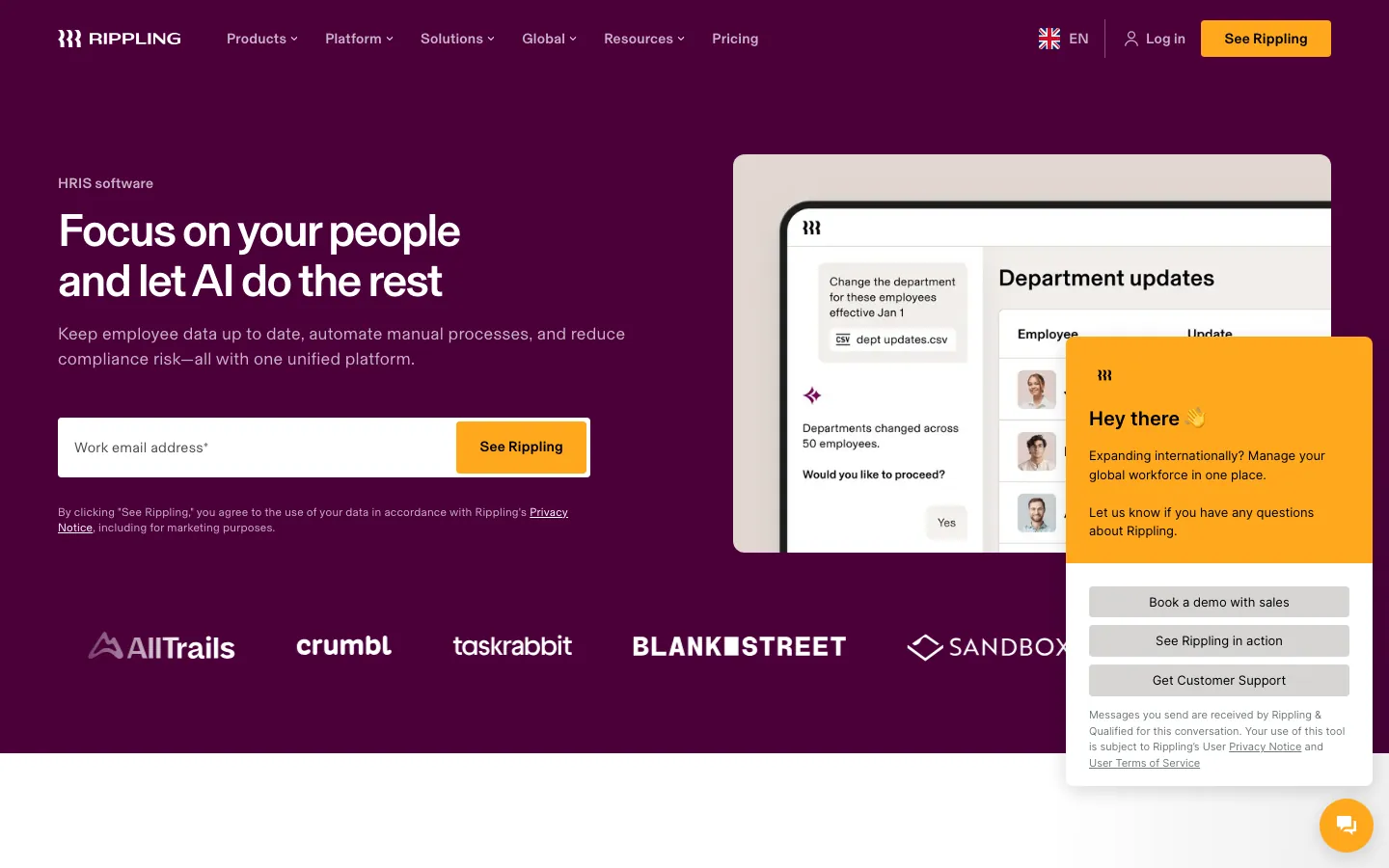
What's great
- Headcount planning sits on the same record as HRIS, payroll, and IT provisioning, so an approved role can trigger the requisition, the laptop order, and the Slack seat in one workflow
- 500+ native integrations with bidirectional sync, the deepest data-pull story of any tool in this list for building a real workforce model
- Global payroll and headcount data across 185+ countries natively, useful for modeling international workforce cost without a separate EOR export
Watch-outs
- Workforce planning sits on top of Rippling's per-module pricing, so a 150-person plan realistically layers $20-$35 PEPM across Unity, HR Cloud, and Payroll before touching a dedicated planning add-on
- No published workforce-planning-specific pricing, every quote is negotiated, and two similarly sized companies can end up paying meaningfully different rates
- Support response times draw a consistent complaint in G2 reviews, slow first response on standard tickets
Rippling is the pick when the workforce plan needs to live next to the actual employee record, not a spreadsheet synced from it. 12,729+ G2 reviews average 4.8/5, the highest rating of any tool in this guide.
Headcount planning runs on the same data model as HRIS, payroll, and device provisioning, so an approved req updates the org chart and the IT queue at once. Rippling markets this directly as workforce planning built into HR, not a bolted-on module.
The catch is pricing. Per-module costs compound, and a 150-person company running Unity plus HR Cloud plus Payroll lands $20-$35 PEPM before any dedicated planning add-on. Skip it if you only need scenario modeling for a finance team; Rippling wants you inside the whole HR stack first.
Pricing breakdown
| Plan | Price | Best for |
|---|---|---|
| Unity (base) | $8/employee/mo | Required foundation, all modules sit on top |
| + HR Cloud | ~$6/employee/mo add-on | Core HRIS records feeding the workforce plan |
| + Payroll | ~$8/employee/mo add-on | Real cost data inside the headcount model |
| + IT Management | ~$8-12/employee/mo add-on | Device and access provisioning tied to approved reqs |
Security & compliance
| Standard | Availability |
|---|---|
| SOC 2 Type II | Yes |
| GDPR | Yes |
| HIPAA | Yes |
| SSO / SAML | ✓ all tiers |
| Audit logs | Yes |
Rippling compliance summary: SOC 2 Type II is yes, GDPR is yes, HIPAA is yes, SSO/SAML is ✓ all tiers, and audit logs is yes.
Key integrations
| Integration | Type |
|---|---|
| Gmail | N/A |
| Outlook | N/A |
| Slack | Native integration |
| LinkedIn Sales Navigator | N/A |
| Outreach / Salesloft | N/A |
Rippling integration summary: Gmail is not specified, Outlook is not specified, Slack is native integration, LinkedIn Sales Navigator is not specified, and Outreach or Salesloft is not specified.
Feature availability
| Feature | Status |
|---|---|
| Free tier | no, demo only |
| AI forecasting | • limited |
| Org chart viz | ✓ |
| Real time sync | ✓ native |
| Scenario modeling | • via reporting |
Rippling feature availability summary: Free tier (no, demo only), AI forecasting (• limited), Org chart viz (✓), Real time sync (✓ native), and Scenario modeling (• via reporting).
What reviewers say about Rippling
Recurring themes across ~12,729 G2 reviews (4.8/5), cross-checked against Capterra, Trustpilot, and Reddit/BBB threads, 2024-2026.
What reviewers praise
- The unified data model draws the most consistent praise: because HRIS, payroll, benefits, time, and IT all sit on one employee record, a promotion or address change flows automatically into payroll and benefits instead of being re-keyed in five tools.
- Reviewers repeatedly call the setup and day-to-day interface clean and fast, with automation that removes manual steps for teams running payroll across multiple states or entities.
- The integration breadth (650+ app connections) and the ability to bundle IT provisioning, device management, and app access alongside HR is cited as a genuine reason teams consolidate onto Rippling.
- Global and multi-state payroll compliance is praised as reliable, including detailed local tax handling, so finance teams report fewer manual overrides at pay-run time.
What reviewers fault
- Opaque, escalating pricing is the single most common gripe: you buy the base Unity platform per employee first, then stack paid modules on top, and reviewers say true all-in cost is hard to compare against competitors before a sales call.
- Support is ticket and chat only with no general phone line, and reviewers report slow or inconsistent resolution once a ticket is routed to the wrong queue.
- The sheer feature depth creates a real learning curve, and configuring advanced workflows or integrations can feel overly complex during onboarding.
- Botched implementations recur in BBB and Reddit accounts: paid onboarding that left teams to self-configure, difficult historical tax-data migration, and account managers who go quiet after the sale.
- The mobile app is described as buggy and missing features that exist on desktop, and reviewers note occasional sync delays between modules on time-sensitive payroll tasks.
Loading reviews…
Anaplan
Best enterprise connected planning for cross-functional headcount models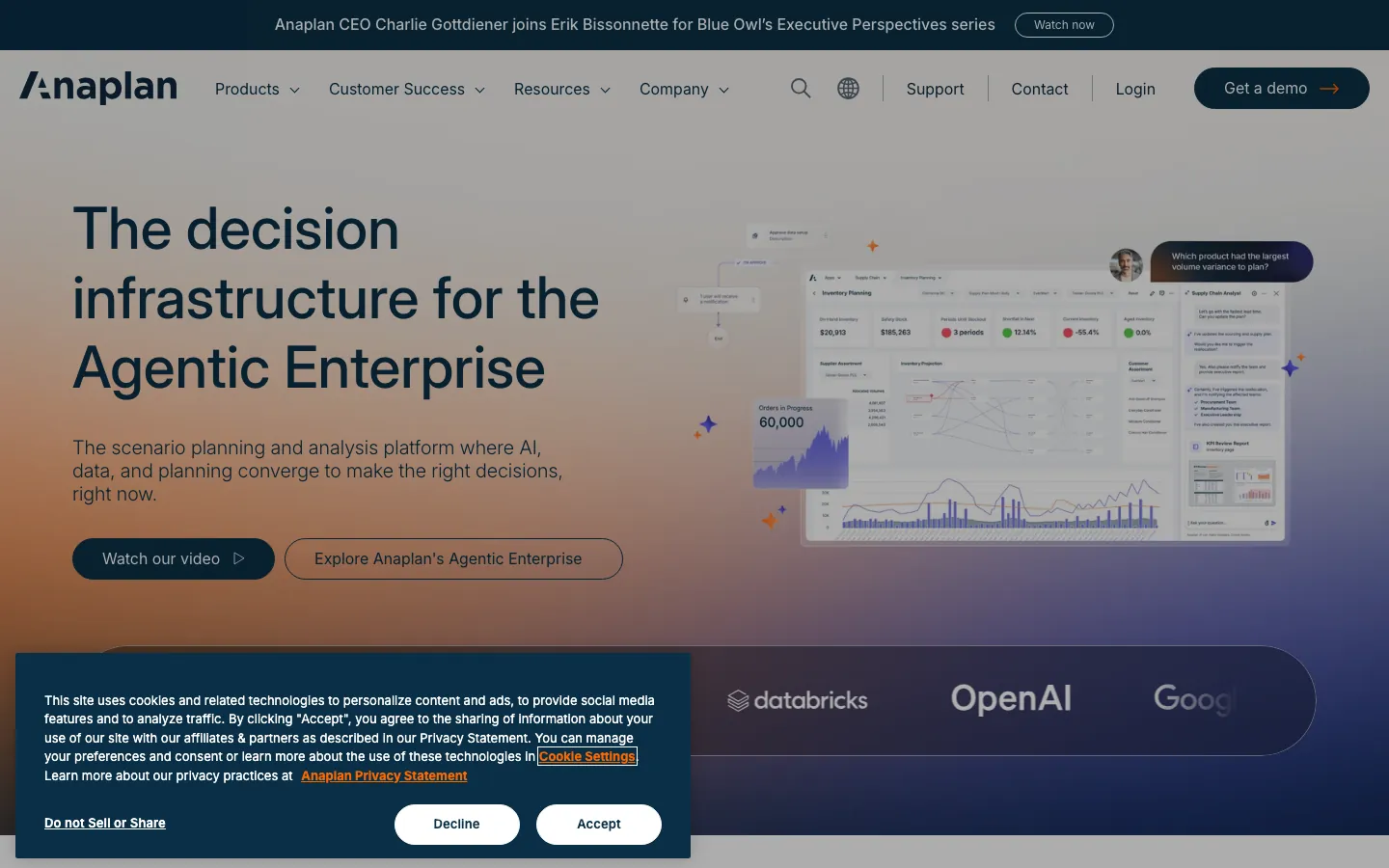
What's great
- Connected planning engine lets a headcount model share live assumptions with sales, supply chain, and finance plans instead of a static export, the reason large enterprises standardize on it
- 4.6/5 across 460+ G2 reviews, the highest and most-reviewed rating among the pure connected-planning tools in this guide
- Deepest scenario-modeling ceiling in the category, built for dozens of headcount and cost variables at once across business units
Watch-outs
- No published pricing anywhere, entry deployments run $30,000-$50,000 a year and Fortune 50 rollouts have been reported at $500,000-$2,000,000+, per independent cost analyses
- Implementation typically runs three to six months or longer with a certified partner, not a self-serve setup
- The modeling depth enterprises want is the same complexity that overwhelms a lean HR or FP&A team without a dedicated model builder
Anaplan is the connected-planning engine large enterprises reach for when headcount can’t be modeled in isolation from revenue and supply chain plans. 460+ G2 reviews average 4.6/5, the strongest rating among the pure enterprise planning platforms here.
The modeling ceiling is real, multiple business units, currencies, and cost drivers on one connected model, not a spreadsheet with a headcount tab bolted on. CFO Shortlist’s 2026 Anaplan buyer’s guide pegs typical mid-market licensing at $80,000-$200,000 a year before implementation.
That cost and a three-to-six-month build mean Anaplan makes sense once workforce planning is genuinely cross-functional. A single HR team modeling next year’s headcount alone will find this expensive overkill.
Pricing breakdown
| Plan | Price | Best for |
|---|---|---|
| Entry deployment | $30,000-$50,000/yr | First connected-planning use case, single team |
| Mid-market | $80,000-$200,000/yr | 15-30 named users, 3-5 model builders |
| Enterprise | $200,000-$500,000/yr | Multiple business units, cross-functional models |
| Fortune 50 deployment | $500,000-$2,000,000+/yr | Global multi-entity connected planning |
Security & compliance
| Standard | Availability |
|---|---|
| SOC 2 Type II | Yes |
| GDPR | Yes |
| HIPAA | No |
| SSO / SAML | ✓ all tiers |
| Audit logs | Yes |
Anaplan compliance summary: SOC 2 Type II is yes, GDPR is yes, HIPAA is no, SSO/SAML is ✓ all tiers, and audit logs is yes.
Key integrations
| Integration | Type |
|---|---|
| Gmail | N/A |
| Outlook | N/A |
| Slack | Limited |
| LinkedIn Sales Navigator | N/A |
| Outreach / Salesloft | N/A |
Anaplan integration summary: Gmail is not specified, Outlook is not specified, Slack is limited, LinkedIn Sales Navigator is not specified, and Outreach or Salesloft is not specified.
Feature availability
| Feature | Status |
|---|---|
| Free tier | no |
| AI forecasting | ✓ PlanIQ |
| Org chart viz | • via model build |
| Real time sync | • via connector |
| Scenario modeling | ✓ deepest in category |
Anaplan feature availability summary: Free tier (no), AI forecasting (✓ PlanIQ), Org chart viz (• via model build), Real time sync (• via connector), and Scenario modeling (✓ deepest in category).
Loading reviews…
Pigment
Best modern headcount planning for fast-growing companies
What's great
- Visual, spreadsheet-like modeling interface with a shorter learning curve than Anaplan's formula environment, non-technical HR and finance users can build a headcount model without a certified admin
- 4.6/5 across 100+ G2 reviews, and Pigment's own Headcount Planning module scored 100% against a 91% category average on G2's Winter 2026 Grid Report
- Typical implementation runs four to twelve weeks, roughly half the timeline of a comparable Anaplan build
Watch-outs
- No published pricing tiers at all, packaging is platform fee plus seats plus planning modules, and the median buyer pays around $74,000 a year per third-party benchmarking
- Younger platform than Anaplan or Board, with a thinner partner and implementation-consultant ecosystem to lean on if something breaks
- Power-user versus viewer seat pricing means the real per-user cost depends heavily on how many people build models versus just view them
Pigment is the workforce-planning pick for high-growth companies that want Anaplan-grade modeling without the Anaplan-grade learning curve. 100+ G2 reviews average 4.6/5, and its dedicated Headcount Planning module posted a 100% score against a 91% category average on G2’s own Winter 2026 Grid Report.
The visual, canvas-style model builder is the real differentiator. Pigment’s own Anaplan comparison leans hard into being up and running in weeks, not quarters, and buyer reports of four-to-twelve-week implementations back that up.
Pricing is opaque, platform fee plus seats plus modules, with a median contract near $74,000 a year. Worth shortlisting once a Series B or later company has outgrown a spreadsheet headcount model but doesn’t want Anaplan’s build timeline.
Pricing breakdown
| Plan | Price | Best for |
|---|---|---|
| Starter deployment | Custom, platform fee + seats | First connected headcount model, single team |
| Growth | ~$50,000-$80,000/yr | Multi-team headcount and budget planning |
| Scale | ~$74,000/yr median | Company-wide workforce and financial planning |
| Enterprise | Custom | Multi-entity, complex modeling needs |
Security & compliance
| Standard | Availability |
|---|---|
| SOC 2 Type II | Yes |
| GDPR | Yes |
| HIPAA | No |
| SSO / SAML | ✓ all tiers |
| Audit logs | Yes |
Pigment compliance summary: SOC 2 Type II is yes, GDPR is yes, HIPAA is no, SSO/SAML is ✓ all tiers, and audit logs is yes.
Key integrations
| Integration | Type |
|---|---|
| Gmail | N/A |
| Outlook | N/A |
| Slack | Native integration |
| LinkedIn Sales Navigator | N/A |
| Outreach / Salesloft | N/A |
Pigment integration summary: Gmail is not specified, Outlook is not specified, Slack is native integration, LinkedIn Sales Navigator is not specified, and Outreach or Salesloft is not specified.
Feature availability
| Feature | Status |
|---|---|
| Free tier | no |
| AI forecasting | ✓ AI agents (2026) |
| Org chart viz | ✓ |
| Real time sync | • via connector |
| Scenario modeling | ✓ visual canvas |
Pigment feature availability summary: Free tier (no), AI forecasting (✓ AI agents (2026)), Org chart viz (✓), Real time sync (• via connector), and Scenario modeling (✓ visual canvas).
Loading reviews…
Visier
Best people-analytics-driven workforce planning insight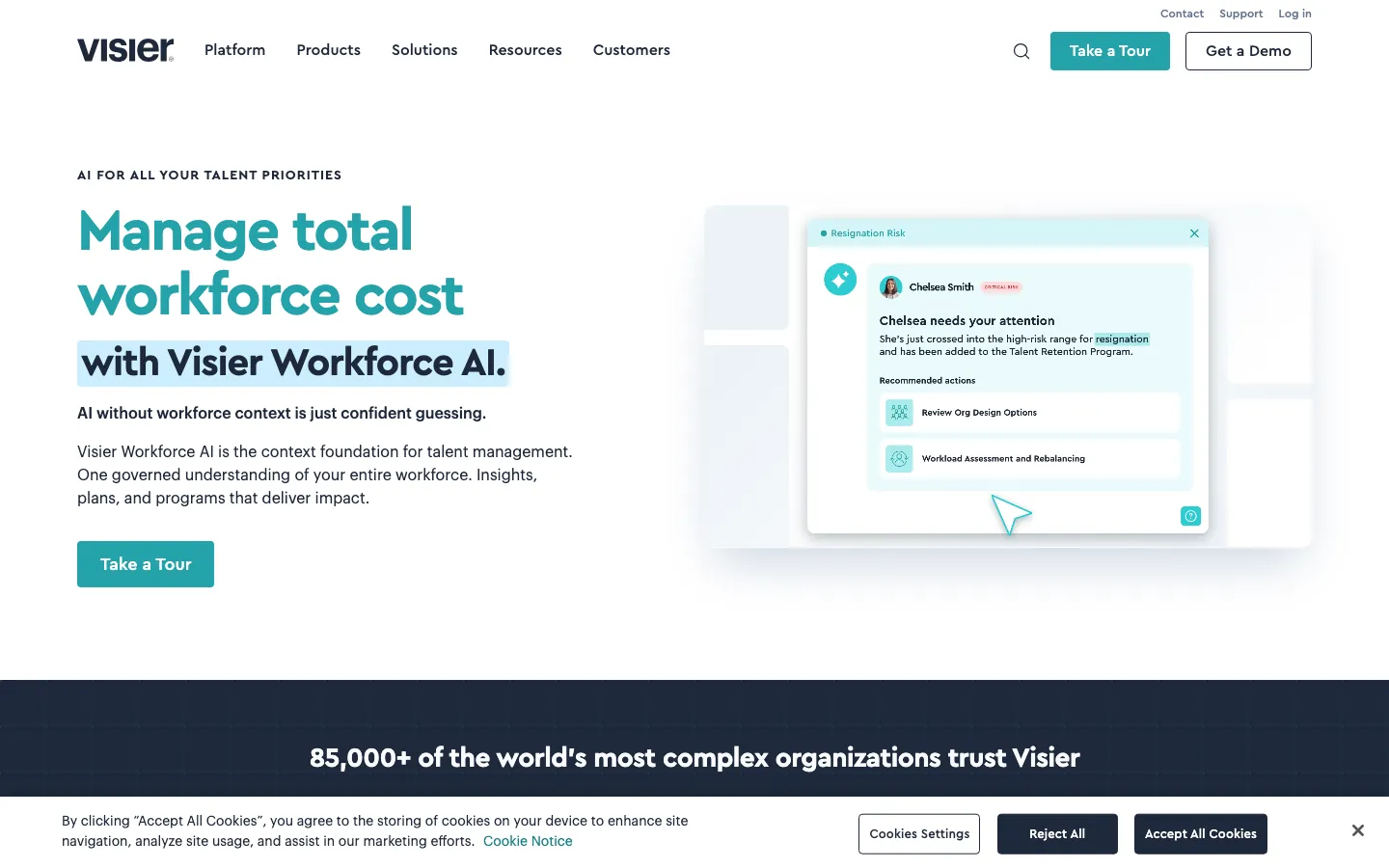
What's great
- Purpose-built on top of people-analytics data rather than a general planning engine, so a headcount scenario starts from real attrition, tenure, and performance signal instead of a blank model
- 4.6/5 across 223 G2 reviews, with an ease-of-support advantage of nearly a full point over category-average competitors per G2's own comparison data
- Vendor-agnostic data model pulls from whichever HRIS a company already runs, useful for companies that don't want to rebuild their HR stack around the planning tool
Watch-outs
- Pricing is quote-only and driven by employee count and module selection, reviewers consistently flag cost as a barrier for smaller companies
- The analytics depth power users love adds a learning curve for a manager who just wants a quick headcount scenario, not a data-science-grade dashboard
- Less of a pure modeling canvas than Anaplan or Pigment, scenario planning leans on pre-built templates more than free-form model building
Visier answers workforce planning from the data side, not the modeling-canvas side. 223 G2 reviews average 4.6/5, with reviewers repeatedly citing ease of use and data analysis as the standout strengths.
The pitch is that a headcount scenario should start from real attrition and tenure data already inside the company’s HRIS, not a fresh spreadsheet. That data-first approach is why people-analytics teams reach for Visier before they reach for a blank planning canvas.
Pricing is opaque and scales with headcount and modules, and reviewers flag it as expensive for smaller companies. This is the right tool when the buyer is an HR analytics leader who wants workforce planning grounded in the company’s own historical people data.
Pricing breakdown
| Plan | Price | Best for |
|---|---|---|
| People (core analytics) | Custom, by employee count | Core headcount and attrition analytics |
| + Workforce Planning module | Custom add-on | Scenario modeling on top of analytics data |
| + Skills/Talent modules | Custom add-on | Skills-based demand modeling |
| Enterprise | Custom | Multi-entity, full analytics plus planning suite |
Security & compliance
| Standard | Availability |
|---|---|
| SOC 2 Type II | Yes |
| GDPR | Yes |
| HIPAA | No |
| SSO / SAML | ✓ all tiers |
| Audit logs | Yes |
Visier compliance summary: SOC 2 Type II is yes, GDPR is yes, HIPAA is no, SSO/SAML is ✓ all tiers, and audit logs is yes.
Key integrations
| Integration | Type |
|---|---|
| Gmail | N/A |
| Outlook | N/A |
| Slack | Limited |
| LinkedIn Sales Navigator | N/A |
| Outreach / Salesloft | N/A |
Visier integration summary: Gmail is not specified, Outlook is not specified, Slack is limited, LinkedIn Sales Navigator is not specified, and Outreach or Salesloft is not specified.
Feature availability
| Feature | Status |
|---|---|
| Free tier | no |
| AI forecasting | ✓ |
| Org chart viz | ✓ |
| Real time sync | ✓ HRIS-agnostic |
| Scenario modeling | ✓ template-led |
Visier feature availability summary: Free tier (no), AI forecasting (✓), Org chart viz (✓), Real time sync (✓ HRIS-agnostic), and Scenario modeling (✓ template-led).
What reviewers say about Visier
Recurring themes across 223 G2 reviews (4.4/5) and Gartner Peer Insights enterprise reviews, 2024-2026. Capterra count too small to report.
What reviewers praise
- Centralized people data is the headline value: HR and finance reviewers cite Visier as their single source of truth for headcount reporting, ending the spreadsheet reconciliation they did before.
- Pre-built analytics depth is praised specifically for enabling end users to run their own analyses without waiting on a data team, with filtering and grouping options that cover most standard HR queries.
- Workforce planning support during annual budget cycles draws consistent positive mentions from HR business partners and finance teams who use Visier to model headcount scenarios collaboratively.
- Predictive attrition and talent gap analysis features are called out as genuinely useful for long-horizon planning, not just retrospective reporting.
- Executive-ready reporting output is valued by HR leaders who use the built-in presentation views to bring people data to the C-suite without reformatting data in PowerPoint.
What reviewers fault
- Customer support inconsistency is the most-cited frustration: reviewers describe difficulty getting timely, expert help on advanced features like Visier Extend and custom business rules.
- Graph and dashboard customization is more constrained than tools like Tableau or Power BI, and reviewers with heavy custom visualization needs report hitting the platform ceiling quickly.
- Implementation is time-intensive, particularly when source HRIS data is fragmented across legacy systems: reviewers note the data modeling phase takes longer than vendor estimates suggest.
- The mobile experience is flagged by multiple reviewers as noticeably worse than the desktop product, described as clunky and lacking the filtering depth available in the browser version.
- Cost is a barrier flagged by smaller enterprise teams: reviewers in organizations with under 1,000 employees question whether the analytics depth justifies the price relative to HRIS-native reporting tools.
Loading reviews…
HiBob
Best mid-market people platform with workforce planning built in
What's great
- Dedicated Workforce Planning module lets managers build multiple headcount plans tied to specific events, a reorg, a new site, seasonal hiring, with position-level detail rather than just a total headcount number
- 4.5/5 across 2,334 G2 reviews, the deepest review base of any people-platform-first tool in this guide
- Native US payroll, launched January 2026 and powered by Gusto's engine, means the cost side of a headcount plan pulls from real payroll data instead of an estimate
Watch-outs
- Workforce Planning sits inside Bob's broader HRIS pricing, so a company evaluating it purely for planning is still buying, and paying for, the full people platform
- Custom pricing only, typical contracts land $16-25 per employee per month plus a 10-20% implementation fee, which makes year-one cost hard to forecast without a call
- Scenario modeling is scoped to HR-style position planning rather than the multi-variable financial modeling Anaplan or Pigment support
HiBob is the workforce-planning pick for mid-market companies that want headcount scenarios built by the same people team that owns the HR record. 2,334 G2 reviews average 4.5/5, with consistent praise for the engagement and people-analytics layer.
HiBob’s own product announcement describes the module as letting managers create multiple headcount plans tied to specific events, a reorg, a new site, an acquisition, with full visibility into current versus planned positions.
The module lives inside Bob’s broader HRIS contract, custom-quoted at $16-25 PEPM plus implementation. Right pick when the same team running HR wants to own workforce planning too; not the pick for a finance-led planning process that needs deep financial modeling.
Pricing breakdown
| Plan | Price | Best for |
|---|---|---|
| Core | ~$16/employee/mo | 50-200 employees, HRIS records + self-service |
| Core + Payroll | ~$20/employee/mo | 50-200 employees with US payroll bundled |
| Plus (Workforce Planning + comp) | ~$25/employee/mo | 200-800 employees, scenario-based headcount planning |
| Enterprise | Custom | 800+ employees, multi-entity, global teams |
Security & compliance
| Standard | Availability |
|---|---|
| SOC 2 Type II | Yes |
| GDPR | Yes |
| HIPAA | Limited |
| SSO / SAML | ✓ all tiers |
| Audit logs | Yes |
HiBob compliance summary: SOC 2 Type II is yes, GDPR is yes, HIPAA is limited, SSO/SAML is ✓ all tiers, and audit logs is yes.
Key integrations
| Integration | Type |
|---|---|
| Gmail | N/A |
| Outlook | N/A |
| Slack | Native integration |
| LinkedIn Sales Navigator | N/A |
| Outreach / Salesloft | N/A |
HiBob integration summary: Gmail is not specified, Outlook is not specified, Slack is native integration, LinkedIn Sales Navigator is not specified, and Outreach or Salesloft is not specified.
Feature availability
| Feature | Status |
|---|---|
| Free tier | no |
| AI forecasting | • limited |
| Org chart viz | ✓ |
| Real time sync | ✓ native |
| Scenario modeling | ✓ position-based |
HiBob feature availability summary: Free tier (no), AI forecasting (• limited), Org chart viz (✓), Real time sync (✓ native), and Scenario modeling (✓ position-based).
What reviewers say about HiBob
Recurring themes across ~2,334 G2 reviews (4.5/5), cross-checked against Capterra and Trustpilot, 2024-2026.
What reviewers praise
- The modern, visual, engaging interface is the most repeated praise: reviewers say Bob is genuinely pleasant to use and easy for employees to navigate, which lifts adoption over legacy HRIS tools.
- Built-in culture and engagement tools, shoutouts, clubs, pulse surveys, and a social feed running natively on the HR record, are called a real differentiator that other core HRIS products do not match.
- Customization of fields, homepage, and the org view is praised for letting mid-market teams shape the system to their own structure without heavy IT work.
- The support team earns frequent positive mentions for quick responses and for actually acting on product feedback.
What reviewers fault
- Missing native payroll (outside the US and UK) and a weak built-in ATS force third-party integrations and manual workarounds, which reviewers say is the biggest functional gap.
- Pricing is quote-only with nothing published, and reviewers find it frustrating to have to book a sales demo before knowing whether Bob fits their budget.
- Reporting and analytics depth is limited, so teams needing advanced or deeply custom reports hit a ceiling in the built-in tools.
- Workflow and time-off configuration are seen as inflexible in places, with reviewers citing gaps like not being able to reassign an absent employee's tasks.
- Implementation and data import can take significant time or vendor help for larger or more complex organizations.
Loading reviews…
ChartHop
Best org-chart-first headcount planning for mid-market HR and finance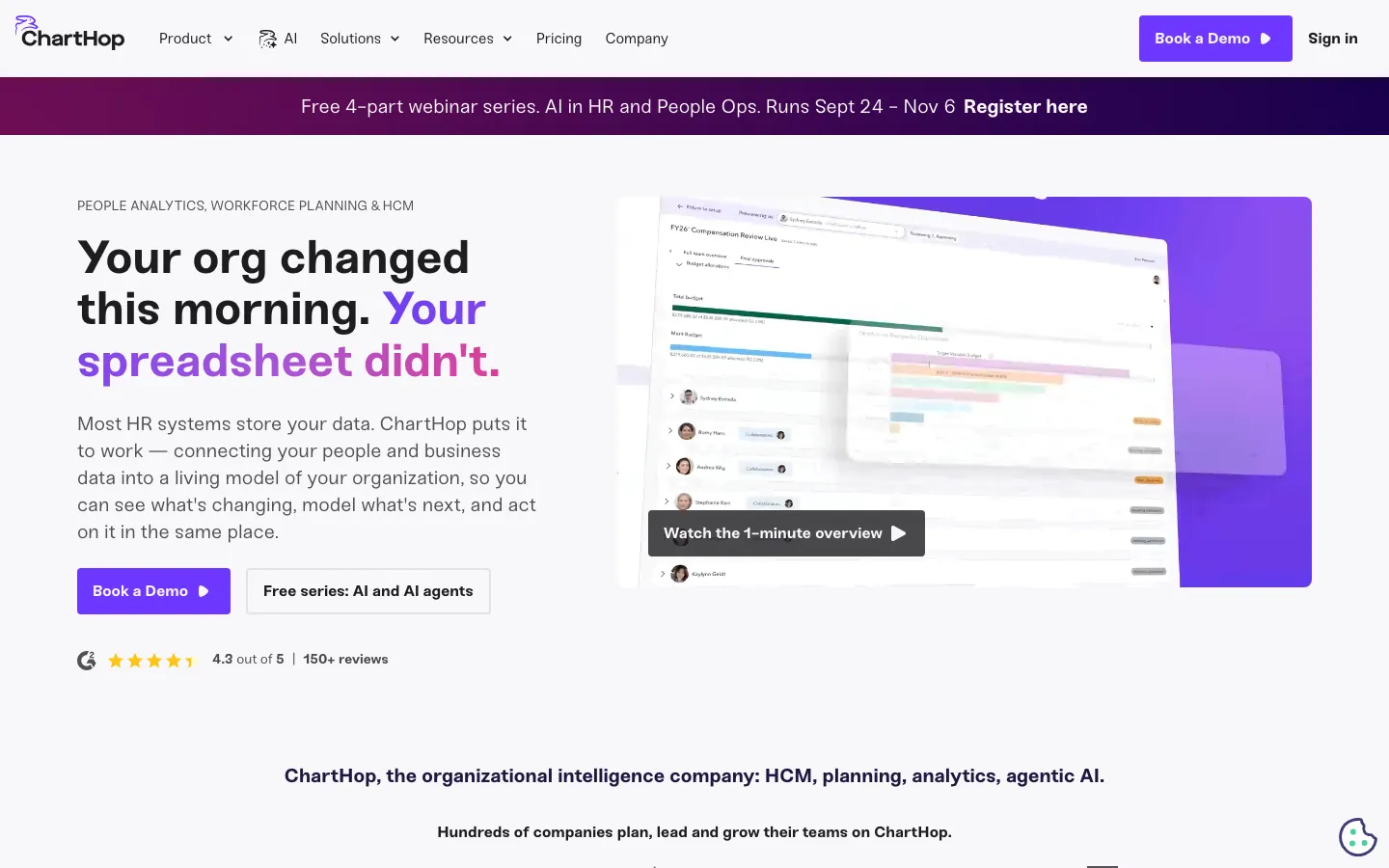
What's great
- Living org chart doubles as the planning canvas, headcount scenarios are built by dragging and adding boxes on the same chart leadership already uses to see the company, not a separate spreadsheet
- 4.3/5 across 165 G2 reviews with a 69% five-star share, and G2's Winter 2026 Grid Report lists it as a category Leader
- Core module starts at a published $5 per employee per month with additional modules from $3 PEPM, one of the only headcount-planning-specific tools in this guide with a real self-serve starting rate
Watch-outs
- Modeling depth tops out below Anaplan, Pigment, or Board, ChartHop is built for org visibility and scenario comparison first, not multi-variable financial modeling
- Smaller company than the enterprise planning vendors, with a thinner partner and consultant network for complex rollouts
- Enterprise pricing beyond the published starting rate still requires a custom quote, so a large deployment loses the price transparency that makes the entry tier attractive
ChartHop turns the org chart itself into the planning tool, the simplest mental model in this entire category. 165 G2 reviews average 4.3/5, and ChartHop’s own headcount planning buyer’s guide is itself one of the more cited resources in this space.
The published starting price, $5 per employee per month for Core with modules from $3 PEPM, is rare in this category; most competitors here are quote-only. That transparency plus a real org-chart interface make it the easiest tool in this guide for a mid-market HR or RevOps lead to trial without a sales call.
The trade-off is modeling depth. A finance team that needs multi-scenario financial modeling across currencies will outgrow ChartHop; an HR team that needs to see and plan the org visually won’t.
Pricing breakdown
| Plan | Price | Best for |
|---|---|---|
| Core | $5/employee/mo | Org chart + basic headcount planning |
| + Compensation module | +$3/employee/mo | Comp bands layered into the headcount plan |
| + Performance module | +$3/employee/mo | Performance data feeding planning decisions |
| Enterprise | Custom | Large or multi-entity deployments |
Security & compliance
| Standard | Availability |
|---|---|
| SOC 2 Type II | Yes |
| GDPR | Yes |
| HIPAA | No |
| SSO / SAML | Enterprise |
| Audit logs | Limited |
ChartHop compliance summary: SOC 2 Type II is yes, GDPR is yes, HIPAA is no, SSO/SAML is enterprise, and audit logs is limited.
Key integrations
| Integration | Type |
|---|---|
| Gmail | N/A |
| Outlook | N/A |
| Slack | Native integration |
| LinkedIn Sales Navigator | N/A |
| Outreach / Salesloft | N/A |
ChartHop integration summary: Gmail is not specified, Outlook is not specified, Slack is native integration, LinkedIn Sales Navigator is not specified, and Outreach or Salesloft is not specified.
Feature availability
| Feature | Status |
|---|---|
| Free tier | no |
| AI forecasting | ✓ AI agents (2026) |
| Org chart viz | ✓ core product |
| Real time sync | ✓ native |
| Scenario modeling | ✓ |
ChartHop feature availability summary: Free tier (no), AI forecasting (✓ AI agents (2026)), Org chart viz (✓ core product), Real time sync (✓ native), and Scenario modeling (✓).
What reviewers say about ChartHop
Recurring themes across roughly 79 Capterra reviews (4.6/5) and about 160 G2 reviews (4.3/5), 2024-2026.
What reviewers praise
- The dynamic org chart with sandbox planning is the feature people keep coming back to for designing and reshaping teams.
- It syncs data from several HR systems into one view, so headcount decisions run off current numbers.
- Real-time headcount planning shows the budget impact of each hire as you model it.
- Reviewers find the org chart easy to read and quick for pulling up who reports to whom.
- Customer service scores well (4.7 on Capterra), and users mention responsive onboarding help.
What reviewers fault
- Onboarding is a 2 to 3 month project, and several teams found the ramp longer than expected.
- Pricing sits at a roughly $9,000 annual minimum, which prices out small teams and micro-businesses.
- The workforce planning module gets clunky for orgs with non-standard headcount patterns.
- Loading employee-level pay data is noticeably more fiddly than importing other data types.
- A few reviewers say the org chart zooms and pans too easily, which feels disorienting.
Loading reviews…
Board
Best unified BI and planning platform for enterprise workforce cost modeling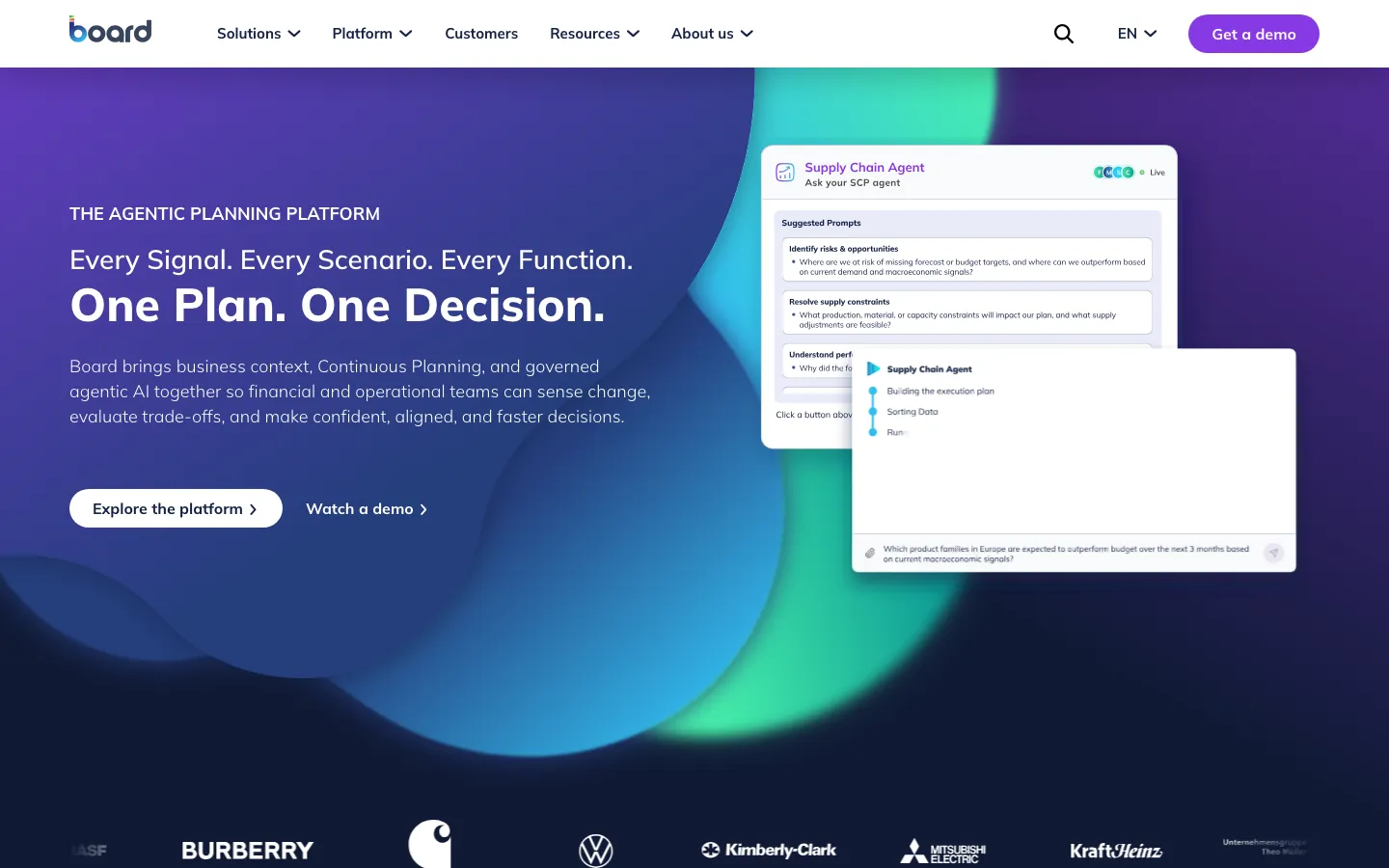
What's great
- Combines business intelligence and planning in one architecture, so a workforce cost model can pull straight from the same reporting layer executives already use, no separate export-and-reimport step
- 4.4/5 across 320+ G2 reviews, with users consistently praising the flexibility to adapt the same platform across finance, sales, and workforce planning use cases
- Agentic planning features added in 2026 let planners ask the model direct questions about headcount risk instead of building a report from scratch
Watch-outs
- Pricing is opaque and quote-based, third-party analyses put a realistic entry point around $10,000 and up, with complex licensing tiers that make cost estimation genuinely difficult before a sales call
- Steep learning curve for new model builders, and reviewers note performance can lag on large datasets
- Smaller ecosystem than Anaplan for pure workforce-planning templates specifically, Board's workforce use cases often get built custom rather than from a packaged module
Board’s pitch is that planning and BI shouldn’t be two tools, a workforce cost model should live in the same place as the dashboard the CFO already trusts. 320+ G2 reviews average 4.4/5, with flexibility as the most repeated praise.
The 2026 agentic planning release lets a planner ask the model a direct question about headcount risk instead of building a fresh report, a real differentiator against older, report-first BI tools.
Pricing is genuinely opaque, real quotes reportedly start around $10,000 and climb fast with licensing complexity. Shortlist Board when workforce planning is one of several planning use cases, finance, sales, supply chain, that need to share one platform, not when workforce planning is the only job to be done.
Pricing breakdown
| Plan | Price | Best for |
|---|---|---|
| Entry deployment | $10,000+/yr (quote-based) | Single team, first connected planning use case |
| Team | Custom | Multi-team BI + planning on one platform |
| Enterprise | Custom | Finance, sales, and workforce planning unified |
| Enterprise + Agentic AI | Custom add-on | 2026 agentic planning and Q&A features |
Security & compliance
| Standard | Availability |
|---|---|
| SOC 2 Type II | Yes |
| GDPR | Yes |
| HIPAA | No |
| SSO / SAML | ✓ all tiers |
| Audit logs | Yes |
Board compliance summary: SOC 2 Type II is yes, GDPR is yes, HIPAA is no, SSO/SAML is ✓ all tiers, and audit logs is yes.
Key integrations
| Integration | Type |
|---|---|
| Gmail | N/A |
| Outlook | N/A |
| Slack | Limited |
| LinkedIn Sales Navigator | N/A |
| Outreach / Salesloft | N/A |
Board integration summary: Gmail is not specified, Outlook is not specified, Slack is limited, LinkedIn Sales Navigator is not specified, and Outreach or Salesloft is not specified.
Feature availability
| Feature | Status |
|---|---|
| Free tier | no |
| AI forecasting | ✓ agentic AI (2026) |
| Org chart viz | • via custom build |
| Real time sync | • via connector |
| Scenario modeling | ✓ |
Board feature availability summary: Free tier (no), AI forecasting (✓ agentic AI (2026)), Org chart viz (• via custom build), Real time sync (• via connector), and Scenario modeling (✓).
Loading reviews…
Workforce.com
Best hourly-team scheduling with built-in demand forecasting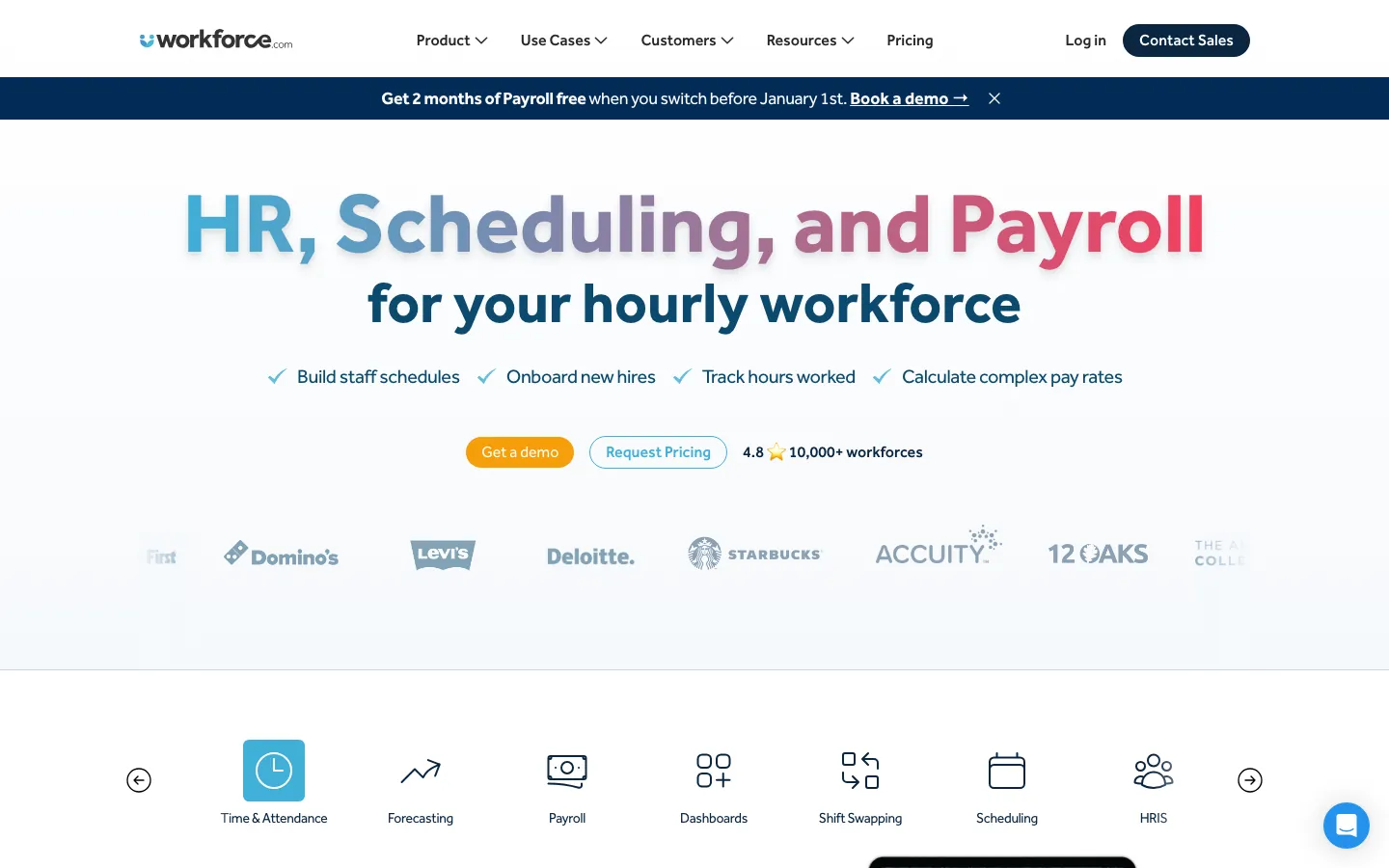
What's great
- Forecasting, scheduling, time and attendance, and payroll sit in one system built specifically for hourly and shift-based teams, not a scheduling bolt-on to a salaried HRIS
- 4.5/5 across 116 G2 reviews, and the platform's own site cites 4.8 stars across 10,000+ workforces on aggregated review sources, among the strongest satisfaction scores of any scheduling-forecasting tool here
- Named enterprise customers include Domino's, Levi's, and Starbucks, real evidence this holds up at multi-location, high-volume-hourly scale
Watch-outs
- Pricing is not published, third-party estimates put it in a $10-$100 per user per month range depending on modules, and a firm number requires a sales call
- The forecasting engine is built around labor demand, foot traffic, sales volume, shift coverage, not the financial-scenario modeling a finance team would expect from Anaplan or Pigment
- Less useful for a company without a meaningful hourly or shift-based headcount, salaried-only organizations should look at the FP&A-style tools in this guide instead
Workforce.com answers the scheduling-forecasting half of workforce planning that pure FP&A tools like Anaplan and Pigment don’t touch. 116 G2 reviews average 4.5/5, and the company’s own site cites 4.8 stars across more than 10,000 workforces on aggregate review platforms.
The product genuinely spans hire-to-pay for hourly teams, build the schedule, forecast the labor demand behind it, track the hours, run the payroll, with named enterprise customers like Domino’s, Levi’s, and Starbucks.
Pricing is a black box until the sales call, third-party estimates range $10-$100 per user monthly depending on modules. Right pick for a multi-location retail, hospitality, or QSR operation planning shift coverage; wrong pick for a salaried-only company modeling next year’s headcount budget.
Pricing breakdown
| Plan | Price | Best for |
|---|---|---|
| Scheduling | Custom (quote-based) | Shift scheduling + demand forecasting core |
| + Time & Attendance | Custom add-on | Clock-in/out and labor compliance tracking |
| + Payroll | Custom add-on | Full hire-to-pay for hourly teams |
| Enterprise | Custom | Multi-location, high-volume hourly operations |
Security & compliance
| Standard | Availability |
|---|---|
| SOC 2 Type II | Yes |
| GDPR | Yes |
| HIPAA | No |
| SSO / SAML | Enterprise |
| Audit logs | Limited |
Workforce.com compliance summary: SOC 2 Type II is yes, GDPR is yes, HIPAA is no, SSO/SAML is enterprise, and audit logs is limited.
Key integrations
| Integration | Type |
|---|---|
| Gmail | N/A |
| Outlook | N/A |
| Slack | Limited |
| LinkedIn Sales Navigator | N/A |
| Outreach / Salesloft | N/A |
Workforce.com integration summary: Gmail is not specified, Outlook is not specified, Slack is limited, LinkedIn Sales Navigator is not specified, and Outreach or Salesloft is not specified.
Feature availability
| Feature | Status |
|---|---|
| Free tier | no |
| AI forecasting | ✓ labor demand forecasting |
| Org chart viz | ✗ |
| Real time sync | ✓ native |
| Scenario modeling | ✗ |
Workforce.com feature availability summary: Free tier (no), AI forecasting (✓ labor demand forecasting), Org chart viz (✗), Real time sync (✓ native), and Scenario modeling (✗).
Loading reviews…
OrgVue
Best strategic org design and scenario workforce planning for enterprise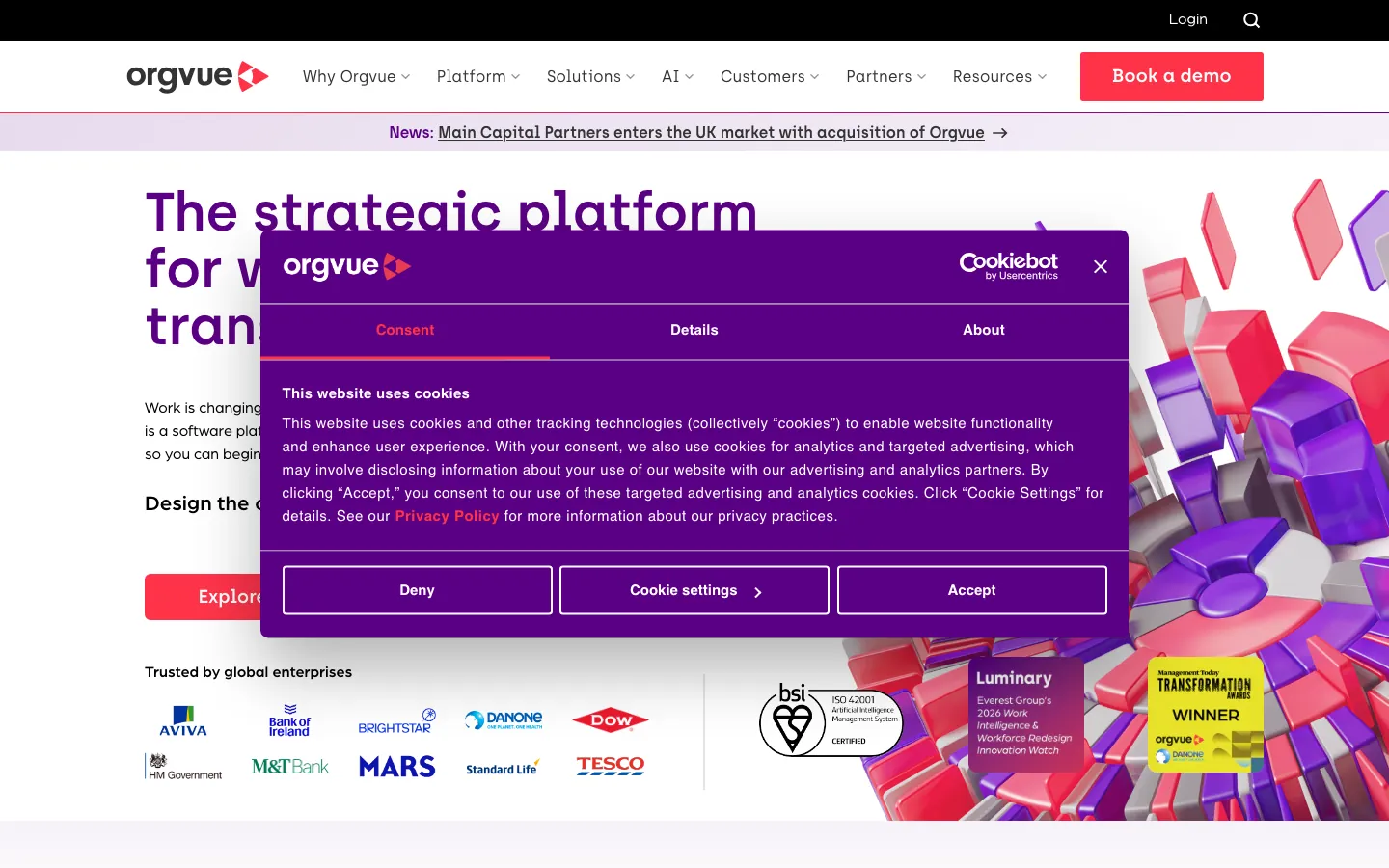
What's great
- Purpose-built for org design and restructuring scenarios, letting a planning team model multiple what-if org structures side by side before committing to one
- Enterprise client roster including Aviva, Mars, Dow, Tesco, and Danone signals this holds up for genuinely large, complex organizational transformations, not just a headcount spreadsheet replacement
- ISO 42001 certification for its AI systems, a specific and verifiable AI-governance credential most competitors in this list haven't published
Watch-outs
- Only 16 G2 reviews on record, the thinnest review base of any deep-tier tool in this guide, a real signal to talk to reference customers directly before signing
- Pricing is quote-only with no published starting rate, buyers should expect an enterprise sales cycle, not a self-serve trial
- Steeper configuration curve for advanced scenario features per reviewer feedback, built for a dedicated org-design analyst, not a generalist HR manager
Orgvue is built for the specific job of redesigning an organization, not just forecasting its headcount total. G2 reviews put it at 4.4/5 on a thin base of 16 reviews, small enough that reference calls matter more than the star rating here.
The client roster, Aviva, Mars, Dow, Tesco, Danone, is genuinely enterprise, and Orgvue’s own Anaplan-alternatives analysis makes the direct case for org-design-first modeling over a general connected-planning engine.
The ISO 42001 AI-governance certification is a specific, checkable credential worth confirming if AI-assisted scenario modeling is part of the buying criteria. Right pick for a genuine org-restructuring or M&A integration project; overkill for routine annual headcount planning.
Pricing breakdown
| Plan | Price | Best for |
|---|---|---|
| Team | Custom (quote-based) | Single org-design project or team |
| Business | Custom | Ongoing org design across multiple teams |
| Enterprise | Custom | Multi-entity, global org transformation |
| Enterprise + AI | Custom add-on | ISO 42001-certified AI scenario modeling |
Security & compliance
| Standard | Availability |
|---|---|
| SOC 2 Type II | Yes |
| GDPR | Yes |
| HIPAA | No |
| SSO / SAML | ✓ all tiers |
| Audit logs | Yes |
OrgVue compliance summary: SOC 2 Type II is yes, GDPR is yes, HIPAA is no, SSO/SAML is ✓ all tiers, and audit logs is yes.
Key integrations
| Integration | Type |
|---|---|
| Gmail | N/A |
| Outlook | N/A |
| Slack | Limited |
| LinkedIn Sales Navigator | N/A |
| Outreach / Salesloft | N/A |
OrgVue integration summary: Gmail is not specified, Outlook is not specified, Slack is limited, LinkedIn Sales Navigator is not specified, and Outreach or Salesloft is not specified.
Feature availability
| Feature | Status |
|---|---|
| Free tier | no |
| AI forecasting | ✓ ISO 42001-certified |
| Org chart viz | ✓ core product |
| Real time sync | • via connector |
| Scenario modeling | ✓ org-design specialist |
OrgVue feature availability summary: Free tier (no), AI forecasting (✓ ISO 42001-certified), Org chart viz (✓ core product), Real time sync (• via connector), and Scenario modeling (✓ org-design specialist).
What reviewers say about OrgVue
Recurring themes across about 16 G2 reviews (4.4/5) plus TrustRadius, a small pool, 2024-2026.
What reviewers praise
- It turns org data into clear visuals that stakeholders actually engage with, well past what Excel or PowerPoint manage.
- Scenario modeling is strong, auto-calculating the cost and headcount impact of each reorg option.
- The support team gets called out repeatedly as excellent to work with.
- It handles hierarchy visualization and workforce planning that used to live in offline slide decks.
What reviewers fault
- The learning curve is steep, and the expression logic reads trickier than Excel formulas.
- Data comes in through manual uploads because system integration is limited.
- Large datasets, screen sharing and complex links can slow the tool down or freeze it.
- The interface feels dated, and permission management gets complicated at scale.
Loading reviews…
Planful
Best FP&A-connected workforce planning tied to the financial close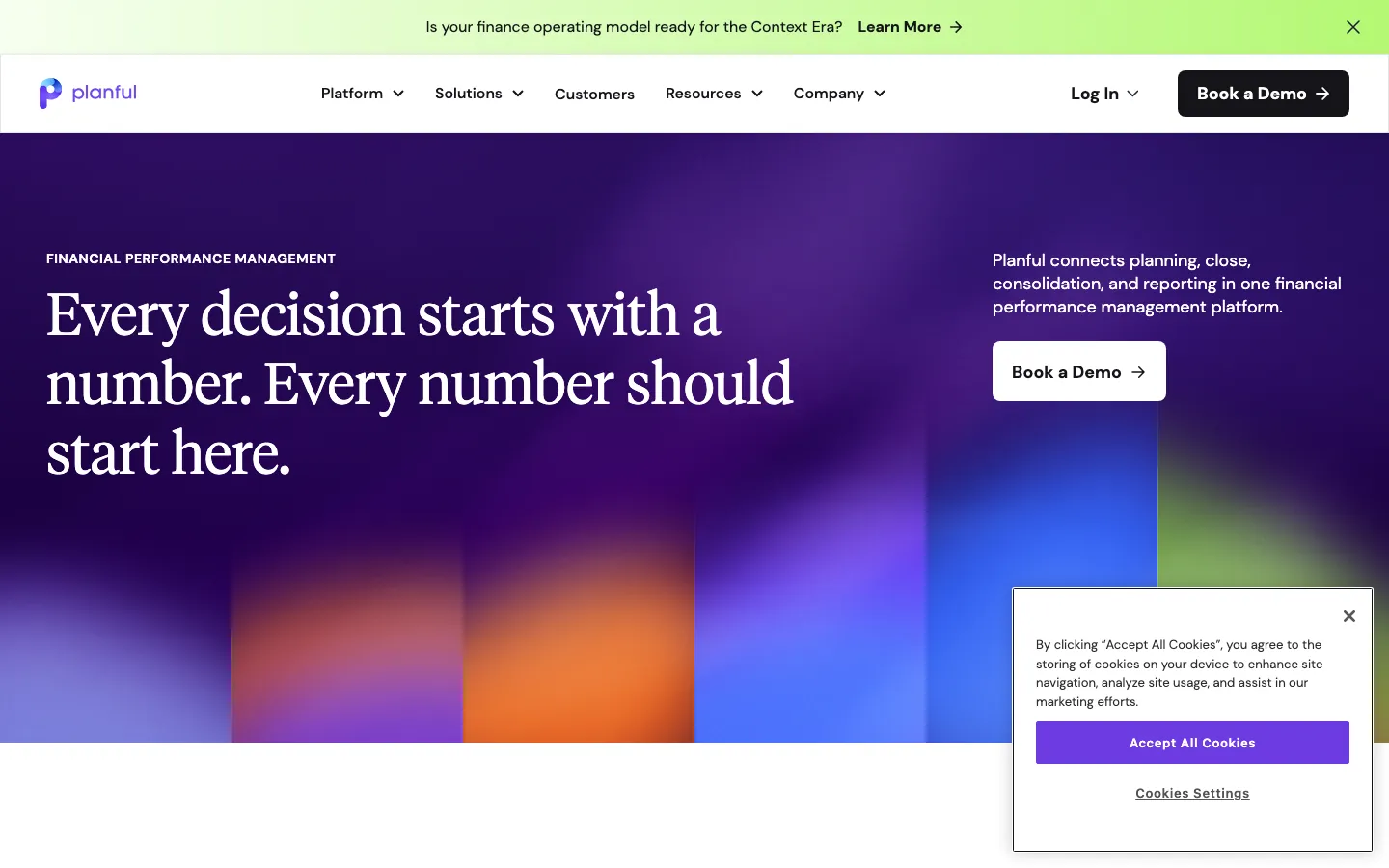
What's great
- Workforce Planning module connects HR, finance, and operational data in one place, so headcount, compensation, and benefits costs feed directly into the same model used for the financial close
- 4.3/5 across 500+ G2 reviews, a large enough sample to trust the rating, with reviewers specifically calling out the workforce planning module as well-designed and flexible for employee cost estimates
- Faster time-to-value relative to the largest connected-planning vendors, reviewers frequently cite ease of use as a top strength
Watch-outs
- No published pricing, third-party data shows plans starting around $1,250 a month with a median buyer paying roughly $42,000 a year, and the Workforce Planning module is a separate incremental fee on top
- Reviewers report a real learning curve and an unintuitive interface once you move past the basic workflows
- Implementation timelines range from four months to a year depending on scope, slower than the mid-market-focused tools in this guide
Planful is the workforce-planning pick for a finance team that wants headcount modeling to live inside the same platform as the budget and the close, not a separate HR tool. 500+ G2 reviews average 4.3/5, a solid sample size for a mid-market FP&A platform.
The Workforce Planning module specifically connects HR, finance, and operational data so salary, benefits, and other employee costs feed straight into the financial plan, and reviewers call it well-designed and flexible for employee cost estimates.
Pricing starts around $1,250 a month with a median annual spend near $42,000, and the workforce module is billed as an add-on. Implementation can run four months to a year, budget for that timeline rather than expecting a quick self-serve rollout.
Pricing breakdown
| Plan | Price | Best for |
|---|---|---|
| Standard | ~$1,250/mo starting | Core FP&A budgeting and reporting |
| Professional | Custom | Adds the Workforce Planning module |
| Enterprise | ~$42,000/yr median | Full FP&A + workforce + operational planning |
| Enterprise + | Custom | Multi-entity consolidation and advanced modeling |
Security & compliance
| Standard | Availability |
|---|---|
| SOC 2 Type II | Yes |
| GDPR | Yes |
| HIPAA | No |
| SSO / SAML | ✓ all tiers |
| Audit logs | Yes |
Planful compliance summary: SOC 2 Type II is yes, GDPR is yes, HIPAA is no, SSO/SAML is ✓ all tiers, and audit logs is yes.
Key integrations
| Integration | Type |
|---|---|
| Gmail | N/A |
| Outlook | N/A |
| Slack | Limited |
| LinkedIn Sales Navigator | N/A |
| Outreach / Salesloft | N/A |
Planful integration summary: Gmail is not specified, Outlook is not specified, Slack is limited, LinkedIn Sales Navigator is not specified, and Outreach or Salesloft is not specified.
Feature availability
| Feature | Status |
|---|---|
| Free tier | no |
| AI forecasting | • limited |
| Org chart viz | ✗ |
| Real time sync | • via connector |
| Scenario modeling | ✓ |
Planful feature availability summary: Free tier (no), AI forecasting (• limited), Org chart viz (✗), Real time sync (• via connector), and Scenario modeling (✓).
Loading reviews…
More top-rated Workforce Planning Software worth checking out
Highly rated Workforce Planning Software that didn't crack our top 10 but are still strong contenders, especially for specific use cases and team sizes.
UKG Pro Workforce Management
For enterprise labor-demand forecasting down to the shift level
Standout: AI-powered demand forecasting analyzes historical sales, foot-traffic, and volume data to predict labor needs and auto-suggest schedules
Workday Adaptive Planning
For finance-connected headcount planning inside a Workday HCM shop
Standout: Native integration with Workday HCM means headcount, compensation, and benefits data flows into the financial plan without a middleware sync
What reviewers say ★ 4.5 · 1,752
Praised
- Unified platform coverage is the top praise: HR, payroll, talent management, and learning in a single system eliminates the multi-tool sprawl that mid-market buyers were trying to escape.
- Employee self-service is consistently valued by non-HR reviewers: viewing pay stubs, submitting time-off, and updating personal info without contacting HR saves time across the org.
- Reporting and analytics depth draws praise from HR analysts and finance teams who use Workday for headcount planning and compliance tracking with real-time data.
- Payroll accuracy earns strong marks once the system is fully configured, with reviewers citing consistent, on-time payroll runs as a reliable baseline.
- The permissions and role-based access model is called out as genuinely granular, useful for larger orgs that need to separate HR, manager, and employee data views.
Faulted
- The learning curve is the most-cited frustration: even technically comfortable users say full platform fluency takes months, and admin configuration requires specialist knowledge.
- Customization is constrained relative to the price point: reviewers flag inability to customize themes, limited report layout flexibility, and workflow rigidity when policy needs are non-standard.
- Support response times draw repeated criticism, with reviewers describing multi-day ticket turnarounds and difficulty reaching someone who understands their specific configuration.
- Performance issues surface under load: slow report generation on large datasets, page lag during peak hours, and authentication friction from multi-step login flows frustrate daily users.
- Administrative overhead surprises buyers: profile changes and certain HR actions require admin involvement rather than direct self-service, slowing down routine tasks.
Deputy
For hourly shift scheduling with built-in demand forecasting
Standout: Auto-scheduling, demand forecasting, and wage-budgeting unlock on the $6.50/user/mo Core tier, the cheapest published forecasting tier in this entire guide
Humanforce
For frontline and deskless workforce operations in regulated industries
Standout: Combines scheduling, time tracking, HR, and payroll for frontline and deskless teams in one command-centre view with real-time AI insights
Legion
For AI-automated demand forecasting at 15-minute shift granularity
Standout: Automated labor forecasts reported at up to 98% accuracy with location-specific workload predictions in 15-minute increments
When I Work
For SMB shift scheduling with the most transparent published pricing
Standout: Cheapest published per-user scheduling price in this guide at $2.50/user/mo Essentials
Agentnoon
For org-chart-first headcount planning at SMB budgets
Standout: Starts at $4/employee/mo for companies under 200 employees, one of the few genuinely SMB-priced headcount planning tools in this guide
What reviewers say
Praised
- Large org charts load fast, with reviewers noting a 3,000-person chart rendering in seconds.
- Scenario modeling is strong, flagging span-of-control exceptions and exporting ready-made stakeholder decks.
- It consolidates data from several HR sources into one org view with good filtering.
- The drag-to-move interface is intuitive, and users call setup and support helpful.
Faulted
- There is no write-back to HRIS, so changes need manual exports like Workday EIB files.
- It is desktop-only and English-only, which limits some global teams.
- Occasional bugs tie to fast feature releases, and a few users hit data-import issues.
Crunchr
For people-analytics-led workforce planning priced per employee per year
Standout: 4.9/5 across 28 G2 reviews with 96% five-star ratings, one of the highest satisfaction scores in this entire guide
What reviewers say ★ 4.8 · 29
Praised
- Implementation is fast compared with typical analytics rollouts, and reviewers call the setup easy.
- Prebuilt visualizations let HR, business and finance users explore data without waiting on the analytics team.
- The interface supports real-time collaboration while people work through workforce questions together.
- Customer success gets repeated praise for being responsive and hands-on.
Faulted
- The internal mobility module lacks a clean single overview of employees and their internal moves.
- The review pool skews almost entirely enterprise, so fit for smaller HR teams is less documented.
Deel
For headcount planning across a global, multi-country workforce
Standout: Headcount and workforce insights sit inside the same system running global payroll, EOR, and HRIS across 150+ countries, useful for modeling international expansion without country-by-country tools
What reviewers say ★ 4.9 · 4,252
Praised
- Global payment reliability is the top praised theme: reviewers across 150+ countries consistently describe payments as on-time, accurate, and handled in local currency without manual intervention.
- Contractor and EOR onboarding speed draws consistent praise, with reviewers noting that getting a new hire or contractor fully set up takes hours rather than the weeks typical of legacy payroll providers.
- Contract and compliance document management is cited as genuinely useful: reviewers appreciate centralized storage, e-signature workflows, and country-specific compliance templates in one dashboard.
- The customer support team earns high marks for 24/7 availability and responsiveness, with many reviewers noting chat support resolving issues faster than expected.
- The HR dashboard clarity is praised by operations and finance reviewers who use it to track PTO, payslips, and contractor spend without needing separate spreadsheets.
Faulted
- Withdrawal and transfer fees frustrate contractors: currency conversion charges and per-transfer fees add up, especially for monthly payees in markets with limited withdrawal options.
- Two-factor authentication friction is a recurring complaint: reviewers describe repetitive verification steps on every login as unnecessary given the existing security layer.
- EOR contract rigidity is flagged when company policy is more favorable than local legal minimums: the platform defaults to local law, and adjusting upward requires back-and-forth with the compliance team.
- Feature discoverability is a complaint for new users: advanced functionality like off-cycle payments and compliance document requests is available but requires digging through the settings hierarchy.
- Mobile app feature gaps are called out repeatedly: reviewers say the web platform and the mobile app are not at parity, with several workflows only completable via browser.
Eightfold AI
For AI skills-graph-based internal mobility and demand modeling
Standout: Skills-graph AI model trained across a billion-plus career profiles matches internal talent to future roles, the deepest skills-based demand modeling in this guide
What reviewers say ★ 4.0 · 14
Praised
- AI-powered candidate matching is the headline praise: reviewers credit the skills-inference engine with surfacing candidates that keyword search would miss.
- Internal mobility use case lands well with enterprise HR teams who cite meaningful productivity gains per recruiter from the talent rediscovery feature.
- Diversity analytics draw consistent positive mentions from talent acquisition leads targeting inclusion hiring goals with actual data.
- Customer success teams receive praise for responsiveness and proactive guidance, especially during initial deployment phases.
- Integration with SAP and other enterprise HRIS platforms is flagged as a working strength by reviewers who got it configured correctly.
Faulted
- Workday sync failures surface repeatedly, with multiple reviewers reporting integration issues that persisted weeks or months after go-live.
- The platform is not a standalone ATS, so teams must maintain a separate applicant tracking system alongside it, adding workflow friction.
- AI match accuracy draws complaints when the model infers skills incorrectly, generating candidate shortlists that require significant manual review.
- Pricing is enterprise-only with no published tiers, and the implementation timeline of weeks to months catches buyers off guard post-sale.
- Customer support quality is inconsistent after the initial onboarding period, with reviewers noting high support-team turnover and slow escalation paths.
Tools we considered but excluded
We evaluated more tools than the 20 you see above. These did not make the cut. Saying what we rejected, and why, is the editorial muscle most listicles skip.
- SAP SuccessFactors Workforce Analytics: Real workforce planning depth, but almost never bought standalone, it's a module inside a broader SAP HCM contract, not a comparable buy for most readers of this guide
- Oracle Fusion Workforce Planning: Same pattern as SAP, genuinely capable but bundled inside Oracle Cloud HCM, and evaluated as part of that decision, not on its own
- WorkForce Software (an ADP company): ADP acquired WorkForce Software in October 2024 for $1.2B, it now sells primarily as an ADP-attached enterprise WFM add-on rather than a standalone competitor
- Paylocity: Mid-market HCM with a headcount reporting layer, but consistent G2 complaints about implementation quality put it behind the dedicated planning tools in this guide
- Orgnostic: Real product with a coherent PEPM pricing model, but we could not verify a real G2 or Capterra rating at time of writing, and we don't publish a rating we can't confirm
- Vena Solutions: Strong Excel-native FP&A tool, but its workforce planning use case is a template on top of general budgeting, thinner than Planful or Anaplan's dedicated modules
Honorable mentions
Solid tools that did not crack the main list but are worth tracking, especially for niche use cases.
- Lattice: Its performance and comp modules increasingly touch headcount planning for companies that already run Lattice for reviews, worth watching as it expands
- One Model: Deep people-analytics platform with a workforce-planning layer, popular with data teams that want to build custom models on raw HR data
- Paylocity Workforce Insights: The reporting layer inside Paylocity's core HCM is improving fast and worth a look if you're already a Paylocity payroll customer
Workforce planning tools, sorted by what they’re actually good at
Twenty tools show up when you search this category.
They solve at least four different problems, not one. Sorting them by job-to-be-done narrows a real shortlist faster than sorting by star rating ever will, and it’s the first filter worth applying before you book a single demo.
Enterprise connected planning is the finance-led branch. Anaplan, Pigment, Board, Workday Adaptive Planning, and Planful all model headcount as one variable inside a bigger financial plan, and they’re also the tools with the least published pricing anywhere on the internet, which tells you something about who’s buying them and how big the checks are.
Org-chart-first headcount tools start from the org structure instead of a spreadsheet. ChartHop, OrgVue, and Agentnoon fit here.
A planner drags boxes on a live chart to build a scenario. That’s a genuinely different mental model from a finance-style planning canvas, and it shows up directly in who buys each one and why the sales cycle looks so different.
People-analytics-led planning treats workforce planning as a data problem first. Visier and Crunchr both start from real attrition, tenure, and performance history already sitting in a company’s HRIS, then layer scenario modeling on top of what’s already true rather than a blank spreadsheet.
Unified HR platforms with planning built in are Rippling and HiBob. Neither started as a planning company.
Both added workforce planning because customers already trusted them with the underlying HR data, and building the plan next to the record was the obvious next move once enough customers asked for it.
Scheduling and labor-demand forecasting is the shift-based half of this category most finance-focused buyer’s guides skip entirely. UKG, Deputy, Humanforce, Legion, Workforce.com, and When I Work all forecast hourly labor demand from historical sales or foot-traffic data, a completely different problem than annual headcount budgeting, and one that deserves its own shortlist rather than getting lumped in with Anaplan and Pigment.
Skills-based demand modeling is the newest branch. Eightfold AI’s skills graph asks a different question, not how many people do we need, but which of our current people could fill the role we’re about to open.
Trial checklist for workforce planning software
Six things to test before you sign anything.
The pattern of which trials end in a confident decision versus a six-month stall is consistent across this whole category, and it usually comes down to whether you actually built something real during the trial or just watched someone else drive a demo for forty-five minutes.
One, build one real scenario with your actual headcount, not demo data. Take your current org chart and model a specific, real decision, a 15% cut, a new regional office, a doubled sales team. If the tool can’t hold your actual complexity, no amount of demo polish matters once you’re three months into a live contract.
Two, time it.
How long does it take a non-specialist to build that scenario end to end, from a blank screen to a number a VP would actually sign off on? ChartHop and Agentnoon are built for a generalist HR manager to self-serve. Anaplan and Board generally need a trained model builder, and you should know which one you’re buying before the contract, not after the first quarter closes.
Three, check whether the plan connects to real cost data. A headcount number without a real loaded cost per role is a guess wearing a chart. Rippling, HiBob, and Workday Adaptive Planning pull this natively; most others need a CSV import or a connector to get there.
Four, run a forecast you already know the answer to. This one’s specifically for the scheduling tools, feed Deputy, Legion, or Workforce.com last quarter’s actual sales or foot-traffic data and see how close the forecast lands to what actually happened on the ground.
Five, export everything. If the data isn’t portable, you don’t really own your own plan, you’re renting it.
Six, ask what breaks the model. Every vendor demo shows the happy path. Ask directly what happens when three assumptions change in the same quarter, a hiring freeze, a reorg, and a new region, all at once. That answer tells you more about the tool than the entire feature list on its pricing page.
Match the workforce planning tool to your stage
Five questions, roughly in order.
Answer them and twenty tools collapse to two or three real options, most of the time faster than a single vendor call would get you there.
1. Who owns the plan
If finance owns headcount planning as part of the annual budget, start with Anaplan, Pigment, Planful, or Board. If HR owns it as part of the people function, ChartHop, HiBob, or Agentnoon fit the workflow better. Genuinely shared ownership is rarer than vendors admit in a sales call, and when it happens, Visier or Crunchr split the difference by starting from data both teams already trust before a scenario gets built.
2. Whether the workforce is salaried or shift-based
A salaried, knowledge-work headcount plan and an hourly, shift-based labor forecast are different problems wearing the same category name.
Salaried teams belong in the FP&A cluster above. Retail, hospitality, healthcare, or field-service operations belong in the scheduling cluster instead, UKG, Deputy, Humanforce, Legion, Workforce.com, or When I Work. Don’t buy from the wrong cluster just because a G2 category page happened to lump them together under one heading.
3. Existing HRIS and ecosystem lock-in
Already on Workday HCM? Workday Adaptive Planning is the lowest-friction add.
Already on Rippling or HiBob for HR, their native planning modules avoid a second contract entirely. Running a different HRIS, ChartHop, Visier, and the pure planning tools stay HRIS-agnostic by design, which matters more the messier your current stack already is.
4. Company size and review-count comfort
Under 200 employees with a real budget concern, Agentnoon or ChartHop publish real per-employee pricing you can act on today. Mid-market at 200-2,000 employees, HiBob, Pigment, or Board fit the complexity without a full enterprise sales cycle attached. Past 2,000 employees, or genuinely multi-entity, Anaplan, OrgVue, or Workday Adaptive Planning are built for that scale specifically, and everything smaller starts to strain.
5. Tolerance for a long, expensive implementation
Anaplan and Board both run three to six months with a certified partner. Pigment cuts that to four to twelve weeks. ChartHop, Agentnoon, and the scheduling-forecast tools can go live in days.
Which one for which team
- Fast-growing startup, 50-300 employees, HR owns the plan: HiBob or ChartHop. Both connect to a real HR record instead of a standalone spreadsheet.
- Series B or later, finance-led planning, no Anaplan budget yet: Pigment. Four-to-twelve-week implementation and a visual builder non-technical planners can actually use.
- Enterprise, multi-business-unit, cross-functional planning: Anaplan. Nothing else here models that much connected complexity.
- Already standardized on Workday HCM: Workday Adaptive Planning. The native data sync is the entire reason to pick it over Anaplan or Pigment.
- Retail, restaurant, or hospitality chain planning shift coverage: Workforce.com or Deputy. Neither models annual budget scenarios. Neither needs to.
- Regulated frontline industries, aged care, healthcare, field service: Humanforce or UKG. Built for the compliance and shift-rule complexity those industries carry every single week.
- Under 200 employees, budget-conscious, need real published pricing: Agentnoon or ChartHop. Both quote a real per-employee rate before a sales call.
- Global, multi-country headcount across borders: Deel. The only tool here treating 150-country payroll and headcount planning as one native workflow.
- HR analytics team that wants planning grounded in real historical data: Visier or Crunchr. Scenarios start from attrition and tenure data already on file.
- Genuine org restructuring or M&A integration project: OrgVue. Built for modeling multiple org structures side by side, not routine annual planning.
The 2026 workforce planning landscape
Agentic AI moved from pilot to a real feature line this year. Board, Pigment, and ChartHop all shipped agent-style features in 2026 that let a planner ask a direct question, where are we at risk of missing a headcount budget, instead of building a report from scratch. Anaplan’s PlanIQ and Legion’s forecasting engine sit at the more mature end of the same trend, having shipped years before agentic became the industry’s favorite word.
HiBob’s January 2026 launch changed the mid-market calculus. For years, a mid-market HR team choosing between HiBob and a dedicated planning tool had to accept a real gap between the two. Bob’s own Workforce Planning module, tied to native payroll data since that same month, closes a real chunk of it for companies under 800 employees.
Pricing transparency is still the exception.
Of the twenty tools in this guide, only Deputy, When I Work, ChartHop, and Agentnoon publish a real self-serve number a buyer can act on without a sales call first. Expect that to stay true through 2026. The category’s most powerful tools remain the least transparent on price, and that’s not an accident, it’s a sales-motion choice.
Workday’s 2024 acquisition of HiredScore is reshaping the skills-planning conversation. Skills-based demand modeling, previously an Eightfold AI specialty, is becoming a feature every major HCM vendor races to add. Watch this space through 2026 as skills-graph features show up inside tools that didn’t originally build them from scratch.
The scheduling-forecast cluster is consolidating around AI accuracy claims. Legion’s 98% forecast-accuracy claim and UKG’s AI-driven schedule optimization are both pushing the entire hourly-workforce segment toward accuracy as the headline marketing metric, a real shift from the labor-compliance-first positioning that dominated this segment through 2024.
For corrections, vendor disputes, or feedback on this methodology, email hello@topickz.com . We re-test the full shortlist every six months, the next refresh ships March 2027.
Frequently asked questions
What's the difference between workforce planning and workforce management software?
Planning models future headcount and cost. Management runs day-to-day scheduling and time tracking. Many teams need both.
Does workforce planning software replace an HRIS?
No. It reads HRIS data to build scenarios. Rippling and HiBob bundle both; most others sync to your existing HRIS.
How much does workforce planning software cost in 2026?
SMB tools run $4-$20 PEPM. Enterprise connected-planning tools like Anaplan run $30K-$500K+ a year, quote only.
Is Anaplan or Pigment better for headcount planning?
Anaplan for cross-functional enterprise models. Pigment for faster setup and a visual builder at Series B or later.
What's the best workforce planning tool for a company under 200 employees?
Agentnoon or ChartHop. Both publish real per-employee pricing instead of a quote-only sales process.
Can workforce planning software forecast hourly labor demand?
Yes, but only the scheduling-first tools. UKG, Deputy, Legion, and Workforce.com forecast shift demand; Anaplan doesn't.
Do I need Workday HCM to use Workday Adaptive Planning?
No, but the native data sync only pays off if you already run Workday HCM for HR records.
How long does enterprise workforce planning software take to implement?
Anaplan and Board run 3-6 months. Pigment runs 4-12 weeks. ChartHop and Agentnoon can go live in days.
What is skills-based workforce planning?
Modeling demand by skill, not just headcount. Eightfold AI's skills graph is the deepest version in this category.
Which workforce planning tool has the most transparent pricing?
ChartHop ($5/employee/mo), Deputy ($5-9/user/mo), and Agentnoon ($4/employee/mo) all publish real self-serve rates.
Related helpful reads
Write a review
Posts to the page right away. Keep it real — no links or email addresses.