
Comparing the best Subscription Billing Software for Startups of 2026 includes 1. Stripe Billing 2. LemonSqueezy 3. Paddle 4. Chargebee 5. Zoho Billing.
TL;DR
- Stripe Billing: Best developer-first billing engine for any pricing model. The 0.5% transaction fee and zero monthly cost make the math work at low ARR — API-first with 135+ payment methods.
- LemonSqueezy: Best zero-overhead merchant of record for indie SaaS. No monthly fee with MoR-handled global tax at 5% + $0.50 per transaction — ideal for solo founders selling globally from day one.
- Paddle: Best MoR for B2B startups with global customers from launch. All-in 5% + $0.50 covers tax in 300+ jurisdictions plus free ProfitWell Metrics dashboards.
- Chargebee: Best startup ramp for teams expecting to cross $250K billing quickly. Free until $250K cumulative billing, with smart dunning and RevRec when you upgrade.
- Zoho Billing: Best budget option for teams already in the Zoho ecosystem. Free plan supports up to 20 subscriptions; paid tiers start at $49/mo with full dunning and multi-currency.
The billing platform decision at $0 to $1M ARR is mostly a cost decision. You want checkout, recurring charges, and failed-payment recovery without a $300 monthly platform seat eating your runway. Here is how the five best options stack up for pre-Series A SaaS teams.
What startup teams actually need from billing software
At pre-Series A, the billing platform job is simple. Collect card details, charge on a schedule, retry failed payments, and not cost more than your cloud bill. Revenue recognition and NRR waterfalls come later.
The mistake most early SaaS teams make is buying a mid-market billing platform at $500K ARR because they think they will need it eventually. A $600/month platform cost is material at $500K ARR. Stripe Billing at 0.5% costs $2,500 on $500K ARR. Do the math before signing.
Best Subscription Billing Software for Startups comparison: features, pricing and verdicts
| Tool | Best for | Starting price | Free trial | External rating |
|---|---|---|---|---|
Best developer-first billing engine for any pricing model | 0.5% per transaction | Free to start (no monthly platform fee) | G2 4.4/5 (738 reviews) | |
Best zero-overhead merchant of record for indie SaaS and micro-products | 5% + $0.50/transaction | Free (no monthly fee) | G2 4.3/5 (142 reviews) | |
Best merchant of record for B2B SaaS with global customers from day one | 5% + $0.50/transaction | Get started free (no monthly fee) | G2 4.5/5 (232 reviews) | |
Best startup-to-Series A ramp with dunning automation and RevRec | Free to $250K billing, then 0.75% | Free Starter (first $250K cumulative billing) | G2 4.4/5 (995 reviews) | |
Best budget billing option for teams already in the Zoho ecosystem | Free (up to 20 subs), from $49/mo | Free plan available | G2 4.3/5 (225 reviews) |
How we chose these tools
We ranked billing platforms for startups on what actually matters before Series A: total cost at $0-$1M ARR (monthly platform fee plus transaction fee), time from signup to first live checkout, quality of the free or low-cost entry tier, and whether the platform scales past $1M without forcing a migration. Enterprise platforms like Zuora and Salesforce Revenue Cloud were excluded outright. Maxio and Recurly were excluded because their pricing entry points and implementation overhead do not fit pre-$1M ARR teams.
How we weight subscription billing software for startups for the Topickz score
Every tool above is scored against the fixed rubric below and combined using these weights into the Topickz score on each card. The weights are set for subscription billing software for startups specifically, they are not copied from another category, and we publish them so you can see what moved a ranking and re-weight for your own priorities.
| Criterion | Weight | What we checked |
|---|---|---|
| Total cost at $0-$1M ARR | 30% | Monthly platform fees add up fast on limited runway. We calculated the real all-in cost including transaction fees, monthly seats, and any required add-ons at $10K, $50K, and $200K ARR. |
| Time to first live checkout | 22% | Early teams need to start charging in days, not weeks. We measured how quickly a two-person engineering team can go from signup to a live subscription checkout without professional services. |
| Recurring billing reliability | 18% | Proration on a mid-cycle plan change is where billing engines break. We tested invoice accuracy on upgrades, downgrades, and cancellations at each platform. |
| Failed-payment recovery | 14% | Failed cards at low ARR hurt disproportionately. We looked at native dunning quality and how much recovery runs without extra tooling or add-on cost. |
| Global tax and payment coverage | 10% | Startups often launch globally from day one. We checked whether the platform handles EU VAT and US sales tax natively or requires a third-party tax tool. |
| Upgrade path past $1M ARR | 6% | The right startup platform grows with you. We checked whether adding RevRec, multi-entity, or CPQ later requires a painful migration or just a plan upgrade. |
| Total | 100% |
Read the full TopickZ.com testing methodology for how we run each test, score every criterion, and combine them into a single rating.
Detailed reviews
Stripe Billing
Best developer-first billing engine for any pricing model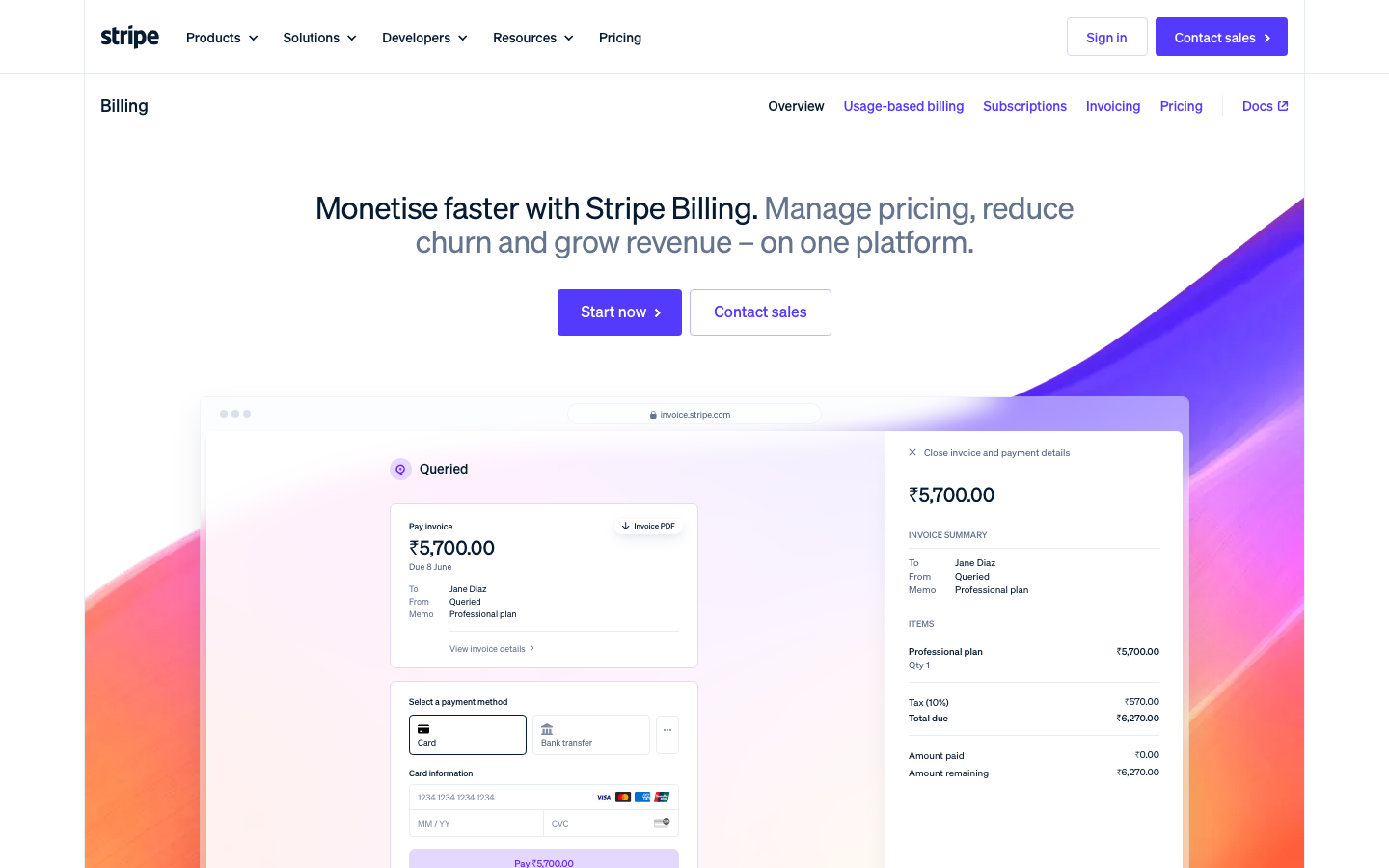
Screenshots of Stripe Billing 4 images
What's great
- 0.5% per recurring charge with no monthly platform fee — on $100K ARR that is $500/year total billing cost, less than two months of a mid-market platform
- Widest native payment method coverage with 135+ countries and 40+ payment methods without separate gateway contracts
- API-first design handles any pricing model (seats, usage, hybrid, one-time plus recurring) without waiting for a product team to build a UI
Watch-outs
- Finance reporting is not included; SaaS metrics require Stripe Sigma queries or external tooling like ChartMogul
- ASC 606 deferred revenue schedules are not automatic; you pay for the Revenue Recognition add-on or build it yourself
- Support is documentation-first at the startup tier; async human support for billing edge cases
Stripe Billing is the default for engineering-led startups. The 0.5% fee means a team doing $500K ARR pays $2,500 in billing fees annually, less than one month of a mid-market billing platform’s cost. 738 G2 reviews at 4.4/5 — praise is consistent around API quality and pricing flexibility. The gap is reporting. If your co-founder is the CFO and needs month-end numbers, they will be running Sigma queries on weekends. That is fine at $500K ARR. It is not fine at $3M ARR when an auditor asks for deferred revenue schedules.
Pricing breakdown
| Plan | Price | Best for |
|---|---|---|
| Starter | 0.5% per transaction | Under $1M ARR, simple billing models |
| Scale | 0.8% per transaction | $1M+ ARR, smart dunning included |
| Revenue Recognition | Custom add-on pricing | ASC 606 automation when needed |
What reviewers say about Stripe Billing
Recurring themes across ~738 G2 reviews (4.4/5), 2024-2026.
What reviewers praise
- The developer experience is the most-cited strength: clean documentation, a consistent well-designed API, and straightforward setup of subscriptions, invoices, and recurring flows without heavy custom engineering.
- Reviewers say Stripe Billing removes the pain of proration, failed-payment retries (Smart Retries), and dunning that previously required in-house code, so recurring revenue runs largely hands-off.
- Tax handling and multi-region compliance via Stripe Tax is repeatedly praised for collecting and remitting across jurisdictions that used to be a manual nightmare.
- Deep integration into the broader Stripe stack (Payments, Checkout, Connect) is called a genuine workflow saver, letting teams keep billing, payments, and payouts under one platform.
What reviewers fault
- Fees add up fast at scale: reviewers flag the per-transaction cut plus an additional percentage layered on top specifically for billing features, which gets expensive for high-volume businesses.
- Many billing essentials sit behind paywalled add-ons, and reviewers argue features they consider core to an online billing system cost extra.
- API rate limits (commonly cited around 100 read/write operations per second in live mode) are called a real growth constraint that B2B companies can hit.
- Reviewers say updating failed cards and generating self-serve payment-update links is clunky, and that out-of-the-box integration with non-Stripe systems could be smoother.
Loading reviews…
LemonSqueezy
Best zero-overhead merchant of record for indie SaaS and micro-products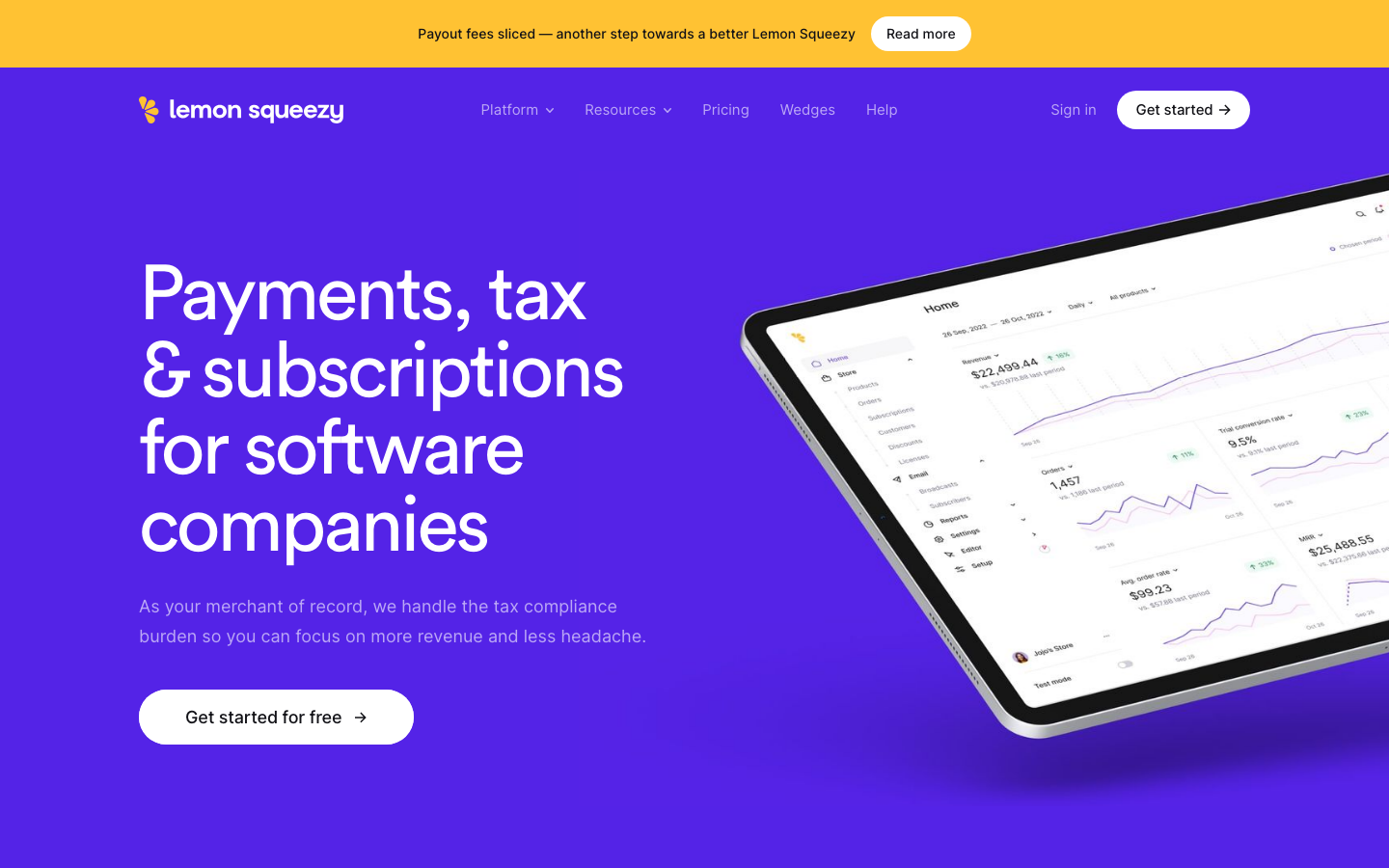
Screenshots of LemonSqueezy 4 images
What's great
- Zero monthly fee with MoR model handling EU VAT, US sales tax, and digital services taxes in 100+ countries with zero configuration
- Acquired by Stripe in 2024, so payment infrastructure reliability now runs on Stripe rails without the complexity of a direct Stripe integration
- Signup to first paying customer can happen in a few hours with hosted checkout links — no backend work required
Watch-outs
- Additional fees stack on international and PayPal transactions; effective rate can reach 8-9% on some international payments
- Product roadmap has slowed since the Stripe acquisition, per consistent community feedback on Reddit and Indie Hackers
- Not designed for B2B enterprise billing; NET-30 invoicing and custom payment terms are not native
LemonSqueezy is the right call when you want to ship a paid product this weekend without thinking about VAT registration. No monthly fee, MoR tax handling out of the box, Stripe infrastructure underneath. 142 G2 reviews at 4.3/5. The 5% rate hurts more as revenue grows, but below $25K MRR it is hard to beat for setup speed and global coverage. Scale past $25K MRR and the fee math starts pointing at Paddle or Chargebee.
Pricing breakdown
| Plan | Price | Best for |
|---|---|---|
| Standard | 5% + $0.50/transaction | Solo founders and indie teams under $25K MRR |
| International surcharge | +1.5% per transaction | Non-US buyers |
What reviewers say about LemonSqueezy
Recurring themes across ~142 G2 reviews (4.3/5), 2024-2026.
What reviewers praise
- The merchant-of-record model wins over indie SaaS and digital sellers: Lemon Squeezy owns the tax obligation and remits sales tax, VAT, and GST across 135+ countries so founders skip registering and filing themselves.
- Setup is fast and beginner-friendly, with reviewers launching a full checkout in minutes and no code required.
- Payments, subscription billing, tax compliance, and digital-file delivery live in one dashboard, which reviewers value for removing separate tools.
- No monthly or setup fee (you pay only the per-transaction 5% + $0.50 when you make a sale) suits solo makers testing products.
What reviewers fault
- The 5% + $0.50 fee is expensive at scale, and international (+1.5%) and PayPal (+1.5%) surcharges stack, hitting EU and non-US sellers hardest.
- Account and payout risk is a recurring worry: reviewers report rejections after document verification and funds frozen or held during account reviews.
- Support has been slower and less responsive since the July 2024 Stripe acquisition, with tickets reportedly going unanswered for weeks.
- Feature scope is limited: no metered or usage-based billing, few integrations beyond email tools, and no real course-building or alternative payment methods.
Loading reviews…
Paddle
Best merchant of record for B2B SaaS with global customers from day one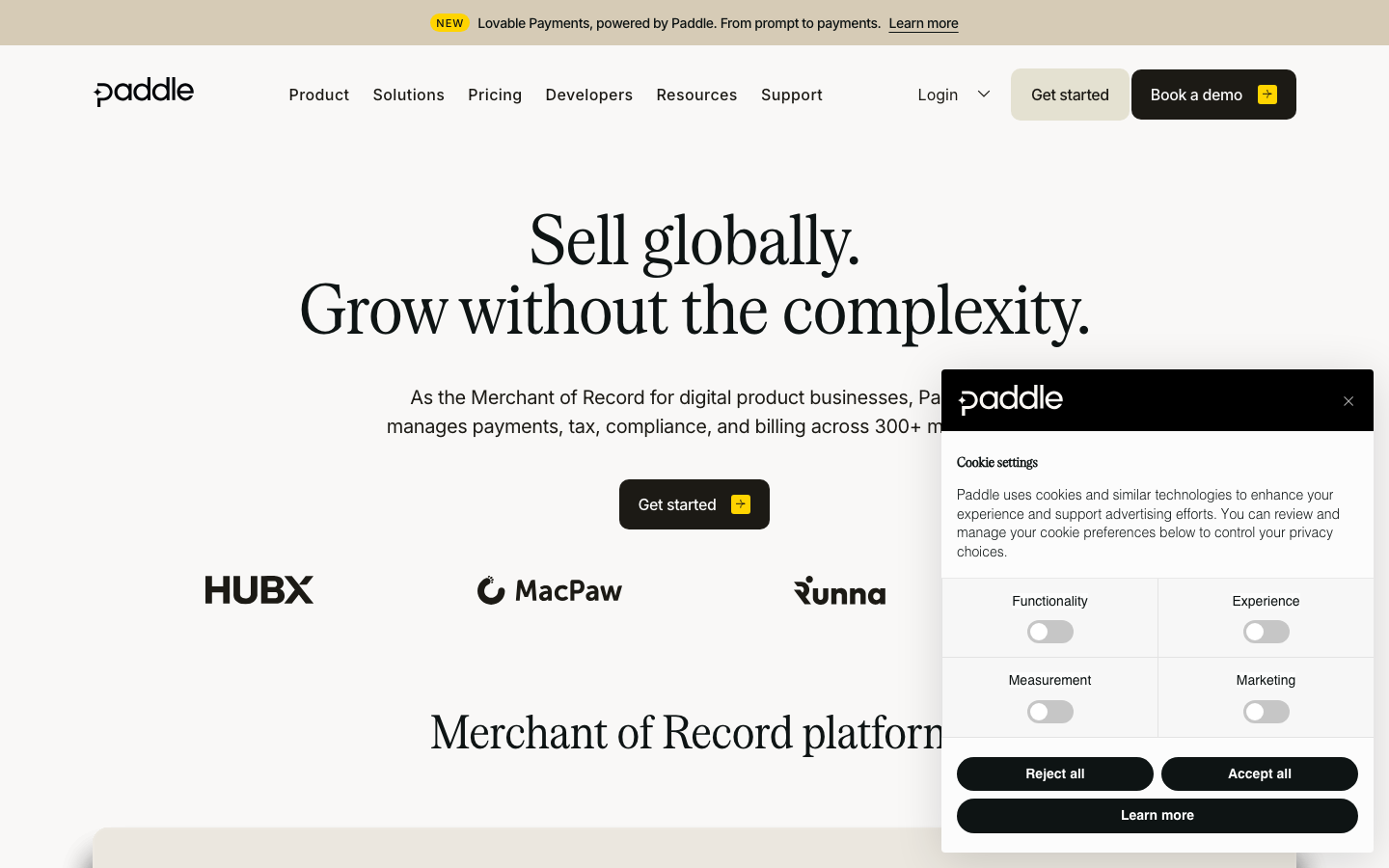
Screenshots of Paddle 4 images
What's great
- Single 5% + $0.50 fee covers checkout, tax in 300+ jurisdictions, fraud protection, and billing support — no Avalara contract, no separate gateway
- ProfitWell Metrics included free with every Paddle account — MRR, churn, and expansion revenue dashboards at zero added cost
- Better suited to B2B SaaS than LemonSqueezy; Paddle handles subscription upgrades, prorations, and annual billing more cleanly
Watch-outs
- 5% becomes expensive past $500K MRR; break-even against a billing platform plus separate tax tool hits around $200K-$300K ARR
- MoR structure creates occasional friction with enterprise procurement teams who want to contract directly with the software vendor
- Less flexible on complex B2B billing patterns like multi-year ramp commitments and enterprise custom invoicing
Paddle is the upgrade from LemonSqueezy when your customer base is B2B and geographically diverse from launch. The same 5% + $0.50 all-in rate covers B2B subscription patterns — upgrades, prorations, annual plans, volume discounts — more cleanly. 232 G2 reviews at 4.5/5, the highest satisfaction in this guide. The case for Paddle strengthens the moment a European customer asks about VAT invoices on day one of their trial.
Pricing breakdown
| Plan | Price | Best for |
|---|---|---|
| Pay as you go | 5% + $0.50/transaction | Under $300K ARR, global from day one |
| Custom volume | Negotiated rate | $300K+ MRR with consistent volume |
| ProfitWell Metrics | $0 included | SaaS metrics dashboards free with Paddle account |
What reviewers say about Paddle
Recurring themes across ~232 G2 reviews (4.5/5), 2024-2026.
What reviewers praise
- The merchant-of-record model is the headline draw: Paddle becomes the seller of record, so global VAT, GST, and sales tax on digital goods is calculated, collected, and remitted for you.
- Because Paddle is the merchant of record, chargebacks and fraud land on them, and reviewers value the dedicated teams that fight disputes on the seller's behalf.
- Reviewers praise a robust API with fast, reliable webhooks that make integration and revenue automation straightforward.
- Customer support gets frequent praise for fast responses and detailed, hands-on guidance during setup.
What reviewers fault
- Onboarding and approval are the biggest pain: reviewers report undisclosed requirements (such as prior payment-processing history) and rejections after a lengthy review, with rules not documented on the site.
- Being merchant of record means giving up direct control of the customer payment relationship, and the closed infrastructure limits unique billing logic or complex usage-based models.
- The flat 5% + $0.50 per-transaction fee is a meaningful cost at scale compared with raw payment processors.
- Discount and coupon-code management is described as limited, and some reviewers report unclear fee structures and restricted currency options.
Loading reviews…
Chargebee
Best startup-to-Series A ramp with dunning automation and RevRec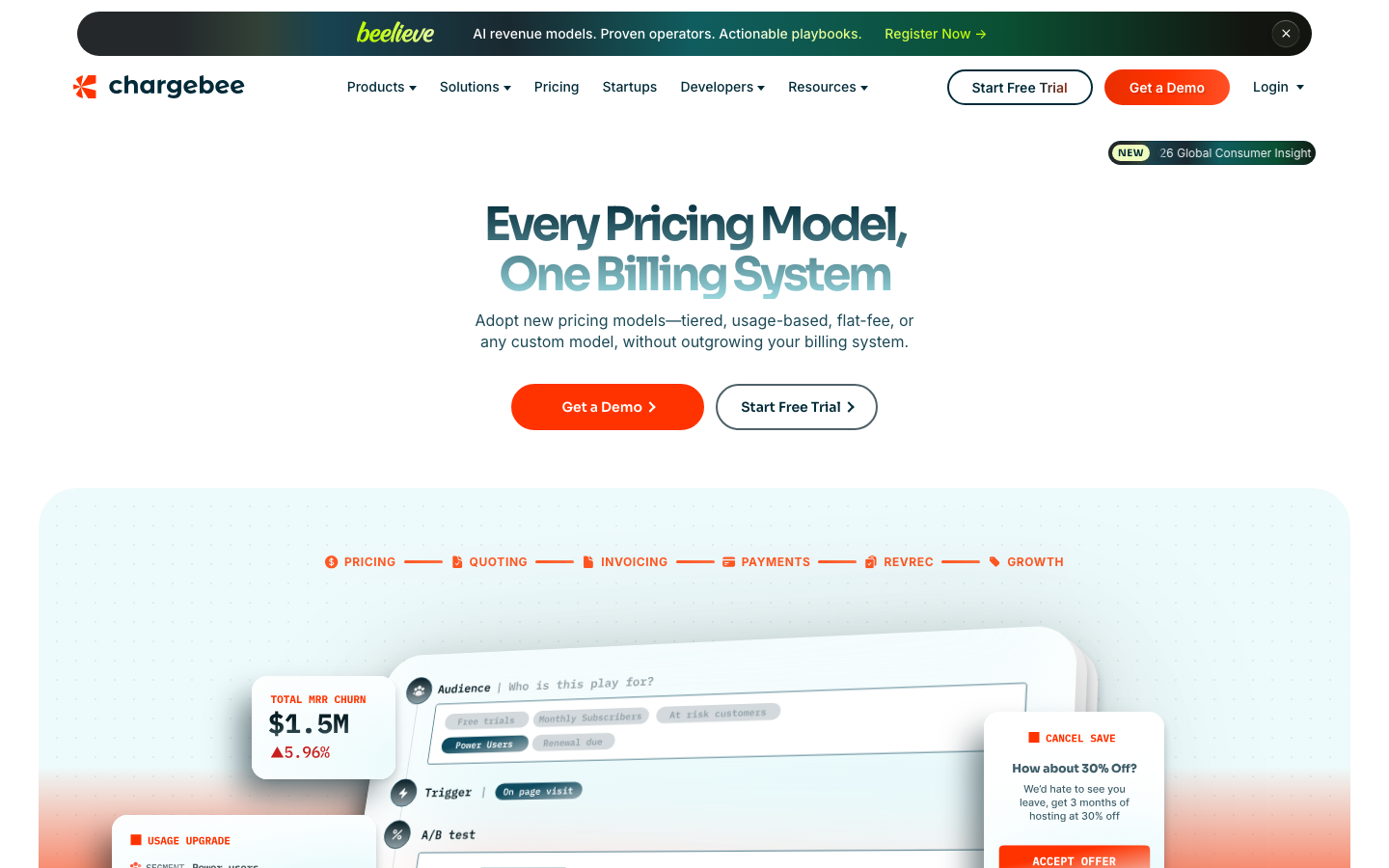
Screenshots of Chargebee 4 images
What's great
- Free until $250K cumulative billing — a genuine zero-cost entry that covers most teams through 12-18 months of their first revenue
- Smart dunning and RevRec module are on the paid tier, so you never migrate to a new platform as you scale into Series A
- 995 G2 reviews means you can find a real operator who has been through the exact billing scenario you are building for
Watch-outs
- Jump from free to Performance at $7,188/year is steep; teams crossing $250K billing face a real cost cliff
- Multi-entity billing is Enterprise-only, which creates friction if you incorporate in multiple jurisdictions early
- Setup is more involved than Stripe Billing; plan on a week to configure product catalog, pricing, and dunning correctly
Chargebee ranks fourth for startups not because it is worse, but because the free tier is a one-time runway that ends. The first $250K cumulative billing is free, then you pay $599/month. For a team at $800K ARR that crossed the $250K threshold 12 months ago, Chargebee is already the right platform. For a team at $50K ARR deciding today, Stripe Billing keeps more runway intact. 995 G2 reviews at 4.4/5. Start here if you know you will be B2B with complex dunning needs within 18 months.
Pricing breakdown
| Plan | Price | Best for |
|---|---|---|
| Starter | Free to $250K cumulative billing | Pre-revenue to early traction |
| Performance | $7,188/yr ($599/mo) | $1M-$30M ARR with dunning and RevRec |
| Enterprise | Custom quote | Multi-entity, $30M+ ARR |
What reviewers say about Chargebee
Recurring themes across ~995 G2 reviews (4.4/5), 2024-2026.
What reviewers praise
- Automated dunning and smart retries are the standout: reviewers report the follow-up emails and retry logic measurably cut involuntary churn without manual chasing.
- The customer self-service portal for managing subscriptions, upgrades, and cancellations is praised for removing day-to-day billing overhead from finance and support teams.
- Chargebee handles complex billing scenarios (multiple plans, proration, coupons, tiered pricing) that reviewers say would otherwise need heavy custom development.
- Broad integrations and a generally user-friendly interface make it straightforward to plug into existing CRM, accounting, and payment stacks.
What reviewers fault
- Analytics and reporting are the most common gap: reviewers say Chargebee shows billing and invoicing figures but not a full view of business health, with weak dashboards and limited customer segmentation.
- Pricing frustrates teams as they scale, with a sharp jump between tiers and revenue-based overage fees that several reviewers describe as a success tax.
- Customer support quality is a recurring complaint across G2, Capterra, and TrustRadius, with slow or unhelpful responses cited repeatedly.
- Customization is restricted in places, and some reviewers report a poor cancellation and refund experience, including being renewed after attempting to cancel.
Loading reviews…
Zoho Billing
Best budget billing option for teams already in the Zoho ecosystem
What's great
- Permanent free plan handles up to 20 active subscriptions with full invoicing, dunning, and multi-currency support
- Native integration with Zoho CRM, Zoho Books, and Zoho Analytics means no extra middleware cost for teams already in the Zoho stack
- $49/month Basic tier is the most affordable entry into a full-featured billing platform with unlimited subscriptions
Watch-outs
- Limited payment gateway options; works best with Zoho Payments or Stripe, not ideal for teams with a preferred gateway already in place
- UI and workflow depth lag behind Chargebee and Stripe Billing; complex pricing model configurations require workarounds
- Not a viable standalone option outside the Zoho ecosystem; ROI depends heavily on using other Zoho products
Zoho Billing earns its place for one reason: the free plan is real. Twenty active subscriptions, unlimited invoices, dunning, and multi-currency at zero cost. 225 G2 reviews at 4.3/5. If you are bootstrapped, running Zoho CRM already, and not yet sure whether subscriptions are your main model, Zoho Billing is a legitimate no-cost starting point. Step up to $49/month when you exceed 20 subscribers. The ceiling is low and the ecosystem lock-in is real, but at the very start those two things are also its advantage.
Pricing breakdown
| Plan | Price | Best for |
|---|---|---|
| Free | $0/month | Up to 20 active subscriptions |
| Basic | $49/month | Unlimited subscriptions, full dunning |
| Standard | $149/month | Advanced workflows, multi-currency, analytics |
What reviewers say about Zoho Billing
Recurring themes across ~2,900 G2 reviews (4.1/5) and Capterra reviews (4.3/5), 2024-2026.
What reviewers praise
- Price-to-feature ratio is the most repeated compliment: reviewers say Zoho delivers lead scoring, workflow automation, and multi-currency support at a fraction of the cost of HubSpot or Salesforce.
- Depth of the Zoho ecosystem is consistently praised by teams already using Zoho Books, Zoho Desk, or Zoho Campaigns, who describe the cross-app data flow as a genuine alternative to buying multiple point solutions.
- The Canvas drag-and-drop UI builder, added in recent years, appears in newer positive reviews as a meaningful upgrade, letting non-technical admins redesign the record layout without code.
- Workflow automation breadth gets strong marks, with reviewers pointing to multi-condition rules, scheduled actions, and blueprint approval processes as features competitors lock behind enterprise tiers.
- Lead management tools including assignment rules, scoring, and conversion tracking are frequently cited as thorough and configurable for teams with defined sales processes.
What reviewers fault
- Customer support is the single most common complaint across G2 and Capterra, with reviewers on standard plans describing slow ticket responses, inconsistent answers, and difficulty escalating urgent issues.
- The learning curve is steep enough that multiple reviewers recommend hiring a Zoho consultant for initial setup, especially for automation, Deluge scripting, and module customization.
- The mobile app has reliability problems that appear consistently in recent reviews, including bugs that prevent notes from displaying, missed call logs, and crashes under poor connectivity.
- Integration with non-Zoho tools is frequently described as more friction than the docs suggest, with third-party connectors requiring Zapier workarounds or custom API work for stable two-way sync.
- The interface, despite recent improvements, is still called cluttered and overwhelming by first-time CRM buyers, and the density of settings can make routine tasks harder to find than in leaner tools.
Loading reviews…
Tools we considered but excluded
We evaluated more tools than the 5 you see above. These did not make the cut. Saying what we rejected, and why, is the editorial muscle most listicles skip.
- Maxio: Best-fit ARR is $5M-$100M; implementation overhead and $599/mo entry point do not fit pre-Series A teams
- Recurly: B2C subscription focus and custom-quote pricing require a sales process that is overkill for teams under $1M ARR
- Zuora: Enterprise billing platform; minimum contract is $30K-$50K/year with $100K+ implementation overhead
- Salesforce Revenue Cloud: Requires Sales Cloud Enterprise at $165/user/mo; not relevant before a 50-seat sales team
- Stax Bill: $499/mo flat fee makes sense past $500K ARR; too expensive per dollar of revenue before that
Honorable mentions
Solid tools that did not crack the main list but are worth tracking, especially for niche use cases.
- Billsby: Transparent $35/mo flat fee for sub-$50K MRR teams that find Chargebee Starter too complex; underrated in the sub-$1M ARR band
- Younium: Strong for B2B SaaS approaching $1M ARR with usage-based components baked into contract terms
The billing platform you pick at $0 ARR should not be the one you build around forever. It should cost least to start and scale cleanly to your next stage.
Three things actually matter upfront. Whether you want a monthly platform fee or transaction-only pricing. Whether you need merchant of record tax handling or are comfortable managing tax separately. And whether you expect a dedicated billing admin within 12 months.
The platform fee versus transaction-only question is the first filter. Stripe Billing and Paddle charge no monthly seat. Zoho Billing has a permanent free plan for the first 20 subscriptions. Chargebee is free through $250K cumulative billing then jumps to $599/month. For a team at $20K MRR, the difference between $0 and $599 per month is material.
The MoR versus self-managed tax question is the second filter. Paddle and LemonSqueezy handle EU VAT, US sales tax, and digital services taxes as the legal seller. You get net revenue and never see a tax filing. Stripe Billing and Zoho Billing leave tax collection to you. At launch, the MoR model removes a real compliance headache. Past $300K ARR, the percentage premium starts hurting more than the compliance burden.
Startup billing cost at $100K ARR
| Platform | Monthly fee | Transaction fee at $100K ARR | Annual billing cost |
|---|---|---|---|
| Stripe Billing | $0 | $500 (0.5%) | ~$500 |
| LemonSqueezy | $0 | $5,000 (5%) | ~$5,000 |
| Paddle | $0 | $5,000 (5%) | ~$5,000 |
| Chargebee Starter | $0 | $0 (free tier) | $0 |
| Zoho Billing Basic | $588 ($49/mo) | $0 (flat fee) | ~$588 |
Stripe Billing wins on cost at $100K ARR for teams with engineering bandwidth. Chargebee is free until $250K cumulative billing. The MoR options cost 10x more per dollar of revenue but include tax compliance that is genuinely worth something for globally distributed customer bases.
Where early teams get the billing decision wrong
Buying a mid-market billing platform too early is the most common mistake. Signing a Maxio or Recurly contract at $300K ARR because the sales team sold the Series A story. That $7,200+ annual contract is real cost at a stage where runway still matters.
The second mistake is ignoring the upgrade path. Picking a platform with no RevRec module, then realizing 18 months later you need to migrate for ASC 606 compliance. The migration costs 3-6 weeks of engineering time and often corrupts historical subscription data.
Start with what costs least. Upgrade when the finance team’s operational pain exceeds the migration cost. That crossover usually happens somewhere between $1M and $3M ARR.
For the full comparison across all 11 billing platforms including enterprise options, see our complete subscription billing guide .
Also relevant: Best Subscription Billing for SMBs and Best Enterprise Subscription Billing .
Frequently asked questions
What is the cheapest billing platform for a new SaaS startup?
Zoho Billing's free plan handles 20 subscriptions at zero cost. For teams expecting to grow quickly, Stripe Billing at 0.5% per transaction beats any fixed monthly seat until ARR reaches several hundred thousand dollars.
When should a startup switch off Stripe Billing to a dedicated platform?
Two triggers. First, if failed-payment churn is measurable and growing, Chargebee's smart dunning pays for itself. Second, if your CFO or auditor asks for ASC 606 deferred revenue schedules, you need a RevRec layer Stripe does not include by default.
Does Paddle handle tax for startups selling to EU customers?
Yes. Paddle acts as merchant of record and collects EU VAT with no configuration. You receive net revenue; Paddle handles the tax filings. Worth the 5% fee for any startup with significant EU exposure from day one.
Can I stay on Chargebee's free tier indefinitely?
No. The free Starter tier covers the first $250K of cumulative billing then converts to 0.75% (minimum $599/month). Most teams hit this threshold within 12-24 months of launching paid billing.
Is LemonSqueezy or Paddle better for a solo indie SaaS founder?
LemonSqueezy for consumer-facing or developer-tool products where buyers pay with a card and expect an instant checkout. Paddle for B2B SaaS where customers expect business invoices and may pay from multiple countries.
Related helpful reads
Write a review
Posts to the page right away. Keep it real — no links or email addresses.