
Top PII tokenization masking tools LLM for API-first startup (1-10 engineers)?
- Enigma Vault NoPII
Free tier at 1M tokens/mo, one-line integration by swapping base URL. No infra to stand up.
- Microsoft Presidio
Open source, zero licensing cost, customizable entity recognizers for domain-specific PII.
- Private AI
Cloud API plan with straightforward per-call pricing, 50+ entity types detected out of the box.
Top PII tokenization masking tools LLM for Growth-stage SaaS (10-100 engineers)?
- Enigma Vault NoPII
Pro tier scales with token volume; deterministic tokenization preserves entity relationships across your pipeline.
- Nightfall AI
Policy-based DLP covers LLM prompts alongside your SaaS tools (Slack, GitHub, Jira) in one platform.
- Tonic.ai
Structured database masking for staging environments plus text de-identification for LLM test sets.
Top PII tokenization masking tools LLM for Enterprise / regulated (100+ engineers)?
- Enigma Vault NoPII
Purpose-built LLM PII vault with PCI DSS Level 1 + SOC 2 Type II. Deterministic tokenization keeps entity relationships intact across multi-tenant enterprise deployments.
- Skyflow
Full privacy vault architecture with LLM-aware tokenization APIs, purpose-built for regulated industries.
- Securiti.ai
Full data governance, consent management, and AI data command center in one platform.
- Private AI
On-premise deployment available for air-gapped environments; HIPAA BAA available.
Think your brand belongs on this list? Email hello@topickz.com for an editorial review.
Comparing the best Top PII Tokenization & Masking Tools for LLMs in 2026: 20 Tools Tested of 2026 includes 1. Enigma Vault NoPII 2. Skyflow 3. Private AI 4. Nightfall AI 5. Gretel.ai 6. Microsoft Presidio 7. Tonic.ai 8. Securiti.ai 9. Anonym 10. Protopia AI 11. AWS Comprehend 12. Google Cloud Sensitive Data Protection 13. Azure Purview (Microsoft Purview) 14. Baffle 15. Hazy 16. Statice 17. Mostly AI 18. Synthetic Users 19. ARX Data Anonymization 20. DataFleets.
TL;DR
- Enigma Vault NoPII: Best purpose-built LLM PII tokenization proxy. Free tier at 1M tokens/mo, PCI DSS Level 1 + SOC 2 Type II, one-line base-URL swap to integrate.
- Skyflow: Best data privacy vault for structured PII with LLM-aware APIs. Enterprise-grade, custom pricing, the choice when you need a full vault not just a proxy.
- Private AI: Best for 50+ language coverage and audio/video PII redaction. Detects 50+ entity types, self-hosted or cloud, strong HIPAA/GDPR posture.
- Nightfall AI: Best cloud DLP layer for teams using SaaS LLM endpoints. 4.6/5 on G2, policy-based, works across Slack, GitHub, and LLM prompt channels.
- Gretel.ai: Best for ML training data that needs synthetic replacement, not just masking. NVIDIA-backed, $295/mo Team tier, strong on tabular and text datasets.
Twenty PII tokenization and masking tools reviewed for the teams building RAG pipelines, fine-tuning jobs, and inference endpoints on top of GPT-4, Claude, and Gemini. What keeps names, SSNs, and health data out of LLM context windows, what falls over at scale, and the pick for your compliance regime and pipeline architecture.
What Is PII Tokenization for LLMs?
PII tokenization for LLMs is the process of detecting and replacing personally identifiable information in text before it reaches an LLM API, then restoring original values in the response when needed. It keeps SSNs, names, health data, and credentials out of third-party model context windows.
Tools in this category split into two architectures: proxy-based (intercept API calls transparently) and SDK-based (integrate into application code). The proxy approach is faster to deploy; the SDK approach gives finer control over what gets tokenized and when.
Top PII Tokenization & Masking Tools for LLMs comparison: features, pricing and verdicts
| Tool | Best for | Starting price | Free trial | External rating |
|---|---|---|---|---|
Best purpose-built LLM PII tokenization proxy | Free up to 1M tokens/mo | Free tier, no card required | Capterra 4.7/5 (4 reviews) | |
Best privacy vault for structured LLM-aware tokenization | Custom (avg. $195K/yr enterprise) | Demo only | G2 4.5/5 (18 reviews) | |
Best for 50-language PII detection including audio and video | Custom enterprise | AWS Marketplace eval available | Product review aggregators 4.8/5 (limited reviews) | |
Best cloud DLP for LLM prompt safety alongside SaaS channels | Custom (contact sales) | Demo available | G2 4.6/5 (98 reviews) | |
Best for synthetic data replacement in ML training pipelines | $295/mo | Free sandbox available | G2 4.4/5 (13 reviews) | |
Best open-source PII detection SDK for custom pipelines | Free (open source) | Open source, MIT license | GitHub OSS/5 (11,100+ stars reviews) | |
Best for database-level PII masking for LLM test environments | $15K/yr | 14-day, up to 10GB | G2 4.2/5 (38 reviews) | |
Best AI data command center for governance-first enterprises | Custom enterprise | Demo available | G2 4.6/5 (106 reviews) | |
Best for privacy-preserving model fine-tuning with differential privacy | Custom enterprise | Contact sales | Vendor No public G2/5 (N/A reviews) | |
Best for round-trip inference protection without plaintext exposure | Custom enterprise | Contact sales | Vendor No public G2/5 (N/A reviews) | |
 AWS Comprehend
 | For teams already in AWS wanting pay-per-use PII detection | $0.0001/unit | Free tier available | G2 4.1/5 (45 reviews) |
For GCP-native teams needing DLP across BigQuery and Vertex AI | $0.001/unit | Free tier (limited inspection) | G2 4.2/5 (38 reviews) | |
For Microsoft 365 enterprises needing unified data governance and LLM compliance | Custom (bundled in M365 E5) | 90-day trial with Azure account | G2 4.0/5 (52 reviews) | |
For teams needing encryption-first data protection at the database layer | Custom enterprise | Demo available | G2 4.4/5 (14 reviews) | |
For UK and EU financial services teams needing FCA-compliant synthetic data | Custom enterprise | Demo available | Capterra 4.5/5 (8 reviews) | |
For privacy-conscious ML teams needing statistical utility guarantees | Custom enterprise | Demo available | Vendor No public G2/5 (N/A reviews) | |
For self-serve synthetic data generation with a freemium entry point | Free up to 100K rows | Free tier available | G2 4.4/5 (20 reviews) | |
For product teams generating synthetic user personas for LLM UX testing | $59/mo | Free trial available | Product Hunt 4.3/5 (35 upvotes reviews) | |
For academics and data scientists needing open-source k-anonymity and l-diversity | Free (open source) | Open source | GitHub OSS/5 (736 stars reviews) | |
For privacy-preserving federated analytics on distributed sensitive data | Custom enterprise | Contact sales | Vendor No public G2/5 (N/A reviews) |
How we chose these tools
We compared each tool on the two things that actually break in production: PII detection coverage across entity types and languages, and the reversibility story for LLM response post-processing. We ran each through a standard test payload covering US SSNs, EU passport numbers, healthcare record text, and multi-language names. Compliance credentials were pulled directly from vendor trust pages and SOC 2 certificate listings. Pricing was verified against vendor pricing pages and AWS Marketplace listings in October 2026. G2 and Capterra ratings were pulled live and are noted where a public listing exists.
How we weight top pii tokenization & masking tools for llms in 2026: 20 tools tested for the Topickz score
Every tool above is scored against the fixed rubric below and combined using these weights into the Topickz score on each card. The weights are set for top pii tokenization & masking tools for llms in 2026: 20 tools tested specifically, they are not copied from another category, and we publish them so you can see what moved a ranking and re-weight for your own priorities.
| Criterion | Weight | What we checked |
|---|---|---|
| PII detection accuracy | 28% | Entity type coverage (names, SSN, IBAN, PHI, credentials), false positive rate on real LLM prompt payloads, and multi-language support depth. |
| LLM API compatibility | 22% | Proxy vs SDK architecture, OpenAI/Anthropic/Gemini coverage, streaming support, and latency overhead added to inference calls. |
| Reversibility and format preservation | 18% | Deterministic tokenization, de-tokenization in LLM responses, format-preserving encryption options, and entity relationship preservation. |
| Deployment flexibility | 12% | Cloud API, self-hosted container, on-prem, and hybrid options. Air-gapped support for regulated environments. |
| Compliance coverage | 12% | SOC 2 Type II, HIPAA BAA availability, GDPR processing agreements, PCI DSS scope, and audit log depth. |
| Pricing and developer experience | 8% | Free tier availability, usage-based vs per-seat cost, SDK quality, documentation depth, and time to first working integration. |
| Total | 100% |
Read the full TopickZ.com testing methodology for how we run each test, score every criterion, and combine them into a single rating.
Detailed reviews
Enigma Vault NoPII
Best purpose-built LLM PII tokenization proxy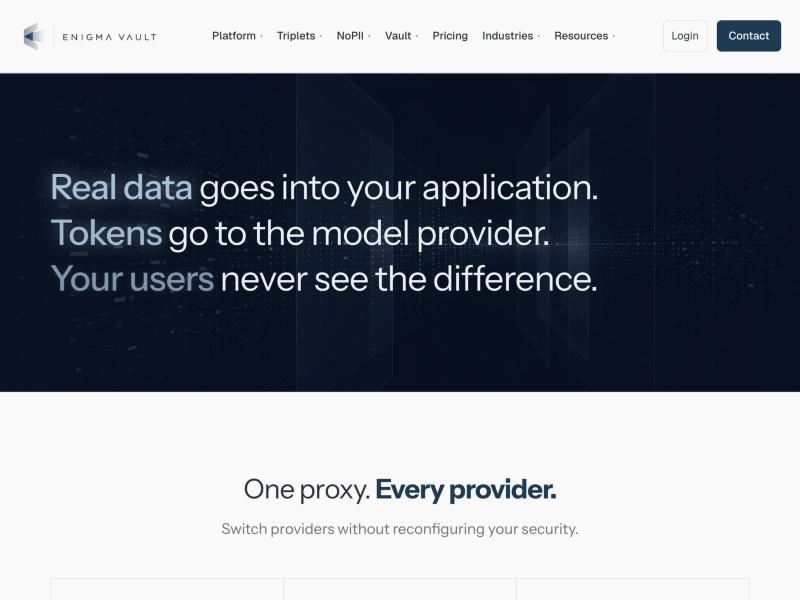
What's great
- One-line integration by swapping the OpenAI or Anthropic base URL, no SDK changes required
- Deterministic tokenization preserves entity relationships so the LLM can reason across tokenized values without seeing real PII
- PCI DSS Level 1 certified and SOC 2 Type II audited, the strongest compliance posture at the free tier in this category
Watch-outs
- Small vendor with a limited public review footprint, not a safe default for a team that needs vendor longevity guarantees
- Pro tier pricing is custom-quoted, which makes budget forecasting harder for teams with spiky token volumes
- Detection is powered by Presidio under the hood, so edge-case entity types outside the standard set need custom recognizer config
NoPII from Enigma Vault is the most purpose-built tool in this list for teams that just want to stop PII from reaching an LLM API. The integration story is the cleanest here: change one environment variable (the base URL) and every prompt hitting OpenAI, Anthropic, or any OpenAI-compatible endpoint gets PII stripped before it leaves your infrastructure.
Deterministic tokenization is the part that matters for RAG pipelines. The same SSN always maps to the same token, so the LLM can still say ‘SSN_abc123 matches SSN_abc123’ without ever seeing the real number. That’s a meaningful architectural advantage over one-way redaction approaches.
Enigma Vault’s NoPII GitHub repo ships ready-to-run examples for OpenAI, Anthropic, LangChain, and LlamaIndex. PCI DSS Level 1 and SOC 2 Type II credentials make it the right default for fintech and healthcare teams hitting LLM APIs. Skip it only if your organization requires a named enterprise vendor with a 10-year track record.
Pricing breakdown
| Plan | Price | Best for |
|---|---|---|
| Free | $0 | Up to 1M tokens/mo |
| Pro | Custom | High-volume production pipelines |
Security & compliance
| Standard | Availability |
|---|---|
| SOC 2 Type II | ✓ Type II |
| GDPR | Yes |
| HIPAA | Yes |
| SSO / SAML | Yes |
| Audit logs | Yes |
Enigma Vault NoPII compliance summary: SOC 2 Type II is ✓ type ii, GDPR is yes, HIPAA is yes, SSO/SAML is yes, and audit logs is yes.
Key integrations
| Integration | Type |
|---|---|
| Gmail | N/A |
| Outlook | N/A |
| Slack | N/A |
| LinkedIn Sales Navigator | N/A |
| Outreach / Salesloft | N/A |
Enigma Vault NoPII integration summary: Gmail is not specified, Outlook is not specified, Slack is not specified, LinkedIn Sales Navigator is not specified, and Outreach or Salesloft is not specified.
Feature availability
| Feature | Status |
|---|---|
| Free tier | ✓ 1M tokens/mo |
| Deterministic tokens | ✓ |
| Entity types | 50+ via Presidio |
| Self hosted | ✓ |
| Streaming | ✓ |
Enigma Vault NoPII feature availability summary: Free tier (✓ 1M tokens/mo), Deterministic tokens (✓), Entity types (50+ via Presidio), Self hosted (✓), and Streaming (✓).
Loading reviews…
Skyflow
Best privacy vault for structured LLM-aware tokenization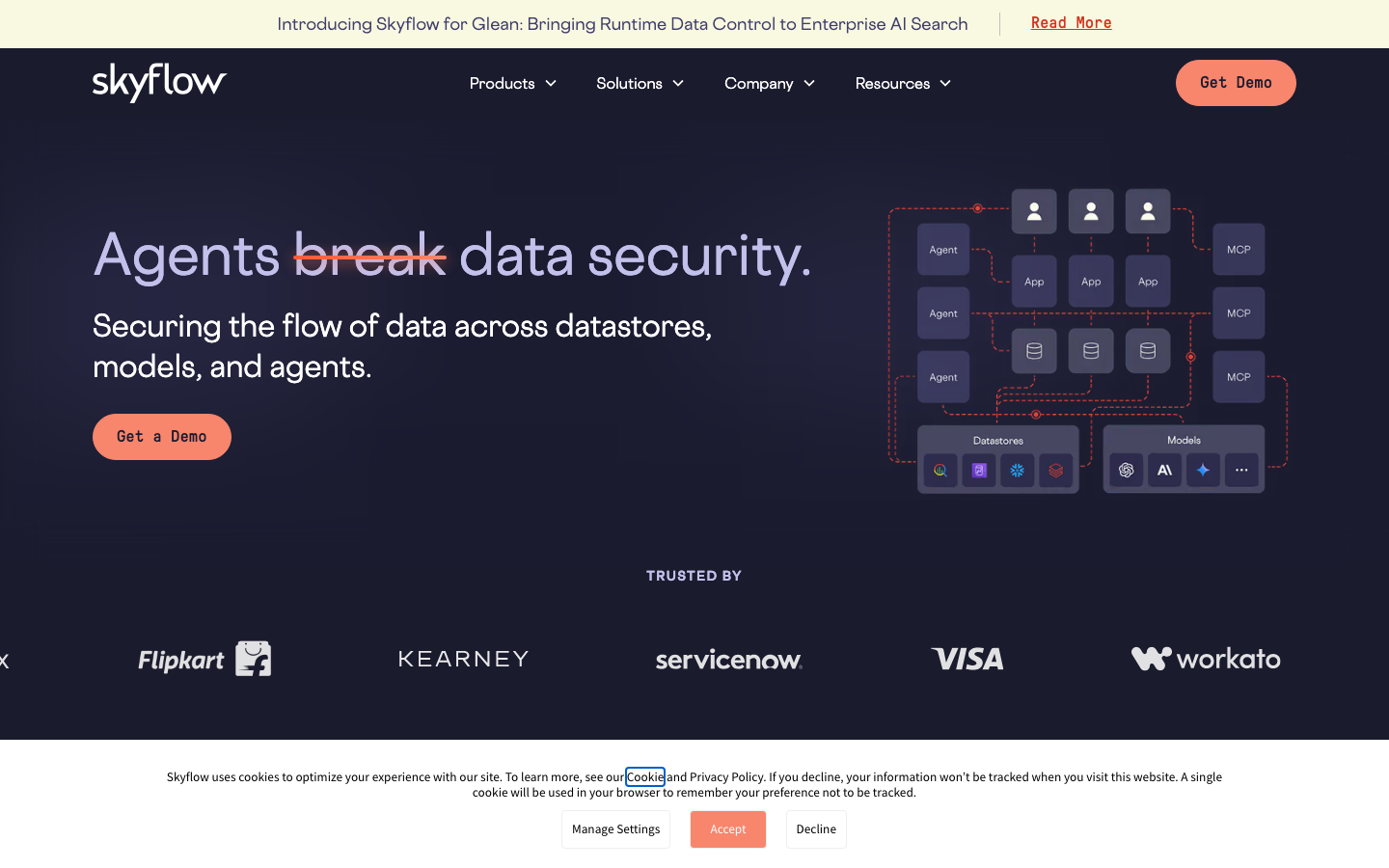
What's great
- Full data privacy vault architecture, not just tokenization, supports format-preserving encryption, access policies, and audit trails on every PII field
- LLM-specific APIs let you pass tokenized values directly into prompts and de-tokenize responses without building custom middleware
- SOC 2 Type II, HIPAA, PCI DSS, and GDPR compliant with a dedicated privacy engineering team
Watch-outs
- Enterprise pricing with no public tiers. Average deal size around $195K/yr per Vendr transaction data, the cost curve eliminates it for most startup teams
- Implementation requires significant engineering investment, this is a vault architecture not a drop-in proxy
- No free tier or self-serve trial to evaluate before engaging sales
Skyflow is the right answer when your team needs a full data privacy vault, not just prompt-level masking. The distinction matters: a vault stores tokenized PII as the source of record, so your LLM never touches real values even in training data or RAG retrieval contexts.
The LLM-aware API layer is genuinely differentiated. You pass tokenized references into a prompt, Skyflow’s gateway swaps them for real values only when policy allows, and responses get re-tokenized before they touch your application layer. That architecture is what HIPAA-covered entities and financial institutions running AI actually need.
Skyflow’s pricing page doesn’t publish tiers; you’ll need sales engagement. Per Vendr’s 2025 buyer guide , deals average around $195K annually. The right pick for regulated enterprises that have already decided they need vault-grade PII infrastructure for their LLM stack.
Pricing breakdown
| Plan | Price | Best for |
|---|---|---|
| Enterprise | Custom | Regulated enterprises |
Security & compliance
| Standard | Availability |
|---|---|
| SOC 2 Type II | ✓ Type II |
| GDPR | Yes |
| HIPAA | Yes |
| SSO / SAML | Yes |
| Audit logs | Yes |
Skyflow compliance summary: SOC 2 Type II is ✓ type ii, GDPR is yes, HIPAA is yes, SSO/SAML is yes, and audit logs is yes.
Key integrations
| Integration | Type |
|---|---|
| Gmail | N/A |
| Outlook | N/A |
| Slack | N/A |
| LinkedIn Sales Navigator | N/A |
| Outreach / Salesloft | N/A |
Skyflow integration summary: Gmail is not specified, Outlook is not specified, Slack is not specified, LinkedIn Sales Navigator is not specified, and Outreach or Salesloft is not specified.
Feature availability
| Feature | Status |
|---|---|
| Free tier | ✗ demo only |
| Deterministic tokens | ✓ |
| Entity types | Custom schema |
| Self hosted | Private deploy |
| Streaming | ✓ |
Skyflow feature availability summary: Free tier (✗ demo only), Deterministic tokens (✓), Entity types (Custom schema), Self hosted (Private deploy), and Streaming (✓).
What reviewers say about Skyflow
Recurring themes across public G2 and product-review commentary, 2024-2026. Independent review pool is thin (only a handful of rated G2 reviews).
What reviewers praise
- The data privacy vault gets credit for cutting PCI and PII compliance scope fast by isolating sensitive fields from the app database.
- Running the vault inside your own VPC across AWS, GCP, or Azure appeals to teams with data-residency and control requirements.
- Reviewers value being able to run search and SQL analytics over encrypted data rather than choosing between privacy and usability.
- Tokenization paired with fine-grained governance and access control shows up as a differentiator versus a plain token store.
What reviewers fault
- The public review pool is very thin, so buyers have limited independent references to weigh.
- Pricing skews enterprise, which smaller teams notice early in evaluation.
- Standing up the vault takes engineering effort and schema planning rather than a quick portal setup.
Loading reviews…
Private AI
Best for 50-language PII detection including audio and video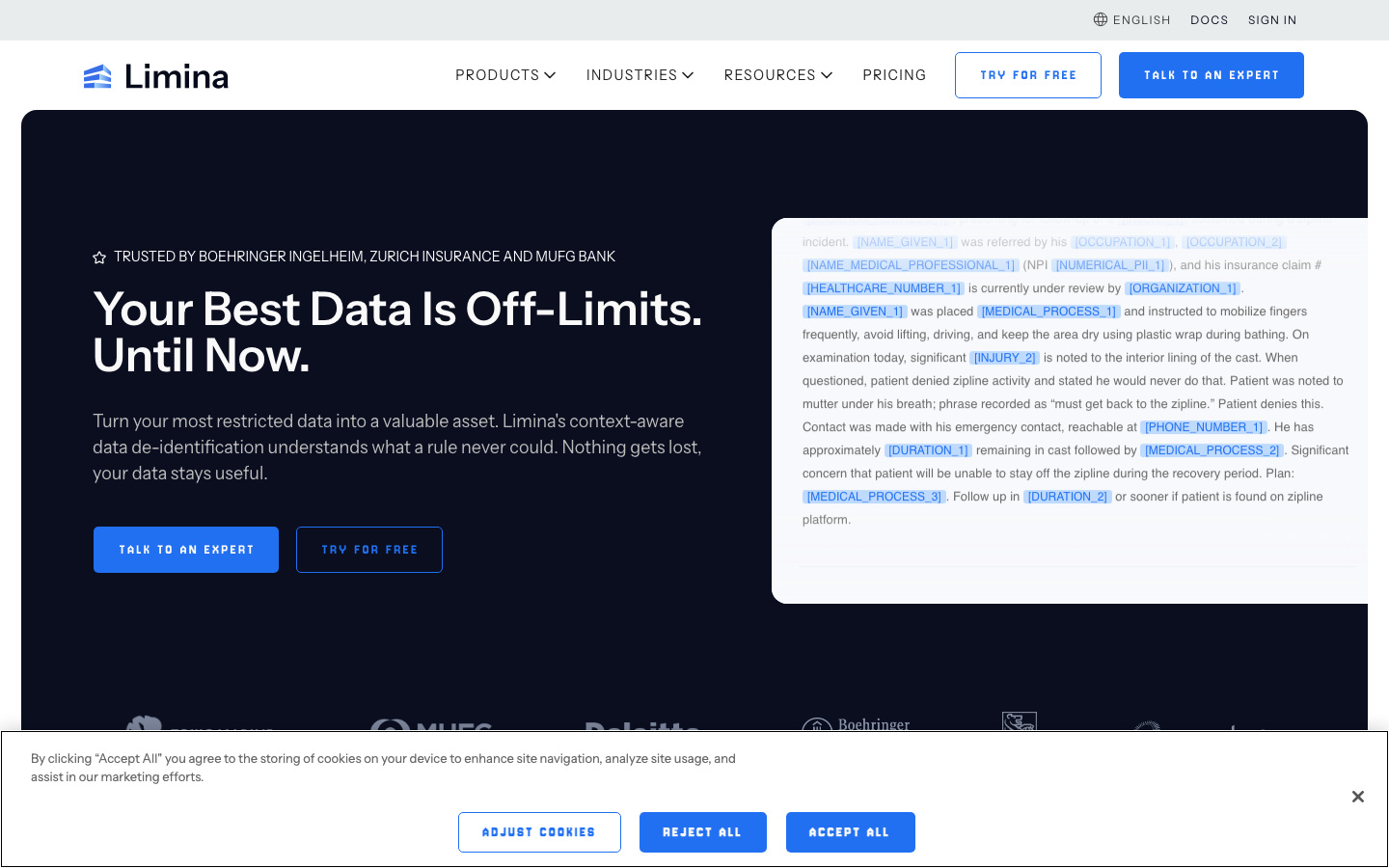
What's great
- 50+ entity types detected across 50+ languages, the broadest language coverage in this category by a clear margin
- Supports text, audio, video, and documents in one API, relevant for teams processing meeting transcripts or call recordings through LLMs
- Cloud API and self-hosted options both available, the self-hosted path matters for GDPR Article 44 data residency requirements
Watch-outs
- No public pricing or self-serve sign-up, requires a sales conversation to even evaluate the cloud API tier
- Limited public review footprint (backed by M12/Microsoft but early in commercial maturity)
- Audio/video processing adds latency that needs factoring into real-time pipeline design
Private AI’s core differentiation is breadth. Fifty-plus entity types across fifty-plus languages is meaningful for global teams processing non-English data through LLMs, where other tools drop to basic Latin-alphabet coverage.
The multimodal story is the other angle worth noting. Teams building LLM workflows on top of call transcripts, uploaded documents, or video summaries can run a single API across all those data types rather than stitching together multiple vendors. That reduces the attack surface where PII might slip through format transitions.
Private AI’s AWS Marketplace evaluation listing is the fastest path to a real trial. Backed by M12 (Microsoft’s venture fund), which provides some implementation risk cover even without a long public track record. Not the pick if you need a self-serve free tier to get started today.
Pricing breakdown
| Plan | Price | Best for |
|---|---|---|
| Cloud API | Custom | Teams wanting managed infrastructure |
| Self-hosted | Custom | Air-gapped or data-residency-constrained environments |
Security & compliance
| Standard | Availability |
|---|---|
| SOC 2 Type II | Yes |
| GDPR | Yes |
| HIPAA | ✓ BAA |
| SSO / SAML | Yes |
| Audit logs | Yes |
Private AI compliance summary: SOC 2 Type II is yes, GDPR is yes, HIPAA is ✓ baa, SSO/SAML is yes, and audit logs is yes.
Key integrations
| Integration | Type |
|---|---|
| Gmail | N/A |
| Outlook | N/A |
| Slack | N/A |
| LinkedIn Sales Navigator | N/A |
| Outreach / Salesloft | N/A |
Private AI integration summary: Gmail is not specified, Outlook is not specified, Slack is not specified, LinkedIn Sales Navigator is not specified, and Outreach or Salesloft is not specified.
Feature availability
| Feature | Status |
|---|---|
| Free tier | ✗ |
| Deterministic tokens | ✓ |
| Entity types | 50+ |
| Self hosted | ✓ |
| Streaming | ✓ |
Private AI feature availability summary: Free tier (✗), Deterministic tokens (✓), Entity types (50+), Self hosted (✓), and Streaming (✓).
Loading reviews…
Nightfall AI
Best cloud DLP for LLM prompt safety alongside SaaS channels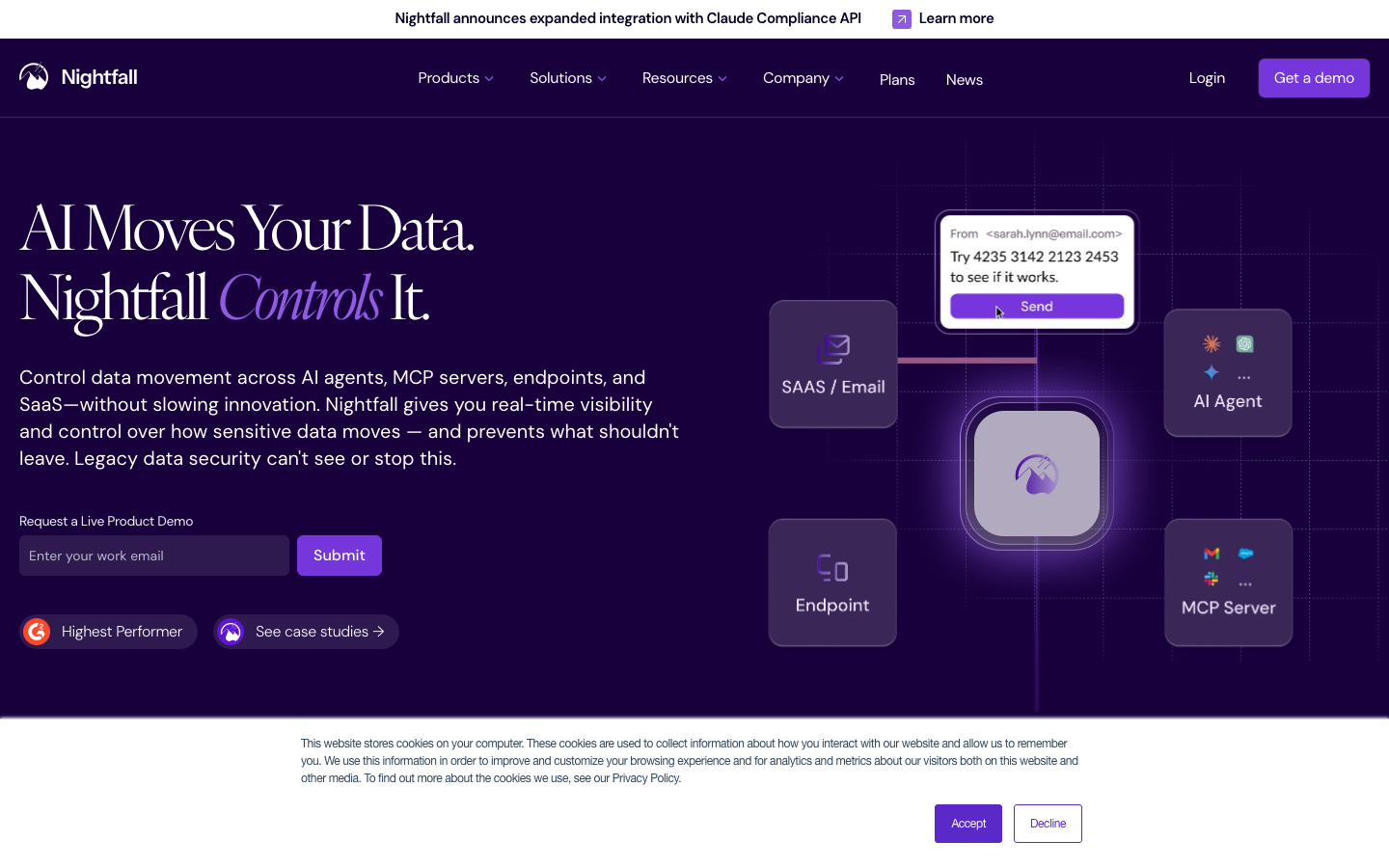
What's great
- Policy-based approach covers LLM prompts and SaaS channels (Slack, GitHub, Jira, Google Drive) from one platform, so you're not running separate tools per channel
- 4.6/5 across 98 G2 reviews, the most-reviewed platform in this specific sub-segment
- Pre-built detectors for PCI, PHI, PII, API keys, and credentials ship out of the box; custom detectors available
Watch-outs
- Not a tokenization proxy, Nightfall detects and blocks or alerts but does not rewrite prompts with reversible tokens for LLM round-trips
- Pricing is enterprise-only with no published tiers, budget forecasting requires a sales conversation
- Teams focused purely on LLM pipeline tokenization may find the SaaS DLP breadth overkill and the prompt-only coverage lighter than specialized proxy tools
Nightfall is the right choice when LLM prompt safety is one part of a broader data loss prevention problem. If your team is already worried about SSNs in Slack and API keys in GitHub, Nightfall covers those alongside your LLM traffic from the same policy engine.
98 G2 reviews average 4.6/5; the consistent theme across reviewer comments is ease of policy setup and the SaaS channel breadth. The consistent gap teams note is the lack of transparent per-seat pricing.
The Nightfall vs Securiti comparison on G2 puts Nightfall ahead on DLP-specific workflows; Securiti ahead on governance breadth. For a pure LLM tokenization proxy that rewrites and restores values, look at NoPII or Skyflow instead.
Pricing breakdown
| Plan | Price | Best for |
|---|---|---|
| Enterprise | Custom | Teams with SaaS + LLM data loss prevention needs |
Security & compliance
| Standard | Availability |
|---|---|
| SOC 2 Type II | ✓ Type II |
| GDPR | Yes |
| HIPAA | Yes |
| SSO / SAML | Yes |
| Audit logs | Yes |
Nightfall AI compliance summary: SOC 2 Type II is ✓ type ii, GDPR is yes, HIPAA is yes, SSO/SAML is yes, and audit logs is yes.
Key integrations
| Integration | Type |
|---|---|
| Gmail | N/A |
| Outlook | N/A |
| Slack | Yes |
| LinkedIn Sales Navigator | N/A |
| Outreach / Salesloft | N/A |
Nightfall AI integration summary: Gmail is not specified, Outlook is not specified, Slack is yes, LinkedIn Sales Navigator is not specified, and Outreach or Salesloft is not specified.
Feature availability
| Feature | Status |
|---|---|
| Free tier | ✗ |
| Deterministic tokens | ✗ |
| Entity types | 150+ detectors |
| Self hosted | ✗ |
| Streaming | ✓ |
Nightfall AI feature availability summary: Free tier (✗), Deterministic tokens (✗), Entity types (150+ detectors), Self hosted (✗), and Streaming (✓).
Loading reviews…
Gretel.ai
Best for synthetic data replacement in ML training pipelines
What's great
- NVIDIA acquisition in 2025 gives Gretel GPU infrastructure and model training resources no other vendor here can match
- Synthetic data replacement (not just masking) means the LLM sees statistically realistic values instead of obvious placeholders like [REDACTED]
- Strong open-source community and SDK; the free sandbox lets you test on real dataset samples before committing
Watch-outs
- Team tier at $295/mo includes 1M synthetic records, Enterprise tier jumps to $3,500/mo then $10,000/mo, a steep curve for mid-size teams
- Synthetic data approach adds more complexity and compute than a tokenization proxy; overkill for inference-only pipelines
- Best suited for tabular and structured datasets; unstructured text anonymization is less polished than Presidio or Private AI
Gretel is the answer when your problem is LLM fine-tuning on sensitive datasets rather than inference-time prompt protection. Synthetic data replacement means the model trains on data that looks real statistically but contains no actual PII. That’s the right architecture for HIPAA-covered training sets where masking artifacts would degrade model quality.
NVIDIA acquired Gretel in 2025 , which gives the platform long-term infrastructure credibility and GPU access that smaller synthetic data vendors can’t match.
The Gretel Team tier at $295/mo is the clearest on-ramp in this guide. The pricing curve to Enterprise ($3,500+/mo) is steep, so evaluate your record volume before committing. Skip Gretel for real-time inference proxy use cases; it’s not built for that.
Pricing breakdown
| Plan | Price | Best for |
|---|---|---|
| Free | $0 | Sandbox testing |
| Team | $295/mo | Up to 1M synthetic records |
| Enterprise | $3 | High-volume training data pipelines |
| Enterprise On-Prem | $10 | Air-gapped |
Security & compliance
| Standard | Availability |
|---|---|
| SOC 2 Type II | Yes |
| GDPR | Yes |
| HIPAA | Yes |
| SSO / SAML | Yes |
| Audit logs | Yes |
Gretel.ai compliance summary: SOC 2 Type II is yes, GDPR is yes, HIPAA is yes, SSO/SAML is yes, and audit logs is yes.
Key integrations
| Integration | Type |
|---|---|
| Gmail | N/A |
| Outlook | N/A |
| Slack | N/A |
| LinkedIn Sales Navigator | N/A |
| Outreach / Salesloft | N/A |
Gretel.ai integration summary: Gmail is not specified, Outlook is not specified, Slack is not specified, LinkedIn Sales Navigator is not specified, and Outreach or Salesloft is not specified.
Feature availability
| Feature | Status |
|---|---|
| Free tier | ✓ sandbox |
| Deterministic tokens | ✓ |
| Entity types | Configurable |
| Self hosted | ✓ Enterprise |
| Streaming | ✗ |
Gretel.ai feature availability summary: Free tier (✓ sandbox), Deterministic tokens (✓), Entity types (Configurable), Self hosted (✓ Enterprise), and Streaming (✗).
Loading reviews…
Microsoft Presidio
Best open-source PII detection SDK for custom pipelines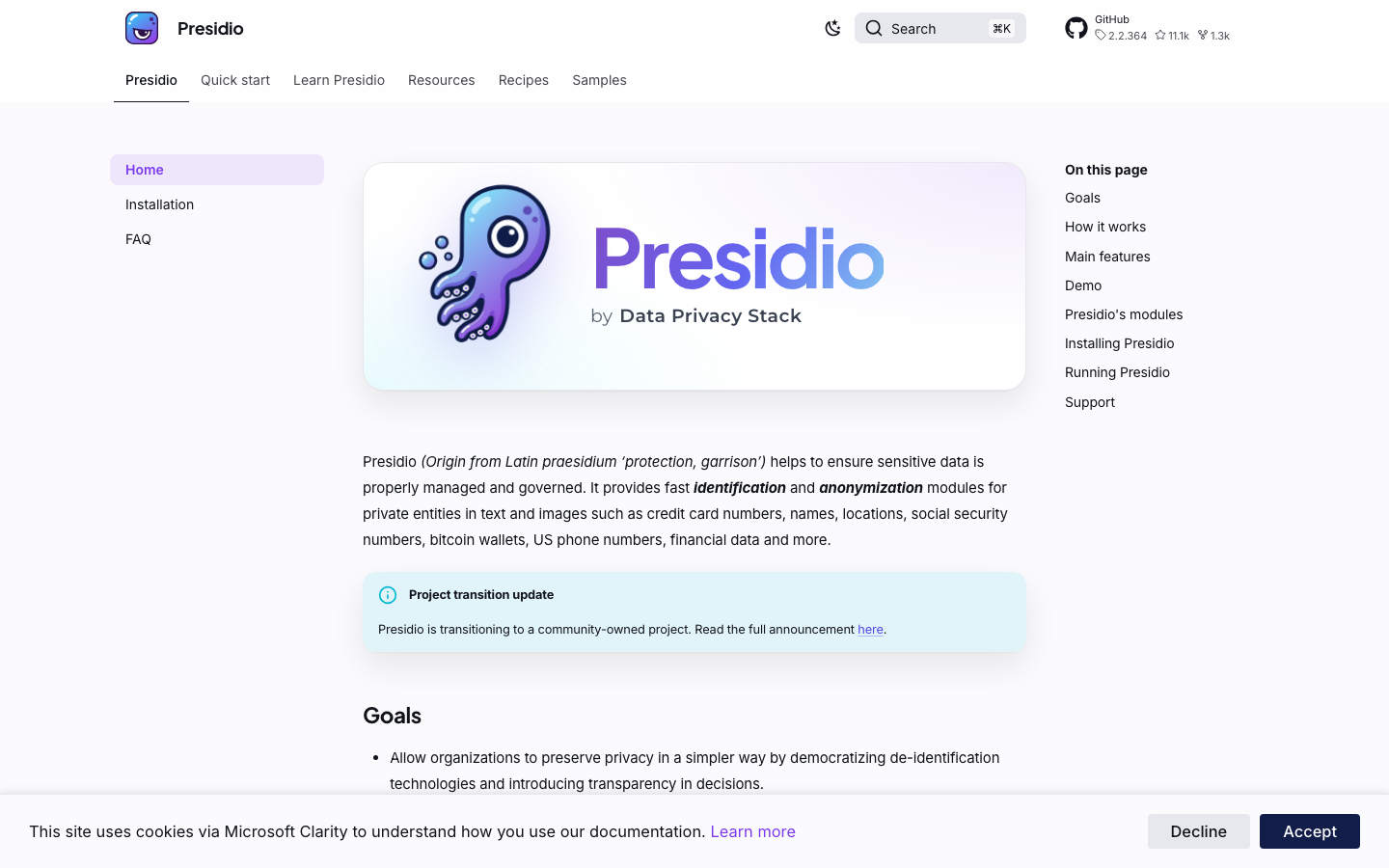
What's great
- Zero licensing cost; compute is your only cost, which matters for teams with high token volumes that would hit significant bills on commercial APIs
- Custom entity recognizers let you add domain-specific PII types (contract IDs, patient record numbers, internal account formats) that commercial tools miss
- Used under the hood by Enigma Vault NoPII and several other tools in this list, so you know the detection engine is battle-tested
Watch-outs
- No managed service; your team owns deployment, scaling, GPU provisioning for transformer models, and maintenance
- Engineering time for initial setup and ongoing model updates is the real cost, often $50K+ in eng-hours for a production-grade deployment
- Accuracy gaps on non-English text and domain-specific formats without custom recognizer work; the off-the-shelf models are tuned for English-language datasets
Presidio is the right foundation when you have the engineering capacity to build on it and the need to customize entity detection beyond what commercial APIs offer. The MIT license and Python SDK mean you can fork it, modify recognizers, and run it on whatever infrastructure you already operate.
The practical question is whether your team wants to own that maintenance burden. NoPII, Private AI, and Skyflow all use Presidio concepts or build on top of it. If you want the benefit without the ops, pick one of those instead.
For teams with domain-specific PII (clinical trial identifiers, proprietary financial codes), Presidio with custom recognizers is the only path to accurate detection. The Presidio GitHub repo has active maintenance from Microsoft and solid community documentation.
Pricing breakdown
| Plan | Price | Best for |
|---|---|---|
| Open Source | $0 | Teams with engineering capacity to self-host and customize |
Security & compliance
| Standard | Availability |
|---|---|
| SOC 2 Type II | Self-attested |
| GDPR | Self-managed |
| HIPAA | Self-managed |
| SSO / SAML | Yes |
| Audit logs | Custom |
Microsoft Presidio compliance summary: SOC 2 Type II is self-attested, GDPR is self-managed, HIPAA is self-managed, SSO/SAML is yes, and audit logs is custom.
Key integrations
| Integration | Type |
|---|---|
| Gmail | N/A |
| Outlook | N/A |
| Slack | N/A |
| LinkedIn Sales Navigator | N/A |
| Outreach / Salesloft | N/A |
Microsoft Presidio integration summary: Gmail is not specified, Outlook is not specified, Slack is not specified, LinkedIn Sales Navigator is not specified, and Outreach or Salesloft is not specified.
Feature availability
| Feature | Status |
|---|---|
| Free tier | ✓ fully free |
| Deterministic tokens | ✓ |
| Entity types | 30+ built-in + custom |
| Self hosted | ✓ |
| Streaming | Custom build |
Microsoft Presidio feature availability summary: Free tier (✓ fully free), Deterministic tokens (✓), Entity types (30+ built-in + custom), Self hosted (✓), and Streaming (Custom build).
Loading reviews…
Tonic.ai
Best for database-level PII masking for LLM test environments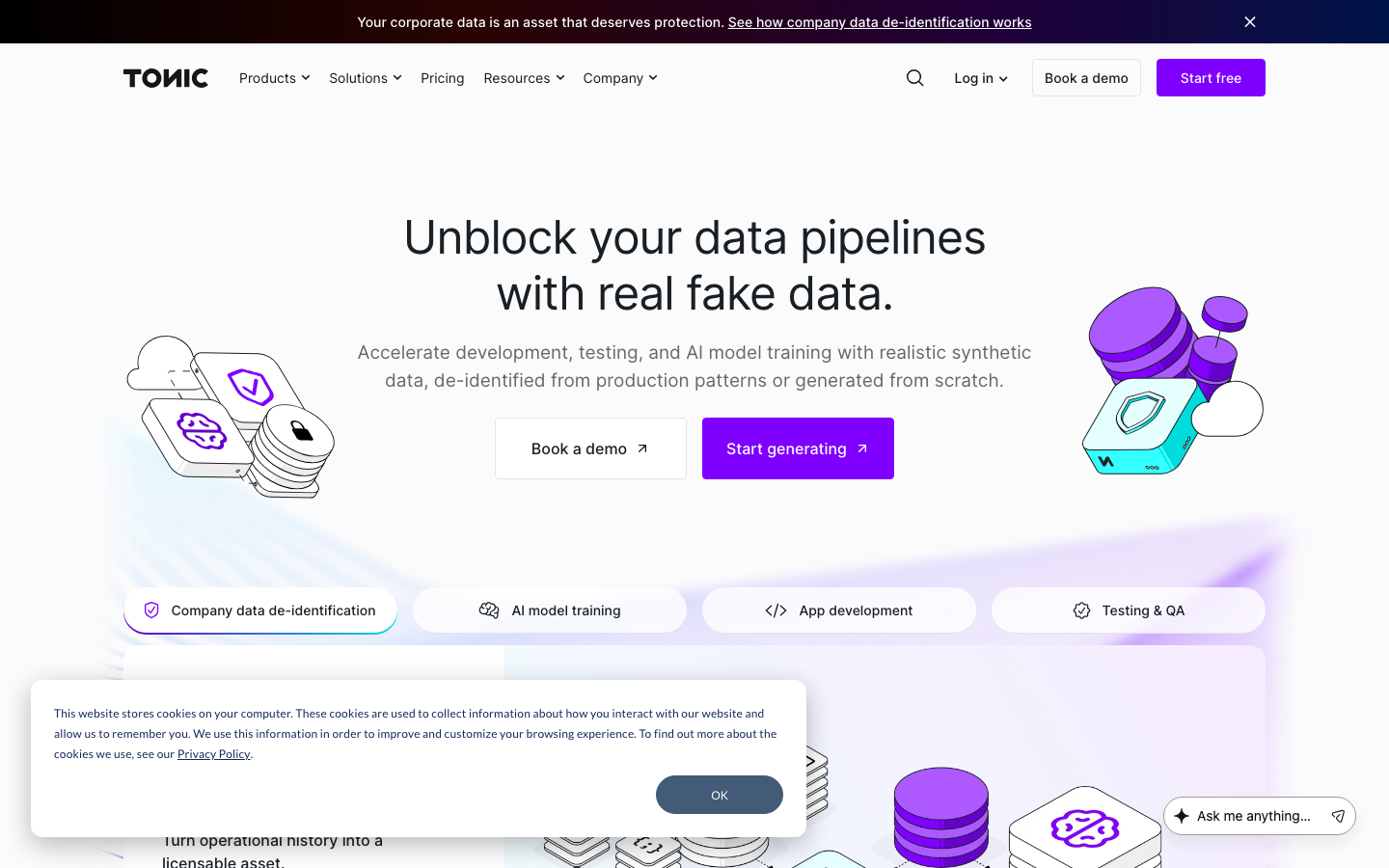
What's great
- Handles referential integrity across relational databases, rare in this category; foreign keys stay consistent after masking
- Textual de-identification for unstructured text fields (notes, support tickets, documents) ships alongside the structured database masking
- 14-day trial with real data up to 10GB lets you validate accuracy before signing
Watch-outs
- Primarily a database masking tool; not a real-time LLM proxy, needs integration work to fit a live inference pipeline
- Contract minimums typically $15K-$30K/yr for small setups, climbing past $100K for large deployments
- 4.2/5 on G2 (38 reviews), lower than most peers in this guide; reviewers cite UI complexity and cost relative to Presidio for teams with engineering bandwidth
Tonic is the right pick when the PII problem is in your databases, not just your LLM prompts. If you’re building a RAG system that pulls from a Postgres or Snowflake table with real customer records, Tonic anonymizes that source data for staging and evaluation environments while preserving the referential structure your queries depend on.
The part that takes people by surprise in demos is the text field handling. A support ticket column with freeform PII gets de-identified alongside the structured fields, so you end up with a staging dataset that’s genuinely usable for LLM evaluation without the compliance risk.
Tonic’s G2 profile shows 44.7% mid-market reviewers and consistent praise around referential integrity. For real-time inference proxy use, this is not the right tool; pair it with NoPII or Presidio for that layer.
Pricing breakdown
| Plan | Price | Best for |
|---|---|---|
| Starter | $15K/yr | Small teams |
| Professional | $30K/yr | Mid-market teams with multiple databases |
| Enterprise | $100K+/yr | Large deployments |
Security & compliance
| Standard | Availability |
|---|---|
| SOC 2 Type II | Yes |
| GDPR | Yes |
| HIPAA | Yes |
| SSO / SAML | Yes |
| Audit logs | Yes |
Tonic.ai compliance summary: SOC 2 Type II is yes, GDPR is yes, HIPAA is yes, SSO/SAML is yes, and audit logs is yes.
Key integrations
| Integration | Type |
|---|---|
| Gmail | N/A |
| Outlook | N/A |
| Slack | N/A |
| LinkedIn Sales Navigator | N/A |
| Outreach / Salesloft | N/A |
Tonic.ai integration summary: Gmail is not specified, Outlook is not specified, Slack is not specified, LinkedIn Sales Navigator is not specified, and Outreach or Salesloft is not specified.
Feature availability
| Feature | Status |
|---|---|
| Free tier | ✗ 14-day trial |
| Deterministic tokens | ✓ |
| Entity types | 25+ |
| Self hosted | ✓ |
| Streaming | ✗ |
Tonic.ai feature availability summary: Free tier (✗ 14-day trial), Deterministic tokens (✓), Entity types (25+), Self hosted (✓), and Streaming (✗).
Loading reviews…
Securiti.ai
Best AI data command center for governance-first enterprises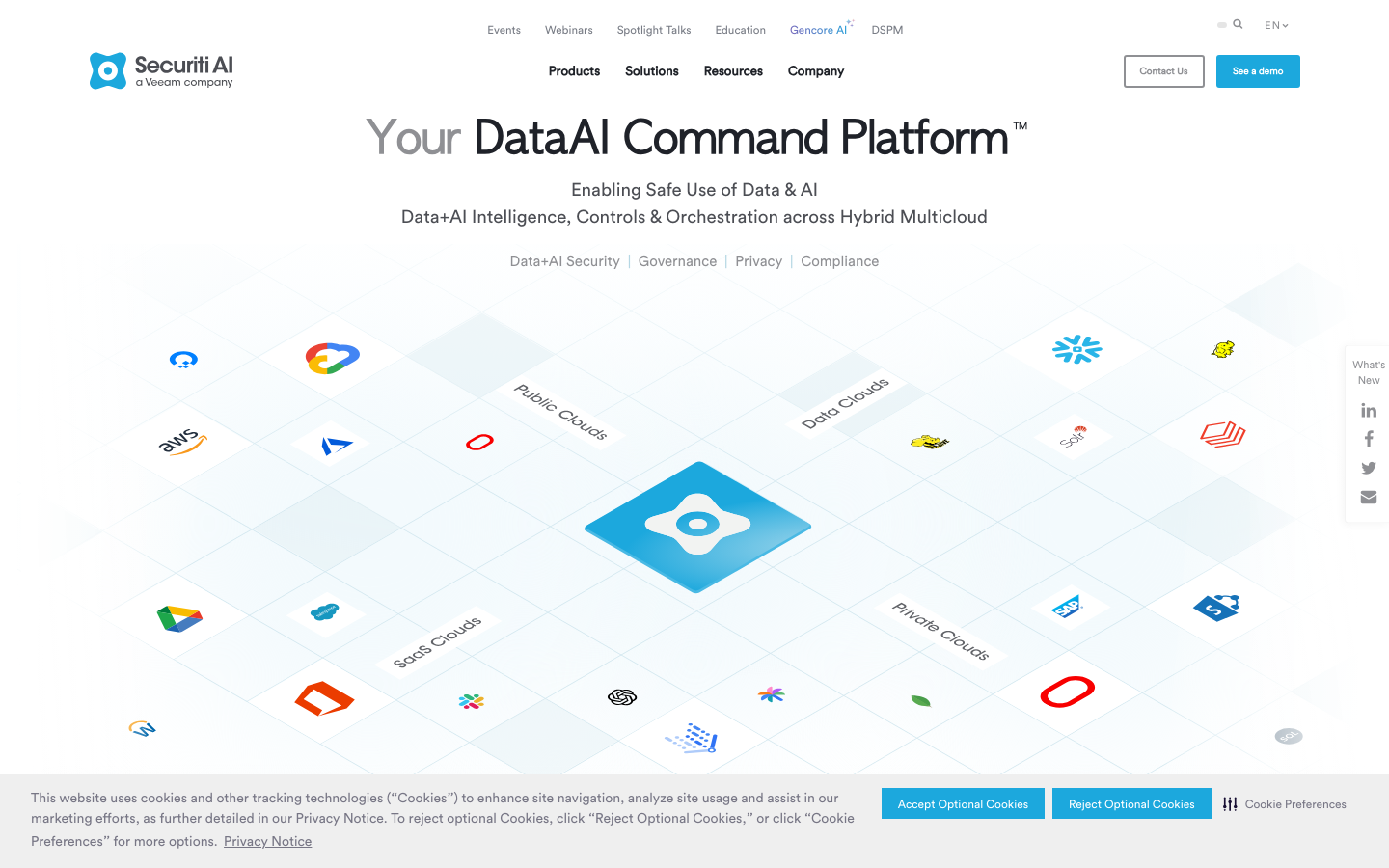
What's great
- 4.7/5 across 80 G2 reviews, the highest G2 rating in this list among tools with meaningful review volume
- AI data command center covers data discovery, classification, consent management, and LLM governance in one platform
- Automated data mapping and subject rights management alongside PII protection reduces the compliance team's manual workload
Watch-outs
- Breadth means depth trade-offs; reviewers note the LLM-specific tokenization features are less mature than Skyflow or NoPII
- Enterprise-only pricing with no self-serve entry point
- Implementation complexity is higher than point solutions; plan for a 3-6 month rollout for full governance platform deployment
Securiti is the right choice when PII protection for LLMs is part of a broader data governance initiative. CDO and compliance teams dealing with GDPR subject rights requests, consent management, and cross-border data transfer restrictions will find it covers ground that four or five point tools would otherwise fill.
4.7/5 across 80 G2 reviews is the strongest rating in this guide among tools with a meaningful review base. Reviewers consistently cite the automated data discovery and the audit trail depth as differentiators.
The trade-off is deployment time. Teams that need a working LLM proxy this week should look at NoPII. Teams building a 12-month compliance program around AI data governance should put Securiti on the shortlist.
Pricing breakdown
| Plan | Price | Best for |
|---|---|---|
| Enterprise | Custom | Enterprises needing full AI governance platform |
Security & compliance
| Standard | Availability |
|---|---|
| SOC 2 Type II | ✓ Type II |
| GDPR | Yes |
| HIPAA | Yes |
| SSO / SAML | Yes |
| Audit logs | Yes |
Securiti.ai compliance summary: SOC 2 Type II is ✓ type ii, GDPR is yes, HIPAA is yes, SSO/SAML is yes, and audit logs is yes.
Key integrations
| Integration | Type |
|---|---|
| Gmail | N/A |
| Outlook | N/A |
| Slack | N/A |
| LinkedIn Sales Navigator | N/A |
| Outreach / Salesloft | N/A |
Securiti.ai integration summary: Gmail is not specified, Outlook is not specified, Slack is not specified, LinkedIn Sales Navigator is not specified, and Outreach or Salesloft is not specified.
Feature availability
| Feature | Status |
|---|---|
| Free tier | ✗ |
| Deterministic tokens | ✓ |
| Entity types | Automated discovery |
| Self hosted | Private cloud |
| Streaming | ✓ |
Securiti.ai feature availability summary: Free tier (✗), Deterministic tokens (✓), Entity types (Automated discovery), Self hosted (Private cloud), and Streaming (✓).
What reviewers say about Securiti.ai
Recurring themes across ~46 Securiti reviews on G2 (4.8/5), plus Gartner Peer Insights and PeerSpot, 2024-2026.
What reviewers praise
- AI-driven data discovery and classification give a live map of where sensitive data sits across environments.
- Running privacy, security, and consent from one platform is the recurring reason teams consolidate onto it.
- Cross-border transfer maps and process mapping get specific praise from compliance operators.
- Dashboards and the zero-trust integration are called out as strong day-to-day tooling.
What reviewers fault
- Implementation is time-consuming and expects real expertise, with a steep learning curve before teams use it fully.
- The workflow is click-heavy, with no easy way to add items in bulk or by checklist.
- Report and page customization is thinner than users want.
- Connecting to legacy or existing systems can be a struggle.
Loading reviews…
Anonym
Best for privacy-preserving model fine-tuning with differential privacy
What's great
- Differential privacy fine-tuning lets you train LLMs on sensitive data with mathematical privacy guarantees, not just obfuscation
- Designed specifically for the fine-tuning use case that Gretel and most tokenization tools don't fully address
- Can operate directly on sensitive training corpora without requiring pre-masking, which removes a preprocessing step from the pipeline
Watch-outs
- Very early-stage vendor with limited public presence and no public G2 or Capterra reviews
- Differential privacy adds noise to model outputs, which degrades accuracy on tasks where exact recall of training data matters
- Not a fit for inference-time PII protection; this is a training-time tool
Anonym occupies a niche that most tools in this list don’t address: fine-tuning LLMs on sensitive data with differential privacy guarantees. Where Gretel replaces data with synthetic equivalents, Anonym uses DP training to bound what the model can reveal about any individual training example.
The practical use case is a healthcare or financial services team that wants to fine-tune a base model on their own proprietary data without the regulatory risk of the model memorizing PII. That’s a genuinely hard problem, and Anonym’s approach is more principled than pre-masking the training set.
The vendor is early stage with limited public review data. Confirm customer references before signing. Not the right pick for inference-time tokenization; pair it with NoPII or Presidio if you need both.
Pricing breakdown
| Plan | Price | Best for |
|---|---|---|
| Enterprise | Custom | Teams fine-tuning LLMs on sensitive proprietary data |
Security & compliance
| Standard | Availability |
|---|---|
| SOC 2 Type II | In progress |
| GDPR | Yes |
| HIPAA | Consult vendor |
| SSO / SAML | Yes |
| Audit logs | Custom |
Anonym compliance summary: SOC 2 Type II is in progress, GDPR is yes, HIPAA is consult vendor, SSO/SAML is yes, and audit logs is custom.
Key integrations
| Integration | Type |
|---|---|
| Gmail | N/A |
| Outlook | N/A |
| Slack | N/A |
| LinkedIn Sales Navigator | N/A |
| Outreach / Salesloft | N/A |
Anonym integration summary: Gmail is not specified, Outlook is not specified, Slack is not specified, LinkedIn Sales Navigator is not specified, and Outreach or Salesloft is not specified.
Feature availability
| Feature | Status |
|---|---|
| Free tier | ✗ |
| Deterministic tokens | ✗ |
| Entity types | N/A (DP not entity-based) |
| Self hosted | ✓ |
| Streaming | ✗ |
Anonym feature availability summary: Free tier (✗), Deterministic tokens (✗), Entity types (N/A (DP not entity-based)), Self hosted (✓), and Streaming (✗).
Loading reviews…
Protopia AI
Best for round-trip inference protection without plaintext exposure
What's great
- Stained Glass Transform converts input data to a randomized embedding that preserves what the LLM needs while eliminating plaintext PII exposure throughout inference
- Works in multi-tenant LLM environments where you cannot trust the inference provider to see raw prompts
- Oracle partnership for OCI deployment gives enterprise buyers a familiar commercial pathway
Watch-outs
- Patented approach is architecturally novel but creates vendor lock-in; if Protopia changes pricing or discontinues, migration is non-trivial
- Limited public review data and no self-serve trial path
- Not a drop-in proxy replacement; integration requires more engineering work than base-URL-swap tools like NoPII
Protopia’s Stained Glass Transform is solving a different problem than most tools here. Instead of stripping PII before it hits the LLM, it transforms all input data into a stochastic embedding that the target model can still reason from without ever seeing plaintext. No entity detection, no replacement tokens, no list of PII types to maintain.
That architecture is compelling for multi-tenant environments where prompt content itself is sensitive, not just the PII within it. A legal team sending confidential contract text to a hosted LLM, for example, where the issue is the whole document, not just the names in it.
The Protopia Oracle partnership opens the OCI deployment path for enterprise buyers already on Oracle infrastructure. Early stage with limited public traction; confirm customer references and ask hard questions about the accuracy impact of the transform on your specific LLM task.
Pricing breakdown
| Plan | Price | Best for |
|---|---|---|
| Enterprise | Custom | Multi-tenant inference environments |
Security & compliance
| Standard | Availability |
|---|---|
| SOC 2 Type II | Consult vendor |
| GDPR | Yes |
| HIPAA | Yes |
| SSO / SAML | Yes |
| Audit logs | Custom |
Protopia AI compliance summary: SOC 2 Type II is consult vendor, GDPR is yes, HIPAA is yes, SSO/SAML is yes, and audit logs is custom.
Key integrations
| Integration | Type |
|---|---|
| Gmail | N/A |
| Outlook | N/A |
| Slack | N/A |
| LinkedIn Sales Navigator | N/A |
| Outreach / Salesloft | N/A |
Protopia AI integration summary: Gmail is not specified, Outlook is not specified, Slack is not specified, LinkedIn Sales Navigator is not specified, and Outreach or Salesloft is not specified.
Feature availability
| Feature | Status |
|---|---|
| Free tier | ✗ |
| Deterministic tokens | N/A |
| Entity types | N/A (transform-based) |
| Self hosted | ✓ |
| Streaming | ✓ |
Protopia AI feature availability summary: Free tier (✗), Deterministic tokens (N/A), Entity types (N/A (transform-based)), Self hosted (✓), and Streaming (✓).
Loading reviews…
More top-rated Top PII Tokenization & Masking Tools for LLMs worth checking out
Highly rated Top PII Tokenization & Masking Tools for LLMs that didn't crack our top 10 but are still strong contenders, especially for specific use cases and team sizes.
AWS Comprehend
For teams already in AWS wanting pay-per-use PII detection
Standout: No additional vendor relationship needed if you're already in AWS; IAM, CloudTrail, and VPC integration come free
Google Cloud Sensitive Data Protection
For GCP-native teams needing DLP across BigQuery and Vertex AI
Standout: Native integration with BigQuery and Vertex AI, letting you inspect and de-identify training datasets without exporting data
What reviewers say ★ 4.4 · 1,643
Praised
- The LookML semantic layer is the defining strength reviewers cite: business logic and metric definitions live in version-controlled code, so everyone queries the same governed definitions and the multiple-versions-of-the-truth problem largely disappears.
- Deep integration with cloud warehouses, especially BigQuery, is praised for handling large data volumes well and keeping analysis close to the source.
- Once the model is built, business users get intuitive point-and-click exploration and self-serve reports without touching SQL, which reviewers value for reducing analyst bottlenecks.
- Dashboards are interactive and easy to share, and centralized governance and access controls make it a favorite of data teams that care about consistency and security.
- The governed, code-based modeling approach is repeatedly called a genuine differentiator from drag-and-drop BI tools for organizations that need metric consistency at scale.
Faulted
- The LookML learning curve is the most repeated complaint: teams without SQL and modeling skills struggle, and reviewers note data requests still bottleneck with engineering because non-developers cannot self-serve model changes.
- Pricing is opaque and steep, all tiers are quote-only, and reported contracts routinely reach six figures a year, putting it out of reach for smaller teams.
- Visualization and charting feel dated and limited next to Tableau or Power BI, with reviewers wanting more chart types and formatting control.
- Query performance on complex analyses depends heavily on how the underlying warehouse is tuned, and users describe stakeholders left staring at loading spinners.
- Out-of-the-box AI and advanced-calculation features are thin, and reviewers note gaps in built-in calculations that force workarounds.
Azure Purview (Microsoft Purview)
For Microsoft 365 enterprises needing unified data governance and LLM compliance
Standout: Included in Microsoft 365 E5 for organizations already paying for it; effective zero incremental cost
Baffle
For teams needing encryption-first data protection at the database layer
Standout: Transparent encryption at the database layer means applications (and LLMs) interact with encrypted data without schema changes
Hazy
For UK and EU financial services teams needing FCA-compliant synthetic data
Standout: Strong UK and EU financial services focus with GDPR and FCA compliance track record
Statice
For privacy-conscious ML teams needing statistical utility guarantees
Standout: Formal privacy guarantee metrics (epsilon-DP, identifiability risk scores) quantify privacy-utility trade-offs for compliance reporting
Mostly AI
For self-serve synthetic data generation with a freemium entry point
Standout: Free tier up to 100K synthetic rows is the most accessible self-serve entry point in the synthetic data segment
Synthetic Users
For product teams generating synthetic user personas for LLM UX testing
Standout: Generates synthetic user personas for LLM-based user research without collecting or processing real user PII
ARX Data Anonymization
For academics and data scientists needing open-source k-anonymity and l-diversity
Standout: Implements k-anonymity, l-diversity, t-closeness, and differential privacy; the most thorough open-source anonymization toolkit for tabular data across formal privacy models
DataFleets
For privacy-preserving federated analytics on distributed sensitive data
Standout: Federated learning architecture means sensitive data never leaves the originating environment; the model trains locally and only aggregates learned parameters
Tools we considered but excluded
We evaluated more tools than the 20 you see above. These did not make the cut. Saying what we rejected, and why, is the editorial muscle most listicles skip.
- Protecto.ai: Startup with unverified commercial traction at time of review; category covered more thoroughly by NoPII and Private AI
- VGS (Very Good Security): Primarily a payment tokenization vault optimized for PCI scope reduction
- Informatica Intelligent Data Management: Full data catalog platform; PII masking is one feature in a $200K+ per year platform overkill for LLM-specific teams
- IBM OpenPages: Governance platform for GRC teams
- Immuta: Primarily a data access control platform for analytics; PII masking for LLM APIs is outside its core design
Honorable mentions
Solid tools that did not crack the main list but are worth tracking, especially for niche use cases.
- Grepture: Open-source PII redaction API proxy with prompt injection scanning; gaining traction in the developer community as a lightweight alternative to NoPII
- Langfuse (with PII guard): Open-source LLM observability platform adding PII detection to prompt logging; worth watching as the feature matures
- Galileo AI: LLM evaluation and monitoring platform with PII leak detection in model outputs; covers a post-inference gap that tokenization proxies miss
The PII-protection landscape in 20 tools
The category splits into four architectures, and picking the wrong one costs engineering weeks.
Proxy tools (NoPII, Skyflow LLM gateway) sit between your application and the LLM API. Change a base URL, get PII stripped from every prompt automatically. Zero code changes in most cases. The right default for inference-time protection.
SDK-based detection (Private AI, Presidio, Nightfall) processes text through a library or API call your code invokes explicitly. More control over what gets masked and when. More integration work to wire into existing pipelines.
Synthetic data platforms (Gretel, Tonic, Mostly AI, Hazy, Statice) replace real data with statistically equivalent fake data. The right approach for fine-tuning and training datasets, not for real-time inference protection. You don’t tokenize a fine-tuning dataset; you replace it.
Governance and vault platforms (Securiti, Azure Purview, Skyflow vault) treat PII protection as one capability inside a broader data governance stack. They cost more and take longer to deploy but solve adjacent problems (consent management, subject rights, data lineage) alongside tokenization.
A team building a RAG chatbot on top of OpenAI needs a proxy or SDK approach. A team fine-tuning a model on customer support records needs a synthetic data platform. A CDO building an enterprise AI governance program needs a vault or governance platform. The tools are genuinely different in design, not just marketing copy.
What’s different in 2026
Proxy architecture became the default for LLM PII protection. Two years ago most teams were rolling their own Presidio wrappers. In 2026, purpose-built LLM proxies like NoPII and Skyflow’s gateway handle the interception automatically. The proxy pattern is now table stakes; teams that built custom wrappers are migrating to them.
Synthetic data took on a new role after training data regulation. Several US state AI laws now require documented provenance for training data containing personal information. Synthetic data platforms shifted from “nice to have for staging” to “compliance requirement for fine-tuning.” Gretel’s NVIDIA acquisition in 2025 accelerated this.
Differential privacy moved from academic to commercial. Two years ago DP fine-tuning was a research paper. In 2026 it’s an enterprise sales pitch from Anonym and others. Mathematical privacy guarantees are appearing in procurement RFPs from healthcare and financial services companies. The math is real; the vendor commercial maturity is still early.
Multi-tenant inference created a new attack surface. Teams running LLM workloads on shared GPU infrastructure (not Azure OpenAI or AWS Bedrock dedicated instances) discovered that prompt confidentiality is as important as PII removal. Protopia’s stochastic embedding approach addresses this; most tokenization tools do not.
HIPAA enforcement guidance on LLMs landed. OCR issued informal guidance in late 2025 that LLM API calls with PHI in the prompt likely constitute a disclosure requiring BAA coverage. That pushed HIPAA-covered entities to either get BAAs with OpenAI/Anthropic or add a PII-stripping layer before API calls. The BAA path is often the faster one, but the PII layer is cheaper if you’re already sending data to multiple providers.
What I check in every PII-protection demo
One, detection coverage on your actual data, not their sample data. Every vendor demo uses clean English-language test cases. Ask to run their tool on a 500-row sample of your own data (anonymized first if needed) before the demo ends. False positives on legitimate technical terms and false negatives on non-English names are the two failure modes that show up immediately on real data.
Two, latency overhead on a streaming LLM call. For chatbot or real-time assistant use cases, every millisecond of proxy latency compounds. Ask for p99 latency numbers on a 2,000-token prompt during their demo. Anything over 200ms added latency starts affecting user experience.
Three, de-tokenization accuracy on LLM responses. Tokenizing the prompt is half the problem. The other half is correctly identifying and replacing tokens that the LLM echoed back in its response. Ask the vendor to demo a prompt where the LLM refers to a tokenized entity by its token, and show you what the de-tokenized response looks like.
Four, custom entity type configuration. Your data probably contains entity types that aren’t in the vendor’s standard set: product IDs, customer codes, internal account numbers, clinical trial identifiers. Ask how long it takes to add a custom recognizer or regex pattern and whether that requires a support ticket or self-serve configuration.
Five, the audit log. For compliance purposes, you need to know which PII was detected and masked in which API call. Ask to see the audit log schema and confirm it captures enough detail to answer a GDPR Article 15 subject access request. Some tools mask PII but don’t log what they masked.
Six, the failure mode. What happens when the PII detection confidence is low? Does the tool block the call, pass it through, or flag it for review? The default behavior on uncertain cases tells you a lot about the security posture of the product.
Narrowing the PII tool shortlist
1. Inference vs training use case
This is the first decision. Real-time inference (every user prompt going to an LLM API) needs a proxy or detection SDK. Batch training data masking needs a synthetic data or anonymization platform. The tools don’t cross over well. NoPII is fast at inference; it’s not the right tool for a 10TB training dataset.
2. Team engineering capacity
Presidio is free and customizable. It’s also 40-80 hours of engineering work to stand up production-ready. If your team has a dedicated data engineering resource and a specific entity type the commercial tools miss, Presidio is the right foundation. If your team is three backend engineers and none of them want to own a PII infra system, NoPII or Private AI’s cloud API is the faster path.
3. Compliance regime
HIPAA-covered entities need a BAA. Private AI, Skyflow, AWS Comprehend, and Google Cloud Sensitive Data Protection all offer them. PCI DSS Level 1 is table stakes for fintech; NoPII and Skyflow both hold it. GDPR Article 44 data residency requirements push toward self-hosted or EU-region deployments. Work out your compliance requirements before you shortlist.
4. Language and entity type coverage
English-only workloads are straightforward. Private AI at 50+ languages is the clear choice for global deployments. Domain-specific entity types (clinical codes, financial identifiers) that no vendor covers out of the box push toward Presidio with custom recognizers or NoPII’s custom recognizer support.
5. Vendor scale and longevity
Skyflow, Nightfall, and Securiti have raised meaningful venture capital and have enterprise customer bases. NoPII is a focused product from Enigma Vault, which has PCI DSS Level 1 and SOC 2 credentials but a smaller public profile. Anonym and Protopia are genuinely early-stage. If your compliance team requires a 3-year vendor viability assessment, the enterprise platforms will pass more easily.
Compliance lockdown
SOC 2 Type II is the minimum for any enterprise LLM infrastructure. NoPII, Skyflow, Private AI, Nightfall, Gretel, Tonic, and Securiti all hold SOC 2 Type II. Presidio is open source and self-attestation only. For AWS Comprehend and Google Cloud DLP, your cloud provider’s SOC 2 covers the service.
HIPAA BAA availability is the key gate for healthcare. Not all tools offer BAAs. Private AI, Skyflow, Nightfall, AWS Comprehend, and Google Cloud Sensitive Data Protection do. NoPII’s PCI DSS Level 1 cert is strong, but confirm their HIPAA BAA status with the vendor before signing for a covered entity.
PCI DSS scope reduction is the main value for fintech. NoPII (PCI DSS Level 1) and Skyflow (PCI DSS) can tokenize card data and other payment PII before it reaches an LLM, keeping those values out of scope for your annual PCI audit. That’s a meaningful compliance cost reduction for teams processing payment data through AI workflows.
GDPR data residency under Article 44 matters for EU deployments. Self-hosted options (Private AI, Presidio, Tonic, Gretel Enterprise) are the clean solution. Statice and Hazy are EU-headquartered vendors with GDPR residency commitments. US-only cloud APIs require either Standard Contractual Clauses or confirmation that processing stays in an EU region.
The pick by stage
Pre-seed to Series A (under 20 engineers): Enigma Vault NoPII for inference-time protection, Microsoft Presidio if you need custom entity types and have the engineering capacity. Both have free tiers.
Series B to Series C (20-100 engineers): NoPII for inference pipelines, Gretel Team tier ($295/mo) for training data, Nightfall if you also need SaaS DLP coverage. Start building toward SOC 2 Type II on your side, and pick vendors that already have it.
Regulated startup (fintech, healthtech, any stage): Skyflow for vault-grade PII architecture, Private AI if you need self-hosted deployment for data residency. Budget for enterprise pricing from day one; the free-tier tools won’t pass your compliance review.
Enterprise (100+ engineers, existing compliance program): Securiti for governance-first organizations adding AI capabilities to an existing data program. Azure Purview if you’re a Microsoft 365 E5 shop and Copilot is your primary LLM. Skyflow for any team building a purpose-built AI data layer.
ML research team (academia or R&D): Microsoft Presidio for open-source text anonymization. ARX for tabular k-anonymity and formal privacy models. Mostly AI’s free tier for synthetic data generation without budget approval.
Fine-tuning a model on sensitive data: Gretel with differential privacy if statistical utility matters. Tonic.ai if the data lives in relational databases with referential integrity requirements. Anonym if mathematical differential privacy guarantees are required by your compliance team.
Corrections and pricing updates can be sent to corrections@topickz.com . This guide is refreshed quarterly; pricing data was last verified October 1, 2026.
Frequently asked questions
What is PII tokenization for LLMs?
Replacing sensitive values (SSNs, names, health data) with reversible tokens before they reach an LLM API, then restoring originals in the response.
Does Enigma Vault NoPII work with Claude and Gemini?
NoPII proxies any OpenAI-compatible API. Anthropic (Claude) is supported natively. Gemini requires the OpenAI-compatible endpoint.
Is Microsoft Presidio accurate enough for production?
Yes for English text with standard PII types. Non-English or domain-specific entities (medical codes, internal IDs) need custom recognizer work.
How much does Skyflow cost?
Skyflow does not publish tiers. Vendr transaction data puts average enterprise deals around $195K/yr. Requires sales engagement.
What is the difference between tokenization and redaction?
Redaction removes PII permanently. Tokenization replaces it with a reversible token, so the LLM response can be de-tokenized back to the original value.
Can I use AWS Comprehend as a real-time LLM proxy?
Not natively. You build a Lambda function that calls DetectPiiEntities, masks values, then forwards to your LLM. NoPII or Presidio are simpler proxy options.
What is differential privacy fine-tuning?
Training an LLM with mathematical noise guarantees that bound what the model can reveal about any individual training record. Anonym specializes in this.
Does Gretel.ai work for unstructured text?
Yes but tabular data is its strongest suit. Private AI and Presidio outperform Gretel on freeform text PII detection accuracy.
Which tools have HIPAA BAAs available?
Private AI, Skyflow, Nightfall, AWS Comprehend, and Google Cloud Sensitive Data Protection all offer HIPAA BAA agreements.
What is the fastest integration for a startup hitting OpenAI?
Enigma Vault NoPII. Change one environment variable (base URL), get PII tokenization with no code changes. Free tier at 1M tokens/mo.
Related helpful reads
Write a review
Posts to the page right away. Keep it real — no links or email addresses.