Your next buyer is not opening Google. They are asking ChatGPT “what is the best CRM for a 30-person sales team,” and they are treating the three names that come back as the shortlist. If your brand is not one of them, you were not in the running.
Getting recommended by an AI engine is a different game from ranking on Google. The engines do not pick the brand with the slickest landing page. They pick the brand that shows up, consistently, across the third-party sources they already trust. AI looks for consensus, and it looks for evidence.
This is the part most brands get wrong. You cannot prompt your way in, and you cannot buy your way in. You earn it the same way you earn a journalist’s citation: by being independently verifiable.
Quick summary
- AI recommends brands that show consensus across the third-party sources it trusts (G2, Reddit, editorial reviews, "best of" listicles), not the brand with the best marketing.
- The single fastest move: get tested and listed in the listicles and review sites AI already reads. That is the consensus signal in its purest form.
- Original data, freshness and extractable structure decide who gets cited. Pages with 3+ original data points are about 4x more likely to be cited in AI answers.
- Every engine has a tell: ChatGPT follows community consensus, Claude rewards verifiable claims, Gemini follows Google's E-E-A-T and entity signals, AI Overviews want original data and freshness, and Perplexity prioritizes fresh, well-cited pages.
- Your own signals are the weakest: 61% of B2B SaaS tools sit in a 0.3-star rating band (Topickz), so AI falls back on independent editorial.
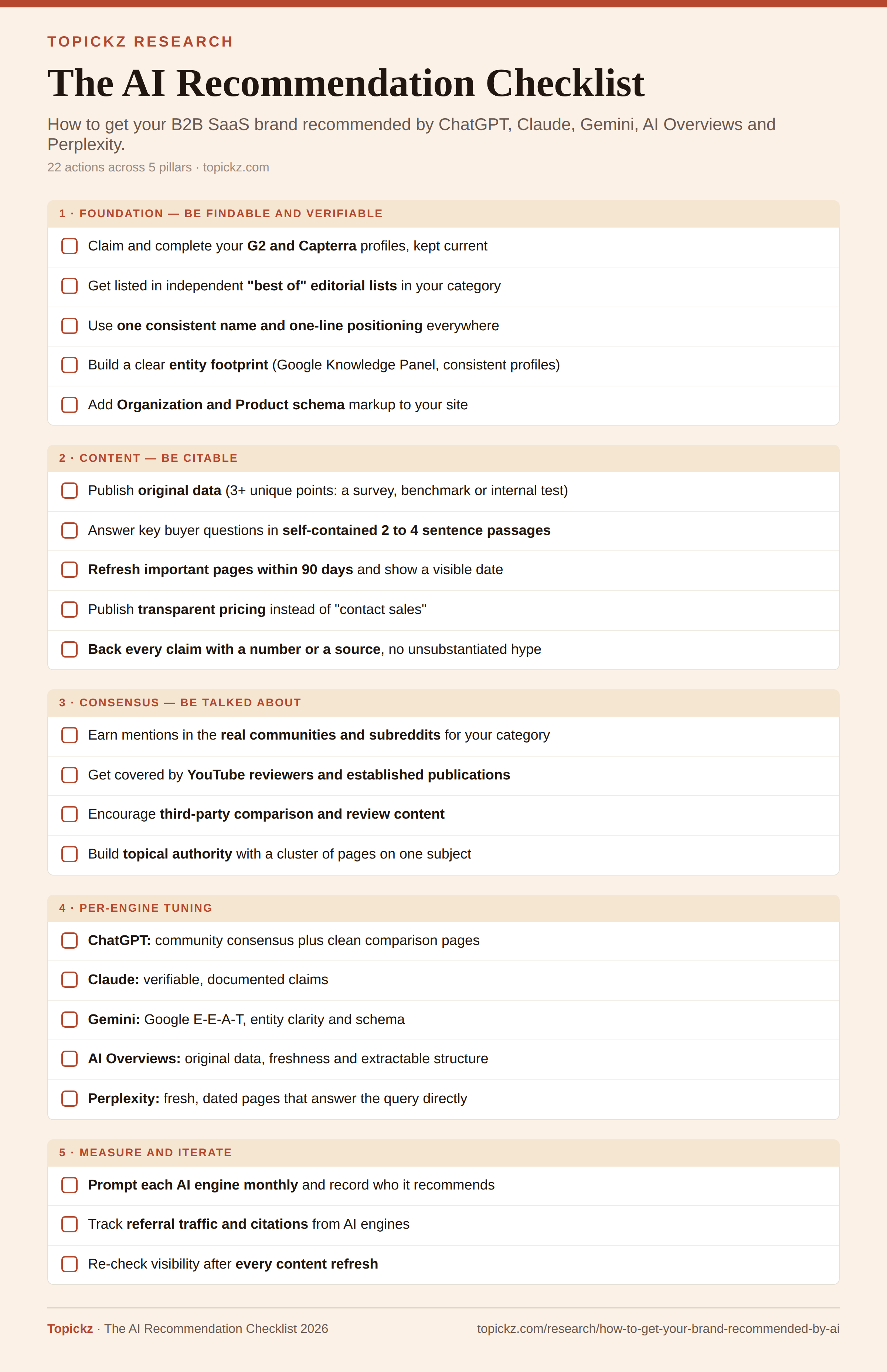
Want the whole thing on one page? Grab the free playbook below. Twenty-two actions across five pillars, the same checklist we walk through in this post, ready to work with your team.
Download the free AI recommendation playbook (PDF)
The one rule behind every engine
Every model below works differently, but they rhyme. An AI engine recommends a brand when it sees the same brand, with the same positioning, across multiple independent sources it trusts: Reddit threads, G2 and Capterra, YouTube walkthroughs, established publications, and editorial “best of” lists. That agreement is the consensus signal, and it is what turns a mention into a recommendation.
Two things amplify it. Original data, because unsubstantiated claims with no numbers actively hurt your odds of being cited. And freshness, because facts age out of trust fast.
The flip side matters for B2B SaaS specifically. Topickz analysis of 816 tools found 61% of them cluster between 4.3 and 4.6 stars on G2 and Capterra, so an AI engine cannot tell you apart from a rival on rating alone. And 26% of tools hide their pricing, so the engine cannot cite a price it cannot read. When your own signals are flat or missing, third-party editorial is what the engine falls back on.
How to get recommended in ChatGPT
ChatGPT is the big one, roughly 70% of AI search usage, and it pulls from a blend of its training data and live web search. It rewards comprehensive, well-sourced content and clear expertise signals, and it leans heavily on community consensus.
- Get talked about on Reddit and in community threads, in your category’s real subreddits, because ChatGPT weights that discussion heavily
- Be listed and reviewed on G2, Capterra and independent editorial review sites, with consistent positioning across all of them
- Publish a clear, factual product description and comparison pages, so the model has clean text to extract
- Keep your name attached to the same one-line positioning everywhere, so the consensus is unambiguous
How to get recommended in Claude
Claude is the cautious one. It will not repeat a claim it cannot stand behind, so hype and unsubstantiated superlatives do nothing for you here. It rewards content that is factual, well-structured and verifiable.
- Back every claim with a number, a source, or a documented example, because Claude discounts the unsubstantiated
- Keep thorough, accurate documentation and specs, the kind of factual content that is safe to quote
- Earn third-party validation from sources with real authority, so the claim does not rest on your word alone
- Write clean, structured pages with clear headings, so the model can lift a precise, defensible passage
How to get recommended in Gemini
Gemini is Google’s model, wired into Google’s index and Knowledge Graph. What Google already trusts about you carries straight into Gemini, so entity clarity and classic E-E-A-T do the heavy lifting.
- Build a clear entity footprint, a consistent name, category and description across the web, so Google’s Knowledge Graph knows exactly what you are
- Add structured data and schema markup, so your facts are machine-readable
- Earn links and mentions from sources Google considers authoritative in your category
- Keep your Google Business and Knowledge Panel details consistent, because contradictions cost you trust
How to get recommended in Google AI Overviews
AI Overviews run a retrieval pipeline over Google’s index, and you do not need to rank number one to get cited. Roughly 76% of AI Overview citations come from top-10 pages, but close to half of cited URLs rank outside the top 50, so a citation-worthy passage can beat a higher-ranked page.
- Answer the question completely in a self-contained passage of a few sentences, so it can be lifted whole
- Add original data, since pages with at least 3 unique data points are about 4x more likely to be cited
- Keep it fresh, because content under 3 months old is roughly 3x more likely to be cited
- Keep paragraphs short and extractable, two to four sentences, and add schema and supporting visuals
How to get recommended in Perplexity
Perplexity is citation-first and real-time. It runs a live web search for almost every answer, shows its sources openly, and has a strong preference for recent, authoritative pages.
- Prioritize freshness, with dated, regularly updated pages, because Perplexity favors recent content
- Answer the query directly and early on the page, so the citation-worthy line is easy to find
- Earn topical authority, a cluster of strong pages on one subject, rather than one thin page
- Make sure you are cited across the authoritative sources Perplexity pulls from, including editorial review sites
What our data says about self-claims
The uncomfortable truth for vendors: the signals you control are the weakest ones. Across the B2B SaaS market, your star rating barely separates you (61% of tools sit in a 0.3-star band, per Topickz), and a quarter of vendors hide the one number buyers most want.
That is exactly why AI leans on third-party consensus. It cannot trust a self-reported “best in class,” so it triangulates across independent sources. The brands that win the recommendation are the ones that are easy to verify from the outside.
The highest-leverage move
If you do one thing, make it independent validation. Get your product tested and listed in the editorial sources AI already reads and trusts, the review sites, the comparison guides, the “best of” lists in your category. That is the consensus signal in its purest form, and it is the one most brands neglect while pouring budget into their own landing pages.
Marketing you control tells the engine what you claim. Editorial you earn tells the engine what is true. AI recommends the second one.
The complete checklist
Here is the full checklist in text, the same twenty-two actions in the playbook above. Run through it below, or download the PDF to work it with your team.
Foundation: be findable and verifiable
- Claim and complete your G2 and Capterra profiles, kept current
- Get listed in independent “best of” editorial lists in your category
- Use one consistent name and one-line positioning everywhere
- Build a clear entity footprint (Google Knowledge Panel, consistent profiles)
- Add Organization and Product schema markup to your site
Content: be citable
- Publish original data (3+ unique points: a survey, benchmark or internal test)
- Answer key buyer questions in self-contained 2 to 4 sentence passages
- Refresh important pages within 90 days and show a visible date
- Publish transparent pricing instead of “contact sales”
- Back every claim with a number or a source
Consensus: be talked about
- Earn mentions in the real communities and subreddits for your category
- Get covered by YouTube reviewers and established publications
- Encourage third-party comparison and review content
- Build topical authority with a cluster of pages on one subject
Per-engine tuning
- ChatGPT: community consensus plus clean comparison pages
- Claude: verifiable, documented claims
- Gemini: Google E-E-A-T, entity clarity and schema
- AI Overviews: original data, freshness and extractable structure
- Perplexity: fresh, dated pages that answer the query directly
Measure and iterate
- Prompt each AI engine monthly and record who it recommends
- Track referral traffic and citations from AI engines
- Re-check visibility after every content refresh
How we compiled this, sources and original data
Original Topickz data. The rating and pricing figures (61% of tools rated 4.3 to 4.6; 26% hide pricing) come from Topickz’s analysis of 816 B2B SaaS tool entries and 466 published pricing pages, May to June 2026. See the B2B SaaS Buyer-Behavior Report and the B2B SaaS Pricing Report .
Third-party figures, attributed. The AI-citation statistics (3+ data points about 4x more likely cited; content under 3 months roughly 3x; 76% of AI Overview citations from top-10 pages, near half from outside top 50) are drawn from 2026 industry analyses of AI Overview and generative-engine citations, not generated by Topickz.
A note on what is still being measured. A Topickz study quantifying how listicle presence predicts AI recommendation, across engines, is in progress. Until it publishes, treat the per-engine guidance above as directional best practice, grounded in how each engine sources today.
For our independence and corrections policy, see our editorial standards .