Everyone has a take on AI in 2026. It is either eating every job or quietly failing inside most companies, and both camps have a tweet thread to prove it. The numbers below are the ones worth arguing from, pulled from the studies the arguments are supposedly based on.
We collected 120+ AI statistics for 2026 and cited every single one to its source, with the month it was published. No figure goes on this page unless we could trace it to the study, survey or dataset it came from. Where two credible sources disagree, we say so.
This is a living page. We refresh it as new research lands, so the figures reflect what is current, not what was true a year ago.
How we compiled this, our sources and method
What this page is. A curated, cited roundup of third-party AI statistics published in 2025 and 2026. The Topickz research desk collected, checked and organized these figures. We did not run these studies ourselves, and we never present another firm’s data as our own.
Sourcing bar. Every stat links to a source and carries a publication month. We prioritized primary sources: the study, survey or dataset that first reported the figure. Where the primary was paywalled or bot-blocked (Gartner and IBM both block automated access), we corroborated the number across multiple independent citations before including it.
What we dropped. Figures we could not trace to a real source were left out, even popular ones. A widely-repeated “1 billion ChatGPT monthly users” claim from mid-2026 could not be traced to a primary OpenAI statement, so it is not on this page. Single-vendor marketing surveys were excluded in favor of analyst and academic sources. Where two credible sources disagree, we show both.
Forecasts. Some figures below are projections (Gartner spend forecasts, the WEF 2030 jobs outlook, Epoch AI compute projections). We phrase these as forecasts in the sentence so you can tell measured data from a prediction.
Disclaimer. This is general market analysis, not advice on any specific vendor. Topickz may earn affiliate commissions from some tools we cover, and commissions never influence our data or analysis. See our editorial standards and affiliate disclosure .
Key takeaways
- 88% of organizations use AI in at least one business function, up from 78% a year earlier, yet only 39% see any measurable bottom-line impact and just 7% call it fully scaled. (McKinsey , November 2025)
- 95% of generative AI pilot programs fail to deliver rapid, measurable P&L impact, with only about 5% achieving fast revenue gains. (MIT NANDA , August 2025)
- Buying beats building: enterprises purchasing AI tools jumped from 53% to 76% of use cases in a year, and bought deployments succeed roughly 3x more often than internal builds. (Menlo Ventures , December 2025)
- Anthropic overtook OpenAI in enterprise model share, 40% to 27%, a reversal from OpenAI’s 50%+ lead in 2023. (Menlo Ventures , December 2025)
- The top 1% of US businesses spend roughly 680x more per employee on AI than the median firm, $7,450 versus $11.38 a month. (Ramp , June 2026)
- AI was cited in 54,836 of the 1.2 million US job cuts announced in 2025, about 4.5% of the total, smaller than the headlines suggest but growing fast. (Challenger, Gray & Christmas , January 2026)
- 97% of organizations breached through an AI system lacked proper AI access controls, and 63% have no AI governance policy at all. (IBM , 2025)
- 50% of Americans are more concerned than excited about AI, up from 37% in 2021, even as on-the-job AI use keeps rising. (Pew Research , September 2025)
- 92% of SaaS companies have shipped or roadmapped AI features, and every company founded in 2025 in the survey called AI core to its product. (High Alpha , 2025)
- Model capability is outrunning safety infrastructure: SWE-bench coding scores went from 60% to near 100% in a year, while the Foundation Model Transparency Index fell from 58 to 40. (Stanford HAI , 2026)
AI business adoption
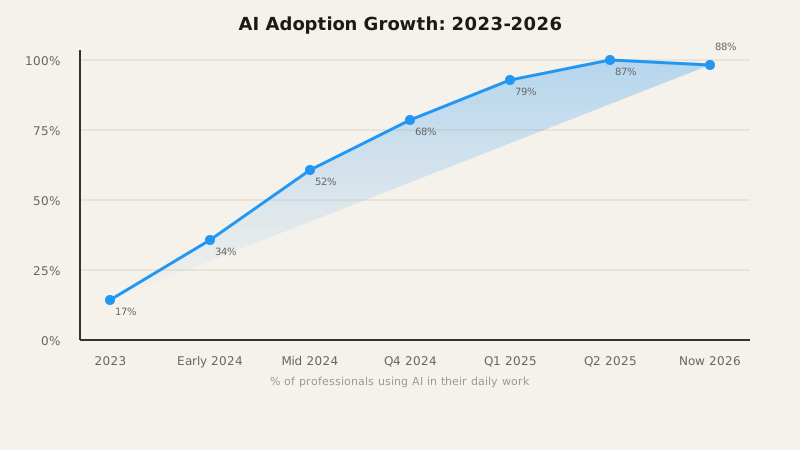
- 88% of organizations report regular AI use in at least one business function in 2025, up from 78% a year earlier. (McKinsey , November 2025)
- Only 39% of organizations can attribute any measurable bottom-line impact to AI, despite near-universal adoption. (McKinsey , November 2025)
- Just 7% of organizations say AI is fully scaled across the enterprise. (McKinsey , November 2025)
- 6% of organizations qualify as AI high performers, where AI drives 5% or more of EBIT. (McKinsey , November 2025)
- Over two-thirds of organizations now use AI in more than one business function, across a survey of 1,993 participants in 105 countries. (McKinsey , November 2025)
- Generative AI is now integrated into at least one business function at 70% of organizations. (Stanford HAI , 2026)
- 4 in 5 university students now use generative AI. (Stanford HAI , 2026)
- 95% of generative AI pilot programs fail to deliver rapid, measurable P&L impact, with only about 5% achieving rapid revenue acceleration, across 300 analyzed deployments. (MIT NANDA , August 2025)
- Buying AI from vendors succeeds in about 67% of deployments, versus internal builds, which succeed at roughly one-third that rate. (MIT NANDA , August 2025)
- 75% of business leaders rank AI among their top three strategic priorities, but only 25% say their organization is realizing significant value from it. (BCG , January 2025)
- Only 22% of companies have advanced beyond proof-of-concept with AI, and just 4% are creating substantial financial value. (BCG , January 2025)
Generative AI and consumer usage
- Generative AI reached 53% adoption within three years of ChatGPT’s launch, the fastest adoption curve the AI Index has tracked. (Stanford HAI , 2026)
- Generative AI adoption varies sharply by country: 64% in the UAE and 61% in Singapore, versus 28.3% in the United States. (Stanford HAI , 2026)
- US consumer surplus from generative AI reached an estimated $172 billion a year by early 2026, up 54% from $112 billion the year before. (Stanford HAI , 2026)
- ChatGPT reached 900 million weekly active users, announced February 27, 2026, alongside 50 million paying subscribers. (TechCrunch , February 2026)
- ChatGPT’s weekly active users grew from 200 million in August 2024 to 900 million in February 2026, roughly quadrupling in 18 months. (TechCrunch , February 2026)
- Users send more than 2.5 billion ChatGPT messages a day globally, over 330 million of them from the US. (Demandsage , 2026)
- 49% of jobs have seen AI used for at least a quarter of their tasks, combining across the Anthropic Economic Index reports, up from 36% in the first edition. (Anthropic Economic Index , January 2026)
- Computer and mathematical work accounts for 37.2% of Claude conversations, the single largest occupational category. (Anthropic Economic Index , 2025)
- 57% of Claude usage involves augmentation (AI collaborating with a human), versus 43% full automation. (Anthropic Economic Index , 2025)
AI at work and productivity
- 80% of the global workforce reports lacking the time or energy to meet productivity demands, while 53% of leaders say more output is needed. (Microsoft , 2025)
- 82% of leaders plan to use digital labor (AI agents) to expand workforce capacity within the next 12 to 18 months. (Microsoft , 2025)
- Developers using GitHub Copilot completed a coding task 55% faster, 1 hour 11 minutes versus 2 hours 41 minutes, in a controlled study of 95 developers. (GitHub , 2024)
- Copilot users had a 78% task completion rate versus 70% without it in the same study. (GitHub , 2024)
- 73% of developers using Copilot reported staying in flow, and 87% said it preserved mental effort on repetitive tasks. (GitHub , 2024)
- Teams using basic AI coding assistants see only 10 to 15% productivity boosts, even though two-thirds of software firms have rolled the tools out. (Bain & Company , 2025)
- Firms that pair AI with end-to-end lifecycle change report 25 to 30% productivity boosts, versus about 10% from code assistants alone. (Bain & Company , 2025)
- AI in daily operations delivers 10 to 20% productivity gains, and restructuring workflows around AI can improve efficiency by 30 to 50%. (BCG , January 2025)
- AI future-built companies achieve 5x the revenue increases and 3x the cost reductions of other companies from the same AI investment. (BCG , January 2025)
- 60% of workers are now equipped with employer-sanctioned AI tools, up from fewer than 40% a year earlier. (Deloitte , 2026)
AI in SaaS and software products
- Enterprise AI investment hit $37 billion in 2025, triple the $11.5 billion of 2024 and up from $1.7 billion in 2023, the fastest category expansion in enterprise software history. (Menlo Ventures , December 2025)
- Enterprise AI now captures 6% of the global SaaS market. (Menlo Ventures , December 2025)
- Application-layer AI spend hit $19 billion (51% of the total) and infrastructure-layer spend hit $18 billion (49%). (Menlo Ventures , December 2025)
- 76% of enterprise AI use cases are purchased rather than built, up from 53% a year earlier. (Menlo Ventures , December 2025)
- AI software deals convert to production at 47%, roughly double the 25% conversion rate of traditional SaaS deals. (Menlo Ventures , December 2025)
- 92% of SaaS companies have launched AI features or have them on the near-term roadmap, and every company founded in 2025 in the survey called AI core to its product. (High Alpha , 2025)
- Gartner forecasts 40% of enterprise applications will feature task-specific AI agents by 2026, up from less than 5% in 2025. (Gartner , August 2025)
- Gartner projects $234 billion in enterprise application software spend is at risk from agentic AI by 2030, roughly 20% of enterprise app SaaS spend. (Gartner , July 2026)


AI spend and investment
- Worldwide AI spending is forecast to reach $2.59 trillion in 2026, up 47% year over year. (Gartner , May 2026)
- AI infrastructure will account for over 45% of that 2026 AI spend, the single largest segment. (Gartner , May 2026)
- AI now accounts for roughly 41% of all worldwide IT spending in 2026, up from about 32% in 2025. (Gartner , May 2026)
- Global corporate AI investment more than doubled in 2025, with generative AI investment alone growing more than 200% and capturing nearly half of all private AI funding. (Stanford HAI , 2026)
- The United States committed 23 times more private AI capital than China in 2025. (Stanford HAI , 2026)
- Newly funded AI companies increased 71% year over year, and billion-dollar AI funding events nearly doubled in 2025. (Stanford HAI , 2026)
- The top 1% of US businesses spend $7,450 per employee per month on AI, while the median business spends just $11.38, a roughly 680-fold gap. (Ramp , June 2026)
- The top 10% of firms by AI spend pay $611 per employee per month, versus $11.38 for the median firm. (Ramp , June 2026)
- Foundation-model share among enterprises has flipped: Anthropic 40% (up from 12% in 2023), OpenAI 27% (down from 50%), Google 21% (up from 7%). (Menlo Ventures , December 2025)


AI ROI and business impact
- AI agents already account for about 17% of total AI value created in 2025, which BCG expects to rise to 29% by 2028. (BCG , January 2025)
- Around 70% of AI value in 2025 comes from core functions: R&D, sales, marketing, production, supply chain and pricing. (BCG , January 2025)
- 34% of companies report using AI to deeply transform their business, while 37% use it only at a surface level. (Deloitte , 2026)
- 25% of leaders report AI has had a transformative effect on their organization, double the prior year’s share. (Deloitte , 2026)
- 66% of software firms using generative AI report productivity and efficiency gains, though only 34% are truly reimagining the business. (Deloitte , 2026)
- 25% of organizations have moved 40% or more of their AI pilots into production, and 54% expect to within three to six months. (Deloitte , 2026)
- The average cost of a data breach fell to $4.44 million globally in 2025, down 9%, helped by faster AI-assisted containment, though US breaches still average $10.22 million. (IBM , 2025)
- Organizations using AI extensively in security cut breach lifecycles by 80 days and saved nearly $1.9 million on average. (IBM , 2025)

AI agents and agentic AI
- 62% of organizations are at least experimenting with AI agents, and 23% report scaling agentic AI somewhere in the enterprise. (McKinsey , November 2025)
- Gartner predicts over 40% of agentic AI projects will be canceled by the end of 2027, citing costs, unclear value and weak risk controls. (Gartner , June 2025)
- Only about 130 of the thousands of self-described agentic AI vendors offer genuine agentic capability, the rest largely rebranded chatbots or RPA (“agent washing”). (Gartner , June 2025)
- Only 19% of organizations had made significant investments in agentic AI, with 42% conservative, 8% none and 31% still undecided. (Gartner , June 2025)
- 85% of companies expect to customize AI agents to their needs, but only 21% have a mature governance model for autonomous deployment. (Deloitte , 2026)
- Only 16% of enterprise and 27% of startup AI deployments qualify as true agents doing autonomous multi-step work, versus copilots and assistants. (Menlo Ventures , December 2025)
- Agent-category enterprise spend hit $750 million in 2025, a 5.3x jump, though still far below copilot spend of $7.2 billion. (Menlo Ventures , December 2025)
- Gartner predicts agentic AI will autonomously resolve 80% of common customer service issues by 2029, cutting operational costs by roughly 30%. (Gartner , March 2025)
- Real agent deployment remains in the single digits across nearly all business functions, despite the hype. (Stanford HAI , 2026)
AI in marketing, sales and service
- 91% of marketing leaders say their employees use AI to assist with their jobs, across 1,000+ marketing professionals surveyed. (HubSpot , 2025)
- 92% of marketers say AI has already changed how they do their jobs. (HubSpot , 2025)
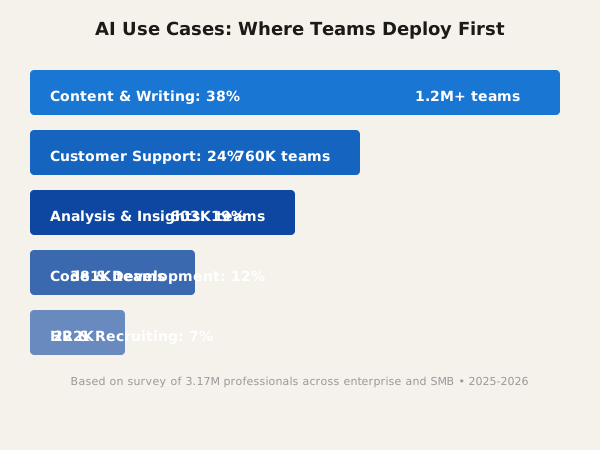
- Top AI marketing use cases: content creation (35%), data analysis (30%), workflow automation (20%), AI-powered research (15%). (HubSpot , 2025)
- 66% of marketing organizations are building internal AI tools for their teams rather than relying only on off-the-shelf tools. (HubSpot , 2025)
- Data-privacy concerns stopped 42% of marketing teams from adopting new AI tools, while 35% say there are too many overlapping AI tools that don’t connect. (HubSpot , 2025)
- AI jumped from the #10 to the #2 priority for customer service leaders in a single year. (Salesforce , 2025)
- Salesforce projects AI will resolve 50% of customer service cases by 2027, up from 30% in 2025. (Salesforce , 2025)
- Service pros using AI agents spend 20% less time on routine cases, freeing up roughly 4 hours a week. (Salesforce , 2025)
- 83% of sales teams using AI saw revenue growth in the past year, versus 66% of teams without AI. (Salesforce , 2025)
- Only 20% of customer service leaders had actually reduced agent staffing because of AI, despite widespread expectation of cuts. (Gartner , February 2026)
- Gartner predicts half of companies that cut service staff due to AI will rehire by 2027. (Gartner , February 2026)
- 64% of customers say they would prefer companies not use AI for service, citing trouble reaching a human (60%) and distrust of AI answers (42%). (Gartner , July 2024)
AI in HR and recruiting
- 43% of organizations now use AI to support HR tasks, up from 26% the prior year. (SHRM , 2025)
- HR AI adoption varies by sector: 58% of publicly traded for-profits down to 19% of federal government. (SHRM , 2025)
- Within HR, AI is most used in HR technology (42%), recruiting (40%) and learning and development (39%). (SHRM , 2025)
- 51% of organizations use AI to support recruiting, most often for writing job descriptions (66%), screening resumes (44%) and automating candidate searches (32%). (SHRM , 2025)
- 89% of HR pros whose org uses AI for recruiting say it saves time, though only 24% say it improved their ability to identify top candidates. (SHRM , 2025)
- About 23.2 million US jobs (15.1% of employment) are highly automatable, but only about 9.2 million (6%) are both highly automatable and lack barriers to actual displacement. (SHRM , October 2025)
- 71% of L&D professionals are exploring or integrating AI into their own work, and 49% report a growing AI-driven skills crisis. (LinkedIn Learning , 2025)
AI risk, security and governance
- 97% of organizations that suffered an AI-related security incident lacked proper AI access controls. (IBM , 2025)
- 63% of surveyed organizations have no AI governance policy to manage AI use or prevent shadow AI. (IBM , 2025)
- High shadow-AI usage adds an average of $670,000 to a breach, pushing shadow-AI-linked breaches to $4.63 million. (IBM , 2025)
- 13% of organizations reported a breach of an AI model or AI application. (IBM , July 2025)
- Documented AI incidents rose to 362 in 2025, up from 233 in 2024. (Stanford HAI , 2026)
- The Foundation Model Transparency Index average fell to 40 in 2026, down from 58 the prior year, even as models grew more capable. (Stanford HAI , 2026)
- Only 21% of companies have a mature governance model for autonomous AI agent deployment. (Deloitte , 2026)
Public attitudes to AI
- 50% of Americans are more concerned than excited about AI in daily life, up from 37% in 2021, while only 10% are more excited than concerned. (Pew Research , September 2025)
- 57% of Americans rate the societal risks of AI as high, versus 25% who rate the benefits as high. (Pew Research , September 2025)
- 53% of Americans believe AI will worsen people’s ability to think creatively; only 16% think it will improve it. (Pew Research , September 2025)
- 57% of Americans want more control over how AI is used in their own lives. (Pew Research , September 2025)
- The share of US workers using AI on the job rose from 16% in 2024 to 21% in 2025, yet 65% still say they don’t use AI much or at all at work. (Pew Research , September 2025)
- 95% of US adults have heard at least a little about AI, and the share who’ve heard “a lot” rose from 26% in 2022 to 47%. (Pew Research , September 2025)
- Globally, 52% of people say AI products make them excited while 53% say the same products make them nervous, across 30 countries. (Ipsos , 2025)
- 45% of Gen Z and 39% of Millennials globally think AI will take their job within five years. (Ipsos , 2025)
- Global optimism about AI’s benefits rose to 59%, up from 52% the prior year. (Stanford HAI , 2026)
AI, jobs and the workforce
- AI was cited as the reason for 54,836 announced US layoffs in 2025, and 71,825 total since employers began naming AI as a distinct reason in 2023. (Challenger, Gray & Christmas , January 2026)
- US employer job-cut announcements hit 1,206,374 in 2025, up 58% from 2024 and the highest annual total since 2020. (Challenger, Gray & Christmas , January 2026)
- Technology-sector job cuts reached 154,445 in 2025 as companies restructured around AI. (Challenger, Gray & Christmas , January 2026)
- By April 2026, AI-cited job cuts reached 21,490 in a single month, having led all cited reasons in March 2026. (Challenger, Gray & Christmas , 2026)
- A median of 17% of organizations report workforce declines from AI in the past year, and a median of 30% expect a decrease in the next year. (McKinsey , November 2025)
- The WEF projects AI-related disruption will touch 22% of jobs by 2030, with 170 million new roles created and 92 million displaced, a net gain of 78 million. (World Economic Forum , January 2025)
- AI and big data top the WEF’s list of fastest-growing skills employers want by 2030, with 59% of the workforce needing retraining. (World Economic Forum , 2025)
Model, compute and capability trends
- AI coding performance on SWE-bench Verified rose from 60% to near 100% in a single year. (Stanford HAI , 2026)
- On graduate-level GPQA, model accuracy passed the 81.2% expert-human baseline to reach 93% in 2025. (Stanford HAI , 2026)
- On OSWorld computer-use tasks, agent accuracy rose from roughly 12% to 66.3% in about a year, closing to within 6 points of human performance. (Stanford HAI , 2026)
- Physical robotics remains the clearest weak spot: robots succeed in only 12% of real household tasks tested. (Stanford HAI , 2026)
- Training compute for frontier AI models grows roughly 4 to 5x per year, doubling about every 5.2 months. (Epoch AI , 2025)
- The cost of training frontier models has grown 2 to 3x per year for eight years, and Epoch AI projects the largest runs will top $1 billion by 2027. (Epoch AI , 2025)
- Compute purchasable per dollar has improved by roughly 40% per year across 20-plus AI accelerators from 2012 to 2025. (Epoch AI , 2025)
- AI data center power capacity rose to 29.6 gigawatts globally, comparable to New York state’s peak electricity demand. (Stanford HAI , 2026)
What these AI statistics mean for 2026
The single number to sit with is the gap between 88% and 39%. Nearly every company now uses AI, but fewer than four in ten can point to a dollar it moved. That is not a failure of the technology so much as a failure of deployment, and the data backs that reading: buying tools beats building them, restructuring a workflow beats bolting AI onto it, and the companies treating AI as a transformation rather than a feature are pulling away fast.
For anyone selling or buying software, three shifts matter most. AI is now table stakes, not a differentiator, since 92% of SaaS companies already ship or roadmap it. The model layer is consolidating around new leaders, with Anthropic overtaking OpenAI in enterprise share. And spend is splitting into a small group paying hundreds of dollars per employee and a long tail paying almost nothing, which is where most buyers still sit.
The workforce story is quieter than the headlines. AI was named in about 4.5% of 2025 layoffs, real and rising, but a fraction of the total, and public sentiment stays net-skeptical even as everyday use climbs. The honest summary of AI in 2026 is that capability is racing ahead while measurable value, governance and trust are all still catching up.
We keep this page current. If a figure here is out of date or you have a study we should add, tell us through our editorial standards page.