Most SaaS pricing pages are designed to be read in one direction: down to the cheapest number, then a fast click to “start free.” The number you remember is almost never the number you pay.
We wanted to put a figure on that gap. So we pulled the published pricing for every tool across the Topickz review desk, 466 products in 10 categories, and measured two things: how many vendors will even show you a price, and how far the advertised entry sits below the tier a real team actually lands on.
The short version: more than a quarter of B2B SaaS tools won’t quote a price until you book a call, and for the ones that do publish, the next tier up costs roughly double.
What we measured
This is not a survey. We did not ask vendors how they price. We read what they publish, on the public pricing page, the way a buyer would, and recorded it.
For each of the 466 tools we captured the advertised entry price (the headline number on the pricing page) and the full published tier ladder where one exists. Then we flagged every tool that shows no number at all, the “contact sales” and “request a quote” crowd.
Figures were pulled from vendor pricing pages and cross-checked against our existing category reviews, all dated within the last 30 days. Our methodology explains how the review desk verifies pricing.
One honesty note up front. An early cut of this analysis compared each tool’s entry price to its most expensive enterprise tier, and the numbers were nonsense, because it was stacking per-user prices against flat enterprise contracts.
Every figure below compares like units only (per-user against per-user, flat against flat) and measures the jump to the next tier up, not the top of the ladder.
The transparency split
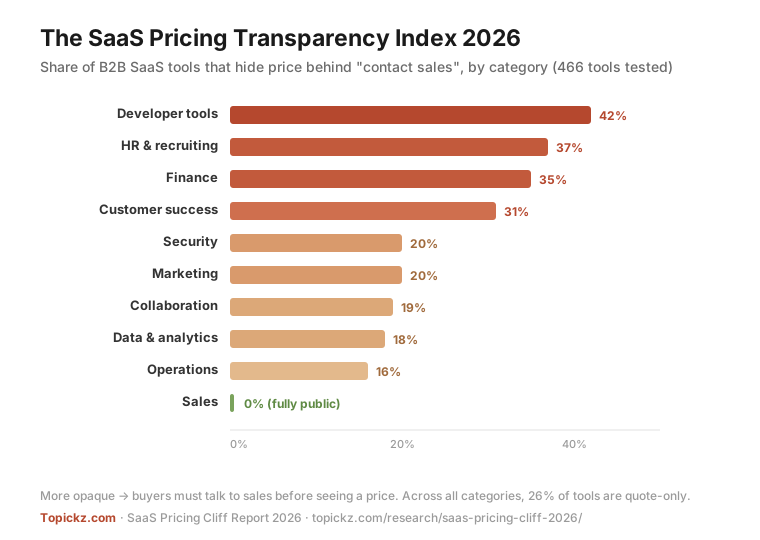
A clean public price is not the norm you might assume it is. Of 466 tools, 345 show a real number and 121 do not. That is 26% of the market asking you to start a sales conversation before you can do basic budgeting.
The pattern is not random. It tracks almost perfectly with who the buyer is. Tools sold to individual practitioners and small teams publish prices, because the buyer expects to swipe a card. Tools sold to IT, security, and finance departments hide them, because the buyer expects a negotiation.
The categories that hide the ball
Developer tools are the worst offenders. 42% of the dev and infrastructure tools we checked are quote-only, the highest of any category. Usage-based and seat-based models get bundled into “let’s talk about your scale,” and the real bill only shows up after a sales call.
HR and recruiting software is close behind at 37%, and finance tools sit at 35%. These are the three categories where a buyer is least likely to find a straight answer on the pricing page. It is not a coincidence that all three sell into departments with procurement teams and annual budget cycles.
Sales software is the outlier in the other direction. Every sales tool we checked, all 39 of them, publishes a price. Operations (84% numeric) and data analytics (82%) are close behind. When the buyer is a line manager with a credit card, the price is right there on the page.
The pricing cliff
Showing a price is only half the trick. The other half is which price you show. The advertised entry tier is usually a stripped-down plan that most teams outgrow within the first month, and the jump to the next tier is steep.
For tools that publish per-user pricing, the next tier up costs a median of 88% more than the advertised entry, and the average jump is 118%. For flat-fee tools the cliff is even sharper: a median 100% increase, average 247%. The number on the page is real. It is just not the number for the plan you need.
Here is the cliff in tools you already know:
| Tool | Advertised entry | Next tier up | Jump |
|---|---|---|---|
| HubSpot Sales Hub | $20/user/mo | $100/user/mo | +400% |
| Freshsales | $9/user/mo | $39/user/mo | +333% |
| Salesforce Sales Cloud | $25/user/mo | $100/user/mo | +300% |
| GitLab CI/CD | $29/user/mo | $99/user/mo | +241% |
| Microsoft Project | $10/user/mo | $30/user/mo | +200% |
| Freshdesk | $19/user/mo | $55/user/mo | +190% |
| Tableau | $15/user/mo | $42/user/mo | +180% |
| Intercom | $39/user/mo | $99/user/mo | +154% |
These are not enterprise contracts. They are the second rung on the ladder, the one a normal growing team hits the moment it needs reporting, automation, or more than a handful of seats.
Why the gap exists
None of this is an accident, and most of it is not even dishonest. It is the land-and-expand model working as designed. Get the lowest possible number in front of the buyer, win the signup, then let the team grow into the features that live one tier up.
The trouble is that the advertised price sets the buyer’s mental anchor, and the anchor is wrong. A team that budgets around the $20 plan and lands on the $100 plan is not getting scammed. It is getting expanded, exactly the way the pricing page was built to expand it.
The quote-only tools play a different version of the same game. By withholding the number, they keep the anchor out of your head entirely, so the first figure you hear is whatever the sales team decides you can absorb.
What buyers should do
Treat the advertised price as a floor, never an estimate. Before you compare two tools, find the tier that actually contains the features you need, then compare those numbers. The entry price tells you almost nothing about your real cost.
For any quote-only tool, ask for the full price list in writing on the first call, not your custom quote, the list. Vendors that genuinely cannot publish a price often can still tell you the tier structure, and the ones that refuse are telling you something about how the negotiation will go.
And model your cost at the tier above the one you think you need. On the data here, that tier is roughly twice the sticker, and you will probably be on it within a year.
Methodology
Sample: 466 B2B SaaS products across 10 categories (sales, marketing, HR and recruiting, finance, security, customer success, collaboration, data and analytics, operations, developer tools), drawn from the Topickz review desk.
Collection: advertised entry price and full published tier ladders were read directly from each vendor’s public pricing page and cross-checked against our category reviews. Tools showing no public number were flagged as quote-only. Data pulled and verified within 30 days of publication.
Cliff calculation: the “next tier up” jump compares the advertised entry price to the next-highest published tier of the same billing unit (per-user against per-user, flat against flat). Free and quote-only tiers were excluded from the cliff math. Tools with only one published price were excluded from the cliff sample (per-user n=116, flat n=126).
This is original Topickz research. We will refresh it annually.
Cite this report
Free to reference with a link back to this page. Suggested credit: “Topickz SaaS Pricing Cliff Report 2026 (topickz.com/research/saas-pricing-cliff-2026/).”
To embed the transparency index chart:
<a href="https://topickz.com/research/saas-pricing-cliff-2026/">
  <img src="https://topickz.com/images/research/saas-pricing-transparency-index-2026.svg"
       alt="Topickz SaaS Pricing Transparency Index 2026" width="760">
</a>
<p>Source: <a href="https://topickz.com/research/saas-pricing-cliff-2026/">Topickz SaaS Pricing Cliff Report 2026</a></p>
Related reading: best CRM software , best IAM and SSO platforms , and our review methodology .