
Comparing the best OKR Software for Startups of 2026 includes 1. Mooncamp 2. OKRs Tool 3. Cascade Strategy 4. Perdoo 5. 15Five 6. Lattice Goals 7. Profit.co 8. Betterworks.
TL;DR
- Best for seed–Series A: Mooncamp, fastest first OKR cycle and the cleanest UX for a young team getting goals off spreadsheets.
- Best value as you scale: OKRs Tool, flat pricing that does not punish headcount growth ($49/mo up to 50 users) plus a 60% adoption-or-refund guarantee.
- Best free tier: Cascade Strategy, the most capable free entry (up to 4 users) for a founding team learning the discipline.
- Best for Series A–B depth: Perdoo, real cascade depth a startup grows into, free up to 5 users.
- Best OKR + check-in habit: 15Five, build the weekly OKR habit at a fast-scaling startup that has no performance tool yet.
- Best when you add reviews: Lattice Goals, the Series B moment when OKRs and performance reviews need one employee record.
Eight OKR tools ranked for a startup from seed to Series B. Which one gets you to a first cycle fastest, which free tier is real, which pricing model survives headcount growth, and where to switch as you raise the next round.
Best OKR Software for Startups comparison: features, pricing and verdicts
| Tool | Best for | Starting price | Free trial | External rating |
|---|---|---|---|---|
Fastest first OKR cycle and the cleanest UX for a seed-stage startup | €7/user/mo | 14-day free trial | G2 4.8/5 (296 reviews) | |
Flat pricing that does not punish headcount growth, plus an adoption guarantee | $49/mo | Free up to 5 users | G2 4.6/5 (7 reviews) | |
A capable free tier for a founding team learning the OKR discipline | Custom quote | 14-day free trial | G2 4.8/5 (236 reviews) | |
Real cascade depth a startup grows into, free up to 5 users | €8/user/mo | Free tier (up to 5 users) | G2 4.6/5 (312 reviews) | |
Build the weekly OKR habit at a fast-scaling startup with no perf tool yet | $11/user/mo | 14-day free trial | G2 4.6/5 (1,902 reviews) | |
The Series B moment when OKRs and performance reviews need one record | $8/seat/mo | Demo only | G2 4.7/5 (4,060 reviews) | |
A startup scaling into deeper execution and AI coaching past ~120 people | Custom quote | 14-day free trial | G2 4.7/5 (896 reviews) | |
500-employee minimum, so a startup is years away; here for completeness only | Custom (500-employee minimum) | Demo only | G2 4.3/5 (215 reviews) |
How we chose these tools
We ranked these tools for the startup buyer, the founder or early-ops lead who needs a first OKR cycle running fast, a free or cheap entry point, and a tool that scales with headcount and the next funding round. The assessment draws on documented product capabilities, recurring themes across real G2 and Capterra reviews, and vendor pricing pages. Pricing was verified directly on vendor sites in May 2026. All G2 ratings cited were pulled on May 28, 2026.
Read the full TopickZ.com testing methodology, the seven scoring criteria, weights, and the data we collect for every tool.
Detailed reviews
Mooncamp
Fastest first OKR cycle and the cleanest UX for a seed-stage startupWhat's great
- 4.8/5 on G2 across 296 reviews, the highest per-review satisfaction score in this comparison; a young team is not betting on a tool people quietly hate
- Native Microsoft Teams integration is first-party and well-maintained; a startup already living in M365 does not need a Zapier bridge to get OKR nudges where the team already talks
- Clean, fast onboarding flow; a founding team can get a first OKR cycle running shortly after signup without a consultant or an implementation budget
Watch-outs
- OKR rules engine and custom dashboards are locked behind the Professional tier ($10/user/mo); the $7 Essential tier is limited for anything beyond basic goal tracking
- Cascade depth past 4-5 levels gets unwieldy; once you are past 300 people this is the moment you migrate out, not the tool you scale forever on
- No built-in performance review layer; once you add review cycles after Series B you pair Mooncamp with a separate HRIS, which adds tooling cost and integration friction
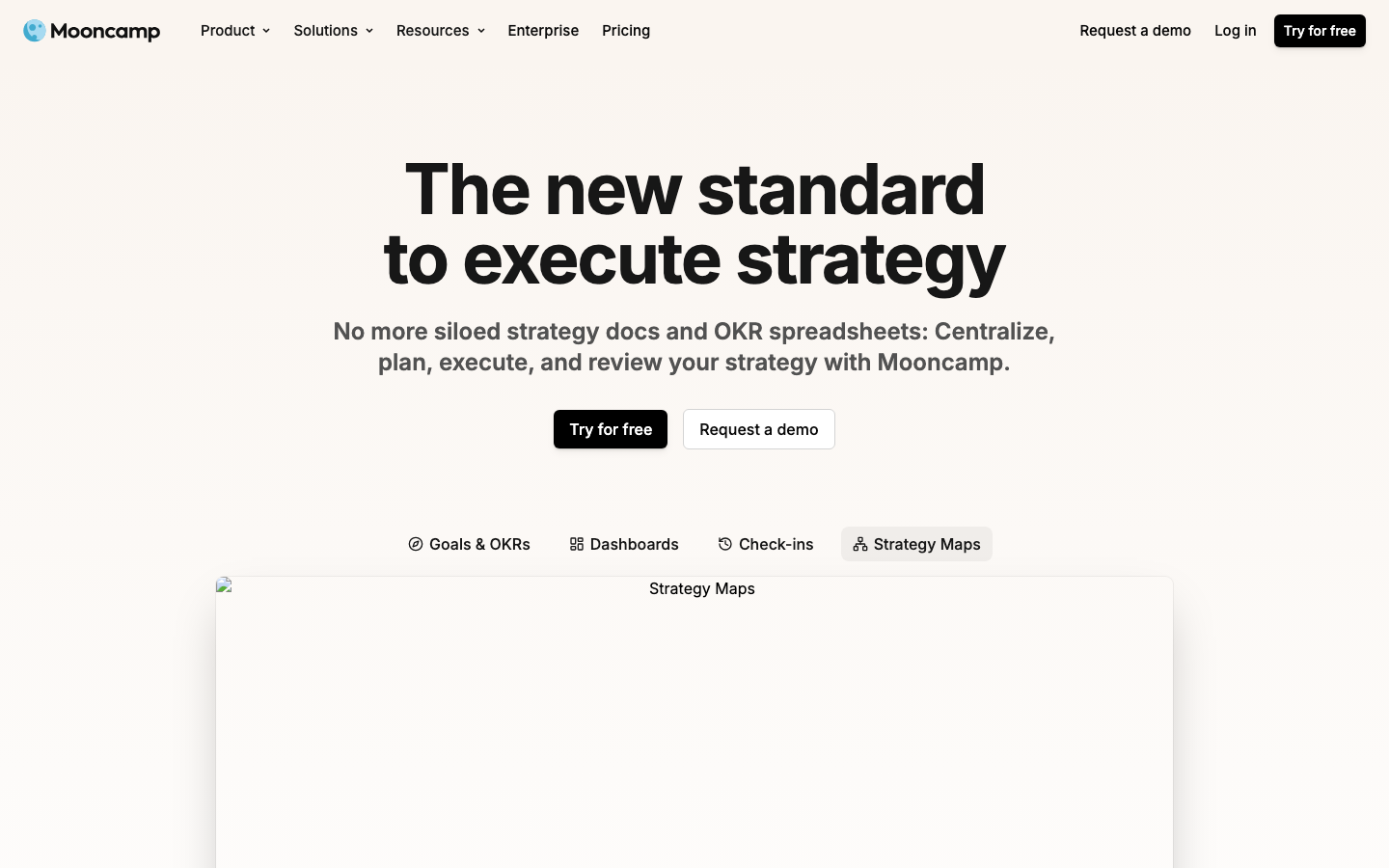
Mooncamp is the tool to buy when you want OKRs off the founder’s spreadsheet without a 6-month implementation project. For a seed to Series A team the UX is the sharpest in this comparison at this price point, and the free trial converts fast because anyone can build a functional OKR tree before the demo call ends. 296 G2 reviews
at 4.8/5 is the highest satisfaction score in this group despite being the smallest sample. Pricing is clean and predictable for a runway-conscious startup, Essential at €7/user/mo ($8 USD), Professional at €10/user/mo ($11.50 USD), billed annually. The limitation shows up at scale; startups past 300 employees with complex cross-team dependencies typically migrate to Perdoo or Profit.co by year two, and that is fine, you switch when the next round funds the headcount. For a first-time OKR deployment or a small team that needs clean dashboards without enterprise overhead, Mooncamp is the right call. Mooncamp’s own comparison of the OKR market
is self-serving but thorough.
Pricing breakdown
| Plan | Price | Best for |
|---|---|---|
| Essential | €7/user/mo (~$8) | 5-100 employees |
| Professional | €10/user/mo (~$11.50) | 100-300 employees with OKR rules and dashboards |
| Enterprise | Custom | 300+ employees with SSO/SCIM |
| Free trial | $0 | 14-day full-feature trial |
Security & compliance
| Standard | Availability |
|---|---|
| SOC 2 Type II | Yes |
| GDPR | Yes |
| HIPAA | No |
| SSO / SAML | Enterprise |
| Audit logs | Professional+ |
Mooncamp compliance summary: SOC 2 Type II is yes, GDPR is yes, HIPAA is no, SSO/SAML is enterprise, and audit logs is professional+.
Key integrations
| Integration | Type |
|---|---|
| Gmail | N/A |
| Outlook | N/A |
| Slack | Native integration |
| LinkedIn Sales Navigator | N/A |
| Outreach / Salesloft | N/A |
Mooncamp integration summary: Gmail is not specified, Outlook is not specified, Slack is native integration, LinkedIn Sales Navigator is not specified, and Outreach or Salesloft is not specified.
Feature availability
| Feature | Status |
|---|---|
| Free tier | ✗ trial only |
| AI coaching | ✗ |
| Cascade | ✓ |
| Check ins | ✓ |
| Task management | ✗ |
Mooncamp feature availability summary: Free tier (✗ trial only), AI coaching (✗), Cascade (✓), Check ins (✓), and Task management (✗).
Loading reviews…
OKRs Tool
Flat pricing that does not punish headcount growth, plus an adoption guaranteeWhat's great
- Flat pricing of $49/mo for up to 50 users and $129/mo beyond means a 50-person team pays about $1/user where the per-seat tools here charge $11 and up; doubling headcount between rounds does not double the bill
- The 60% adoption guarantee refunds you in full if the team misses 60% adoption inside 30 days, the only money-back adoption promise in this category and exactly the risk a first-time founder buyer worries about
- Built for the growing team that just crossed 50 people, with required KR ownership, weekly check-in nudges, and a visual alignment map that sets up in an afternoon
Watch-outs
- Only 7 G2 reviews (4.6/5 as of June 2026), a thin sample if your future enterprise buyers or board ever scrutinize your internal stack
- Newer and lighter than the incumbents, cascade depth and reporting top out around 200 people, not the 1,000-plus that Betterworks or Lattice handle, so plan to revisit if you scale fast
- No published SOC 2 Type II certification, and SSO, MFA, RBAC, and audit logs are gated to the top $129/mo Expand tier
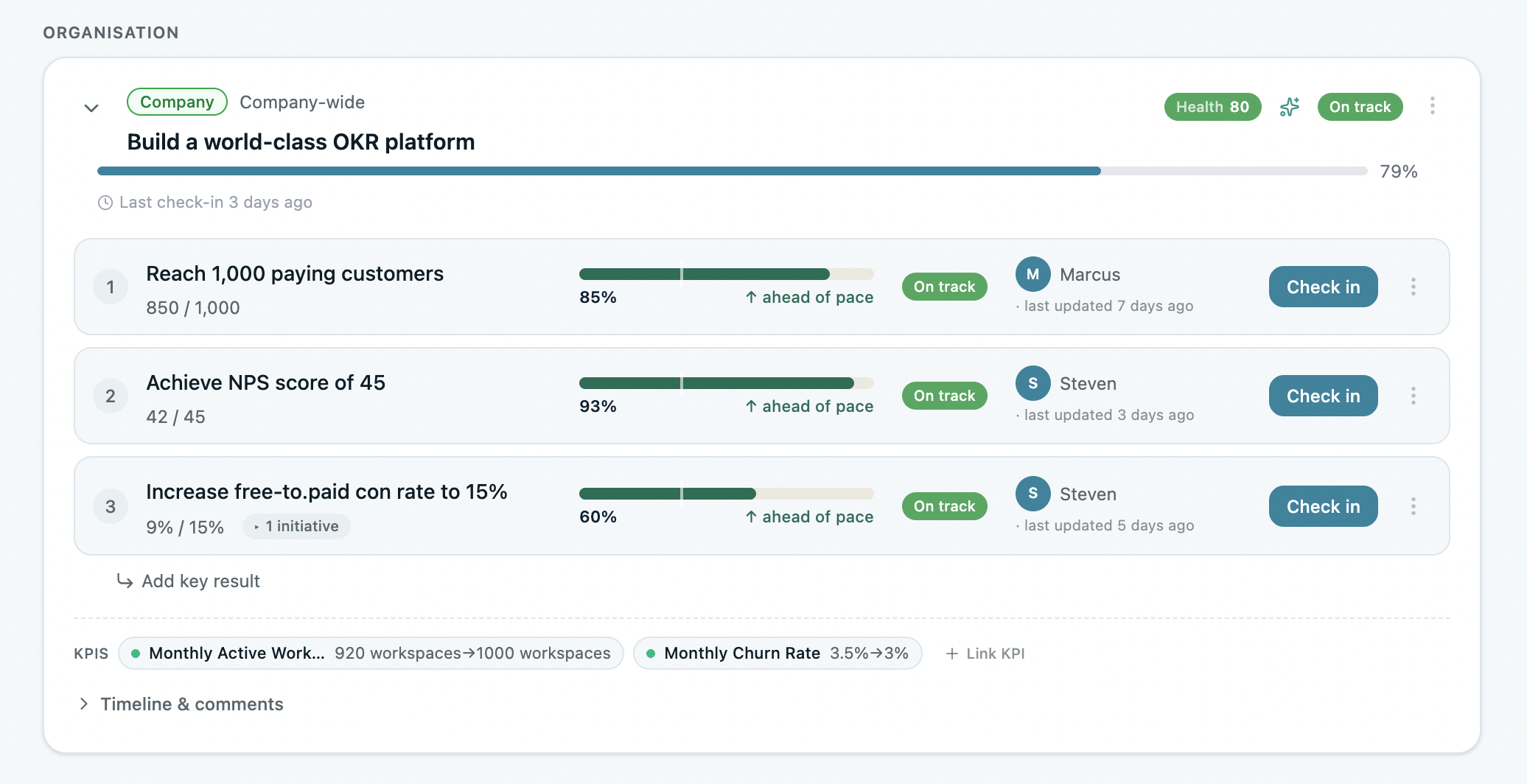
OKRs Tool is the price story for a startup watching its runway. Where almost every tool here charges per seat, OKRs Tool charges flat, $49/mo for up to 50 users and $129/mo past that. Run the math on a 50-person team and that is roughly $49/mo against $550/mo on 15Five at $11 a seat, and the gap only widens as you hire. The pitch lands squarely at the founder or department head inside a 50-200 person company, set up in an afternoon, no consultants, required KR ownership, weekly check-in nudges, and an alignment map that shows how every goal connects. The differentiator that earned the value spot is the 60% adoption guarantee, a full refund if the team does not hit 60% adoption in 30 days, which attacks the exact reason most startup OKR programs die. The honest caveat is track record. 7 G2 reviews at 4.6/5 is a thin sample, and the product is newer and lighter than the names around it, the depth a 1,000-person org needs is not here yet. For a budget-conscious team of 50-200 that wants OKRs running next week without a per-seat bill that climbs with every hire, OKRs Tool is the value pick.
Pricing breakdown
| Plan | Price | Best for |
|---|---|---|
| Launch (Free) | $0 | Up to 5 users on one active cycle |
| Scale | $49/mo flat | 6-50 users; unlimited cycles and AI insights |
| Expand | $129/mo flat | 51+ users; SSO/MFA/RBAC and audit logs |
| Adoption guarantee | Full refund | If under 60% adoption in 30 days |
Security & compliance
| Standard | Availability |
|---|---|
| SOC 2 Type II | No |
| GDPR | ✓ EU residency |
| HIPAA | No |
| SSO / SAML | Expand |
| Audit logs | Expand |
OKRs Tool compliance summary: SOC 2 Type II is no, GDPR is ✓ eu residency, HIPAA is no, SSO/SAML is expand, and audit logs is expand.
Key integrations
| Integration | Type |
|---|---|
| Gmail | N/A |
| Outlook | N/A |
| Slack | Native integration |
| LinkedIn Sales Navigator | N/A |
| Outreach / Salesloft | N/A |
OKRs Tool integration summary: Gmail is not specified, Outlook is not specified, Slack is native integration, LinkedIn Sales Navigator is not specified, and Outreach or Salesloft is not specified.
Feature availability
| Feature | Status |
|---|---|
| Free tier | ✓ 5 users |
| AI coaching | ✓ AI insights |
| Cascade | ✓ |
| Check ins | ✓ |
| Task management | • initiatives |
OKRs Tool feature availability summary: Free tier (✓ 5 users), AI coaching (✓ AI insights), Cascade (✓), Check ins (✓), and Task management (• initiatives).
Loading reviews…
Cascade Strategy
A capable free tier for a founding team learning the OKR disciplineWhat's great
- Free tier ships with unlimited plans, unlimited metrics, and up to 4 users; the most feature-complete free entry in the comparison and enough for a founding team to run a real first cycle at zero cost
- 4.8/5 on G2 across 236 reviews, tied for the highest per-review satisfaction score in this group alongside Mooncamp
- Strategy Roadmap layer connects the company vision a founder is already pitching to investors down to quarterly OKRs; the only tool here built top-down from strategy rather than bottom-up from team goals
Watch-outs
- Pricing is opaque past the free tier, custom-quote-only; buyer reports suggest Essentials-tier contracts run $10-30/user/mo depending on team size, so budget for a sales call once you outgrow the free 4 seats
- Stronger for the founder and exec view than for IC-level updates; the UI rewards big-picture thinkers, not the engineer updating a KR on a Thursday afternoon
- Implementation time is 4-6 weeks for a complete strategy-to-OKR buildout; not the fastest quick-deploy tool if you want a cycle running this week
Cascade earns the free-tier spot because its free entry is the most capable in this list, unlimited plans, unlimited metrics, up to 4 users, which is exactly enough for a founding team to learn the OKR discipline before spending a dollar. Where most tools here start from the team OKR and work up, Cascade starts from the company strategy and works down. That inverted approach resonates with the founder or strategy lead who already thinks in terms of the deck they pitched investors. 236 G2 reviews at 4.8/5 puts user satisfaction near the top of the market. The limitation is the same as the advantage, a tool designed for strategy thinkers is sometimes frustrating for ICs who just want to update a KR without loading a strategy map. Cascade’s own comparison of strategy execution platforms is thorough, and the free tier is the most capable here for a team evaluating without a budget commitment yet. Best for a startup that already frames its quarter around a strategy document and wants OKRs to sit visibly inside it.
Pricing breakdown
| Plan | Price | Best for |
|---|---|---|
| Free | $0 | Up to 4 users |
| Essentials | Custom (~$10-30/user/mo) | Teams up to 100 employees |
| Enterprise+ | Custom | 100+ employees with strategy roadmaps and deep partnerships |
| Implementation | Included or quoted | Strategy buildout with Cascade's team |
Security & compliance
| Standard | Availability |
|---|---|
| SOC 2 Type II | Yes |
| GDPR | Yes |
| HIPAA | No |
| SSO / SAML | Enterprise+ |
| Audit logs | Enterprise+ |
Cascade Strategy compliance summary: SOC 2 Type II is yes, GDPR is yes, HIPAA is no, SSO/SAML is enterprise+, and audit logs is enterprise+.
Key integrations
| Integration | Type |
|---|---|
| Gmail | N/A |
| Outlook | N/A |
| Slack | Native integration |
| LinkedIn Sales Navigator | N/A |
| Outreach / Salesloft | N/A |
Cascade Strategy integration summary: Gmail is not specified, Outlook is not specified, Slack is native integration, LinkedIn Sales Navigator is not specified, and Outreach or Salesloft is not specified.
Feature availability
| Feature | Status |
|---|---|
| Free tier | ✓ 4 users |
| AI coaching | ✓ AI insights |
| Cascade | ✓ |
| Check ins | ✓ |
| Task management | ✓ |
Cascade Strategy feature availability summary: Free tier (✓ 4 users), AI coaching (✓ AI insights), Cascade (✓), Check ins (✓), and Task management (✓).
Loading reviews…
Perdoo
Real cascade depth a startup grows into, free up to 5 usersWhat's great
- Free tier up to 5 users lets a small founding team start at zero, then the same tool scales into real Series A-B cascade depth without a migration
- Strategy Map feature visually connects company vision to team OKRs to individual KRs in a single scrollable tree; the best cascade visualization in this comparison and the one that earns its keep past 100 people
- Supreme tier at $10/user/mo ships KPI boards, Jira integration, Power BI connector, and custom dashboards included; no add-on fees, which matters when every line item is scrutinized
Watch-outs
- Review count (312 on G2) is thin compared to Lattice (4,060) and 15Five (1,902); newer buyers have less community evidence to pull from
- No built-in performance review or 1-on-1 workflows; pure OKR tool means you need a separate system for the review layer once you start running reviews
- Check-in depth is lighter than 15Five; the platform excels at goal structure, not the weekly-cadence behavioral layer a young team may need to build the habit
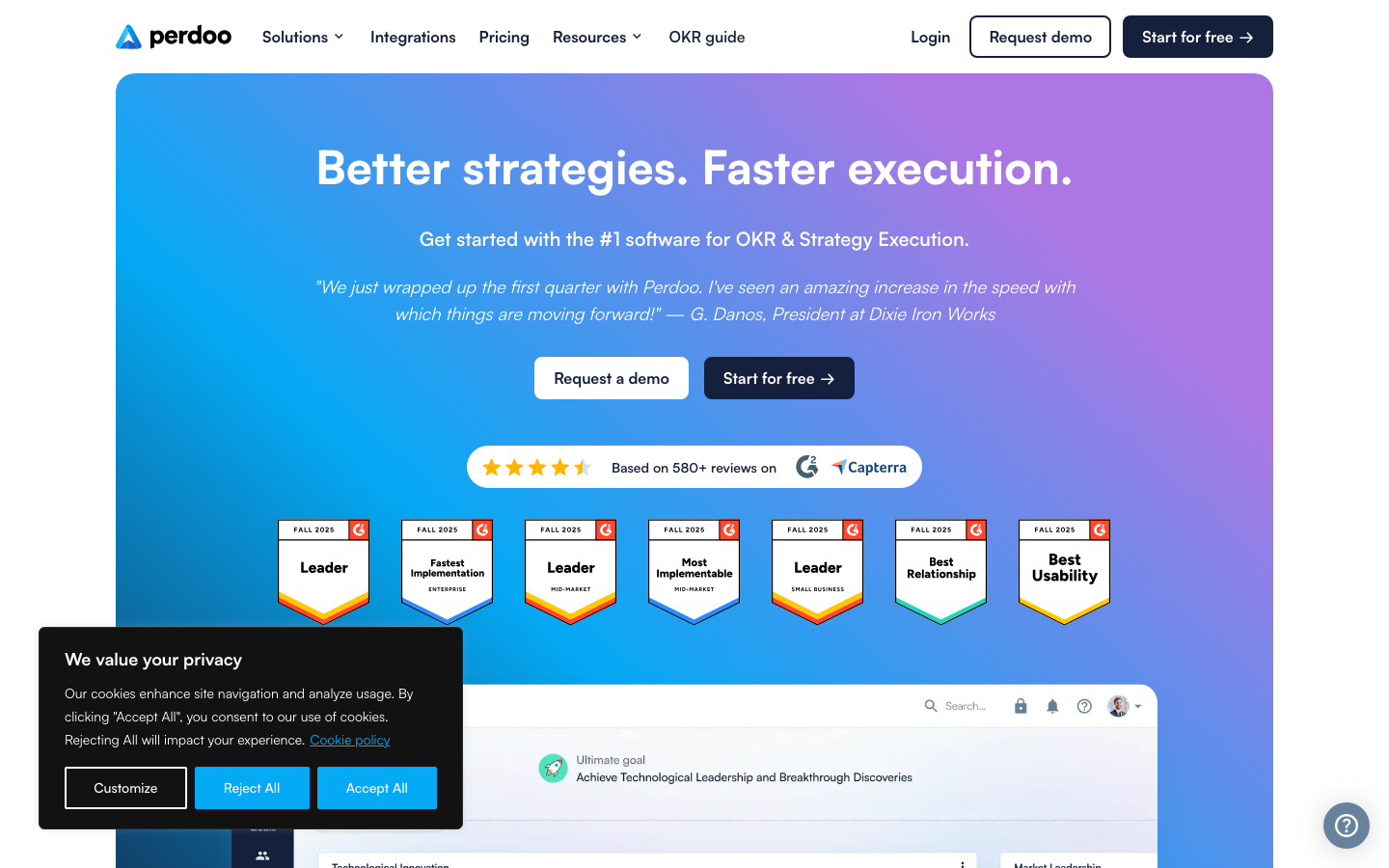
Perdoo is the OKR specialist’s pick, and for a startup the appeal is that you start free up to 5 users and the same tool keeps earning its price as you raise and hire. Where the people-management suites (Lattice, 15Five) treat OKRs as one module among several, Perdoo treats strategy execution as the entire product. The result is a cascade visualization and KPI integration depth that none of the suite players match, depth a Series A-B team grows into rather than out of. 312 G2 reviews at 4.6/5 is a thinner sample than Lattice’s four thousand, but satisfaction among teams running dedicated OKR programs is consistently high. A finance ops director I know at a 250-person SaaS put it plainly, ’every other tool we tried was built for HR to manage people; Perdoo was built for the strategy team to manage the company.’ Pricing is transparent and in euros, €8/user/mo Premium and €10/user/mo Supreme on annual billing (roughly $9 and $11 USD at current rates); one of few OKR tools that publishes real numbers publicly, which a runway-conscious founder appreciates. Mooncamp’s Perdoo comparison gives a balanced view of where Perdoo wins and loses versus its direct competitors.
Pricing breakdown
| Plan | Price | Best for |
|---|---|---|
| Free | $0 | Up to 5 users |
| Premium | €8/user/mo (~$9) | 5-100 employees with full OKR depth |
| Supreme | €10/user/mo (~$11) | 100-500 employees with KPI boards and Jira |
| Enterprise | Custom | 500+ with SSO/SCIM and dedicated support |
Security & compliance
| Standard | Availability |
|---|---|
| SOC 2 Type II | Yes |
| GDPR | Yes |
| HIPAA | No |
| SSO / SAML | Supreme+ |
| Audit logs | Supreme+ |
Perdoo compliance summary: SOC 2 Type II is yes, GDPR is yes, HIPAA is no, SSO/SAML is supreme+, and audit logs is supreme+.
Key integrations
| Integration | Type |
|---|---|
| Gmail | N/A |
| Outlook | N/A |
| Slack | Native integration |
| LinkedIn Sales Navigator | N/A |
| Outreach / Salesloft | N/A |
Perdoo integration summary: Gmail is not specified, Outlook is not specified, Slack is native integration, LinkedIn Sales Navigator is not specified, and Outreach or Salesloft is not specified.
Feature availability
| Feature | Status |
|---|---|
| Free tier | ✓ 5 users |
| AI coaching | • limited |
| Cascade | ✓ |
| Check ins | ✓ |
| Task management | ✗ |
Perdoo feature availability summary: Free tier (✓ 5 users), AI coaching (• limited), Cascade (✓), Check ins (✓), and Task management (✗).
Loading reviews…
15Five
Build the weekly OKR habit at a fast-scaling startup with no perf tool yetWhat's great
- Weekly check-in format makes OKR updates a 5-minute habit rather than a quarterly fire drill; for a fast-scaling startup the cadence is what stops goals drifting between rounds
- Perform tier at $11/user/mo ships OKRs, 360 feedback, performance reviews, and 1-on-1 templates in one subscription, so a startup with no perf tool yet gets both for one bill
- AI-powered manager insights flag which direct reports have not updated OKRs in 10+ days; early-warning before drift becomes invisible across a growing team
Watch-outs
- OKR cascade depth is shallower than Profit.co or Perdoo; cross-team dependency linking requires workarounds past 5-6 levels
- The platform rewards teams already running weekly check-ins; if a young culture does not support that cadence yet, 15Five's main advantage thins out
- Kona AI meeting assistant is a $2/user/mo add-on; feels like nickel-and-diming on a product already priced at $11 base, and every dollar counts pre-profitability
15Five’s thesis is simple, OKRs fail because nobody updates them, and for a fast-scaling startup that is the whole ballgame. The weekly check-in format wraps a 5-minute KR update into the same workflow as manager 1-on-1 prep, so the habit forms while you are still small enough to set the culture. 1,902 G2 reviews at 4.6/5 show teams actually use it, which is the only metric that matters in OKR software. Wrapping the KR update into the weekly check-in is what tends to keep update frequency high relative to tools that treat OKRs as a separate task. The Perform tier at $11/user/mo is the real entry point and it ships reviews too, which is the draw for a startup that has no performance tool yet; the $4/user Engage-only tier does not include OKRs. For teams weighing the budget, 15Five’s pricing page shows the full module breakdown. Strong fit for 50-120 person startups building their first operating rhythm; less compelling if your exec team runs annual strategy work separate from team-level OKRs.
Pricing breakdown
| Plan | Price | Best for |
|---|---|---|
| Engage | $4/user/mo | Engagement surveys only |
| Perform | $11/user/mo | 50-500 employees |
| Total Platform | $16/user/mo | Full suite with manager training |
| Enterprise | Custom | 500+ employees with custom workflows |
Security & compliance
| Standard | Availability |
|---|---|
| SOC 2 Type II | Yes |
| GDPR | Yes |
| HIPAA | No |
| SSO / SAML | Perform+ |
| Audit logs | Perform+ |
15Five compliance summary: SOC 2 Type II is yes, GDPR is yes, HIPAA is no, SSO/SAML is perform+, and audit logs is perform+.
Key integrations
| Integration | Type |
|---|---|
| Gmail | N/A |
| Outlook | N/A |
| Slack | Native integration |
| LinkedIn Sales Navigator | N/A |
| Outreach / Salesloft | N/A |
15Five integration summary: Gmail is not specified, Outlook is not specified, Slack is native integration, LinkedIn Sales Navigator is not specified, and Outreach or Salesloft is not specified.
Feature availability
| Feature | Status |
|---|---|
| Free tier | ✗ trial only |
| AI coaching | ✓ Perform+ |
| Cascade | ✓ |
| Check ins | ✓ |
| Task management | • limited |
15Five feature availability summary: Free tier (✗ trial only), AI coaching (✓ Perform+), Cascade (✓), Check ins (✓), and Task management (• limited).
Loading reviews…
Lattice Goals
The Series B moment when OKRs and performance reviews need one recordWhat's great
- Goals, performance reviews, engagement surveys, and 1-on-1s all on one data model; the right call at the Series B moment when a startup formalizes its first real review cycle
- 4,060 G2 reviews at 4.7/5, the highest review count in the OKR category and among the highest in any HR software category, so your future enterprise hires already know it
- Cascading goal visibility from company to team to IC in three clicks; most growing teams can build the full tree in a single half-day session
Watch-outs
- The Goals module is $8/seat/mo on top of the Performance base ($8/seat/mo), so a full deployment runs $16+ per user before Engagement or Compensation; a minimum annual contract of $4,000 applies, which is real money for an early startup
- Standalone as an OKR tool (without the Performance layer) Lattice is outclassed by Profit.co and Perdoo on depth of KR tracking; you buy it for the suite, not for OKRs alone
- Pricing has a complexity wall; buyers consistently flag 'harder to buy than to use' in G2 reviews from Q1 2026
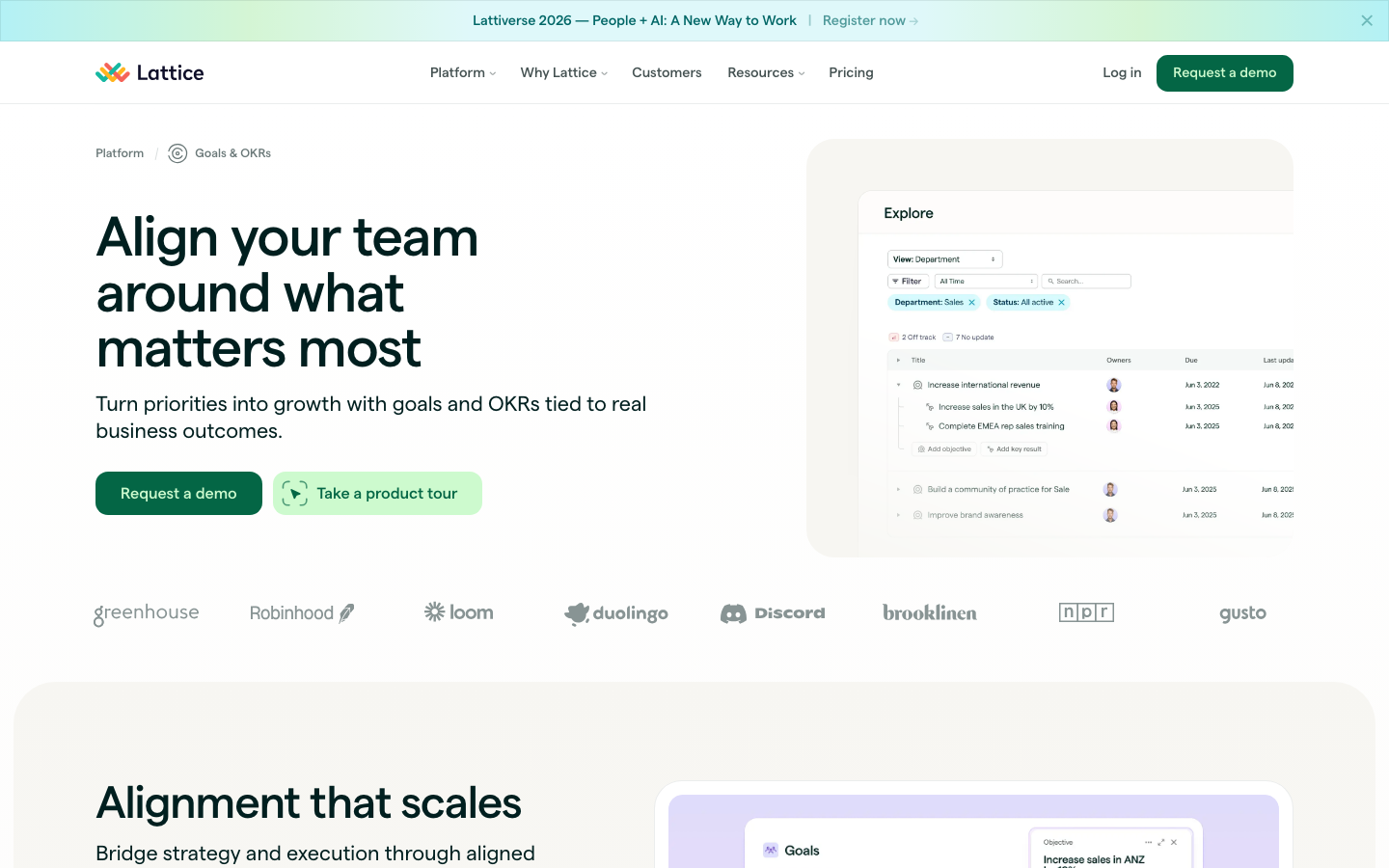
Lattice isn’t primarily an OKR tool, and that is exactly why it ranks here for the Series B startup rather than the seed-stage one. It is a people-management platform where OKRs are the connective tissue between performance cycles. If you have hit the point where OKRs and performance reviews need one record, where a manager should click from an OKR check-in straight into a review comment, Lattice is the only tool in this list that delivers it natively. 4,060 G2 reviews at 4.7/5 put it among the best-loved products in HR tech, full stop. The watch-out for a startup is the pricing build, a 100-person deployment with Performance plus Goals plus Engagement adds up to $20+/seat/mo before the $4,000 annual minimum bites. Tability’s independent Lattice pricing analysis is worth reading before you build the business case. Right pick for a Series B+ startup that is about to run structured reviews anyway; wrong pick if you just want to track quarterly OKRs without paying for the broader people-management suite.
Pricing breakdown
| Plan | Price | Best for |
|---|---|---|
| Goals & OKRs only | $8/seat/mo | Teams that already have a separate perf tool |
| Performance + Goals | $16/seat/mo | Series B-C teams running full review cycles |
| Full Suite (Perf + Goals + Engage) | $20/seat/mo | HR-led orgs with 200-1000 employees |
| Enterprise | Custom quote | 1000+ with compensation and advanced analytics |
Security & compliance
| Standard | Availability |
|---|---|
| SOC 2 Type II | Yes |
| GDPR | Yes |
| HIPAA | No |
| SSO / SAML | All tiers |
| Audit logs | Yes |
Lattice Goals compliance summary: SOC 2 Type II is yes, GDPR is yes, HIPAA is no, SSO/SAML is all tiers, and audit logs is yes.
Key integrations
| Integration | Type |
|---|---|
| Gmail | N/A |
| Outlook | N/A |
| Slack | Native integration |
| LinkedIn Sales Navigator | N/A |
| Outreach / Salesloft | N/A |
Lattice Goals integration summary: Gmail is not specified, Outlook is not specified, Slack is native integration, LinkedIn Sales Navigator is not specified, and Outreach or Salesloft is not specified.
Feature availability
| Feature | Status |
|---|---|
| Free tier | ✗ |
| AI coaching | • limited |
| Cascade | ✓ |
| Check ins | ✓ |
| Task management | • via 1-on-1s |
Lattice Goals feature availability summary: Free tier (✗), AI coaching (• limited), Cascade (✓), Check ins (✓), and Task management (• via 1-on-1s).
Loading reviews…
Profit.co
A startup scaling into deeper execution and AI coaching past ~120 peopleWhat's great
- G2 Leader badge in the OKR category for 18 consecutive quarters through the G2 Winter 2026 report, one of the longest active runs in the segment
- Built-in task management, project portfolio tracking, and 1-on-1 meeting modules at no extra per-module fee; a scaling startup gets several tools in one subscription
- AI coaching layer surfaces OKR at-risk signals with specific suggested interventions, not just a red status flag, which helps a stretched ops lead catch drift across more teams
Watch-outs
- Pricing is custom-quote-only past the base tier; teams over 200 users report wide variation in annual costs, and a founder gets no public number to budget against
- Initial OKR setup for companies new to the framework takes 2-4 weeks to configure properly, notably longer than Mooncamp, so it is not the tool for your very first cycle
- Mobile app lags the desktop experience; G2 reviews from early 2026 note it hasn't caught up to the web UI
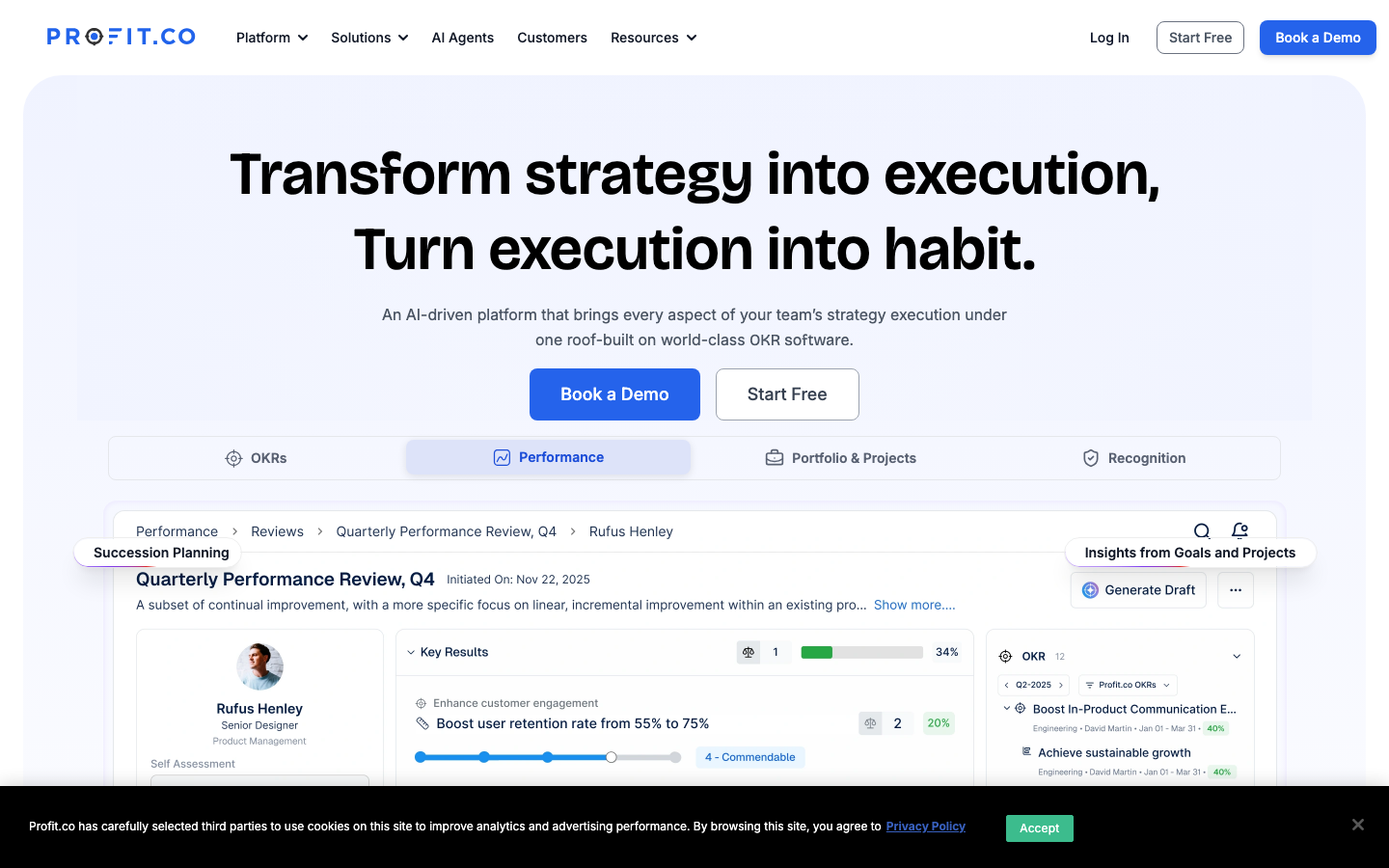
Profit.co is the most complete OKR platform in this comparison, which is exactly why it ranks where it does for startups, it is the tool you scale into past roughly 120 people, not the one you start with. 896 G2 reviews average 4.7/5, and it held the G2 Leader badge in the OKR category for 18 consecutive quarters through the G2 Winter 2026 report, one of the longest active runs in the segment. The differentiator isn’t the OKR tree or the progress bars, those are table stakes. It’s the AI coaching layer that flags which objectives are running behind, surfaces the likely cause (low KR update frequency, no owner assigned, no milestone checkpoints), and suggests a specific intervention, which is genuinely useful once a single ops lead is watching many teams. Profit.co moved to fully custom, quote-only pricing in 2026; the public pricing page lists no per-user dollar figures or tier names, just a talk-to-sales flow that prices by module mix and user count. Plan on roughly $15-18/user/mo all-in once performance management and project modules are bundled, but that range comes from buyer reports, not a published price sheet. Best for a Series B startup with a dedicated people-ops or strategy function; overkill for a seed-stage team running its first OKR cycle.
Pricing breakdown
| Plan | Price | Best for |
|---|---|---|
| OKRs & Tasks | Custom quote | Under 50 users |
| Performance + Goals | Custom quote | 50-200 users |
| Portfolio + Scorecard | Custom quote | 200-500 users with performance and engagement |
| Enterprise | Custom quote | 500+ users |
Security & compliance
| Standard | Availability |
|---|---|
| SOC 2 Type II | Yes |
| GDPR | Yes |
| HIPAA | $ Enterprise |
| SSO / SAML | Growth+ |
| Audit logs | Scale+ |
Profit.co compliance summary: SOC 2 Type II is yes, GDPR is yes, HIPAA is $ enterprise, SSO/SAML is growth+, and audit logs is scale+.
Key integrations
| Integration | Type |
|---|---|
| Gmail | N/A |
| Outlook | N/A |
| Slack | Native integration |
| LinkedIn Sales Navigator | N/A |
| Outreach / Salesloft | N/A |
Profit.co integration summary: Gmail is not specified, Outlook is not specified, Slack is native integration, LinkedIn Sales Navigator is not specified, and Outreach or Salesloft is not specified.
Feature availability
| Feature | Status |
|---|---|
| Free tier | ✗ 14-day trial |
| AI coaching | ✓ Growth+ |
| Cascade | ✓ |
| Check ins | ✓ |
| Task management | ✓ |
Profit.co feature availability summary: Free tier (✗ 14-day trial), AI coaching (✓ Growth+), Cascade (✓), Check ins (✓), and Task management (✓).
Loading reviews…
Betterworks
500-employee minimum, so a startup is years away; here for completeness onlyWhat's great
- Purpose-built for enterprise OKR governance; calibration workflows, manager alignment trees, and cascade reporting handle the complexity of 500+ employee orgs that the lighter tools can't
- Deep integration with Workday, SuccessFactors, and ADP natively; HR data flows into goal ownership without a middleware layer
- Conversation and feedback workflows embedded in the OKR flow; managers can log a coaching note directly from the objective view
Watch-outs
- 500-employee minimum and custom-only pricing puts it flatly out of reach for any startup; estimated contracts land $8-15/user/mo plus $20K-$50K implementation costs
- G2 rating (4.3/5 across 215 reviews) is the lowest in this comparison; complexity and onboarding friction are the consistent complaints
- Roadmap cadence is slower than the OKR-first vendors; feature releases from the past 12 months have been incremental rather than structural
Betterworks is in this list for completeness, not because a startup should buy it. The 500-employee minimum means most startups are years and a couple of funding rounds away from even qualifying. Where 15Five and Lattice handle goals for 200-person companies, Betterworks handles OKR calibration for 2,000-person enterprises with matrixed reporting and HRIS data feeding goal ownership. 215 G2 reviews at 4.3/5 is the lowest score in this guide, and the pattern is consistent, teams that were already OKR-mature with a dedicated people-ops function gave it 4-5 stars; teams that bought it hoping the software would install the discipline gave it 2-3 stars. That pattern shows up in every enterprise OKR platform, but it is worth naming here because a startup buying ahead of its stage is the classic version of that mistake. Estimated contracts per PeopleOpsClub’s published Betterworks pricing analysis land at $96K-$180K/yr for a 1,000-person company. Revisit it the year you cross 500 employees; until then it is not a startup tool.
Pricing breakdown
| Plan | Price | Best for |
|---|---|---|
| Mid-Market | Custom (500+ employees) | 500-2500 employees |
| Enterprise | Custom (2500+ employees) | 2500+ with premium support |
| Implementation | $20K-$50K one-time | Year-1 onboarding and change management |
| Annual uplift | Est. 8-15% yr-over-yr | Renewal planning baseline |
Security & compliance
| Standard | Availability |
|---|---|
| SOC 2 Type II | Yes |
| GDPR | Yes |
| HIPAA | No |
| SSO / SAML | ✓ all tiers |
| Audit logs | Yes |
Betterworks compliance summary: SOC 2 Type II is yes, GDPR is yes, HIPAA is no, SSO/SAML is ✓ all tiers, and audit logs is yes.
Key integrations
| Integration | Type |
|---|---|
| Gmail | N/A |
| Outlook | N/A |
| Slack | Native integration |
| LinkedIn Sales Navigator | N/A |
| Outreach / Salesloft | N/A |
Betterworks integration summary: Gmail is not specified, Outlook is not specified, Slack is native integration, LinkedIn Sales Navigator is not specified, and Outreach or Salesloft is not specified.
Feature availability
| Feature | Status |
|---|---|
| Free tier | ✗ |
| AI coaching | ✓ |
| Cascade | ✓ |
| Check ins | ✓ |
| Task management | ✗ |
Betterworks feature availability summary: Free tier (✗), AI coaching (✓), Cascade (✓), Check ins (✓), and Task management (✗).
Loading reviews…
Tools we considered but excluded
We evaluated more tools than the 8 you see above. These did not make the cut. Saying what we rejected, and why, is the editorial muscle most listicles skip.
- Quantive (formerly Gtmhub): Acquired by WorkBoard in May 2025 and discontinued as a standalone product; existing customers are mid-migration and it is not a viable new purchase
- WorkBoard: Post-Quantive acquisition the product is in transition; pricing and roadmap are unstable for a 12-month commitment, revisit in late 2026
- Ally.io (Microsoft Viva Goals): Microsoft folded Ally.io into Viva Goals; the product has been de-emphasized and feature development is minimal; not a credible independent OKR purchase in 2026
- Tability: Strong for individual and small-team OKR habit-building, but reporting depth and cascade visualization fall short for any org above 50 people
- ClickUp Goals: ClickUp is a project management tool that added OKRs; the Goals module lacks confidence scoring, cascade analytics, and check-in cadence that dedicated tools ship natively
- Asana Goals: Same problem as ClickUp Goals, a PM tool's OKR module is a feature, not a product; teams using Asana for projects benefit from the integration but not from the OKR depth
Honorable mentions
Solid tools that did not crack the main list but are worth tracking, especially for niche use cases.
- Peoplebox: Strong AI-powered OKR + performance combo for Series A/B SaaS companies, cheaper than Lattice, worth evaluating if Profit.co's pricing lands too high
- Leapsome: Popular in European mid-market; OKR module is solid within a broader people-enablement suite and improving fast; worth watching for US expansion in 2026-27
- Koan: The simplest OKR check-in tool in the market, Slack-native, beloved by tech-forward small teams; too thin for companies past 100 employees but a fine pick for a sub-100 startup that lives in Slack
- Weekdone: Plans-Progress-Problems weekly check-in tool, free up to 3 users and transparent flat-band pricing; a fine first-OKR pick for a sub-50 startup, but a thin G2 base (38 reviews) and no SOC 2 keep it out of the ranked list
What this guide covers
The OKR market looks uniform until you run it inside a startup with real runway pressure. Eight tools, ranked not by abstract depth but by the question a founder actually asks: which one gets goals off the spreadsheet this week, costs little while we are small, and scales as we raise.
The startup lens reorders everything. The most “complete” tool is not the best first buy. The thing that wins at seed is fast time to first cycle and a free or cheap entry point. The thing that wins at Series B is depth and one record for OKRs plus reviews.
Fast, cheap, first-cycle tools. Mooncamp, OKRs Tool, Cascade, Perdoo. These get a young team running without a consultant. Two of them are free at the bottom (Cascade up to 4, Perdoo up to 5), one charges flat instead of per seat (OKRs Tool), and one has the cleanest UX in the category (Mooncamp).
Habit and review tools. 15Five and Lattice. 15Five builds the weekly OKR habit at a fast-scaling team with no perf tool yet. Lattice is the Series B moment when OKRs and performance reviews need the same employee record.
Scale-into tools. Profit.co past roughly 120 people, when bundled performance and project modules plus AI coaching start earning their price.
Not yet. Betterworks. A 500-employee minimum means a startup is years away. It is here for completeness so you know what you are growing toward, not what you buy now.
Pick your OKR tool by funding stage
This is the section that replaces the feature matrix. Find your stage, then read the rest.
Pre-seed and seed, 5-25 people
Pay nothing and learn the discipline. Cascade free tier (up to 4 users) or Perdoo free tier (up to 5 users). OKRs Tool is also free up to 5. The goal at this stage is not perfect tooling, it is teaching a founding team to write a real KR instead of a task. Any of these three free tiers does that.
If your team already lives in Microsoft Teams, jump straight to Mooncamp’s trial; the first-party Teams integration is worth more than a free tier you have to bolt a notifier onto.
Series A, 25-80 people
This is Mooncamp’s stage. Fastest first cycle, cleanest UX, honest €7/user/mo (~$8) Essential pricing. A reps-can-build-it-before-the-demo-ends UX is exactly what a busy A-stage team needs.
If you are budget-bound and crossing 50 people, OKRs Tool’s flat $49/mo (up to 50 users) is the cheapest year-one cost in this guide, and the 60% adoption-or-refund guarantee de-risks the rollout. If you have no performance tool and want to build the weekly habit early, 15Five Perform at $11/user/mo gives you OKRs and reviews in one bill.
Series B, 80-150 people
Now depth and integration matter. Perdoo Supreme (€10/user/mo, ~$11) earns its cascade visualization past 100 people. Profit.co (custom quote, roughly $15-18/user/mo all-in) bundles task management, 1-on-1s, and AI coaching once a single ops lead is watching many teams.
The other Series B trigger is reviews. The quarter you formalize performance reviews is the quarter Lattice Goals ($8/seat/mo on top of the Performance base) starts making sense, because OKRs and reviews finally share one record.
Free-tier reality for startups
Three tools here ship a real free tier, and they are not the same.
Cascade free is the most capable: unlimited plans, unlimited metrics, up to 4 users. A four-person founding team can run a genuine first cycle on it at zero cost. The catch is the jump past 4 users lands you in custom-quote pricing, so budget a sales call when you grow.
Perdoo free goes to 5 users and covers OKR basics, then upgrades cleanly to Premium (€8/user/mo) without a migration. OKRs Tool’s Launch tier is free up to 5 users on one active cycle, then jumps to a flat $49/mo for up to 50, which is the model that punishes headcount growth the least.
Mooncamp and 15Five are trial-only, not free-forever. Both convert fast, but plan to pay once the trial ends.
Fast deployment beats deep features at seed stage
The mistake first-time founders make is buying the deepest tool and stalling on a 4-week setup nobody finishes. At seed and Series A, time to first cycle is the metric that predicts whether OKRs survive.
Mooncamp and OKRs Tool deploy in days, no consultant. Perdoo takes 2-3 weeks. Profit.co and Cascade run 4-6 weeks for a full buildout, which is fine at Series B with a dedicated ops lead and wrong at seed with a founder doing it between board prep and hiring.
If the team cannot get to a first check-in inside a 2-week trial, the onboarding overhead will kill cycle-one adoption. Test exactly that before you sign anything: load last quarter’s real objectives, create KRs with owners and confidence scores, and run one simulated check-in.
Why most startup OKR rollouts fail
Founders who have been through two or three OKR purchases land on the same conclusion: the problem was never the tool, it was founder sponsorship. That is the thing nobody tells you in the demo.
The pattern across failed startup rollouts is consistent. No founder sponsorship means OKRs become a middle-management reporting exercise that ICs resent. The CEO who stops referencing OKRs in the all-hands by week four has already killed the program, whatever the software cost.
KRs written as tasks rather than outcomes produce boxes to check, not real measurement. No mid-cycle check-in habit means OKRs are written in January and reviewed in March, with three months of progress invisible to everyone.
The software choice matters at the margin. A tool with a better IC update experience (15Five, Mooncamp) reduces the friction that lets good habits erode. A tool with better cascade visibility (Perdoo, Cascade) makes it easier for a founder to see where drift is happening. Those improvements are real. They are also marginal.
The one thing software solves unambiguously is the visibility problem. Before a dedicated tool, when an investor or the CEO asks “what’s the status of OKR 2.3?” the answer is someone opening a spreadsheet and hoping it was updated last week. With any tool in this list, that question has a live answer in 15 seconds. That is the return on investment. Alignment and accountability are the founder’s job, not the software’s.
Pricing reality for a lean team
The gap between sticker price and year-one all-in matters more for a startup than anyone else, because the difference is real runway.
| Tool | Listed price | Real year-1 (50 users) | Key cost drivers |
|---|---|---|---|
| OKRs Tool | $49/mo flat (up to 50 users) | ~$590 | Flat fee, no per-seat scaling |
| Cascade | Free up to 4, then custom | $0 to ~$6,000+ | Free tier real; custom past 4 users |
| Perdoo | ~$9-11/user/mo (€8-10) | ~$6,000-$7,500 | Free up to 5; annual billing |
| Mooncamp | ~$8/user/mo (€7) | ~$4,800 | Mostly sticker; no impl fees |
| 15Five | $11/user/mo (Perform) | ~$7,500-$9,000 | Manager coaching add-ons |
| Lattice | $16+/user/mo (full suite) | ~$11,000-$14,000 | $4K minimum; module build |
| Profit.co | Custom quote | ~$9,000-$13,000 | Module stacking; quote-only in 2026 |
The biggest forecast error in startup OKR budgeting is buying the base tier and discovering 60 days in that the features the team needs are in the next tier up. Mooncamp’s €7 Essential is real, but OKR rules and custom dashboards are Professional. 15Five’s $4 Engage tier is real, but OKRs are Perform at $11. Check the feature gates before the business case.
Compliance and security at a startup stage
Most early startups do not need HIPAA or audit logs yet. But if you sell to enterprise accounts, your buyers will review your internal stack, and SOC 2 Type II is the line that stalls a deal.
Profit.co, Lattice, 15Five, and Cascade all hold SOC 2 Type II. Mooncamp holds it. Perdoo holds it at the Supreme tier. OKRs Tool does not publish a SOC 2 Type II certification, though it ships EU data residency and GDPR, so weigh that if your customers run vendor security reviews.
For a pre-Series-A team with no enterprise customers yet, this rarely matters. The moment you start selling upmarket, it does.
Integration depth for a Slack or Teams startup
| Tool | Slack | MS Teams | Jira | Salesforce | HRIS sync |
|---|---|---|---|---|---|
| Mooncamp | N | N (first-party) | Professional | • | M |
| OKRs Tool | N | N | N | ✗ | ✗ |
| Cascade | N | N | N | N | M |
| Perdoo | N | N | Supreme | M | M |
| 15Five | N | N | M | M | N (BambooHR/Workday) |
| Lattice | N | N | M | M | N (Workday/Rippling) |
| Profit.co | N | N | N | N | M (Merge) |
| Betterworks | N | N | N | N | N (Workday/ADP native) |
Mooncamp is the only tool here with a well-maintained native Teams integration, which matters for a Microsoft-heavy startup. OKRs Tool punches above its size with native Slack, Microsoft Teams, and Jira plus Asana, Linear, ClickUp, and Notion, though it offers no Salesforce or HRIS sync yet. A young team that lives in Slack should weight the chat-native check-in path heavily, because OKR updates that happen where the team already talks are the ones that actually happen.
Final pick by funding stage
- Pre-seed and seed, under 25 people: Cascade free tier (up to 4 users) or Perdoo free tier (up to 5 users). Pay nothing; learn the discipline. OKRs Tool is also free up to 5.
- Series A, 25-80 people: Mooncamp Essential (€7/user/mo, about $8). Fastest first cycle, cleanest UX, honest pricing.
- Budget-constrained, crossing 50 people: OKRs Tool Scale ($49/mo flat up to 50 users) or Expand ($129/mo for 51+). Flat pricing makes it the cheapest year-one cost in this guide by a wide margin, and the 60% adoption-or-refund guarantee de-risks the rollout. Accept the trade: a newer product with a thin G2 base, not the depth a 1,000-person org needs.
- Series A, no existing perf tool: 15Five Perform ($11/user/mo). The check-in cadence builds the OKR habit faster than any other tool at this stage and ships reviews in the same bill.
- Series B, 80-150 people, OKR-first culture: Perdoo Supreme (€10/user/mo, about $11). The cascade visualization and KPI board depth start earning their price past 100 employees, and you never had to migrate off the free tier.
- Series B, scaling past ~120 people, full platform needed: Profit.co with the performance and project modules bundled (custom quote, roughly $15-18/user/mo all-in per buyer reports). Task management, 1-on-1s, and AI coaching in one subscription beats Lattice or 15Five plus a standalone OKR tool on total cost.
- Series B, formalizing reviews: Lattice Goals at $8/seat/mo incremental over the Performance base. The right call the quarter OKRs and review cycles need one employee record.
- Microsoft 365 startups at any size: Mooncamp, for the first-party Teams integration. No other tool in this list has a comparably maintained Teams-native experience.
- Not yet: Betterworks. The 500-employee minimum means you revisit it years from now, not at any startup stage.
If your shortlist is still three tools, run the free tiers or 14-day trials in parallel with the same five people running a real cycle. Decide at day 10 based on IC update frequency and time-to-first-check-in, not the feature list.
For the full picture across every company size, including the enterprise tools a startup grows toward, read our full best OKR software guide .
For corrections, vendor disputes, or feedback on this methodology, email hello@topickz.com . We re-test the full shortlist every six months; the next refresh ships in November 2026.
Frequently asked questions
What is the best OKR software for an early-stage startup?
For a seed to Series A team, Mooncamp wins on fastest first cycle and cleanest UX. If you want to spend nothing yet, Cascade is free up to 4 users and Perdoo is free up to 5.
Is there a free OKR tool a startup can actually use?
Cascade is free up to 4 users with unlimited plans and metrics, Perdoo is free up to 5 users, and OKRs Tool is free up to 5. All three are real tools, not stripped demos.
How much does OKR software cost per employee for a startup in 2026?
Startup-friendly tools run $7-$11/user/mo. OKRs Tool charges flat ($49/mo up to 50 users) instead of per seat, which is the cheapest year-one cost as you hire.
Which OKR tool scales best as a startup grows from seed to Series B?
Perdoo starts free up to 5 users and scales into real Series A-B cascade depth without a migration. Profit.co takes over past roughly 120 people when you need bundled performance and project modules.
Do we actually need OKR software or will a spreadsheet do at our stage?
Under 50 people a structured spreadsheet works. Above 50, software cascade visibility starts paying. Above 200, software is required to keep goals visible across teams.
Why do most startup OKR rollouts fail in the first two quarters?
Founder sponsorship, not software. If the CEO stops referencing OKRs in the all-hands by week four, no tool saves the program. KRs written as tasks and no mid-cycle check-in habit are the other two killers.
How fast can a startup deploy OKR software?
Mooncamp and OKRs Tool deploy in days. Perdoo takes 2-3 weeks. Profit.co and Cascade run 4-6 weeks for a full buildout, which is why they fit later-stage startups, not a first cycle.
Which OKR tool is best if our startup lives in Slack or Microsoft Teams?
Mooncamp has the only well-maintained first-party Teams integration here, ideal for an M365 shop. For Slack-native check-ins, OKRs Tool ships native Slack and Koan (honorable mention) is built around it.
Related helpful reads
Write a review
Posts to the page right away. Keep it real — no links or email addresses.