

Comparing the best Subscription Billing Platforms of 2026 includes 1. Stripe Billing 2. Whop 3. TrueRev 4. Chargebee 5. Maxio 6. Recurly 7. Paddle 8. Zuora 9. LemonSqueezy 10. Salesforce Revenue Cloud 11. Stax Bill.
TL;DR
- Stripe Billing: Best developer-first billing engine for any pricing model. You pay 0.5% per transaction with no monthly platform fee until you need advanced dunning, the most transparent pricing in the segment.
- Whop: Best pay-as-you-go billing with no monthly platform fee. At 2.7% + $0.30 per domestic card transaction, early-stage teams avoid a $300 platform seat while still getting hosted checkout, subscription billing, and global payouts in one integration.
- TrueRev: Best QuickBooks-native revenue recognition for B2B SaaS. At $299/month it brings ASC 606 schedules, deferred revenue, contract renewals, and ARR/MRR reporting into one platform that syncs directly to QuickBooks Online.
- Chargebee: Best for mid-market billing complexity and retention automation. It powers 6,500+ businesses and folds native dunning and RevRec into one platform, so you skip the third-party revenue recognition integration Stripe Billing needs.
- Maxio: Best B2B SaaS metrics platform with billing included. It is the only platform here that ships a native NRR waterfall inside the billing engine, so your board reporting runs off the same contract data as your invoices, no BI tool required.
- Paddle: Best merchant of record for B2B software with global tax exposure. The single 5% + $0.50 fee covers tax collection in 300+ jurisdictions, so your finance team can stop worrying about EU VAT and US sales tax.
- LemonSqueezy: Best zero-overhead MoR for indie SaaS and micro-products. There is no monthly fee, just 5% + $0.50 per transaction, so you can ship global billing on day one without a finance operations hire.
Nine subscription billing platforms compared across three billing motion types, pure seat-based SaaS, usage-based pricing, and enterprise CPQ. What handles ASC 606 natively, what blows up on proration edge cases, and the pick for your ARR band and billing complexity.
What Is subscription billing software?
Subscription billing software helps recurring-revenue businesses manage plans, invoices, and renewals, automating proration, dunning, and revenue recognition as customers upgrade or churn.
Tools like Stripe Billing, Chargebee, Maxio, and Recurly differ on pricing flexibility, revenue recognition, and how much engineering setup they need.
Best Subscription Billing Platforms for SaaS Finance comparison: features, pricing and verdicts
| Tool | Best for | Starting price | Free trial | External rating |
|---|---|---|---|---|
Best developer-first billing engine for any pricing model | 0.5% per transaction | Free tier (no billing fee until revenue) | G2 4.4/5 (738 reviews) | |
Best pay-as-you-go checkout and subscription billing without a monthly platform fee | 2.7% + $0.30/transaction | Free to start (no monthly platform fee) | G2 2.6/5 (4 reviews) | |
Best QuickBooks-native revenue recognition platform for B2B SaaS | $299/month | 14-day free trial | G2 5.0/5 (11 reviews) | |
Best for mid-market billing complexity and retention automation | Free to $250K billing, then 0.75% | Free starter (first $250K billing) | G2 4.4/5 (995 reviews) | |
Best B2B SaaS metrics platform with billing included | $599/mo | 30-day sandbox (Build tier) | G2 4.3/5 (829 reviews) | |
Best for subscription businesses with high failed-payment churn | $249/mo | Demo only | G2 4.0/5 (205 reviews) | |
Best merchant of record for B2B software with global tax exposure | 5% + $0.50/transaction | Get started free (no monthly fee) | G2 4.5/5 (232 reviews) | |
Best enterprise subscription platform for complex contract and CPQ workflows | Custom (Launch, Scale, Enterprise) | Demo only | G2 3.9/5 (309 reviews) | |
Best zero-overhead MoR for indie SaaS and micro-products | 5% + $0.50/transaction | Free (no monthly fee) | G2 4.3/5 (142 reviews) | |
Best for Salesforce-native CPQ and contract lifecycle management | $75/user/mo (CPQ) | Demo only | G2 4.2/5 (1,498 reviews) | |
Best predictable-fee billing platform for North American mid-market | $499/mo | Demo + free trial available | Capterra 4.4/5 (117 reviews) |
How we chose these tools
We compared each platform on published pricing across tiers, the recurring themes in real G2 reviews, and hands-on feature checks for the workflows a SaaS finance team lives in, invoice accuracy on mid-cycle plan changes, dunning, engineering effort to implement a new pricing tier, month-end close, and ASC 606 schedule automation quality. We weighed each tool against three billing motions, pure seat-based SaaS, a hybrid usage plus seat model with overage tiers, and multi-entity billing with ASC 606 revenue recognition schedules. Pricing was verified directly with each vendor or taken from published pricing pages in May 2026. All G2 ratings and review counts were pulled May 25, 2026.
How we weight subscription billing platforms for the Topickz score
Every tool above is scored against the fixed rubric below and combined using these weights into the Topickz score on each card. The weights are set for subscription billing platforms specifically, they are not copied from another category, and we publish them so you can see what moved a ranking and re-weight for your own priorities.
| Criterion | Weight | What we checked |
|---|---|---|
| Recurring billing accuracy | 21% | Proration on a mid-cycle upgrade is where billing engines quietly break. We tested invoice accuracy across plan changes, add-ons, and the messy edge cases that generate support tickets. |
| Dunning and failed-payment recovery | 19% | Failed cards are pure lost revenue if nothing chases them. We checked native dunning, retry logic, and how much recovery runs without a third-party tool. |
| Revenue recognition and ASC 606 | 16% | Recurring revenue and ASC 606 schedules have to reconcile to the invoices. We looked at whether revenue recognition is native or needs a separate integration. |
| Pricing-model flexibility | 12% | Seat-based, usage-based, and hybrid plans each stress the engine differently. We weighed how many pricing motions each tool supports without custom code. |
| Engineering effort to implement | 11% | Shipping a new pricing tier should not need a sprint. We checked how much engineering time it takes to stand up and change plans. |
| Payment and tax coverage | 9% | Global billing pulls in payment methods and sales tax or VAT. We looked at native payment coverage and whether the tool acts as merchant of record for tax. |
| Month-end close and metrics | 7% | Finance still has to close the books off billing data. We checked export quality and whether SaaS metrics come off the same contract data as the invoices. |
| Total cost of the billing stack | 5% | Percentage fees and platform costs add up as revenue grows. We compared the real all-in cost, not just the headline transaction rate. |
| Total | 100% |
Read the full TopickZ.com testing methodology for how we run each test, score every criterion, and combine them into a single rating.
Detailed reviews
Stripe Billing
Best developer-first billing engine for any pricing model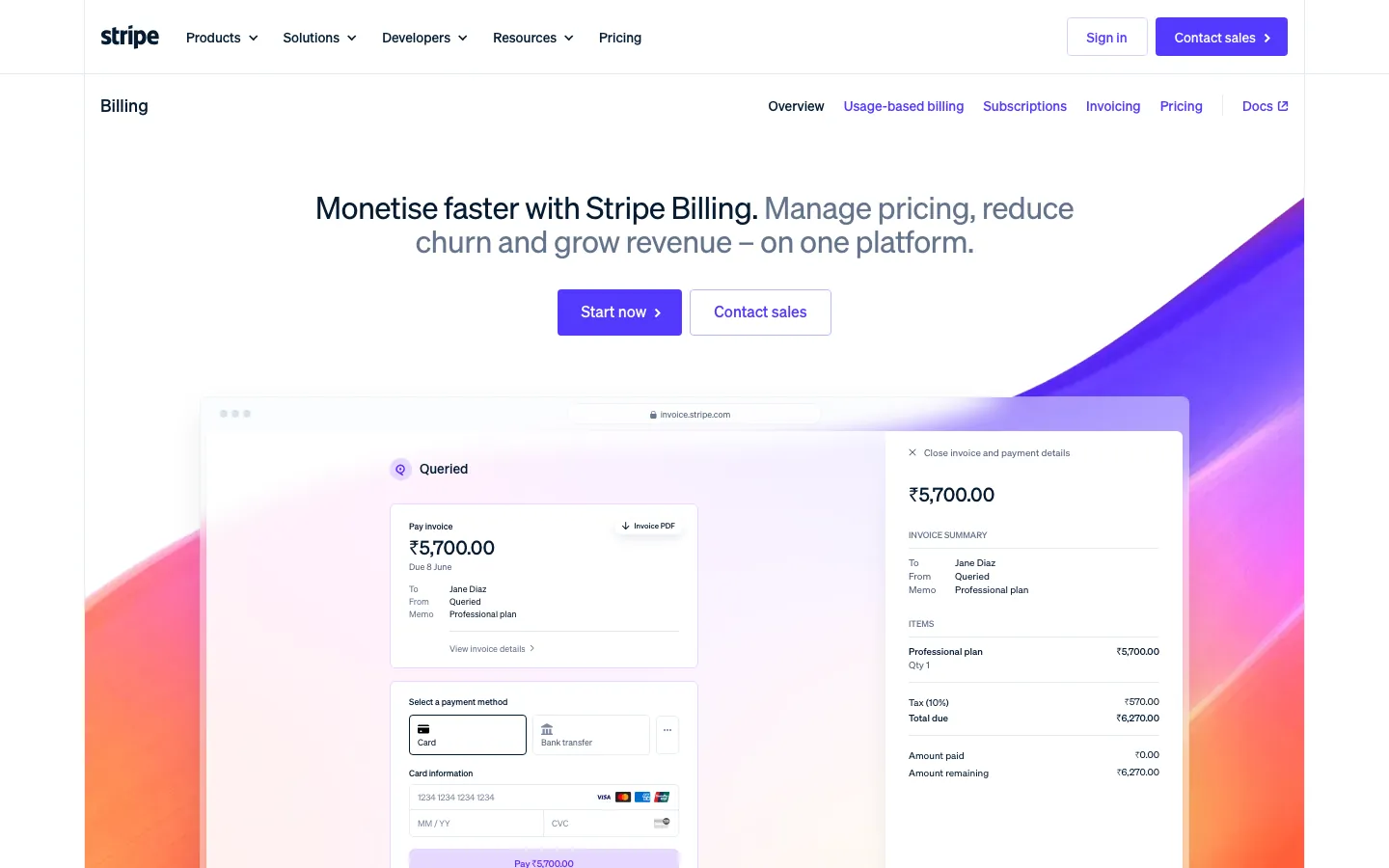
Screenshots of Stripe Billing 4 images
What's great
- 0.5-0.8% per recurring charge is the most transparent pricing in the segment; no monthly platform fee until you need advanced dunning
- Widest native payment method coverage (135+ countries, 40+ payment methods) in a single integration; no separate gateway contracts
- Meter API for usage-based billing handles real-time event ingestion at millions of events per second, the only billing engine that genuinely scales to enterprise usage volumes without re-engineering
Watch-outs
- SaaS-specific metrics (NRR, GRR, ARR waterfall, cohort churn) require external tooling or Stripe Sigma queries; not a reporting platform
- ASC 606 revenue recognition is manual or requires a third-party integration; the billing engine does not automate deferred revenue schedules
- Support is developer-documentation-first; getting a human on ASC 606 edge cases can take 48+ hours via ticketing
Pricing breakdown
| Plan | Price | Best for |
|---|---|---|
| Starter | 0.5% per transaction | Under $500K ARR, simple seat-based billing |
| Scale | 0.8% per transaction | $500K-$5M ARR, dunning and smart retries included |
| Revenue Recognition | Custom add-on | ASC 606 automation, requires Stripe Sigma |
| Enterprise | Negotiated flat fee | $10M+ ARR, custom rate on volume |
What reviewers say about Stripe Billing
Recurring themes across ~738 G2 reviews (4.4/5), 2024-2026.
What reviewers praise
- The developer experience is the most-cited strength: clean documentation, a consistent well-designed API, and straightforward setup of subscriptions, invoices, and recurring flows without heavy custom engineering.
- Reviewers say Stripe Billing removes the pain of proration, failed-payment retries (Smart Retries), and dunning that previously required in-house code, so recurring revenue runs largely hands-off.
- Tax handling and multi-region compliance via Stripe Tax is repeatedly praised for collecting and remitting across jurisdictions that used to be a manual nightmare.
- Deep integration into the broader Stripe stack (Payments, Checkout, Connect) is called a genuine workflow saver, letting teams keep billing, payments, and payouts under one platform.
What reviewers fault
- Fees add up fast at scale: reviewers flag the per-transaction cut plus an additional percentage layered on top specifically for billing features, which gets expensive for high-volume businesses.
- Many billing essentials sit behind paywalled add-ons, and reviewers argue features they consider core to an online billing system cost extra.
- API rate limits (commonly cited around 100 read/write operations per second in live mode) are called a real growth constraint that B2B companies can hit.
- Reviewers say updating failed cards and generating self-serve payment-update links is clunky, and that out-of-the-box integration with non-Stripe systems could be smoother.
Loading reviews…
Whop
Best pay-as-you-go checkout and subscription billing without a monthly platform fee Sponsored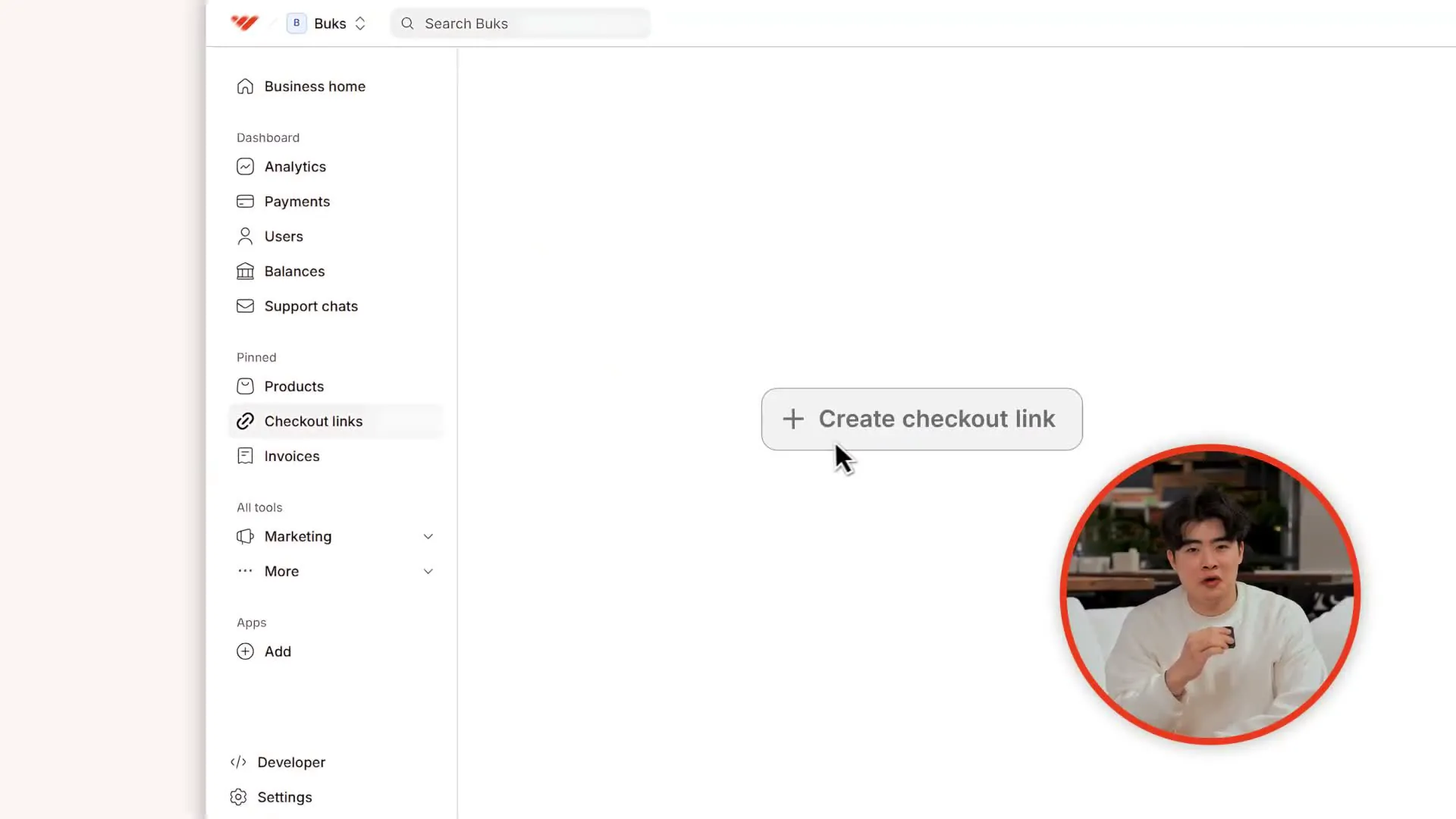
Screenshots of Whop 4 images
What's great
- No monthly platform fee; domestic cards are 2.7% + $0.30 per successful charge, with optional billing automation at 0.5% per transaction
- Hosted checkout plus subscription charges and payouts on one payments path, so early SaaS teams avoid stacking a separate gateway seat on top of a billing SaaS seat
- Optional tax collect-and-remit (2% when tax is collected) and orchestration (0.8% when enabled) for failed-payment recovery and multi-PSP routing
Watch-outs
- map[Not a SaaS finance platform:no native ASC 606 / IFRS 15 schedules, NRR waterfall, or board-pack metrics like Maxio or Chargebee RevRec]
- Lighter on mid-market billing complexity like multi-entity, CPQ, and ramp contracts than Chargebee, Zuora, or Salesforce Revenue Cloud
- G2 review data is very thin (4 reviews at time of publishing), so market sentiment on the billing-specific workflows is not well established yet
Pricing breakdown
| Plan | Price | Best for |
|---|---|---|
| Standard cards | 2.7% + $0.30/transaction | Early SaaS checkout and subscriptions |
| International / FX | +1.5% international; +1% FX when conversion applies | Cross-border card sales |
| Billing automation | 0.5% per transaction | Recurring billing automation |
| Orchestration | 0.8% per transaction when enabled | Failed-payment recovery / multi-PSP routing |
| Tax collect-and-remit | 2% when tax is collected | Optional tax collection in supported jurisdictions |
Loading reviews…
TrueRev
Best QuickBooks-native revenue recognition platform for B2B SaaS Sponsored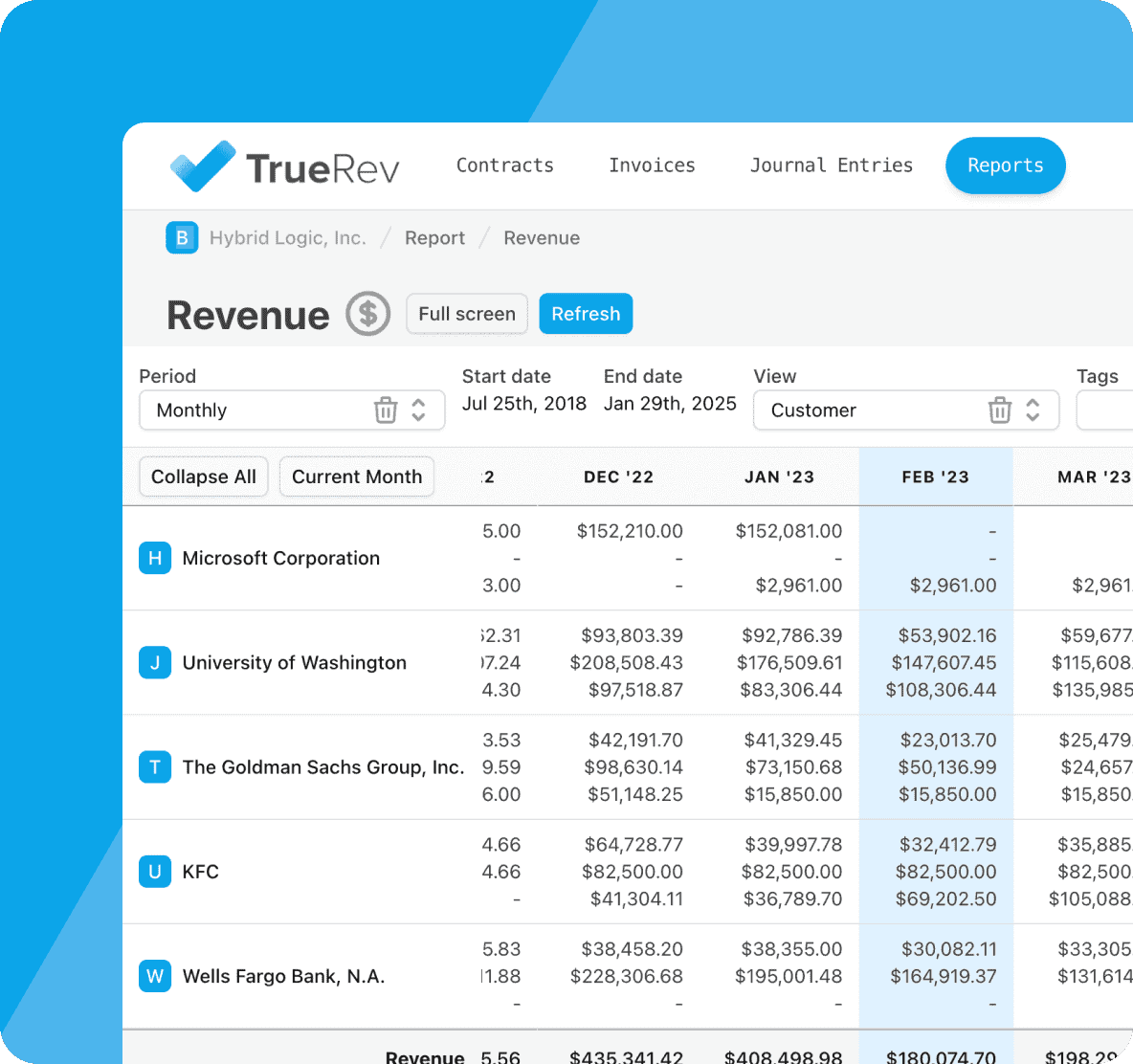
Screenshots of TrueRev 4 images
What's great
- Native QuickBooks Online sync posts recognized and deferred revenue directly to your QBO chart of accounts with no manual journal entry work at month-end
- ASC 606 schedules generate from contract terms automatically, including ratable and milestone recognition, which eliminates the spreadsheet model most controllers run before a Series A audit
- ARR, MRR, churn, and expansion metrics all run off the same contract data as the invoices, so the board packet and the billing system never diverge
- Contract management handles multi-year terms, renewals, amendments, and non-recurring components with separate recognition rules per product line
Watch-outs
- Hard dependency on QuickBooks Online; not compatible with NetSuite, Sage Intacct, Xero, or a custom GL
- Not a billing engine or payment processor; invoicing still lives in Stripe, Chargebee, or your existing gateway
- Lighter dunning and subscription lifecycle tooling than Chargebee or Maxio; failed-payment recovery is outside its scope
Pricing breakdown
| Plan | Price | Best for |
|---|---|---|
| Starter | $299/month billed annually | B2B SaaS teams on QuickBooks Online needing ASC 606 compliance |
| Growth | Custom pricing | Higher contract volume or multi-product recognition needs |
Loading reviews…
Chargebee
Best for mid-market billing complexity and retention automation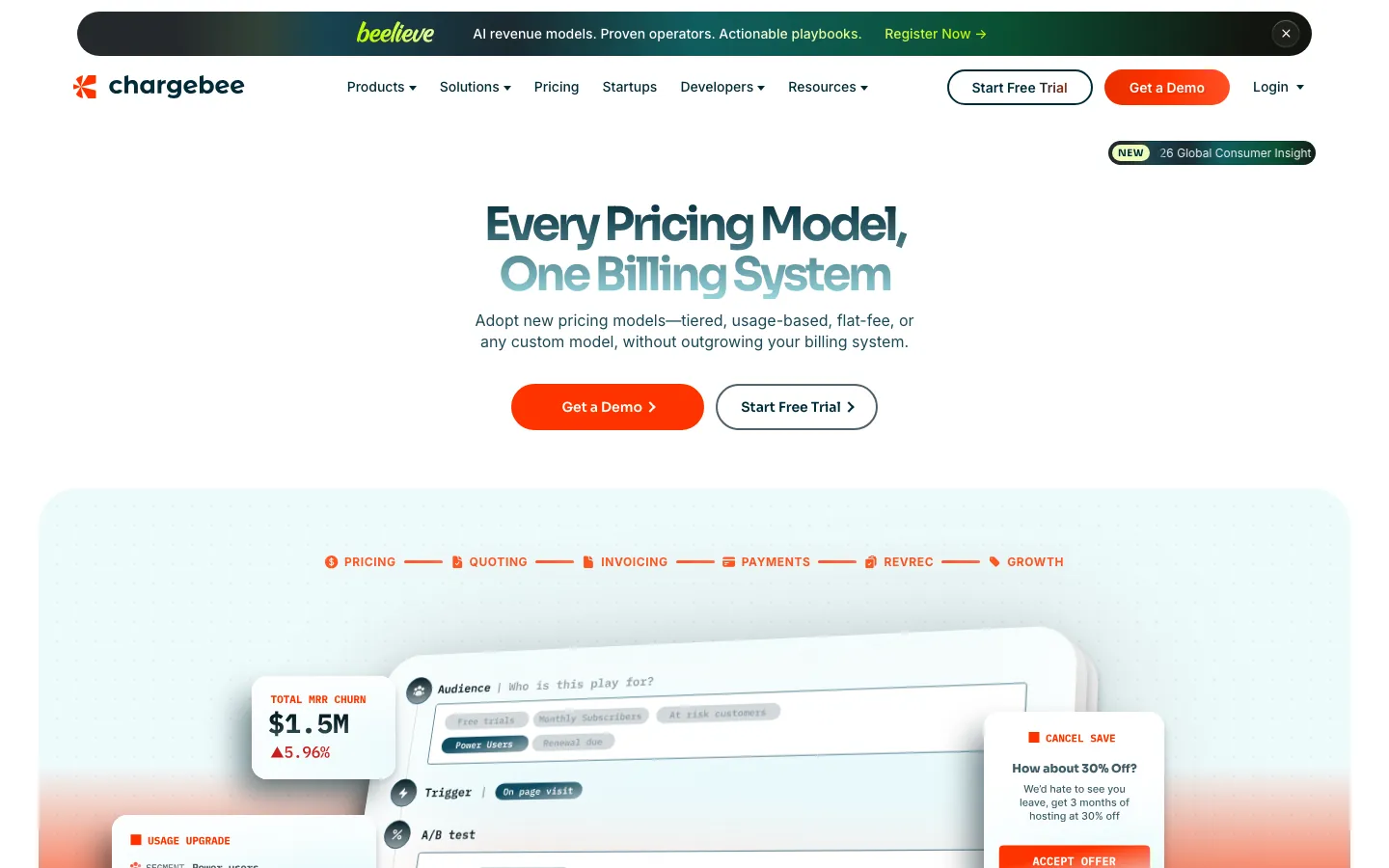
Screenshots of Chargebee 4 images
What's great
- Free for the first $250K cumulative billing, then 0.75% on the Performance tier; the startup ramp is the most generous pricing model in the non-MoR segment
- Smart Dunning uses ML-trained retry logic; published Chargebee data shows 20-30% higher payment recovery than fixed retry schedules on the same failed-payment cohort
- Native revenue recognition module (Chargebee RevRec) handles ASC 606 and IFRS 15 without a third-party integration, a genuine differentiator versus Stripe Billing
Watch-outs
- Performance tier at $7,188/year is the real paid entry point for teams past the $250K threshold; the jump from free to paid is steep
- Multi-entity billing is Enterprise-only; companies with multiple legal entities or subsidiaries hit a hard wall on Performance
- Integration depth with NetSuite and Sage Intacct requires careful mapping; the CFO desk I was sitting at last month spent three weeks cleaning up deferred revenue sync issues on their NetSuite connector
Pricing breakdown
| Plan | Price | Best for |
|---|---|---|
| Starter | Free to $250K billing, then 0.75% | Seed to $1M ARR |
| Performance | $7,188/yr ($599/mo) | $1M-$30M ARR with dunning and RevRec needs |
| Enterprise | Custom quote | Multi-entity, $30M+ ARR |
| CPQ add-on | Contact sales | Complex quoting, multi-year contracts |
What reviewers say about Chargebee
Recurring themes across ~995 G2 reviews (4.4/5), 2024-2026.
What reviewers praise
- Automated dunning and smart retries are the standout: reviewers report the follow-up emails and retry logic measurably cut involuntary churn without manual chasing.
- The customer self-service portal for managing subscriptions, upgrades, and cancellations is praised for removing day-to-day billing overhead from finance and support teams.
- Chargebee handles complex billing scenarios (multiple plans, proration, coupons, tiered pricing) that reviewers say would otherwise need heavy custom development.
- Broad integrations and a generally user-friendly interface make it straightforward to plug into existing CRM, accounting, and payment stacks.
What reviewers fault
- Analytics and reporting are the most common gap: reviewers say Chargebee shows billing and invoicing figures but not a full view of business health, with weak dashboards and limited customer segmentation.
- Pricing frustrates teams as they scale, with a sharp jump between tiers and revenue-based overage fees that several reviewers describe as a success tax.
- Customer support quality is a recurring complaint across G2, Capterra, and TrustRadius, with slow or unhelpful responses cited repeatedly.
- Customization is restricted in places, and some reviewers report a poor cancellation and refund experience, including being renewed after attempting to cancel.
Loading reviews…
Maxio
Best B2B SaaS metrics platform with billing included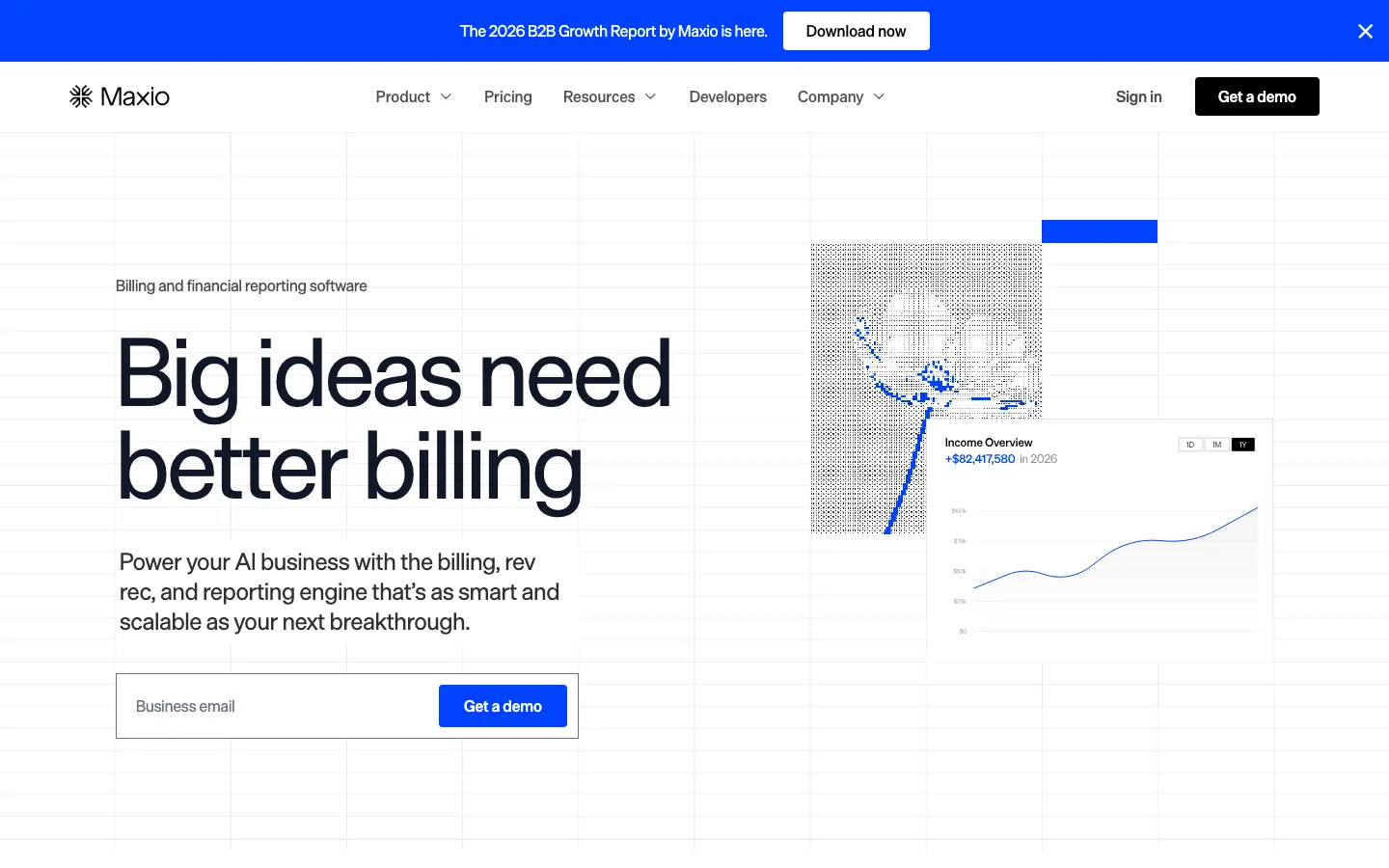
Screenshots of Maxio 4 images
What's great
- Only billing platform in this comparison that ships a native NRR/GRR/ARR waterfall inside the billing engine; no BI tool required for investor reporting
- Native ASC 606 revenue recognition schedules on every contract, auto-generates deferred revenue journal entries with Salesforce CRM data sync
- Purpose-built for B2B SaaS contract models including multi-year commitments, ramp schedules, true-ups, and amendment workflows
Watch-outs
- Interface complexity draws consistent complaints; multiple G2 reviewers describe the navigation as 'labyrinth-like' once you have 50+ contract types configured
- Reporting customization is limited out of the box; ad hoc invoice filtering and bulk export workflows require workarounds that the platform's roadmap has been promising for two years
- Best-fit ARR band is $5M to $100M; below $5M ARR the platform cost-to-complexity ratio is hard to justify versus Chargebee
Pricing breakdown
| Plan | Price | Best for |
|---|---|---|
| Build | Free (30-day sandbox) | Dev testing and migration prep |
| Grow | $599/mo billed annually | $3M-$20M ARR with basic billing and RevRec |
| Scale | Custom quote | $20M-$100M ARR, high billing volume |
| Enterprise | Custom quote | $100M+ ARR, multi-entity, complex commitments |
What reviewers say about Maxio
Recurring themes across ~829 G2 reviews (4.3/5), 2024-2026.
What reviewers praise
- The SaaSOptics-side reporting and revenue-recognition depth is called a game changer, giving finance leaders the subscription metrics needed to make strategic decisions.
- Reviewers praise the automation of complex B2B subscription billing and rev-rec that would otherwise be manual and error-prone.
- It integrates well with accounting tools (QuickBooks, NetSuite) and handles complicated, sales-led subscription structures that simpler tools cannot.
- Bulk Excel uploads are repeatedly mentioned as a practical way to move large volumes of billing data efficiently.
What reviewers fault
- Support is the loudest complaint: slow response times, and reviewers note you often have to buy support hours in bulk, turning a one-hour config task into a four-figure expense.
- Implementation is long and heavy, with some small companies reporting onboarding that stretched past ten months.
- The interface is not intuitive and requires real training, worsened by a knowledge base that mixes SaaSOptics and Chargify material with no way to filter between them.
- Reporting flexibility and customization are limited, and reviewers say the API is poorly documented, forcing guesswork.
- Syncing data across a dual product-led and sales-led motion (plus CRM) gets complex, making product-catalog and pricing updates onerous.
Loading reviews…
Recurly
Best for subscription businesses with high failed-payment churn
Screenshots of Recurly 4 images
What's great
- Industry-leading dunning engine trained on data from Twitch, Paramount+, and CBS Interactive; ML retry logic achieves 9-15% higher recovery rates versus rules-based alternatives
- Native Revenue Recognition (RevRec) module handles ASC 606 and IFRS 15 with automated period-close reporting starting at $1,200/mo
- Operates independently and keeps investing in its own platform; in 2025 it acquired Redfast and Prive (now Recurly Engage and Recurly Commerce) to extend retention and Shopify-side subscription tooling
Watch-outs
- G2 review count at 205 is the smallest in this comparison for a "major" platform; social proof is thinner than Chargebee or Stripe Billing
- Pricing moved to custom quotes for the main subscription tier; the $249/mo Shopify Commerce tier is the only published price, B2B SaaS contracts require a sales conversation
- Best results skew to consumer and prosumer subscriptions with high card-decline rates; pure B2B seat-based teams get more native finance tooling out of Chargebee or Maxio
Pricing breakdown
| Plan | Price | Best for |
|---|---|---|
| Commerce (Shopify) | $399/mo + 1.5% GMV | Shopify merchants with subscription add-ons |
| Core Subscriptions | Custom (TPV-based) | $1M+ TPV B2B subscription businesses |
| RevRec | $1,200/mo starting | ASC 606/IFRS 15 automation at any ARR |
| Enterprise | Custom | $50M+ ARR, complex multi-channel billing |
What reviewers say about Recurly
Recurring themes across ~205 G2 reviews (4.0/5), 2024-2026.
What reviewers praise
- Automated dunning and churn recovery draw the most praise, with reviewers crediting reliable retries and one-click payment updates for reducing failed-payment churn.
- Billing reliability is a recurring theme: Recurly charges on the right cycle consistently, and reviewers say that dependability offsets the cost.
- The ability to plug in and swap almost any payment gateway with minimal effort is called out as genuine flexibility.
- The interface is generally seen as user-friendly and support is described as responsive by higher-rated reviewers.
What reviewers fault
- Customization is limited: reviewers say editing invoices, changing line-item pricing or descriptions after issuance, and setting custom renewal notifications is harder than it should be.
- Handling price localization, tax-inclusive versus tax-exclusive setups, and pricing A/B tests is cumbersome, and documentation is described as scattered and inconsistent.
- Reporting lacks depth, especially dunning-email performance (open, click, and cohort-churn visibility), leaving teams without insight into what is working.
- Pricing is called expensive for startups and low-volume businesses (list starts around $1,200), and a few reviewers felt misled or overcharged by fine-print contract terms.
Loading reviews…
Paddle
Best merchant of record for B2B software with global tax exposure
Screenshots of Paddle 4 images
What's great
- Single 5% + $0.50 transaction fee covers checkout, tax collection in 300+ jurisdictions, fraud protection, and billing support; no separate payment gateway or tax compliance vendor
- Handles EU VAT, US sales tax, Australian GST, and country-specific digital services taxes without any code changes; the tax compliance alone saves a 10-person finance team 4-6 hours per month
- ProfitWell Metrics (acquired and now free with Paddle) gives every customer SaaS metrics dashboards at no extra cost; this is the most underrated feature in the segment
Watch-outs
- 5% + $0.50 becomes expensive past $500K MRR; the break-even against Chargebee plus a separate tax tool typically hits around $200K-$300K ARR
- Less flexible on complex B2B billing patterns (multi-year ramp commitments, true-ups, enterprise invoicing); better suited to simpler product-led growth billing motions
- MoR structure means Paddle is the legal seller of record; this creates occasional friction with enterprise procurement teams who want to contract directly with the software vendor
Pricing breakdown
| Plan | Price | Best for |
|---|---|---|
| Pay as you go | 5% + $0.50/transaction | Under $500K ARR, global from day one |
| Custom volume | Negotiated rate | $500K+ MRR with consistent volume |
| Enterprise add-ons | Contact sales | Premium support, implementation, custom SLA |
| ProfitWell Metrics | $0 included | SaaS metrics layer, free with Paddle account |
What reviewers say about Paddle
Recurring themes across ~232 G2 reviews (4.5/5), 2024-2026.
What reviewers praise
- The merchant-of-record model is the headline draw: Paddle becomes the seller of record, so global VAT, GST, and sales tax on digital goods is calculated, collected, and remitted for you.
- Because Paddle is the merchant of record, chargebacks and fraud land on them, and reviewers value the dedicated teams that fight disputes on the seller's behalf.
- Reviewers praise a robust API with fast, reliable webhooks that make integration and revenue automation straightforward.
- Customer support gets frequent praise for fast responses and detailed, hands-on guidance during setup.
What reviewers fault
- Onboarding and approval are the biggest pain: reviewers report undisclosed requirements (such as prior payment-processing history) and rejections after a lengthy review, with rules not documented on the site.
- Being merchant of record means giving up direct control of the customer payment relationship, and the closed infrastructure limits unique billing logic or complex usage-based models.
- The flat 5% + $0.50 per-transaction fee is a meaningful cost at scale compared with raw payment processors.
- Discount and coupon-code management is described as limited, and some reviewers report unclear fee structures and restricted currency options.
Loading reviews…
Zuora
Best enterprise subscription platform for complex contract and CPQ workflows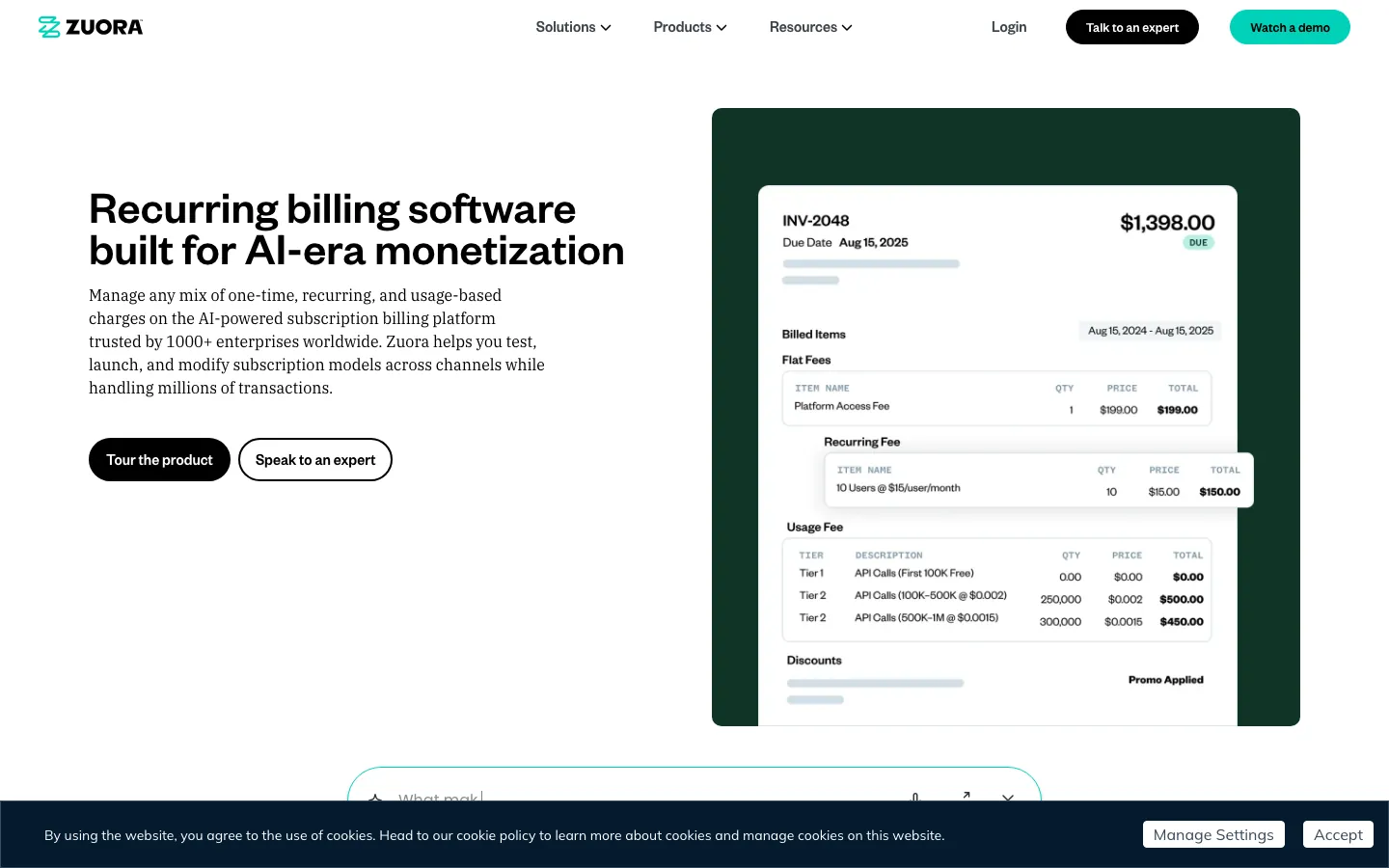
Screenshots of Zuora 4 images
What's great
- Enterprise-grade billing engine trusted by Zoom, General Motors, and The New York Times; processes millions of subscription transactions globally without architecting around volume limits
- Zuora Revenue handles ASC 606 and IFRS 15 compliance as a standalone module, the deepest revenue recognition automation in the segment with automated journal entry posting to major GL systems
- Zuora CPQ handles configure-price-quote workflows for complex product bundles, multi-year ramp contracts, and amendments without breaking downstream billing; this is where Chargebee and Maxio stop scaling
Watch-outs
- 3.9/5 on G2 across 309 reviews, the lowest in this guide; 'powerful but slow and complex' is the consistent complaint from mid-market buyers who picked it without enterprise-scale requirements
- Implementation cost is real; contracts start around $75K/year and implementation partner fees commonly add $100K-$300K in year one depending on data model complexity
- The platform is designed for dedicated administrators; companies without a Zuora admin on staff or a SI partner on retainer hit walls within the first three months
Pricing breakdown
| Plan | Price | Best for |
|---|---|---|
| Launch | Custom quote ~$30K-$50K/yr | Mid-market teams testing the platform |
| Scale | Custom quote ~$75K-$120K/yr | $20M-$100M ARR, CPQ and billing |
| Enterprise | Custom quote $120K+/yr | $100M+ ARR, multi-entity, global |
| Zuora Revenue (add-on) | Custom | ASC 606/IFRS 15, GL journal automation |
What reviewers say about Zuora
Recurring themes across ~309 G2 reviews (3.9/5), 2024-2026.
What reviewers praise
- Zuora handles genuinely complex subscription billing and revenue recognition at enterprise scale, managing recurring models, pricing changes, renewals, and invoicing without heavy in-house systems.
- Subscription-lifecycle automation is valued for cutting manual work and keeping billing accurate as volume grows.
- Out-of-the-box Salesforce and NetSuite integrations, multi-currency support, and tax automation are cited as strong fits for large, multi-entity operations.
- Reviewers note the platform is powerful and highly configurable once the API is used to work around interface limits.
What reviewers fault
- Complexity is the dominant theme: setup, configuration, and ongoing maintenance are resource-intensive and often need dedicated staff or consultants.
- The native UI is a repeated weak point, with reviewers effectively routing around it through the API.
- Reporting is called weak, pushing some teams to export into their own data warehouse for real analysis.
- Reviewers report trouble with line-level and invoice-wide discounts, constraints on payment plans and billing frequencies, and several mention server outages.
Loading reviews…
LemonSqueezy
Best zero-overhead MoR for indie SaaS and micro-products
Screenshots of LemonSqueezy 4 images
What's great
- Zero monthly fee, just 5% + $0.50 per transaction; a solo founder or indie team can ship global billing on day one without a finance operations hire
- MoR model handles global tax compliance including EU VAT, US sales tax, and country-specific digital services levies across 100+ countries with zero configuration
- Acquired by Stripe in 2024 and integrated into the Stripe ecosystem; payment reliability now backs the Stripe infrastructure rather than the legacy Lemon Squeezy payment stack
Watch-outs
- Post-Stripe acquisition, developer community sentiment has been mixed; a recurring complaint in the indie SaaS community is that the product roadmap has slowed since acquisition
- Additional fees stack quickly for international buyers: +1.5% for international transactions, +0.5% for subscription recurring charges, +1.5% for PayPal, so effective rate can reach 8-9% on some transactions
- Not designed for B2B enterprise billing; custom invoicing, NET-30 payment terms, and purchase-order workflows are not native to the platform
Pricing breakdown
| Plan | Price | Best for |
|---|---|---|
| Standard | 5% + $0.50/transaction | Solo founders and indie teams under $25K MRR |
| Volume custom | Negotiated | $25K+ MRR, custom rate discussions |
| International surcharge | +1.5% per transaction | Non-US buyers |
| PayPal surcharge | +1.5% per transaction | PayPal checkout enabled |
What reviewers say about LemonSqueezy
Recurring themes across ~142 G2 reviews (4.3/5), 2024-2026.
What reviewers praise
- The merchant-of-record model wins over indie SaaS and digital sellers: Lemon Squeezy owns the tax obligation and remits sales tax, VAT, and GST across 135+ countries so founders skip registering and filing themselves.
- Setup is fast and beginner-friendly, with reviewers launching a full checkout in minutes and no code required.
- Payments, subscription billing, tax compliance, and digital-file delivery live in one dashboard, which reviewers value for removing separate tools.
- No monthly or setup fee (you pay only the per-transaction 5% + $0.50 when you make a sale) suits solo makers testing products.
What reviewers fault
- The 5% + $0.50 fee is expensive at scale, and international (+1.5%) and PayPal (+1.5%) surcharges stack, hitting EU and non-US sellers hardest.
- Account and payout risk is a recurring worry: reviewers report rejections after document verification and funds frozen or held during account reviews.
- Support has been slower and less responsive since the July 2024 Stripe acquisition, with tickets reportedly going unanswered for weeks.
- Feature scope is limited: no metered or usage-based billing, few integrations beyond email tools, and no real course-building or alternative payment methods.
Loading reviews…
Salesforce Revenue Cloud
Best for Salesforce-native CPQ and contract lifecycle management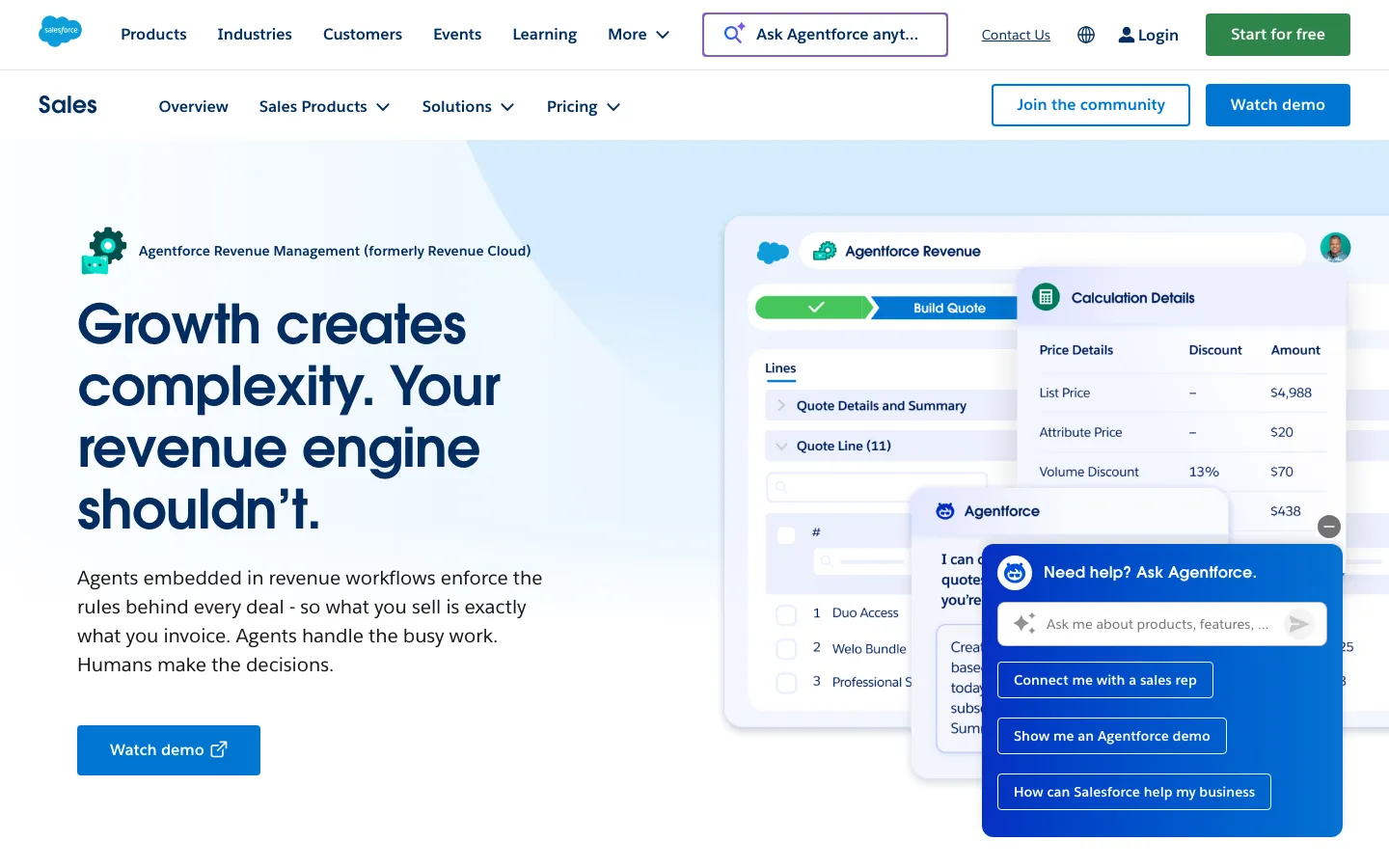
Screenshots of Salesforce Revenue Cloud 4 images
What's great
- Native Salesforce CRM data model; quote-to-cash lives in the same object layer as opportunities, accounts, and contacts with no middleware sync required
- Agentforce Revenue Management (formerly Revenue Cloud) handles ASC 606 recognition, automated invoicing, payment runs, and GL posting within the Salesforce platform
- Largest partner ecosystem for revenue operations; 200+ certified Revenue Cloud implementation partners in the Salesforce AppExchange
Watch-outs
- Minimum viable configuration requires Sales Cloud Enterprise at $165/user/mo plus CPQ at $75/user/mo; the loaded per-seat cost starts at $240/user/mo before billing and RevRec modules
- Implementation is slow and expensive; a clean Salesforce Revenue Cloud deployment runs a multi-month timeline with significant professional-services cost
- Complexity scales with the org; every new pricing model or contract amendment type requires admin configuration that Chargebee or Maxio handles out of the box
Pricing breakdown
| Plan | Price | Best for |
|---|---|---|
| CPQ | $75/user/mo (requires Sales Cloud Enterprise) | 50-200 seat Salesforce shops with complex quoting |
| CPQ Plus | $150/user/mo | Multi-year contracts, advanced approvals |
| CPQ + Billing | $300/user/mo | Full billing engine and RevRec in Salesforce |
| Revenue Lifecycle Mgmt | Custom enterprise | 200+ seats with full CPQ, billing, RevRec, payments |
What reviewers say about Salesforce Revenue Cloud
Recurring themes across ~25,800 G2 reviews (4.4/5) and ~18,000 Capterra reviews (4.4/5), 2024-2026.
What reviewers praise
- Customization is the most-cited strength; reviewers say you can model almost any sales process and Salesforce will bend to it.
- The AppExchange ecosystem and integration depth are seen as unmatched, nearly every tool a team uses connects.
- It scales with the enterprise, reviewers running large, multi-team orgs say nothing else handles their complexity.
- Reporting and forecasting are praised as powerful and granular once configured by someone who knows the platform.
- Einstein AI and automation features draw positive mentions for surfacing next steps and cutting manual data entry.
What reviewers fault
- Complexity is the dominant complaint, reviewers say it needs a dedicated admin or paid consultant to set up and maintain.
- Total cost is repeatedly flagged: per-seat pricing plus add-ons, sandboxes, and implementation make it the most expensive option.
- The learning curve is steep and reps resist adoption without serious training, a recurring theme in negative reviews.
- The interface feels dated and cluttered to many reviewers compared with newer, lighter CRMs.
- Support is criticized as slow or tiered behind premium plans, with basic support seen as inadequate for the price.
Loading reviews…
Stax Bill
Best predictable-fee billing platform for North American mid-market
Screenshots of Stax Bill 4 images
What's great
- Flat $499/mo for up to $85K monthly billing with no transaction percentage; predictable cost structure appeals to finance teams who hate percentage-of-revenue pricing models
- Strong proration handling on mid-cycle upgrades, downgrades, and cancellations; the engine handles the edge cases that Stripe Billing requires custom code to cover
- North American payment gateway integrations are deeper than most competitors in this tier; Stripe, Braintree, Authorize.net, and PSiGate all work natively
Watch-outs
- G2 review count is thin at the vendor level; most reviews are on Capterra and GetApp under the legacy Fusebill name, making objective comparison harder
- Limited global tax compliance; primarily built for North American billing, international VAT handling requires third-party tooling
- Product innovation pace is slower than Chargebee or Maxio; the platform is mature and stable but not adding features at the rate of the VC-backed competitors
Pricing breakdown
| Plan | Price | Best for |
|---|---|---|
| Starter | $499/mo | Up to $85K monthly billing, no overages |
| Growth | Custom quote | $85K-$250K monthly billing |
| Enterprise | Custom quote | $250K+ monthly billing, advanced workflows |
| Implementation | $2K-$8K one-time | Full migration and onboarding support |
What reviewers say about Stax Bill
Recurring themes across ~117 Capterra reviews (4.4/5), 2024-2026.
What reviewers praise
- Customer service is the most-praised strength, described as quick and stellar during setup and ongoing use.
- Reviewers value the deep per-subscription custom pricing options, which let them tailor plans to individual customers.
- Automated collections, card processing, and auto-updating of expired credit cards are called out as reliable, hands-off features.
- Ease of adding clients, emailing invoices directly, and tracking AP/AR is repeatedly mentioned as a practical day-to-day win.
What reviewers fault
- Pricing sits on the high side (Growth plan starts around $499/month billed annually), which reviewers flag for smaller operations.
- The interface is complex and slows noticeably at month-end, and simple tasks require a lot of employee training.
- Updating prices across active subscriptions is a real pain point, with some reviewers writing custom code because bulk price changes are not built in.
- Reporting is described as not configurable and only marginally useful, with weak support for cost-based accounting.
- The API is decent but uneven (only some changes trigger events), and SSO reportedly breaks the standard login flow.
Loading reviews…
Tools we considered but excluded
We evaluated more tools than the 11 you see above. These did not make the cut. Saying what we rejected, and why, is the editorial muscle most listicles skip.
- Braintree: A payment gateway, not a billing platform; lacks subscription lifecycle, dunning, and RevRec workflows required by this comparison
- Zuora Revenue (standalone): RevRec-only module; included as part of the Zuora platform entry above rather than as a separate comparison point
- Chargify: Merged into Maxio in 2022; the legacy Chargify product no longer exists as a standalone offering
- SaaSOptics: Merged into Maxio in 2022; same as above
- Avalara: Tax compliance tool, not a billing platform; relevant as a complement to Stripe Billing or Recurly, not a competitor
- Sage Intacct Billing: ERP subscription billing module requiring Sage Intacct core; best compared in an ERP context, not against purpose-built billing platforms
Honorable mentions
Solid tools that did not crack the main list but are worth tracking, especially for niche use cases.
- Ordway Labs: Strong ASC 606 automation for mid-market SaaS without the Maxio complexity; worth evaluating for $5M-$30M ARR teams that need RevRec without an ERP
- Zoho Subscriptions: Solid billing for Zoho One shops under $2M ARR; redundant if you are not already in the Zoho ecosystem but genuinely good within it
- Billsby: Transparent $35/mo flat-fee billing engine for sub-$50K MRR SaaS teams that find Chargebee Starter too complex; underrated in the sub-$1M ARR band
The four categories of subscription billing platforms
The subscription billing market splits into four practical categories that get confused constantly. What you actually need depends on your pricing model, legal entity structure, and where your customers are.
Billing engines (self-managed). You handle tax, payment gateway, and compliance yourself. The platform manages the subscription lifecycle, invoicing, and dunning. Stripe Billing, Chargebee, Maxio, Recurly, Zuora, and Stax Bill fall here. These are the right choice when your team wants control and has the operational capacity to manage the surrounding compliance stack.
Merchant of Record platforms. The platform becomes the legal seller. It collects tax globally, processes payments, handles refunds, and remits everything back to you as net revenue. Paddle and LemonSqueezy are the main players. Operationally simpler; the 5% fee is the cost of outsourcing all of that. Right for teams that want to go global without a tax operations hire.
SaaS metrics plus billing. Some platforms combine the billing engine with investor-grade SaaS reporting: NRR waterfall, GRR, cohort churn, ARR bridge. Maxio is the standout here; Chargebee’s Growth module does a partial version. This matters a lot once you have a board and an investor update cadence.
Enterprise CPQ plus billing. Configure-price-quote workflows, multi-year ramp contracts, amendment workflows, and GL journal posting integrated with your CRM. Salesforce Revenue Cloud and Zuora live here. Not relevant until you have complex product catalogs and enterprise AEs quoting custom contracts.
The eleven platforms in this guide cover all four buckets. Three additional criteria worth naming upfront: whether ASC 606 revenue recognition is native or a bolt-on, whether the platform handles usage-based pricing properly, and whether the fee structure is percentage-of-revenue or flat monthly.
What I check in every subscription billing demo
Every billing platform demo follows the same choreography: show the happy path, show the dunning config screen, show a RevRec schedule. The demos almost never reveal the edge cases that will occupy your finance team for the first six months. Eight things to test before you sign.
One, run a mid-cycle upgrade on an annual contract. Take an annual subscriber, upgrade their tier at month 4, and check the proration math. Compare the invoice against what you would calculate manually. Stripe Billing handles this correctly if your code is right. Chargebee handles it out of the box. Some platforms get the credit memo wrong on co-term annual contracts. This error will show up in your ARR calculations.
Two, test a failed payment retry with the ML dunning. Create a test subscription, decline the card on renewal, and watch the retry cadence. Count how many retries happen over the next 14 days and whether the timing is smart or just scheduled. For a $3M ARR company with 2% monthly involuntary churn, getting this right is worth $60K/year in recovered revenue.
Three, generate an ASC 606 deferred revenue schedule. Take a $12,000 annual contract signed in October, and ask the platform to show you what gets recognized in each month through September of the following year. Then change the contract to add a professional services milestone at month 6 and regenerate the schedule. This is where Stripe Billing shows its limits and where Maxio and Chargebee RevRec show theirs.
Four, export the full subscriber ledger to a spreadsheet. All active contracts, their billing dates, payment methods, plan history, and current status. If this requires a support ticket or a “talk to your CSM” conversation, the data portability story is weak. You want this export to be a one-click operation for your controller.
Five, set up a usage-based pricing tier. Build a product with three usage tiers, add metering for API calls or seats or GB processed, and send a test event through the metering API. Time how long it takes from event ingestion to the next invoice reflecting the overage. For SaaS companies moving to usage-based pricing in 2026, this is the critical path.
Six, test the Salesforce or HubSpot CRM sync. Create a new contract in the billing platform and check how long it takes to reflect in your CRM. Then update a subscription in the CRM and watch whether the billing platform picks up the change bidirectionally. The sync latency and field mapping errors are where quarter-end reconciliation pain lives.
Seven, ask about your year-2 cost in writing. The platform rep will give you year-1 pricing. Ask specifically: what is the average annual uplift at renewal for customers at our ARR band? If they can’t give a range, assume 10-20% and negotiate an uplift cap into the contract before signing.
Eight, run the audit trail on a disputed charge. Pick a subscription and pull the full event log for its last three renewals, including every payment attempt, every state change, and every admin action. If the audit log is incomplete or requires a support ticket to access, that is a red flag for any company approaching an audit or a fundraise.
Where the eleven billing platforms differ on RevRec and tax
| Tool | Usage-based billing | Native RevRec | Smart dunning | MoR tax handling | Multi-entity |
|---|---|---|---|---|---|
| Stripe Billing | N (Meter API) | Paid add-on | $ add-on | ✗ | N |
| Whop | ✗ | ✗ | • (orchestration) | • (2% add-on) | ✗ |
| TrueRev | ✗ | N (native QBO sync) | ✗ | ✗ | ✗ |
| Chargebee | N | N (RevRec module) | N | ✗ | Enterprise |
| Maxio | N | N (native) | N | ✗ | N |
| Recurly | N | $ (RevRec $1.2K/mo) | N | ✗ | Enterprise |
| Paddle | • (limited) | ✗ | • | N | ✗ |
| Zuora | N | N (Zuora Revenue) | N | ✗ | N |
| LemonSqueezy | ✗ | ✗ | • | N | ✗ |
| Salesforce Rev Cloud | N (CPQ+Billing) | N | N | ✗ | N |
| Stax Bill | • | ✗ | N | ✗ | ✗ |
Maxio is the only platform that ships native billing, native RevRec, and native NRR waterfall together at no extra charge. Chargebee comes closest and is more accessible at mid-market ARR. Stripe Billing and LemonSqueezy are the weakest on the RevRec axis. Paddle and LemonSqueezy are the only platforms with genuine MoR tax handling.
Billing platform security and compliance, tier by tier
| Tool | SOC 2 Type II | GDPR | HIPAA | SSO-SAML | Audit logs |
|---|---|---|---|---|---|
| Stripe Billing | ✓ | ✓ | ✗ | Enterprise | ✓ |
| Whop | ✓ | ✓ | ✗ | ✗ | • |
| TrueRev | ✓ | ✓ | ✗ | ✗ | ✓ |
| Chargebee | ✓ | ✓ | $ add-on | Performance+ | ✓ |
| Maxio | ✓ | ✓ | ✗ | ✓ | ✓ |
| Recurly | ✓ | ✓ | ✓ | Enterprise | ✓ |
| Paddle | ✓ | ✓ | ✗ | ✗ | ✓ |
| Zuora | ✓ | ✓ | ✓ | ✓ | ✓ |
| LemonSqueezy | ✓ | ✓ | ✗ | ✗ | • |
| Salesforce Rev Cloud | ✓ | ✓ | ✓ | ✓ | ✓ |
| Stax Bill | ✓ | ✓ | ✗ | Enterprise | N |
For enterprise IT reviews, Stripe Billing, Maxio, Recurly, Zuora, and Salesforce Revenue Cloud all clear the standard SOC 2, GDPR, SSO-SAML, and audit-log checklist. HIPAA is the exception.
Only Recurly, Zuora, and Salesforce Revenue Cloud carry it outright, Chargebee offers it as a paid add-on, and Stripe Billing, Maxio, Paddle, LemonSqueezy, and Stax Bill do not sign BAAs. Any company selling into healthcare should rule those five out and confirm the BAA tier with the rest before signing.
Integration depth across the billing stack
| Tool | Salesforce CRM | NetSuite GL | QuickBooks | Stripe Payments | Slack/Notifications |
|---|---|---|---|---|---|
| Stripe Billing | M | M | M | N (native) | M |
| Whop | ✗ | ✗ | ✗ | M | ✗ |
| TrueRev | ✗ | ✗ | N (native) | M | ✗ |
| Chargebee | N | N | N | N | N |
| Maxio | N | N | N | N | N |
| Recurly | N | M | N | N | M |
| Paddle | M | ✗ | M | N (Stripe infra) | ✗ |
| Zuora | N | N | N | M | M |
| LemonSqueezy | ✗ | ✗ | ✗ | N (Stripe owned) | ✗ |
| Salesforce Rev Cloud | N (native) | M | M | M | N |
| Stax Bill | M | ✗ | N | N | ✗ |
Maxio and Chargebee have the strongest native integration story outside of Salesforce-native tools. Both ship bidirectional Salesforce CRM sync, NetSuite GL posting, and Stripe as the payment gateway without middleware. Zuora and Salesforce Revenue Cloud own the Salesforce-native story for enterprise.
LemonSqueezy and Paddle are the weakest on GL integrations; they are designed for product-led growth motions, not accounting-department workflows. Whichever billing engine you land on, its journal entries still have to post cleanly into whatever general ledger you run, so if the GL itself is still up for grabs, pin that down first with our best accounting software guide before you lock the billing side.
Merchant of Record vs billing engine split
This is the decision that determines your entire vendor shortlist. Most SaaS teams spend a week evaluating billing platforms before realizing they made the wrong category choice on day one.
A billing engine manages the subscription lifecycle (pricing models, plan changes, invoicing, dunning, RevRec) but does not become the legal seller. You still need a payment gateway, a tax compliance solution (Avalara, TaxJar, or in-house), and potentially a local legal entity in each tax jurisdiction where you sell.
Stripe Billing, Chargebee, Maxio, Recurly, Zuora, Stax Bill, and Salesforce Revenue Cloud are all billing engines.
A Merchant of Record platform becomes the legal seller of your software. Paddle and LemonSqueezy collect the money, handle all tax obligations globally, issue receipts from their own legal entity, and remit net revenue to you. Your company does not appear as the seller in the transaction from a tax authority’s perspective.
The trade-offs are real on both sides. Billing engines give you more control over pricing flexibility, contract structures, and enterprise billing patterns. MoR platforms eliminate 80-90% of tax compliance operational work and are genuinely faster to launch with.
The break-even is approximately $200K-$300K ARR when comparing a billing engine (Chargebee starter, Stripe 0.5% fee) plus tax compliance (Avalara $150-$300/mo at this scale) versus an MoR (Paddle at 5% + $0.50). Below that threshold, the operational simplicity of Paddle or LemonSqueezy almost always wins.
Above $500K MRR the percentage math tips back toward a billing engine.
One other nuance: enterprise B2B buyers frequently have contractual requirements to purchase from the actual software vendor, not a reseller. MoR structure fails that test because Paddle or LemonSqueezy is the legal seller.
If your ICP includes government buyers, regulated industries, or companies with strict procurement policies, an MoR model is a blocker, not just a trade-off.
Revenue recognition automation
ASC 606 and IFRS 15 changed the revenue recognition landscape for SaaS companies in 2018, and the operational burden of running compliant revenue schedules has only grown as billing models have gotten more complex. Here is where each platform actually stands.
Stripe Billing does not automate ASC 606. It timestamps transactions and provides clean event data, but the deferred revenue schedule, the performance obligation allocation, and the journal entry posting are all on your team. Stripe Sigma can query raw billing data, but that is a BI query tool, not an accounting module. For any company past $5M ARR with a proper controller, this gap creates real month-end close friction.
Chargebee RevRec (the dedicated revenue recognition module bundled with Performance and Enterprise tiers) handles 5-step ASC 606 framework automation including performance obligation identification, transaction price allocation, and period-close journal entries. The RevRec module integrates directly with NetSuite and Sage Intacct.
It is not perfect; complex multi-element contracts with variable consideration require manual override. But for 80-90% of standard SaaS contract patterns, it automates what would otherwise be a multi-day controller exercise.
Maxio ships native RevRec as a core feature, not a module. Every contract in Maxio has an automatic deferred revenue schedule and a period-close report. The integration with Salesforce pulls opportunity data for multi-element contract allocation. This is Maxio’s single clearest advantage over Chargebee: RevRec is part of the core product, not an additional purchase, and the NRR waterfall bridges from bookings to recognized revenue in one report.
Recurly RevRec is a standalone add-on starting at $1,200/mo. It handles ASC 606 and IFRS 15 automation with multi-currency support and automated period close. Teams that outgrow it usually graduate to a dedicated enterprise engine like Zuora Revenue for more complex recognition patterns.
Zuora Revenue is the most powerful standalone RevRec engine in the subscription market. It handles variable consideration, contract modifications, license versus service obligation splits, and automated journal posting to 15+ GL systems. It is priced and architected for enterprise-scale complexity, not mid-market SaaS.
Salesforce Revenue Cloud automates RevRec within the Salesforce platform, which means the performance obligation data comes directly from the CPQ quote object. For Salesforce shops, eliminating the CRM-to-RevRec sync is the strongest argument for staying on-platform.
The practical hierarchy: Maxio for $5M-$50M ARR B2B SaaS that wants RevRec without an ERP. Chargebee RevRec for the same band when dunning and retention tooling are equally important. Zuora Revenue for $50M+ ARR or complex multi-element contract structures.
Stripe Billing for teams that will run RevRec in a spreadsheet or outsource it to their accounting firm.
Match the billing platform to your stage
Five questions that collapse the list from nine tools to two or three real options.
1. Your pricing model
- Pure seat-based, simple monthly or annual: Stripe Billing (developer) or Chargebee Starter (no-code). Both handle this without breaking a sweat.
- Seat plus usage overage or consumption-based: Chargebee Performance or Maxio Grow. Both handle multi-dimension metering cleanly out of the box.
- Enterprise CPQ, ramp schedules, multi-year true-ups: Salesforce Revenue Cloud or Zuora. Nothing else in the list handles quote-to-cash without significant workarounds at this complexity.
- Simple products sold globally to individuals or developers: Paddle or LemonSqueezy. The MoR model eliminates your entire tax stack.
2. Your current ARR band
- Pre-revenue to $500K ARR: Stripe Billing (0.5% fee, no commitment) or LemonSqueezy/Paddle if you’re going global. No reason to pay a monthly platform fee at this stage.
- $500K to $5M ARR: Chargebee Performance or Stax Bill. The dunning math justifies the platform fee somewhere in this band.
- $5M to $30M ARR: Maxio or Chargebee, with Recurly as a contender if payment recovery is a primary concern.
- $30M to $100M ARR: Maxio Scale or Zuora Scale. Also the point where Salesforce Revenue Cloud starts making sense if you’re a Salesforce shop.
- $100M+ ARR: Zuora Enterprise or Salesforce Revenue Cloud. The complexity justifies the implementation cost.
3. Selling to enterprise buyers with procurement requirements
If yes, rule out Paddle and LemonSqueezy. Enterprise procurement teams will not sign contracts where the legal seller is a third-party MoR platform. Stick to billing engines.
4. Maturity of your finance team
A solo CFO at a Series A who also manages FP&A, investor relations, and HR admin does not have time to build RevRec schedules in Stripe Sigma. That team needs a platform that closes the books with three clicks, not 30. Maxio or Chargebee RevRec.
A Series C with a controller, a FP&A analyst, and a VP Finance can handle Zuora’s complexity. They probably need it.
5. Whether you run on Salesforce
If yes and your ARR is above $20M and you have AEs quoting complex multi-product deals, Salesforce Revenue Cloud is worth the implementation cost because the alternative is maintaining a bidirectional sync between your CRM and your billing platform forever.
If yes and your ARR is under $20M, connect Chargebee to Salesforce natively and skip the Revenue Cloud overhead.
Rolling out a billing platform without breaking existing subscribers
Billing migrations fail in predictable ways. They fail when the team underestimates the data mapping exercise, when they try to migrate and launch a new pricing model simultaneously, and when they cut over too fast without a parallel-running validation period.
Phase 1 (weeks 1-2): Data audit and mapping. Export every active subscriber record from your current system with full contract history, payment method tokens, and billing date data. Map every field to the new platform’s data model. Find the gap fields, the ones your current platform stores that the new one does not have a native field for, before migration starts. Custom fields are always cheaper to build in week 2 than to backfill in week 12.
Phase 2 (weeks 3-6): Parallel environment setup and test migration. Build your full product catalog in the new platform. Run a migration of 50-100 subscriber records through a staging environment and generate the invoices. Compare the invoice output line by line against what your current system generates. Proration differences, rounding differences, and tax calculation differences surface here. Fix them before going live.
Phase 3 (weeks 7-10): Staged cutover by cohort. Migrate new subscribers first, then renewing subscribers in billing date order. Never migrate an entire subscriber base in a single batch. The pattern teams that do this cleanly tend to follow: new subscribers go live in the new system on day 1, renewals migrate over a rolling 4-week window, existing mid-cycle subscribers are the last group.
Phase 4 (weeks 11-12): Decommission and close. Keep read-only access to the old system for 13 months (one full billing cycle plus audit buffer). Migrate historical invoices to your document management system. Lock the old system’s data export. Only then cancel the old contract.
What is changing in subscription billing software in 2026
Usage-based pricing is the dominant new contract motion. The Zuora Subscription Economy Index 2025 reported that 61% of subscription businesses now offer at least one usage-based pricing component. Every platform in this comparison has scrambled to build metering APIs; the quality varies significantly. Stripe Billing’s Meter API and Maxio’s usage billing module are the two most mature as of Q2 2026.
Merchant of Record is gaining B2B legitimacy. Paddle processed $5B+ in gross merchandise volume in 2025 and is actively signing mid-market B2B customers, not just indie developers. The narrative that MoR is only for consumer products is fading. The procurement-gate friction is still real for enterprise deals, but the $2M-$10M ARR product-led growth company is a legitimate Paddle customer in 2026.
AI is entering the dunning layer. Chargebee and Recurly both shipped ML-based payment retry logic in their 2025 product cycles. The early data shows 8-15% higher recovery rates versus static retry schedules on the same cohort. This is the most concrete AI feature with a measurable financial outcome among the eleven platforms here.
RevRec automation is a board-level requirement above $10M ARR. The days of a controller manually building deferred revenue schedules in Excel are ending. Every board and every auditor now expects automated RevRec output from the billing system. Platforms that cannot provide it, Stripe Billing, LemonSqueezy, Stax Bill, will lose deals to Chargebee and Maxio in any evaluation where the finance team has a seat at the table.
Recurly is expanding from billing into retention and commerce. Its 2025 acquisitions of Redfast and Prive, now rebranded Recurly Engage and Recurly Commerce, push it past pure billing into subscriber engagement and Shopify-side subscriptions. The bet for mid-market teams is consolidation, running dunning, engagement, and commerce under one vendor instead of three. Whether those pieces feel native by the time you evaluate is the thing to test, not the roadmap slide.
What subscription billing really costs in year one
| Stage | Tool | Listed price | Real year-1 all-in |
|---|---|---|---|
| Pre-$500K ARR | Stripe Billing | 0.5% of billing | $2.5K-$5K on $500K ARR |
| Pre-$500K ARR | Paddle | 5% + $0.50 | $25K+ on $500K ARR |
| $1M-$5M ARR | Chargebee Performance | $7,188/yr | $10K-$20K (setup + first year) |
| $1M-$5M ARR | Maxio Grow | $599/mo | $20K-$35K (setup + implementation) |
| $5M-$30M ARR | Recurly Core | Custom quote | $30K-$80K |
| $5M-$30M ARR | Salesforce Rev Cloud | $240/user/mo loaded | $300K-$600K (implementation dominant) |
| $30M+ ARR | Zuora Scale | Custom | $150K-$400K+ (platform + SI partner) |
| $30M+ ARR | Maxio Enterprise | Custom | $80K-$150K |
The biggest forecast error finance ops teams make: not accounting for implementation partner costs. Chargebee and Maxio both have partner ecosystems where mid-market implementations run $15K-$40K. Zuora and Salesforce Revenue Cloud have SI partners where implementations run $150K-$400K.
These costs are never in the vendor’s quote and always show up in the year-1 actuals.
A finance team that already polices every recurring line item through its expense management stack should hold the billing platform to the same standard on the buy side.
The billing platform to pick by ARR stage
- Pre-revenue to $500K ARR, US-only billing: Stripe Billing. Zero overhead, 0.5% fee, ships in a week.
- Pre-revenue to $500K ARR, global from launch: Paddle. The tax compliance overhead it eliminates is worth the 5% fee at this scale.
- Indie SaaS and micro-products, under $25K MRR: LemonSqueezy. No monthly fee, live in hours.
- Seed to Series A, $500K-$3M ARR, seat-based: Chargebee Starter into Performance. The free tier to $250K is the right ramp.
- Series A to B, $3M-$15M ARR, B2B SaaS: Maxio Grow. The NRR waterfall and native RevRec start paying back when investor reporting becomes a quarterly requirement.
- Series A to B, $3M-$15M ARR, high failed-payment churn concern: Recurly. The dunning engine is the differentiator.
- North American-focused, flat-fee preference under $5M ARR: Stax Bill. Predictable $499/mo beats percentage fees once MRR is above $100K.
- Series B to C, $15M-$50M ARR: Maxio Scale or Chargebee Enterprise. This is where the RevRec and investor reporting depth of both platforms pays back most clearly.
- $50M+ ARR or Salesforce-native shop with enterprise CPQ: Zuora or Salesforce Revenue Cloud. Pick Zuora if your stack is heterogeneous; pick Salesforce Revenue Cloud if your sales team, CS team, and finance team all live in Salesforce.
- Enterprise selling into regulated or government buyers: Rule out MoR platforms. Chargebee, Maxio, Zuora, or Salesforce Revenue Cloud only.
For corrections, vendor disputes, or pricing updates, email hello@topickz.com . We re-verify pricing and re-test the shortlist every six months; the next refresh ships in November 2026.
Frequently asked questions
When should we switch from Stripe Billing to a dedicated platform?
At $1M ARR if you need dunning optimization. At $3M if RevRec or investor SaaS metrics reporting breaks your month-end. Both signal a platform move pays back.
What does Paddle actually handle as merchant of record?
Tax in 300+ jurisdictions, payments, refunds, fraud, chargebacks. You get net revenue. Paddle is the legal seller globally.
How long does a subscription billing migration take?
8-16 weeks under 5K subscribers. 16-24 weeks for 5K-50K. Run parallel before cutover; migrations that skip this lose deferred revenue records.
Chargebee vs Maxio in 2026, which one wins?
Chargebee for $1M-$10M ARR with dunning focus. Maxio for $5M-$50M ARR where NRR waterfall and native RevRec for board reporting matter more than dunning.
Does subscription billing software automate ASC 606?
Chargebee RevRec, Maxio, Recurly RevRec, and Zuora Revenue automate it. Stripe Billing does not; it needs a separate RevRec tool.
What is the total year-1 cost for Chargebee vs Zuora?
Chargebee Performance runs $7K-$15K year one including setup. Zuora lands $75K-$300K+ once implementation partners are included. Gap is real and intentional.
Is Paddle right for enterprise B2B deals?
No. Enterprise procurement teams reject MoR structures. They need the software vendor as legal seller. Use Chargebee, Maxio, or Zuora.
How much does failed payment churn cost a typical SaaS company?
1-3% of MRR monthly is the benchmark. At $1M MRR that is $10K-$30K monthly. A dunning platform recovering 20% of that pays back fast.
What G2 review count signals a mature, trustworthy billing platform?
200+ is the floor. Chargebee at 995 and Maxio at 829 are strong. Stripe Billing at 738 is fine. Stax Bill under 100 on G2 is thin.
Can we use LemonSqueezy for B2B annual contracts?
Only for simple annual seats under $10K ACV. NET-30, PO workflows, and custom terms are not native. Use Chargebee or Maxio for real B2B.
What is the best subscription billing software for an early-stage SaaS startup?
Stripe Billing for pure dev simplicity under $500K ARR. Chargebee when you need dunning, proration logic, and a finance team dashboard without building it yourself. Both integrate with the same Stripe payment gateway.
Chargebee vs Stripe Billing, which one is better for a $1M ARR SaaS?
Chargebee. At $1M ARR, involuntary churn from failed payments is already costing $10K-$30K/mo and Chargebee's dunning logic recovers 20-30% of that. Stripe Billing requires custom code to get the same result.
What is the best subscription billing software for digital products and creator tools?
Whop handles digital products, communities, and memberships with no monthly fee on the free plan, taking a percentage of revenue instead. Paddle is the alternative for creators wanting a merchant-of-record setup globally.
Whop vs Paddle for selling digital products online?
Whop is better for communities, memberships, and software licenses with a simple setup. Paddle is better when you need global tax compliance as a merchant of record and sell in multiple currencies at volume.
What subscription billing software works best for SaaS companies doing usage-based pricing?
Chargebee and Maxio both handle usage-based billing natively. Zuora is the enterprise option for complex metered models. Stripe Billing supports usage-based but requires more configuration at the product level.
What are the best alternatives to Stripe Billing for a growing SaaS company?
Chargebee is the most direct alternative with better dunning and RevRec. Recurly has strong analytics for consumer subscription businesses. Maxio is the pick when you need NRR waterfall and board-level SaaS metrics built in.
What subscription billing software is best for Indian SaaS companies selling globally?
Paddle or Chargebee. Paddle handles international tax as merchant of record across 300+ jurisdictions, removing the compliance burden entirely. Chargebee integrates with Indian payment gateways and supports INR billing for domestic customers alongside USD for global.
TrueRev vs Maxio for revenue recognition?
TrueRev is QuickBooks-native and built specifically for SaaS companies already running QuickBooks, making ASC 606 schedules automatic without a separate tool. Maxio handles RevRec inside a broader billing and metrics platform, better suited for companies past $5M ARR needing the full stack.
What subscription billing software handles both B2B invoicing and consumer subscriptions?
Chargebee covers both well. Recurly leans consumer. Maxio is built for B2B SaaS specifically. If you have both motions, Chargebee is the most flexible without custom engineering.
Related helpful reads
Write a review
Posts to the page right away. Keep it real — no links or email addresses.