
Comparing the best Product Analytics Platforms of 2026 includes 1. Amplitude 2. PostHog 3. Pendo 4. Mixpanel 5. Heap 6. LogRocket 7. FullStory 8. Hotjar.
TL;DR
- Amplitude: Best overall for behavioral analytics at scale. Warehouse-native queries run directly on your Snowflake or BigQuery data, and it now bundles a production-grade experiment layer after taking over Statsig.
- PostHog: Best for engineering-led teams and data-sovereign orgs. It is open-source and self-hostable so no data leaves your VPC, and a single bill bundles analytics, session replay, feature flags, and experiments that would otherwise be three subscriptions.
- Pendo: Best for B2B SaaS user adoption and account analytics. It is the only tool here that puts in-app guides and behavioral analytics on the same user record, so your CS and product teams act on adoption data without a separate onboarding tool.
- LogRocket: Best session replay with frontend error tracking. It ties frontend JavaScript errors to the exact user sessions where they happened, and its 4.6/5 across 2,305 G2 reviews is the highest rating in this guide.
- Heap: Best autocapture analytics for fast-moving product teams. Autocapture records every click and pageview, so you can define events after the fact and query historic data without touching a line of instrumentation code.
Eight product analytics platforms compared across the use cases that matter, a PLG developer tool, a B2B SaaS workspace, and a B2C mobile app. What delivers genuine insight velocity, what just delivers dashboards, and the pick for your team size, data maturity, and infrastructure posture.
What Is product analytics software?
Product analytics software helps product teams understand how users behave, tracking events, funnels, and retention so teams see what drives engagement and where users drop off.
Tools like Amplitude, PostHog, Pendo, and Mixpanel differ on depth, in-app guidance, self-hosting, and price as data volume grows.
Best Product Analytics Platforms for PLG and SaaS comparison: features, pricing and verdicts
| Tool | Best for | Starting price | Free trial | External rating |
|---|---|---|---|---|
Best overall for behavioral analytics at scale | $49/mo | Free tier (10K MTUs) | G2 4.5/5 (3,081 reviews) | |
Best for engineering-led teams and data-sovereign orgs | $0 (usage-based after free tier) | Free tier (1M events/mo) | G2 4.5/5 (1,034 reviews) | |
Best for B2B SaaS user adoption and account analytics | Free (500 MAUs) | Free tier | G2 4.5/5 (1,489 reviews) | |
Best for event-tracking depth without a data team | $0 (1M events/mo free) | Free tier | G2 4.5/5 (1,287 reviews) | |
Best autocapture analytics for fast-moving product teams | Free (10K sessions/mo) | Free tier | G2 4.4/5 (1,089 reviews) | |
Best session replay with frontend error tracking | $0 (1K sessions/mo) | Free tier | G2 4.6/5 (2,305 reviews) | |
Best digital experience intelligence for enterprise teams | Free (30K sessions/mo) | Free tier | G2 4.5/5 (1,047 reviews) | |
Best heatmaps and user feedback for early-stage web products | $0 (35 sessions/day) | Free tier | G2 4.3/5 (335 reviews) |
How we chose these tools
We compared the platforms on pricing, real G2 review themes, instrumentation model, funnel and retention analysis depth, warehouse export, and hands-on feature checks. Pricing was verified directly on each vendor pricing page and via Vendr contract data in May 2026. All G2 ratings cited were pulled from G2 on May 28, 2026.
How we weight product analytics platforms for the Topickz score
Every tool above is scored against the fixed rubric below and combined using these weights into the Topickz score on each card. The weights are set for product analytics platforms specifically, they are not copied from another category, and we publish them so you can see what moved a ranking and re-weight for your own priorities.
| Criterion | Weight | What we checked |
|---|---|---|
| Event tracking and instrumentation | 22% | The instrumentation model, manual events versus autocapture, and how much engineering it takes to get clean data. Bonus for defining events after the fact against historic data. |
| Funnel and retention depth | 20% | How far funnel, cohort, and retention analysis goes before you have to export to SQL. This is where product teams live day to day. |
| Pricing across event volume | 16% | Cost modeled at real MTU or event bands, and where the curve jumps as data grows. |
| Warehouse export | 13% | Whether raw events flow back to your Snowflake or BigQuery, or stay locked inside the tool. |
| Session replay and experimentation | 12% | Replay, error linkage, and a built-in experiment layer versus paying for three separate subscriptions. |
| Integrations | 9% | CDP, warehouse, and marketing-tool connections a product stack expects out of the box. |
| Ease of adoption | 8% | Whether PMs self-serve answers or funnel every question back to a data team. |
| Total | 100% |
Read the full TopickZ.com testing methodology for how we run each test, score every criterion, and combine them into a single rating.
Detailed reviews
Amplitude
Best overall for behavioral analytics at scale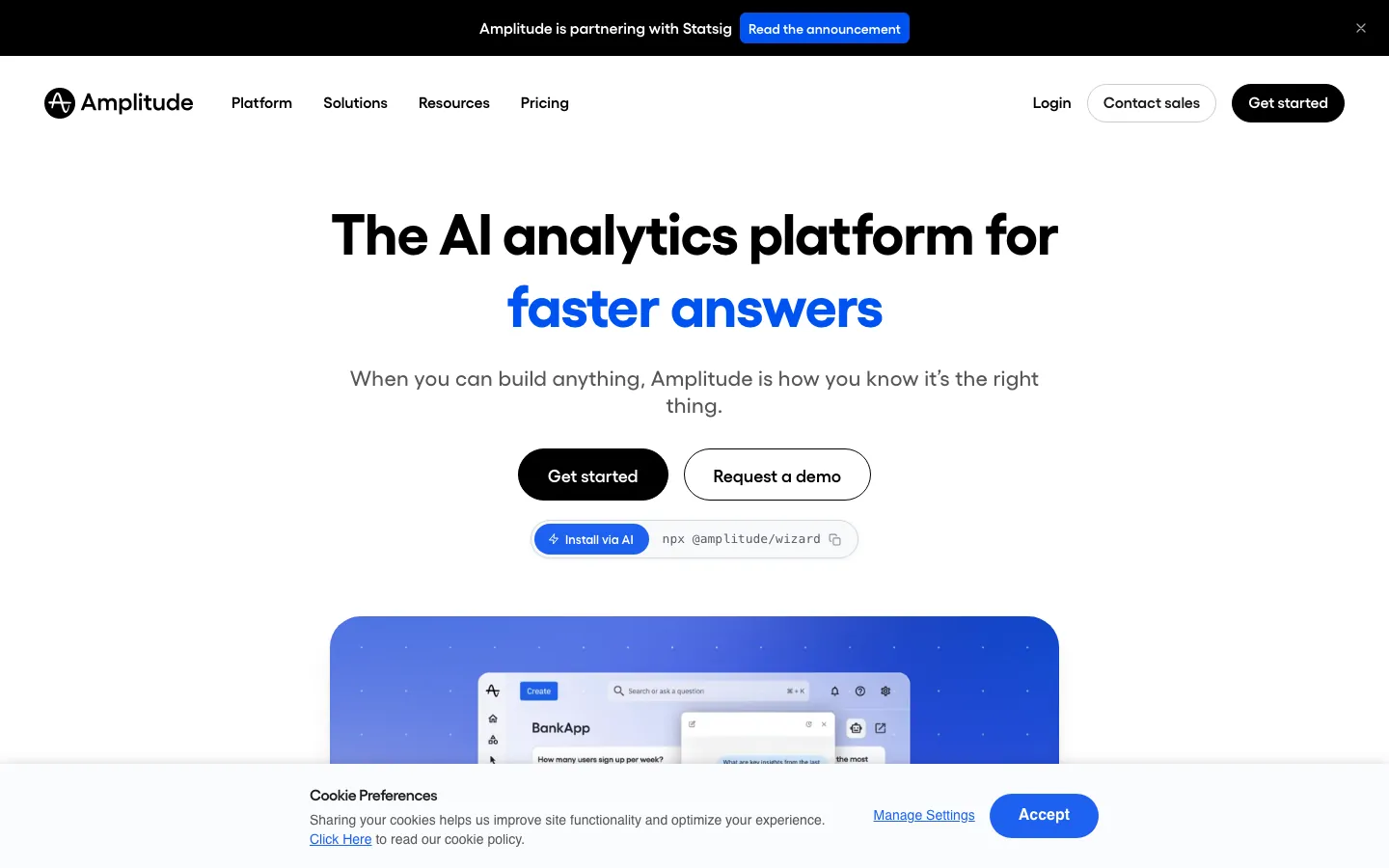
Screenshots of Amplitude 3 images
What's great
- Warehouse-native queries on Growth tier let analysts run Amplitude SQL directly on your Snowflake or BigQuery data without moving it
- Experiment module now built on the Statsig platform Amplitude took over in May 2026, giving full A/B testing and the tightest experiment-to-analytics loop in the segment
- Behavioral cohorts update in real time, no overnight batch jobs to wait on before acting on a segment
Watch-outs
- MTU-based pricing creates budget surprises as a product grows; a 10x user volume increase can produce a 15-20x price increase depending on anonymous vs identified user ratio
- Growth and Enterprise tiers require a sales call for exact pricing; teams routinely get quoted $48K/year for mid-scale products
- The UI depth is genuinely great but the learning curve past basic funnels is real; junior PMs take 3-4 weeks to build cohort analyses independently
Amplitude is the safest default for product analytics teams that plan to grow past 50,000 MAUs and need a platform that won’t hit analytical limits at Series B. 3,081 G2 reviews average 4.5/5, with the consistent praise around cohort depth and the speed of funnel queries.
Amplitude took over the Statsig brand and customer base in May 2026 , bringing a production-grade experimentation layer in-house; no other standalone analytics tool ships an experiment layer this tight.
The catch worth knowing: OpenAI kept Statsig’s founding team in its own 2025 acquisition, so Amplitude inherited the platform and customers, not the original engineers. The pricing model is the honest concern. MTU-based pricing can spike fast when a product grows, so verify the MTU pricing calculator before you sign anything.
Pricing breakdown
| Plan | Price | Best for |
|---|---|---|
| Starter | $0 | Under 10K MTUs |
| Plus | $49/mo | Up to 300K MTUs |
| Growth | Custom | 300K+ MTUs |
| Enterprise | Custom | Multi-product orgs |
Loading reviews…
PostHog
Best for engineering-led teams and data-sovereign orgs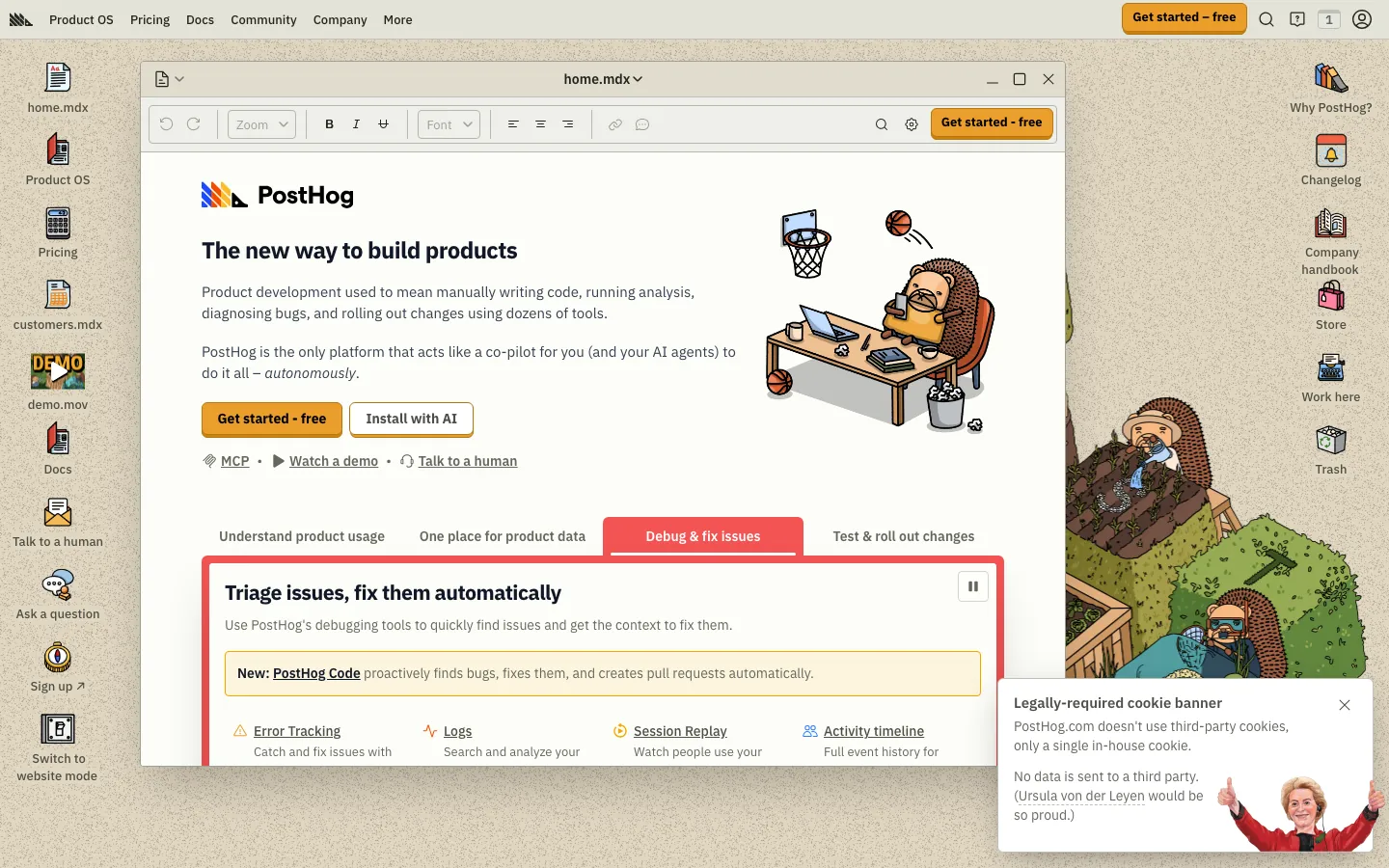
Screenshots of PostHog 3 images
What's great
- MIT-licensed open source core; self-hosting gives complete data sovereignty, no data ever leaves your VPC, which is the deciding factor for strict EU data-residency and air-gapped financial services requirements (for HIPAA, PostHog points you to Cloud under a BAA, not self-hosting)
- Single bill covers product analytics, session replay, feature flags, A/B testing, surveys, and error tracking; for many teams this replaces three separate tool subscriptions
- Usage-based pricing where more than 90% of products run on the free tier; $0.00005/event after 1M events monthly means a product with 5M events/month pays roughly $150
Watch-outs
- Self-hosted version requires a competent DevOps or platform engineer to manage Kafka, ClickHouse, and PostgreSQL infrastructure; this is not a one-click deploy for non-engineers
- Some modules (LLM observability, data warehouse connector) are still maturing relative to Amplitude's depth
- The breadth of features means new users face a wider surface area to learn; Amplitude's opinionated analytics workflow is faster to adopt for pure-analytics use cases
PostHog is the rising default for engineering-led product teams and any company where data leaving a third-party cloud is not an option. 1,034 G2 reviews land at 4.5/5, with consistent praise for the all-in-one billing model and the self-hosting flexibility.
The PostHog blog comparison against Amplitude alternatives is worth reading; the transparency around trade-offs is itself a product signal. The teams that land best on PostHog are those where the head of product and an engineer co-own the analytics stack.
If product analytics is purely a PM function with no eng involvement, Amplitude or Mixpanel will get to insights faster.
Pricing breakdown
| Plan | Price | Best for |
|---|---|---|
| Free | $0 | Up to 1M events/mo |
| Pay-as-you-go | $0.00005/event | Growing products |
| Teams | Custom | SSO |
| Enterprise (self-hosted) | Custom | On-prem |
Loading reviews…
Pendo
Best for B2B SaaS user adoption and account analytics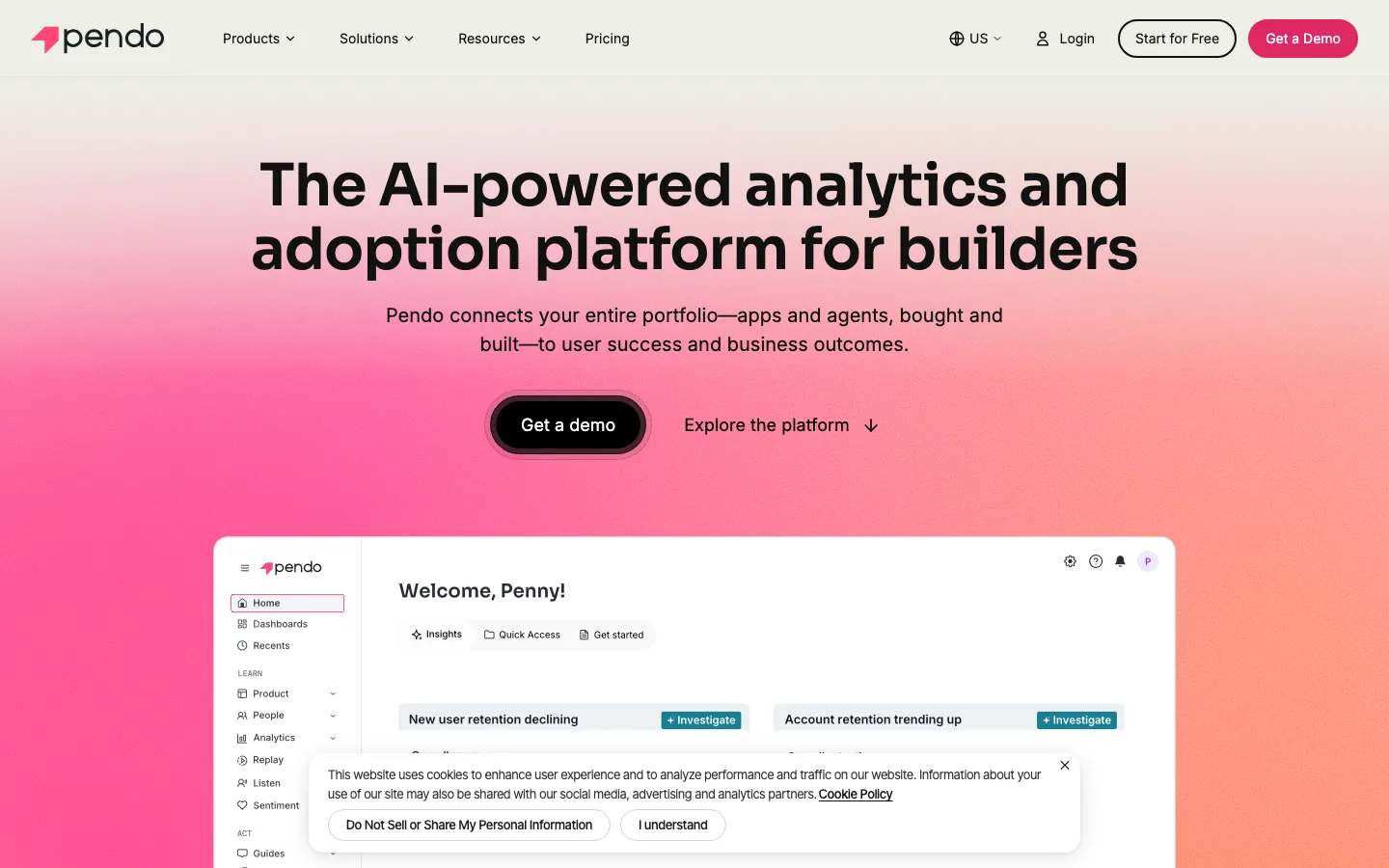
Screenshots of Pendo 3 images
What's great
- Only platform in this guide that ships in-app guides (tooltips, modals, walkthroughs) and behavioral analytics on the same user record; no separate Intercom subscription for onboarding flows
- Account-level analytics out of the box with NPS and sentiment surveys, the right shape for B2B SaaS CS teams watching retention signals
- AI-powered intent signals on Ultimate tier surface which accounts are at risk of churn before they file a support ticket
Watch-outs
- All three paid tiers are custom-quoted, no transparent per-seat pricing; mid-market contracts typically run $15K-$60K/year based on MAU band and module selection
- The modular licensing model means you often pay for a base platform plus add-ons for session replay and multi-app support; budget for 1.5-2x the base quote
- The event taxonomy is less flexible than Amplitude or Mixpanel for deep funnel work; Pendo is better at "how many users completed onboarding" than "why did 40% of users drop off at step 3"
Pendo is the right call for B2B SaaS companies where the product, CS, and marketing teams all need to act on user behavior data without routing everything through a data analyst. 1,489 G2 reviews average 4.5/5.
The in-app guide layer is the genuine differentiator; pairing Pendo analytics with Pendo guides on the same user records is the reason teams pick it over a separate analytics tool plus a separate onboarding tool. The pricing opacity is a real friction point for procurement; Pendo pricing is quote-only for all paid tiers.
Ask for the Base tier with a 90-day NPS add-on pilot before committing to Ultimate.
Pricing breakdown
| Plan | Price | Best for |
|---|---|---|
| Free | $0 | Up to 500 MAUs |
| Base | Custom | Growing products with core analytics needs |
| Core | Custom | Analytics plus session replay |
| Ultimate | Custom | Enterprise |
Loading reviews…
Mixpanel
Best for event-tracking depth without a data team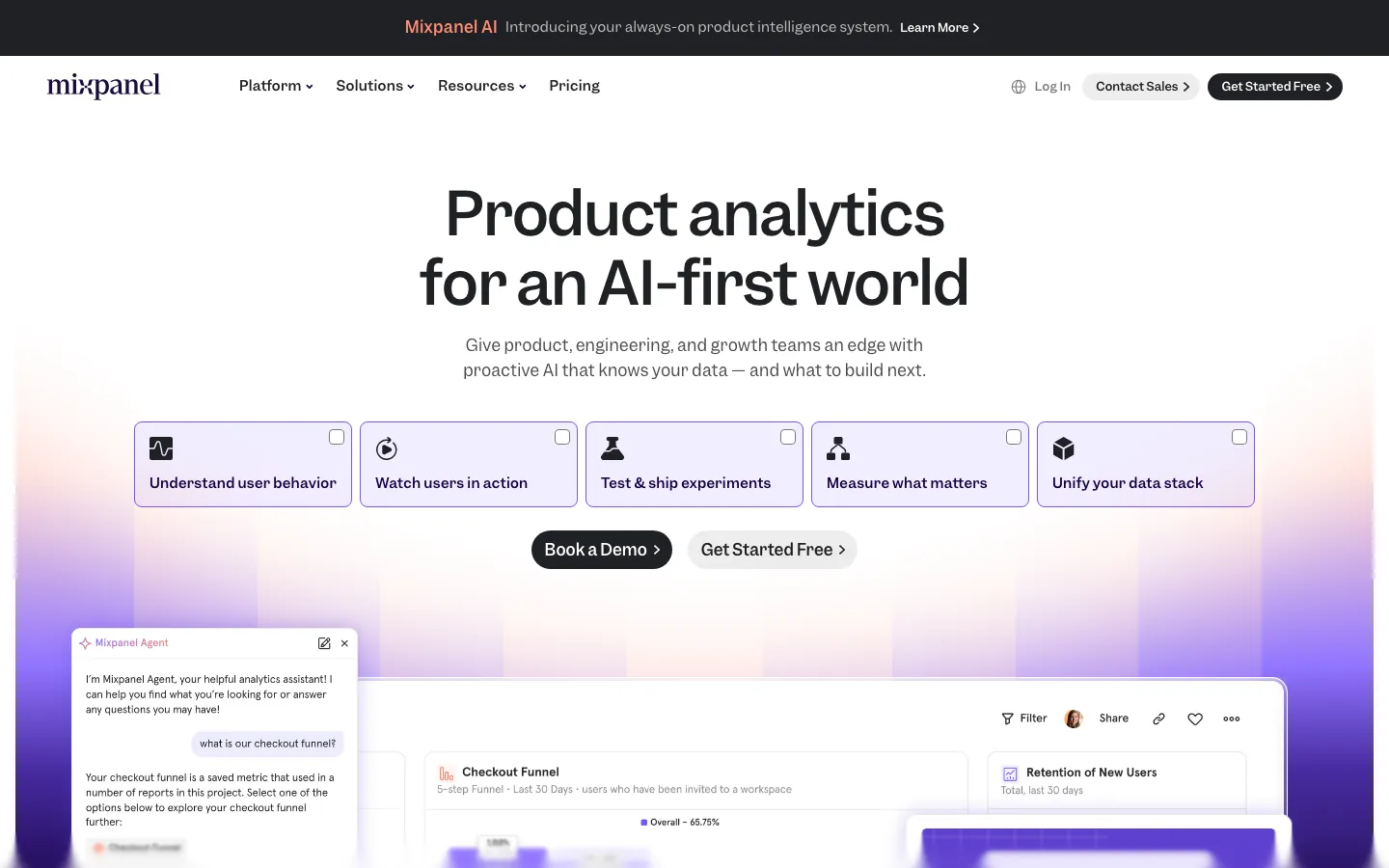
Screenshots of Mixpanel 3 images
What's great
- Intuitive funnel and retention report builder that non-technical PMs and marketers build independently without SQL; most PMs are self-serving reports within the first few days
- Event-based pricing model with 1M events free monthly is the most genuinely generous free tier in the pure-analytics bucket; startups run on it for 18-24 months
- Mixpanel relaunched experimentation and added feature flags in late 2025; the analytics-to-experiment workflow is now closer to PostHog than it was a year ago
Watch-outs
- Less warehouse-native than Amplitude; Mixpanel syncs bidirectionally but does not run queries on top of your Snowflake or BigQuery data the way Amplitude Growth does
- The initial event tracking setup still requires careful planning; one wrong taxonomy decision early creates months of messy data that is painful to retroactively clean
- No in-app guide layer like Pendo, no error tracking layer like LogRocket; the scope is pure analytics
Mixpanel is the go-to when the buyer is a product manager or growth team who needs to run funnel and retention analyses independently, without filing data requests. 1,287 G2 reviews average 4.5/5 on G2.
The Mixpanel pricing page is the most transparent in the segment: 1M events free, then $0.28/1K events with volume discounts. For an early-stage product pushing 3M events per month, that’s roughly $560/month before volume kicks in.
The honest critique in 2026 is that Amplitude’s warehouse-native query layer is pulling enterprise data teams away, and PostHog is pulling early-stage engineering teams. Mixpanel’s sweet spot is the 10-100 person product team where SQL-free self-service matters most.
Pricing breakdown
| Plan | Price | Best for |
|---|---|---|
| Free | $0 | Up to 1M events/mo |
| Growth | $0.28/1K events | 1M-10M events/mo |
| Enterprise | Custom | Unlimited events |
| Startup Program | $0 year 1 | Early-stage companies under $8M raised |
Loading reviews…
Heap
Best autocapture analytics for fast-moving product teams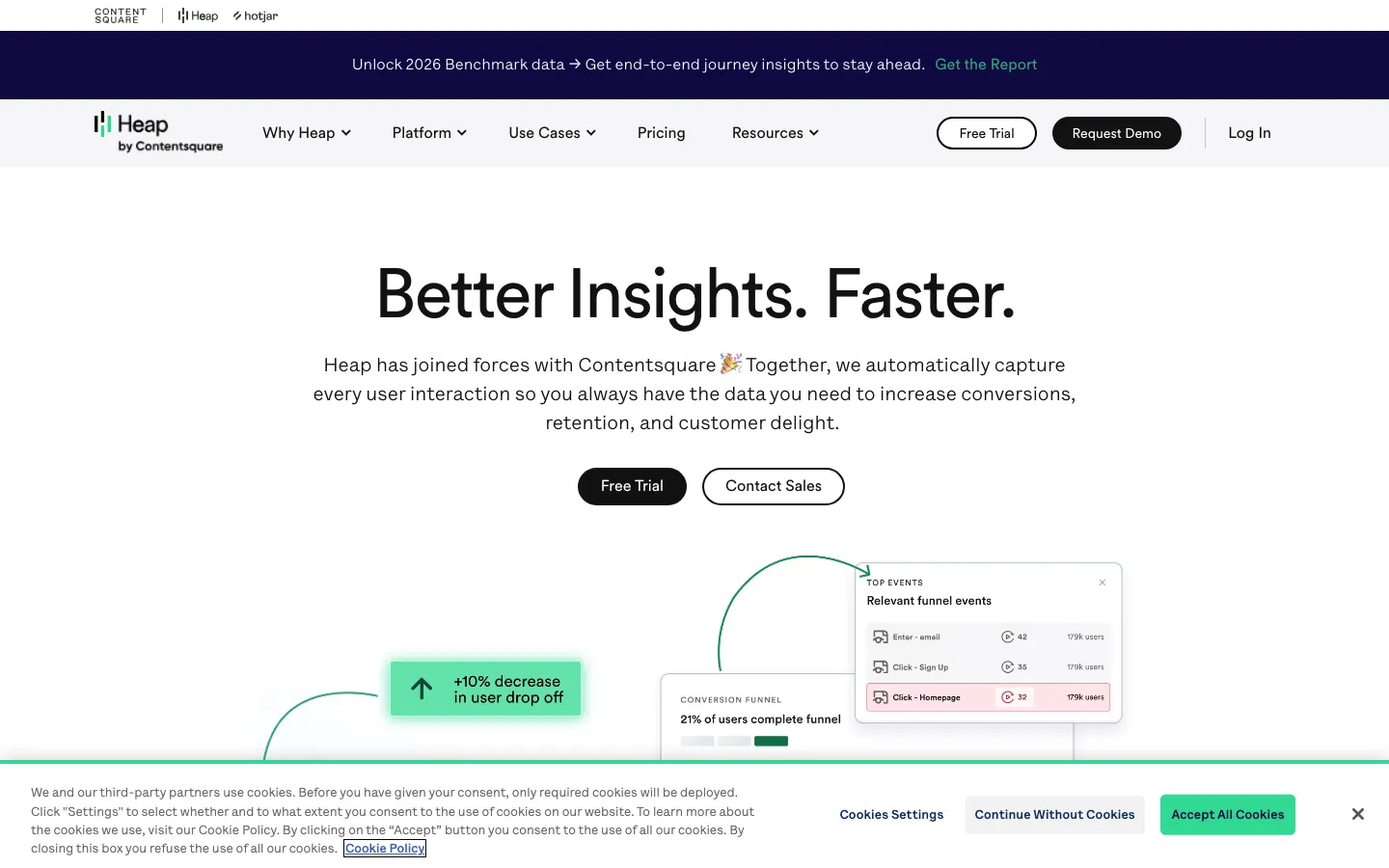
Screenshots of Heap 3 images
What's great
- Autocapture records every click, form submission, and pageview retroactively; you can define events after the fact and query historic data without re-instrumentation
- Sense AI assistant (Growth tier) surfaces unexpected behavior patterns the team didn't think to query, the kind of drop-off that manual analysis often misses
- Contentsquare acquisition brings DXM (Digital Experience Monitoring) and heatmap capabilities into the same platform, reducing the number of tools teams need for qualitative analysis
Watch-outs
- Autocapture data is inherently noisier than intentional instrumentation; analysts spend meaningful time filtering out noise before getting to signal
- Growth, Pro, and Premier tier pricing is not publicly listed; teams report wide variation in quotes, and the free tier caps at 10K sessions per month, which is tight for any product past the first few months
- The Contentsquare integration is still maturing; some features exist on one platform and not the other, and the combined roadmap is not fully public
Heap is the pick for product teams that ship fast and don’t want event-tracking decisions to bottleneck product development. The retroactive event definition is the real differentiator; because autocapture records everything, you can define events against historic data without touching a single line of instrumentation code.
1,089 G2 reviews average 4.4/5.
Contentsquare completed the acquisition of Heap in December 2023 , and the combined platform is increasingly the right call for ecommerce and B2C products where session context and click behavior matter as much as funnel metrics.
Skip Heap if your team has strong event-tracking discipline and wants clean data from day one; Amplitude or Mixpanel gives you that structure. Use Heap if you want to ship first and instrument later.
Pricing breakdown
| Plan | Price | Best for |
|---|---|---|
| Free | $0 | Up to 10K sessions/mo |
| Growth | Custom | Startups scaling past 10K sessions/mo |
| Pro | Custom | Account analytics |
| Premier | Custom | Enterprise |
Loading reviews…
LogRocket
Best session replay with frontend error tracking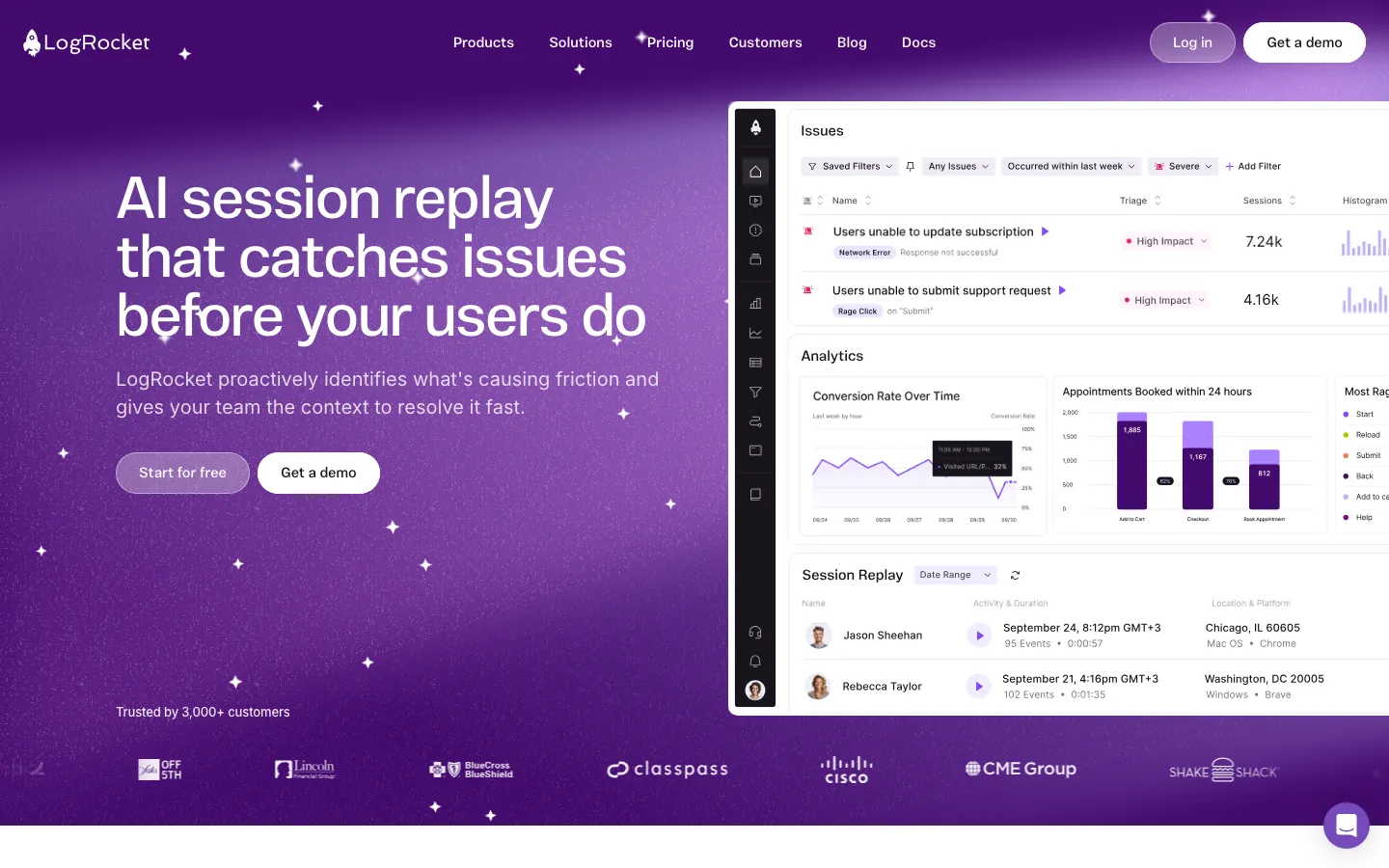
Screenshots of LogRocket 3 images
What's great
- Uniquely links frontend JavaScript errors and performance degradations to the exact user sessions where they occurred; no other tool in this comparison does this as cleanly
- AI-powered issue detection (Galileo) surfaces high-impact bugs automatically, ranked by user impact percentage, before engineering triages them manually
- 4.6/5 on G2 across 2,305 reviews, the highest single-product G2 rating in this guide, with consistent praise for "catching bugs my team didn't know existed"
Watch-outs
- Session-based pricing model means the bill scales with user count; a product with 500K MAUs and 2M monthly sessions can push Team plan costs well past $500/month
- Pure product analytics depth (retention curves, cohort analysis, event funnels) is less mature than Amplitude or Mixpanel; LogRocket is a session and error tool that added analytics, not the reverse
- Professional plan at $295/month requires annual commitment; the free tier at 1K sessions/month is genuinely limited for any post-launch product
Pricing breakdown
| Plan | Price | Best for |
|---|---|---|
| Free | $0 | Up to 1K sessions/mo |
| Team | $69/mo | 10K-25K sessions/mo |
| Professional | $295/mo | AI issue detection |
| Enterprise | Custom | 1M+ sessions/mo |
Loading reviews…
FullStory
Best digital experience intelligence for enterprise teams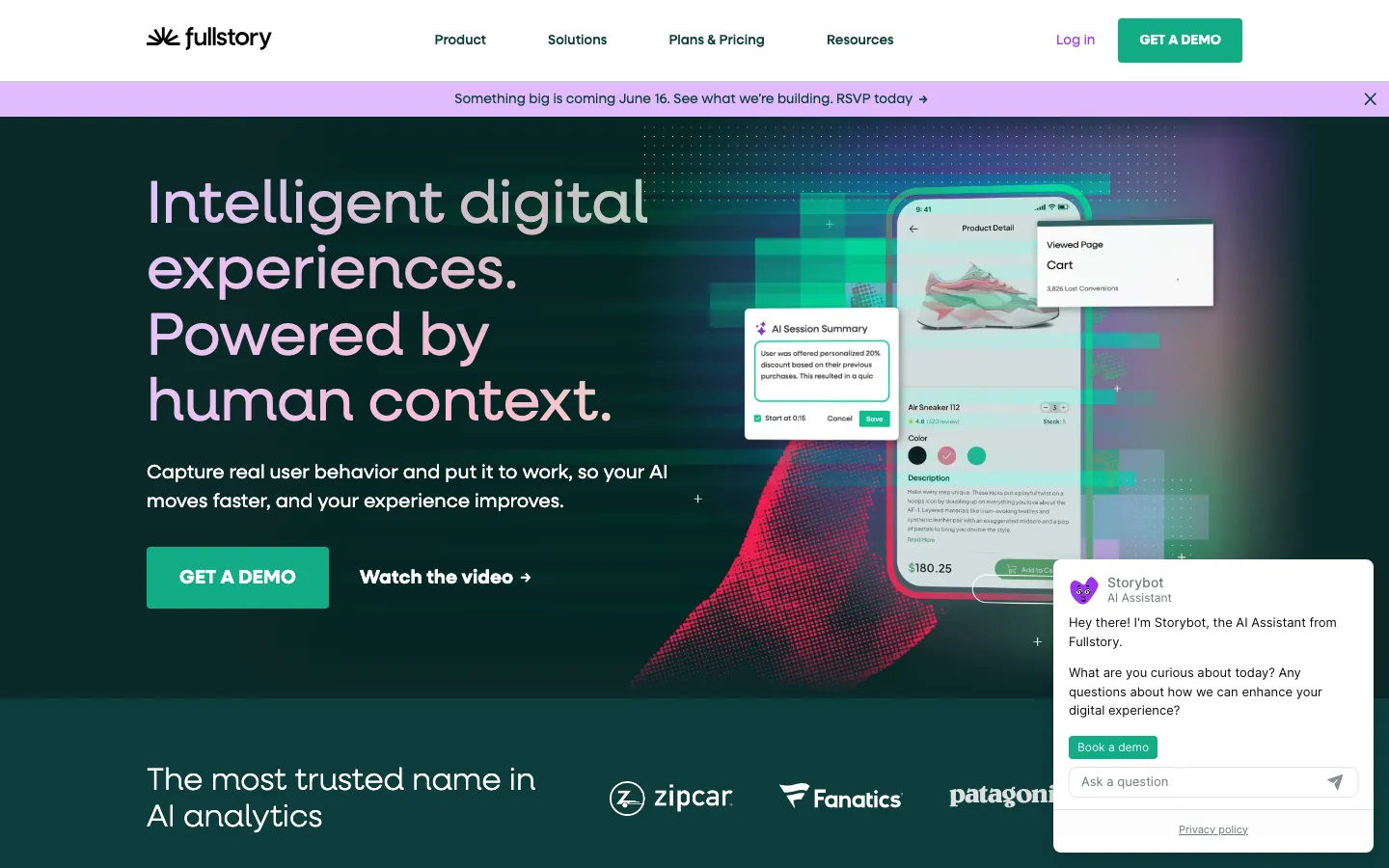
Screenshots of FullStory 3 images
What's great
- Most generous free tier in the session replay bucket: 30K sessions/month with 12 months data retention, no credit card required
- DX Data API exports behavioral signals (click rage, error clicks, dead clicks) directly to data warehouses, enabling ML teams to build churn prediction models on top of behavioral data
- Enterprise clients including Patagonia and Fanatics (visible on the homepage) signal it holds up at ecommerce scale with complex session volumes
Watch-outs
- Enterprise contracts run $80K-$105K/year at mid-market scale based on Vendr benchmark data; the entry point for paid tiers is steep
- Product analytics features are weaker than Amplitude or Mixpanel; FullStory is a session intelligence platform that added analytics, not a native analytics product
- Setup requires a meaningful JavaScript tagging effort for full event capture; less autocapture breadth than Heap
FullStory sits in the digital experience intelligence (DXI) category rather than pure product analytics. The FullStory DX Data API is the 2026 differentiator: enterprise data science teams use it to feed behavioral signals into downstream ML models in a way that Hotjar or Heap cannot match.
1,047 G2 reviews average 4.5/5. Vendr contract data shows most paid contracts landing between $27,500 and $105,630 annually; the free 30K-session tier is genuinely useful for small teams before they need a sales conversation.
Skip FullStory for pure funnel analytics; buy it when you need enterprise-grade session intelligence with a clean data export story for your ML platform.
Pricing breakdown
| Plan | Price | Best for |
|---|---|---|
| Free | $0 | Up to 30K sessions/mo |
| Business | Custom | Product analytics plus session intelligence |
| Advanced | Custom | Trend discovery |
| Enterprise | Custom | Data science teams |
Loading reviews…
Hotjar
Best heatmaps and user feedback for early-stage web products
Screenshots of Hotjar 3 images
What's great
- Heatmaps (click, scroll, move) are the best visual-feedback layer for landing page and onboarding optimization; non-technical stakeholders understand them immediately
- Free tier covers 35 sessions/day with heatmaps and basic recordings; useful for early-stage web products without a dedicated analytics budget
- NPS and on-page surveys built in at the Plus tier, giving qualitative context alongside quantitative session data
Watch-outs
- Now part of Contentsquare, which means the pricing page redirects to Contentsquare; the standalone Hotjar heatmap product is being absorbed into a broader enterprise platform
- Session replay depth is meaningfully weaker than LogRocket or FullStory; error linking and JavaScript performance monitoring are not in scope
- The 4.3/5 G2 rating across only 335 reviews is the lowest in this guide; the user base is large (1.3M+ websites) but the G2 representation suggests users are less likely to actively advocate for it
Hotjar is the right first tool for a team that wants to understand where users are clicking on a landing page or where they’re dropping out of an onboarding flow, without setting up a full analytics platform. 335 G2 reviews average 4.3/5.
The Hotjar acquisition by Contentsquare is the key 2026 context; the standalone product continues to operate, but the Contentsquare platform strategy explains how Hotjar, Heap, and Contentsquare are converging into one enterprise DXM platform.
For teams that need session replay depth, error tracking, or event-based behavioral analytics, step up to LogRocket, PostHog, or Amplitude. Hotjar is the entry-point tool, useful for as long as heatmaps and basic recordings answer the questions you’re asking.
Pricing breakdown
| Plan | Price | Best for |
|---|---|---|
| Free | $0 | 35 sessions/day |
| Plus | $39/mo | 100 sessions/day |
| Business | $99/mo | 500 sessions/day |
| Scale | Custom | 500+ sessions/day |
Loading reviews…
Tools we considered but excluded
We evaluated more tools than the 8 you see above. These did not make the cut. Saying what we rejected, and why, is the editorial muscle most listicles skip.
- June.so: Joined Amplitude in August 2025; standalone product is on end-of-life path and new accounts are not recommended
- Smartlook: Reached End of Sale on May 31, 2026 after Cisco acquisition; no new accounts accepted and no new features shipping
- Glassbox: Enterprise-only pricing (no free tier, minimum $80K/yr contracts) makes it out of scope for most readers of this guide
- Mouseflow: Strong heatmap tool for marketing teams but lacks the event-tracking depth and retention analysis needed for a product analytics shortlist
- Contentsquare: The parent platform of Heap and Hotjar; enterprise-only with no transparent pricing, suits large ecommerce brands not PLG or B2B SaaS teams
Honorable mentions
Solid tools that did not crack the main list but are worth tracking, especially for niche use cases.
- Segment (Twilio): The best customer data infrastructure layer for teams that want to instrument once and route events to Amplitude, Mixpanel, or a warehouse; not a standalone analytics platform but worth knowing
- Sprig: Best in-class for continuous product discovery surveys embedded inside the product; pairs well with Amplitude or PostHog for teams running weekly user research
- Statsig: Purpose-built experimentation platform now folded into Amplitude, which took over the Statsig brand and customers in May 2026 (the founding team left for OpenAI); evaluate it as Amplitude's experimentation layer, and weigh the acquisition context before signing a new standalone Statsig contract
The four buckets of product analytics tools
The product analytics market splits into four practical buckets that marketers, PMs, and engineers often confuse with each other. This guide tests across all four, so the right pick depends on what your team actually needs to know.
Behavioral event analytics. The core funnel and retention engine. Amplitude, Mixpanel, PostHog. Every product team past the spreadsheet era needs one of these. They answer “what did users do, in what order, how many of them, and did they come back?”
Autocapture analytics. Heap by Contentsquare sits here. You drop in a script tag and every click, pageview, and form submission is captured retroactively, with no upfront event taxonomy required. The trade-off is data noise.
Session replay and digital experience intelligence. LogRocket, FullStory, Hotjar. These tools record user sessions as videos and overlay behavioral signals like rage clicks, dead clicks, and error clicks. They answer “why did the user drop off” with a literal recording, not just a funnel number.
All-in-one platforms. PostHog and Pendo. PostHog bundles analytics, session replay, feature flags, experiments, and error tracking under one bill. Pendo bundles analytics with in-app guides and NPS surveys, specifically designed for B2B SaaS retention and adoption workflows.
The eight tools above cover all four buckets. The choice between them comes down to team composition (PMs vs engineers), data posture (SaaS cloud vs self-hosted), and whether the primary question is “what are users doing” or “why is a feature not converting.” None of them replace a business intelligence platform ; product analytics answers behavioral questions, while BI tools model revenue, finance, and blended company metrics off the warehouse.
Where the eight product analytics tools differ on core features
| Tool | Free tier | Autocapture | Session replay | Feature flags | Warehouse-native |
|---|---|---|---|---|---|
| Amplitude | 10K MTUs | • (limited) | $ add-on | $ (Statsig) | ✓ Growth+ |
| PostHog | 1M events | ✓ | ✓ | ✓ | ✓ |
| Pendo | 500 MAUs | ✓ | $ Core+ | ✗ | ✗ |
| Mixpanel | 1M events | ✗ | ✓ (20K/mo) | ✓ (2025+) | ✗ |
| Heap | 10K sessions | ✓ | $ Pro+ | ✗ | $ Premier |
| LogRocket | 1K sessions | ✓ | ✓ | ✗ | ✗ |
| FullStory | 30K sessions | ✓ | ✓ | ✗ | ✓ API |
| Hotjar | 35 sessions/day | ✓ | ✓ | ✗ | ✗ |
PostHog is the only tool that ships a complete stack (analytics, replay, flags, experiments) without a paid add-on. Amplitude covers the most ground for warehouse-native analytics but requires a paid tier and its Statsig-based experiment layer for experiments. FullStory’s free tier is the most generous in the session replay bucket at 30K sessions per month.
Product analytics data governance and security, tool by tool
| Tool | SOC 2 Type II | GDPR | HIPAA | SSO/SAML | Audit logs |
|---|---|---|---|---|---|
| Amplitude | ✓ | ✓ | $ BAA available | Enterprise | Enterprise |
| PostHog | ✓ (cloud) | ✓ | $ BAA (Cloud, Boost+) | Teams+ | ✓ |
| Pendo | ✓ | ✓ | $ BAA | Core+ | Ultimate |
| Mixpanel | ✓ | ✓ | $ BAA (Enterprise) | Enterprise | Enterprise |
| Heap | ✓ | ✓ | $ BAA | Pro+ | Pro+ |
| LogRocket | ✓ | ✓ | ✗ | Enterprise | Enterprise |
| FullStory | ✓ | ✓ | ✓ | Business+ | Business+ |
| Hotjar | ✓ | ✓ | ✗ | Scale | ✗ |
PostHog offers a HIPAA BAA on PostHog Cloud (Boost, Scale, or Enterprise package); its own docs steer regulated teams to Cloud under a BAA, not the self-hosted build. FullStory’s BAA is available without moving to Enterprise, which is why it shows up in regulated ecommerce and financial services stacks.
Mixpanel and Heap both sign a BAA too (Mixpanel on Enterprise, Heap via sales), so the more common evaluation mistake is assuming these tools have no HIPAA path at all when the gating is really a tier and a contract.
Integration depth across the product analytics stack
| Tool | Segment CDP | Slack alerts | dbt/warehouse | GitHub/Linear | Zapier |
|---|---|---|---|---|---|
| Amplitude | N | N | N | N | N |
| PostHog | N | N | N | N | N |
| Pendo | N | N | M | M | M |
| Mixpanel | N | N | N | M | N |
| Heap | N | N | $ Premier | M | M |
| LogRocket | N | N | M | N | N |
| FullStory | N | N | N (DX API) | M | M |
| Hotjar | N | ✗ | ✗ | ✗ | N |
N = native/first-party. M = marketplace or third-party. $ = paid add-on. ✗ = no path.
Amplitude and PostHog have the broadest native integration coverage. The Segment CDP integration is the critical one for teams with complex multi-source instrumentation; every tool in this list except Hotjar supports it natively. PostHog’s dbt and warehouse connectors are the most capable for teams running a modern data stack.
Event taxonomy planning
This section is here because it is the single largest reason product analytics deployments fail. The pattern is consistent: teams that spend two weeks on taxonomy planning before touching an SDK ship useful analysis within 30 days. Teams that skip it spend months cleaning up event noise.
What an event taxonomy actually is. It is a written spec of every event your product will track, the properties attached to each event, the naming conventions, and the business question each event answers. It is a Google Doc or Notion page, not a piece of software. Amplitude and Mixpanel both publish taxonomy templates; PostHog has a community guide. None of them will write it for you.
The five naming decisions you must make before day one. First, casing convention: button_clicked (snake case) or ButtonClicked (Pascal case) or button-clicked (kebab). Pick one and never break it. Second, verb tense: User Signed Up or User Sign Up or signup_completed.
Third, object-first or action-first: Profile Updated vs Updated Profile. Fourth, whether to include product area prefix: Onboarding Completed vs Completed. Fifth, how to handle anonymous vs identified user events and whether to alias at signup or merge retroactively.
The four events every SaaS product must instrument first. Sign up (or account created). Activation event (the “aha moment” action specific to your product). Core value event (the action that drives retention). Upgrade or conversion event. Everything else is secondary. Teams that try to instrument 200 events in month one end up with 200 events none of which they trust.
Autocapture does not solve the taxonomy problem. Heap’s autocapture is genuinely useful for exploratory work. But the moment you need a retention curve on “activated users who completed at least two core value events in the first 14 days,” you need intentional events with clean properties. Autocapture gives you raw signal. Taxonomy gives you the analysis framework.
The retroactive fix is expensive. If you instrument badly and realize it at month four, the options are: accept dirty data in historical analysis, re-instrument and lose continuity, or spend two to four engineering weeks on a data cleaning project. The two weeks of upfront planning are not optional work.
Self-hosted vs SaaS tradeoffs
PostHog is the reason this section exists in a product analytics guide in 2026. The self-hosted option changes the build vs buy calculus for a specific slice of the market.
Who actually benefits from self-hosting. Three company profiles. Fintech and healthcare companies with strict data-residency rules where behavioral data simply cannot leave their own infrastructure (note that for HIPAA itself, PostHog’s recommended path is Cloud under a BAA, not self-hosting; residency is the real self-hosting driver). Companies operating in EU jurisdictions where Schrems II compliance for third-party US data processors creates legal risk.
Enterprise products where a SaaS analytics contract would represent $150K+ in annual spend and a platform engineering team already manages Kubernetes infrastructure.
What self-hosting actually costs. PostHog’s self-hosted stack runs on ClickHouse (analytical queries), Kafka (event ingestion), and PostgreSQL (metadata). A production-grade deployment for a product pushing 50M events monthly needs approximately three nodes (2x 8-core, 1x 16-core) plus managed storage.
At AWS or GCP on-demand pricing that’s roughly $1,800-$3,200/month in infrastructure. A dedicated platform engineer spends 4-6 hours per week on maintenance, upgrades, and scaling. Factor in that engineer cost before comparing to a $2,400/month Amplitude Growth contract.
The compliance advantage is real but narrow. Read PostHog’s own HIPAA guidance before you assume self-hosting is the regulated-industry answer. PostHog signs a BAA only for PostHog Cloud on the Boost, Scale, or Enterprise package, and it explicitly recommends Cloud under a BAA over the legacy self-hosted build for HIPAA workloads.
The genuine self-hosting advantage is data residency: behavioral data can stay inside your own VPC, which matters for EU data-residency and air-gapped requirements. For teams outside regulated industries, the compliance argument for self-hosting mostly disappears.
The SaaS case for most teams. If your data volume is under 100M events monthly and you don’t operate in a regulated industry, the operational overhead of self-hosting is not worth the cost savings. PostHog Cloud’s graduated pricing (starting at $0.00005/event and dropping with volume) puts 50M events at roughly $1,500/month.
The infrastructure and engineering cost of self-hosting at that volume is in the same ballpark, so the SaaS bill rarely loses on pure cost. The free 1M events/month tier on PostHog Cloud covers most early-stage products entirely.
How to choose the right product analytics platform for your team
Five questions, in order. Answer them and the shortlist collapses to two or three real options.
1. Who runs the analytics workflow day to day
- Product managers without SQL access. Mixpanel is the tightest fit. The report builder lets non-technical PMs build funnels and retention curves independently without filing data requests.
- Engineers and data engineers. PostHog’s SDK-first design and warehouse connectors are built for this workflow. Amplitude Growth’s warehouse-native SQL is also strong here.
- A dedicated data or analytics team. Amplitude Enterprise or PostHog Teams. The warehouse-native query layer and permissioning structure are built for multi-team analytics orgs.
- CS and product managers jointly. Pendo. The in-app guide layer and account-level analytics are designed for B2B SaaS teams where CS and product both act on the same user data.
2. Compliance requirements that limit SaaS cloud options
HIPAA: PostHog Cloud (BAA on Boost+ tier), FullStory, Mixpanel Enterprise, or Heap all sign a BAA; line up the BAA tier and contract before you commit, and note that Heap’s parent Contentsquare does not sign one even though Heap the product does. PCI: Amplitude and FullStory support it; verify with your security team before committing.
SOC 2 Type II as a vendor requirement: every tool in this guide covers it at the appropriate tier. EU data residency: PostHog self-hosted or PostHog Cloud EU region.
3. Event volume, today and in 18 months
Model 5x growth from today. A product pushing 5M events monthly should plan for 25M. At 25M events monthly, Mixpanel costs roughly $6,500/month on the Growth tier before volume discounts. PostHog Cloud’s graduated event pricing lands around $800/month at that volume.
Amplitude’s Growth tier at that MTU count is typically $4,000-$8,000/month depending on anonymous vs identified user ratio. The pricing math is not intuitive until you run the model.
4. Session replay in the same platform
If yes: PostHog (bundled), LogRocket (best-in-class for error-linked sessions), FullStory (best for enterprise DXI), or Heap (best autocapture with replay available at Pro tier). If session replay is a separate decision from event analytics, buying them independently often produces a better outcome.
Amplitude plus LogRocket is a common stack for engineering-heavy B2B SaaS teams.
5. The weight of feature flagging and experimentation
If experiments are central to the product development workflow, PostHog has the tightest native integration between feature flags, experiments, and analytics. Amplitude’s May 2026 takeover of the Statsig brand and customer base is the 2026 answer for teams already on Amplitude, now that the experimentation layer is in-house.
Mixpanel added feature flags in late 2025 and the integration is functional but newer.
For teams running 10+ concurrent experiments, a dedicated experimentation platform (LaunchDarkly, or Statsig now under Amplitude) paired with any analytics tool is often better than the bundled option.
Rolling out product analytics without poisoning your data
A four-phase rollout pattern that holds up across team sizes.
Phase 1 (weeks 1-2): Taxonomy first, SDK second. Write the taxonomy doc before any engineer touches the SDK. Define the five core events, their properties, the naming conventions, and the business question each event answers. Have the PM, a senior engineer, and the data lead all sign off on the naming convention. Changing event names after production instrumentation is a multi-week cleanup project.
Phase 2 (weeks 3-4): Instrument the four critical events, no more. Sign up, activation, core value event, and conversion. Get these right and queryable before adding any secondary events. Run the funnel analysis on these four events end-to-end with real data. This is the validation gate: if the funnel analysis doesn’t make sense, the problem is in the taxonomy or the instrumentation, and you need to fix it before expanding.
Phase 3 (weeks 5-8): Expand instrumentation and build the first three dashboards. Add secondary events (feature adoption, settings changed, notifications interacted with). Build the three dashboards the team will review weekly: activation funnel, 14-day retention curve, and top feature adoption by cohort. Socialize these dashboards with the team; adoption of the analytics tool starts here.
Phase 4 (weeks 9-12): Lock the schema and connect to the warehouse. Once instrumentation is stable, add the data warehouse export. This is when behavioral data starts joining with revenue from your subscription billing platform , support ticket, and CRM data for full customer journey analysis.
Lock the event schema; every new event from this point goes through the same taxonomy review process. Teams that keep adding ad-hoc events past month four end up with 200+ events most of which nobody trusts.
What’s changing in product analytics software in 2026
Warehouse-native analytics is becoming a table-stakes requirement for enterprise teams. Amplitude Growth’s SQL-on-Snowflake/BigQuery capability, launched in 2025 and maturing in 2026, is pulling data teams away from moving events out of the warehouse and into a separate analytics database.
The model of “events live in the warehouse, analytics queries run on top of them” is now viable at production scale. Mixpanel and PostHog both have warehouse sync but not the same native query layer; this is Amplitude’s strongest 2026 differentiator.
PostHog’s breadth is compressing the multi-tool product stack. In 2023, the typical early-stage product analytics stack was Mixpanel plus LaunchDarkly plus Hotjar. By 2026, a meaningful number of teams have consolidated onto PostHog alone. The pricing math (free tier covers most early-stage products) and the breadth (analytics plus flags plus replay plus experiments) make the single-platform argument genuinely compelling, not just a vendor talking point.
Contentsquare is absorbing both Heap and Hotjar into an enterprise DXM platform. The strategy is clear: Heap’s autocapture plus Hotjar’s heatmaps plus Contentsquare’s digital experience monitoring equals an enterprise DXM platform that competes with FullStory and Glassbox. The transition is mid-execution in 2026; both standalone products continue to operate but the roadmap is increasingly shaped by the parent company’s enterprise priorities.
AI-generated insights are showing up in every platform but useful ones are rare. Amplitude’s Ask Amplitude natural-language query feature, LogRocket’s Galileo AI issue detection, and Heap’s Sense assistant all shipped in the last 18 months. Of the three, Galileo is the most production-ready: it accurately surfaces high-impact frontend errors ranked by user impact.
Ask Amplitude is useful for simple queries but falls short on complex cohort analysis. The AI features are worth testing but not worth paying a tier premium for in 2026.
June.so’s acquisition by Amplitude in August 2025 is the consolidation signal. June was the cleanest B2B SaaS-native analytics tool; account-level metrics out of the box, built-in workspace activation tracking, CRM-connected product signals. Amplitude acquired it to accelerate the B2B analytics roadmap.
Existing June customers are on a migration path to Amplitude’s B2B analytics features; new teams should evaluate Amplitude or Pendo for the account-level analytics use case rather than starting on June.
What product analytics really costs once event volume climbs
| Team profile | Tool | Listed price | Real all-in (year 1) |
|---|---|---|---|
| Early-stage, <10K MAUs | PostHog Cloud | $0 | $0 |
| Early-stage, <1M events | Mixpanel Free | $0 | $0 |
| Series A, 50K MAUs | Amplitude Plus | $49/mo | $600-$1,200 |
| Series A, 5M events/mo | Mixpanel Growth | ~$1,000/mo | $10,000-$15,000 |
| Series B, 300K MTUs | Amplitude Growth | Custom | $25,000-$55,000 |
| Series B, B2B SaaS | Pendo Core | Custom | $20,000-$45,000 |
| Mid-market, 2M sessions | LogRocket Professional | $295/mo | $6,000-$15,000 |
| Enterprise, DXI | FullStory Business | Custom | $30,000-$105,000 |
The biggest forecast error we see: teams model their current event volume and forget to account for a 5-10x growth year. Amplitude’s MTU pricing is the most aggressive in this regard; a 3x MAU growth quarter without a volume cap negotiated upfront can triple the monthly bill in 90 days.
Negotiate a cap on MTU overages before signing any Amplitude Growth or Enterprise contract.
The right product analytics tool for each company stage
- Pre-seed, building the first product: PostHog Cloud free tier. One SDK install, analytics plus session replay plus feature flags, zero cost until you scale.
- Seed, under 1M events/month, PM-led analytics: Mixpanel Free tier. The self-serve funnel and retention builder is the fastest path to weekly product reviews.
- Seed to Series A, engineering-led team: PostHog Cloud pay-as-you-go. The breadth and developer experience are the best in this guide; cost is near zero until substantial scale.
- Series A, 50K-300K MAUs, growing fast: Amplitude Plus or Growth. The behavioral analytics depth starts paying back here, especially if a data team is on board.
- Series A/B, B2B SaaS with 500+ accounts: Pendo Core or Amplitude with B2B account analytics. The account-level view is not optional once CS teams need to act on expansion signals.
- Series B+, compliance requirement (HIPAA/PCI): PostHog Cloud (BAA on Boost+) or FullStory with BAA. Both solve the compliance case; PostHog is cheaper, FullStory is easier to operate. Pick self-hosting only when data residency, not the BAA, is the driver.
- Series B+, engineering team, error tracking priority: LogRocket Professional plus Amplitude. The pairing covers session debugging and deep behavioral analytics without one tool trying to do both.
- Mid-market, ecommerce/B2C, high session volume: FullStory or Heap by Contentsquare. The autocapture and DXI story is built for this use case.
- Enterprise, data science team, ML pipelines: FullStory (DX Data API) or Amplitude Enterprise (warehouse-native SQL). Both export clean behavioral signals to downstream models.
- Already running a Contentsquare contract: Heap or Hotjar are likely in your bundle already; check before buying a separate analytics tool.
For corrections, vendor pricing disputes, or methodology feedback, email hello@topickz.com . We re-verify the full shortlist every six months; the next refresh ships in November 2026.
Frequently asked questions
Amplitude vs Mixpanel in 2026, which one wins?
Amplitude for warehouse-native SQL and enterprise scale. Mixpanel for PM self-service. Under 5M events/mo, Mixpanel is the easier start.
Is PostHog actually production-ready for enterprise products?
Yes. Cloud tier handles any volume. Self-hosted requires a platform engineer. Over 1,000 G2 reviews confirm it at scale including compliance-sensitive orgs.
How much does Amplitude actually cost at 500K MAUs?
Expect $4,000-$8,000/mo on Growth tier at 500K MTUs. Use the MTU calculator on amplitude.com and negotiate an overage cap before signing.
What's the difference between session replay and product analytics?
Product analytics tracks events and funnels. Session replay records the user journey as video. Most teams need both past 10K MAUs.
Do we need both product analytics and session replay?
Most teams with 10K+ MAUs benefit from both. PostHog and LogRocket bundle them. Amplitude and Mixpanel pair with Hotjar or FullStory as add-ons.
What's the most common product analytics mistake teams make?
Skipping event taxonomy planning before instrumenting. Bad taxonomy means 6 months of data you can't trust. Build the taxonomy doc before touching the SDK.
Can product analytics tools replace a data warehouse?
No. They handle behavioral event data. Revenue, support, and CRM data live in the warehouse. Most teams add a warehouse around Series A or 100K+ MAUs.
Is Heap or Amplitude better for autocapture?
Heap. Its autocapture retroactively defines events on historic data. Amplitude added autocapture in 2024 but it is less mature. Heap's is still the benchmark.
How long does product analytics implementation take?
With clean event taxonomy: 2-4 weeks. Without one: 3-6 months. PostHog and Mixpanel SDKs onboard in a day; the taxonomy is the long pole.
When should we switch product analytics platforms?
Three triggers: query limits eat 30% of analyst time, event costs double without volume doubling, or warehouse-native SQL is a hard requirement.
Related helpful reads
Write a review
Posts to the page right away. Keep it real — no links or email addresses.