
Comparing the best OKR Software of 2026 includes 1. Profit.co 2. Lattice Goals 3. OKRs Tool 4. 15Five 5. Perdoo 6. Mooncamp 7. Betterworks 8. Cascade Strategy.
TL;DR
- Profit.co: Best overall for OKR-first execution. The AI coaching layer flags which objectives are running behind and suggests a fix, so you catch drift before the quarter-end retrospective does.
- Lattice Goals: Best for teams where OKRs and performance reviews share one record. It is the only pick here that lets a manager click straight from an OKR check-in into a review comment, and its 4,060 G2 reviews are the highest count in the category.
- 15Five: Best for keeping OKRs alive between quarters. The weekly check-in wraps a 5-minute KR update into the same flow as manager 1-on-1 prep, so updates become a habit rather than a quarterly fire drill. Perform runs $11/user/mo.
- OKRs Tool: Best value for teams that refuse to pay per seat. Flat pricing at $49/mo up to 50 users beats the per-seat tools on year-one cost, and the 60% adoption-or-refund guarantee is the only money-back adoption promise here.
- Mooncamp: Best for teams deploying OKRs for the first time. Its 4.8/5 across 296 G2 reviews is the highest satisfaction score in this group, and the onboarding is fast enough to build a first OKR tree before the demo call ends.
- Betterworks: Best enterprise OKR governance for companies past 500 employees. Calibration workflows, manager alignment trees, and native Workday and ADP sync handle the matrixed complexity that the lighter tools cannot.
Eight OKR platforms compared on alignment depth, check-in cadence, AI coaching, pricing, and adoption. What drives real alignment, what just produces quarterly dashboards, and which tools survive where most OKR programs actually die, the third cycle.
What Is OKR software?
OKR software helps companies set, align, and track objectives and key results, connecting strategy to daily work so teams stay focused on measurable outcomes.
Tools like Profit.co, Lattice Goals, OKRs Tool, and 15Five differ on simplicity, performance-management features, and price across team sizes.
Best OKR Software comparison: features, pricing and verdicts
| Tool | Best for | Starting price | Free trial | External rating |
|---|---|---|---|---|
Best overall for OKR-first execution across 50-2000 employees | Custom quote | 14-day free trial | G2 4.7/5 (896 reviews) | |
Best for teams where OKRs and performance reviews share the same record | $8/seat/mo | Demo only | G2 4.7/5 (4,060 reviews) | |
Best value for 50-200 person teams who refuse to pay per seat | $49/mo | Free up to 5 users | G2 4.6/5 (7 reviews) | |
Best for keeping OKRs alive between quarters with weekly check-in cadence | $11/user/mo | 14-day free trial | G2 4.6/5 (1,902 reviews) | |
Best pure-play OKR tool for mid-market teams who want depth without platform overhead | €8/user/mo | Free tier (up to 5 users) | G2 4.6/5 (312 reviews) | |
Best for teams deploying OKRs for the first time, fastest time to first cycle | €7/user/mo | 14-day free trial | G2 4.8/5 (296 reviews) | |
Best enterprise OKR governance for companies past 500 employees | Custom (500-employee minimum) | Demo only | G2 4.3/5 (215 reviews) | |
Best for strategy-execution teams who need OKRs connected to strategic plans | Custom quote | 14-day free trial | G2 4.8/5 (236 reviews) |
How we chose these tools
We compared these platforms on alignment-tree depth, check-in cadence, AI coaching, manager adoption signals, reporting and admin features, integrations, and total cost. The assessment draws on documented product capabilities, recurring themes across real G2 and Capterra reviews, and vendor pricing pages. Pricing was verified directly on vendor sites in May 2026. All G2 ratings cited were pulled on May 28, 2026.
How we weight okr software for the Topickz score
Every tool above is scored against the fixed rubric below and combined using these weights into the Topickz score on each card. The weights are set for okr software specifically, they are not copied from another category, and we publish them so you can see what moved a ranking and re-weight for your own priorities.
| Criterion | Weight | What we checked |
|---|---|---|
| Alignment | 20% | Whether the tool cascades company objectives down to team and individual OKRs, and how honestly the alignment tree exposes dependencies and orphaned goals nobody owns. |
| Ease of adoption | 15% | Time to a first live OKR tree, the admin setup burden, and whether managers keep using it past cycle one without constant nudging. |
| AI capabilities | 15% | Draft-OKR suggestions, drift and risk flags on objectives running behind, and the quality of coaching prompts, not just an AI badge on the pricing page. |
| Check-ins | 15% | The weekly or biweekly update flow, reminders, confidence scoring, and whether check-ins fold into existing 1-on-1s instead of adding a separate chore. |
| Reporting | 10% | Progress dashboards, leadership roll-up views, export options, and how much manual work a clean quarterly readout actually takes. |
| Integrations | 10% | Native links to Slack, Teams, Jira, and HRIS or SSO providers, and whether data syncs both ways or only fires a notification. |
| Pricing | 10% | Published per-seat or flat cost, the size of the jump between tiers, and the real year-one total for a mid-size team once onboarding is added. |
| Security | 5% | SOC 2 status, GDPR posture, SSO and role-based permissions, and admin control over who can see whose goals. |
| Total | 100% |
Read the full TopickZ.com testing methodology for how we run each test, score every criterion, and combine them into a single rating.
Detailed reviews
Profit.co
Best overall for OKR-first execution across 50-2000 employees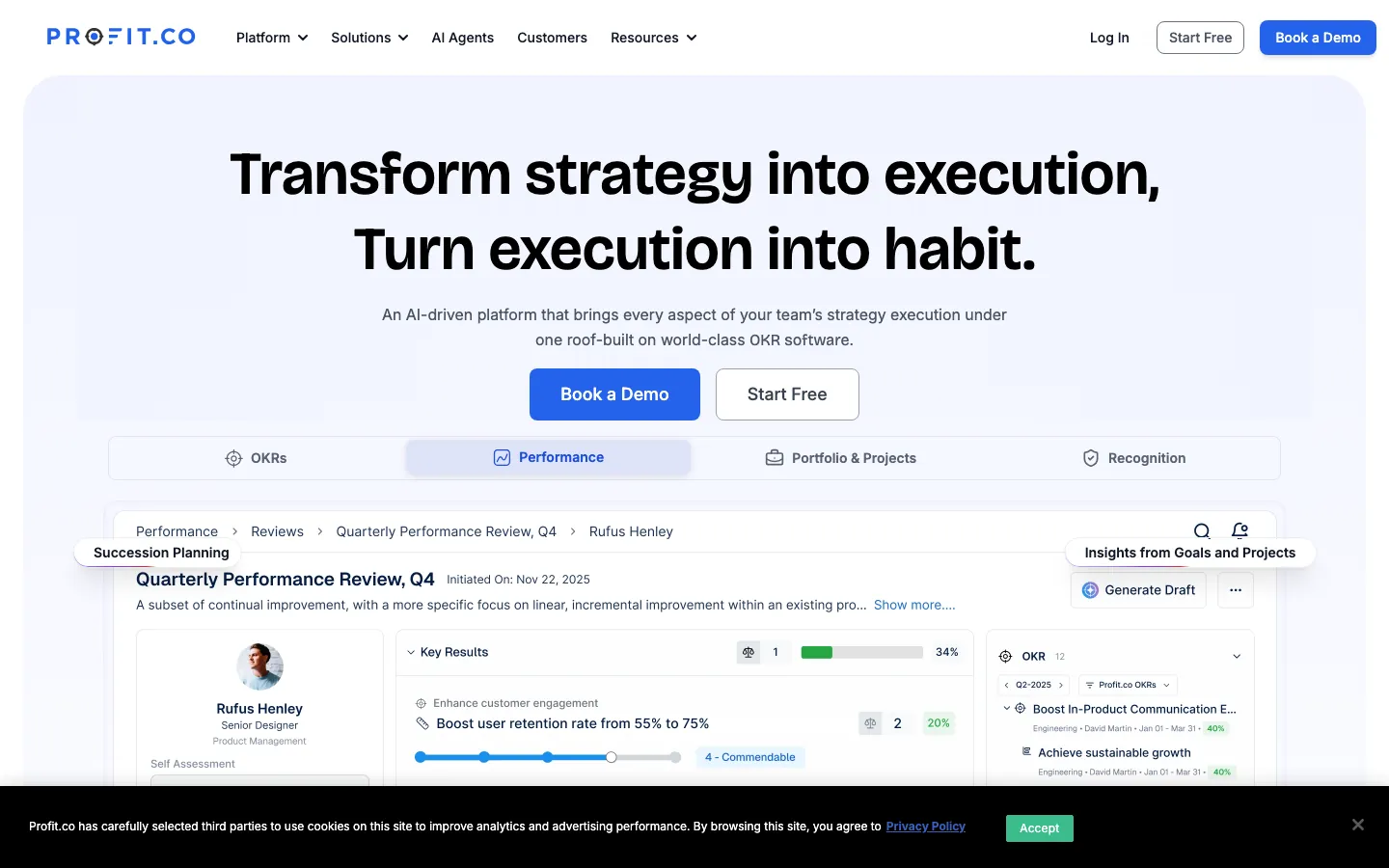
Screenshots of Profit.co 4 images
What's great
- G2 Leader badge in the OKR category for 18 consecutive quarters through the G2 Winter 2026 report, one of the longest active runs in the segment
- Built-in task management, project portfolio tracking, and 1-on-1 meeting modules at no extra per-module fee
- AI coaching layer surfaces OKR at-risk signals with specific suggested interventions, not just a red status flag
Watch-outs
- Pricing is custom-quote-only past the base tier; teams over 200 users report wide variation in annual costs
- Initial OKR setup for companies new to the framework takes 2-4 weeks to configure properly, notably longer than Mooncamp
- Mobile app lags the desktop experience; G2 reviews from early 2026 note it hasn't caught up to the web UI
Pricing breakdown
| Plan | Price | Best for |
|---|---|---|
| OKRs & Tasks | Custom quote | Under 50 users |
| Performance + Goals | Custom quote | 50-200 users |
| Portfolio + Scorecard | Custom quote | 200-500 users with performance and engagement |
| Enterprise | Custom quote | 500+ users |
Security & compliance
| Standard | Availability |
|---|---|
| SOC 2 Type II | Yes |
| GDPR | Yes |
| HIPAA | $ Enterprise |
| SSO / SAML | Growth+ |
| Audit logs | Scale+ |
Profit.co compliance summary: SOC 2 Type II is yes, GDPR is yes, HIPAA is $ enterprise, SSO/SAML is growth+, and audit logs is scale+.
Key integrations
| Integration | Type |
|---|---|
| Gmail | N/A |
| Outlook | N/A |
| Slack | Native integration |
| LinkedIn Sales Navigator | N/A |
| Outreach / Salesloft | N/A |
Profit.co integration summary: Gmail is not specified, Outlook is not specified, Slack is native integration, LinkedIn Sales Navigator is not specified, and Outreach or Salesloft is not specified.
Feature availability
| Feature | Status |
|---|---|
| Free tier | ✗ 14-day trial |
| AI coaching | ✓ Growth+ |
| Cascade | ✓ |
| Check ins | ✓ |
| Task management | ✓ |
Profit.co feature availability summary: Free tier (✗ 14-day trial), AI coaching (✓ Growth+), Cascade (✓), Check ins (✓), and Task management (✓).
What reviewers say about Profit.co
Recurring themes across ~476 G2 reviews (4.7/5) and Capterra reviews (4.8/5), 2024-2026.
What reviewers praise
- Reviewers credit the structured OKR onboarding flow for getting teams from signup to a first live objective cycle without hiring a consultant.
- The alignment view earns steady praise for cascading company objectives down to team and individual key results in one tree.
- Progress dashboards and weekly check-ins get called out for making goal status visible to leadership at a glance.
- Buyers repeatedly single out the implementation and customer success team as hands-on during the OKR rollout.
- Newer AI features for drafting objectives and summarizing check-in progress are mentioned as a genuine time saver.
What reviewers fault
- Teams new to the OKR framework report a real learning curve before the platform clicks.
- Initial setup and configuration is described as heavy, with a lot of upfront decisions before the tool feels useful.
- The performance-review and appraisal module is seen as less mature than dedicated HR performance tools.
- The sheer number of modules and settings can overwhelm smaller teams that only wanted OKR tracking.
- A few reviewers note the depth of reporting options takes time to learn to pull the view they actually need.
Loading reviews…
Lattice Goals
Best for teams where OKRs and performance reviews share the same record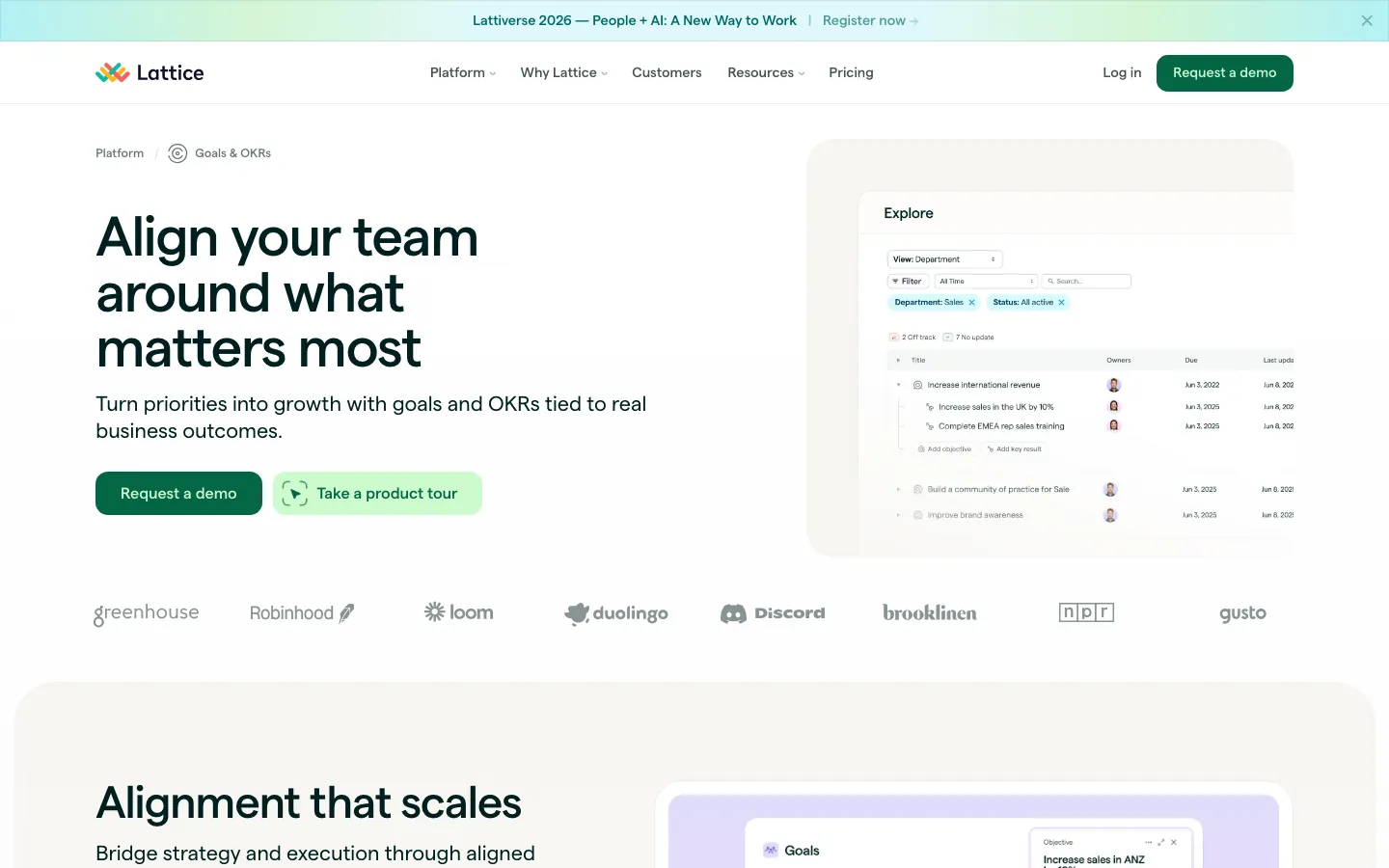
Screenshots of Lattice Goals 4 images
What's great
- Goals, performance reviews, engagement surveys, and 1-on-1s all on one data model; no integration friction between OKR and review cycles
- 4,060 G2 reviews at 4.7/5, the highest review count in the OKR category and among the highest in any HR software category
- Cascading goal visibility from company to team to IC in three clicks; most mid-market teams can build the full tree in a single half-day session
Watch-outs
- The Goals module is $8/seat/mo on top of the Performance base ($8/seat/mo), so a full deployment runs $16+ per user before Engagement or Compensation; minimum annual contract of $4,000 applies
- Standalone as an OKR tool (without the Performance layer) Lattice is outclassed by Profit.co and Perdoo on depth of KR tracking
- Pricing has a complexity wall; buyers consistently flag 'harder to buy than to use' in G2 reviews from Q1 2026
Pricing breakdown
| Plan | Price | Best for |
|---|---|---|
| Goals & OKRs only | $8/seat/mo | Teams that already have a separate perf tool |
| Performance + Goals | $16/seat/mo | Series B-C teams running full review cycles |
| Full Suite (Perf + Goals + Engage) | $20/seat/mo | HR-led orgs with 200-1000 employees |
| Enterprise | Custom quote | 1000+ with compensation and advanced analytics |
Security & compliance
| Standard | Availability |
|---|---|
| SOC 2 Type II | Yes |
| GDPR | Yes |
| HIPAA | No |
| SSO / SAML | All tiers |
| Audit logs | Yes |
Lattice Goals compliance summary: SOC 2 Type II is yes, GDPR is yes, HIPAA is no, SSO/SAML is all tiers, and audit logs is yes.
Key integrations
| Integration | Type |
|---|---|
| Gmail | N/A |
| Outlook | N/A |
| Slack | Native integration |
| LinkedIn Sales Navigator | N/A |
| Outreach / Salesloft | N/A |
Lattice Goals integration summary: Gmail is not specified, Outlook is not specified, Slack is native integration, LinkedIn Sales Navigator is not specified, and Outreach or Salesloft is not specified.
Feature availability
| Feature | Status |
|---|---|
| Free tier | ✗ |
| AI coaching | • limited |
| Cascade | ✓ |
| Check ins | ✓ |
| Task management | • via 1-on-1s |
Lattice Goals feature availability summary: Free tier (✗), AI coaching (• limited), Cascade (✓), Check ins (✓), and Task management (• via 1-on-1s).
What reviewers say about Lattice Goals
Recurring themes across ~205 Capterra reviews (4.5/5) and G2 reviews (4.7/5), 2024-2026.
What reviewers praise
- The 1:1 meeting module is the most consistently praised feature: reviewers say the shared agenda builder keeps both manager and employee accountable without extra prep overhead.
- Goal and OKR tracking lands well for mid-size companies, with reviewers citing the alignment visualization that shows how individual goals connect to team and company objectives.
- Performance review workflows are praised for keeping both sides in one place, with manager and employee sections completing in parallel rather than sequentially.
- Slack integration is specifically called out for enabling timely peer recognition without switching tabs, which reviewers say increases actual usage rates.
- Customer support is rated highly for response speed and quality, with onboarding tutorials described as practical and useful for new admins.
What reviewers fault
- Navigation complexity is the top complaint: features are buried across multiple menus, and new users consistently report needing multiple clicks to find basic functions.
- The OKR framework becomes unwieldy at scale: reviewers say goals get tangled when parent-child linking is done incorrectly, and fixing mis-linked OKRs is painful.
- Pricing is the most common reason reviewers say they considered switching: at roughly $14-22 per employee per month, the cost is hard to justify for teams under 50.
- Growth and development plan features feel disconnected from the rest of the platform, lacking smooth integration with OKR and review sections.
- Employee engagement surveys have limited question format flexibility, with reviewers noting they cannot customize survey logic or branching as freely as in dedicated survey tools.
Loading reviews…
OKRs Tool
Best value for 50-200 person teams who refuse to pay per seat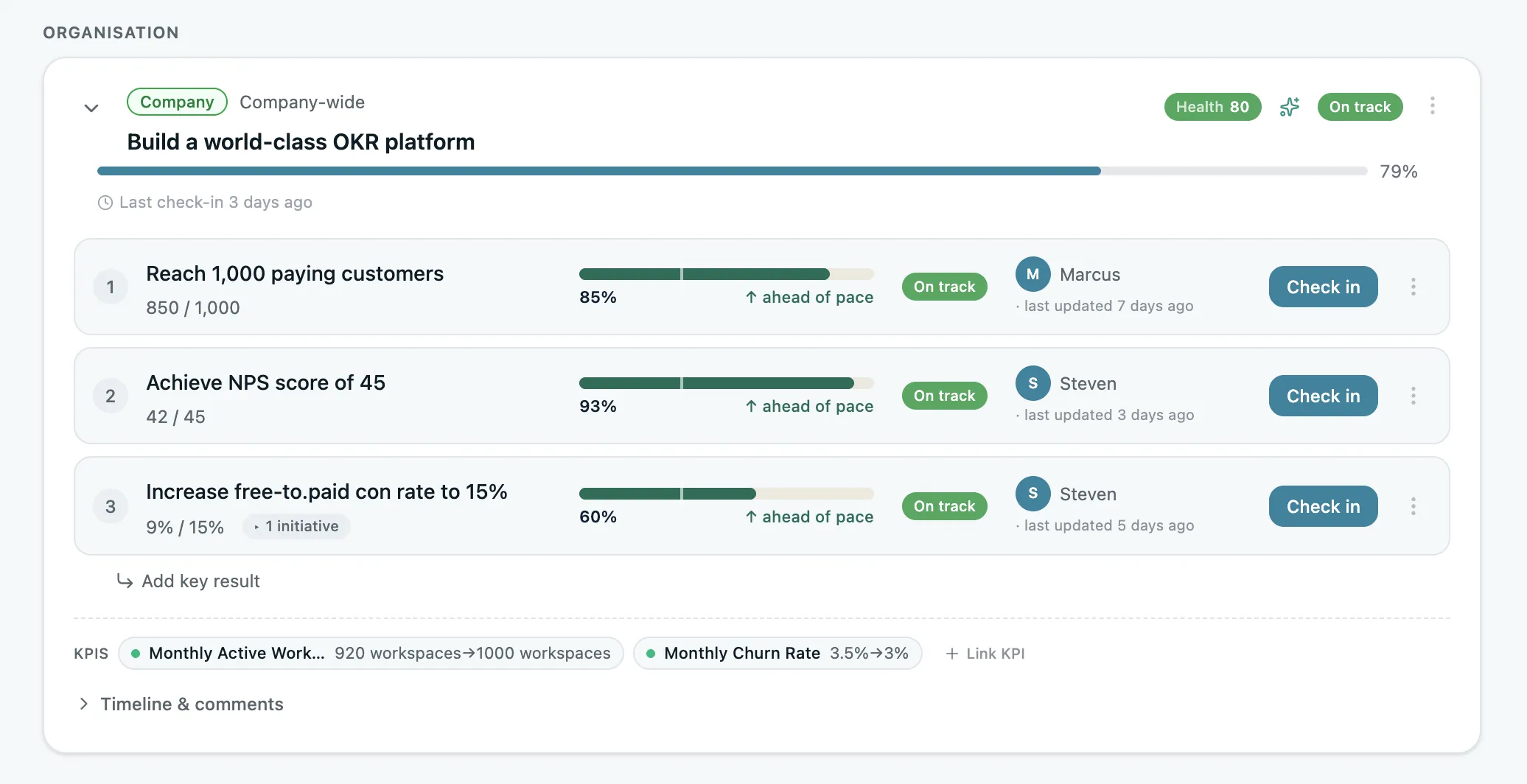
Screenshots of OKRs Tool 4 images
What's great
- Flat pricing of $49/mo for up to 50 users and $129/mo beyond means a 50-person team pays about $1/user where the per-seat tools here charge $11 and up
- The 60% adoption guarantee refunds you in full if the team misses 60% adoption inside 30 days, the only money-back adoption promise in this category
- Built for the 50-200 person VP and department-head segment with required KR ownership, weekly check-in nudges, and a visual alignment map that sets up in an afternoon
Watch-outs
- Only 7 G2 reviews (4.6/5 as of June 2026), a thin sample for the kind of vendor diligence a 500-person buyer runs
- Newer and lighter than the tested incumbents, cascade depth and reporting top out around 200 people, not the 1,000-plus that Betterworks or Lattice handle
- No published SOC 2 Type II certification, and SSO, MFA, RBAC, and audit logs are gated to the top $129/mo Expand tier
Pricing breakdown
| Plan | Price | Best for |
|---|---|---|
| Launch (Free) | $0 | Up to 5 users on one active cycle |
| Scale | $49/mo flat | 6-50 users; unlimited cycles and AI insights |
| Expand | $129/mo flat | 51+ users; SSO/MFA/RBAC and audit logs |
| Adoption guarantee | Full refund | If under 60% adoption in 30 days |
Security & compliance
| Standard | Availability |
|---|---|
| SOC 2 Type II | No |
| GDPR | ✓ EU residency |
| HIPAA | No |
| SSO / SAML | Expand |
| Audit logs | Expand |
OKRs Tool compliance summary: SOC 2 Type II is no, GDPR is ✓ eu residency, HIPAA is no, SSO/SAML is expand, and audit logs is expand.
Key integrations
| Integration | Type |
|---|---|
| Gmail | N/A |
| Outlook | N/A |
| Slack | Native integration |
| LinkedIn Sales Navigator | N/A |
| Outreach / Salesloft | N/A |
OKRs Tool integration summary: Gmail is not specified, Outlook is not specified, Slack is native integration, LinkedIn Sales Navigator is not specified, and Outreach or Salesloft is not specified.
Feature availability
| Feature | Status |
|---|---|
| Free tier | ✓ 5 users |
| AI coaching | ✓ AI insights |
| Cascade | ✓ |
| Check ins | ✓ |
| Task management | • initiatives |
OKRs Tool feature availability summary: Free tier (✓ 5 users), AI coaching (✓ AI insights), Cascade (✓), Check ins (✓), and Task management (• initiatives).
What reviewers say about OKRs Tool
Recurring themes across a small pool of public G2 reviews, 2024-2026.
What reviewers praise
- Reviewers highlight the flat, budget-friendly pricing that does not scale up as headcount grows.
- Setup is described as fast, with teams live in minutes and no formal training needed.
- The support team is called responsive for a product this small.
What reviewers fault
- Integrations and reporting depth are limited and unlikely to satisfy a growing team.
- API support and enterprise-security readiness are thin compared with larger OKR platforms.
- Teams unfamiliar with the OKR framework still face a learning curve when setting things up.
Loading reviews…
15Five
Best for keeping OKRs alive between quarters with weekly check-in cadence
Screenshots of 15Five 4 images
What's great
- Weekly check-in format makes OKR updates a 5-minute habit rather than a quarterly fire drill; the cadence is the differentiator
- Perform tier at $11/user/mo ships OKRs, 360 feedback, performance reviews, and 1-on-1 templates in one subscription
- AI-powered manager insights flag which direct reports have not updated OKRs in 10+ days; early-warning before drift becomes invisible
Watch-outs
- OKR cascade depth is shallower than Profit.co or Perdoo; cross-team dependency linking requires workarounds past 5-6 levels
- The platform rewards teams already doing weekly check-ins; if your culture doesn't support that cadence, 15Five's main advantage disappears
- Kona AI meeting assistant is a $2/user/mo add-on; feels like nickel-and-diming on a product already priced at $11 base
Pricing breakdown
| Plan | Price | Best for |
|---|---|---|
| Engage | $4/user/mo | Engagement surveys only |
| Perform | $11/user/mo | 50-500 employees |
| Total Platform | $16/user/mo | Full suite with manager training |
| Enterprise | Custom | 500+ employees with custom workflows |
Security & compliance
| Standard | Availability |
|---|---|
| SOC 2 Type II | Yes |
| GDPR | Yes |
| HIPAA | No |
| SSO / SAML | Perform+ |
| Audit logs | Perform+ |
15Five compliance summary: SOC 2 Type II is yes, GDPR is yes, HIPAA is no, SSO/SAML is perform+, and audit logs is perform+.
Key integrations
| Integration | Type |
|---|---|
| Gmail | N/A |
| Outlook | N/A |
| Slack | Native integration |
| LinkedIn Sales Navigator | N/A |
| Outreach / Salesloft | N/A |
15Five integration summary: Gmail is not specified, Outlook is not specified, Slack is native integration, LinkedIn Sales Navigator is not specified, and Outreach or Salesloft is not specified.
Feature availability
| Feature | Status |
|---|---|
| Free tier | ✗ trial only |
| AI coaching | ✓ Perform+ |
| Cascade | ✓ |
| Check ins | ✓ |
| Task management | • limited |
15Five feature availability summary: Free tier (✗ trial only), AI coaching (✓ Perform+), Cascade (✓), Check ins (✓), and Task management (• limited).
What reviewers say about 15Five
Recurring themes across ~1,902 G2 reviews (4.6/5) and Capterra reviews, 2024-2026.
What reviewers praise
- The weekly check-in cadence is the standout, surfacing morale dips and blockers before they turn into problems.
- Managers like that performance reviews pull from months of logged check-ins instead of a last-minute scramble.
- The clean interface drives high adoption, with reviewers noting teams pick it up without formal training.
- Having goals, feedback, and engagement pulse surveys in one tool is cited as the main reason teams consolidate onto it.
- The High Five recognition feature gets repeat mentions for building a lightweight culture of peer feedback.
What reviewers fault
- Cost climbs quickly as you add users and stack on modules like Engage and Perform.
- Small teams without a dedicated HR owner find the initial setup and admin configuration confusing.
- Reviewers report fewer native integrations than some competitors, especially outside the core HRIS set.
- The OKR and goal-tracking depth is lighter than tools built purely for OKRs.
- AI-generated review summaries and suggestions occasionally miss context and need editing.
Loading reviews…
Perdoo
Best pure-play OKR tool for mid-market teams who want depth without platform overhead
Screenshots of Perdoo 4 images
What's great
- Ranked
- Strategy Map feature visually connects company vision to team OKRs to individual KRs in a single scrollable tree; the best cascade visualization in this comparison
- Supreme tier at $10/user/mo ships KPI boards, Jira integration, Power BI connector, and custom dashboards included; no add-on fees
Watch-outs
- Review count (312 on G2) is thin compared to Lattice (4,060) and 15Five (1,902); newer buyers have less community evidence to pull from
- No built-in performance review or 1-on-1 workflows; pure OKR tool means you need a separate system for the review layer
- Check-in depth is lighter than 15Five; the platform excels at goal structure, not the weekly-cadence behavioral layer
Pricing breakdown
| Plan | Price | Best for |
|---|---|---|
| Free | $0 | Up to 5 users |
| Premium | €8/user/mo (~$9) | 5-100 employees with full OKR depth |
| Supreme | €10/user/mo (~$11) | 100-500 employees with KPI boards and Jira |
| Enterprise | Custom | 500+ with SSO/SCIM and dedicated support |
Security & compliance
| Standard | Availability |
|---|---|
| SOC 2 Type II | Yes |
| GDPR | Yes |
| HIPAA | No |
| SSO / SAML | Supreme+ |
| Audit logs | Supreme+ |
Perdoo compliance summary: SOC 2 Type II is yes, GDPR is yes, HIPAA is no, SSO/SAML is supreme+, and audit logs is supreme+.
Key integrations
| Integration | Type |
|---|---|
| Gmail | N/A |
| Outlook | N/A |
| Slack | Native integration |
| LinkedIn Sales Navigator | N/A |
| Outreach / Salesloft | N/A |
Perdoo integration summary: Gmail is not specified, Outlook is not specified, Slack is native integration, LinkedIn Sales Navigator is not specified, and Outreach or Salesloft is not specified.
Feature availability
| Feature | Status |
|---|---|
| Free tier | ✓ 5 users |
| AI coaching | • limited |
| Cascade | ✓ |
| Check ins | ✓ |
| Task management | ✗ |
Perdoo feature availability summary: Free tier (✓ 5 users), AI coaching (• limited), Cascade (✓), Check ins (✓), and Task management (✗).
What reviewers say about Perdoo
Recurring themes across public G2 and Capterra reviews, 2024-2026.
What reviewers praise
- The Goal Tree view is the recurring favorite for showing how objectives and key results connect across the org.
- Reviewers describe Perdoo as easy to understand and adopt, even for teams new to OKRs.
- It is called highly customizable, letting teams adapt it to their process rather than the reverse.
- Support gets steady credit for being fast and genuinely helpful when questions come up.
- Weekly reminders and the option to attach initiatives with named owners help keep check-ins on track.
What reviewers fault
- The per-user pricing model draws complaints, with users wanting seats bundled into plans instead of charging per head.
- Expanding and collapsing key results or sub-goals is glitchy and does not always respond on the first click.
- The platform can feel rigid when trying to edit a goal or restructure OKRs mid-cycle.
- Reviewers mention occasional minor bugs and translation gaps in non-English interfaces.
Loading reviews…
Mooncamp
Best for teams deploying OKRs for the first time, fastest time to first cycle
Screenshots of Mooncamp 4 images
What's great
- 4.8/5 on G2 across 296 reviews, the highest per-review satisfaction score in this comparison
- Native Microsoft Teams integration is first-party and well-maintained; teams inside M365 shops don't need a Zapier bridge
- Clean, fast onboarding flow; small teams can get a first OKR cycle running shortly after signup without a consultant
Watch-outs
- OKR rules engine and custom dashboards are locked behind the Professional tier ($10/user/mo); the $7 Essential tier is limited for anything beyond basic goal tracking
- Cascade depth past 4-5 levels gets unwieldy; less suited for large hierarchical orgs than Perdoo or Profit.co
- No built-in performance review layer; pairing Mooncamp with a separate HRIS for review cycles adds tooling cost and integration friction
Pricing breakdown
| Plan | Price | Best for |
|---|---|---|
| Essential | €7/user/mo (~$8) | 5-100 employees |
| Professional | €10/user/mo (~$11.50) | 100-300 employees with OKR rules and dashboards |
| Enterprise | Custom | 300+ employees with SSO/SCIM |
| Free trial | $0 | 14-day full-feature trial |
Security & compliance
| Standard | Availability |
|---|---|
| SOC 2 Type II | Yes |
| GDPR | Yes |
| HIPAA | No |
| SSO / SAML | Enterprise |
| Audit logs | Professional+ |
Mooncamp compliance summary: SOC 2 Type II is yes, GDPR is yes, HIPAA is no, SSO/SAML is enterprise, and audit logs is professional+.
Key integrations
| Integration | Type |
|---|---|
| Gmail | N/A |
| Outlook | N/A |
| Slack | Native integration |
| LinkedIn Sales Navigator | N/A |
| Outreach / Salesloft | N/A |
Mooncamp integration summary: Gmail is not specified, Outlook is not specified, Slack is native integration, LinkedIn Sales Navigator is not specified, and Outreach or Salesloft is not specified.
Feature availability
| Feature | Status |
|---|---|
| Free tier | ✗ trial only |
| AI coaching | ✗ |
| Cascade | ✓ |
| Check ins | ✓ |
| Task management | ✗ |
Mooncamp feature availability summary: Free tier (✗ trial only), AI coaching (✗), Cascade (✓), Check ins (✓), and Task management (✗).
What reviewers say about Mooncamp
Recurring themes across ~296 G2 reviews (4.8/5) and Capterra reviews, 2024-2026.
What reviewers praise
- The interface gets consistent praise for fast onboarding, with non-technical staff running OKRs on their first day.
- The Microsoft Teams integration is a repeat favorite, letting people update and check OKRs without leaving Teams.
- Reviewers value how customizable the dashboards and views are for tailoring reporting to each team.
- It is described as a clean, focused OKR tool without the enterprise bloat some rivals carry.
- Cross-team visibility and goal alignment come up often as the reason adoption sticks after rollout.
What reviewers fault
- The mobile web experience lags the desktop version, and several users ask for a real iOS app.
- The flexibility can overwhelm at first, with new admins unsure how to structure things.
- Some reviewers feel it lacks maturity next to older tools, pointing to missing recognition or badge features.
- A few Enterprise-tier features that teams want sit above the Pro plan.
- It is not a task-level project management tool, so teams needing that still run a second app.
Loading reviews…
Betterworks
Best enterprise OKR governance for companies past 500 employees
Screenshots of Betterworks 4 images
What's great
- Purpose-built for enterprise OKR governance; calibration workflows, manager alignment trees, and cascade reporting handle the complexity of 500+ employee orgs that the lighter tools can't
- Deep integration with Workday, SuccessFactors, and ADP natively; HR data flows into goal ownership without a middleware layer
- Conversation and feedback workflows embedded in the OKR flow; managers can log a coaching note directly from the objective view
Watch-outs
- 500-employee minimum and custom-only pricing puts it out of reach for sub-500 teams; estimated contracts land $8-15/user/mo plus $20K-$50K implementation costs
- G2 rating (4.3/5 across 215 reviews) is the lowest in this comparison; complexity and onboarding friction are the consistent complaints
- Roadmap cadence is slower than the OKR-first vendors; feature releases from the past 12 months have been incremental rather than structural
Pricing breakdown
| Plan | Price | Best for |
|---|---|---|
| Mid-Market | Custom (500+ employees) | 500-2500 employees |
| Enterprise | Custom (2500+ employees) | 2500+ with premium support |
| Implementation | $20K-$50K one-time | Year-1 onboarding and change management |
| Annual uplift | Est. 8-15% yr-over-yr | Renewal planning baseline |
Security & compliance
| Standard | Availability |
|---|---|
| SOC 2 Type II | Yes |
| GDPR | Yes |
| HIPAA | No |
| SSO / SAML | ✓ all tiers |
| Audit logs | Yes |
Betterworks compliance summary: SOC 2 Type II is yes, GDPR is yes, HIPAA is no, SSO/SAML is ✓ all tiers, and audit logs is yes.
Key integrations
| Integration | Type |
|---|---|
| Gmail | N/A |
| Outlook | N/A |
| Slack | Native integration |
| LinkedIn Sales Navigator | N/A |
| Outreach / Salesloft | N/A |
Betterworks integration summary: Gmail is not specified, Outlook is not specified, Slack is native integration, LinkedIn Sales Navigator is not specified, and Outreach or Salesloft is not specified.
Feature availability
| Feature | Status |
|---|---|
| Free tier | ✗ |
| AI coaching | ✓ |
| Cascade | ✓ |
| Check ins | ✓ |
| Task management | ✗ |
Betterworks feature availability summary: Free tier (✗), AI coaching (✓), Cascade (✓), Check ins (✓), and Task management (✗).
What reviewers say about Betterworks
Recurring themes across ~212 G2 reviews (4.3/5) and Capterra reviews (around 4.2/5), 2024-2026.
What reviewers praise
- Reviewers say tracking OKRs in Betterworks is a clear upgrade over the spreadsheets and docs they replaced.
- The goal-setting flow and dashboards are called intuitive for aligning individual work to company objectives.
- Real-time progress dashboards get credited for giving managers a live read on where goals stand.
- Continuous check-ins and feedback features help teams address issues between formal review cycles.
- Customer support draws steady praise for being responsive during setup and day-to-day questions.
What reviewers fault
- Users flag inconsistency between different UI views, which creates confusion moving around the product.
- Setting and aligning goals gets cumbersome once the org has complex hierarchies or nested structures.
- Customization is limited, so teams cannot always shape the tool to their exact process.
- Reporting is called weak, often needing manual work to assemble the data leadership wants.
- The mobile app is basic and third-party integrations are restricted, sometimes needing extra dev work.
Loading reviews…
Cascade Strategy
Best for strategy-execution teams who need OKRs connected to strategic plans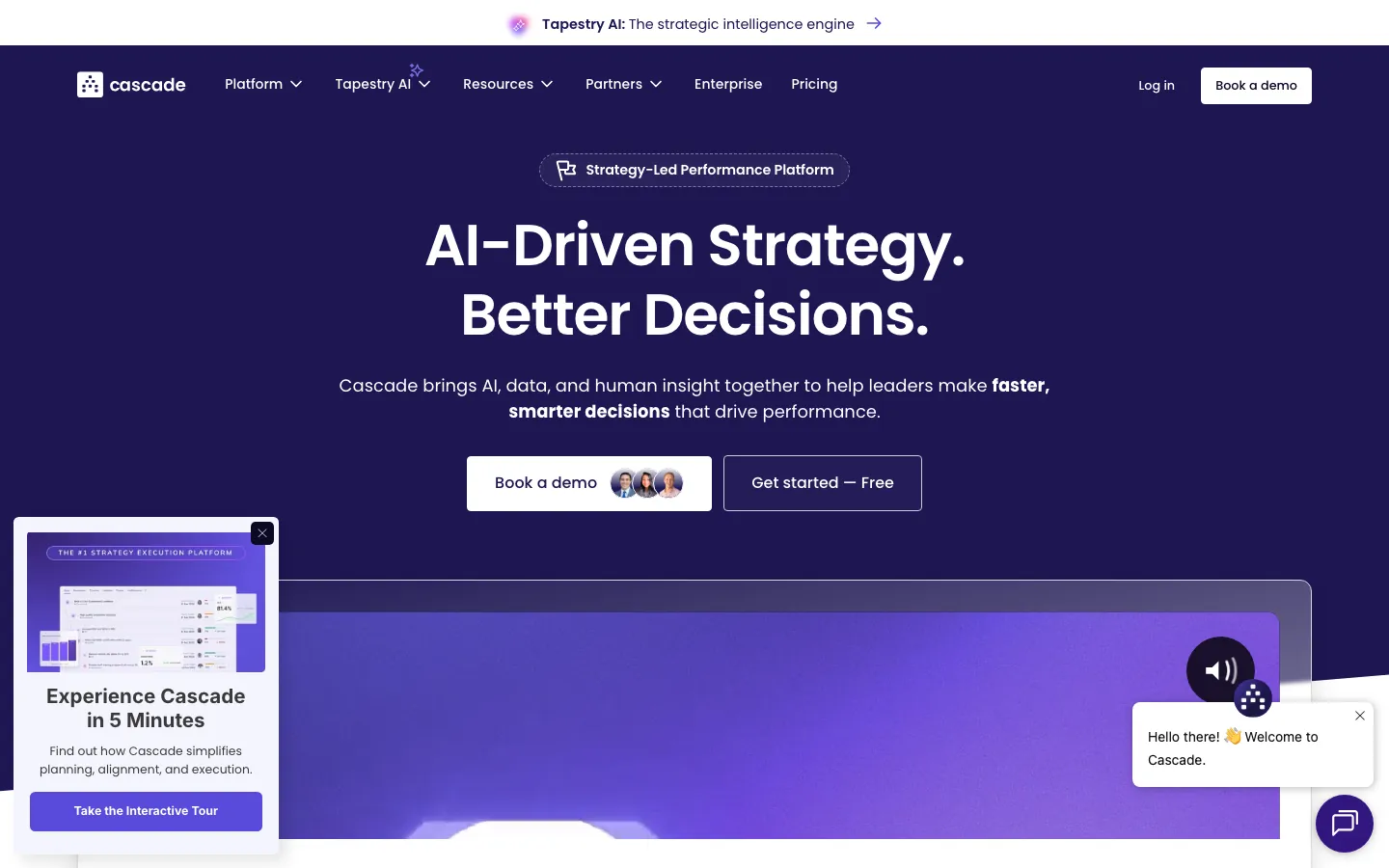
Screenshots of Cascade Strategy 4 images
What's great
- 4.8/5 on G2 across 236 reviews, tied for the highest per-review satisfaction score in this group alongside Mooncamp
- Strategy Roadmap layer connects company vision and multi-year strategic themes to quarterly OKRs; the only tool in this list built top-down from strategy documents rather than bottom-up from team goals
- Free tier ships with unlimited plans, unlimited metrics, and up to 4 users; the most feature-complete free entry in the comparison
Watch-outs
- Pricing is opaque, custom-quote-only past the free tier; buyer reports suggest Essentials-tier contracts run $10-30/user/mo depending on team size
- Stronger for strategy and exec teams than for IC-level OKR tracking; the UI rewards big-picture thinkers, not the team member updating a KR on a Thursday afternoon
- Implementation time is 4-6 weeks for a complete strategy-to-OKR buildout; not a quick-deploy tool
Pricing breakdown
| Plan | Price | Best for |
|---|---|---|
| Free | $0 | Up to 4 users |
| Essentials | Custom (~$10-30/user/mo) | Teams up to 100 employees |
| Enterprise+ | Custom | 100+ employees with strategy roadmaps and deep partnerships |
| Implementation | Included or quoted | Strategy buildout with Cascade's team |
Security & compliance
| Standard | Availability |
|---|---|
| SOC 2 Type II | Yes |
| GDPR | Yes |
| HIPAA | No |
| SSO / SAML | Enterprise+ |
| Audit logs | Enterprise+ |
Cascade Strategy compliance summary: SOC 2 Type II is yes, GDPR is yes, HIPAA is no, SSO/SAML is enterprise+, and audit logs is enterprise+.
Key integrations
| Integration | Type |
|---|---|
| Gmail | N/A |
| Outlook | N/A |
| Slack | Native integration |
| LinkedIn Sales Navigator | N/A |
| Outreach / Salesloft | N/A |
Cascade Strategy integration summary: Gmail is not specified, Outlook is not specified, Slack is native integration, LinkedIn Sales Navigator is not specified, and Outreach or Salesloft is not specified.
Feature availability
| Feature | Status |
|---|---|
| Free tier | ✓ 4 users |
| AI coaching | ✓ AI insights |
| Cascade | ✓ |
| Check ins | ✓ |
| Task management | ✓ |
Cascade Strategy feature availability summary: Free tier (✓ 4 users), AI coaching (✓ AI insights), Cascade (✓), Check ins (✓), and Task management (✓).
What reviewers say about Cascade Strategy
Recurring themes across ~253 G2 reviews (4.7/5) and Capterra reviews, 2024-2026.
What reviewers praise
- Reviewers like that the planning interface holds OKRs, KPIs, and scorecards in one model instead of separate spreadsheets.
- The board-ready reports get called out for turning strategy status into something leadership can read in minutes.
- Users credit the tool with adding transparency and accountability across departments once plans are connected.
- Real-time tracking dashboards are praised for showing whether initiatives are on schedule.
- The support and implementation team draws repeated praise for handling queries quickly during rollout.
What reviewers fault
- The mobile app is described as limited next to the full desktop experience.
- Workflow customization is restricted, which frustrates teams with more complex planning processes.
- The breadth of features creates a learning curve, and new users can feel overwhelmed at first.
- Data visualization options are called basic, with fewer chart types than some reviewers want.
- Custom pricing starts reasonable but adds up quickly as seats and modules grow.
Loading reviews…
Tools we considered but excluded
We evaluated more tools than the 8 you see above. These did not make the cut. Saying what we rejected, and why, is the editorial muscle most listicles skip.
- Quantive (formerly Gtmhub): Acquired by WorkBoard in May 2025 and discontinued as a standalone product; existing customers are mid-migration and it is not a viable new purchase
- WorkBoard: Post-Quantive acquisition the product is in transition; pricing and roadmap are unstable for a 12-month commitment, revisit in late 2026
- Ally.io (Microsoft Viva Goals): Microsoft folded Ally.io into Viva Goals; the product has been de-emphasized and feature development is minimal; not a credible independent OKR purchase in 2026
- Tability: Strong for individual and small-team OKR habit-building, but reporting depth and cascade visualization fall short for any org above 50 people
- ClickUp Goals: ClickUp is a project management tool that added OKRs; the Goals module lacks confidence scoring, cascade analytics, and check-in cadence that dedicated tools ship natively
- Asana Goals: Same problem as ClickUp Goals -- a PM tool's OKR module is a feature, not a product; teams using Asana for projects benefit from the integration but not from the OKR depth
Honorable mentions
Solid tools that did not crack the main list but are worth tracking, especially for niche use cases.
- Peoplebox: Strong AI-powered OKR + performance combo for Series A/B SaaS companies, cheaper than Lattice, worth evaluating if Profit.co's pricing lands too high
- Leapsome: Popular in European mid-market; OKR module is solid within a broader people-enablement suite and improving fast; worth watching for US expansion in 2026-27
- Koan: The simplest OKR check-in tool in the market, Slack-native, beloved by tech-forward small teams; too thin for companies past 100 employees but worth knowing
- Weekdone: Plans-Progress-Problems weekly check-in tool, free up to 3 users and transparent flat-band pricing; a fine first-OKR pick for sub-50 teams, but a thin G2 base (38 reviews) and no SOC 2 keep it out of the ranked list
The four sub-categories of the OKR software market
The OKR software market looks deceptively uniform until you run it in practice. Eight tools, four real sub-categories, and the answer to the question nobody asks in demos: what happens in cycle three when the initial energy is gone?
OKR-first specialist tools. Perdoo, Mooncamp, OKRs Tool, Cascade, Profit.co. Built from the ground up around objective and key result management. Stronger cascade visualization, deeper KR confidence scoring, and more flexible goal structures than the suite players. The trade-off is a separate system for performance reviews.
People-management suites with OKR modules. Lattice and 15Five. OKRs sit inside a broader platform that also runs performance reviews, engagement surveys, 1-on-1 templates, and compensation cycles. The advantage is one data record for the whole people-management workflow. The disadvantage is that OKR depth is often a step behind the specialists, and per-seat pricing stacks up fast once you add modules.
Enterprise OKR governance platforms. Betterworks. Built for 500+ employee organizations where OKRs need to survive a matrixed reporting structure, quarterly calibration reviews, and HRIS data feeding into goal ownership. Different purchase, different buyer (usually CHROs, not ops directors). The deeper cut on SCIM, calibration, and HRIS-sync tests lives in the enterprise OKR shortlist .
Strategy-execution platforms. Cascade. These start from the strategic plan and derive OKRs from it, rather than building from team goals up. The use case is a COO or strategy director who wants OKRs visibly connected to board-level priorities, not just a team productivity tracker.
The eight tools above cover all four sub-categories. The right pick depends almost entirely on which sub-category your company actually needs, not on features in a comparison matrix.
How to choose the right OKR software for your team
Five questions, in order. Work through them before opening a single vendor demo.
1. OKRs inside a performance system, or separate from it
This is the fork in the road that rules out half the tools before you touch a trial.
- OKRs embedded in performance reviews: Lattice or 15Five. Both ship performance reviews and OKRs on one data record. The advantage is real: a manager can click from a KR update into a review comment without switching tools. The cost is real: $16-20/seat/mo before Compensation and Grow modules.
- OKRs as a standalone system: Perdoo, Mooncamp, Profit.co, OKRs Tool, Cascade. All cheaper per seat, all stronger on OKR-specific depth. You’ll need a separate HRIS or performance tool for review cycles.
- Enterprise governance across both: Betterworks. The only tool that handles OKR calibration at 500+ employees while also shipping HRIS-native integrations for review data.
2. Organization size and the number of OKR levels you need
- Under 50 employees. OKRs Tool, Mooncamp, or Cascade (free tier). Three levels max (company, team, IC) is enough; any tool in this list handles that. Lean teams can go straight to the small-business OKR picks for the value-first ranking.
- 50-200 employees. 15Five Perform, Mooncamp Professional, or Perdoo Premium. The cascade tree gets complex at this size; pick tools with strong cascade visualization.
- 200-500 employees. Profit.co (performance and project modules bundled), Perdoo Supreme, or Lattice full suite. Cross-team dependencies, multi-level alignment, and reporting depth start mattering here.
- 500+ employees. Betterworks or Profit.co Enterprise. Sub-500 tools hit real limits at enterprise scale: provisioning, audit trails, HRIS sync, and calibration workflows.
3. Your existing weekly check-in culture
If yes, 15Five extracts outsized value from that culture by embedding OKR updates inside the Monday morning prep flow. The weekly check-in is not a bolt-on; it’s the product’s core mechanic, and it works because of the existing habit, not despite its absence. If your team has no weekly operating rhythm, 15Five won’t install one.
Mooncamp, Perdoo, and Profit.co all work fine for teams that update OKRs monthly rather than weekly.
4. The weight of the strategy-to-OKR connection
If OKRs in your company are expected to trace visibly to a company strategy document, a multi-year strategic theme, or a Balanced Scorecard framework, Cascade is the right tool. Its build-down-from-strategy architecture is unique in this comparison. For most companies under 300 employees, this connection is less important than actual IC update frequency.
5. The realistic IT security and compliance requirement
If you’re in a regulated industry or selling to enterprise accounts and expect customers to review your vendor stack, you need SOC 2 Type II at minimum. Profit.co, Lattice, 15Five, Betterworks, and Cascade all hold it. Mooncamp holds it. Perdoo holds it at the Supreme tier. OKRs Tool does not publish a SOC 2 Type II certification, though it ships EU data residency and GDPR.
If HIPAA is required, Profit.co is the only tool here that ships an enterprise-grade path; Betterworks does not publish HIPAA coverage.
What to validate before signing
Nine months of sitting in on OKR software evaluations at partner companies produced a consistent list of the tests that separate real deployments from shelfware. Eight of them.
One, run a real OKR cycle in the trial. Not demo data. Take your actual company objectives from the last quarter, load them, create KRs with owners and confidence scores, and run a simulated check-in meeting. If the team can’t get to first check-in in a 2-week trial, the onboarding overhead will kill cycle one adoption.
Two, test IC update time. Have a non-power-user IC open the tool cold and update three KRs. Time it. The difference between a good and a bad OKR tool is often 45 seconds versus 4 minutes per KR update. Multiply by 20 ICs and 12 weekly cycles and that’s hours of friction either building or destroying the habit.
Three, build the cascade to three levels. Company objective to department objective to team KR. The visualization quality varies significantly between tools; Perdoo and Cascade are standouts. Screenshot the cascade for your CEO. If it doesn’t pass the three-second legibility test, it won’t get used in board prep.
Four, export the full OKR dataset. Try to pull all objectives, KRs, owners, progress history, and confidence scores from a full quarter into a CSV. Some tools make this easy (Perdoo, Mooncamp). Others require a support ticket or an API call. If you can’t export it cleanly, your data isn’t actually yours.
Five, test the HRIS user-provisioning flow. For any team above 100 employees, provisioning users manually is a quarterly headache. Ask the vendor to demonstrate a SCIM-provisioned import from your HRIS during the trial. The tools that wave their hands at ‘we integrate with Workday’ in the demo are often the ones where provisioning requires a 3-hour IT ticket.
Six, run a calibration meeting in the tool. Get three managers to score the same objective independently and then bring them together in the platform to reconcile. The enterprise tools (Betterworks, Lattice) have real calibration workflows. The SMB tools don’t; if your team needs manager calibration, that matters.
Seven, ask about renewal pricing in writing. This is the OKR software question that nobody asks until year two. Several platforms in this category have raised prices 15-25% on renewal in 2025-2026. Ask the sales rep: what did your average customer pay in year two versus year one? If they can’t give a real range, assume 10-20% and negotiate a cap before signing.
Eight, find two current customers at your company size and call them. Not the references the vendor provides. Use LinkedIn to find them. Ask the single most useful question: ‘Would you buy this again, knowing what you know now?’ The honest answer tells you more than any G2 review or vendor demo.
Where the eight OKR tools differ on core features
| Tool | Free tier | AI coaching | Check-in cadence | Cascade depth | Performance reviews |
|---|---|---|---|---|---|
| Profit.co | ✗ trial | ✓ Growth+ | ✓ built-in | ✓ deep | $ add-on |
| Lattice Goals | ✗ | • limited | ✓ built-in | ✓ | ✓ (separate module) |
| OKRs Tool | ✓ 5 users | ✓ insights | ✓ nudges | ✓ | • Expand tier |
| 15Five | ✗ trial | ✓ Perform+ | ✓ core mechanic | ✓ | ✓ bundled |
| Perdoo | ✓ 5 users | • limited | ✓ | ✓ deep | ✗ |
| Mooncamp | ✗ trial | ✗ | ✓ | ✓ | ✗ |
| Betterworks | ✗ | ✓ | ✓ | ✓ deep | ✓ bundled |
| Cascade | ✓ 4 users | ✓ insights | ✓ | ✓ strategy-down | ✗ |
Profit.co and Betterworks lead on AI coaching depth. 15Five leads on check-in habit mechanics. Perdoo and Cascade lead on cascade visualization. Lattice and 15Five are the only tools that bundle performance reviews without a separate purchase.
Pricing reality
The gap between sticker price and year-1 all-in is significant in this category, partly because of implementation fees and partly because the cheapest tiers rarely have the features most teams actually need.
| Tool | Listed price | Real year-1 (100 users) | Key cost drivers |
|---|---|---|---|
| OKRs Tool | $129/mo flat (51+ users) | ~$1,550 | Flat fee, no per-seat scaling |
| Mooncamp | ~$8/user/mo (€7) | ~$9,600 | Mostly sticker; no impl fees |
| Perdoo | ~$9-11/user/mo (€8-10) | ~$12,000-$15,000 | Annual billing required |
| 15Five | $11/user/mo (Perform) | ~$15,000-$18,000 | Manager coaching add-ons |
| Profit.co | Custom quote | ~$18,000-$26,000 | Module stacking; quote-only in 2026 |
| Lattice | $16+/user/mo (full suite) | ~$22,000-$28,000 | $4K minimum; module build |
| Cascade | Custom | ~$12,000-$30,000 | Wide range; depends on tier |
| Betterworks | Custom (500+ min) | ~$96,000-$180,000 (1,000 users) | Impl fees $20K-$50K; enterprise floor |
The biggest forecast error in OKR software budgeting is buying the base tier and discovering 60 days in that the features the team actually needs are in the next tier up. Mooncamp’s $7 Essential is real, but OKR rules and custom dashboards are Professional. 15Five’s $4 Engage tier is real, but OKRs are Perform at $11.
Check the feature gates before the business case.
Compliance and security
| Tool | SOC 2 Type II | GDPR | HIPAA | SSO/SAML | Audit logs |
|---|---|---|---|---|---|
| Profit.co | ✓ | ✓ | $ Enterprise | Growth+ | Scale+ |
| Lattice | ✓ | ✓ | ✗ | ✓ all tiers | ✓ |
| OKRs Tool | ✗ | ✓ EU residency | ✗ | Expand | Expand |
| 15Five | ✓ | ✓ | ✗ | Perform+ | Perform+ |
| Perdoo | ✓ | ✓ | ✗ | Supreme+ | Supreme+ |
| Mooncamp | ✓ | ✓ | ✗ | Enterprise | Professional+ |
| Betterworks | ✓ | ✓ | ✗ | ✓ all tiers | ✓ |
| Cascade | ✓ | ✓ | ✗ | Enterprise+ | Enterprise+ |
For any org selling to enterprise accounts or operating in regulated industries: OKRs Tool is the one to scrutinize, it ships EU data residency and GDPR but no published SOC 2 Type II certification, so it can stall an enterprise IT security review. Profit.co is the only tool in this list with a HIPAA path at the enterprise tier. The rest pass a standard SOC 2 and GDPR check but don’t publish HIPAA coverage.
Betterworks does not advertise HIPAA on its security page either, so if HIPAA is a hard requirement, Profit.co is the only option here.
Integration depth across the OKR stack
| Tool | Slack | MS Teams | Jira | Salesforce | HRIS sync |
|---|---|---|---|---|---|
| Profit.co | N | N | N | N | M (Merge) |
| Lattice | N | N | M | M | N (Workday/Rippling) |
| OKRs Tool | N | N | N | ✗ | ✗ |
| 15Five | N | N | M | M | N (BambooHR/Workday) |
| Perdoo | N | N | Supreme | M | M |
| Mooncamp | N | N (first-party) | Professional | • | M |
| Betterworks | N | N | N | N | N (Workday/ADP native) |
| Cascade | N | N | N | N | M |
Betterworks has the strongest native HRIS story (Workday and ADP are first-party integrations, not Merge.dev bridges). Lattice and 15Five have the most complete HRIS native integrations in the sub-enterprise tier. Mooncamp is the only tool with a well-maintained native Teams integration, which matters for Microsoft-heavy shops.
OKRs Tool punches above its size here, with native Slack, Microsoft Teams, and Jira plus Asana, Linear, ClickUp, and Notion, though it offers no Salesforce or HRIS sync yet.
Strategy execution vs performance review overlap
This is where most OKR software buying decisions go sideways. The question isn’t “which OKR tool is best” – it’s “do we want OKRs to live inside our performance management system or alongside it?”
The case for inside: when a manager can click from a KR update directly into the performance review comment, context is preserved. The quarterly OKR cycle and the semi-annual review cycle share the same evidence. Lattice and 15Five are built on this premise and it’s a real advantage, especially for managers running 5+ direct reports.
The case for alongside: dedicated OKR tools are faster, cheaper per seat, and stronger on the specific mechanics of OKR management (cascade visualization, confidence scoring, retrospective analytics). When OKRs are a strategy and operations function rather than an HR function, the dedicated tools win. Perdoo, Profit.co, and Cascade are built on this premise.
The blur between the two is real and it shows up in most evaluations at the CFO desk. Finance ops and strategy teams consistently prefer Perdoo and Profit.co. HR and people-ops teams consistently prefer Lattice and 15Five. Both camps are right for their use case. The mistake is buying the wrong one because it won a comparison table.
Why most OKR rollouts fail
Teams that have been through two or three OKR software purchases tend to land on the same conclusion: the problem was never the tool, it was the program. That’s the thing nobody tells you in the demo.
The pattern across failed rollouts is consistent, and the strategy-execution literature lands on the same root causes. No executive sponsorship means OKRs become a middle-management reporting exercise that ICs resent.
KRs written as tasks rather than outcomes produce boxes to check, not real measurement. No mid-cycle check-in habit means OKRs are written in January and reviewed in March, with three months of progress invisible to anyone.
The software choice matters at the margin. A tool with a better IC update experience (15Five, Mooncamp) does reduce the friction that lets good habits erode. A tool with better cascade visibility (Perdoo, Cascade) does make it easier for leadership to see where drift is happening. Those marginal improvements are real. But they’re marginal.
A great OKR tool cannot save a program where the CEO stops referencing OKRs in their all-hands after week four.
The one thing that software does solve, unambiguously, is the visibility problem. Before a dedicated OKR tool, when the CFO asks ‘what’s the status of OKR 2.3?’ the answer is someone opening a spreadsheet and hoping it was updated last week. With any tool in this list, that question has a live answer in 15 seconds. That is the return on investment.
The rest – alignment, accountability, culture change – is the program’s job, not the software’s.
How to implement OKR software without killing cycle two
The implementation pattern that works. Four phases.
Phase 1 (weeks 1-2): Configure with one exec and one ops person. Pick your three company-level objectives for the quarter. Build the first-level cascade to two or three department objectives. Do not configure the full company tree yet. The teams that try to load 40 objectives in week one are the teams with blank KRs by week six.
Phase 2 (weeks 3-4): Run one team as the pilot. The team whose lead is the most OKR-fluent, not the biggest team or the CEO’s team. Run a real cycle with them including a mid-cycle check-in meeting. Fix what breaks. The teams that skip this phase do their full company launch in week one and discover the problems in front of everyone.
Phase 3 (weeks 5-8): Expand to all teams. 30-minute onboarding session for team leads, not ICs. ICs learn by doing, not by training. The one thing worth doing in writing: a one-page guide with exactly what a good KR looks like versus a bad one, with examples from your company’s own objectives.
Phase 4 (weeks 9-12): Run the first retrospective, then lock the format. The retrospective reveals which KRs were measurable (good) and which were binary tasks (needs fixing). Fix those before cycle two launches. Then stop changing the OKR format. The companies that tweak the structure every cycle never build the institutional memory that makes OKRs useful by year two.
The implementations that fail almost always collapse at the same point: the second cycle. Cycle one has energy. Cycle two has the same format, the same meeting requests, and less energy. The tools that survive cycle two are the ones that made cycle one update frequency effortless enough to become a habit.
What’s changing in OKR software in 2026
The Quantive/WorkBoard merger is reshaping the enterprise market. WorkBoard acquired Quantive in May 2025. Existing Quantive customers are mid-migration. The combined platform is still stabilizing. Enterprise buyers who were evaluating Quantive in late 2025 are largely landing on Profit.co or Betterworks for 2026 deployments; the market is genuinely in motion.
AI coaching is finally shipping real signal, not just colored dashboards. In 2024 and early 2025, the ‘AI insights’ in most OKR tools were pattern-matching on update frequency – essentially ’this KR hasn’t been updated in 10 days.’ Profit.co and Betterworks in 2026 are shipping confidence-trend analysis that compares a KR’s progress trajectory against similar KRs from past quarters, flagging deviations before they become misses.
It’s a real improvement. Lattice’s AI insights remain more limited.
Microsoft Viva Goals (formerly Ally.io) is quietly fading. The product has had minimal feature investment since Microsoft absorbed Ally.io in 2021. Teams evaluating OKR software in early 2026 are regularly told by Microsoft sales reps that Viva Goals ‘is not a priority product.’ The customers I know who are on it are mostly evaluating Lattice or 15Five for migration in the second half of 2026.
Pricing transparency is emerging as a market wedge. Perdoo, Mooncamp, and 15Five all publish clear per-user prices on their sites. Profit.co, Cascade, Betterworks, and Lattice all require a sales conversation for most tiers. As buyers increasingly filter to tools with visible pricing in the first research phase, the opaque vendors are seeing longer sales cycles. Expect at least one of the opaque vendors to publish pricing in the next 12 months as competitive pressure grows.
The OKR category is starting to eat into the performance management category. 15Five and Lattice already compete directly with Workday’s performance module and SuccessFactors at the mid-market. The direction of travel is people-management suites getting OKR-deeper, not OKR tools getting review-shallower. By late 2027 the category distinction between OKR software and performance management software will be largely meaningless for companies under 500 employees.
The right OKR tool for each company stage
- Pre-seed and seed, under 15 people: OKRs Tool free tier (up to 5 users) or Cascade free tier (up to 4 users). Pay nothing; learn the discipline. Founders can dig into OKR tools sized for startups for the seed-to-Series-A path.
- Seed to Series A, 15-50 people: Mooncamp Essential (€7/user/mo, about $8). Fastest first cycle, cleanest UX, honest pricing.
- Budget-constrained, 50-200 people: OKRs Tool Scale ($49/mo flat up to 50 users) or Expand ($129/mo for 51+). Flat pricing makes it the cheapest year-one cost in this guide by a wide margin, and the 60% adoption-or-refund guarantee de-risks the rollout. Accept the trade: a newer product with a thin G2 base, not the depth a 1,000-person org needs.
- Series A, 50-120 people, no existing perf management tool: 15Five Perform ($11/user/mo). The check-in cadence builds the OKR habit faster than any other tool at this stage.
- Series A, 50-120 people, already running Lattice for performance: Lattice Goals at $8/seat/mo incremental over what you already pay. Adding a second OKR tool here doubles your people-ops tooling cost for no gain.
- Series B, 120-300 people, OKR-first culture: Perdoo Supreme (€10/user/mo, about $11). The cascade visualization and KPI board depth start earning their price past 100 employees.
- Series B/C, 120-300 people, strategy team drives OKRs: Cascade Essentials. The strategy-to-OKR architecture is the right frame for companies where OKRs are an exec function, not an HR function.
- Series B/C, 120-500 people, full platform needed: Profit.co with the performance and project modules bundled (custom quote, roughly $15-18/user/mo all-in per buyer reports). Task management, 1-on-1s, and AI coaching in one subscription is the better total cost of ownership versus Lattice or 15Five plus a standalone OKR tool.
- Enterprise, 500+ employees: Betterworks if you need HRIS-native integration and calibration workflows. Profit.co Enterprise if you want more configurability at the cost of a heavier implementation.
- Microsoft 365 shops at any size: Mooncamp, for the first-party Teams integration. No other tool in this list has a comparably maintained Teams-native experience.
If your shortlist is still three tools after this guide, run the 14-day trials in parallel with the same five people running a real cycle. Decide at day 10 based on IC update frequency and manager time-in-tool, not the feature list.
For corrections, vendor disputes, or feedback on this methodology, email hello@topickz.com . We re-test the full shortlist every six months; the next refresh ships in November 2026.
Frequently asked questions
Do you actually need OKR software or will a spreadsheet do?
Under 50 people a structured spreadsheet works. Above 50, software cascade visibility pays. Above 200, software is required.
How much does OKR software cost per employee in 2026?
SMB tools run $7-$15/user/mo. Enterprise platforms (Betterworks, Lattice) land $15-25/user/mo all-in. Free tiers exist for under 5 users.
What is the difference between OKR software and performance management software?
OKR tools track goal progress. Perf management tools run review cycles. Lattice and 15Five do both. Perdoo and Mooncamp do OKRs only.
How long does OKR software deployment take?
Mooncamp and OKRs Tool deploy in days. Profit.co and Perdoo take 2-3 weeks. Betterworks and Lattice need 4-8 weeks for full configuration.
Why do most OKR programs fail within two quarters?
Culture, not software. No exec sponsorship, KRs written as tasks, no mid-cycle check-in habit. Software can't fix a missing operating rhythm.
Should OKRs cascade top-down or bubble up?
Hybrid wins. Company OKRs top-down for direction; team KRs bottom-up for ownership. Pure top-down creates compliance theater.
How often should employees update OKR progress?
Weekly signals, monthly confidence updates, quarterly retros. Daily check-ins create fatigue; quarterly-only updates lose the data.
Is there a free OKR tool worth using?
OKRs Tool is free up to 5 users. Cascade is free up to 4. Perdoo is free up to 5. All real tools, not stripped demos.
Can OKR software integrate with our HRIS?
Profit.co, Lattice, 15Five, and Betterworks all ship native HRIS integrations with Workday, BambooHR, and Rippling. Others use Merge.dev.
Lattice vs 15Five for OKRs, which one wins?
15Five wins on check-in cadence and OKR habit-building. Lattice wins when review cycles and OKRs need to share the same employee record.
Related helpful reads
Write a review
Posts to the page right away. Keep it real — no links or email addresses.