

Comparing the best IAM and SSO Platforms of 2026 includes 1. Okta Workforce Identity 2. Microsoft Entra ID 3. Auth0 (Okta CIC) 4. JumpCloud 5. Cisco Duo 6. WorkOS 7. OneLogin 8. Ping Identity 9. AWS IAM Identity Center.
TL;DR
- Okta Workforce Identity: Best overall workforce IAM for cloud-first orgs. The 7,000+ app Okta Integration Network is the broadest catalog in this guide, and its lifecycle automation is the most mature in the segment.
- Microsoft Entra ID: Best for Microsoft 365 enterprise shops. It is free inside the M365 E3 and E5 licenses you likely already own, and its conditional access is the most mature in the segment.
- Auth0 (Okta CIC): Best CIAM platform for SaaS builders and B2C apps. You get the cleanest developer ergonomics in the CIAM segment, with SDKs for 30+ languages and a free tier that covers 25,000 monthly active users.
- JumpCloud: Best unified directory, IAM, and MDM for IT-led orgs. It is the only tool here that bundles cloud directory, SSO, MFA, and MDM into one per-seat price, so your IT team stops running four separate vendor contracts.
- Cisco Duo: Best MFA and device-trust layer for any existing stack. It layers phishing-resistant MFA and device trust onto an existing Okta or Entra stack without a rip-and-replace, and Duo Essentials starts at $3/user/mo.
Nine IAM and SSO platforms compared on pricing, app catalog depth, lifecycle automation, compliance posture, and real G2 review themes. Which one holds up at audit time, and the pick for your org size and compliance posture.
What Is IAM and SSO software?
IAM and SSO software helps IT teams control who can access which apps, giving employees one secure login and enforcing security policies across every system.
Tools like Okta, Microsoft Entra ID, Auth0, and JumpCloud differ on workforce versus customer identity, device management, and price per user.
Best IAM and SSO Platforms comparison: features, pricing and verdicts
| Tool | Best for | Starting price | Free trial | External rating |
|---|---|---|---|---|
Best overall workforce IAM for cloud-first orgs | $6/user/mo | 30-day trial | G2 4.5/5 (1,487 reviews) | |
Best for Microsoft 365 enterprise shops | $6/user/mo | Included in M365 E3 | G2 4.5/5 (2,100 reviews) | |
Best CIAM platform for SaaS builders and B2C apps | Free | Free up to 25K MAU | G2 4.3/5 (255 reviews) | |
Best unified directory, IAM, and MDM for IT-led orgs | $11/user/mo | Free up to 10 users | G2 4.5/5 (3,817 reviews) | |
Best MFA and device-trust layer for any existing stack | $3/user/mo | 30-day free trial | G2 4.5/5 (640 reviews) | |
Best enterprise SSO infrastructure for B2B SaaS products | Free | Free up to 1M MAU | G2 4.7/5 (89 reviews) | |
Best value workforce IAM for mid-market teams | $3/user/mo | Demo only | G2 4.4/5 (288 reviews) | |
Best for hybrid enterprise and billion-scale CIAM | Custom | Demo only | G2 4.4/5 (268 reviews) | |
 AWS IAM Identity Center
 | Best zero-cost SSO for AWS-native engineering orgs | $0 | Included with AWS account | G2 4.5/5 (380 reviews) |
How we chose these tools
We compared the nine platforms on the dimensions that decide an IAM purchase: app catalog and integration depth, lifecycle automation maturity (joiners, movers, leavers), MFA and passwordless support, security-audit readiness across SOC 2 Type II and FedRAMP controls, and total cost per user across all bundled feature SKUs. Feature support was checked against vendor documentation. Pricing verified directly on vendor sites in May 2026. G2 ratings pulled on May 28, 2026, and the recurring praise and complaint themes are drawn from those reviews. Where G2 counts were low we supplemented with Gartner Peer Insights and TrustRadius data.
How we weight iam and sso platforms for the Topickz score
Every tool above is scored against the fixed rubric below and combined using these weights into the Topickz score on each card. The weights are set for iam and sso platforms specifically, they are not copied from another category, and we publish them so you can see what moved a ranking and re-weight for your own priorities.
| Criterion | Weight | What we checked |
|---|---|---|
| Protocol support and app catalog | 21% | We checked support for the standards that actually wire identity together, SAML, OIDC, and SCIM, and how deep the pre-built app catalog runs. A catalog in the thousands means fewer custom SAML setups your team maintains by hand. |
| Lifecycle provisioning | 18% | We tested how cleanly the platform handles joiners, movers, and leavers through SCIM: birthright access on day one and full deprovisioning the hour someone leaves. This is the control auditors probe hardest. |
| MFA and passwordless | 14% | We looked at the MFA range, from push and TOTP to phishing-resistant FIDO2 and passkeys, and how painless enrollment is. Device trust and step-up policies counted here too. |
| Security and audit readiness | 13% | We checked the vendor's own attestations, SOC 2 Type II and FedRAMP where relevant, plus the access logs and reporting you hand an auditor. Identity is the blast radius for everything else, so posture weighs heavily. |
| Conditional access controls | 11% | We assessed policy granularity, context and risk-based rules, device posture checks, and how far you can tighten access without generating a helpdesk queue. |
| Workforce versus customer identity fit | 8% | We separated workforce IAM from customer identity, since a B2C app and an internal directory need very different things. Tools were judged against the job they are actually built for. |
| Admin and user experience | 8% | We rated the admin console and the daily login experience, because an IAM rollout that frustrates employees gets bypassed, and bypassed identity controls are worthless. |
| Cost per user at scale | 7% | We modeled real per-user cost across the SKUs you end up bundling, since the headline seat price rarely includes MFA, governance, and lifecycle in one number. |
| Total | 100% |
Read the full TopickZ.com testing methodology for how we run each test, score every criterion, and combine them into a single rating.
Detailed reviews
Okta Workforce Identity
Best overall workforce IAM for cloud-first orgs
What's great
- 7,000+ pre-built app connectors in the Okta Integration Network, broadest catalog in segment by a wide margin
- Lifecycle management (SCIM-based joiners, movers, leavers) is the most mature and error-tolerant in the comparison
- Okta Identity Governance add-on ships access certifications, birthright access, and separation-of-duties controls used by 40% of Fortune 500 identity teams
Watch-outs
- Per-product pricing compounds fast: SSO at $2/user/mo, MFA at $3/user/mo, Lifecycle at $4/user/mo, Governance add-on at $7/user/mo, and the median customer ends up at $43,840/yr per verified CostBench data
- October 2023 breach (customer support system compromise affecting 99% of support users) still surfaces in security review conversations two years on
- Starter Suite at $6/user/mo is the entry point but Core Essentials ($14) is where most teams land once lifecycle automation is needed
Okta Workforce Identity is the default answer to the question ‘what identity platform does a cloud-first company buy?’ The 7,000-app OIN is the real moat. Competitor catalogs stop at 1,000-2,500 apps; the long tail of SaaS tooling that doesn’t support SCIM natively is where Okta’s no-code workflow automation earns its price.
1,487 G2 reviews average 4.5/5; the consistent praise across G2 and Gartner Peer Insights is around the MFA push notification UX and lifecycle reliability. The consistent gripe is pricing.
As CostBench’s 2026 pricing analysis documents, the median Okta customer pays $43,840/yr once all the product SKUs stack. Buyers report saving an average of 14% through negotiation, so treat list prices as starting points.
Verified on okta.com/pricing in May 2026. Right pick for orgs with 50+ employees and a real SaaS stack; overkill for sub-20-seat teams.
Pricing breakdown
| Plan | Price | Best for |
|---|---|---|
| SSO Only | $2/user/mo | Small teams needing SSO without lifecycle management |
| Starter Suite | $6/user/mo | 20-100 seats |
| Core Essentials Suite | $14/user/mo | 100-500 seats |
| Essentials Suite | $17/user/mo | 500+ seats |
Loading reviews…
Microsoft Entra ID
Best for Microsoft 365 enterprise shops
Screenshots of Microsoft Entra ID 3 images
What's great
- Included free in Microsoft 365 E3 and E5 licenses most enterprise companies already own; the per-user cost is effectively zero for M365 shops
- Conditional access policies are the most mature in the segment: location-aware, device-compliance-gated, and risk-signal-fed via Microsoft Defender integration
- FIDO2 security key support and Windows Hello for Business make it the only platform in this list with a fully passwordless story that is already battle-tested at scale
Watch-outs
- P2 tier at $9/user/mo is required for Privileged Identity Management (PIM) and risk-based conditional access, the two features most security teams actually need
- Non-Microsoft app integration requires Azure Enterprise Applications config that is meaningfully more friction than Okta's one-click OIN connectors
- Governance features (entitlement management, access reviews) are powerful but complex to configure without a dedicated Azure AD admin
Microsoft Entra ID wins when two conditions are true, the org already pays for M365 E3 or E5, and at least 60% of the app stack is Microsoft-native. When those conditions hold, the integrated conditional access, passwordless, and Defender threat-signal story is harder to beat than anything Okta or JumpCloud ships.
Zluri’s lifecycle management comparison puts it clearly, ‘Entra ID is the right answer if you’re already a Microsoft shop.’
Across 2,100 G2 reviews the rating sits at 4.5/5; the consistent complaint is friction on third-party SaaS app connectors. The G2 compare page for Okta vs Entra ID shows the category ratings side-by-side.
For orgs where the stack is 50%+ Google Workspace, Atlassian, and SaaS-first tooling, Okta’s integration depth usually wins the eval.
Pricing breakdown
| Plan | Price | Best for |
|---|---|---|
| Free | $0 | Included in Microsoft 365 |
| P1 | $6/user/mo | Conditional access |
| P2 | $9/user/mo | PIM |
| Governance add-on | $7/user/mo | Entitlement management |
Loading reviews…
Auth0 (Okta CIC)
Best CIAM platform for SaaS builders and B2C apps
What's great
- Cleanest developer SDK library in the CIAM segment: SDKs for 30+ languages and frameworks, rules engine for custom logic, and a login-flow customization layer that most CIAM tools charge extra for
- Generous free tier covers 25,000 monthly active users with MFA, social login, passwordless, and custom domains included
- Machine-to-machine authentication and API authorization are genuinely mature, not bolted-on; ideal for multi-service SaaS architectures
Watch-outs
- Pricing tier jumps are steep: free to $35/mo (Essentials), then Professional at $240/mo; the per-connection model in some tiers becomes painful when you have 30+ enterprise customers each counted as a separate SSO connection
- Post-Okta acquisition, developers on Reddit and Hacker News [consistently cite](https://securityboulevard.com/2025/09/top-10-auth0-complaints-developers-post-on-reddit-analysed/) declining product quality, slower documentation updates, and support response degradation
- Enterprise SSO (SAML and OIDC connections per enterprise customer) is priced per-connection in a way that penalizes SaaS companies with mid-market customers; WorkOS is the cheaper alternative at that scale
Auth0 is the right answer for one specific question, ‘we’re building a product and we need to handle customer authentication ourselves without rolling our own identity.’ The developer ergonomics are the best in segment.
Thirty-plus SDKs, a rules engine that handles edge-case auth logic without a custom service, and a login-flow UI that actually converts users. 255 G2 reviews at 4.3/5 don’t capture the depth of developer opinion here; a better signal is the Hacker News thread where practitioners note post-Okta quality concerns.
The free tier at 25K MAU is genuinely usable for early-stage products. The pain point is the pricing model once you start adding enterprise SSO connections per B2B customer, where WorkOS becomes cheaper at scale. Auth0 is the right default for B2C and consumer-facing products.
The Auth0 pricing page shows the MAU tier structure. WorkOS is increasingly preferred for B2B SaaS with enterprise buyers.
Pricing breakdown
| Plan | Price | Best for |
|---|---|---|
| Free | $0 | Up to 25K MAU |
| Essentials | $35/mo | 25K-100K MAU |
| Professional | $240/mo | 100K+ MAU |
| Enterprise | Custom | 1M+ MAU |
Loading reviews…
JumpCloud
Best unified directory, IAM, and MDM for IT-led orgs
What's great
- The only platform in this list that combines cloud directory, SSO, MFA, MDM, and password management in a single per-seat price; no additional MDM contract needed
- Free for 10 users and 10 devices permanently, the most generous IAM free tier in the comparison
- Cross-platform device management (Windows, macOS, Linux) from the same console that handles identity, which halves the number of tools an IT team of two has to run
Watch-outs
- App catalog depth falls short of Okta at scale: JumpCloud's SSO package covers thousands of apps, but the long tail of SCIM-based provisioning for niche SaaS tools hits gaps faster than Okta
- The UI, while functional, lacks the polish of Okta or Microsoft Entra; advanced policy configuration requires more manual JSON-level work than competing products
- Above 500 seats, most security teams graduate to dedicated Okta plus Intune/Jamf for the depth of controls; JumpCloud is the right fit from free to roughly 500 seats
JumpCloud is the platform I recommend to IT leads at 30-300 seat companies who are running a two-or-three person IT team and don’t want to manage four separate vendor contracts for directory, SSO, MFA, and MDM.
The bundled pricing is the differentiator, $13/user/mo for Device Identity Management covers what costs $15-20/user across separate Okta and Jamf contracts. 3,817 G2 reviews at 4.5/5 put it among the highest-rated IAM tools in this list.
The Zluri comparison notes JumpCloud ‘hits a useful sweet spot for smaller organizations.’ The free tier at 10 users and 10 devices is genuinely usable for the first few months of a new company.
Current pricing is detailed on jumpcloud.com/pricing . The limit is enterprise depth; past 500 seats most orgs migrate to Okta plus a dedicated MDM platform.
Pricing breakdown
| Plan | Price | Best for |
|---|---|---|
| Free | $0 | Up to 10 users |
| Device Management | $9/user/mo | Cross-platform MDM only |
| SSO | $11/user/mo | 10-200 seats |
| Device Identity Management | $13/user/mo | 50-300 seats |
| Platform Prime | Custom | 300+ seats |
Loading reviews…
Cisco Duo
Best MFA and device-trust layer for any existing stack
What's great
- Fastest time-to-MFA in the segment: Duo Essentials activates in minutes, and the push-notification UX is consistently praised for high end-user enrollment completion
- FIDO2 / WebAuthn and biometric support across all paid tiers; phishing-resistant MFA is the single highest-ROI security control and Duo delivers it without full IAM rip-and-replace
- Device trust policies in Duo Premier let you gate access based on OS version, disk encryption status, and endpoint security posture, a meaningful control for orgs that can't afford CrowdStrike for every seat
Watch-outs
- Duo is a security layer on top of identity, not a full IAM platform; it doesn't replace directory services, lifecycle management, or SSO for net-new app onboarding
- Premier tier at $9/user/mo starts to compete with JumpCloud's full-platform bundle on price without the directory and MDM story
- Gartner notes that 98% of customers would recommend Duo, but the 62-review sample size from the 18-month Peer Insights period is thin for enterprise buying decisions
Duo is the right call in two specific situations, you need phishing-resistant MFA deployed fast, or you have an existing IAM setup that’s missing device-trust enforcement. It’s not a replacement for Okta or Entra; it’s the security layer that plugs into either. The push-notification experience is the best in class.
Gartner Peer Insights awarded Cisco a Customers’ Choice distinction for access management in 2026 , with 98% of reviewers willing to recommend. 640 G2 reviews settle at 4.5/5.
The free tier covers 10 users, and Duo Essentials at $3/user/mo is the most affordable entry point for serious MFA in this comparison. All plans and pricing are on duo.com/pricing . Buy it as the MFA and device-trust layer; don’t try to make it your primary directory.
Pricing breakdown
| Plan | Price | Best for |
|---|---|---|
| Duo Free | $0 | Up to 10 users |
| Duo Essentials | $3/user/mo | 10-500 seats |
| Duo Advantage | $6/user/mo | 50-500 seats |
| Duo Premier | $9/user/mo | 500+ seats |
Loading reviews…
WorkOS
Best enterprise SSO infrastructure for B2B SaaS products
What's great
- Cleanest API-first approach to enterprise SSO and SCIM Directory Sync for SaaS products adding B2B identity to their platform; one integration unlocks SAML, OIDC, and SCIM for all enterprise customers
- AuthKit ships free up to 1 million MAU, including email/password, social login, passkeys, MFA, and magic auth, making it the most generous CIAM free tier in the comparison
- Documentation quality is consistently praised across G2 reviews; enterprise customers implement SSO in days rather than the weeks Auth0 typically requires at that stage
Watch-outs
- Per-connection pricing ($50-$125 per enterprise SSO connection) becomes painful as the customer base grows; a SaaS company going from 5 to 30 enterprise customers sees the bill jump from $250/mo to $1,500-$3,750/mo for the same SSO infrastructure
- G2 review count is thin at 89, which limits confidence in the aggregate score despite the 4.7/5 rating
- WorkOS is a developer tool for building B2B identity into a SaaS product, not a workforce IAM platform; using it to manage internal employee access is outside its design intent
WorkOS solves a specific problem that Auth0 and Okta solve badly at mid-scale, ‘we’re a B2B SaaS company and we need enterprise customers to connect their identity provider to our product via SAML or OIDC without us writing the integration ourselves.’ The AuthKit free tier at 1M MAU is the most generous free CIAM in this comparison by a wide margin.
89 G2 reviews at 4.7/5 are thin on volume but consistent in praise around documentation and implementation speed.
The WorkOS pricing model rewards early-stage companies and penalizes growth-stage ones, once you’re past 30 enterprise connections, the per-connection math becomes a meaningful line item on the infrastructure budget. Worth the trade-off if you’re pre-30 enterprise accounts.
The WorkOS IAM provider comparison benchmarks the major CIAM alternatives. Worth comparing against a custom SAML library at 50+ accounts.
Pricing breakdown
| Plan | Price | Best for |
|---|---|---|
| AuthKit Free | $0 | Up to 1M MAU |
| SSO per connection | $50-$125/connection/mo | Each enterprise customer's identity provider |
| Directory Sync | $50-$125/connection/mo | SCIM user provisioning per enterprise customer |
| Annual Credits | Custom | 10+ enterprise connections, pre-paid discount model |
Loading reviews…
OneLogin
Best value workforce IAM for mid-market teams
What's great
- Transparent published tier pricing from $3 to $10/user/mo, the only major workforce IAM platform that posts real prices without a sales call
- Faster average deployment than Okta in mid-market evaluations: OneLogin implementations typically complete in 2-4 weeks vs 6-12 weeks for Okta at the 200-500 seat band
- OneLogin Protect (mobile MFA app) is included on all paid tiers; no separate MFA SKU charge unlike Okta's a-la-carte model
Watch-outs
- App catalog depth is narrower than Okta at around 2,000-3,000 apps vs Okta's 7,000+; the gap is felt most in large enterprises with unusual SaaS tooling
- OneLogin was acquired by One Identity in 2021; product investment pace has slowed relative to Okta and Microsoft, and the roadmap transparency is lower
- Governance and access certification features are lighter than Okta Identity Governance or Microsoft Entra ID Governance; not the right pick for orgs with formal access review programs
OneLogin is the pick when the eval is ‘we need workforce SSO and MFA for 100-300 people and we don’t want to pay Okta’s prices or spend six weeks on implementation.’ The published pricing is the rarest thing in enterprise IAM, honest list prices you can actually act on.
288 G2 reviews at 4.4/5 with consistent praise around deployment speed and the value-for-money at the Business tier ($10/user/mo covers SSO, MFA, and lifecycle management).
The TechnologyMatch comparison positions OneLogin as the value-and-simplicity pick, the platform that proves you do not need to overpay for IAM. The gap is catalog depth and governance depth.
If your org runs mainstream SaaS (GSuite, Slack, GitHub, Salesforce, Zendesk, Workday), OneLogin’s catalog covers you. If you have long-tail custom apps or a SOC 2 access-review requirement, Okta wins.
Pricing breakdown
| Plan | Price | Best for |
|---|---|---|
| Basic | $3/user/mo | Small teams |
| Essentials | $6/user/mo | 50-200 seats, SSO + MFA + directory |
| Business | $10/user/mo | 200-500 seats, SSO + MFA + lifecycle + SCIM |
| Enterprise | Custom | 500+ seats, enterprise governance |
Loading reviews…
Ping Identity
Best for hybrid enterprise and billion-scale CIAM
What's great
- Hybrid deployment model (cloud, private cloud, on-premises) is the most mature in the segment; the only platform here that runs cleanly in air-gapped government and financial services environments
- Post-ForgeRock merger, Ping owns the deepest CIAM stack in the comparison: orchestration, fraud detection, identity verification, and consent management in one contract
- PCI-DSS, FedRAMP, and HIPAA compliance certification depth is unmatched in this shortlist; the only platform that passes a FedRAMP Moderate authorization out of the box
Watch-outs
- Minimum commit is effectively $180,000/yr (5,000 user floor at $3/user/mo for PingOne Essential); this is not an SMB or mid-market tool
- Complexity is real: Ping implementations average 3-6 months and require experienced identity architects, not a two-person IT team
- The ForgeRock merger created some product overlap and a roadmap that is still being rationalized; early post-merger evaluations show some instability in the combined documentation
Ping Identity is the right answer for a narrow set of buyers, banks, healthcare systems, government-adjacent enterprises, and any company needing CIAM at genuine scale (100M+ identities) with FedRAMP authorization. For everyone else, Okta or Entra ID will cover 95% of the same controls at lower implementation cost.
268 G2 reviews at 4.4/5 are consistent, the product is powerful and complex in equal measure.
The Ping-ForgeRock merger adds ForgeRock’s identity orchestration and customer identity capabilities, making Ping the most complete CIAM platform in the comparison for billion-identity use cases.
The TechnologyMatch 2026 comparison lands on the same read, Ping protects non-standard on-premise apps that nothing else touches but demands skilled identity architects and a learning curve steeper than Okta.
Skip unless you have a dedicated identity engineering team and a contract that justifies the minimum.
Pricing breakdown
| Plan | Price | Best for |
|---|---|---|
| PingOne Essential | $3/user/mo (5K min) | 5 |
| PingOne Plus | Custom | Enterprise with advanced MFA + risk policies |
| PingOne Advanced | Custom | CIAM at scale |
| Full Platform | Custom | Hybrid on-prem + cloud |
Loading reviews…
AWS IAM Identity Center
Best zero-cost SSO for AWS-native engineering orgs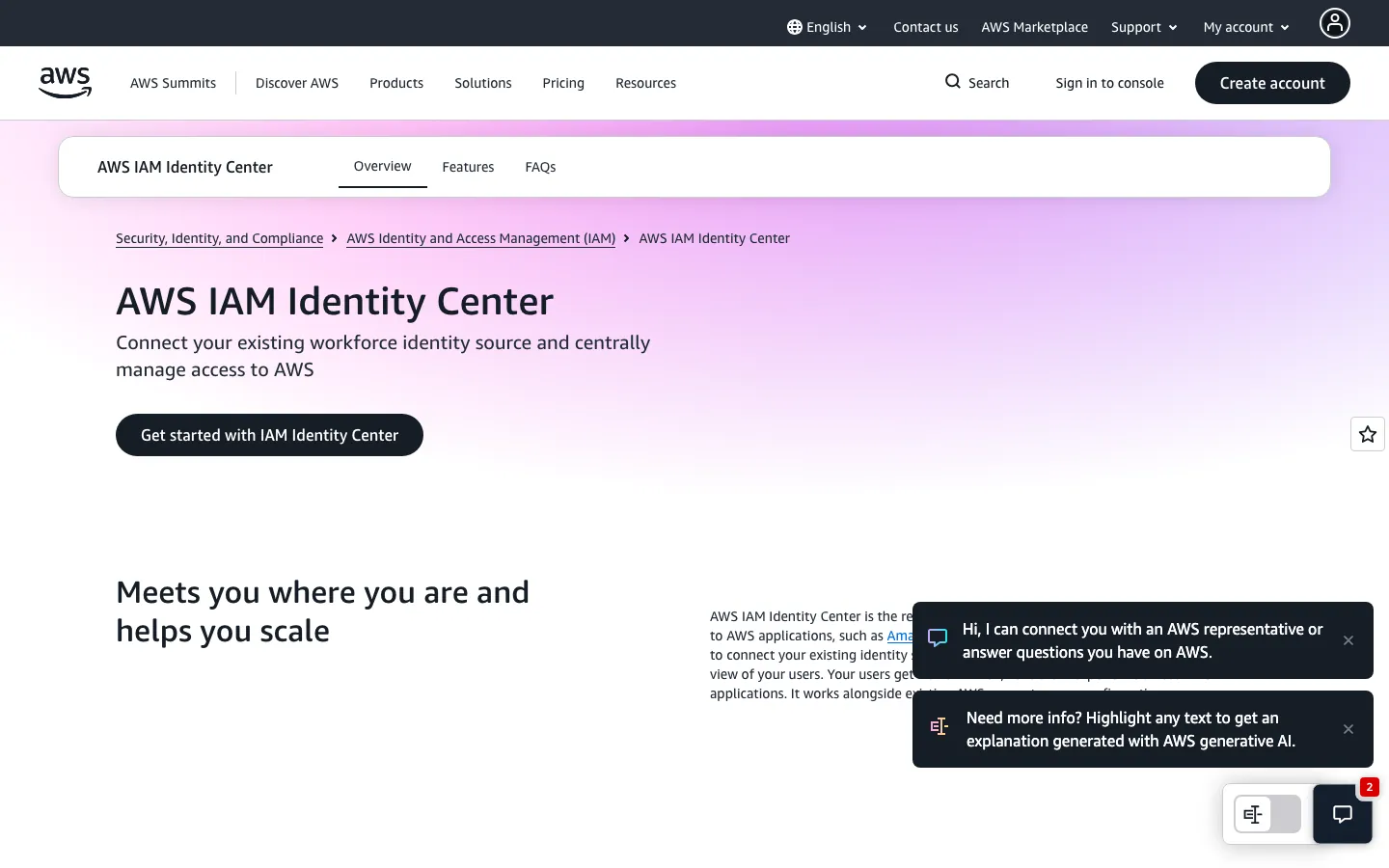
What's great
- Zero additional cost: AWS IAM Identity Center is included in every AWS account with no per-user fees; for AWS-native companies already paying for EC2 and S3, this is free workforce SSO
- Native multi-account governance across AWS Organizations: one permission set applies to 50 AWS accounts instantly, a task that requires separate tooling on every other platform
- Attribute-Based Access Control (ABAC) lets you write access policies that respond to user attributes (department, cost center, team tag) rather than managing static groups, a governance model that scales to 10,000 users without manual group maintenance
Watch-outs
- Designed for AWS-to-everything-else access, not general workforce SSO; connecting non-AWS SaaS apps works via SAML but is less turnkey than Okta's OIN or JumpCloud's catalog
- No mobile push notification MFA native to IAM Identity Center; MFA relies on TOTP apps or hardware tokens (FIDO2 keys), which creates more end-user friction than Duo's push UX
- Lifecycle management (joiners, movers, leavers) requires integration with an external HR system or SCIM provider; not self-contained like Okta or JumpCloud
AWS IAM Identity Center is the right call when the engineering org lives primarily in AWS and the budget conversation is real. Free, included, and genuinely capable for multi-account AWS access governance.
The AWS-native integration is what no other platform matches, spinning up permission sets across 40 AWS accounts in one action is a real-ops superpower for platform teams. 380 G2 reviews at 4.5/5 with consistent praise for the multi-account story and ABAC flexibility.
The constraint is that IAM Identity Center is optimized for AWS-first access, not general workforce SSO. Companies with meaningful Google Workspace, Atlassian, or SaaS-heavy stacks find the non-AWS SAML integration rougher than Okta.
Pair it with Okta or Entra ID for the SaaS SSO layer and use IAM Identity Center for AWS account access governance; the combination is the most cost-effective stack for AWS-native companies. See AWS IAM Identity Center FAQs for the SAML connector setup.
Pricing breakdown
| Plan | Price | Best for |
|---|---|---|
| Included | $0 | All AWS accounts |
| Advanced controls | AWS Security Hub costs apply | Orgs needing anomaly detection + compliance scoring |
| With Okta federation | $6+/user/mo Okta cost | Mixed AWS + SaaS workforce |
| With Entra ID federation | $6+/user/mo Entra P1 | AWS + Microsoft 365 hybrid |
Loading reviews…
Tools we considered but excluded
We evaluated more tools than the 9 you see above. These did not make the cut. Saying what we rejected, and why, is the editorial muscle most listicles skip.
- CyberArk Workforce Identity: Positioned primarily as privileged access management for infra-heavy orgs; pricing and complexity are enterprise-only and not comparable for the SaaS-first teams this guide targets
- SailPoint IdentityIQ: IGA (Identity Governance Administration) platform for complex compliance programs; requires 6-month implementations and dedicated identity architects, outside scope for most readers
- Google Cloud Identity: Useful as an identity extension for Google Workspace shops but is essentially a subset of Entra ID's feature set without the enterprise IAM depth; Workspace SSO covers the same ground for G-Suite-native orgs
- IBM Security Verify: FedRAMP High and DoD-authorized but the deployment model, pricing, and sales motion are aimed at government and large regulated enterprise; too heavy for 98% of the SaaS teams reading this guide
- ManageEngine ADManager Plus: Strong for Active Directory management and on-prem identity governance but lags cloud-native IAM platforms significantly in SCIM provisioning and SaaS app coverage
- Rippling IT: Compelling all-in-one HR-plus-IT pitch but the IAM module is secondary to the HRIS story; Okta or JumpCloud are stronger standalone identity purchases
Honorable mentions
Solid tools that did not crack the main list but are worth tracking, especially for niche use cases.
- Stytch: Developer-first auth with the cleanest passkeys and magic link implementation in the segment; worth tracking for consumer app authentication as a WorkOS alternative
- Frontegg: Lightweight multi-tenancy and enterprise SSO library that SaaS products embed directly; faster to ship than WorkOS for teams building tenant-level permissions into their product
- Delinea: Privileged access management that pairs well with Okta for orgs needing secrets management and just-in-time privileged escalation alongside standard IAM
The four categories of IAM and SSO platforms
The IAM market splits into four distinct categories that buyers frequently conflate. Getting the category wrong means buying the wrong tool entirely.
Workforce IAM. SSO, MFA, and lifecycle automation for employees. Okta Workforce Identity, Microsoft Entra ID, JumpCloud, OneLogin, and Ping Identity all live here. The buying team is IT and security. The use case is: every employee gets one login, provisioned automatically when they start, revoked automatically when they leave, and protected by phishing-resistant MFA throughout.
Customer Identity and Access Management (CIAM). Authentication and authorization for the customers or users of a product you build. Auth0, WorkOS, and Stytch live here. The buying team is engineering.
The use case is: when someone creates an account in your SaaS product, the identity infrastructure handles registration, login, MFA, and enterprise SSO so your team doesn’t build it from scratch. If you are searching for the best SSO integration platform for developers, this is the category to focus on, not workforce IAM.
MFA and device-trust layers. Cisco Duo sits in this sub-category. Rather than replacing an IAM platform, Duo bolts onto existing infrastructure to add phishing-resistant MFA, device-trust gating, and endpoint visibility. Many orgs run Okta for lifecycle management and Duo for endpoint MFA enrollment, using the platforms in combination.
Cloud infrastructure IAM. AWS IAM Identity Center, Google Cloud IAM, and Azure Privileged Identity Management focus on controlling access to cloud resources (AWS accounts, GCP projects, Azure subscriptions) rather than SaaS apps. AWS IAM Identity Center also bridges into SaaS SSO for AWS-native teams.
The nine platforms in this guide span all four categories. The section below clarifies which bucket your buying decision actually lives in before walking through the evaluation criteria.
Where the nine IAM platforms differ on core features
| Platform | SAML/OIDC SSO | Adaptive MFA | SCIM Lifecycle | Passwordless | Free Tier |
|---|---|---|---|---|---|
| Okta Workforce | ✓ | ✓ | ✓ | ✓ | ✗ trial |
| Microsoft Entra ID | ✓ | ✓ P2 | ✓ P1 | ✓ FIDO2 | ✓ basic SSO |
| Auth0 | ✓ | ✓ | ✓ Business | ✓ passkeys | ✓ 25K MAU |
| JumpCloud | ✓ | ✓ | ✓ | ✓ | ✓ 10 users |
| Cisco Duo | • via SAML | ✓ | ✗ | ✓ FIDO2 | ✓ 10 users |
| WorkOS | ✓ | ✓ | ✓ | ✓ passkeys | ✓ 1M MAU |
| OneLogin | ✓ | ✓ Advanced+ | ✓ Pro | ✓ | ✗ trial |
| Ping Identity | ✓ | ✓ | ✓ | ✓ | ✗ demo |
| AWS IAM Identity Center | ✓ | • TOTP/FIDO2 | • external SCIM | ✓ FIDO2 | ✓ all AWS |
WorkOS and Auth0 have the most generous free tiers by a wide margin. Okta has the broadest adaptive MFA and SCIM coverage across the widest app catalog. Cisco Duo is the only platform where SSO is secondary to MFA; use it as a layer, not a primary platform.
Compliance lockdown: SOC 2, HIPAA, FedRAMP, FIDO2, SAML vs OIDC
| Platform | SOC 2 Type II | GDPR | HIPAA BAA | FedRAMP | FIDO2 Native |
|---|---|---|---|---|---|
| Okta Workforce | ✓ | ✓ | ✓ | ✓ Moderate | ✓ |
| Microsoft Entra ID | ✓ | ✓ | ✓ | ✓ Moderate | ✓ |
| Auth0 | ✓ | ✓ | ✓ | ✗ | ✓ |
| JumpCloud | ✓ | ✓ | ✓ | ✗ | ✓ |
| Cisco Duo | ✓ | ✓ | ✓ | ✓ | ✓ |
| WorkOS | ✓ | ✓ | ✗ | ✗ | ✓ |
| OneLogin | ✓ | ✓ | ✓ | ✗ | ✓ |
| Ping Identity | ✓ | ✓ | ✓ | ✓ High | ✓ |
| AWS IAM Identity Center | ✓ | ✓ | ✓ | ✓ Moderate | ✓ |
For regulated industries or FedRAMP requirements, the platforms that clear the bar are Ping Identity (FedRAMP High), Okta (FedRAMP Moderate for the commercial Identity Cloud, plus FedRAMP High via its government-tier offering), AWS IAM Identity Center (Moderate), and Microsoft Entra ID (Moderate).
For pure HIPAA requirements, most platforms offer a BAA; the question is whether audit log export and access certification features satisfy your auditor’s specific controls, which vary by auditing firm.
On SAML vs OIDC: SAML 2.0 is still required for a long tail of legacy enterprise apps (Salesforce Enterprise, old Workday configurations, on-prem Oracle). OIDC is the right default for any modern cloud-native app. All nine platforms support both.
When building your own SaaS product, require OIDC from new vendor integrations; only fall back to SAML when an enterprise customer’s IdP demands it.
Integration depth across the IAM and SSO stack
| Platform | Slack | Google Workspace | GitHub | Workday | Salesforce |
|---|---|---|---|---|---|
| Okta Workforce | N | N | N | N | N |
| Microsoft Entra ID | N | M | N | N | N |
| Auth0 | M | M | N | ✗ | M |
| JumpCloud | N | N | N | M | N |
| Cisco Duo | N | N | N | • | N |
| WorkOS | M | ✗ | N | ✗ | ✗ |
| OneLogin | N | N | N | N | N |
| Ping Identity | N | N | N | N | N |
| AWS IAM Identity Center | • | M | N | M | M |
N = native first-party connector. M = marketplace or SAML/OIDC config required. • = limited or Zapier-only. ✗ = no documented path.
Okta has the strongest native integration story across all five columns by a large margin. JumpCloud is strong across mainstream SaaS. Microsoft Entra ID is native for Salesforce and GitHub but requires additional setup for Google Workspace (understandable given the competitive relationship).
AWS IAM Identity Center is native for GitHub and AWS-adjacent tooling but limited for pure SaaS connectors.
Workforce IAM vs Customer IAM, the split most buyers get wrong
This is the single category distinction that wastes the most buying budget in IAM. The two categories have different buyers, different security models, different compliance requirements, and different pricing logic.
Workforce IAM (Okta, Entra ID, JumpCloud, OneLogin, Ping) is bought by IT and security teams to manage employee access. The design requirement is: zero-friction daily login for employees, zero-trust enforcement at the perimeter, and clean audit trails for compliance. Pricing is per-employee-seat, billed annually, with enterprise governance add-ons layered on top.
Customer IAM / CIAM (Auth0, WorkOS, Stytch) is bought by engineering teams to authenticate end users of a product. The design requirement is: conversion-optimized login flows, flexible auth methods (social, magic link, passkeys), and B2B multi-tenancy where each enterprise customer might use a different identity provider. Pricing is per-monthly-active-user or per-connection, not per-employee-seat.
The common mistake is: a product team buys Auth0 because it’s cheap for CIAM, then tries to use it for workforce SSO (wrong product, wrong pricing model).
Or an IT team buys Okta for workforce IAM and tries to use it for the product’s customer authentication (possible but expensive; Auth0 at $0 for 25K MAU beats Okta’s CIAM story for early-stage products). Buy the right tool for the right category; the line between them is clear once you know it exists.
Selection criteria, what to test in your IAM trial
These are the eight tests worth running before signing any IAM contract.
One, run the full joiner-mover-leaver cycle on a synthetic user. Create a test user in your HR system or directory. Trigger the provisioning workflow. Verify the user appears in all apps with correct role assignments within five minutes.
Then promote the user to manager. Verify the new role propagates correctly. Then terminate the user.
Verify all app access is revoked within 60 seconds. Platforms that fail any leg of this test in a trial environment will fail in production at the worst possible moment.
Two, measure push notification delivery time under load. Send 50 MFA push notifications simultaneously and measure median delivery time. Anything above eight seconds creates end-user abandonment. Push UX is where the platforms diverge most under load, so run this test on your own traffic rather than trusting a vendor benchmark.
Three, test the de-provisioning speed for a terminated employee. This is the most important security test: take a provisioned user, mark them as terminated in your HR system, and measure how many seconds pass before their SSO session is revoked across all apps. The right answer is under two minutes. The wrong answer is anything involving a manual step, a ticket queue, or a scheduled batch sync.
Four, run an access certification against 100 entitlements. Most platforms claim access review support. The practical test is: generate a reviewable list of 100 user-app entitlements, assign reviewers, track completion, and verify that revocations actually propagate.
OneLogin and WorkOS have lighter certification flows; Okta Identity Governance and Microsoft Entra ID Governance are the leaders here. These access reviews are also the exact evidence a compliance automation platform pulls for a SOC 2 audit, so the IAM you pick shapes how clean that evidence looks come audit time.
Five, import 200 users from your HRIS and measure provisioning time. Take a real export from Workday, BambooHR, or Rippling. Import via SCIM. Measure how many users provision without errors on the first pass and how long the full sync takes. The first-pass error rate matters more than raw speed; legacy IAM platforms tend to choke on SCIM imports at this volume.
Six, attempt the admin console as a non-admin. Create a test account with a standard employee role. Try to access the admin console. Verify the role-based access control catches it. Then escalate that account to a mid-level admin and verify which actions are gated behind full-admin approval. Platforms with weak RBAC in the admin layer create insider-threat exposure.
Seven, export a 90-day audit log in structured format. Pull a full 90-day audit log of user logins, app access events, admin changes, and policy modifications. Verify the export is in a structured format (JSON or CSV, not PDF). Try importing it into your SIEM. Platforms that produce unstructured audit exports fail their own SOC 2 evidence requirements.
Eight, simulate a phishing attack against your MFA enrollment. Use a standard phishing simulation tool (GoPhish or similar) to test whether your MFA configuration resists real-time phishing proxy attacks. TOTP and SMS are vulnerable to AITM (adversary-in-the-middle) proxies. FIDO2 security keys and passkeys are resistant. Any platform that doesn’t support FIDO2 natively should be weighted lower in your security scoring.
How to choose the right IAM platform for your team
Five questions. Answer them and the shortlist drops from nine to two or three.
1. Employee access versus customer authentication
Employee access: Okta, Entra ID, JumpCloud, OneLogin, Ping Identity. Customer authentication: Auth0, WorkOS. Duo and AWS IAM Identity Center span both but with clear primary use cases.
2. Your Microsoft 365 licensing status
If you pay for M365 E3 or E5, Entra ID P1 is partially included and P2 costs $9/user/mo. For Microsoft shops, the math almost always favors Entra ID over a separate Okta contract for the core workforce SSO use case.
3. Team size and IT staffing model
- Under 50 seats with a one-person IT team: JumpCloud free tier, then $11-13/user/mo bundle.
- 50-300 seats with a two-person IT team: JumpCloud Platform or OneLogin Business.
- 300-2,000 seats with a dedicated IT/security team: Okta Core Essentials or Entra ID P2.
- 2,000+ seats with a CISO and identity team: Okta Enterprise, Ping Identity, or Entra ID P2 with Governance.
4. Building a SaaS product versus securing internal employees
Building a product: Auth0 for B2C consumer products. WorkOS for B2B SaaS needing enterprise SSO per customer. Both. Securing employees: everything else in this list.
5. Compliance certifications your auditor requires
FedRAMP Moderate or High: Microsoft Entra ID, Ping Identity, Okta (Moderate commercial, High via government tier), and AWS IAM Identity Center. HIPAA with BAA: most platforms sign one. SOC 2 Type II with access certifications: Okta Identity Governance or Entra ID Governance.
No formal compliance requirements: JumpCloud or OneLogin cover the basics without the governance add-on cost.
How to deploy IAM without a six-week lockout crisis
The IAM migrations that fail tend to fail for the same reason: they cut over too fast, without a rollback path. Four-phase deployment that works.
Phase 1 (weeks 1-2): Provision the directory and test lifecycle with synthetic users. Create 10-20 test accounts across the target apps in a staging environment. Run the full joiner-mover-leaver cycle. Don’t touch production users until this passes clean. Configure the HRIS sync in test mode and verify SCIM provisioning accuracy before enabling automatic provisioning.
Phase 2 (weeks 3-4): Pilot with one non-critical team. Choose a team of 10-20 people whose loss of access would be painful but recoverable (marketing, finance, not engineering or on-call). Migrate them fully: SSO, MFA enrollment, app provisioning. Leave their legacy credentials working in parallel for two weeks. Track helpdesk tickets carefully; any UX friction that spikes tickets is a rollout design issue, not a user training issue.
Phase 3 (weeks 5-8): Expand to all teams, maintain legacy parallel access. Roll out MFA enrollment to all users with a two-week completion window. Enforce MFA on the new platform before disabling legacy credentials. Use the IAM platform’s adoption dashboard to track enrollment percentage by team. Engineering and on-call teams get priority support and a dedicated Slack channel for IAM questions during the transition.
Phase 4 (weeks 9-12): Cut off legacy credentials and lock the policy baseline. Revoke legacy passwords and pre-SSO credentials. Lock down the SSO policy to require phishing-resistant MFA for all admin access. Configure the conditional access policy for out-of-scope IP addresses (VPN-required or geofencing).
Archive the legacy directory export and save it for 12 months per your retention policy. The orgs that skip Phase 4 and leave legacy credentials active indefinitely create a parallel attack surface that negates the entire IAM investment.
What is changing in IAM and SSO software in 2026
Passwordless is crossing from aspiration to deployment reality. Microsoft Entra ID and Okta both report that FIDO2 security key enrollments doubled from 2024 to 2025.
The operational change is that helpdesk password reset tickets, historically 15-25% of IT ticket volume, are declining in proportion to passkey adoption. The ROI calculation is now concrete enough to justify the change-management cost.
SSO and passkeys still don’t cover every credential. Shared vendor logins, legacy apps, and service accounts live outside the IdP, which is why most teams pair an IAM platform with one of the business password managers we test.
Okta’s pricing restructuring toward suite-based bundles. Okta moved from individual product SKUs to solution-based suites in early 2025.
The Okta blog post on simplified pricing frames it as simplification, but the Starter Suite at $6/user/mo is still not the all-in price: Governance, advanced workflows, and API access management are still separate line items.
The median customer still lands at $43,840/yr per CostBench’s 2026 pricing analysis .
AI-driven access anomaly detection is shipping in mainstream tiers. Okta’s Identity Threat Protection, Microsoft Entra ID Protection, and JumpCloud’s Conditional Access Policies all shipped AI-based anomaly detection at non-enterprise tier pricing in 2025-2026. The real-world value is catching credential-stuffing attacks faster than SIEM rules alone. The caveat is that tuning false-positive rates takes 60-90 days of baseline data, similar to the problem Zoho Zia faces in CRM.
CIAM consolidation is accelerating through Okta and WorkOS. Auth0 (part of Okta), WorkOS, and Stytch are competing for the same market: SaaS companies that want to offer enterprise SSO to their customers without building it in-house. Okta is pushing Auth0 hard at the enterprise tier.
WorkOS is growing faster at the startup and Series A tier with the per-connection pricing model and the 1M MAU free tier. Auth0 per-connection enterprise pricing is a commonly cited switching reason to WorkOS among mid-stage SaaS companies.
Non-human identity is the next unsolved problem. Machine-to-machine authentication, service accounts, API keys, and CI/CD secrets are the fastest-growing attack surface in cloud environments. JumpCloud’s 2026 messaging around ‘agentic identities’ is the first IAM platform to explicitly position for AI agent authentication.
AWS IAM Identity Center addresses AWS service roles natively. The market for non-human IAM is nascent; expect dedicated tooling (Conjur, HashiCorp Vault, Delinea) to merge with mainstream IAM platforms over the next 18 months.
FedRAMP authorization is becoming a procurement requirement outside government. Four years ago, FedRAMP was a government procurement requirement. Today, Fortune 1000 companies with government clients, healthcare systems, and financial services firms are requiring FedRAMP-authorized IAM from their vendors.
The good news for buyers is the field is wider than people assume: Okta (Moderate since 2017, plus High via its government tier), Microsoft Entra ID, Ping Identity, and AWS IAM Identity Center all carry FedRAMP authorization, so this requirement no longer narrows the shortlist to one or two names.
What IAM and SSO software really costs in year one
| Segment | Listed price | Real all-in (year 1) |
|---|---|---|
| JumpCloud (50 seats, SSO bundle) | $550/mo | $6,600-$8,000 |
| OneLogin Business (150 seats) | $1,500/mo | $18,000-$22,000 |
| Cisco Duo Advantage (200 seats) | $1,200/mo | $14,400-$16,000 |
| Okta Core Essentials (300 seats) | $4,200/mo | $60,000-$72,000 |
| Microsoft Entra ID P2 (500 seats) | $4,500/mo | $54,000-$65,000 |
| Ping Identity (5,000 user minimum) | $15,000/mo | $225,000-$300,000 |
“Real all-in” includes implementation partner cost (typically 30-50% of year-1 license for Okta and Ping), training credits, integration engineering time for non-SCIM apps, and the first-year admin overhead of one FTE at 0.25 allocation. JumpCloud and OneLogin have the lowest implementation overhead; Okta and Ping have the highest.
The single biggest forecast error buyers make: estimating per-seat cost from the entry-tier price. Okta’s SSO-only SKU at $2/user looks like $2,400/yr for 100 users. Once MFA, Lifecycle, and the Governance add-on are added, that same 100 users lands at $20,000-$22,000.
Get a full-bundle quote with all the features you’ll need in month six, not just month one.
The right IAM platform for each company stage
- Pre-seed, 1-10 employees: JumpCloud free tier. Zero cost, covers SSO and MFA for the first 10 users and 10 devices.
- Seed to Series A, 10-50 employees: JumpCloud SSO ($11/user/mo) or OneLogin Essentials ($6/user/mo). Don’t overbuy; the full Okta stack is unnecessary here.
- Series A to B, 50-200 employees, IT-led: JumpCloud Platform or OneLogin Business. The $10-13/user/mo range is the value zone for this stage.
- Series A to B, 50-200 employees, security-led or SOC 2 requirement: Okta Core Essentials ($14/user/mo). The audit evidence and lifecycle reliability justify the price step-up.
- Series B to C, 200-1,000 employees: Okta Essentials Suite ($17/user/mo) or Microsoft Entra ID P2 ($9/user/mo if already on M365 E3/E5). Budget for a dedicated identity admin.
- Series C+, 1,000+ employees: Okta Enterprise or Microsoft Entra ID P2 with Governance. Plan for 6-month implementation and a dedicated CISO-level sponsor.
- Enterprise, regulated industry (finance, healthcare, government): Ping Identity, Microsoft Entra ID, or Okta, all FedRAMP authorized. Ping carries High, Okta holds Moderate (commercial) plus High via its government tier, and Entra ID is Moderate. Match the level to what your auditor demands.
- AWS-native engineering orgs: AWS IAM Identity Center for cloud access governance, paired with Duo for MFA or Okta for SaaS SSO. The AWS-native combination is the most cost-effective stack for cloud-first teams.
- Building a B2C consumer product: Auth0 free tier (25K MAU). Don’t pay for anything until you cross 25K monthly active users.
- Building a B2B SaaS with enterprise customers: WorkOS for enterprise SSO per customer ($50-125/connection). The economics beat Auth0 for B2B SaaS at most stages until you exceed 50 enterprise connections.
- Need MFA fast without ripping out existing identity: Cisco Duo Essentials ($3/user/mo). Deploy in a day, plug into your existing directory, pass your next security audit with phishing-resistant MFA.
- Microsoft 365 E3/E5 shops at any stage: Microsoft Entra ID P1 or P2. The license cost is partially included; a separate Okta contract is a redundant spend.
For corrections, vendor disputes, or pricing updates to this guide, email hello@topickz.com . We re-test the IAM shortlist every six months; the next full refresh ships in November 2026.
Frequently asked questions
Workforce IAM vs CIAM, what is the actual difference?
Workforce IAM secures employee access to internal tools. CIAM handles customer login to your product. Okta and Entra ID own workforce. Auth0 and WorkOS own CIAM. Different buyers, different controls.
How much should IAM cost per employee per month in 2026?
SMB to mid-market lands $6-$17/user/mo. Enterprise all-in with governance runs $22+. JumpCloud and OneLogin undercut Okta by 40-60% for comparable core features.
Do we need both SSO and MFA, or does one replace the other?
Both. SSO reduces passwords but concentrates risk on one credential. MFA protects that credential. Running SSO without MFA is actively worse than no SSO at all.
How long does an Okta implementation take in practice?
4-6 weeks for 50-200 seats with a clean SaaS stack. 12-16 weeks for 200+ seats with legacy apps. Budget 2 hours per 100 apps for integration testing.
What is FedRAMP and which IAM platforms actually have it?
FedRAMP is federal cloud security authorization. Ping Identity, Microsoft Entra, and AWS IAM Identity Center have FedRAMP Moderate or High. Okta holds FedRAMP Moderate (commercial) and FedRAMP High through its government-tier offering.
SAML vs OIDC, which one should we require from our SaaS vendors?
OIDC for modern cloud-native apps. SAML for legacy enterprise apps that haven't updated. Both are fine; prefer OIDC where available for shorter token lifetimes and better mobile support.
What is the biggest hidden cost in IAM contracts?
Okta's per-product SKU stacking. The base SSO tier at $2/user looks cheap; lifecycle, MFA, and governance add-ons push the real cost to $17-22/user. Get a full-bundle quote before signing.
Can JumpCloud replace Active Directory completely?
For cloud-native orgs without on-prem Windows servers, yes. JumpCloud's cloud directory replaces AD for SSO, group policy, and device management. Legacy AD-dependent apps need LDAP bridge.
How do we test IAM during a trial without breaking production?
Provision a test directory with 10-20 synthetic users. Test full joiner-mover-leaver cycles. Check that de-provisioning revokes all app access within 60 seconds. Export audit logs.
Which IAM platform passes a SOC 2 Type II audit with the least prep work?
Okta and Entra ID have the most SOC 2 audit evidence pre-built. JumpCloud and Duo also ship audit log exports. Ping Identity has the deepest compliance documentation overall.
Related helpful reads
Write a review
Posts to the page right away. Keep it real — no links or email addresses.