

Comparing the best HRIS Platforms of 2026 includes 1. Rippling 2. Gusto 3. HiBob 4. BambooHR 5. Justworks 6. ADP Workforce Now 7. Paychex Flex 8. Workday HCM 9. Justworks Payroll.
TL;DR
- Rippling: Best overall for fast-growing companies that need HR, IT, and payroll unified. It carries the highest G2 rating in this guide at 4.8/5, and one offboarding workflow revokes Slack, laptop, and 401k access in a single pass.
- Gusto: Best payroll-first HRIS for US-only teams under 75 employees. It is the only platform here with public pricing you can read without a sales call, starting at $49/mo plus $6/person.
- HiBob: Best people-analytics and engagement HRIS for 100-800-person teams. Its analytics and engagement dashboards are built for people-data decisions, and native US payroll landed in January 2026, which removes the biggest reason not to consolidate on Bob.
- Justworks: Best PEO-model HRIS for compliance-heavy small teams. One invoice at $59/employee/mo bundles payroll, benefits, workers comp, and compliance, with no setup fees and month-to-month contracts.
- Workday HCM: Best enterprise HRIS for 1,000+ employee companies with global complexity. It is the only system here that survives past 2,000 employees without a custom build, but plan for a real implementation cost of $500K to $1.5M at the 1,000-3,000 range.
Nine HRIS platforms compared on pricing, real G2 review themes, and feature and compliance checks. Which one survives an 18-month growth sprint, which one your IT team won't hate, and the pick for every company stage from seed to post-IPO.
What Is an HRIS?
An HRIS helps companies manage employee records, payroll, benefits, and time off in one system, automating onboarding and compliance across the employee lifecycle.
Tools like Rippling, Gusto, HiBob, and BambooHR differ on payroll, global support, and price for small versus mid-market teams.
Best HRIS Platforms comparison: features, pricing and verdicts
| Tool | Best for | Starting price | Free trial | External rating |
|---|---|---|---|---|
Best overall for fast-growing companies that need HR, IT, and payroll unified | $8/employee/mo (Unity base) | Demo only | G2 4.8/5 (12,729 reviews) | |
Best payroll-first HRIS for US-only teams under 75 employees | $49/mo + $6/person | 30-day free trial | G2 4.6/5 (10,486 reviews) | |
Best people-analytics and engagement HRIS for 100-800-person teams | $16-25/employee/mo | Demo only | G2 4.5/5 (2,334 reviews) | |
Best compliance-first HRIS for HR-led small to mid-market teams | $10/employee/mo | 7-day free trial | Capterra 4.6/5 (3,429 reviews) | |
Best PEO-model HRIS for compliance-heavy small teams | $59/employee/mo | Demo only | G2 4.6/5 (1,126 reviews) | |
Best mid-market payroll-plus-HRIS for 75-750-person US companies | $23-30/employee/mo | Demo only | G2 4.2/5 (4,219 reviews) | |
Best payroll-first option for 10-150-person companies wanting simplicity | $39/mo + $5/employee | Demo only | G2 4.1/5 (1,699 reviews) | |
Best enterprise HRIS for 1,000+ employee companies with global complexity | Custom (starts ~$100/employee/yr) | Demo only | G2 4.1/5 (1,627 reviews) | |
Best standalone payroll for startups not ready for full HRIS | $8/employee/mo + $50/mo base | Demo only | G2 4.6/5 (1,126 reviews) |
How we chose these tools
We compared each platform on the things an HRIS buyer actually decides on: published pricing and the real all-in cost, the themes that recur across G2 reviews, the depth of payroll, onboarding, self-service, and reporting features, and compliance posture (SOC 2, GDPR, HIPAA, SSO, audit logs). Every HRIS vendor promises fewer tickets; the real test is how many you get on day 31. Pricing was verified directly on vendor pricing pages in May 2026. G2 ratings were pulled on May 28, 2026.
How we weight hris platforms for the Topickz score
Every tool above is scored against the fixed rubric below and combined using these weights into the Topickz score on each card. The weights are set for hris platforms specifically, they are not copied from another category, and we publish them so you can see what moved a ranking and re-weight for your own priorities.
| Criterion | Weight | What we checked |
|---|---|---|
| Core HR data model and records | 20% | One clean system of record for employee data is the reason to buy an HRIS at all. We checked how well each holds records, roles, and history without duplication. |
| Compliance posture | 17% | SOC 2, GDPR, HIPAA, SSO, and audit logs. An HRIS holds the most sensitive data in the company, so this weighting is deliberately high. |
| Payroll depth | 13% | Native payroll, multi-state handling, and for some vendors global coverage. Rippling's 185-plus country payroll sits at the deep end. |
| Onboarding and employee self-service | 12% | How much new-hire and day-to-day work employees can do themselves. The real test is how few tickets HR gets on day 31. |
| Reporting depth | 11% | Standard and custom reporting a people team can run without exporting everything to a spreadsheet. |
| Integration breadth | 10% | Native app connections with real two-way sync, not one-way exports. We counted working integrations, not marketing logos. |
| Pricing and all-in cost | 10% | Published pricing was verified on vendor pages in May 2026, from Gusto at $49/mo plus $6/person up to enterprise builds in the six figures. |
| Review signal | 7% | G2 ratings were pulled on May 28, 2026, and read for recurring themes rather than a single score. |
| Total | 100% |
Read the full TopickZ.com testing methodology for how we run each test, score every criterion, and combine them into a single rating.
Detailed reviews
Rippling
Best overall for fast-growing companies that need HR, IT, and payroll unified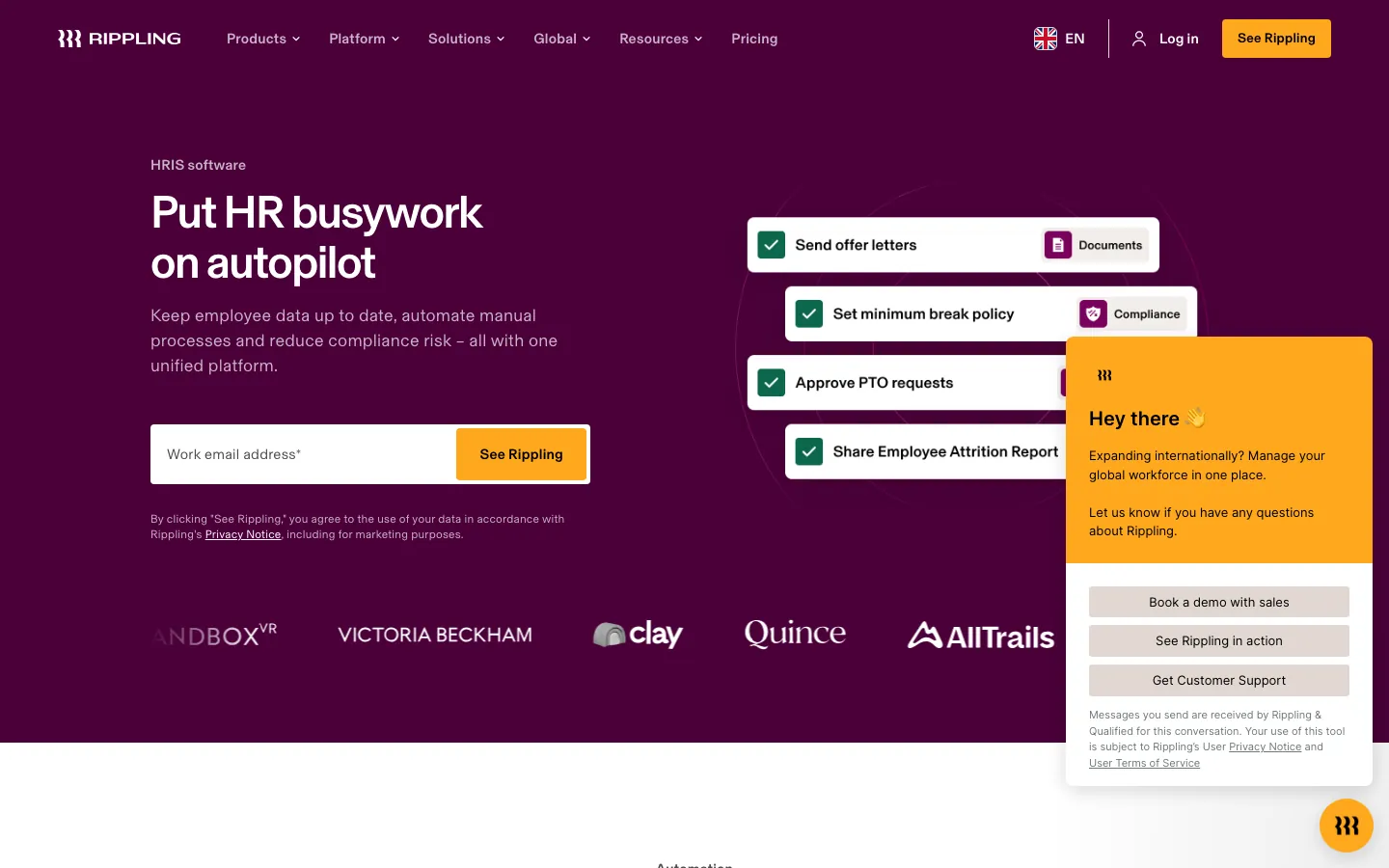
Screenshots of Rippling 4 images
What's great
- Cross-functional automation across HR, IT provisioning, and payroll in one data model: offboarding a rep deactivates their Slack, laptop, and 401k access in one workflow
- 500+ native app integrations with bidirectional sync, the deepest integration story of any HRIS in this comparison
- Global payroll in 185+ countries natively, no third-party EOR required for most jurisdictions
Watch-outs
- Per-module pricing compounds fast: Unity base ($8/employee/mo) plus payroll, benefits admin, and IT management realistically lands $20-$35 PEPM all-in for a 100-person team
- Support response times draw consistent complaints in G2 reviews, with slow first-response on standard tickets a recurring theme
- No published pricing, every contract is negotiated, which means two companies of similar size can pay meaningfully different rates
Pricing breakdown
| Plan | Price | Best for |
|---|---|---|
| Unity (base) | $8/employee/mo | Required foundation; all other modules sit on top |
| + HR Cloud | ~$6/employee/mo add-on | Core HRIS records; workflows; onboarding |
| + Payroll | ~$8/employee/mo add-on | Full US payroll + tax filing |
| + IT Management | ~$8-12/employee/mo add-on | Device provisioning; SaaS access control |
Security & compliance
| Standard | Availability |
|---|---|
| SOC 2 Type II | Yes |
| GDPR | Yes |
| HIPAA | Yes |
| SSO / SAML | ✓ all tiers |
| Audit logs | Yes |
Rippling compliance summary: SOC 2 Type II is yes, GDPR is yes, HIPAA is yes, SSO/SAML is ✓ all tiers, and audit logs is yes.
Key integrations
| Integration | Type |
|---|---|
| Gmail | N/A |
| Outlook | N/A |
| Slack | Native integration |
| LinkedIn Sales Navigator | N/A |
| Outreach / Salesloft | N/A |
Rippling integration summary: Gmail is not specified, Outlook is not specified, Slack is native integration, LinkedIn Sales Navigator is not specified, and Outreach or Salesloft is not specified.
Feature availability
| Feature | Status |
|---|---|
| Mobile app | ✓ |
| Open API | ✓ |
| Payroll | ✓ native |
| Performance management | $ add-on |
| Self service | ✓ |
Rippling feature availability summary: Mobile app (✓), Open API (✓), Payroll (✓ native), Performance management ($ add-on), and Self service (✓).
What reviewers say about Rippling
Recurring themes across ~12,729 G2 reviews (4.8/5), cross-checked against Capterra, Trustpilot, and Reddit/BBB threads, 2024-2026.
What reviewers praise
- The unified data model draws the most consistent praise: because HRIS, payroll, benefits, time, and IT all sit on one employee record, a promotion or address change flows automatically into payroll and benefits instead of being re-keyed in five tools.
- Reviewers repeatedly call the setup and day-to-day interface clean and fast, with automation that removes manual steps for teams running payroll across multiple states or entities.
- The integration breadth (650+ app connections) and the ability to bundle IT provisioning, device management, and app access alongside HR is cited as a genuine reason teams consolidate onto Rippling.
- Global and multi-state payroll compliance is praised as reliable, including detailed local tax handling, so finance teams report fewer manual overrides at pay-run time.
What reviewers fault
- Opaque, escalating pricing is the single most common gripe: you buy the base Unity platform per employee first, then stack paid modules on top, and reviewers say true all-in cost is hard to compare against competitors before a sales call.
- Support is ticket and chat only with no general phone line, and reviewers report slow or inconsistent resolution once a ticket is routed to the wrong queue.
- The sheer feature depth creates a real learning curve, and configuring advanced workflows or integrations can feel overly complex during onboarding.
- Botched implementations recur in BBB and Reddit accounts: paid onboarding that left teams to self-configure, difficult historical tax-data migration, and account managers who go quiet after the sale.
- The mobile app is described as buggy and missing features that exist on desktop, and reviewers note occasional sync delays between modules on time-sensitive payroll tasks.
Loading reviews…
Gusto
Best payroll-first HRIS for US-only teams under 75 employees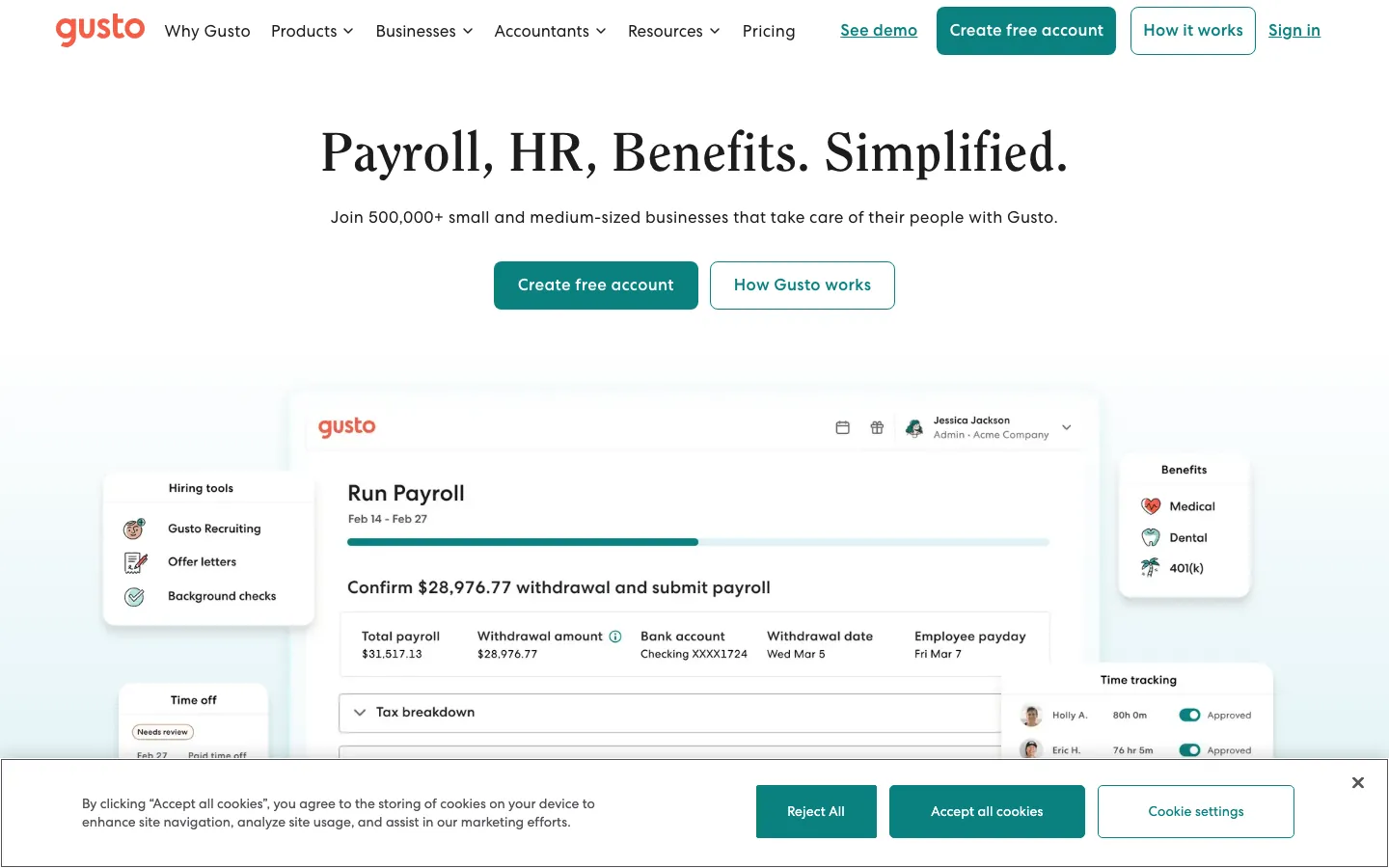
Screenshots of Gusto 3 images
What's great
- Transparent published pricing ($49/mo + $6/person on Simple, $80/mo + $12/person on Plus), the only HRIS in this guide that doesn't require a sales call to get a number
- Best payroll UX in the segment; the run-payroll flow is consistently the most-praised part of Gusto in G2 reviews
- HiBob launched native US payroll powered by Gusto's engine in late 2025, a validation of how good the payroll core actually is
Watch-outs
- Not the right pick for multi-country teams; international payroll is through Gusto Global (EOR), which adds cost and workflow complexity
- Reporting depth is lighter than HiBob or Rippling; past 100 employees the analytics gaps become friction for people-data-focused HR teams
- March 2026 pricing increase raised the Simple plan base from $40 to $49/mo, the first price hike since 2022
Pricing breakdown
| Plan | Price | Best for |
|---|---|---|
| Simple | $49/mo + $6/person | Under 25 employees; basic payroll + filing |
| Plus | $80/mo + $12/person | 25-50 employees; time tracking + multi-state |
| Premium | $180/mo + $22/person | 50-100 employees; HR advisory + priority support |
| Gusto Global (EOR) | $599/person/mo | International contractors and employees |
Security & compliance
| Standard | Availability |
|---|---|
| SOC 2 Type II | Yes |
| GDPR | Yes |
| HIPAA | Limited |
| SSO / SAML | Premium |
| Audit logs | Plus+ |
Gusto compliance summary: SOC 2 Type II is yes, GDPR is yes, HIPAA is limited, SSO/SAML is premium, and audit logs is plus+.
Key integrations
| Integration | Type |
|---|---|
| Gmail | N/A |
| Outlook | N/A |
| Slack | Native integration |
| LinkedIn Sales Navigator | N/A |
| Outreach / Salesloft | N/A |
Gusto integration summary: Gmail is not specified, Outlook is not specified, Slack is native integration, LinkedIn Sales Navigator is not specified, and Outreach or Salesloft is not specified.
Feature availability
| Feature | Status |
|---|---|
| Mobile app | ✓ |
| Open API | ✓ |
| Payroll | ✓ native |
| Performance management | • |
| Self service | ✓ |
Gusto feature availability summary: Mobile app (✓), Open API (✓), Payroll (✓ native), Performance management (•), and Self service (✓).
What reviewers say about Gusto
Recurring themes across ~10,486 G2 reviews (4.6/5), cross-checked against Capterra, Trustpilot, and BBB complaints, 2024-2026.
What reviewers praise
- Ease of use is the standout theme: small-business admins repeatedly say payroll and onboarding are quick to set up and simple to run without a dedicated HR person.
- Automated payroll runs and automatic federal, state, and local tax filing are praised for removing the manual filing burden that trips up first-time employers.
- The all-in-one bundle of payroll, benefits administration, and basic HR at an approachable price is cited as strong value for companies under roughly 100 employees.
- The employee self-service portal, where staff view pay stubs, W-2s, and benefits on their own, is frequently called out for cutting down admin back-and-forth.
What reviewers fault
- Support is the most common complaint by far: no dedicated account manager, inconsistent agent quality, and slow resolution exactly when it hurts, on tax notices, W-2 corrections, and reversed direct deposits (a pattern that pulls the Trustpilot score far below G2).
- Reviewers report payment-processing errors: incorrect tax withholdings, delayed or reversed deposits, and onboarding staff mishandling tax setup despite information being provided in writing.
- Advanced reporting and customization are thin compared with enterprise HR systems, so growing teams outgrow the reporting depth.
- Recent price increases draw complaints, with the base plan and EOR rates both raised inside a single year.
- W-2 handling on mid-year cancellation is a documented pain point, with the option to file buried in the cancellation flow and former employees affected when it is missed.
Loading reviews…
HiBob
Best people-analytics and engagement HRIS for 100-800-person teams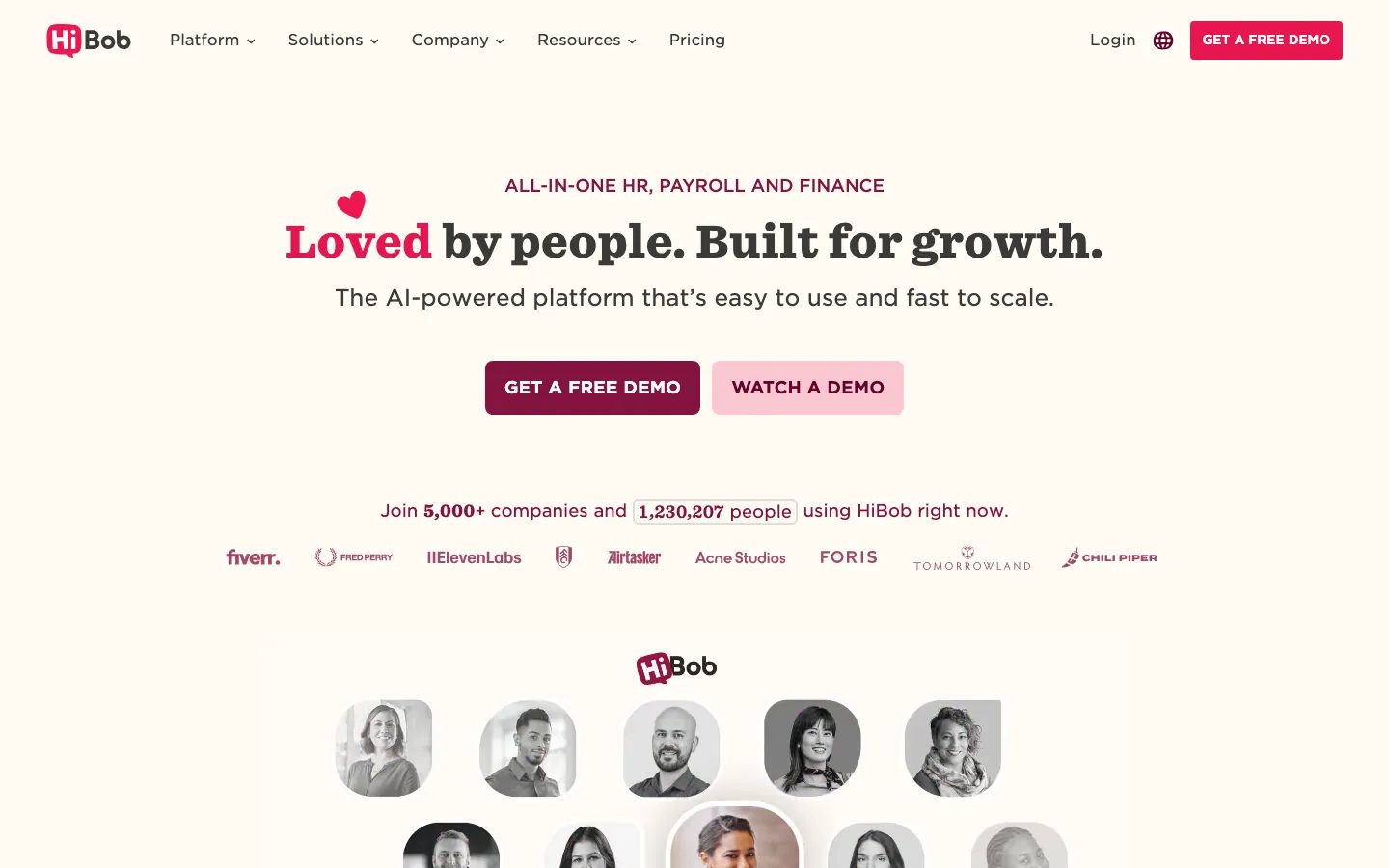
What's great
- Strongest people analytics and engagement layer in the mid-market segment, the dashboards are designed for people-data decisions, not just compliance reporting
- Launched native US payroll (powered by Gusto's engine) in January 2026, eliminating the payroll-integration dependency that was the platform's biggest knock
- The self-service portal and employee experience design is noticeably better than BambooHR and Rippling; employees actually use it
Watch-outs
- Custom pricing only, typical contracts land $16-25 PEPM plus 10-20% implementation fee, making year-one cost hard to forecast without a call
- The newer US payroll module (GA January 2026) is mature in features but hasn't been tested across 12+ months of real edge cases the way Gusto's core has
- Customer support response times draw the same complaints as Rippling; enterprise-tier CSM access isn't automatic
Pricing breakdown
| Plan | Price | Best for |
|---|---|---|
| Core | ~$16/employee/mo | 50-200 employees; HRIS records + self-service |
| Core + Payroll | ~$20/employee/mo | 50-200 employees with US payroll bundled |
| Plus (performance + comp) | ~$25/employee/mo | 200-800 employees; analytics-focused HR |
| Enterprise | Custom | 800+ employees; multi-entity; global teams |
Security & compliance
| Standard | Availability |
|---|---|
| SOC 2 Type II | Yes |
| GDPR | Yes |
| HIPAA | Limited |
| SSO / SAML | ✓ all tiers |
| Audit logs | Yes |
HiBob compliance summary: SOC 2 Type II is yes, GDPR is yes, HIPAA is limited, SSO/SAML is ✓ all tiers, and audit logs is yes.
Key integrations
| Integration | Type |
|---|---|
| Gmail | N/A |
| Outlook | N/A |
| Slack | Native integration |
| LinkedIn Sales Navigator | N/A |
| Outreach / Salesloft | N/A |
HiBob integration summary: Gmail is not specified, Outlook is not specified, Slack is native integration, LinkedIn Sales Navigator is not specified, and Outreach or Salesloft is not specified.
Feature availability
| Feature | Status |
|---|---|
| Mobile app | ✓ |
| Open API | ✓ |
| Payroll | ✓ native (Jan 2026) |
| Performance management | ✓ built-in |
| Self service | ✓ |
HiBob feature availability summary: Mobile app (✓), Open API (✓), Payroll (✓ native (Jan 2026)), Performance management (✓ built-in), and Self service (✓).
What reviewers say about HiBob
Recurring themes across ~2,334 G2 reviews (4.5/5), cross-checked against Capterra and Trustpilot, 2024-2026.
What reviewers praise
- The modern, visual, engaging interface is the most repeated praise: reviewers say Bob is genuinely pleasant to use and easy for employees to navigate, which lifts adoption over legacy HRIS tools.
- Built-in culture and engagement tools, shoutouts, clubs, pulse surveys, and a social feed running natively on the HR record, are called a real differentiator that other core HRIS products do not match.
- Customization of fields, homepage, and the org view is praised for letting mid-market teams shape the system to their own structure without heavy IT work.
- The support team earns frequent positive mentions for quick responses and for actually acting on product feedback.
What reviewers fault
- Missing native payroll (outside the US and UK) and a weak built-in ATS force third-party integrations and manual workarounds, which reviewers say is the biggest functional gap.
- Pricing is quote-only with nothing published, and reviewers find it frustrating to have to book a sales demo before knowing whether Bob fits their budget.
- Reporting and analytics depth is limited, so teams needing advanced or deeply custom reports hit a ceiling in the built-in tools.
- Workflow and time-off configuration are seen as inflexible in places, with reviewers citing gaps like not being able to reassign an absent employee's tasks.
- Implementation and data import can take significant time or vendor help for larger or more complex organizations.
Loading reviews…
BambooHR
Best compliance-first HRIS for HR-led small to mid-market teams
Screenshots of BambooHR 3 images
What's great
- Cleanest onboarding setup in the comparison; the onboarding builder is one of the fastest to get core records and a full onboarding flow live
- Live phone support from human reps, a real differentiator vs Rippling and HiBob where email and chat are the primary channels
- Strong performance management (360 reviews, 1-on-1 templates, calibration) on the Pro and Elite tiers, not treated as an afterthought
Watch-outs
- Payroll is an add-on (or handled via payroll-provider integration), not native core; the Paychex and ADP integrations work but add a vendor and an invoice
- $250/mo minimum for teams under 25 employees makes it more expensive than Gusto at small headcount
- No public pricing; getting an actual quote requires a sales conversation, and contract prices vary widely based on negotiation
Pricing breakdown
| Plan | Price | Best for |
|---|---|---|
| Core | ~$10/employee/mo | Under 100 employees; records + onboarding |
| Pro | ~$17/employee/mo | 100-300 employees; performance management + community |
| Elite | ~$25/employee/mo | 300-500 employees; compensation planning + analytics |
| Add-on: Payroll | ~$6/employee/mo extra | Any tier adding managed payroll |
Security & compliance
| Standard | Availability |
|---|---|
| SOC 2 Type II | Yes |
| GDPR | Yes |
| HIPAA | $ available |
| SSO / SAML | Pro+ |
| Audit logs | Pro+ |
BambooHR compliance summary: SOC 2 Type II is yes, GDPR is yes, HIPAA is $ available, SSO/SAML is pro+, and audit logs is pro+.
Key integrations
| Integration | Type |
|---|---|
| Gmail | N/A |
| Outlook | N/A |
| Slack | Native integration |
| LinkedIn Sales Navigator | N/A |
| Outreach / Salesloft | N/A |
BambooHR integration summary: Gmail is not specified, Outlook is not specified, Slack is native integration, LinkedIn Sales Navigator is not specified, and Outreach or Salesloft is not specified.
Feature availability
| Feature | Status |
|---|---|
| Mobile app | ✓ |
| Open API | ✓ |
| Payroll | $ add-on |
| Performance management | Pro+ |
| Self service | ✓ |
BambooHR feature availability summary: Mobile app (✓), Open API (✓), Payroll ($ add-on), Performance management (Pro+), and Self service (✓).
What reviewers say about BambooHR
Recurring themes across ~3,429 Capterra reviews (4.6/5) and G2 reviews (4.4/5), 2024-2026.
What reviewers praise
- The interface is the most-praised aspect by a wide margin: reviewers across company sizes call it one of the cleanest HR UIs they have used, with new employees self-serving from day one.
- Onboarding automation earns consistent praise for pre-boarding packet delivery, e-signature workflows, and automated task checklists that reduce HR coordinator workload.
- Time-off management is called out specifically: the system accounts for company holidays automatically, which reviewers say eliminates a common manual error.
- Mobile app performance is praised as reliable and responsive, with employees able to request leave, view pay stubs, and update personal info without calling HR.
- Customer support response times are rated highly, with most reviewers noting fast, knowledgeable help on initial tickets during business hours.
What reviewers fault
- Payroll module limitations are the top complaint: reviewers say it lacks automation depth and often requires manual reconciliation steps, especially for multi-state payroll.
- Pricing opacity frustrates buyers, with per-employee charges, separate add-on fees for payroll and performance modules, and no public rate card on the website.
- Reporting customization is limited: building non-standard reports requires more clicks than expected and export formatting options are narrow.
- The platform shows strain at scale, with reviewers at larger organizations (500+ employees) noting it lacks the workflow complexity their HR operations require.
- Support quality outside US business hours draws complaints, with slower response times flagged by international teams and US offices needing after-hours help.
Loading reviews…
Justworks
Best PEO-model HRIS for compliance-heavy small teams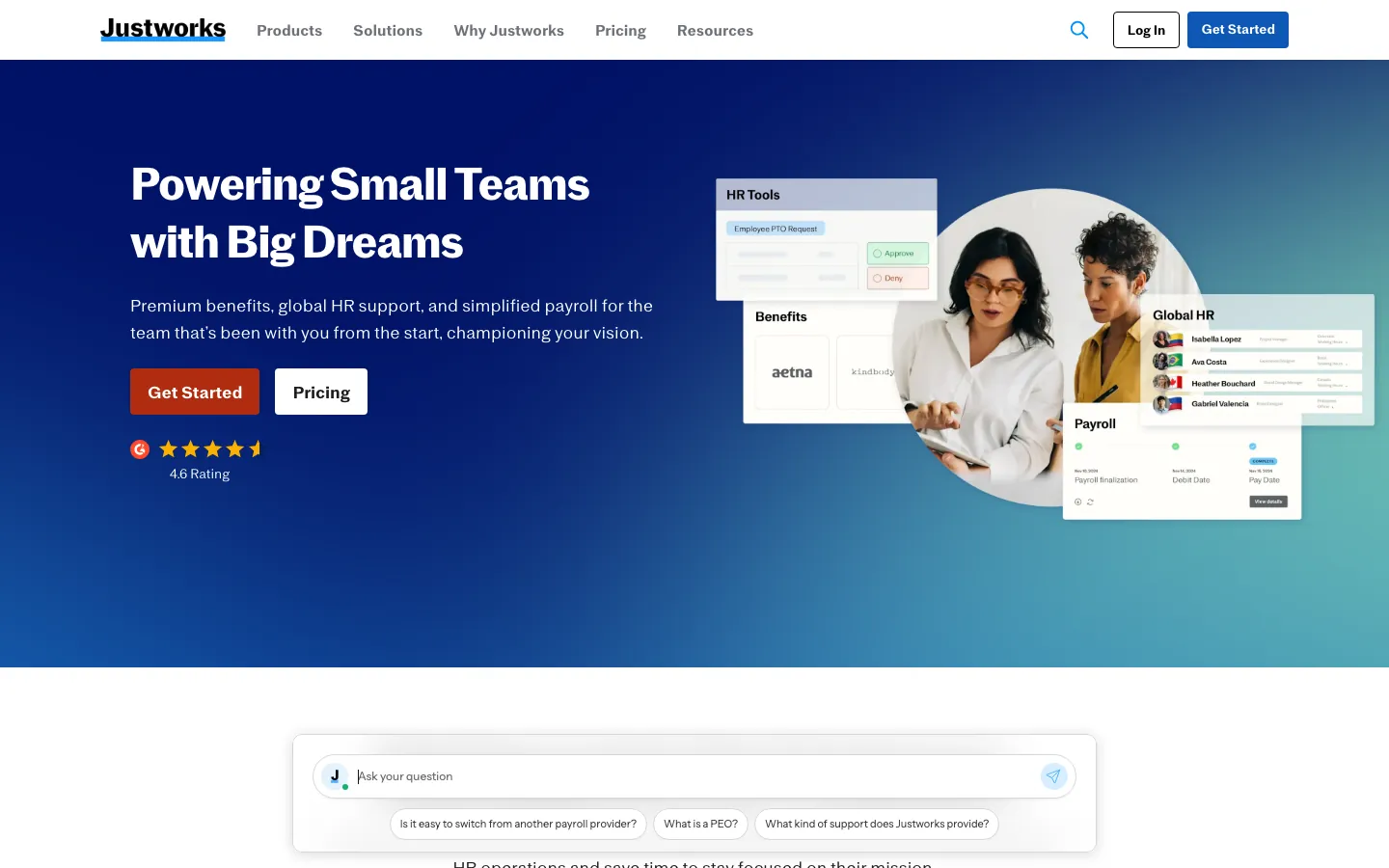
Screenshots of Justworks 3 images
What's great
- Full PEO model bundles payroll, benefits administration (via Aetna and UnitedHealthcare), workers comp, and compliance into one invoice at $59/employee/mo Basic
- No setup fees, no long-term contracts, month-to-month on all plans, the most flexible purchase structure in this comparison
- 24/7 support included on all tiers, the only platform in this guide where you can call at 11pm on a Sunday during open enrollment
Watch-outs
- $59/employee/mo Basic (or $109/mo Plus with health insurance admin) is premium pricing vs buying HRIS plus benefits separately for larger teams
- Platform is built around the PEO model; companies that want to exit the PEO and run benefits independently have a meaningful migration project ahead
- Reporting is functional but not deep; teams that need compensation benchmarking or advanced people analytics will outgrow it
Pricing breakdown
| Plan | Price | Best for |
|---|---|---|
| PEO Basic | $59/employee/mo | 10-75 employees; payroll + compliance + 401k |
| PEO Plus | $109/employee/mo | 10-100 employees; adds full health/dental/vision admin |
| Justworks Payroll | $8/employee/mo + $50/mo base | Teams that want payroll only; no PEO |
| Justworks EOR | $599/employee/mo | International contractors in 50+ countries |
Security & compliance
| Standard | Availability |
|---|---|
| SOC 2 Type II | Yes |
| GDPR | Yes |
| HIPAA | Yes |
| SSO / SAML | Yes |
| Audit logs | Yes |
Justworks compliance summary: SOC 2 Type II is yes, GDPR is yes, HIPAA is yes, SSO/SAML is yes, and audit logs is yes.
Key integrations
| Integration | Type |
|---|---|
| Gmail | N/A |
| Outlook | N/A |
| Slack | Native integration |
| LinkedIn Sales Navigator | N/A |
| Outreach / Salesloft | N/A |
Justworks integration summary: Gmail is not specified, Outlook is not specified, Slack is native integration, LinkedIn Sales Navigator is not specified, and Outreach or Salesloft is not specified.
Feature availability
| Feature | Status |
|---|---|
| Mobile app | ✓ |
| Open API | ✓ |
| Payroll | ✓ native |
| Performance management | ✗ |
| Self service | ✓ |
Justworks feature availability summary: Mobile app (✓), Open API (✓), Payroll (✓ native), Performance management (✗), and Self service (✓).
What reviewers say about Justworks
Recurring themes across ~1,126 G2 reviews (4.6/5) for Justworks and Justworks Payroll, cross-checked against Capterra, TrustRadius, Trustpilot, and Reddit, 2024-2026.
What reviewers praise
- Transparent, publicly listed pricing is a genuine differentiator that reviewers repeatedly note, since PEO rivals like Paychex, TriNet, and ADP all hide rates behind a sales call.
- Ease of use is a dominant theme: straightforward setup, clean organization, and a design simple enough that a small team can run payroll and HR without specialists.
- Access to Fortune-500-caliber benefits, big-carrier medical plus 401(k) through co-employment pooling, lets 20 to 200 person companies offer plans they could not negotiate alone.
- Customer support is rated highly for routine questions, with reviewers citing human, multi-channel help and answers within hours.
What reviewers fault
- Per-employee PEO fees feel steep, and reviewers note that once you pass roughly 50 to 100 employees the model gets expensive versus a standalone HRIS plus broker.
- Integrations are very limited (a handful of connectors), so teams relying on a wider software stack hit walls versus platforms with hundreds of integrations.
- Support quality falls off a cliff during real escalations: missed payroll runs, W-2 errors needing IRS follow-up, and tickets going unanswered surface in Trustpilot and Reddit accounts.
- The platform trades flexibility for simplicity, so reviewers flag limited customization and missing features for teams with non-standard needs.
- Recurring app bugs (freezing, crashes, login issues) disrupt time tracking, and eligibility restrictions exclude high-risk or heavily contractor-based businesses from the workers' comp policy.
Loading reviews…
ADP Workforce Now
Best mid-market payroll-plus-HRIS for 75-750-person US companies
Screenshots of ADP Workforce Now 3 images
What's great
- Payroll processing depth and tax compliance breadth is unmatched in the mid-market; 40+ years of tax-law updates baked into the engine
- Named Best Software for Mid-Market Businesses by G2 in the 2026 awards, a category-specific validation
- Strong time and attendance and benefits administration modules that hold up at 200-500 employees where lightweight HRIS tools start breaking down
Watch-outs
- 4.2/5 on G2 across 4,219 reviews, among the lowest satisfaction scores in this guide; complex UX is the consistent gripe
- No public pricing; custom quote required, and pricing varies based on negotiation and account-executive relationship
- Implementation takes 8-16 weeks for a clean deployment; faster than Workday but meaningfully slower than BambooHR or Gusto
Pricing breakdown
| Plan | Price | Best for |
|---|---|---|
| Select | ~$23/employee/mo | 75-200 employees; payroll + basic HR records |
| Plus | ~$27/employee/mo | 200-400 employees; adds benefits administration |
| Premium | ~$30+/employee/mo | 400-750 employees; adds time and attendance |
| Comprehensive Services | $40-50/employee/mo | Outsourced HR + payroll administration |
Security & compliance
| Standard | Availability |
|---|---|
| SOC 2 Type II | Yes |
| GDPR | Yes |
| HIPAA | Yes |
| SSO / SAML | ✓ all tiers |
| Audit logs | Yes |
ADP Workforce Now compliance summary: SOC 2 Type II is yes, GDPR is yes, HIPAA is yes, SSO/SAML is ✓ all tiers, and audit logs is yes.
Key integrations
| Integration | Type |
|---|---|
| Gmail | N/A |
| Outlook | N/A |
| Slack | Marketplace add-on |
| LinkedIn Sales Navigator | N/A |
| Outreach / Salesloft | N/A |
ADP Workforce Now integration summary: Gmail is not specified, Outlook is not specified, Slack is marketplace add-on, LinkedIn Sales Navigator is not specified, and Outreach or Salesloft is not specified.
Feature availability
| Feature | Status |
|---|---|
| Mobile app | ✓ |
| Open API | ✓ |
| Payroll | ✓ native |
| Performance management | $ add-on |
| Self service | ✓ |
ADP Workforce Now feature availability summary: Mobile app (✓), Open API (✓), Payroll (✓ native), Performance management ($ add-on), and Self service (✓).
What reviewers say about ADP Workforce Now
Recurring themes across ~4,219 G2 reviews (4.2/5), cross-checked against Capterra, GetApp, Gartner Peer Insights, and Reddit, 2024-2026.
What reviewers praise
- Core payroll, tax, and benefits administration are the recognized strength: reviewers trust ADP to run accurate multi-state payroll and handle tax filing at a scale few competitors match.
- Consolidating payroll, benefits, and time and attendance in one platform with employee self-service is praised for cutting admin work across a large workforce.
- The outsourcing layers, letting companies hand off payroll tax, garnishments, and compliance to ADP-managed services, are called out as valuable for teams without a big internal HR bench.
- The employee-facing mobile app and self-service for pay stubs, tax forms, and time-off requests get steady positive mentions for everyday convenience.
What reviewers fault
- Poor customer support is the single most cited complaint (tagged over 100 times in recent G2 reviews): long hold times, transfers between departments, and slow resolution on urgent issues.
- The interface and reporting feel dated and clunky, with reviewers describing awkward navigation and a report-building process that is hard to learn.
- Customization is limited, so reports and workflows are inflexible for teams with non-standard requirements.
- Opaque pricing and hidden fees recur across accounts: implementation charges, annual platform fees, and per-item costs like W-2 printing and garnishment processing that were not clear during the sale.
- Costs creep upward each renewal as modules are added, and BBB threads document early-termination and post-cancellation billing disputes.
Loading reviews…
Paychex Flex
Best payroll-first option for 10-150-person companies wanting simplicity
Screenshots of Paychex Flex 2 images
What's great
- Essentials plan starts at $39/mo + $5/employee, the lowest published entry price in the mid-market HRIS segment
- Dedicated payroll specialist assigned to your account on most mid-tier plans, a human backup most SaaS HRIS tools don't offer
- Strong 24/7 phone support reputation; consistently outperforms Rippling and HiBob on support satisfaction in TrustRadius surveys
Watch-outs
- Multi-state payroll tax filing requires Pro tier or above; Essentials is single-state only, a limitation that bites growing companies
- Platform feels like payroll with HR bolted on, not a native HRIS; the recordkeeping and performance modules are noticeably lighter than BambooHR at the same price point
- Mobile app UX lags behind Gusto and HiBob, and employee self-service adoption tends to be lower as a result
Pricing breakdown
| Plan | Price | Best for |
|---|---|---|
| Essentials | $39/mo + $5/employee | 10-50 employees; single-state payroll |
| Select | Custom quote | 50-150 employees; multi-state + dedicated specialist |
| Pro | Custom quote | 150-500 employees; full HR suite + time tracking |
| Enterprise | Custom quote | 500+ employees; multi-EIN; advanced analytics |
Security & compliance
| Standard | Availability |
|---|---|
| SOC 2 Type II | Yes |
| GDPR | Limited |
| HIPAA | Yes |
| SSO / SAML | Pro+ |
| Audit logs | Pro+ |
Paychex Flex compliance summary: SOC 2 Type II is yes, GDPR is limited, HIPAA is yes, SSO/SAML is pro+, and audit logs is pro+.
Key integrations
| Integration | Type |
|---|---|
| Gmail | N/A |
| Outlook | N/A |
| Slack | Marketplace add-on |
| LinkedIn Sales Navigator | N/A |
| Outreach / Salesloft | N/A |
Paychex Flex integration summary: Gmail is not specified, Outlook is not specified, Slack is marketplace add-on, LinkedIn Sales Navigator is not specified, and Outreach or Salesloft is not specified.
Feature availability
| Feature | Status |
|---|---|
| Mobile app | ✓ |
| Open API | ✓ |
| Payroll | ✓ native |
| Performance management | • limited |
| Self service | ✓ |
Paychex Flex feature availability summary: Mobile app (✓), Open API (✓), Payroll (✓ native), Performance management (• limited), and Self service (✓).
What reviewers say about Paychex Flex
Recurring themes across ~1,699 G2 reviews (4.1/5), cross-checked against Capterra and BBB complaints, 2024-2026.
What reviewers praise
- Reviewers find core payroll straightforward to run day to day, with a self-service portal that makes pay, time, and employee data easy to manage for small and mid-size teams.
- Full-service tax filing and compliance handling are cited as reliable, which is the main reason smaller employers stay with an established provider like Paychex.
- Many reviewers call it good value for time tracking plus payroll, and note it can come in cheaper than some other national payroll companies.
- When you reach a knowledgeable rep, support and onboarding help are praised, and the breadth of add-on HR services (401(k), benefits, HR advisory) suits growing teams.
What reviewers fault
- Support is inconsistent and a frequent complaint: slow response times, high rep turnover, and the recent cut from 24/7 to 8am-8pm coverage frustrate users who need urgent help.
- Pricing is opaque and reviewers report invoices exceeding the quote because of undisclosed add-ons for W-2s, integrations, and time tracking.
- Early-termination fees and continued billing after cancellation are documented in BBB complaints, catching customers who tried to leave.
- The platform is described as glitchy, with slow performance and recurring errors that disrupt payroll workflows and need repeated fixes.
- Login is a recurring pain point, with frequent lockouts and multi-step verification, and reviewers call the overall interface dated compared with newer competitors.
Loading reviews…
Workday HCM
Best enterprise HRIS for 1,000+ employee companies with global complexity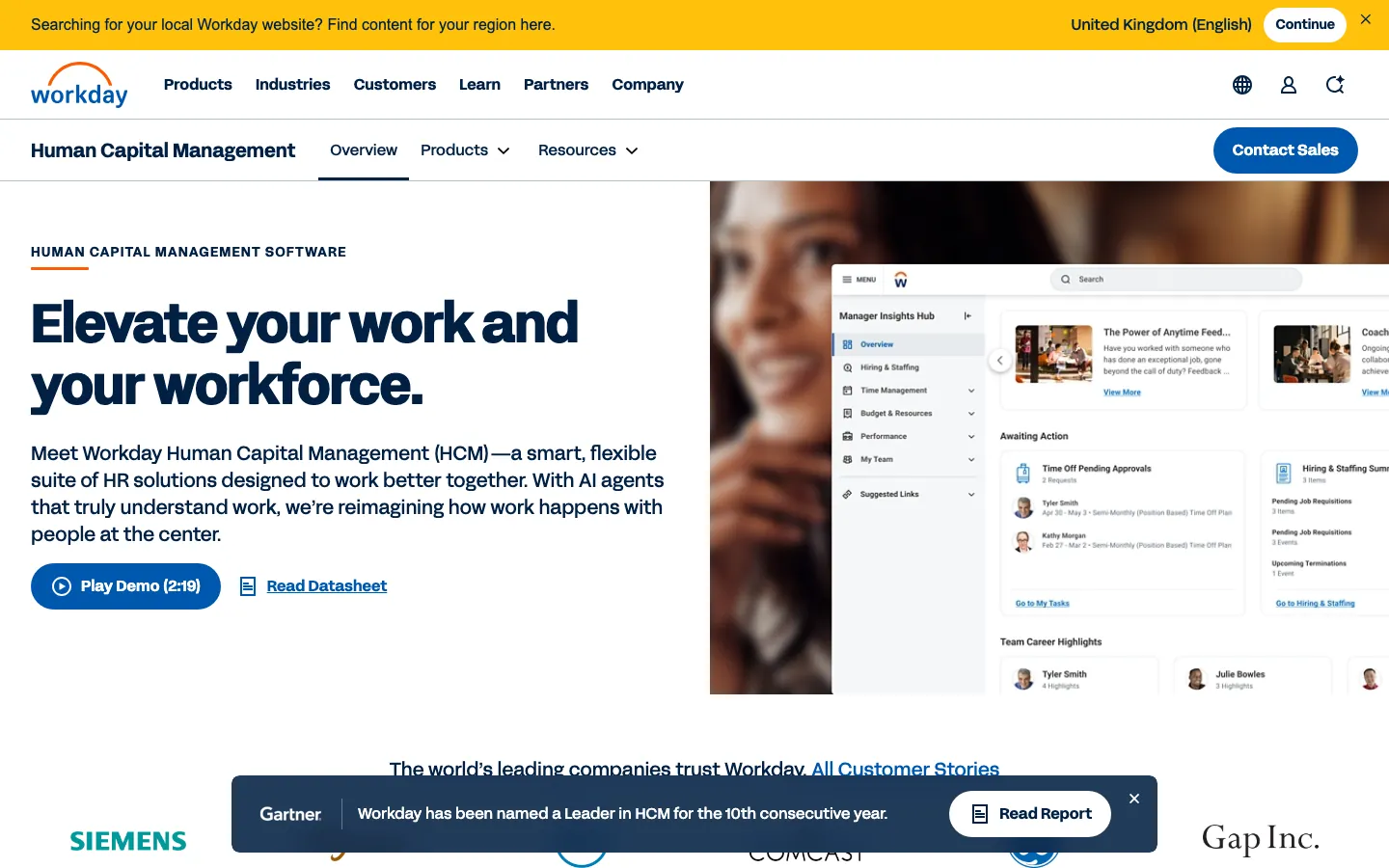
Screenshots of Workday HCM 3 images
What's great
- The only HRIS that scales cleanly past 2,000 employees without a custom build; multi-entity, multi-currency, and multi-country in one data model
- Workforce planning and people analytics depth that no mid-market tool approaches; the reporting engine is built for CFO conversations
- Named a Leader in Gartner's Cloud HCM Suites Magic Quadrant for the 10th consecutive year in 2025 (the most recent ranking)
Watch-outs
- Implementation cost at the 1,000-3,000 employee range runs $500K-$1.5M, and implementation fees equal 100-150% of annual contract value per verified 2026 contract benchmarks
- $100-130 per employee per year for a 1,000-2,500 person company means the annual contract alone is $100K-$325K before implementation
- Configuration requires a dedicated internal Workday admin plus an implementation partner; teams without both in place before go-live have painful first quarters
Pricing breakdown
| Plan | Price | Best for |
|---|---|---|
| HCM Core (1-2.5K employees) | ~$90-130/employee/yr | 1,000-2,500 employees; core HR |
| HCM Core (2.5-7.5K employees) | ~$70-110/employee/yr | 2,500-7,500 employees |
| + Financial Management | Custom add-on | Companies combining finance and HR in Workday |
| + Payroll | Custom add-on | US payroll processing in the Workday data model |
Security & compliance
| Standard | Availability |
|---|---|
| SOC 2 Type II | Yes |
| GDPR | Yes |
| HIPAA | Yes |
| SSO / SAML | ✓ all tiers |
| Audit logs | Yes |
Workday HCM compliance summary: SOC 2 Type II is yes, GDPR is yes, HIPAA is yes, SSO/SAML is ✓ all tiers, and audit logs is yes.
Key integrations
| Integration | Type |
|---|---|
| Gmail | N/A |
| Outlook | N/A |
| Slack | Native integration |
| LinkedIn Sales Navigator | N/A |
| Outreach / Salesloft | N/A |
Workday HCM integration summary: Gmail is not specified, Outlook is not specified, Slack is native integration, LinkedIn Sales Navigator is not specified, and Outreach or Salesloft is not specified.
Feature availability
| Feature | Status |
|---|---|
| Mobile app | ✓ |
| Open API | ✓ |
| Payroll | $ add-on module |
| Performance management | ✓ built-in |
| Self service | ✓ |
Workday HCM feature availability summary: Mobile app (✓), Open API (✓), Payroll ($ add-on module), Performance management (✓ built-in), and Self service (✓).
What reviewers say about Workday HCM
Recurring themes across ~1,752 Capterra reviews (4.5/5) and G2 reviews (4.0/5), 2024-2026.
What reviewers praise
- Unified platform coverage is the top praise: HR, payroll, talent management, and learning in a single system eliminates the multi-tool sprawl that mid-market buyers were trying to escape.
- Employee self-service is consistently valued by non-HR reviewers: viewing pay stubs, submitting time-off, and updating personal info without contacting HR saves time across the org.
- Reporting and analytics depth draws praise from HR analysts and finance teams who use Workday for headcount planning and compliance tracking with real-time data.
- Payroll accuracy earns strong marks once the system is fully configured, with reviewers citing consistent, on-time payroll runs as a reliable baseline.
- The permissions and role-based access model is called out as genuinely granular, useful for larger orgs that need to separate HR, manager, and employee data views.
What reviewers fault
- The learning curve is the most-cited frustration: even technically comfortable users say full platform fluency takes months, and admin configuration requires specialist knowledge.
- Customization is constrained relative to the price point: reviewers flag inability to customize themes, limited report layout flexibility, and workflow rigidity when policy needs are non-standard.
- Support response times draw repeated criticism, with reviewers describing multi-day ticket turnarounds and difficulty reaching someone who understands their specific configuration.
- Performance issues surface under load: slow report generation on large datasets, page lag during peak hours, and authentication friction from multi-step login flows frustrate daily users.
- Administrative overhead surprises buyers: profile changes and certain HR actions require admin involvement rather than direct self-service, slowing down routine tasks.
Loading reviews…
Justworks Payroll
Best standalone payroll for startups not ready for full HRIS
Screenshots of Justworks Payroll 3 images
What's great
- $50/mo base + $8/employee is the lowest all-in entry price for a real payroll product with tax filing included
- Month-to-month, no setup fees, cancel anytime, the least-risky payroll commitment in the comparison
- Scales into the full PEO (Justworks PEO Basic or Plus) without migrating to a new platform; the transition is a plan upgrade
Watch-outs
- Payroll-only; no performance management, no org chart, no learning modules, no compensation benchmarking
- Not the right fit for multi-state teams on the entry plan; multi-state requires upgrading to the full PEO
- Reporting is minimal; HRIS-grade people data requires moving to the full Justworks PEO platform
Pricing breakdown
| Plan | Price | Best for |
|---|---|---|
| Justworks Payroll | $50/mo + $8/employee | 5-25 employees; payroll + tax filing only |
| PEO Basic (upgrade path) | $59/employee/mo | 25-100 employees; adds compliance + 401k |
| PEO Plus (upgrade path) | $109/employee/mo | 25-100 employees; adds full benefits admin |
| EOR (upgrade path) | $599/employee/mo | International team expansion |
Security & compliance
| Standard | Availability |
|---|---|
| SOC 2 Type II | Yes |
| GDPR | Yes |
| HIPAA | Limited |
| SSO / SAML | Yes |
| Audit logs | Yes |
Justworks Payroll compliance summary: SOC 2 Type II is yes, GDPR is yes, HIPAA is limited, SSO/SAML is yes, and audit logs is yes.
Key integrations
| Integration | Type |
|---|---|
| Gmail | N/A |
| Outlook | N/A |
| Slack | No |
| LinkedIn Sales Navigator | N/A |
| Outreach / Salesloft | N/A |
Justworks Payroll integration summary: Gmail is not specified, Outlook is not specified, Slack is no, LinkedIn Sales Navigator is not specified, and Outreach or Salesloft is not specified.
Feature availability
| Feature | Status |
|---|---|
| Mobile app | ✓ |
| Open API | ✓ |
| Payroll | ✓ native |
| Performance management | ✗ |
| Self service | ✓ |
Justworks Payroll feature availability summary: Mobile app (✓), Open API (✓), Payroll (✓ native), Performance management (✗), and Self service (✓).
What reviewers say about Justworks Payroll
Recurring themes across ~1,126 G2 reviews (4.6/5) for Justworks and Justworks Payroll, cross-checked against Capterra, TrustRadius, Trustpilot, and Reddit, 2024-2026.
What reviewers praise
- Transparent, publicly listed pricing is a genuine differentiator that reviewers repeatedly note, since PEO rivals like Paychex, TriNet, and ADP all hide rates behind a sales call.
- Ease of use is a dominant theme: straightforward setup, clean organization, and a design simple enough that a small team can run payroll and HR without specialists.
- Access to Fortune-500-caliber benefits, big-carrier medical plus 401(k) through co-employment pooling, lets 20 to 200 person companies offer plans they could not negotiate alone.
- Customer support is rated highly for routine questions, with reviewers citing human, multi-channel help and answers within hours.
What reviewers fault
- Per-employee PEO fees feel steep, and reviewers note that once you pass roughly 50 to 100 employees the model gets expensive versus a standalone HRIS plus broker.
- Integrations are very limited (a handful of connectors), so teams relying on a wider software stack hit walls versus platforms with hundreds of integrations.
- Support quality falls off a cliff during real escalations: missed payroll runs, W-2 errors needing IRS follow-up, and tickets going unanswered surface in Trustpilot and Reddit accounts.
- The platform trades flexibility for simplicity, so reviewers flag limited customization and missing features for teams with non-standard needs.
- Recurring app bugs (freezing, crashes, login issues) disrupt time tracking, and eligibility restrictions exclude high-risk or heavily contractor-based businesses from the workers' comp policy.
Loading reviews…
Tools we considered but excluded
We evaluated more tools than the 9 you see above. These did not make the cut. Saying what we rejected, and why, is the editorial muscle most listicles skip.
- Personio: Primarily EU/DACH market, expanding in US but US-specific compliance depth and payroll coverage still lags the US-native tools in this guide
- Deel: EOR and global payroll leader, but not primarily a core HRIS; covered in international-hiring and EOR comparisons separately
- Paylocity: Strong mid-market tool but consistent G2 complaints about implementation quality and pricing opacity put it below ADP Workforce Now and Paychex for this list
- TriNet: PEO competitor to Justworks with higher PEPM pricing and less transparent contracts; Justworks beats it on both price and UX for the 10-150 employee band
- Zenefits (acquired by TriNet, now TriNet HR Platform): TriNet acquired Zenefits in 2022 and folded the product into its HR platform; for the TriNet PEO/platform comparison, see the TriNet entry above and our standalone PEO coverage
- Sapling by Kallidus: Strong onboarding-specific tool but not a full HRIS; the core HR records and payroll gaps are too large for this comparison
Honorable mentions
Solid tools that did not crack the main list but are worth tracking, especially for niche use cases.
- Lattice HRIS: Launched a full HRIS product in 2023 that pairs naturally with their performance and compensation modules; worth watching for HiBob-alternative buyers who already run Lattice
- Paycor: Strong mid-market HRIS with native recruiting and onboarding modules; underrated relative to ADP and Paychex in the 200-500 employee band
- Bob (international): HiBob's European product variant with stronger GDPR/Works-Council compliance features; US teams with European subsidiaries should evaluate the Bob international modules specifically
The five sub-categories of HRIS platforms
The HRIS market has five practical sub-categories that get conflated at buying time. Understanding which bucket your team is buying from narrows the shortlist before a single demo.
Payroll-first systems. The payroll engine is the core; HRIS records are a layer on top. Gusto, Paychex Flex, Justworks Payroll, and ADP Workforce Now sit here. The right choice when payroll accuracy and tax-compliance depth are the top requirements and the HR team is small.
People-data-first HRIS. Core records, org charts, performance management, and engagement analytics are the priority; payroll is an integration or add-on. BambooHR and HiBob lead here. The right choice when HR is building a people-ops function, not just processing paychecks.
Unified platform (HR plus IT plus finance). Rippling is the standout. The value is in the cross-module automation, not the individual modules. The right choice when onboarding and offboarding workflows need to touch HR records, laptop provisioning, and SaaS access simultaneously.
PEO model. The provider co-employs your workforce, bundling payroll, benefits, workers comp, and compliance handling. Justworks PEO and TriNet are the primary US options. The right choice for sub-100-employee companies without internal HR infrastructure who want to outsource the compliance surface entirely.
Enterprise HCM. Workday HCM and SAP SuccessFactors. Past 1,000 employees with multi-entity and multi-country requirements, no mid-market tool holds up. The implementation cost is real; the ROI case requires a true enterprise organization.
The nine tools in this guide cover all five categories. The comparison tables below give the specific feature and compliance breakdown.
Trial checklist for HRIS
The pattern of which HRIS trials end in a confident decision vs a six-month stall is consistent. Eight things to test before any purchase.
One, import your actual employee roster on day one. Not demo data. Take your real CSV from whatever HR tool you’re leaving (even if it’s a spreadsheet), map the fields, and do the full import including custom fields, department structure, and manager relationships. BambooHR’s import is among the fastest in this comparison; Rippling’s module-by-module setup takes longer, and ADP Workforce Now is slower still.
Two, run a complete payroll cycle with real numbers. Use actual pay rates, real PTO balances, real benefit deductions. Time the run end-to-end. Measure how many manual steps are required. Gusto’s run is one of the fastest in this comparison; ADP Workforce Now generally takes longer with more manual reconciliation steps.
Three, test the employee self-service portal with real employees. Pick 10 actual employees and ask them to do three things without help: update a personal address, request a PTO day, and view their pay stub. Measure how many give up before completing all three. Rippling and HiBob have the most polished self-service portals in this comparison; Paychex Flex tends to see higher drop-off.
Four, configure a complete onboarding workflow for a new hire. Build the full onboarding checklist, the day-one IT provisioning tasks, the tax-form collection, and the benefits enrollment sequence. Time how long setup takes. BambooHR’s onboarding builder is the fastest in the comparison; Workday’s is the most powerful but requires a configuration specialist.
Five, export all employee data. Try to pull every employee record, every time-off request, every performance review note, and every payroll record into a CSV with all custom fields. If this requires a support ticket, the data is not really yours. Gusto and BambooHR both pass this test cleanly.
Six, test the compliance and audit trail. Ask for a user-access log for the last 30 days. Ask for a report of every field that was changed by an admin in the last 90 days. If either requires a custom report build or a support request, that’s a red flag for regulated industries.
Seven, ask about implementation timeline and what goes wrong. Not “how long does it take” but “what are the top three things that extend implementation past the original timeline for companies our size.” Good vendors answer this question specifically. Vague answers are predictive of vague implementations.
Eight, talk to three current customers at your company stage and size. Not the references the vendor offers. Find them on LinkedIn, in HR Slack communities, or through your network. Ask: “Would you sign again knowing what you know now, and what is the thing you wish you’d tested during the trial?” That answer tells you more than any feature demo.
How to pick the right HRIS platform for your team
Five questions, in order. The shortlist collapses to two or three real options after these.
1. Your headcount, today and in 18 months
- Under 30 employees. Gusto Simple ($49/mo + $6/person) or Justworks Payroll ($50/mo + $8/person). Don’t overbuy; you don’t need an HRIS yet.
- 30-75 employees. Gusto Plus or Justworks PEO Basic. The PEO model makes sense here if the HR team is a single person stretched thin.
- 75-200 employees. BambooHR Pro or HiBob Core. This is the band where a real HRIS pays back in reduced HR admin hours.
- 200-500 employees. Rippling or HiBob Plus. You need cross-module automation and real people analytics.
- 500-1,000 employees. ADP Workforce Now or Rippling. Both hold up; pick based on payroll complexity vs HR-feature priority.
- 1,000+ employees. Workday HCM. Nothing else in this guide was designed for this scale.
2. Payroll complexity as the primary concern
If yes, ADP Workforce Now (75-750 employees), Paychex Flex (10-150 employees), or Gusto (under 75). If payroll is a solved problem and people data is the priority, go HiBob or BambooHR.
3. PEO service requirements
If yes, Justworks PEO. If the team is past 100 employees or wants to control benefits independently, skip the PEO model and go with a standalone HRIS.
4. Onboarding that touches IT provisioning
If yes (new employee gets a laptop and SaaS accounts on day one, and offboarding needs to revoke all access simultaneously), Rippling is the only tool in this guide built for that workflow natively. The others require Zapier or custom integrations to replicate it.
5. Compliance certifications your industry requires
- Healthcare (HIPAA required). ADP Workforce Now, Rippling, Justworks, Workday. BambooHR and Gusto offer HIPAA Business Associate Agreements as add-ons; verify before signing.
- Public company (SOX required). Rippling, ADP, Workday. Audit logs and role-based permissions are not optional.
- Multi-country with GDPR exposure. Rippling (185+ countries native), Workday, or HiBob international. Gusto and BambooHR are US-only or require third-party EOR for international.
The right HRIS for each company stage
- Pre-seed to seed, 5-20 employees: Justworks Payroll ($50/mo + $8/person). Get payroll out of spreadsheets without a commitment.
- Seed, 20-50 employees: Gusto Simple or Plus. Honest pricing, fast setup, the payroll core everyone respects.
- Series A, 50-100 employees: BambooHR Pro (if HR-data-focused) or Justworks PEO Plus (if you want to outsource compliance). Both are clean decisions at this size.
- Series A/B, 100-200 employees, US-only: HiBob Core. The people analytics pay back at this stage; the January 2026 native payroll launch removes the biggest objection.
- Series B, 100-300 employees, HR-plus-IT automation: Rippling. The cross-module automation is the only reason to pay the modular pricing premium.
- Series B/C, 200-500 employees: ADP Workforce Now or Rippling. ADP wins if payroll complexity is the priority; Rippling wins if automation is.
- Series C+, 500-1,000 employees: ADP Workforce Now or Rippling at the higher module tiers. Budget for a dedicated HRIS admin.
- Post-IPO or 1,000+ employees: Workday HCM. Plan $400K-$1.5M year-one all-in.
- Healthcare or regulated industry, any stage: Verify HIPAA BAA availability before shortlisting. ADP, Rippling, Justworks, and Workday all provide them.
- Multi-country hiring, any stage: Rippling (global payroll native) or Justworks EOR for smaller international headcounts.
Related HR software guides: Best payroll software · Best recruiting software · Best employee onboarding software , the tools HRIS buyers most often evaluate alongside their core system.
Where the nine HRIS platforms differ on core features
The five features asked about most in HRIS evaluations, across all nine platforms, in rank order.
| Platform | Self-service portal | Native payroll | Performance mgmt | API access | Mobile app |
|---|---|---|---|---|---|
| Rippling | ✓ | ✓ | $ add-on | ✓ | ✓ |
| Gusto | ✓ | ✓ | • | ✓ | ✓ |
| HiBob | ✓ | ✓ (Jan 2026) | ✓ built-in | ✓ | ✓ |
| BambooHR | ✓ | $ add-on | Pro+ | ✓ | ✓ |
| Justworks PEO | ✓ | ✓ | ✗ | ✓ | ✓ |
| ADP Workforce Now | ✓ | ✓ | $ add-on | ✓ | ✓ |
| Paychex Flex | ✓ | ✓ | • limited | ✓ | ✓ |
| Workday HCM | ✓ | $ add-on | ✓ built-in | ✓ | ✓ |
| Justworks Payroll | ✓ | ✓ | ✗ | ✓ | ✓ |
The standout: Rippling and Workday HCM both offer the full stack natively, but at completely different price points and target company sizes. HiBob’s January 2026 native payroll launch moved it into the same column as Rippling for US teams, which changes the evaluation for any buyer who was previously choosing between the two.
Compliance lockdown
HRIS platforms handle sensitive employee data including SSNs, banking details, and compensation records. These five certifications are the baseline enterprise IT will check.
| Platform | SOC 2 Type II | GDPR | HIPAA | SSO/SAML | Audit logs |
|---|---|---|---|---|---|
| Rippling | ✓ | ✓ | ✓ | ✓ all tiers | ✓ |
| Gusto | ✓ | ✓ | • BAA available | Premium | Plus+ |
| HiBob | ✓ | ✓ | • | ✓ all tiers | ✓ |
| BambooHR | ✓ | ✓ | $ add-on BAA | Pro+ | Pro+ |
| Justworks PEO | ✓ | ✓ | ✓ | ✓ | ✓ |
| ADP Workforce Now | ✓ | ✓ | ✓ | ✓ all tiers | ✓ |
| Paychex Flex | ✓ | • | ✓ | Pro+ | Pro+ |
| Workday HCM | ✓ | ✓ | ✓ | ✓ all tiers | ✓ |
| Justworks Payroll | ✓ | ✓ | • | ✓ | ✓ |
For healthcare, financial services, or any publicly traded company: Rippling, ADP Workforce Now, Justworks PEO, and Workday HCM are the platforms that clear the full IT security review without exceptions. Gusto and BambooHR clear it with HIPAA BAA add-ons; verify the BAA language covers your use case before signing.
Integration depth across the HRIS stack
The five integrations HR teams ask about most frequently in evaluations.
| Platform | Slack | Workday (ATS sync) | Greenhouse ATS | LinkedIn Recruiter | DocuSign |
|---|---|---|---|---|---|
| Rippling | N native | N/A (is Workday) | N native | M marketplace | N native |
| Gusto | N native | ✗ | N native | • Zapier | M marketplace |
| HiBob | N native | M marketplace | N native | M marketplace | N native |
| BambooHR | N native | M marketplace | N native | M marketplace | N native |
| Justworks PEO | N native | ✗ | N native | • | M marketplace |
| ADP Workforce Now | M marketplace | • | N native | M marketplace | N native |
| Paychex Flex | M marketplace | • | M marketplace | • | M marketplace |
| Workday HCM | N native | N/A (is Workday) | N native | N native | N native |
| Justworks Payroll | ✗ | ✗ | • | ✗ | ✗ |
Rippling and Workday HCM have the deepest native integration stories, for very different reasons: Rippling built its ecosystem around IT-plus-HR automation; Workday built for enterprise multi-system connectivity. BambooHR and HiBob both have clean Greenhouse integrations that matter for the handoff from your applicant tracking system to the HRIS.
Migration playbook for HRIS switches
HRIS migrations are genuinely painful. A BambooHR-to-Rippling migration can eat months of calendar time. That’s not a knock on either tool; it’s what HRIS migrations cost when they’re not planned properly.
The historical data problem is the hardest part. Performance review notes, custom fields built over years, historical salary records, and time-off balances all have to move. Most platforms export these as CSV; most imports require field remapping.
The data that doesn’t map cleanly either gets lost or lands in a catch-all “legacy notes” field nobody looks at again. Plan for 20-40% of historical custom-field data to not migrate cleanly; save everything in an archive export before cutting over.
There are six to twelve months of actual work in a proper HRIS migration at the 150-500 employee range. Not six to twelve months of dedicated attention, but calendar time from first decision to final cut-over.
The platforms that promise 30-day deployments are usually measuring from contract signature to “technically live,” not from “all data migrated and all workflows replaced.”
The parallel-run period is what most teams skip and then regret. Running old and new systems simultaneously for 60 days is painful and double-work, but it’s the only way to catch the edge cases before you’ve turned off the old system.
Payroll edge cases specifically, retro adjustments, equity vesting events, leave-of-absence calculations, show up in month two, not month one.
Five migration rules that hold across every platform:
Export raw before you negotiate the new contract. Once you’ve signed the new contract, the old vendor’s cooperation on data exports drops. Get every record, every log, every document attachment before you tell the current vendor you’re leaving.
Build the field map before the vendor builds it for you. Every HRIS has different custom-field structures. The vendor’s “data migration service” maps their fields to their fields. You need to map your fields to your business logic first, then hand that spec to the vendor.
Pilot payroll in parallel for two cycles. Run the new HRIS payroll and the old payroll simultaneously for two pay cycles before cutting over. The delta between the two outputs identifies the edge cases. The teams that skip this pilot have unplanned payroll corrections in month one.
Keep the old system in read-only mode for twelve months. You’ll get compliance audit requests for historical data that predates the cut-over. Read-only access for a year costs very little and saves real headaches.
Assign one internal owner with authority. HRIS migrations die from committee decision-making. One person with budget authority and HR plus IT access, making calls and escalating when the vendor’s timeline slips. Without that person, the migration extends by a quarter minimum.
Pricing reality for HRIS platforms
The published PEPM is never what you pay. Here is what year-one all-in typically looks like, based on published pricing plus third-party cost analyses and buyer reports.
| Segment | Listed price | Real all-in (year 1) |
|---|---|---|
| Gusto Simple (50 employees) | $49/mo + $6/person | $6,500-$7,000 |
| Justworks PEO Basic (50 employees) | $59/employee/mo | $37,000-$40,000 |
| BambooHR Pro (100 employees) | ~$17/employee/mo | $28,000-$35,000 |
| HiBob Core (150 employees) | ~$16-20/employee/mo | $36,000-$48,000 |
| Rippling (150 employees, full stack) | $8/employee/mo base | $54,000-$72,000 |
| ADP Workforce Now (300 employees) | ~$23-27/employee/mo | $90,000-$110,000 |
| Workday HCM (1,500 employees) | ~$90-130/employee/yr | $450,000-$1,200,000 |
The “real all-in” includes implementation fees, training, integration setup, and first-year support credits. Year two typically lands 8-15% higher across the mid-market tools as seat counts grow and modules expand.
The single biggest forecast error buyers make: underestimating implementation. Mid-market buyers assume the vendor-quoted implementation fee ($5K-$30K) is the whole cost. It isn’t.
Implementation requires internal HR and IT admin time, often 200-400 hours of internal labor at mid-market; integration work for the recruiting/finance/IT stack that connects to the HRIS; and a 60-90 day period of reduced productivity while the team is half on the old system and half on the new one.
Build 30% on top of the implementation quote as an internal labor cost.
What’s changing in HRIS software in 2026
HiBob’s native US payroll launch in January 2026 changes the mid-market evaluation. For the previous four years, HiBob’s main objection in US evaluations was “great people platform, but we need native payroll.” That objection is gone. The Gusto-powered payroll engine running inside HiBob means the two-vendor story (HiBob for HRIS plus Gusto for payroll) collapses into one. Watch how this shifts shortlists through the second half of 2026.
Rippling’s pricing model is coming under more scrutiny. As the platform adds modules, the gap between the $8/employee base price and the real all-in cost is becoming a negotiation point in evaluations. G2 reviews from late 2025 and early 2026 show a pattern of “great product, real sticker shock on the contract.” Companies that negotiate the full module bundle upfront are getting 15-25% better pricing than those who add modules incrementally.
HRIS AI features are early-stage and mostly not worth the premium. Every platform in this guide has added an “AI-powered” feature in 2025-2026. Rippling’s AI for workforce analytics, Workday’s AI for skills matching, ADP’s compensation benchmarking AI. So far none of these features produce consistently actionable outputs for an HR team under 500 employees. Use them as supporting tools, not decision drivers.
State-level pay transparency and pay-equity compliance is becoming an HRIS requirement. California, New York, Colorado, and now Washington state all have salary-range disclosure laws that generate compliance reporting obligations. Platforms that can generate pay-equity audit outputs natively (Rippling, Workday, ADP) are seeing this become a purchase criterion rather than a nice-to-have in regulated states.
Workday’s 10th consecutive Gartner HCM Magic Quadrant Leader ranking (2025) reinforces its enterprise moat. No other platform in this guide has the breadth of enterprise-grade capabilities. For mid-market buyers evaluating Workday “for the future,” the evaluation calculus is when you’ll realistically need it, not whether it’s a good product. Most sub-500-employee teams implementing Workday in 2026 are spending 3-5x what they need to.
For corrections, updated pricing, or feedback on this methodology, email hello@topickz.com . We re-review the full shortlist every six months; next full refresh ships November 2026.
Frequently asked questions
HRIS vs payroll software, what's the actual difference?
Payroll processes wages and tax filings. HRIS is the system of record for employee data. Most modern tools combine both, but payroll depth varies widely.
How much should an HRIS actually cost per employee in 2026?
SMB ($5-20 PEPM), mid-market ($15-35 PEPM), enterprise ($35-80 PEPM). Year-1 all-in is 1.5-3x sticker once implementation lands.
Do we need an HRIS under 50 employees?
Usually no below 30. Above 30, compliance and onboarding requirements typically force the decision. Gusto Payroll bridges the gap cheaply.
How long does HRIS implementation take?
Gusto/Justworks, 1-2 weeks. BambooHR/Rippling/HiBob, 4-8 weeks. ADP Workforce Now, 8-16 weeks. Workday, 6-18 months.
What is a PEO and when does it make sense?
A PEO co-employs your staff to bundle benefits, payroll, and compliance. Worth it under 100 employees if you lack internal HR capacity.
Rippling vs BambooHR, which one wins for a 150-person company?
Rippling if you want HR, IT, and payroll in one workflow. BambooHR if HR owns the decision and compliance reporting is the priority.
Can we migrate our HRIS data to a new platform?
Yes, but plan 6-12 weeks and expect to lose 20-40% of historical notes and custom-field data. Export raw files before starting.
What's the biggest hidden cost in HRIS contracts?
Three, implementation fees (10-150% of ACV), annual renewal uplifts of 8-15%, and payroll or benefits modules priced separately.
Does HRIS affect SOX compliance?
Yes for public companies. Audit logs, access controls, and role-based permissions are required. Rippling, ADP, and Workday all pass; verify before signing.
What HRIS does a typical Series B SaaS company use?
Gusto or Rippling from seed to 100 employees, then BambooHR or HiBob at 100-300, then Workday or ADP past 500.
What is the best HRIS for a startup with 20 to 50 employees?
Rippling or Gusto at this size. Gusto covers payroll, benefits, and onboarding at $40/mo base plus $6/person and handles the full employment workflow a first-time HR hire can run solo. Rippling is the step up when you need IT device management and HR in one system, common for SaaS startups with distributed teams.
What HRIS do companies with 100 to 500 employees use?
BambooHR and HiBob dominate this band. BambooHR is the safe choice for traditional org structures with strong reporting and onboarding. HiBob is the pick for modern tech companies that want a culture-forward system with manager effectiveness tools and strong Slack and HRIS integrations.
What is the best HRIS for a 1,000 person company?
Workday HCM for enterprise companies that need workforce planning, succession management, and FP&A integration in one platform. ADP Workforce Now for companies already in the ADP payroll ecosystem. Both are 90-day procurement and implementation cycles.
What HRIS is best for remote-first companies?
Rippling handles remote-first best, device management, employer-of-record infrastructure, and multi-country payroll in one system. Deel is the alternative for companies with heavy contractor and international employee mix. Both beat legacy systems for distributed teams.
What is the best HRIS for SaaS companies in 2026?
HiBob from 50 to 300 employees, the culture analytics and performance module fit SaaS orgs better than BambooHR's traditional HR model. Rippling for SaaS companies that want IT, HR, and payroll consolidated. Workday once the company passes 500 FTE and needs workforce planning depth.
What is the best HRIS for tech companies?
HiBob for tech companies under 500 employees, strong integrations with Linear, Slack, and Greenhouse. Rippling for tech companies that want one system for HR and IT device management. Workday for large tech companies that need workforce analytics at the board level.
What HRIS do healthcare companies use?
ADP Workforce Now for large healthcare networks that need payroll and compliance at scale. Rippling for healthcare SaaS startups with a mixed employee and contractor workforce. Workday for enterprise health systems that run succession planning and workforce analytics alongside HR.
What is the best HRIS for a construction company?
ADP Workforce Now handles multi-state payroll, certified payroll reporting, and field-worker time tracking that construction companies run. Rippling is the alternative for construction tech companies. BambooHR suits smaller construction firms that need a clean HR system without complex payroll.
What is the best HRIS for Indian companies with global employees?
Rippling handles multi-country payroll, employer-of-record setup, and US entity management for Indian SaaS companies expanding globally. Deel is the alternative focused on global payroll and contractor compliance across 150+ countries. Both avoid the complexity of setting up legal entities in each target market.
What HRIS is best for professional services and consulting firms?
BambooHR for consulting firms under 200 people, clean onboarding and PTO tracking without an HR ops team. Workday for large professional services firms with complex resource allocation and skills-based staffing. HiBob for growth-stage consulting companies that want performance and engagement tools alongside the core HR record.
Related helpful reads
Write a review
Posts to the page right away. Keep it real — no links or email addresses.