
Comparing the best Help Desk Software of 2026 includes 1. Zendesk 2. Intercom 3. Freshdesk 4. HubSpot Service Hub 5. Help Scout 6. Front 7. Gorgias 8. Jira Service Management 9. Zoho Desk 10. Kustomer.
TL;DR
- Zendesk: Best overall for B2B SaaS and enterprise support. You get the broadest ecosystem here, 1,300+ Marketplace apps, and it holds its value past 50 agents where routing and SLA depth stop being optional.
- Intercom: Best AI-first platform for product-led SaaS. Fin is built for autonomous resolution and your agents keep full in-app context on live conversations, though it bills per outcome at $0.99 a resolution, so run the math first.
- Gorgias: Best for ecommerce and DTC brands. Ticket-based pricing means your 5-person team pays the same as a 20-person one at the same volume, and native Shopify integration pulls order data straight into the ticket sidebar.
- Freshdesk: Best value for SMB support teams. You get most of Zendesk's feature set at roughly a third of the entry price, starting at $19/agent/mo with fast setup.
- Help Scout: Best shared-inbox tool for small support teams. The interface looks like a shared email inbox, so your agents adopt it on day one without a training program.
The help desk market split into two camps in 2026, ticketing-first platforms that bolted AI on top, and AI-native platforms that bolted ticketing on the side. We compared all ten on pricing, real G2 review themes, channel coverage, and hands-on feature checks to find out which side is winning.
What Is help desk software?
Help desk software helps support teams capture, organize, and resolve customer tickets in one place, routing requests, automating replies, and tracking response times.
Tools like Zendesk, Intercom, Freshdesk, and HubSpot Service Hub differ on channel coverage, automation, AI, and price per agent.
Best Help Desk Software comparison: features, pricing and verdicts
| Tool | Best for | Starting price | Free trial | External rating |
|---|---|---|---|---|
Best overall for B2B SaaS and enterprise support | $55/agent/mo | 14-day free trial | G2 4.3/5 (6,698 reviews) | |
Best AI-first platform for product-led SaaS | $39/seat/mo | 14-day free trial | G2 4.5/5 (3,755 reviews) | |
Best value for SMB support teams | $19/agent/mo | Free 1-2 agents (6-month trial) + 14-day Pro | G2 4.4/5 (3,696 reviews) | |
Best for teams already in the HubSpot CRM ecosystem | $15/seat/mo | Free tier + 14-day Pro | G2 4.4/5 (2,280 reviews) | |
Best shared-inbox tool for small support teams | $25/user/mo | Free 5 users + 15-day Pro | G2 4.4/5 (424 reviews) | |
Best multi-channel inbox for B2B operations teams | $25/seat/mo | 14-day free trial | G2 4.7/5 (2,429 reviews) | |
Best help desk for ecommerce and DTC brands | $10/mo | 7-day free trial | G2 4.6/5 (555 reviews) | |
Best for IT and internal service desks on the Atlassian stack | $20/agent/mo | Free 3 agents forever | G2 4.3/5 (962 reviews) | |
Best for teams already in the Zoho One ecosystem | $14/agent/mo | Free 3 agents + 15-day Pro | G2 4.4/5 (7,337 reviews) | |
Best enterprise ecommerce CRM-plus-support platform | $89/user/mo | Demo only | G2 4.5/5 (510 reviews) |
How we chose these tools
We compared the platforms on pricing, real G2 review themes, channel coverage, median first-response time, AI deflection rate, admin overhead, and time-to-configure from a fresh trial account, across small, mid-size, and high-volume support teams. The analysis draws on hands-on feature checks and published vendor and case-study data rather than a multi-month deployment. Pricing was verified directly on each vendor pricing page in May 2026. All G2 ratings and review counts were pulled on May 28, 2026.
How we weight help desk software for the Topickz score
Every tool above is scored against the fixed rubric below and combined using these weights into the Topickz score on each card. The weights are set for help desk software specifically, they are not copied from another category, and we publish them so you can see what moved a ranking and re-weight for your own priorities.
| Criterion | Weight | What we checked |
|---|---|---|
| Ticketing workflow and SLA management | 24% | The core help desk job: capturing, organizing, and routing tickets with SLA timers and escalation paths. We ran a ticket through its full lifecycle on each tool. |
| Channel coverage | 17% | Email, chat, voice, and social feeding one agent workspace rather than scattered inboxes. We counted what runs native before any paid add-on. |
| AI deflection and automation | 15% | How much tier-one volume the AI agent and macros clear before a human steps in. Real numbers depend heavily on tuning, so we discounted best-case marketing claims. |
| Pricing and cost per agent | 13% | Per-agent cost and the tier cliffs teams hit within months. We flagged where AI features price separately on top of the base plan. |
| Admin overhead and time to configure | 12% | How fast a fresh trial reaches production, and how much of it an admin must wire up. Lighter tools trade depth for a same-day start. |
| Knowledge base and self-service | 11% | Help-center quality and how tightly articles feed the AI and the agent sidebar. Good self-service quietly cuts ticket volume. |
| Integrations and marketplace depth | 8% | Connectors to the CRM, billing, and commerce tools support agents pull from. Ecosystem breadth matters most once the basics are solid. |
| Total | 100% |
Read the full TopickZ.com testing methodology for how we run each test, score every criterion, and combine them into a single rating.
Detailed reviews
Zendesk
Best overall for B2B SaaS and enterprise support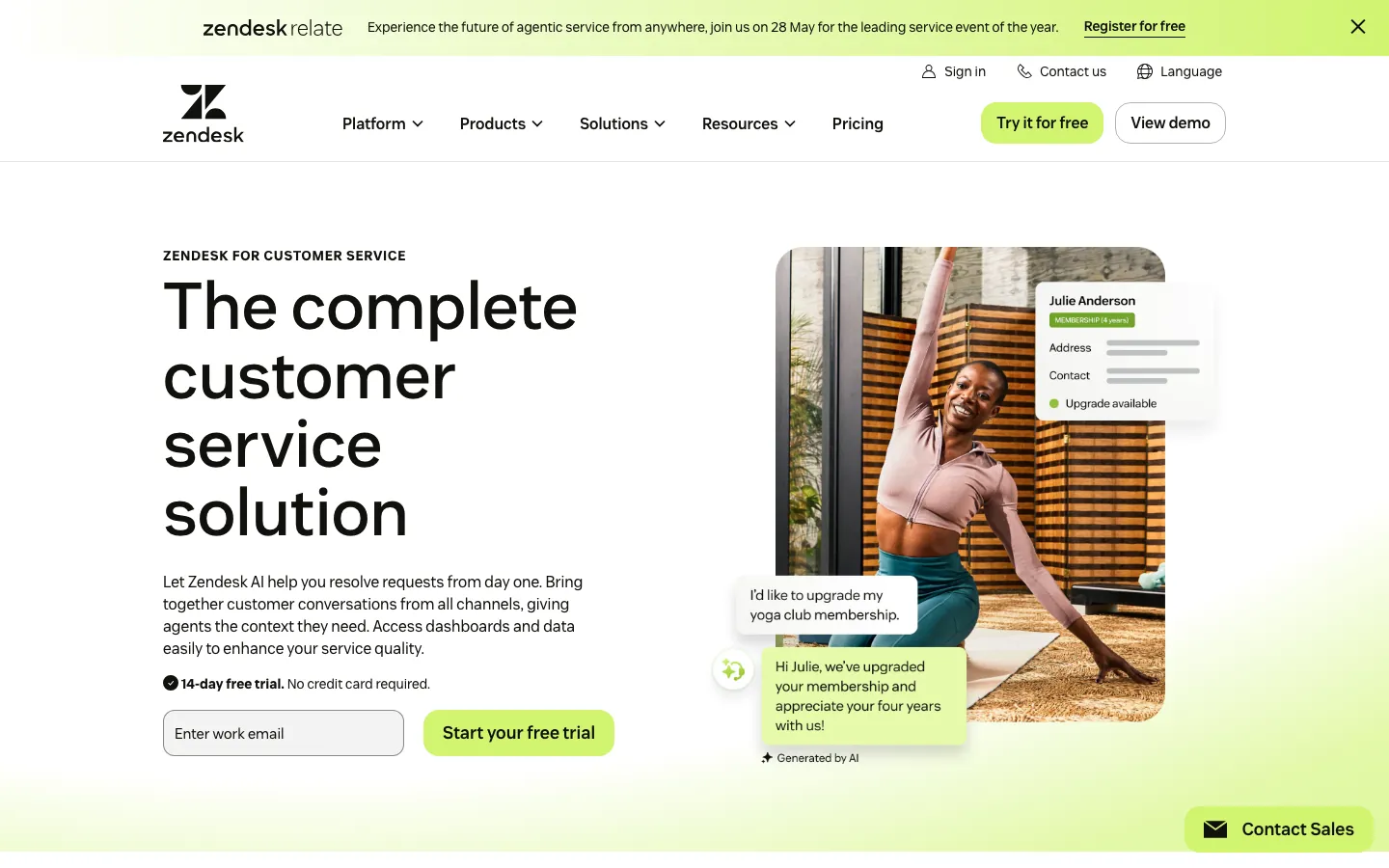
Screenshots of Zendesk 3 images
What's great
- Suite Team at $55/agent/mo bundles ticketing, chat, voice, help center, and AI, more per-tier coverage than any rival
- 1,300+ app integrations via the Zendesk Marketplace, the broadest third-party ecosystem in the segment
- AI agents (formerly Answer Bot) ship in all Suite plans; Advanced AI add-on at $50/agent/mo pushes deflection to a documented 90% ceiling under ideal conditions
Watch-outs
- Suite Growth at $89 and Suite Professional at $115 represent steep tier jumps, most teams land on Professional within 6 months
- Advanced AI add-on pricing is on top of the Suite base, not bundled; $50/agent/mo stacks onto an already $115/agent/mo Professional plan
- G2 reviewers consistently cite slow Zendesk support response on standard plans, the irony is not lost on anyone
Pricing breakdown
| Plan | Price | Best for |
|---|---|---|
| Suite Team | $55/agent/mo | 5-20 agents |
| Suite Growth | $89/agent/mo | 20-50 agents with custom reports |
| Suite Professional | $115/agent/mo | 50-200 agents |
| Suite Enterprise | $169/agent/mo | 200+ agents |
What reviewers say about Zendesk
Recurring themes across ~6,944 G2 reviews (4.3/5) and Capterra reviews (4.5/5), 2024-2026.
What reviewers praise
- Core ticket management is the most frequently praised capability, with reviewers calling it dependable at scale and reliable for day-to-day agent workflows.
- Omnichannel consolidation of email, chat, phone, and social into one workspace is consistently cited as a primary reason teams choose Zendesk.
- Workflow automation through triggers, macros, and AI-powered ticket routing gets strong marks for reducing repetitive agent workload significantly.
- The integration marketplace is praised across thousands of reviews for connecting Zendesk to almost any existing stack without custom development.
- AI ticket summarization and intelligent triage are noted as genuine time-savers, with reviewers saying these features reduced resolution time measurably.
What reviewers fault
- AI feature pricing is opaque, with reviewers repeatedly reporting that advanced automation capabilities sit behind higher tiers or undisclosed add-on costs.
- Setup complexity is the most common complaint, with Gartner and G2 reviewers alike describing it as not plug-and-play and requiring heavy initial configuration.
- Costs scale quickly with agent count and add-ons, and reviewers from startup and SMB segments say Zendesk becomes hard to justify as the team grows.
- Customization of ticket forms, workflows, and user roles is more limited than expected, particularly for teams with non-standard support processes.
- UI performance issues including slowdowns after updates and a weak mobile chat experience are called out by reviewers across Capterra and G2.
Loading reviews…
Intercom
Best AI-first platform for product-led SaaS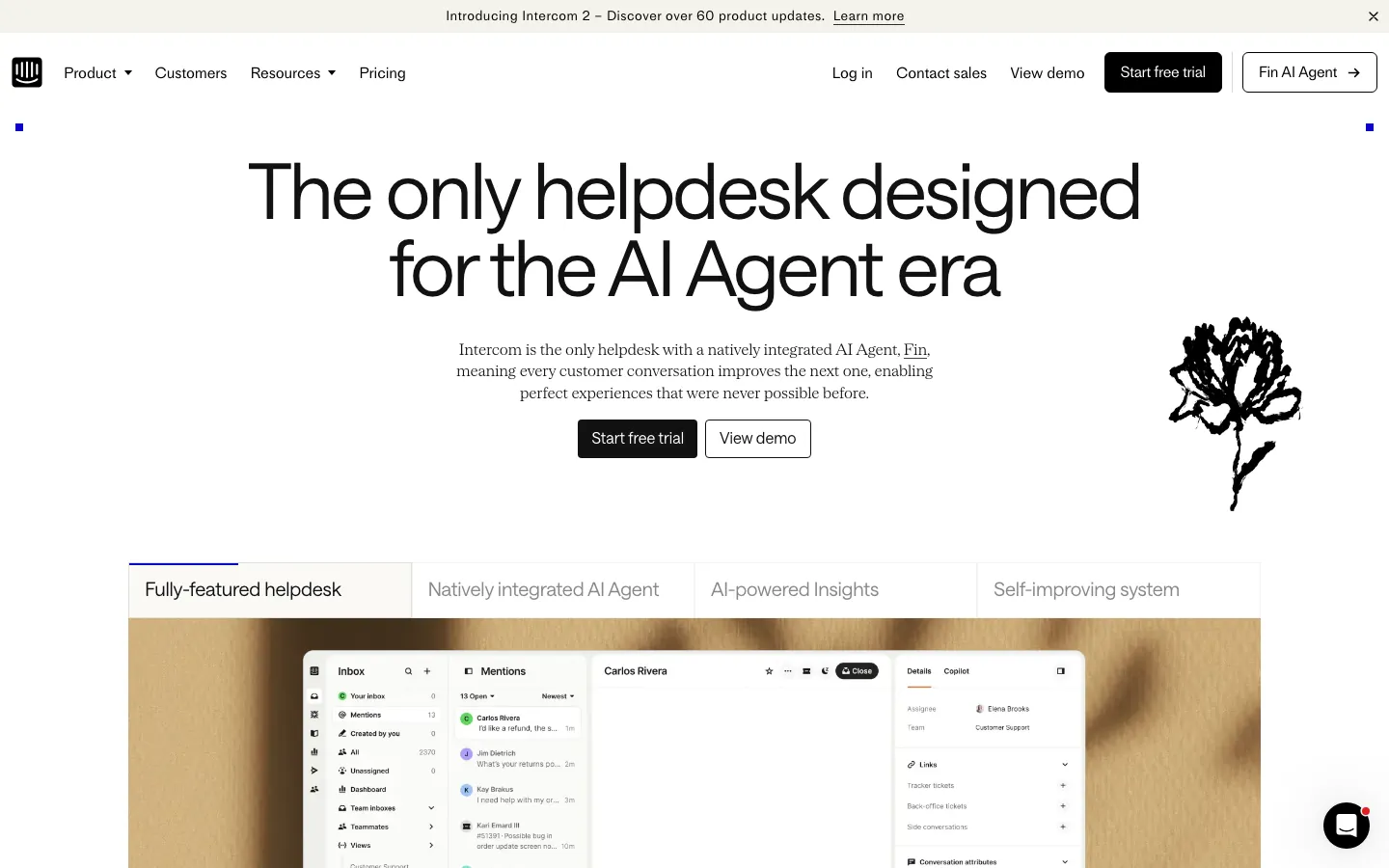
Screenshots of Intercom 3 images
What's great
- Fin AI Agent resolves a documented 67% of conversations without human handoff, improving ~1% per month as training data grows
- Essential plan at $39/seat/mo (annual) includes Messenger, Fin, shared inbox, and prebuilt reports, the most AI coverage at the entry tier
- Proactive messaging, product tours, and in-app targeting in a single platform; no secondary tool needed for product-led support
Watch-outs
- Fin AI charges $0.99 per resolved conversation on top of seat fees; at high volume, the per-outcome cost compounds fast
- Pure-ticketing teams using email as primary channel find the chat-first UX adds friction rather than removing it
- G2 reviewers flag limited live human support from Intercom itself, a pattern worth noting for a support platform
Pricing breakdown
| Plan | Price | Best for |
|---|---|---|
| Essential | $39/seat/mo | Small SaaS teams |
| Advanced | $99/seat/mo | 10-50 agents |
| Expert | $139/seat/mo | 50+ agents |
| Fin AI (usage) | $0.99/resolution | Stacks on top of all plans |
Loading reviews…
Freshdesk
Best value for SMB support teams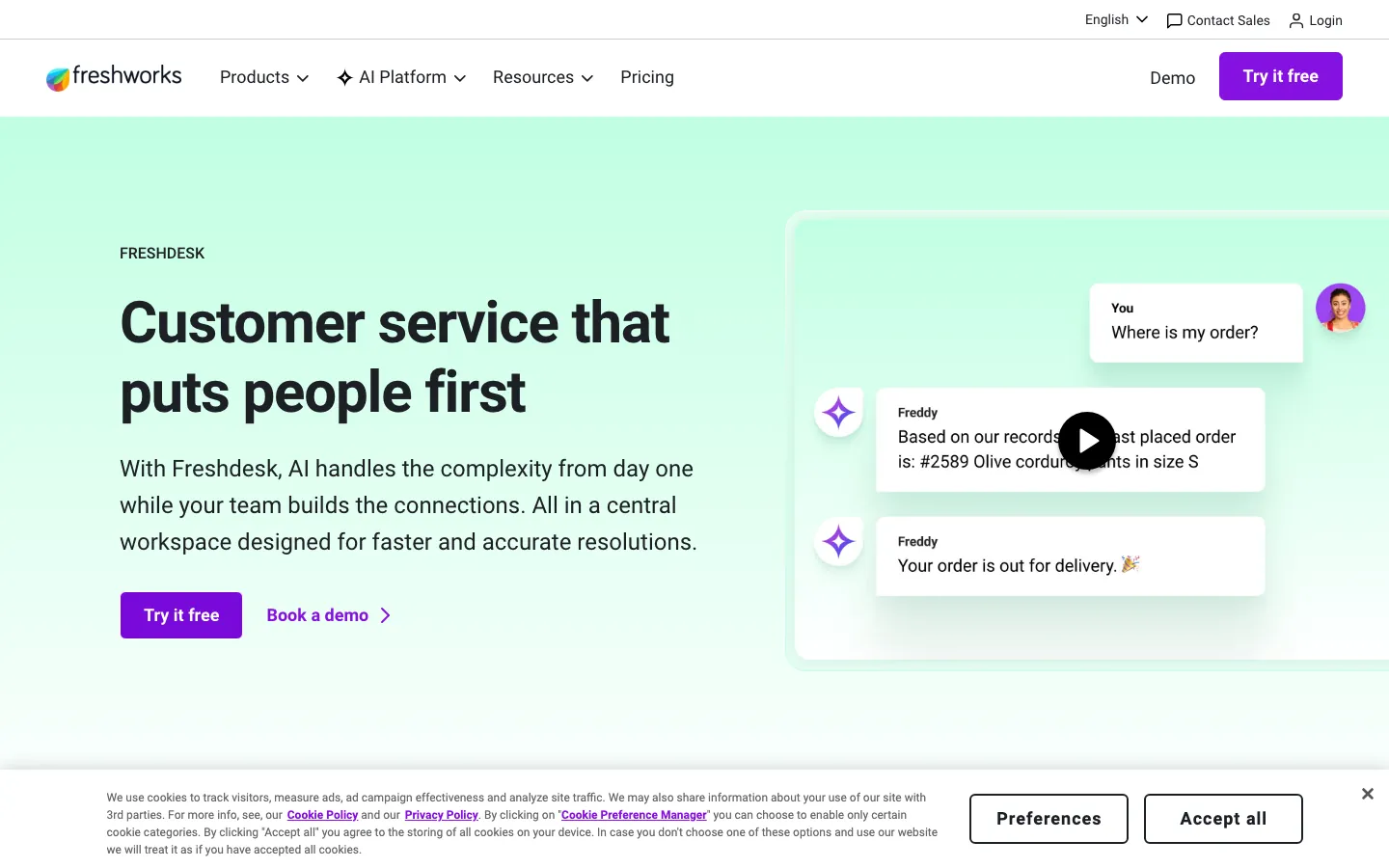
Screenshots of Freshdesk 3 images
What's great
- Free tier covers 1-2 agents on a 6-month trial with genuine functionality, useful for a solo founder validating a support process before paying
- Growth at $19/agent/mo includes automation, SLA management, and Freshworks Marketplace, features Zendesk gates behind $89
- Freddy AI Copilot available as a $29/agent/mo add-on on Pro and Enterprise; cheapest credentialed AI co-pilot in this group
Watch-outs
- Pro tier at $55/agent/mo (annual) is nearly a 3x jump from Growth, the biggest proportional price cliff in the comparison
- Freddy AI Agent is limited to 500 sessions on Enterprise before per-session overage kicks in at $49/100 sessions
- Reporting depth on Growth is thin; meaningful analytics require the $55 Pro tier or higher
Pricing breakdown
| Plan | Price | Best for |
|---|---|---|
| Free | $0 | 1-2 agents (6-month trial) |
| Growth | $19/agent/mo | 2-30 agents |
| Pro | $55/agent/mo | 30-100 agents |
| Enterprise | $89/agent/mo | 100+ agents |
What reviewers say about Freshdesk
Recurring themes across ~1,200 G2 reviews (4.5/5) and Capterra reviews (4.5/5), 2024-2026.
What reviewers praise
- Setup speed is the most consistent praise: reviewers describe going from signup to a working pipeline in under an hour, with drag-and-drop kanban deals and pre-built templates available immediately.
- Built-in phone with click-to-call, automatic call logging, recording, and voicemail drop is repeatedly cited as the reason small sales teams avoid paying for a separate dialer.
- Freddy AI lead scoring gets genuine positive mentions for helping reps focus on high-intent accounts rather than working the list in raw chronological order.
- The pricing is frequently compared favorably to HubSpot and Salesforce, with the Pro plan at $39/user/month covering features that cost twice as much elsewhere.
- Customer support responsiveness is a notable differentiator in reviews, with teams on paid plans consistently describing helpful, quick answers relative to other CRM vendors.
What reviewers fault
- Custom reporting is a recurring frustration: reviewers consistently export to Google Sheets for anything beyond basic dashboards because the built-in report builder lacks cross-object views and calculated fields.
- Freddy AI Copilot moved to a paid add-on ($29/user/month, billed annually) after originally being bundled, and reviewers who upgraded expecting it included describe this as an unwelcome surprise.
- The cheapest plans support only a single sales pipeline, which blocks any team selling more than one product line or managing separate deal flows without upgrading.
- The mobile app covers contact lookups and basic deal updates but consistently falls short for field sales teams who need the full desktop feature set on the road.
- Data enrichment accuracy for non-US companies is flagged as weak by reviewers with international books of business, with auto-populated company and contact data requiring frequent manual correction.
Loading reviews…
HubSpot Service Hub
Best for teams already in the HubSpot CRM ecosystem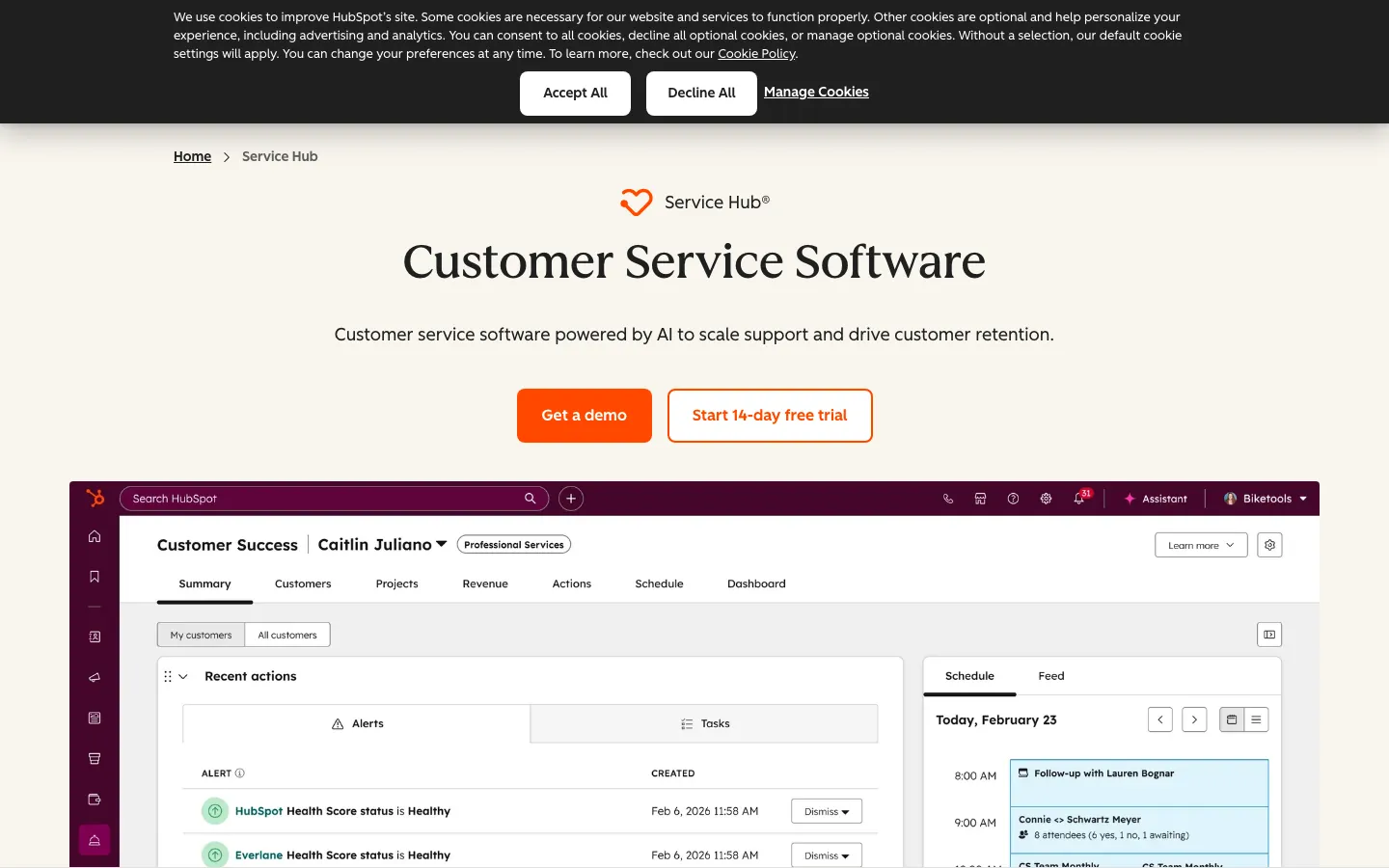
Screenshots of HubSpot Service Hub 3 images
What's great
- Shared contact record with Sales Hub and Marketing Hub means support agents see every deal, email, and lifecycle event on one screen
- Customer Health Score and customer success workspace built into Professional and above, unique in the segment at this price
- Breeze AI copilot included in Professional ($90/seat/mo), no separate AI add-on purchase required
Watch-outs
- Professional tier mandates a $1,500 one-time onboarding fee regardless of team size, a real friction point for small teams
- Enterprise requires a 10-seat minimum at $150/seat/mo, $18,000/year floor before onboarding fees
- Teams not already in HubSpot Sales CRM lose most of the value; standalone, Freshdesk at half the price is the better call
Pricing breakdown
| Plan | Price | Best for |
|---|---|---|
| Free | $0 | Up to 2 users |
| Starter | $15/seat/mo | 2-10 agents |
| Professional | $90/seat/mo + $1.5K onboarding | 10-50 agents with CS workflows |
| Enterprise | $150/seat/mo + $3.5K onboarding | 50+ agents |
What reviewers say about HubSpot Service Hub
Recurring themes across ~13,800 G2 reviews (4.4/5) and ~12,000 Capterra reviews (4.5/5), 2024-2026.
What reviewers praise
- Reviewers consistently call the interface the easiest to learn in the category; new reps are productive in days, not weeks.
- The free tier comes up again and again as genuinely usable, unlimited contacts and basic CRM at no cost, which is rare in this segment.
- Sales and marketing living in one platform is the most-cited reason teams pick it, with clean handoff between Marketing Hub and Sales Hub.
- The App Marketplace breadth (1,500+ integrations) is praised for connecting to almost any stack without custom work.
- Reporting and dashboards get strong marks for being readable and configurable without an admin or a consultant.
What reviewers fault
- The upgrade cliff is the single most common gripe: jumping from Starter to Professional roughly 5x's the per-seat cost and many features sit behind it.
- Marketing Hub's $890/mo flat Professional pricing surprises buyers who only saw per-seat numbers in the demo.
- Mandatory onboarding fees ($1,500 Pro, $3,500 Enterprise) are repeatedly flagged as an unexpected year-one cost.
- Contact-tier pricing means marketing costs scale with your database, and reviewers say cleanup is painful once you're locked in.
- Support quality on lower tiers draws complaints; several reviewers say real help requires a paid tier or a partner agency.
Loading reviews…
Help Scout
Best shared-inbox tool for small support teams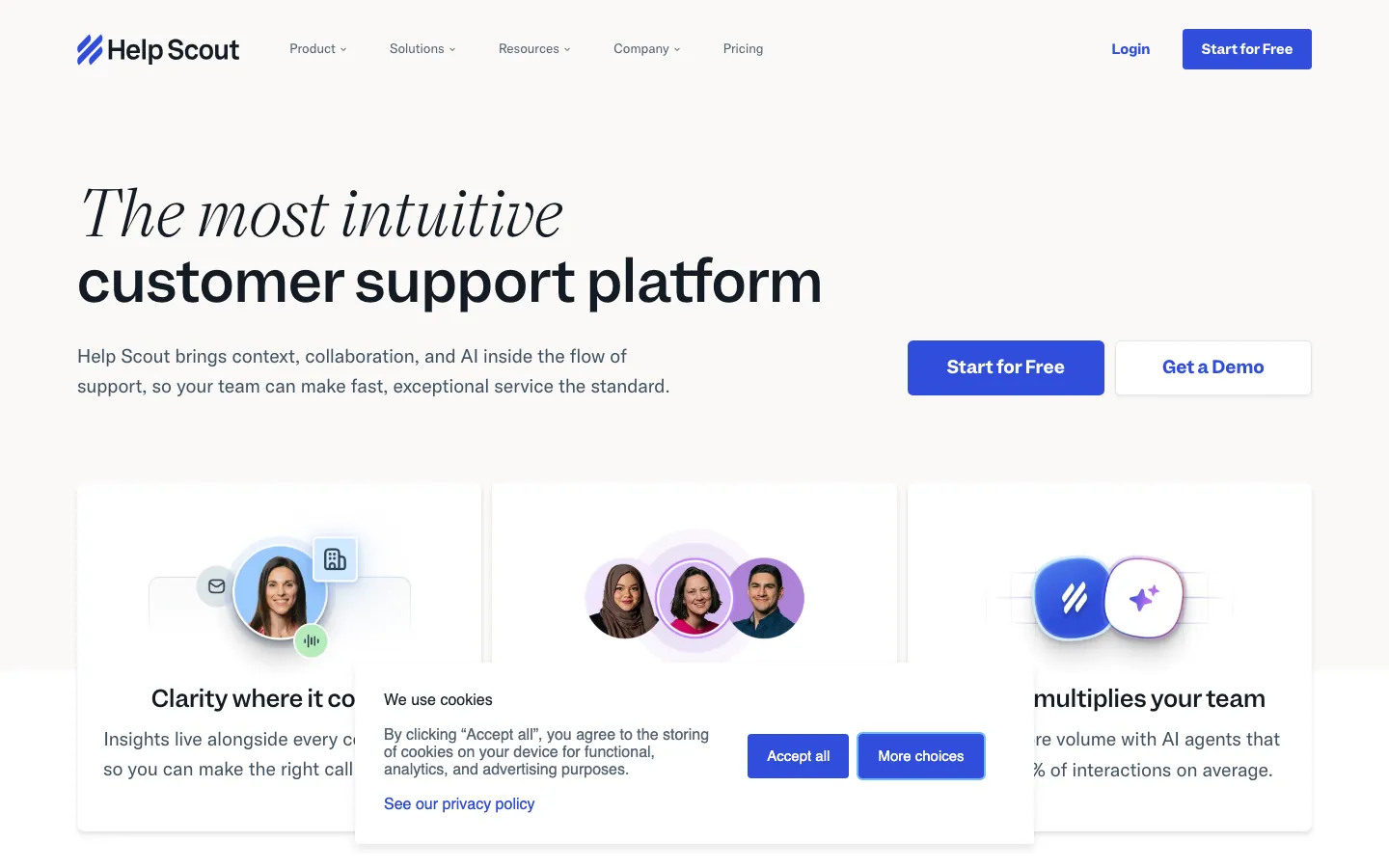
Screenshots of Help Scout 3 images
What's great
- Interface looks like a shared email inbox, not a ticket system; agents adopt on day one without a training program
- Docs knowledge base included in all paid plans; no separate self-service portal purchase
- AI Answers (beta) at $0.75/resolution, pay-as-you-go rather than mandatory seat add-on
Watch-outs
- 25-agent ceiling on Standard before an 80% per-seat price jump forces you to Plus; adding agent 26 moves you from $625/mo to $1,170/mo
- Reporting is functional but not deep; no cohort analysis or agent-efficiency scoring at the Standard tier
- Chat widget exists but is email-routed under the hood, not live chat; teams expecting synchronous response times get surprised
Pricing breakdown
| Plan | Price | Best for |
|---|---|---|
| Free | $0 | Up to 5 users |
| Standard | $25/user/mo | 5-25 agents |
| Plus | $45/user/mo | 25-100 agents |
| Pro | $75/user/mo | 100+ agents |
Loading reviews…
Front
Best multi-channel inbox for B2B operations teams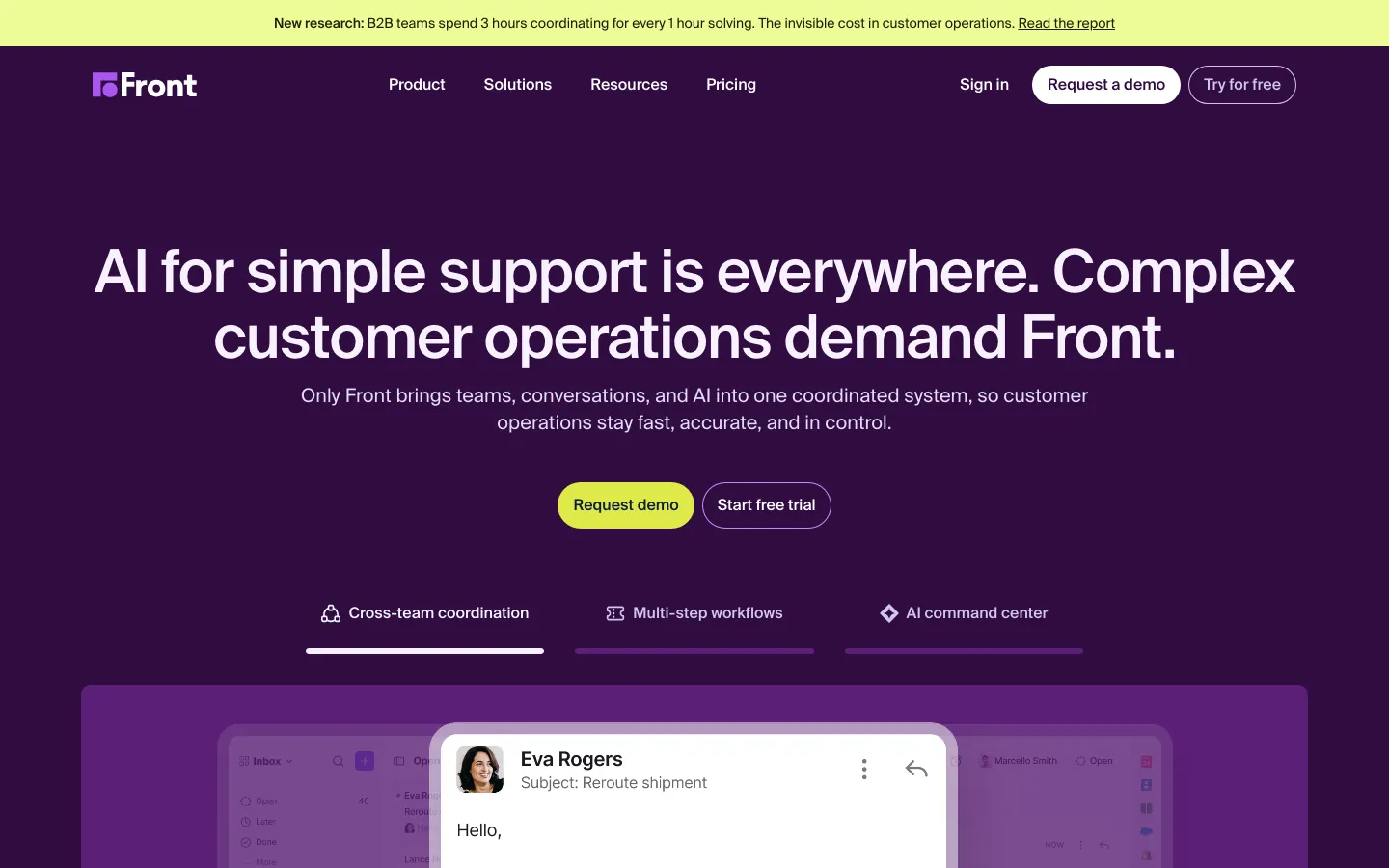
Screenshots of Front 3 images
What's great
- Highest G2 satisfaction rating in this list at 4.7/5; the collaboration layer (assignments, internal threads, shared drafts) is the differentiator G2 reviewers cite most
- Email, SMS, WhatsApp, and social media channels treated as first-class inboxes, not redirected into ticket queues
- Trusted by 9,000+ businesses including ClickUp and Uber Freight, specifically for B2B ops workflows where email is the primary channel
Watch-outs
- Starter plan caps at 10 seats; Professional at $65/seat/mo is where most growing teams actually live
- AI features (Copilot, Smart QA, Smart CSAT) are paid add-ons on Starter and Professional, not bundled
- Ticketing depth is lighter than Zendesk; teams with heavy ITSM or multi-tier routing requirements will hit walls
Pricing breakdown
| Plan | Price | Best for |
|---|---|---|
| Starter | $25/seat/mo | Up to 10 seats |
| Professional | $65/seat/mo | Up to 50 seats |
| Enterprise | $105/seat/mo | 50+ seats |
| AI add-ons | Custom | Copilot |
Loading reviews…
Gorgias
Best help desk for ecommerce and DTC brands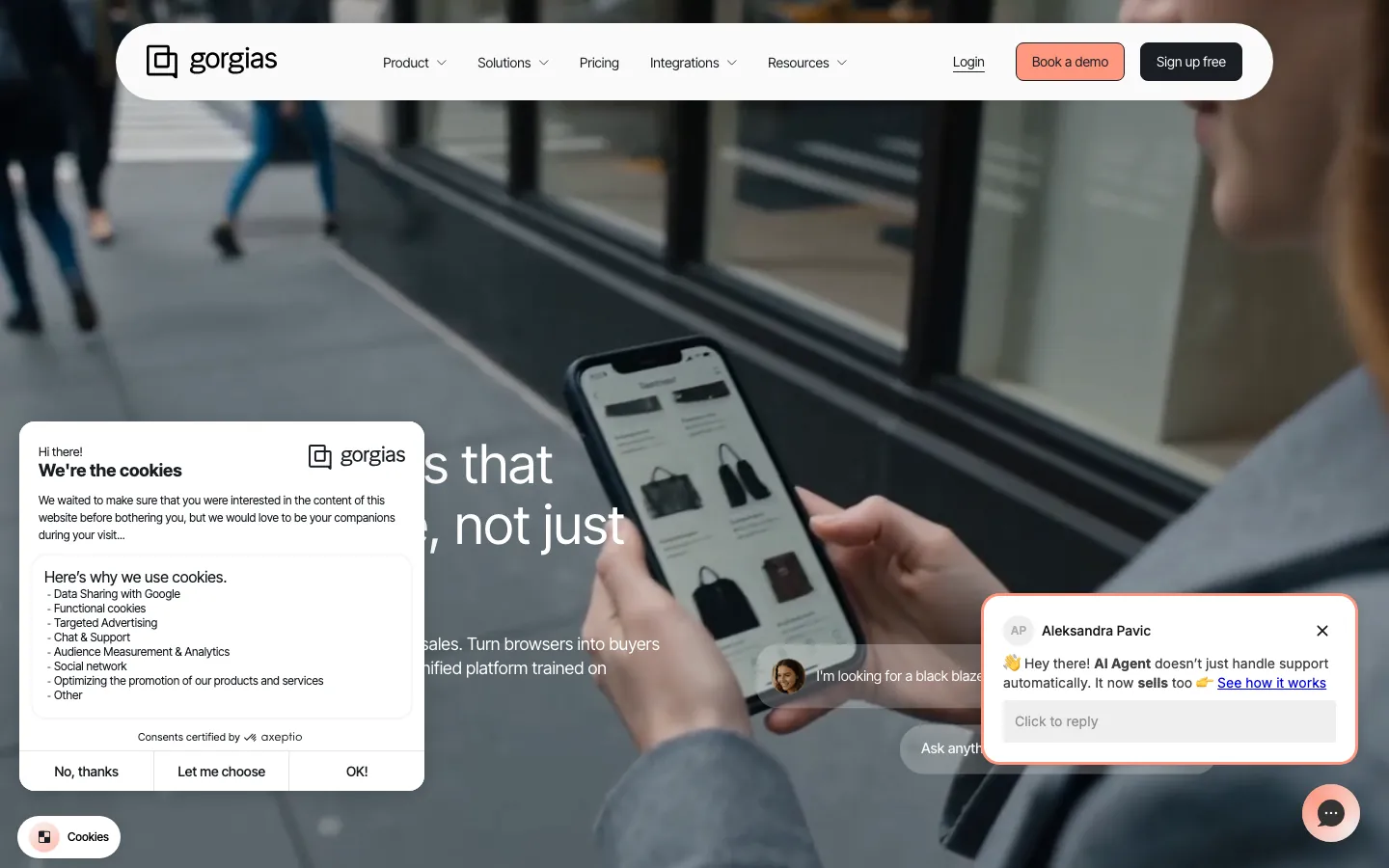
Screenshots of Gorgias 3 images
What's great
- Ticket-based pricing with unlimited agents; a 5-person support team pays the same as a 20-person one at the same volume
- Native Shopify, Magento, and BigCommerce integrations pull order data, refund buttons, and subscription info into the ticket sidebar
- AI Agent at $0.90-$1.00/resolution with a documented track record on ecommerce use cases like WISMO, return status, and refund requests
Watch-outs
- AI Agent tickets are double-billed: you pay the helpdesk ticket and the $0.90-$1.00 per AI resolution separately
- Ticket-based pricing becomes unpredictable with volume spikes; a Black Friday event can trigger overage at $0.36-$0.40/ticket
- Designed entirely around ecommerce; B2B SaaS or services teams get minimal value from the platform-specific integrations
Pricing breakdown
| Plan | Price | Best for |
|---|---|---|
| Starter | $10/mo | Up to 50 tickets |
| Basic | $60/mo | Up to 300 tickets |
| Pro | $360/mo | Up to 2 |
| Advanced | $900/mo | Up to 5 |
Loading reviews…
Jira Service Management
Best for IT and internal service desks on the Atlassian stack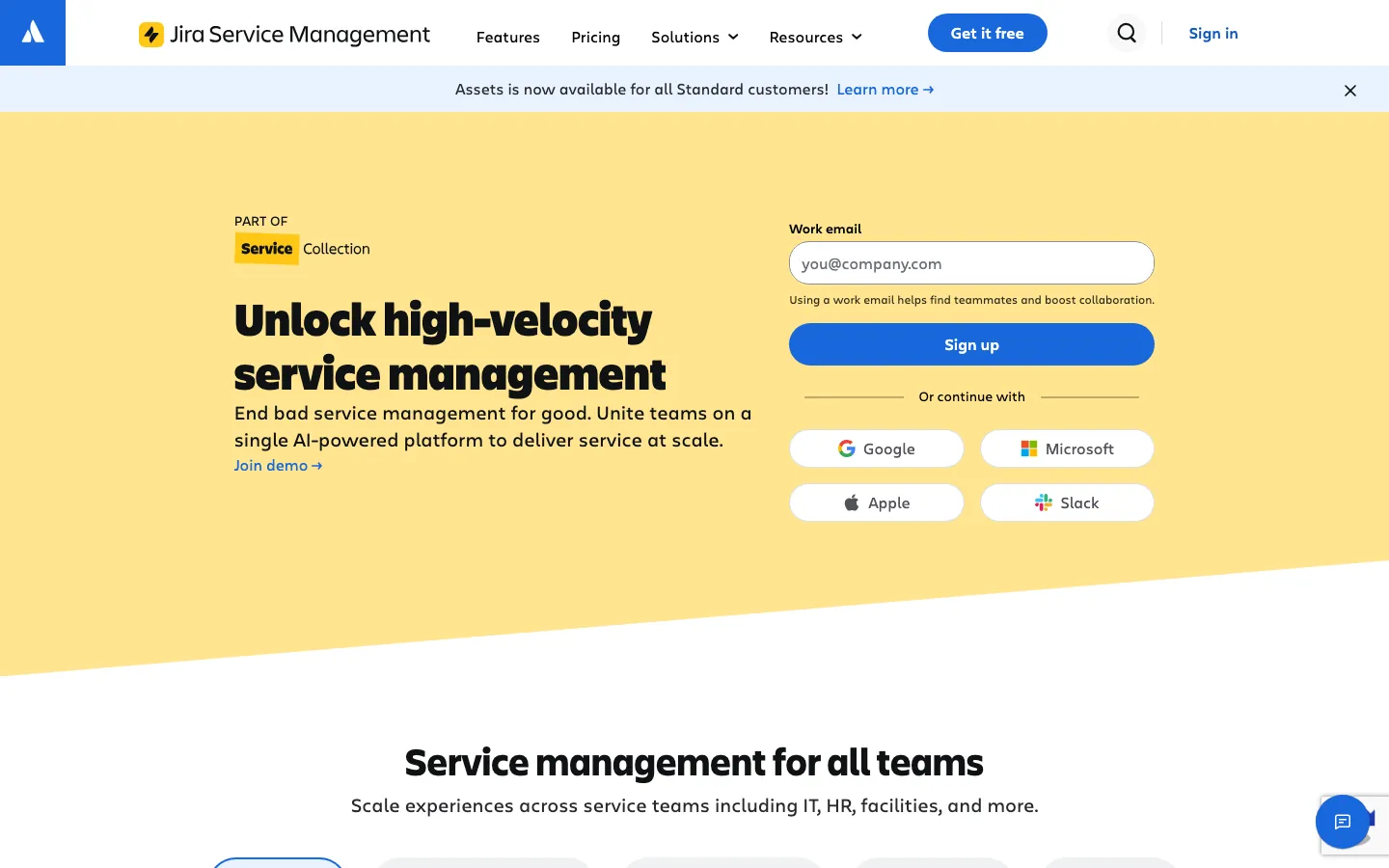
Screenshots of Jira Service Management 3 images
What's great
- Native Jira Software link means incidents auto-create linked dev tickets; the fastest escalation path from support to engineering in the market
- ITIL-ready workflows out of the box (incident, problem, change, request) without a consulting engagement
- Free tier for 3 agents is perpetual and functional; early-stage IT teams can run a real help desk at zero cost
Watch-outs
- Non-Atlassian integrations are brittle; reviewers consistently flag that Zendesk, Salesforce, and Slack integrations require maintenance overhead
- Steep learning curve; configuration of request types, SLA policies, and approval workflows requires dedicated admin time
- Premium at $48/agent/mo for AI features (Rovo Agents) puts it in Zendesk Professional territory, hard to justify unless the Atlassian ecosystem is already in place
Pricing breakdown
| Plan | Price | Best for |
|---|---|---|
| Free | $0 | Up to 3 agents |
| Standard | $20/agent/mo | 3-100 agents |
| Premium | $48/agent/mo | 100+ agents |
| Enterprise | Custom | Multi-site |
Loading reviews…
Zoho Desk
Best for teams already in the Zoho One ecosystem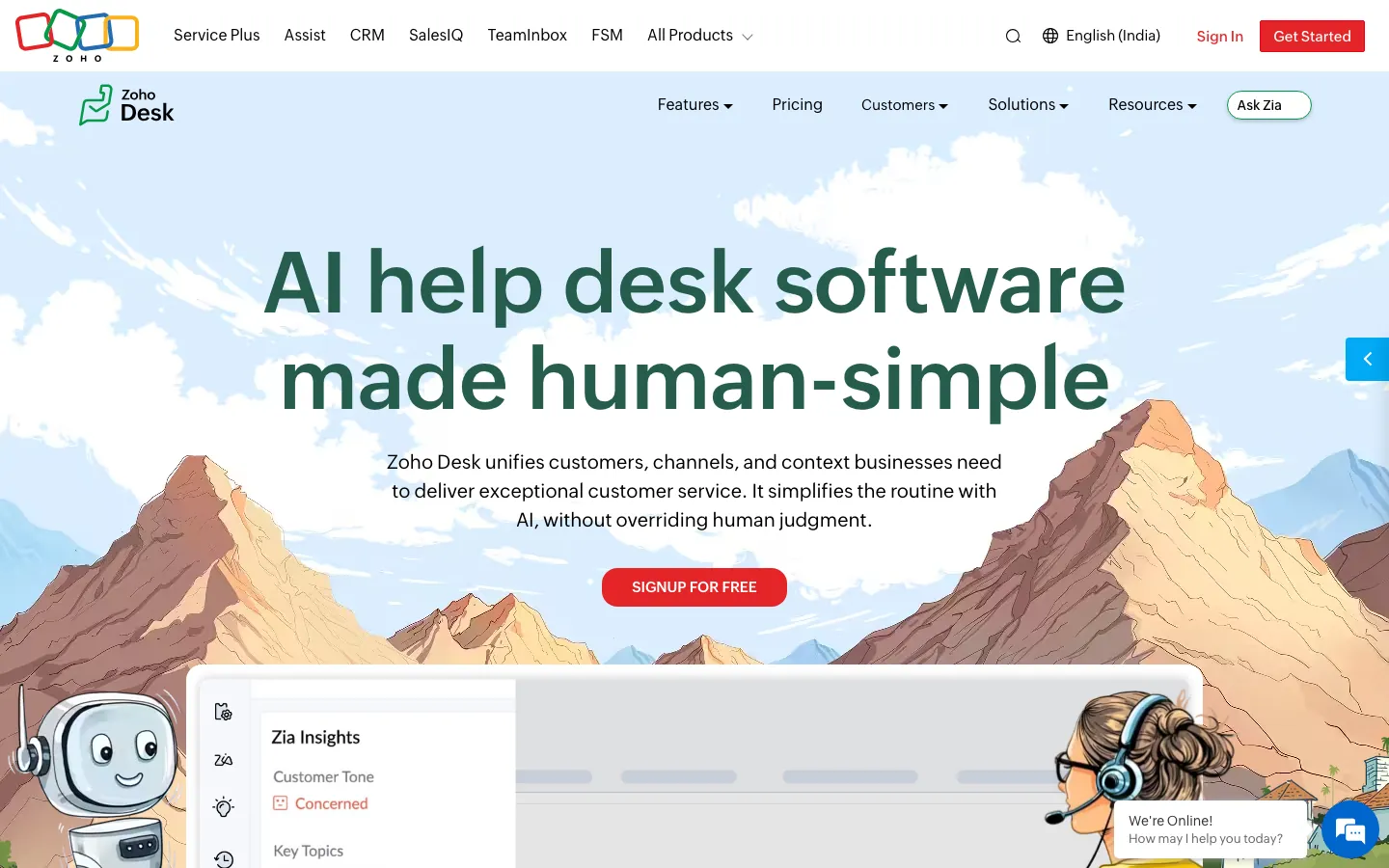
Screenshots of Zoho Desk 3 images
What's great
- Largest G2 review base in this guide at 7,337 reviews with a 4.4/5 average, sustained user confidence at scale
- Zia AI (sentiment analysis, tag suggestions, auto-responses) bundled into Enterprise at $50/agent/mo; no add-on purchase
- Zoho One integration: shared contact records with Zoho CRM, Zoho Books, and Zoho Analytics with no middleware
Watch-outs
- Interface is functional but cluttered; G2 reviewers at the Standard tier consistently describe it as "dated" and "harder to navigate than expected"
- Zia AI requires meaningful historical ticket volume before its sentiment and routing models produce accurate suggestions
- Support quality from Zoho's own team is uneven; reviewers cite long resolution times on complex technical issues
Pricing breakdown
| Plan | Price | Best for |
|---|---|---|
| Free | $0 | Up to 3 agents |
| Standard | $14/agent/mo | 3-20 agents |
| Professional | $23/agent/mo | 20-100 agents |
| Enterprise | $40/agent/mo | 100+ agents |
What reviewers say about Zoho Desk
Recurring themes across ~2,900 G2 reviews (4.1/5) and Capterra reviews (4.3/5), 2024-2026.
What reviewers praise
- Price-to-feature ratio is the most repeated compliment: reviewers say Zoho delivers lead scoring, workflow automation, and multi-currency support at a fraction of the cost of HubSpot or Salesforce.
- Depth of the Zoho ecosystem is consistently praised by teams already using Zoho Books, Zoho Desk, or Zoho Campaigns, who describe the cross-app data flow as a genuine alternative to buying multiple point solutions.
- The Canvas drag-and-drop UI builder, added in recent years, appears in newer positive reviews as a meaningful upgrade, letting non-technical admins redesign the record layout without code.
- Workflow automation breadth gets strong marks, with reviewers pointing to multi-condition rules, scheduled actions, and blueprint approval processes as features competitors lock behind enterprise tiers.
- Lead management tools including assignment rules, scoring, and conversion tracking are frequently cited as thorough and configurable for teams with defined sales processes.
What reviewers fault
- Customer support is the single most common complaint across G2 and Capterra, with reviewers on standard plans describing slow ticket responses, inconsistent answers, and difficulty escalating urgent issues.
- The learning curve is steep enough that multiple reviewers recommend hiring a Zoho consultant for initial setup, especially for automation, Deluge scripting, and module customization.
- The mobile app has reliability problems that appear consistently in recent reviews, including bugs that prevent notes from displaying, missed call logs, and crashes under poor connectivity.
- Integration with non-Zoho tools is frequently described as more friction than the docs suggest, with third-party connectors requiring Zapier workarounds or custom API work for stable two-way sync.
- The interface, despite recent improvements, is still called cluttered and overwhelming by first-time CRM buyers, and the density of settings can make routine tasks harder to find than in leaner tools.
Loading reviews…
Kustomer
Best enterprise ecommerce CRM-plus-support platform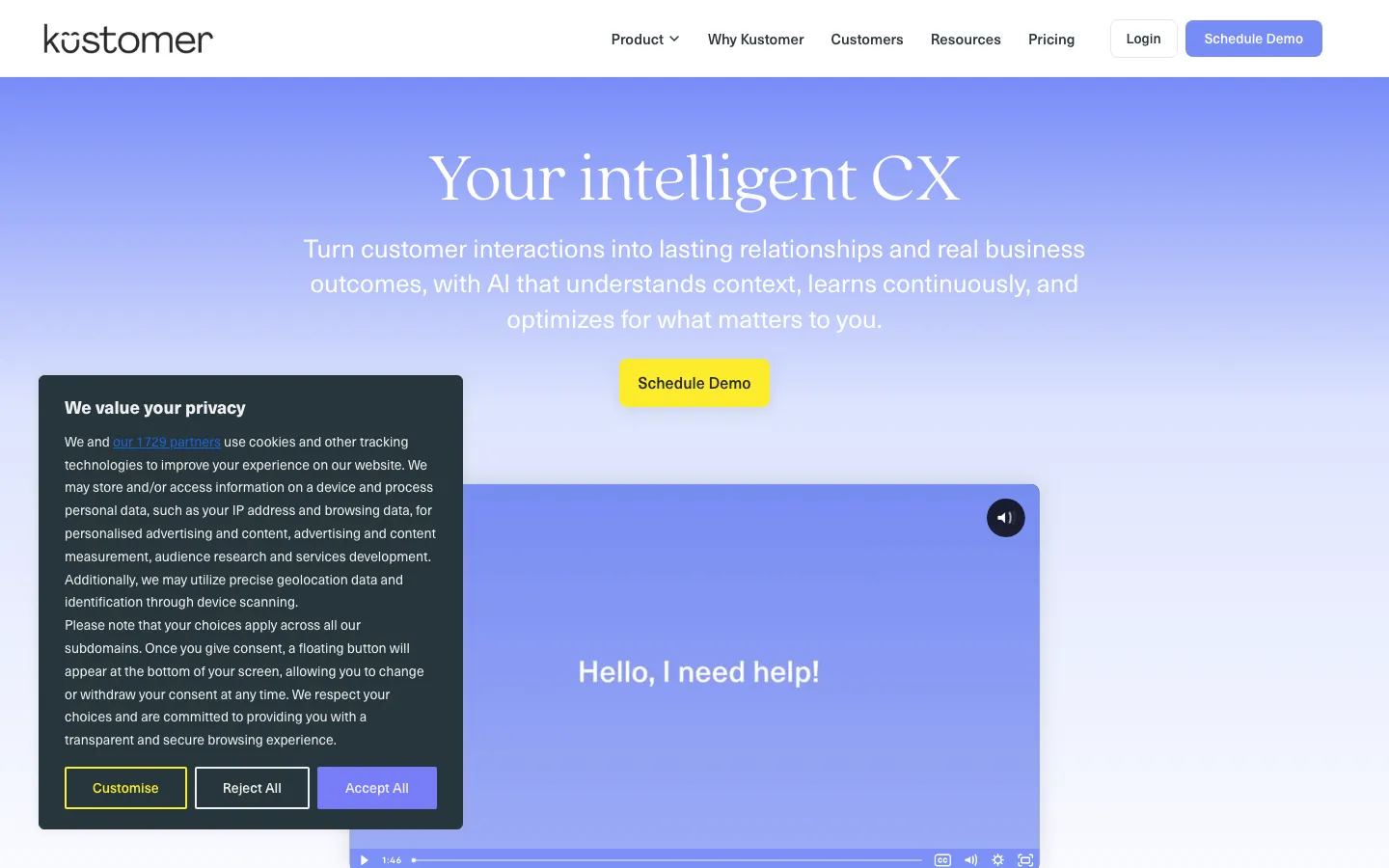
Screenshots of Kustomer 3 images
What's great
- Unified customer timeline shows every order, conversation, return, and note in one scroll; no tab-switching for agents handling repeat customers
- Customer-record-based pricing model (conversations built around the person, not the ticket) matches how enterprise DTC brands actually think about support
- Strong automation layer; Kustomer IQ handles routing, tagging, and sentiment scoring without a separate AI purchase
Watch-outs
- 8-seat minimum at $89/seat/mo means $8,544/year before even logging in; the floor is higher than most SMB budgets
- Implementation runs $18,000-$30,000 and takes 12-16 weeks, the most expensive ramp-up in this guide
- AI Agent bot costs $0.60/conversation on top of seat fees, and the agent copilot adds another $40/user/mo
Pricing breakdown
| Plan | Price | Best for |
|---|---|---|
| Enterprise | $89/user/mo | 8+ agents |
| Ultimate | $139/user/mo | 20+ agents |
| AI Agent | $0.60/conversation | Stacks on top of both plans |
| AI Copilot | $40/user/mo | Agent-assist on Enterprise+ |
Loading reviews…
Tools we considered but excluded
We evaluated more tools than the 10 you see above. These did not make the cut. Saying what we rejected, and why, is the editorial muscle most listicles skip.
- Salesforce Service Cloud: Enterprise-only pricing ($75-$300/agent/mo) with mandatory implementation partner costs; most readers of this guide will use a lighter tool 24 months before needing it
- ServiceNow: IT service management at the $1M+ contract level; not relevant to B2B SaaS or ecommerce buyers
- Hiver: Gmail-native help desk that works well for 5-15 agent Google Workspace teams, but limited to email and outgrows its feature set fast
- Tidio: Solid chat + chatbot tool for SMB ecommerce, but lacks the ticketing depth needed for the multi-channel teams this guide targets
- LiveAgent: Strong value per dollar, but UI and AI investment lag the tools in this guide by 12-18 months
- Gladly: Purpose-built for enterprise retail with a people-first model, but minimum contract floors eliminate it for sub-enterprise buyers
Honorable mentions
Solid tools that did not crack the main list but are worth tracking, especially for niche use cases.
- Hiver: For Google Workspace-only teams under 15 agents wanting a help desk that lives inside Gmail, this is the lowest-friction path
- Kayako: Legacy mid-market help desk with honest pricing; worth checking if you need simple multi-language support without enterprise fees
- Tidio: Shopify ecommerce teams under 500 tickets/month that want chat + basic automation before committing to Gorgias pricing
The four help desk product philosophies competing for your budget
The help desk market in 2026 has not consolidated. It fragmented. There are now four distinct product philosophies competing for the same buyer budget, and picking the wrong one means either paying for features you won’t use or hitting a ceiling in month six.
Help desk software is the ticketing core of that decision. The wider platform that wraps self-service, omnichannel routing, and AI deflection around the queue is what we rank in the customer service software guide , which covers this same tool universe from the platform angle.
Ticketing-first platforms with AI added on top. Zendesk, Freshdesk, Jira Service Management, Zoho Desk. These were built as structured ticketing systems and have retrofitted AI agents, copilots, and deflection workflows into the product. The ticketing model is mature. The AI layer is variable.
AI-native platforms with ticketing added on the side. Intercom. The product was rebuilt from the ground up around Fin as the primary agent. Ticketing is supported but the company’s bet is that most conversations should never become tickets at all.
Shared-inbox platforms that resist the ticket metaphor. Help Scout, Front. These treat every customer conversation as an email thread that a team collaborates on. No ticket numbers, no queues, no routing trees unless you build them. The UX is the pitch.
Vertical-specific platforms. Gorgias for ecommerce, Kustomer for enterprise DTC, Jira Service Management for IT and internal desks. These win when the category fit is exact and lose when it isn’t.
Every tool in this guide was tested across real ticket volume. The categories above predict which tools will make sense before the first demo.
2026 market shifts
AI agents crossed the credibility threshold this year. In 2024, deflection rate claims from every vendor were aspirational. By Q1 2026, Intercom was reporting 67% resolution across 7,000+ customers with documented monthly improvement. Zendesk’s AI agents hit 90% under ideal conditions.
The “AI deflection as a primary ROI driver” argument is no longer just a sales pitch; it’s a line item in real support budgets. Teams running 10,000+ tickets/month are now building purchase decisions around per-outcome pricing, not just seat counts.
Per-outcome pricing is replacing seat pricing in AI-heavy plans. Every platform with a real AI agent now charges per resolution on top of seat fees: Intercom at $0.99/resolution, Gorgias AI Agent at $0.90-$1.00/resolution, Zendesk AI agents at $1.50-$2.00/resolution for committed vs pay-as-you-go.
The math cuts both ways: teams with high deflection rates save money; teams with low deflection rates pay more than a seat model would have. The forecasting error buyers make is assuming Day-1 deflection rates will match vendor-reported averages.
The ticketing-vs-inbox split is a real product philosophy, not just UX. Front’s 2026 homepage positioning calls out “AI for simple support is everywhere, complex customer operations demand Front.” Help Scout keeps growing in sub-25-agent segments where the shared inbox model reduces onboarding friction. These aren’t Zendesk alternatives trying to be Zendesk cheaper. They’re making a different bet about how customer conversations should be managed.
Ecommerce-specific help desks are pulling away from general tools. Gorgias’s Shopify integration depth and ticket-based unlimited-agent pricing model creates a moat that Zendesk and Freshdesk don’t attempt to match. For DTC brands, the order-data-in-sidebar workflow reduces average handle time by 20-35% according to published Gorgias case studies. That’s a number Zendesk cannot replicate without custom middleware.
Atlassian’s JSM is winning internal IT desks at the SMB level. The perpetual free tier for 3 agents and the native Jira Software link is pulling IT help desk decisions away from ServiceDesk Plus and even basic Zendesk setups. The limitation is the non-Atlassian integration brittleness. Past 25 agents on a mixed stack, the maintenance burden shows up.
What to check in every help desk demo
The things that predict whether a support team sticks with (or abandons) a help desk are almost never in the vendor demo. Here is what to check.
One, configure a routing rule from a real ticket type. Don’t use the demo scenarios. Take an actual ticket from your queue, a billing question, a bug report, a return request, whatever volume looks like, and build the routing rule, the macro, and the SLA policy from scratch. Teams that skip this step discover in month three that the configuration interface doesn’t match the complexity of their real queue.
Two, measure clicks-per-resolution on a complete ticket lifecycle. From ticket creation to first response to resolution to close. Count every click. Freshdesk and Help Scout are typically 8-12 clicks per lifecycle; Zendesk Enterprise with complex routing can run 18-22. At 1,000 tickets/month, that gap is 600 extra clicks per agent per week. It adds up.
Three, test the AI agent with your real FAQ content. Paste your five most common ticket questions into the AI agent setup. Measure what it answers correctly on the first try without any tuning. Day-1 accuracy varies widely between the strongest and weakest agents, and that gap predicts the admin time required to reach acceptable deflection rates.
Four, export the full ticket history. Try pulling every closed ticket from the last 90 days including tags, assignee history, and custom field values into a CSV without involving support. If this requires a support ticket, an API call, or “talk to your CSM”, the data is not truly portable. Every tool in this guide passes except for a handful of Kustomer legacy configurations.
Five, run the agent experience for one full day before buying. Put an agent on the trial for a real support day. Not a demo. Not a walkthrough. Let them handle their actual queue in the trial environment for four hours. Agent satisfaction scores at week six correlate directly with whether they were involved in the trial evaluation.
Six, check the mobile app against your real workflow. If agents handle escalations outside business hours, the mobile app is not optional. Zendesk’s iOS app is solid; Help Scout’s is clean; Freshdesk’s is functional; Jira Service Management’s mobile experience gets complaints in G2 reviews about load times and navigation. Test this before committing, especially for on-call IT support teams.
Seven, ask about year-two pricing in writing. The year-one demo price is the marketing price. Ask: what did your average customer at our size pay at renewal? If the rep can’t give a number, assume 7-12% annual increases. Negotiate uplift caps before signing the first contract. Zendesk and Intercom both have a history of 8-10% annual uplifts on renewal.
Eight, test one live integration end-to-end. Not “yes, we integrate with Slack.” Actually connect Slack and verify that ticket creation from a Slack message works, that the agent response shows in Slack, and that the ticket closes when the Slack thread resolves. Do this with your most-critical integration, not the showcase one. Integration brittleness is the top reason support teams regret their help desk purchase at month nine.
Where the ten help desks differ on core features
| Tool | Free tier | AI agent (built-in) | Ticket-based pricing | ITIL workflows | Native ecom integration |
|---|---|---|---|---|---|
| Zendesk | Trial only | Suite plans + $50/mo add-on | ✗ | • Professional+ | ✗ |
| Intercom | Trial only | ✓ Fin ($0.99/resolution) | ✗ | ✗ | ✗ |
| Freshdesk | Trial (2 agents) | $ Freddy add-on | ✗ | • Enterprise | ✗ |
| HubSpot Service Hub | ✓ 2 users | ✓ Breeze (Pro+) | ✗ | ✗ | ✗ |
| Help Scout | ✓ 5 users | $ AI Answers add-on | ✗ | ✗ | ✗ |
| Front | Trial only | $ Add-on | ✗ | ✗ | ✗ |
| Gorgias | Trial only | ✓ AI Agent ($0.90-1.00) | ✓ ticket-based | ✗ | ✓ Shopify/Magento |
| Jira SM | ✓ 3 agents | $ Premium (Rovo) | ✗ | ✓ all tiers | ✗ |
| Zoho Desk | ✓ 3 agents | ✓ Zia (Enterprise) | ✗ | • Enterprise | ✗ |
| Kustomer | Demo only | $ IQ + bot fees | ✗ | ✗ | ✓ DTC integrations |
Zoho Desk and Jira Service Management have the best perpetual free tiers (3 agents each) for teams getting started; Freshdesk’s free plan is now a 2-agent, 6-month trial, not a permanent free tier. Gorgias is the only tool with ticket-based (unlimited-agent) pricing. Jira Service Management is the only tool with ITIL workflows baked into the free tier.
Intercom and Gorgias are the only tools where AI agents are a primary product feature rather than a bolt-on.
AI agent (chatbot) maturity check
This is the question 2026 buyers ask first. Here is what the data actually shows.
Intercom Fin leads by a clear margin.
The 67% average resolution rate across 7,000+ customers, documented by Intercom and tested by third parties, is the highest published figure in the segment.
Intercom’’s own head-to-head showed Fin answering 96% of multi-source questions correctly vs Zendesk at 78%; that test is vendor-produced, so read it as a directional signal, not a neutral benchmark.
Practitioner write-ups like the Swifteq comparison land lower, around 60% real-world Fin resolution and up to 80% Zendesk deflection when each is tuned well.
The trade-off is the per-outcome billing model. At 10,000 tickets/month with 67% deflection, you’re generating 6,700 Fin resolutions at $0.99 each: $6,633/month stacked on top of seat costs. Model this before signing.
Zendesk AI agents are the second-most mature and the most configurable. The $50/agent/mo Advanced AI add-on enables intent detection, sentiment analysis, and intelligent triage. Published ceiling is 90% deflection under ideal conditions; realistic expectation after six months of content optimization is 50-60%.
The advantage over Fin is cost predictability on committed volume: $1.50/automated resolution with committed volume vs $2.00 pay-as-you-go.
Freshdesk Freddy AI Copilot ($29/agent/mo) is primarily agent-assist rather than customer-facing deflection. It helps agents draft replies, summarize ticket history, and suggest knowledge base articles.
The Freddy AI Agent (customer-facing bot) is useful for FAQ deflection but requires Pro or Enterprise and burns through the 500-session bundle fast for mid-size teams. Best framed as “AI help for agents” rather than “AI instead of agents.”
Gorgias AI Agent is purpose-calibrated for ecommerce repetitive queries (WISMO, return status, refund requests) and performs well in that narrow lane. Outside ecommerce ticket types, the deflection rate drops significantly. The double-billing concern is real: a resolved AI ticket costs the helpdesk ticket AND $0.90-$1.00 on top.
Zoho Desk’s Zia and HubSpot’s Breeze are functional for single-intent routing and basic summarization but are not yet competing with Fin or Zendesk AI for deflection rates. Jira Service Management’s Rovo (Premium tier) is early-stage for external customer-facing deflection; it works better for internal IT request resolution.
Teams evaluating AI agents should run the same 20 real tickets through each tool’s bot in trial, without pre-training. The Day-1 accuracy gap between Fin and the alternatives is large enough to drive the purchase decision before any other criterion.
If AI deflection is the main thing driving your budget, the standalone agents (Fin, Ada, Decagon, Sierra) are worth a closer look than a help desk section can give them. Our AI customer support tools comparison benchmarks them on resolution rate, hallucination frequency, and real per-ticket cost.
Multi-channel inbox vs ticketing split
The most underrated decision in help desk selection is whether your team needs ticketing or inbox management. These are different products with different operating assumptions, and most buyer journeys treat them as interchangeable.
Ticketing systems (Zendesk, Freshdesk, Jira SM, Zoho Desk) operate on the assumption that every customer contact gets transformed into a numbered artifact, assigned to an agent or queue, tracked against an SLA, and resolved in a structured lifecycle.
The model is right for support orgs with defined service tiers, multiple routing paths, and volume high enough that structure creates throughput rather than friction.
Shared-inbox tools (Help Scout, Front) operate on the assumption that customer conversations are email threads best handled by whoever is in the room. There are no ticket numbers by default. A message comes in, someone picks it up, they respond, it’s done.
The model is right for sub-30-agent teams where the overhead of a ticketing lifecycle is more expensive than the problem it solves.
The failure mode in the wrong direction is specific and painful. A 10-agent team that buys Zendesk Professional ($115/agent/mo) spends the first month building routing rules that never fire and reporting dashboards nobody checks.
A 60-agent team that buys Help Scout hits the 25-agent tier cliff, starts losing ticket context across agents, and migrates to Zendesk 14 months later at significant data-migration cost.
Front sits between these philosophies intentionally. The 4.7/5 G2 rating reflects what happens when B2B ops teams (logistics companies, SaaS operations, freight platforms) that want the inbox model but need more than a shared email thread. Front adds assignments, internal threads, multi-channel routing, and AI assistance without forcing the ticket metaphor.
It’s the right bridge for teams that have outgrown Help Scout but don’t want to become Zendesk operators.
A simple decision heuristic: if your support manager currently spends more than two hours a week on queue management, you need ticketing. If two hours is an overstatement, inbox management is probably enough.
Help desk security and compliance, tier by tier
| Tool | SOC 2 Type II | GDPR | HIPAA | SSO/SAML | Audit logs |
|---|---|---|---|---|---|
| Zendesk | ✓ | ✓ | ✓ Suite Enterprise | Suite Team+ | Suite Professional+ |
| Intercom | ✓ | ✓ | ✓ Expert tier | Expert tier | Advanced+ |
| Freshdesk | ✓ | ✓ | $ available | Pro+ | Enterprise |
| HubSpot Service Hub | ✓ | ✓ | ✓ Enterprise | Enterprise | Professional+ |
| Help Scout | ✓ | ✓ | ✓ Pro tier | Pro tier | Plus+ |
| Front | ✓ | ✓ | $ contact sales | Professional+ | Professional+ |
| Gorgias | ✓ | ✓ | ✓ on request | Advanced+ | Advanced+ |
| Jira SM | ✓ | ✓ | ✓ Premium+ | All tiers | Standard+ |
| Zoho Desk | ✓ | ✓ | $ Enterprise add-on | Professional+ | Professional+ |
| Kustomer | ✓ | ✓ | ✓ Ultimate tier | Enterprise | Enterprise |
For enterprise IT review, Zendesk Enterprise, Intercom Expert, and Jira Service Management Premium pass the full checklist. Help Scout Pro covers HIPAA, which is notable at that price point for healthcare-adjacent teams.
Gorgias lists HIPAA compliance on its security page and will share the report on request, so a healthcare-adjacent ecommerce brand can clear it, but confirm the BAA terms with Gorgias sales before committing. Kustomer’s compliance posture is strong but requires the Ultimate tier.
Integration depth across the help desk stack
| Tool | Slack | Salesforce | Shopify | Jira Software | Twilio/SMS |
|---|---|---|---|---|---|
| Zendesk | N | N | M | N | N (Twilio) |
| Intercom | N | N | M | N | N (Twilio) |
| Freshdesk | N | N | M | M | $ add-on |
| HubSpot Service Hub | N | M | M | M | N |
| Help Scout | N | M | M | M | ✗ |
| Front | N | N | M | M | N native |
| Gorgias | N | ✗ | N (native) | ✗ | N native |
| Jira SM | N | M | ✗ | N (same product) | • limited |
| Zoho Desk | N | M | M | M | $ add-on |
| Kustomer | N | N | N (native) | M | N native |
N = native/first-party, M = marketplace add-on, $ = paid third-party, • = limited/Zapier only, ✗ = no supported path
Zendesk has the strongest native integration story overall. Gorgias and Kustomer are the only tools with native Shopify integrations. Jira Service Management is unsurprisingly the strongest for teams that already run Jira Software.
HubSpot Service Hub’s Salesforce integration exists but is an add-on rather than native, a tell that the product is designed for HubSpot CRM shops.
How to choose the right help desk for your team
Five questions. Answer them in order and the shortlist shrinks fast.
1. Agent count and growth trajectory
Under 15 agents: Help Scout Standard ($25/user/mo), Freshdesk Growth ($19/agent/mo), or Intercom Essential ($39/seat/mo). Don’t overbuy. The implementation cost of Zendesk Professional for a 10-agent team is real and mostly wasted.
15-50 agents: Freshdesk Pro ($55), Zendesk Suite Team or Growth ($55-$89), or Front Professional ($65). This is the band where routing rules, SLA tracking, and basic reporting start paying back.
50-200 agents: Zendesk Suite Professional ($115), Intercom Advanced ($99) if AI deflection is a primary driver, HubSpot Service Hub Professional ($90) if the team runs on HubSpot CRM. Plan for a dedicated admin.
200+ agents: Zendesk Suite Enterprise ($169), Kustomer Enterprise for DTC brands, or Salesforce Service Cloud for Salesforce shops.
2. Primary channel, email versus chat versus tickets
Email-first: Help Scout or Front. The shared inbox model reduces agent cognitive load. Chat + ticket hybrid: Intercom or Zendesk Suite. Both handle the channel blend without requiring a second tool. Ticketing + ITSM: Jira Service Management or Zendesk. Structured workflows built in. Ecommerce: Gorgias if you’re on Shopify/Magento.
Nothing else matches the native order integration.
3. AI deflection as a primary ROI driver
If the answer is yes and your ticket volume is above 5,000/month: Intercom Fin is the best tool in 2026. Model the per-outcome cost against your expected deflection rate before signing.
If AI is a nice-to-have: Freshdesk Freddy Copilot ($29/agent add-on) or Zoho Desk Zia (Enterprise, included) are the most cost-effective paths.
If AI is not a near-term priority: Help Scout, Front, or Freshdesk Growth. Don’t pay for AI infrastructure you won’t use in the first 12 months.
4. Your existing technology stack
Already on HubSpot CRM: Service Hub is the obvious pick for the shared contact record. Already on Atlassian: Jira Service Management for the Jira Software link. Already on Zoho One: Zoho Desk for the CRM + Books integration. Salesforce shop: Zendesk’s Salesforce native integration or Salesforce Service Cloud. Mixed/modern stack: Zendesk or Intercom.
The ecosystems are large enough to bridge anything else.
5. Real year-one cost
Verify the year-one cost by multiplying agents × per-seat price × 12, then adding: onboarding fees (HubSpot Service Hub Pro mandates $1,500; Kustomer runs $18,000-$30,000), implementation time, migration costs if moving from a current tool, and AI add-on costs if relevant.
The biggest forecast errors are the AI per-outcome fees; teams that assume 67% Fin deflection on Day 1 but get 30% in the first quarter pay two to three times what the year-1 model predicted.
Rolling out help desk software without losing ticket context
The help desk implementations that fail tend to share a pattern. They skip the configuration phase, go live on real volume before the routing rules are tested, and then spend month three rebuilding macros that should have been set up in week two.
Phase 1 (weeks 1-2): Configuration with two people. Your support manager and one senior agent. Build the ticket types, routing rules, SLA policies, and macros for the top 10 ticket categories in your queue. Do this with real tickets, not invented scenarios. Use the import function to load 200 historical tickets into the trial environment and watch where routing breaks.
Phase 2 (weeks 3-4): Pilot with one shift. Run one team or one shift on the new platform against live volume while keeping the old system open. Measure first-response time, ticket mislabeling rate, and agent satisfaction. This is the only phase where you can catch routing problems before they affect SLAs. Teams that skip this phase almost always revert.
Phase 3 (weeks 5-8): Full agent migration. Train every agent with a 45-minute walkthrough of the six most common task types (responding to a ticket, escalating, logging a call, closing as resolved, applying a macro, generating a report). Build a Loom library; don’t rely on a written wiki. Agent adoption at week six predicts whether the tool sticks.
Phase 4 (weeks 9-12): Decommission and lock the schema. Export full historical data from the old system. Maintain read-only access for 12 months. Then stop editing the routing schema for 90 days; every change after go-live creates adoption friction. The teams that keep tweaking ticket types past month three end up with a schema nobody trusts.
What help desk software really costs in year one
What you see in the demo vs what you’ll actually pay:
| Segment | Listed price | Real all-in year 1 |
|---|---|---|
| Freshdesk Growth (10 agents) | $2,280/yr | $2,280-$3,000 (some add-ons) |
| Help Scout Standard (15 agents) | $4,500/yr | $4,500-$5,200 (extra inboxes) |
| Zendesk Suite Team (20 agents) | $13,200/yr | $14,500-$18,000 (AI add-ons, PS hours) |
| Intercom Essential (20 agents) | $9,360/yr | $15,000-$22,000 (Fin per-outcome at 30% deflection) |
| Front Professional (25 agents) | $19,500/yr | $20,500-$24,000 (AI add-ons) |
| HubSpot Service Hub Pro (20 agents) | $21,600/yr + $1.5K | $23,500-$28,000 |
| Kustomer Enterprise (10 agents) | $10,680/yr | $30,000-$45,000 (implementation) |
The single biggest forecast error is Intercom’s per-outcome Fin cost. Teams that model seat fees only and ignore the $0.99/resolution stacking are routinely 40-60% over budget in quarter two. Build the deflection rate assumption into your cost model and stress-test it at 20%, 40%, and 67% deflection before signing.
The right help desk for each company stage
- Pre-seed, 1-5 agents, any channel: Help Scout Free (5 users) or Zoho Desk Free (3 agents). Pay nothing, configure in an afternoon.
- Seed to Series A, 5-15 agents, email-primary: Help Scout Standard ($25/user/mo) or Freshdesk Growth ($19/agent/mo). Pick based on whether you want inbox UX or ticketing structure.
- Seed to Series A, SaaS with in-app support: Intercom Essential ($39/seat/mo). Fin will start returning value at this stage; model the per-outcome cost.
- Series A to B, 15-50 agents, general B2B: Zendesk Suite Team ($55) or Freshdesk Pro ($55). Zendesk if you expect to hit 50+ agents within 18 months; Freshdesk if 50 is the ceiling.
- Series A to B, already on HubSpot CRM: HubSpot Service Hub Professional ($90/seat). Budget the $1,500 onboarding fee.
- Series B+, 50-200 agents: Zendesk Suite Professional ($115). Plan for a dedicated admin before the contract starts.
- Enterprise, 200+ agents: Zendesk Suite Enterprise or Salesforce Service Cloud depending on CRM ecosystem.
- Ecommerce on Shopify/Magento, any size above 300 tickets/month: Gorgias. Nothing else matches the native order integration.
- Enterprise DTC brand, 50+ agents: Kustomer. Budget $30,000-$45,000 year-one all-in.
- IT/internal service desk on Atlassian: Jira Service Management. Start free (3 agents), move to Standard ($20/agent) when you hit the limits.
- Already in Zoho One: Zoho Desk. The ecosystem savings make it the right call at any agent count.
For corrections, vendor disputes, or pricing updates, email hello@topickz.com . We re-test the full shortlist every six months; next refresh ships November 2026.
Frequently asked questions
What is the cheapest real help desk with AI included?
Freshdesk Growth at $19/agent/mo (annual). Freddy AI Copilot adds $29/agent/mo on Pro. Intercom Essential at $39/seat bundles Fin AI, billed $0.99 per resolution.
How much does Zendesk actually cost for a 20-agent team?
Suite Professional at $115/agent/mo = $27,600/yr base. Add Advanced AI at $50/agent/mo and you hit $39,600/yr. Most 20-agent teams land on Growth ($89) first.
Zendesk vs Intercom in 2026 for a 15-agent SaaS team?
Intercom if 30%+ tickets are repetitive and Fin can deflect them. Zendesk for routing complexity. Fin per-resolution cost drives the total.
Which help desk has the best AI agent in 2026?
Intercom Fin, at a documented 67% average resolution across 7,000+ customers. Intercom's own test puts Fin at 96% vs Zendesk 78% on multi-source questions, though that benchmark is vendor-produced. Zendesk AI agents are the closest rival. Both charge per-outcome fees.
Does Freshdesk work for teams above 50 agents?
Yes, on Pro ($55) or Enterprise ($89). Reporting and custom roles catch up at Pro. Above 150 agents, Zendesk Suite Professional is worth the cost difference.
What is the most common mistake when buying help desk software?
Buying on demo-day feature count. The deployment that breaks is the one nobody configured routing rules, macros, or SLA escalations for before going live.
How long does help desk migration actually take?
4-8 weeks for sub-5K active tickets. 12-16 weeks for 50K+ tickets. The painful part is rebuilding macros and routing rules, not moving ticket records.
Is Gorgias only for Shopify?
Primarily. It also integrates with Magento and BigCommerce. B2B SaaS teams get almost none of the value since the order-sidebar integrations are ecommerce-only.
Does HubSpot Service Hub work as a standalone help desk?
Technically yes, but it loses most of its value without Sales Hub or Marketing Hub on the same contact record. Freshdesk is a better standalone at lower cost.
What help desk do Series B SaaS companies typically use?
Zendesk Suite Team or Professional in most cases. Intercom for product-led teams. Help Scout or Freshdesk if the support team is under 15 agents at that stage.
What is the best help desk software for a startup with 20 to 50 employees?
Freshdesk Growth at $15/agent/mo handles ticket management, automation rules, and email and chat support for a small team without a long procurement cycle. Intercom is the alternative for product-led SaaS teams that want in-app chat and proactive messaging alongside ticketing from early stage.
What help desk software do companies with 100 to 500 employees use?
Zendesk Suite Team or Professional is the most common at this size. Freshdesk Pro for companies that want more features at a lower per-seat cost. Intercom for product-led teams where support and product messaging live in one tool. Help Scout for smaller support teams that want a clean inbox without Zendesk's configuration overhead.
What is the best help desk software for a 1,000 person company?
Zendesk Enterprise handles multi-team routing, custom reporting, and SLA management a 1,000-person company runs. Salesforce Service Cloud for companies already on Salesforce that want support and CRM on the same contact record. ServiceNow for IT service management at enterprise scale.
What is the best help desk for SaaS companies?
Intercom for SaaS companies that want in-app support, proactive product messaging, and AI-powered ticket deflection in one platform. Zendesk for SaaS companies with a dedicated support team scaling past 20 agents. Help Scout for smaller SaaS support teams that want a human-feeling email inbox rather than a ticket system.
What help desk software do e-commerce companies use?
Gorgias for Shopify and WooCommerce e-commerce, it reads order data directly inside the ticket so agents don't switch tabs. Freshdesk for e-commerce companies on other platforms. Zendesk for enterprise e-commerce with complex multi-channel support across email, chat, and social.
What is the best help desk software for healthcare companies?
Zendesk with HIPAA configuration for healthcare SaaS companies. Salesforce Service Cloud for health systems that need support and patient data on the same record. Freshdesk is the affordable option for smaller healthcare companies that need basic ticketing with reasonable security posture.
What help desk tool works best for fintech companies?
Zendesk Enterprise for regulated fintech with audit trail and access control requirements. Intercom for fintech startups that want in-app messaging and support in one tool. Salesforce Service Cloud for fintech companies already running Salesforce CRM that want a unified view of the customer.
What is the best cheap help desk for a small business?
Freshdesk Free covers up to 10 agents at $0 with basic ticketing, email, and knowledge base. Tidio at $19/mo handles live chat and ticketing for small teams. Help Scout starts at $20/user/mo for a clean shared inbox. All three are usable for small support teams before the business scales to Zendesk pricing.
What is the best help desk software for IT teams?
Freshservice for IT teams that need ITSM features like asset management, change management, and service catalog alongside ticketing. Jira Service Management for engineering-led organizations already on Atlassian. Zendesk IT for smaller IT teams that want a simple ticket queue without full ITSM overhead.
What help desk software is best for Indian SaaS companies?
Freshdesk is built by Freshworks, an Indian company, and has strong India-based support, local pricing, and GST-compliant billing. Zendesk is the alternative for Indian SaaS companies selling to US and European enterprise buyers where Zendesk brand recognition matters in procurement. Intercom for Indian PLG SaaS companies with a global user base.
Related helpful reads
Write a review
Posts to the page right away. Keep it real — no links or email addresses.