
Comparing the best Feature Flag Tools of 2026 includes 1. LaunchDarkly 2. Statsig 3. Optimizely Feature Experimentation 4. Split by Harness 5. Unleash 6. GrowthBook 7. ConfigCat 8. Flagsmith 9. PostHog Feature Flags 10. Hypertune.
TL;DR
- LaunchDarkly: Best overall for regulated and enterprise teams. The 30+ SDKs cover every language in your stack, and the approval workflows plus audit logs are the ones your security team will actually accept.
- Statsig: Best for product-led teams, free flags at any scale. Feature flags stay unlimited even on the free tier, so you pay only for analytics events above the 2M-per-month allowance.
- GrowthBook: Best open-source experimentation with warehouse-native analysis. Experiment results pull straight from your own Snowflake or BigQuery, and the free OSS tier covers unlimited flags and traffic with no MAU caps.
- ConfigCat: Best value SaaS for teams that just want flags. The flat per-download pricing does not climb with your MAU count, and its 4.8/5 across 147 G2 reviews is the highest rating in this guide.
- Unleash: Best open-source flag platform for self-hosting. You can run the MIT-licensed core on a single t3.medium, and it is the only OSS tool that actively alerts you to flags left live past 90 days.
Teams shipping 15-20 times a day cannot dark-launch behind environment variables forever, which is basically duct tape. The same shortlist of feature flag platforms keeps rising to the top across high-velocity engineering orgs. Ten platforms compared on SDK coverage, rollout controls, and pricing.
What Is a feature flag platform?
A feature flag platform helps engineering teams turn features on or off without deploying, rolling out changes gradually, running experiments, and killing problems instantly.
Tools like LaunchDarkly, Statsig, Optimizely, and Split differ on experimentation depth, scale, pricing, and whether they target product or engineering.
Best Feature Flag Tools comparison: features, pricing and verdicts
| Tool | Best for | Starting price | Free trial | External rating |
|---|---|---|---|---|
Best overall for regulated and enterprise teams | Free tier | Free Developer tier | G2 4.5/5 (700 reviews) | |
Best for product-led teams, free flags at any scale | Free | Free tier, no card | G2 4.6/5 (345 reviews) | |
Best for marketing-and-engineering combined experimentation | Custom | Demo only | G2 4.3/5 (381 reviews) | |
Best CI/CD-integrated feature flags for dev-led teams | Free | Free Developer tier | G2 4.6/5 (300 reviews) | |
Best open-source flag platform for self-hosting | Free OSS | Free OSS or 14-day cloud trial | G2 4.4/5 (89 reviews) | |
Best open-source experimentation with warehouse-native analysis | Free OSS | Free OSS or free cloud Starter | G2 4.6/5 (24 reviews) | |
Best value SaaS for teams that just want flags | Free | Free forever tier | G2 4.8/5 (147 reviews) | |
Best for teams that need flags plus remote config in one tool | Free | Free tier or self-hosted OSS | G2 4.5/5 (62 reviews) | |
Best all-in-one platform for product analytics plus flags | Free | Free tier, no card | G2 4.4/5 (1,048 reviews) | |
Best type-safe flags for TypeScript and React teams | Free | Free tier | G2 4.7/5 (18 reviews) |
How we chose these tools
We compared these platforms on SDK language coverage, time to first flag evaluation, percentage-rollout and targeting controls, evaluation latency, audit logs and SSO, self-hosted vs SaaS deployment, and cost across MAU bands. The assessment draws on documented product capabilities, recurring themes across real G2 and Capterra reviews, and vendor pricing pages. Pricing was pulled directly from vendor pages in May 2026. G2 ratings and review counts were verified on May 24, 2026. MAU-based pricing was modeled at 10K, 50K, and 500K MAU bands so the cost curves are real.
How we weight feature flag tools for the Topickz score
Every tool above is scored against the fixed rubric below and combined using these weights into the Topickz score on each card. The weights are set for feature flag tools specifically, they are not copied from another category, and we publish them so you can see what moved a ranking and re-weight for your own priorities.
| Criterion | Weight | What we checked |
|---|---|---|
| Targeting and rollout safety | 20% | Percentage rollouts, segment targeting, and how fast you can kill a bad flag when a release goes sideways. This is the whole point of flags, so it leads. |
| SDK language coverage | 16% | Whether the SDKs cover every language in your stack, server side and client side, without a gap you have to work around. |
| Cost across MAU bands | 15% | Bill modeled at 10K, 50K, and 500K MAU so the real curve shows, not the entry price. Some tools stay flat, others climb fast. |
| Evaluation latency | 12% | How fast a flag resolves at runtime, and whether evaluation happens locally or over a streaming connection. |
| Self-hosted vs SaaS | 11% | Whether you can run it inside your own VPC or must send evaluation data to the vendor. |
| Governance (audit logs and SSO) | 10% | Approval workflows, audit trails, and SSO that a security team will actually sign off on. |
| Time to first flag | 9% | How quickly a new team ships its first real flag evaluation after install. |
| Flag hygiene | 7% | Tooling that surfaces stale toggles left live so old flags do not pile up as tech debt. |
| Total | 100% |
Read the full TopickZ.com testing methodology for how we run each test, score every criterion, and combine them into a single rating.
Detailed reviews
LaunchDarkly
Best overall for regulated and enterprise teams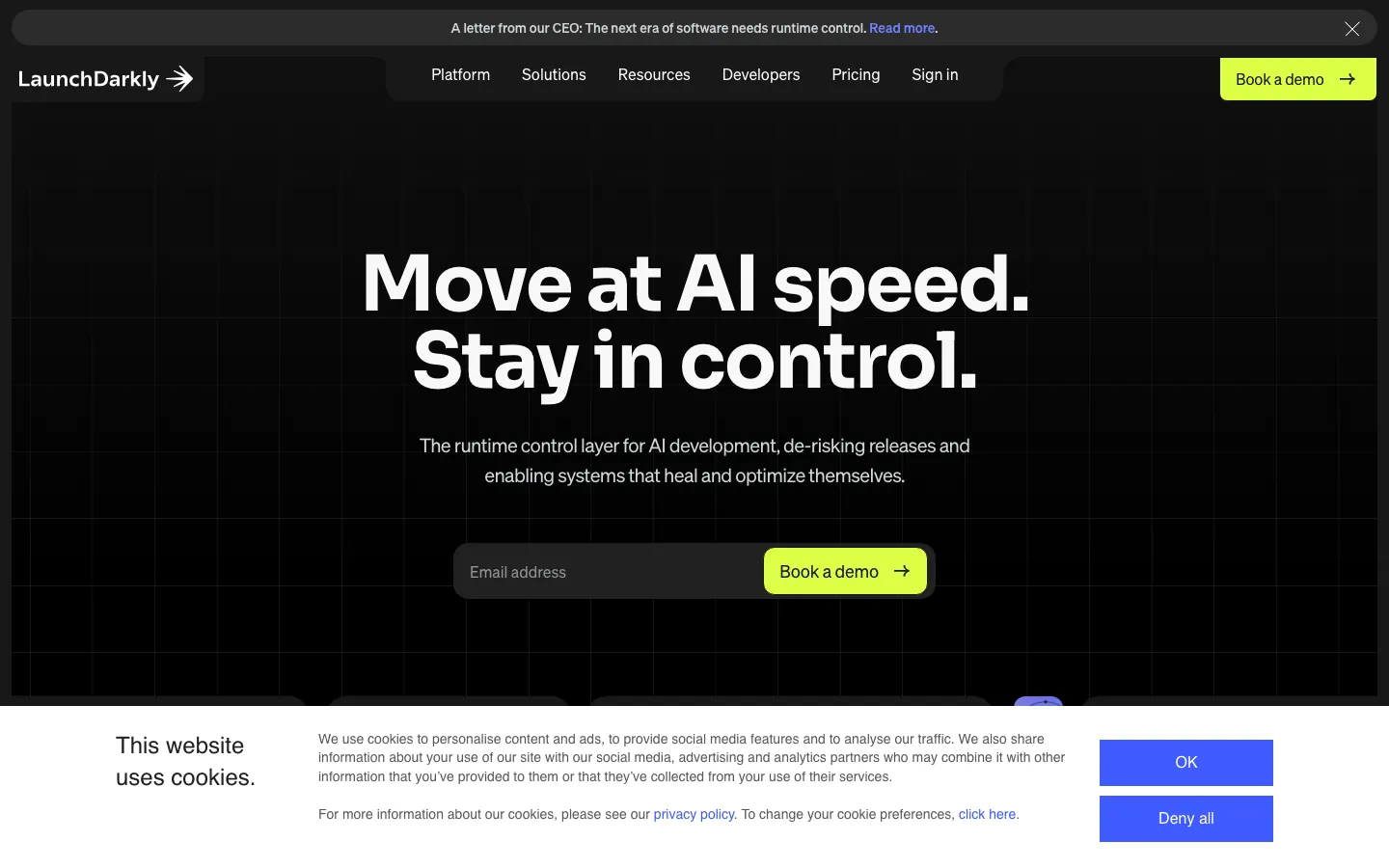
What's great
- 30+ idiomatic SDKs covering every major language; the Go SDK handles goroutine-safe flag evaluation without custom mutex work
- Approval workflows, flag scheduling, and automated rollback on error spikes are built into the Enterprise tier without third-party add-ons
- 97% of G2 reviewers gave 4 or 5 stars; the consistent praise from senior engineers is around audit trail depth and RBAC granularity
Watch-outs
- Foundation tier MAU pricing hits hard at scale: $8.33 per 1K client-side MAU/month billed annually means 500K MAU runs $50K/yr on flags alone before experimentation
- No free flag count on Foundation; the Developer tier is capped at dev use and not production-grade for compliance teams
- Sales-led enterprise motion means teams below 50 engineers often wait 2-3 weeks for contract paperwork before going live
Pricing breakdown
| Plan | Price | Best for |
|---|---|---|
| Developer | Free | Local dev and staging environments only |
| Foundation | $8.33/1K MAU/mo + $10/service | Production teams under 100K MAU |
| Enterprise | Custom | 100K+ MAU with approval workflows and SAML |
| Guardian | Custom | Regulated orgs needing automatic rollback on error spikes |
Loading reviews…
Statsig
Best for product-led teams, free flags at any scale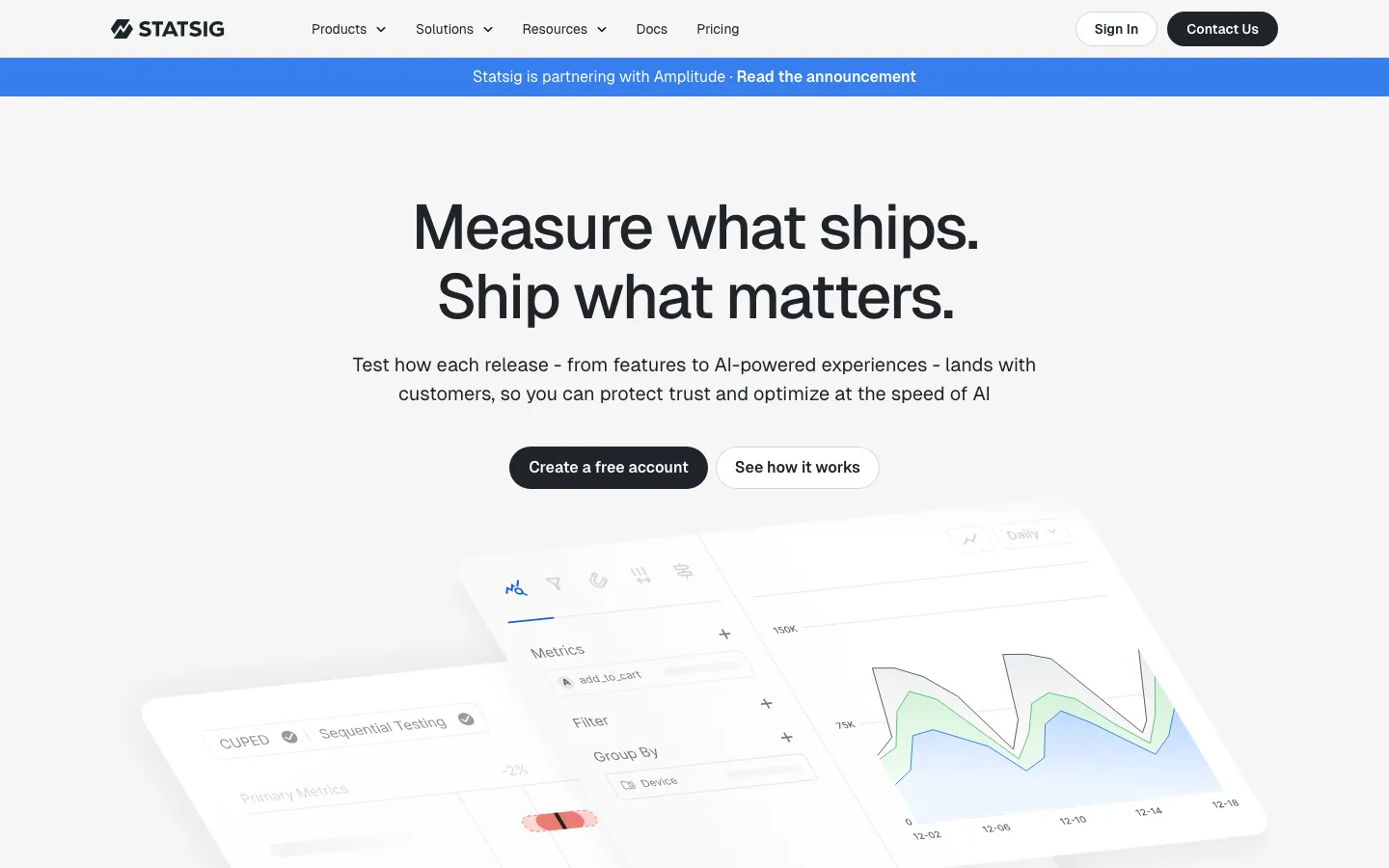
What's great
- Feature flags are genuinely unlimited at every tier including free; you pay only for analytics events above the 2M/mo free allowance
- CUPED variance reduction, sequential testing, and holdouts ship built-in at Pro ($150/mo), not as a $30K enterprise add-on
- Warehouse-native delivery is a genuine strength; experiment data can stay in your own Snowflake or BigQuery instead of a vendor event store
Watch-outs
- Not open-source; teams with air-gap or data-residency requirements cannot self-host
- The event-based billing model is predictable for flagging but can scale unexpectedly when experiments fire high-frequency client-side events
- SDK maturity gap vs LaunchDarkly in some languages; the Rust and Swift SDKs are newer and have fewer community-contributed examples
Pricing breakdown
| Plan | Price | Best for |
|---|---|---|
| Developer | Free | Any team size |
| Pro | $150/mo | Teams needing advanced experiments and approval workflows |
| Enterprise | Custom | Warehouse-native |
| Enterprise (events) | Custom volume | 500M+ events/mo with dedicated support |
Loading reviews…
Optimizely Feature Experimentation
Best for marketing-and-engineering combined experimentation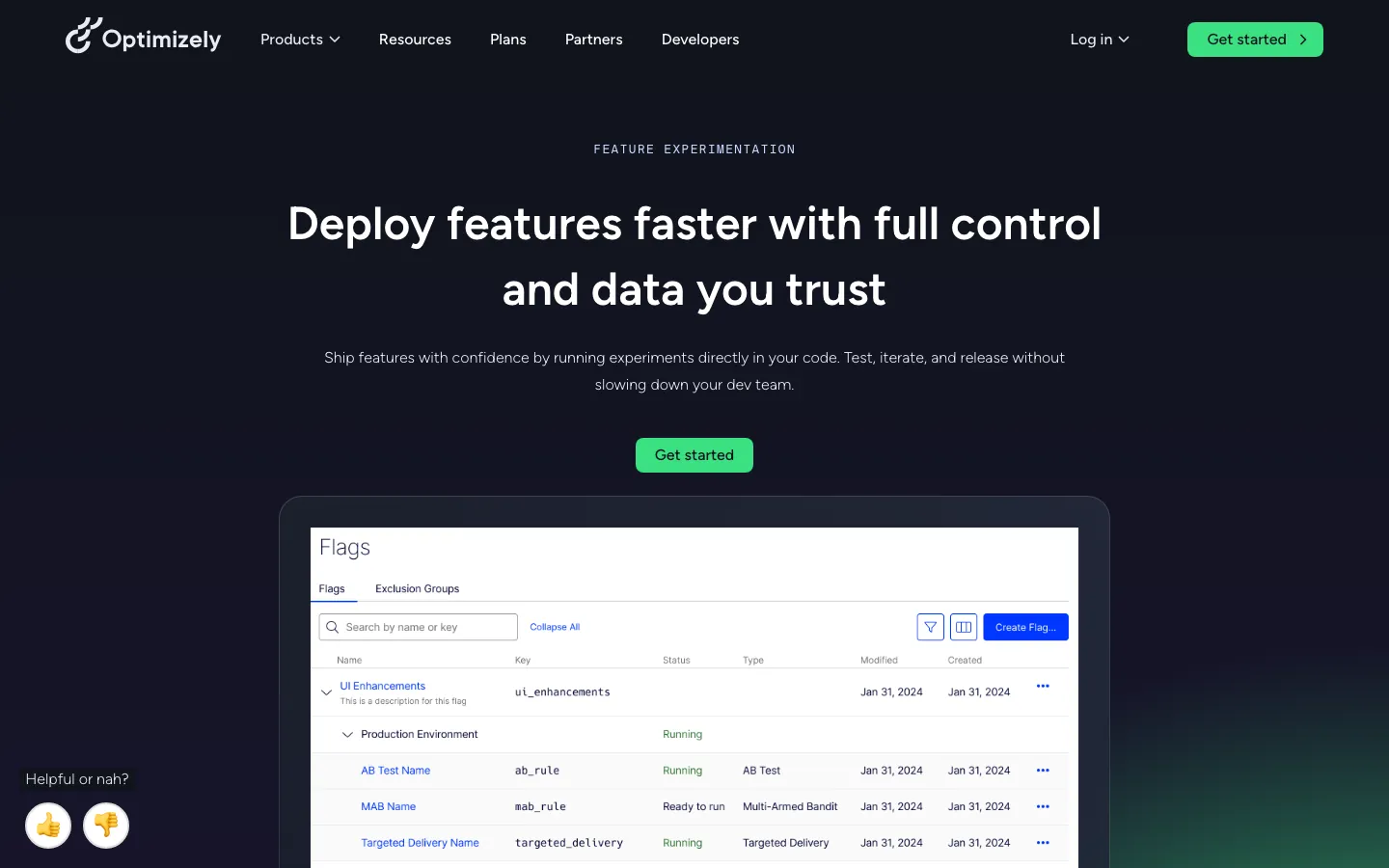
What's great
- Only tool in this list that bridges server-side feature flags with a full-stack experimentation layer marketing and product teams share without API access
- SDKs available in 12+ languages; the React and Next.js SDKs handle server-side rendering flag evaluation correctly without hydration mismatches
- Dedicated experimentation platform with Bayesian and frequentist stats engines switchable per experiment
Watch-outs
- Pricing starts at $36K/yr and scales with monthly tracked users (MTUs); a team reaching 500K MTUs lands well above $100K/yr before any support tier
- Contract includes 3-7% annual price escalators that are negotiable before signing but almost never surfaced in the initial demo
- The platform breadth (CMS, Commerce Cloud, Experimentation) means onboarding involves account managers for each SKU; pure flag teams feel the weight
Pricing breakdown
| Plan | Price | Best for |
|---|---|---|
| Feature Experimentation | ~$36K/yr base | Engineering + product teams under 500K MTU |
| Feature Experimentation + Personalization | Custom | Product + marketing with personalization |
| Full Platform | $150K+/yr | Enterprise with CMS + Commerce + Experimentation |
| Enterprise add-ons | Custom | Premium SLAs and dedicated CSM |
Loading reviews…
Split by Harness
Best CI/CD-integrated feature flags for dev-led teams
What's great
- Tight Harness CI/CD pipeline integration; flags can gate deployments and trigger rollbacks directly from the pipeline definition without webhook gymnastics
- Best-in-class measurement engine with attribution windows, guardrail metrics, and statistical significance thresholds built into the flag dashboard
- 15+ SDKs with a notably clean Go SDK that handles concurrent goroutine evaluation correctly out of the box
Watch-outs
- Acquired by Harness in 2023; the roadmap is increasingly tied to Harness platform priorities and some standalone features have slowed in cadence
- Growth and Enterprise pricing requires a sales conversation; the lack of published pricing is a friction point for self-serve engineering teams evaluating options
- Smaller community than LaunchDarkly or Statsig; fewer Stack Overflow answers and community plugins
Pricing breakdown
| Plan | Price | Best for |
|---|---|---|
| Developer | Free | Individual developers and staging environments |
| Growth | Custom (usage-based) | Teams needing experimentation and guardrail metrics |
| Enterprise | Custom | Harness CI/CD-integrated teams with governance needs |
| Harness Platform Bundle | Custom | Full DevOps platform with CI/CD + flags + testing |
Loading reviews…
Unleash
Best open-source flag platform for self-hosting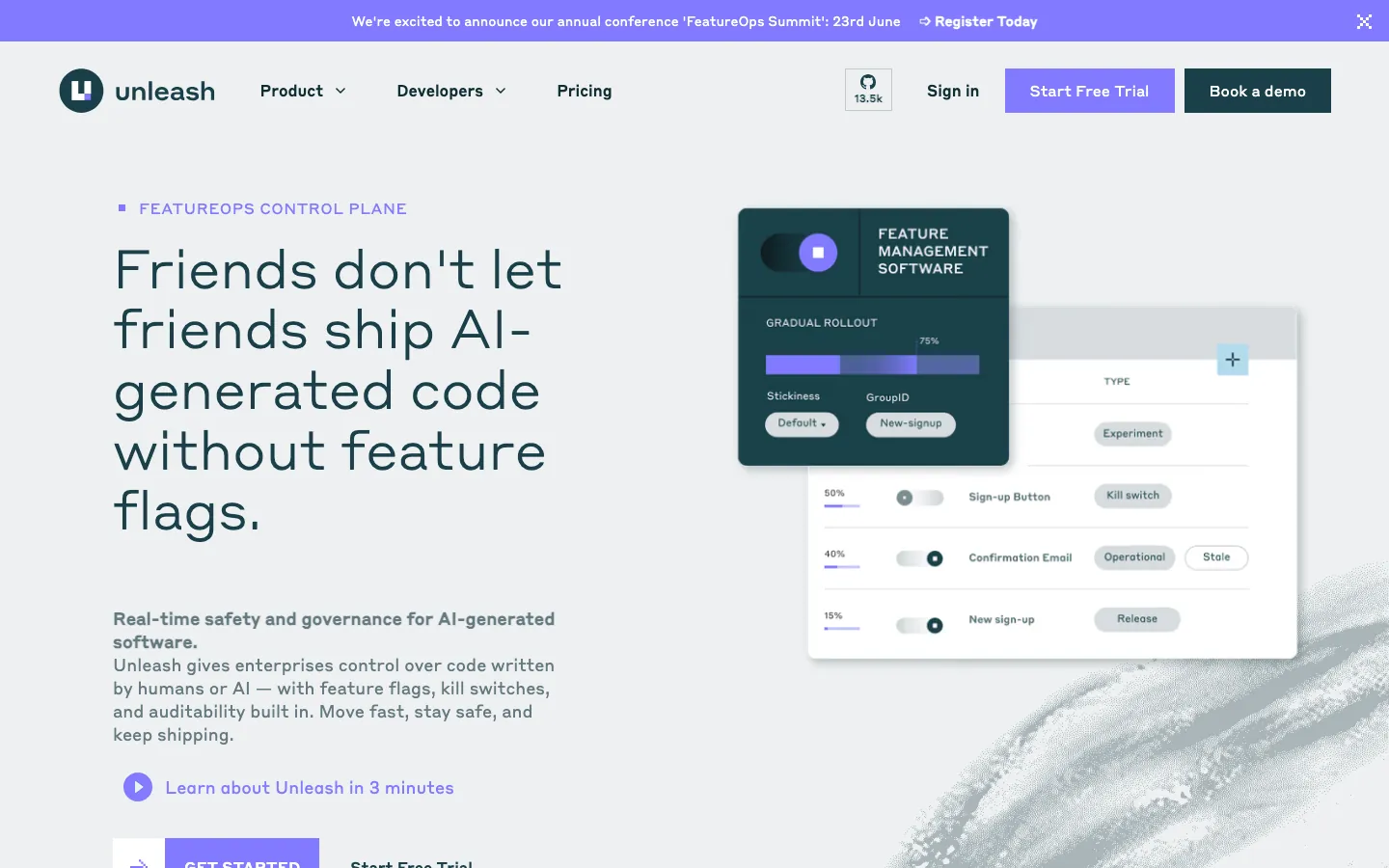
What's great
- Open-source codebase with MIT license; a production-grade self-hosted instance runs comfortably on a small single instance like a t3.medium
- 25+ SDKs with staleness markers built into the admin UI, the only open-source tool that actively alerts you to flags that have been live for 90+ days
- SOC 2 Type II certified on the cloud tier; data residency in EU or US; GDPR-compliant by default
Watch-outs
- Cloud tier at $75/seat/month (5-seat minimum) is expensive relative to GrowthBook's free OSS or Statsig's free flag tier; self-hosting is the real value path
- Experimentation is limited to paid tiers; the OSS version has activation strategies but no statistical analysis engine
- Admin UI is functional but dated; newer tools like GrowthBook and Statsig have noticeably more polished interfaces
Pricing breakdown
| Plan | Price | Best for |
|---|---|---|
| Open Source | Free | Self-hosted |
| Pay-As-You-Go Cloud | $75/seat/mo (5-seat min) | Teams wanting cloud with SOC 2 |
| Enterprise Cloud | Custom | 50+ seats with dedicated CSM and 99.99% SLA |
| Enterprise Self-Hosted | Custom | Air-gap or multi-region self-hosted deployments |
Loading reviews…
GrowthBook
Best open-source experimentation with warehouse-native analysis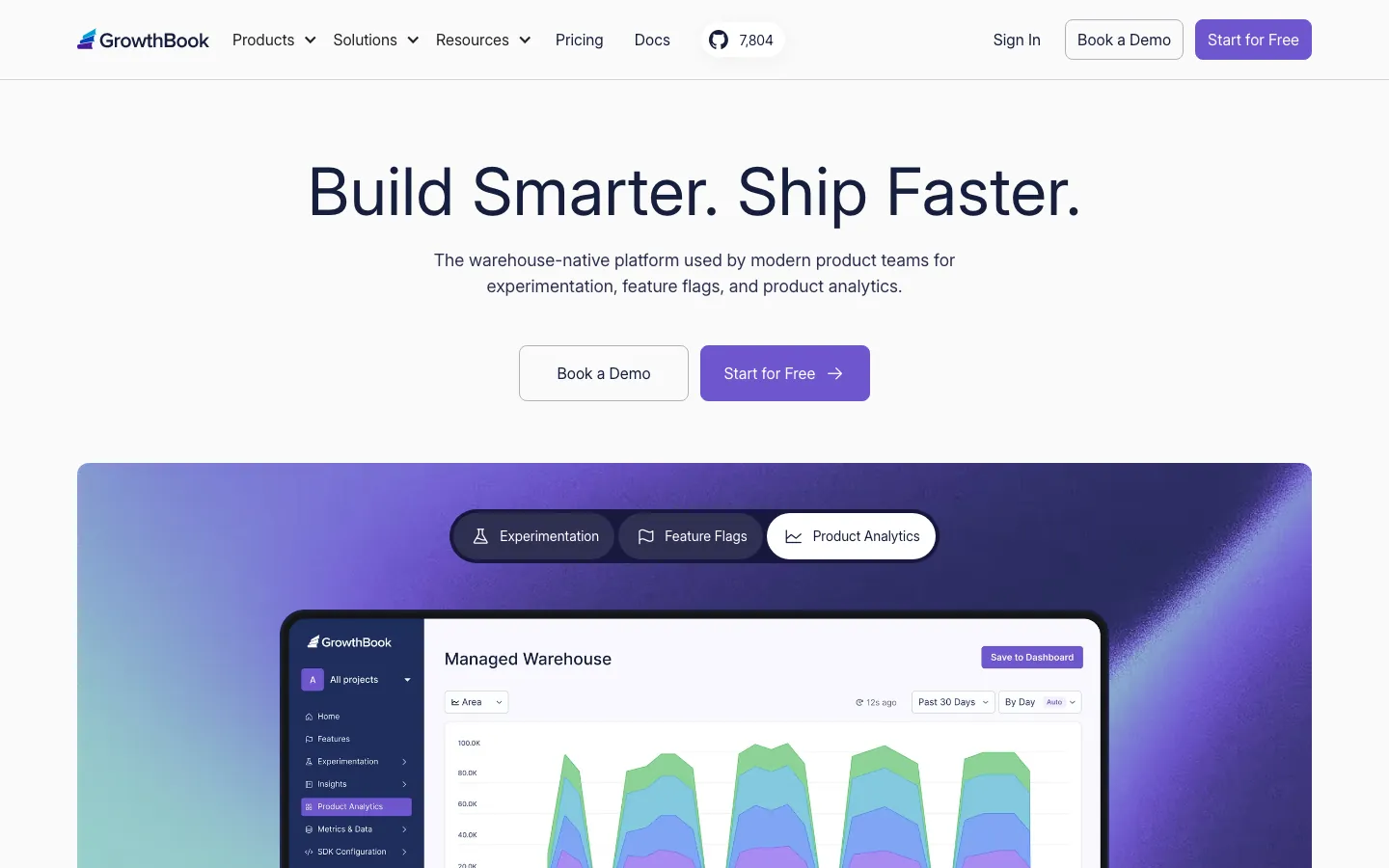
What's great
- Only open-source tool with a native BigQuery, Snowflake, and Redshift connection; experiment results pull directly from your warehouse without a middleman SDK event stream
- Visual A/B test editor ships at Pro tier ($40/seat/mo), letting non-engineer product managers create experiments without writing flag code
- Free OSS tier covers unlimited feature flags, unlimited experiments, and unlimited traffic with no MAU caps
Watch-outs
- 24 G2 reviews is the smallest review base in this guide; real production edge cases surface less often in community forums than for LaunchDarkly or Statsig
- MongoDB dependency in the self-hosted stack adds operational overhead compared to Unleash's Postgres-first approach
- Enterprise features like approval workflows and SSO/SAML require the custom Enterprise tier; the Pro cloud tier is priced per-seat which can add up for larger teams
Pricing breakdown
| Plan | Price | Best for |
|---|---|---|
| Cloud Starter | Free (3 users) | Small teams with basic flag + experiment needs |
| Cloud Pro | $40/seat/mo (50 user max) | Teams needing CUPED and visual editor |
| Cloud Enterprise | Custom | SSO/SAML |
| Self-Hosted Open Source | Free | Self-hosting with unlimited users and traffic |
Loading reviews…
ConfigCat
Best value SaaS for teams that just want flags
What's great
- Flat per-config-download pricing that does not move with your MAU count; 25M downloads/mo at Pro ($110/mo) is predictable regardless of user growth
- 4.8/5 on G2 across 147 reviews, the highest star rating in this entire shortlist; users consistently cite billing predictability as the top reason they stay
- 30+ SDKs with a polling architecture that caches flag state client-side; SDK evaluation adds under 1ms latency in benchmarks
Watch-outs
- Free tier caps at 10 feature flags; the Pro tier at $110/mo covers 100 flags, which is the real entry point for any serious product team
- No native experimentation or A/B testing engine; teams that need statistical analysis need a second tool
- Targeting rules per flag are capped by tier (4 on Free, 8 on Pro); complex segmentation scenarios hit these limits faster than expected
Pricing breakdown
| Plan | Price | Best for |
|---|---|---|
| Free | $0 | Under 10 flags |
| Pro | $110/mo | 100 flags |
| Smart | $325/mo | Unlimited flags |
| Enterprise | $900/mo | 1B downloads |
Loading reviews…
Flagsmith
Best for teams that need flags plus remote config in one tool
What's great
- Built-in user identity and trait management; each flag evaluation carries user context without a separate identity store or event pipeline
- Full audit logging ships in the open-source tier, not gated behind an enterprise contract like most competitors
- Flexible storage backends (PostgreSQL, SQLite, DynamoDB) give self-hosted teams more infrastructure choices than Unleash's Postgres-only model
Watch-outs
- No experimentation or A/B testing engine in any tier; pure flag and remote config tool
- Default API-evaluation mode (server-side evaluation per request) adds latency compared to SDK-local evaluation; caching configuration is required for hot paths
- G2 review base of 62 is small; production edge cases in niche language SDKs (Rust, Elixir) are less documented than Unleash or LaunchDarkly
Pricing breakdown
| Plan | Price | Best for |
|---|---|---|
| Free | $0 (1 user) | Solo developers and proof-of-concept |
| Startup | $40/3 users/mo annual ($45 monthly) | Small teams with basic targeting |
| Scale | Custom | High-traffic apps with SLA requirements |
| Enterprise Self-Hosted | Custom | Air-gap environments with full control |
Loading reviews…
PostHog Feature Flags
Best all-in-one platform for product analytics plus flags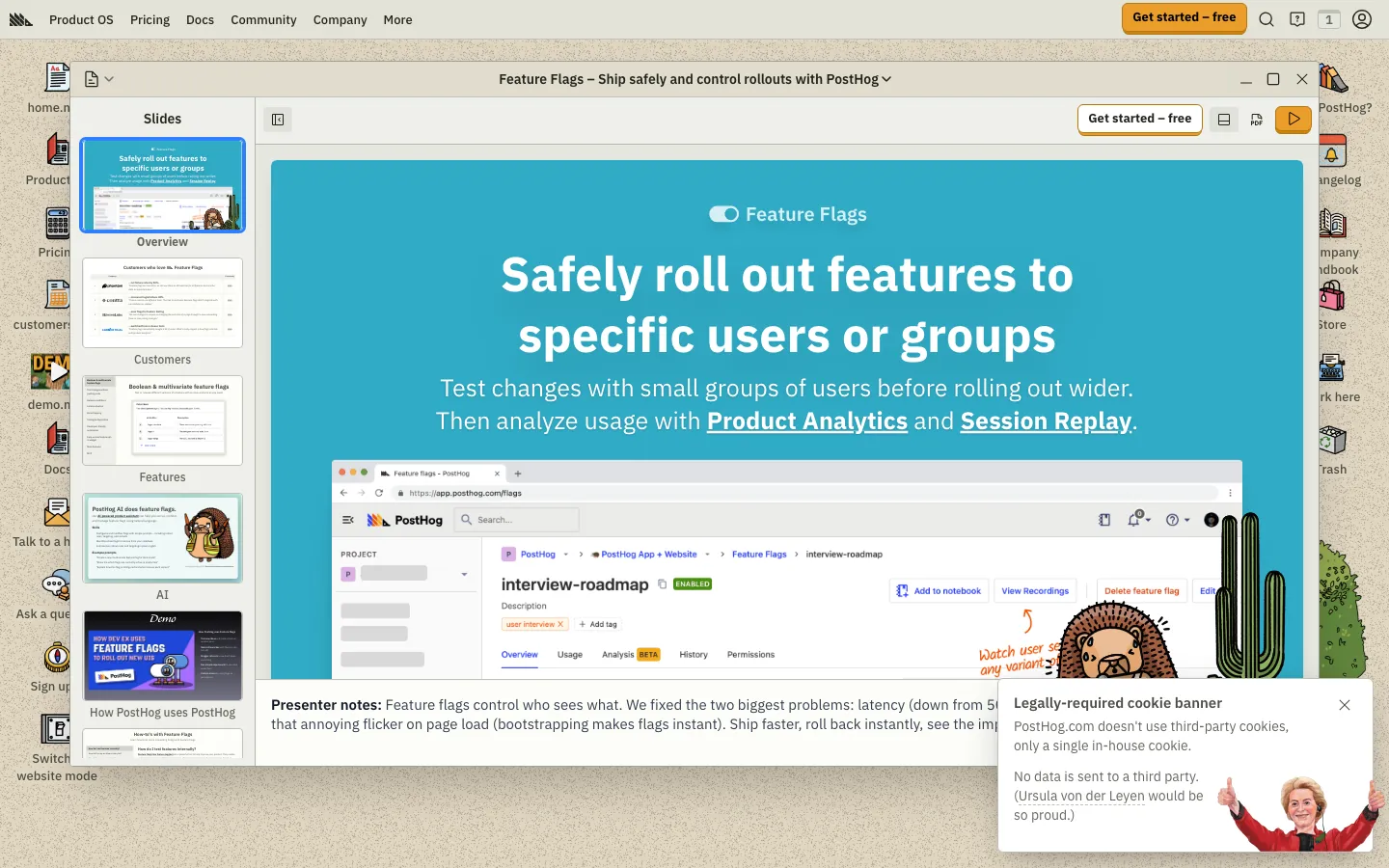
What's great
- Replaces four tools in one bill: feature flags, product analytics, session replay, and error tracking all share the same event stream
- Open-source codebase available on GitHub; self-hosted PostHog Cloud or on-prem, with the same feature set in both deployment modes
- 1,048 G2 reviews at 4.4/5, the largest review base for a non-enterprise flag tool in this guide, giving buyers real signal on edge cases
Watch-outs
- Feature flags are not PostHog's primary product; the flag management UI is functional but lacks approval workflows and scheduling that LaunchDarkly or Split ship natively
- Request-based pricing for flags creates a non-linear cost curve for apps with many users making many flag checks per session; a 1M DAU mobile app can generate 20M+ flag requests per day
- Self-hosted PostHog requires Kubernetes or Docker Compose with 4+ CPU and 16GB RAM minimum; heavier than Unleash or Flagsmith for flag-only use cases
Pricing breakdown
| Plan | Price | Best for |
|---|---|---|
| Free | $0 (1M flag req/mo) | Early-stage products under 1M flag checks/mo |
| Usage-based | $0.0001/req past 1M | Growing products with predictable flag call patterns |
| Teams | $0/mo + usage | Teams needing SSO |
| Enterprise | Custom | HIPAA |
Loading reviews…
Hypertune
Best type-safe flags for TypeScript and React teams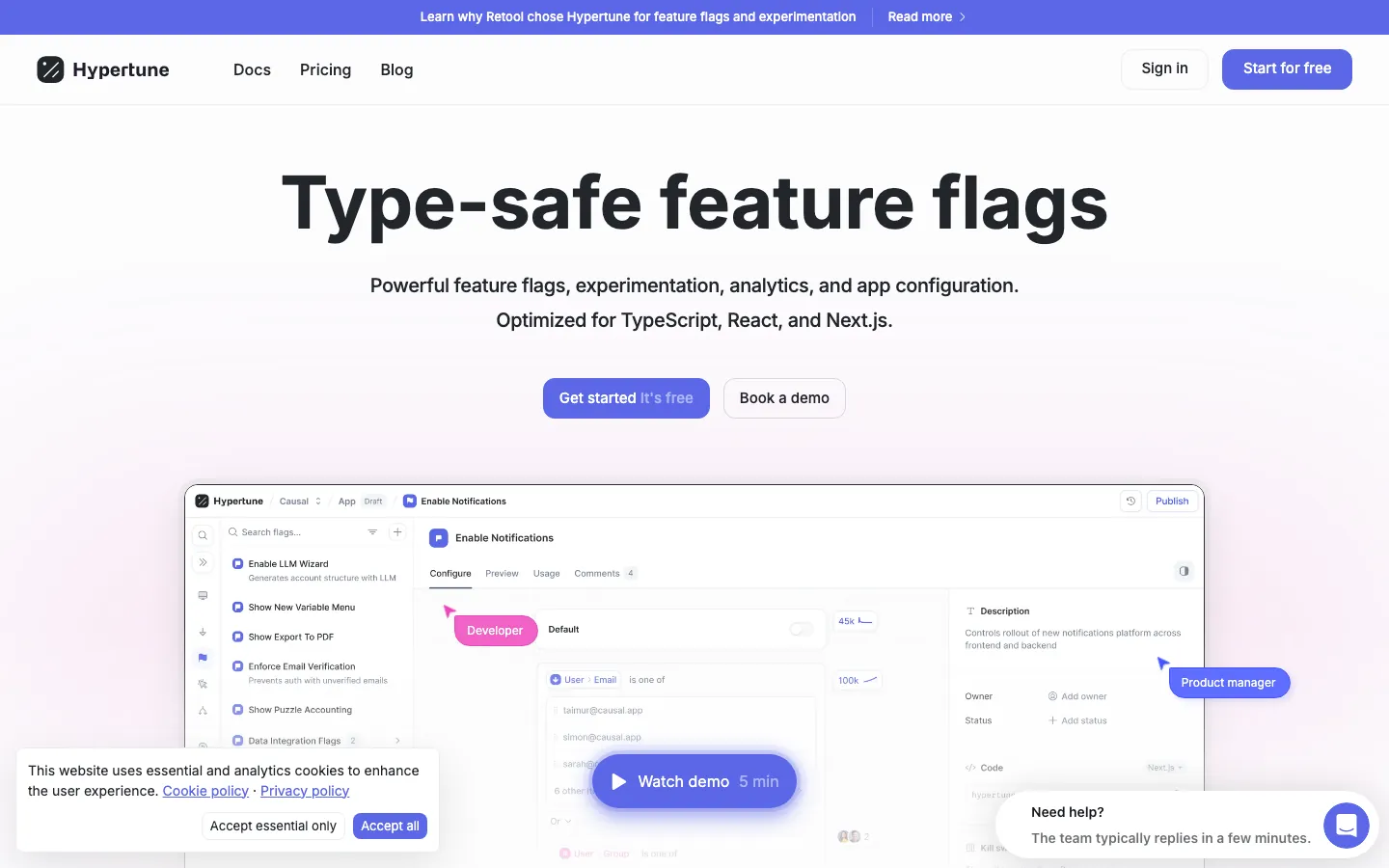
What's great
- Type-safe SDK generates TypeScript types from your flag schema; mismatched flag key calls fail at compile time, not at 2am in production
- Git-based version control for flag changes; flag updates go through pull requests with schema validation before merging, the only tool in this list with that workflow
- CDN-edge evaluation means flag checks resolve at under 5ms globally without a round-trip to a central server
Watch-outs
- 18 G2 reviews is the smallest sample in this guide; production edge cases in non-TypeScript stacks are barely documented
- The type-safe SDK adds a code-generation step to the development workflow; teams on mixed stacks find the build-time overhead adds friction
- Free tier caps at 1M CDN requests per month and 3 team members; most production deployments need the Starter tier within weeks
Pricing breakdown
| Plan | Price | Best for |
|---|---|---|
| Free | $0 (3 members) | Solo developers and proof-of-concept TypeScript projects |
| Starter | $10/user/mo | Small TypeScript teams with branch testing |
| Pro | $20/user/mo | Teams needing approval workflows and advanced experiments |
| Enterprise | Custom | HIPAA |
Loading reviews…
Tools we considered but excluded
We evaluated more tools than the 10 you see above. These did not make the cut. Saying what we rejected, and why, is the editorial muscle most listicles skip.
- DevCycle: Solid SDK quality but thin G2 review base and pricing model changed twice in 12 months; not stable enough for this guide's buyers
- Flipt: GitOps-native flag management is genuinely interesting but no experimentation and the gRPC-first API limits adoption in non-Go stacks
- Harness Feature Flags (standalone): Bundled into Split by Harness above; evaluating it separately from the rest of Harness makes little procurement sense in 2026
- Kameleoon: Strong server-side experimentation but priced and positioned for web personalization at $50K+/yr, not for flag-first engineering teams
- VWO Feature Testing: Better evaluated as a web experimentation tool; the feature flag module is secondary to VWO's A/B testing core
- CloudBees Feature Management: Heavy enterprise tool designed for financial services; overkill for most engineering teams and review volume on G2 is thin relative to the price point
Honorable mentions
Solid tools that did not crack the main list but are worth tracking, especially for niche use cases.
- Flipt: GitOps YAML-based flag management with zero infrastructure dependencies; worth watching for infra-minimalist teams who never need experiments
- DevCycle: OpenFeature-native SDK is the cleanest standards-compliant implementation in the category; worth tracking as OpenFeature adoption grows
- AB Tasty: Strong server-side and full-stack experimentation at mid-market price points; bridges the Optimizely gap for teams that need marketing-engineering experiments without enterprise contracts
The five buckets of the feature flag market
The feature flag market in 2026 splits into five distinct buckets, and the right tool depends almost entirely on which bucket your team sits in. I’ve seen the same mismatch cost teams six months and a second procurement cycle.
Enterprise flag management. LaunchDarkly, Split by Harness. These exist for regulated environments, public companies, and organizations where a flag change triggers a change management process. Approval workflows, SAML, RBAC down to the flag level, audit logs your security team will accept. The cost reflects the compliance surface they cover.
Product-led experimentation platforms. Statsig, Optimizely Feature Experimentation. These treat flags as infrastructure for running experiments at scale. The differentiator is the statistics engine: CUPED, holdouts, sequential testing, guardrail metrics. Statsig runs at the price of a feature flag tool. Optimizely runs at the price of an experimentation platform.
Open-source self-hosted. Unleash, GrowthBook, Flagsmith. All three have permissive licenses and real production deployments. The self-hosting cost is infrastructure, not software. Unleash is the incumbent for pure flags. GrowthBook is the pick when warehouse-native experimentation matters. Flagsmith covers the remote-config use case alongside flags.
Value SaaS. ConfigCat. Flat download-based pricing that does not escalate with user growth. No experimentation. No experiments. Just reliable flags with the highest star rating in this guide.
All-in-one product platforms. PostHog, Hypertune. PostHog collapses flags, analytics, and session replay into one bill. Hypertune is the type-safe niche pick for TypeScript teams.
The ten tools above cover all five buckets. The choice is about compliance surface, experimentation depth, and whether your MAU growth rate makes per-user pricing dangerous.
What’s changing in feature flag software in 2026
The MAU pricing model is under real pressure from free-tier challengers. LaunchDarkly’s Foundation tier moved to $8.33 per 1K client-side MAU in the last pricing revision. Statsig responded by making flags unlimited at every tier including free. ConfigCat never adopted MAU pricing and is benefiting from the backlash. The engineering leaders I talk to now start every procurement cycle with ‘how does this scale to 500K MAU?’ before any feature evaluation.
OpenFeature adoption is creating a new migration dynamic. The CNCF OpenFeature standard shipped its 1.0 spec in late 2024 and adoption picked up through 2025. DevCycle has the most complete OpenFeature SDK today; most other vendors now ship at least a contrib SDK. The implication for buyers is real: teams that build against OpenFeature interfaces today can swap flag backends without rewriting application code. It’s not yet a commodity play, but the switching cost is dropping.
AI feature control is becoming a distinct product category. LaunchDarkly’s 2026 homepage tagline is ‘Move at AI speed. Stay in control.’ The Guardian tier ships automatic rollback when AI model error rates spike. Statsig and PostHog are both adding LLM-call tracking to their event pipelines. Teams deploying AI features in production need flag platforms that understand model versioning, not just boolean on/off states.
Harness acquisition aftermath is still playing out. Split became Split by Harness in 2023. Two years later, the core flag product is still strong but the roadmap cadence has noticeably tied to Harness platform priorities. Teams evaluating Split for standalone flag use should note the current direction; the tool’s best value is inside the Harness DevOps platform, not outside it.
Statsig changed hands twice in under a year. OpenAI acquired Statsig in September 2025 for $1.1B, and founder Vijaye Raji moved to OpenAI as CTO of Applications. On May 5, 2026, Amplitude announced it is taking over the Statsig brand and customer base while the original team stays at OpenAI, so existing customers are being migrated onto Amplitude-maintained infrastructure.
The product is still live and the free-flag pricing still holds today, but the roadmap now belongs to Amplitude, not the people who built it. Any team signing a new Statsig contract in 2026 should treat it as a vendor in transition and ask Amplitude directly about pricing and roadmap commitments before committing.
Self-hosted OSS quality crossed a threshold. In 2024, self-hosting any open-source flag platform meant accepting meaningful operational overhead. By 2026, Unleash, GrowthBook, and Flagsmith have all reached a level of polish where a single mid-level platform engineer can deploy and maintain production-grade self-hosted flags. The build-vs-buy calculus for under-50-engineer teams has genuinely shifted.
Selection criteria, what I check in every feature flag demo
One, SDK install to first flag evaluation. Start a fresh project in your primary language and time how long it takes from npm install (or equivalent) to a working flag check in production-like code. LaunchDarkly and Statsig both hit under 15 minutes. If the SDK setup requires reading three documentation pages and a Slack message to support, that’s a signal about the day-to-day developer experience.
Two, flag evaluation latency in your hot path. Measure actual SDK evaluation time in a request handler that runs 1000 times per second. The difference between SDK-local evaluation with cached state and API-call-per-evaluation is 0.1ms versus 20ms+. Every tool here supports local caching; the question is whether the default configuration enables it or requires explicit setup.
Three, percentage rollout with consistency guarantees. Create a flag with a 10% rollout and verify that the same user ID consistently evaluates to the same bucket across sessions and services. This is the minimum requirement for any canary deployment that can’t flip users between feature versions mid-session. Test it; don’t assume it.
Four, the audit log export. As your security team what they need from a flag change history. Then export the last 90 days of flag changes as CSV or JSON. If this requires a support ticket or a sales call, plan for a compliance problem. LaunchDarkly, Split, and Unleash all pass this test at their respective enterprise tiers. ConfigCat passes at the Smart tier.
Five, SSO and RBAC depth. Map your team’s actual access pattern: who can create flags, who can approve them, who can toggle production flags at 3am. Test whether the tool’s role model matches that. LaunchDarkly’s custom roles are the deepest in the group. ConfigCat’s permission groups are simpler. If your security policy requires ‘read-only production access for junior engineers,’ verify that the tool can express it before signing.
Six, self-hosted deployment time. For open-source tools, spin up a self-hosted instance on a single t3.medium and time the process from Docker pull to admin login. Unleash and Flagsmith both land under 45 minutes from a clean VM. GrowthBook with MongoDB takes 90-120 minutes if you have not run MongoDB before.
Seven, flag count at scale. Create 200 flags across five environments and check whether the admin UI becomes unusable. Tagging, search, and archiving matter when a codebase has accumulated 18 months of flags. Tools without flag lifecycle management (staleness alerts, cleanup workflows) will have you manually auditing a 300-flag list every quarter.
Eight, pricing at your 12-month MAU projection. Run the cost math at 10K, 100K, and 500K MAU before the demo ends. LaunchDarkly Foundation hits $50K/yr at 500K MAU. Statsig stays near $150/mo unless your event volume is high. ConfigCat depends on download counts, not users. The tool that looks cheapest at 10K MAU is often not cheapest at 500K.
Where the ten flag tools differ on core features
| Tool | Free tier | Self-hostable | Experimentation | Approval workflows | TypeScript types |
|---|---|---|---|---|---|
| LaunchDarkly | ✓ dev only | ✗ | ✓ Enterprise | ✓ Enterprise | • contrib |
| Statsig | ✓ unlimited flags | ✗ | ✓ Pro+ | ✓ Pro+ | ✓ native |
| Optimizely | ✗ demo only | ✗ | ✓ all tiers | ✓ Enterprise | • contrib |
| Split by Harness | ✓ Developer | ✗ | ✓ Growth+ | ✓ Enterprise | ✓ native |
| Unleash | ✓ OSS | ✓ MIT | • paid cloud only | ✓ cloud | • contrib |
| GrowthBook | ✓ OSS + cloud | ✓ MIT | ✓ Pro+ | ✓ Enterprise | ✓ native |
| ConfigCat | ✓ 10 flags | ✗ | ✗ | ✗ | ✓ native |
| Flagsmith | ✓ 1 user | ✓ BSD | ✗ | ✗ | ✓ native |
| PostHog | ✓ 1M req/mo | ✓ MIT | ✓ all tiers | ✗ | ✓ native |
| Hypertune | ✓ 1M req/mo | ✓ Enterprise | ✓ Pro+ | ✓ Pro+ | ✓ core feature |
Standouts: Statsig ships free flags at any scale with no MAU cap, the only SaaS tool in this table to do so. GrowthBook and Unleash are the two open-source tools with both a free OSS tier and an experimentation engine. Hypertune’s TypeScript-native type generation is table stakes for that product, not a nice-to-have.
ConfigCat is the only tool with no experimentation path at any tier, which is a feature for teams that want to stay simple, not a gap.
Integration depth across the feature flag stack
| Tool | GitHub Actions | Datadog | Jira | Slack | LaunchDarkly API |
|---|---|---|---|---|---|
| LaunchDarkly | N | N | N | N | N (it is the API) |
| Statsig | N | N | N | N | N |
| Optimizely | N | M | N | N | N |
| Split by Harness | N | N | N | N | N |
| Unleash | N | N | N | N | M |
| GrowthBook | N | • | • | N | N |
| ConfigCat | N | N | N | N | N |
| Flagsmith | N | • | • | N | N |
| PostHog | • | N | • | N | N |
| Hypertune | N (via Git) | • | • | N | N |
N = native/first-party, M = marketplace add-on, • = Zapier or webhook only.
LaunchDarkly and Split by Harness have the deepest native integration stories for the DevOps stack: Datadog APM metrics inside the flag dashboard, Jira ticket linking, and GitHub Actions gates. GrowthBook and Flagsmith are lighter on integrations; plan for webhook-based custom work if your CI/CD pipeline needs flag-aware gates.
Hypertune’s GitHub integration is native because flag changes are pull requests; it’s a fundamentally different model than the others.
Feature flag security and compliance, tier by tier
| Tool | SOC 2 Type II | GDPR | HIPAA | SSO/SAML | Audit logs |
|---|---|---|---|---|---|
| LaunchDarkly | ✓ | ✓ | ✓ Enterprise | ✓ Foundation+ | ✓ Enterprise |
| Statsig | ✓ | ✓ | ✓ Enterprise (BAA) | ✓ Enterprise | ✓ Pro+ |
| Optimizely | ✓ | ✓ | ✓ Enterprise | ✓ Enterprise | ✓ Enterprise |
| Split by Harness | ✓ | ✓ | ✓ Enterprise | ✓ Enterprise | ✓ Enterprise |
| Unleash | ✓ Cloud | ✓ | ✗ | ✓ Cloud | ✓ OSS + Cloud |
| GrowthBook | ✓ Cloud | ✓ | ✓ Enterprise | ✓ Enterprise | ✓ Enterprise |
| ConfigCat | ISO 27001 (not SOC 2) | ✓ | ✗ | ✗ | ✓ Smart+ |
| Flagsmith | ✓ Cloud | ✓ | ✗ | ✗ | ✓ OSS |
| PostHog | ✓ | ✓ | ✓ Enterprise | ✓ Teams+ | ✓ Enterprise |
| Hypertune | ✓ | ✓ | ✓ Enterprise | ✓ Enterprise | ✓ Pro+ |
Enterprise IT checklist survivors: LaunchDarkly, Statsig, Optimizely, and Split are the four SaaS tools that pass a full enterprise IT review including HIPAA BAA availability. Unleash Cloud passes SOC 2 and GDPR but does not currently offer HIPAA BAA.
ConfigCat is the exception worth flagging: it carries ISO/IEC 27001:2022 certification and GDPR compliance rather than a SOC 2 Type II report, so if your security review specifically demands SOC 2 it will not clear that line even though ISO 27001 covers comparable information-security controls.
For self-hosted deployments, GrowthBook and Flagsmith both allow teams to meet their own HIPAA requirements by keeping data in-house, but the vendors do not issue BAAs for self-hosted installations.
Self-hosted vs SaaS tradeoffs
This section is worth a dedicated read if data residency or security controls drive your evaluation. Every other review site glosses over it.
Self-hosting a feature flag platform sounds straightforward until you account for the operational surface. Unleash, GrowthBook, and Flagsmith all provide Docker Compose files that deploy to a single VM in under an hour. The deployment cost is low.
The ongoing operational cost is not. SDK updates ship from the vendor; your self-hosted instance needs to track those updates manually. When a critical flag evaluation bug ships in a new SDK version, you learn about it from GitHub or your own monitoring, not from a vendor notification.
Teams running self-hosted Unleash well tend to wire up a Renovate bot to auto-update the containers weekly; without that automation, it is easy to drift several minor versions behind over a year.
The SaaS tradeoff is the inverse. You get automatic updates, vendor-managed uptime SLAs, and support tickets that escalate to someone who built the SDK. The cost is that flag evaluations transit a vendor’s infrastructure.
For teams processing health information, financial data, or operating in jurisdictions with strict data localization requirements (EU data residency under GDPR, CJKR in South Korea, etc.), the SaaS path requires a vendor DPA, a BAA if HIPAA applies, and often a legal review of the vendor’s subprocessor list.
The practical rule for most teams: SaaS until you have a specific compliance driver. Unleash Cloud passes SOC 2 and GDPR and lets you pick EU or US data regions; that covers 90% of regulated SaaS companies without self-hosting. GrowthBook self-hosted is the call for teams with strict data localization requirements who also need experimentation.
Flagsmith self-hosted is the call for teams with flag + remote config needs in an air-gap environment.
Experimentation overlap: when your flag tool also does A/B testing
Feature flags and A/B testing started as separate tools. By 2026, they’ve converged at the product layer in ways that change the vendor evaluation. Before spending $150K/yr on Optimizely, map what you actually need.
Statsig, GrowthBook, and PostHog all ship a full statistical analysis engine as part of their flag platform. CUPED (Controlled-experiment Using Pre-Experiment Data) reduces variance and lets you reach significance with smaller sample sizes. Sequential testing lets you stop experiments early when results are clear without inflating false positive rates.
Holdout groups let you measure the cumulative lift of multiple feature releases. These are not demo features; they are the same statistical infrastructure that Airbnb and Netflix built internally and open-sourced in research papers.
The teams that still buy Optimizely standalone in 2026 are those where marketing and product run experiments from the same platform and the marketing team cannot use an API-only tool. Optimizely’s visual editor and non-engineer workflow justify the contract for those orgs.
For engineering-led teams where all experiments are code-shipped, Statsig at $150/mo Pro covers the same statistical surface as Optimizely at $40K/yr.
LaunchDarkly and Split both offer experimentation, but it’s not the core product for either. LaunchDarkly’s experiment module is well-built and integrates cleanly with the flag lifecycle. Split’s measurement engine is strong. Neither matches Statsig’s experiment analysis depth at equivalent price points.
ConfigCat and Flagsmith have no experimentation path. That’s a deliberate product choice. If you want flag management and nothing else, both are better per dollar than any tool with a bundled experimentation engine.
Picking the right feature flag tool for your team
1. Compliance pressure from an auditor or customer security review
If a SOC 2 Type II report or HIPAA BAA is on the requirement list, the shortlist is LaunchDarkly, Statsig Enterprise, Split by Harness, or Optimizely at the enterprise tier. For self-hosted compliance, GrowthBook or Unleash self-hosted plus your own BAA setup. Everything else drops off.
2. Your MAU trajectory over the next 18 months
- Under 50K MAU: Any SaaS tool works. Statsig is cheapest at free. ConfigCat Pro at $110/mo is the most predictable.
- 50K-500K MAU: Model the cost at 500K before signing. LaunchDarkly Foundation hits $50K/yr here. Statsig stays under $200/mo if event volume is moderate. ConfigCat at Smart ($325/mo) covers 250M downloads regardless of user count.
- 500K+ MAU: MAU-based pricing stops making sense. Negotiate a custom enterprise contract. Statsig’s event-based model is more favorable than LaunchDarkly’s MAU model at this scale.
3. Experimentation versus flags only
Flags only: ConfigCat, Flagsmith, Unleash OSS. Clean, cheap, no complexity you didn’t ask for.
Flags plus A/B testing: Statsig, GrowthBook, PostHog. Pick based on whether your experiment analysis lives in a warehouse (GrowthBook) or in a third-party event stream (Statsig, PostHog).
Full experimentation platform with marketing-team access: Optimizely Feature Experimentation. Budget $36K/yr minimum.
4. Self-hosting as a hard requirement versus a preference
Hard requirement (data residency, air-gap): Unleash OSS, GrowthBook OSS, or Flagsmith OSS. All three are MIT or BSD licensed and production-tested.
Preference only: SaaS is almost always the right call for under 50 engineers. The operational overhead of maintaining SDK update cycles, database backups, and uptime monitoring costs more in engineering time than the SaaS license.
5. Your primary stack
TypeScript-first Next.js teams: Hypertune for the compile-time type safety, or Statsig for the broader feature set.
Polyglot microservices: LaunchDarkly for the SDK breadth, or Unleash for OSS depth. Both have production-grade SDKs in Go, Python, Java, and Ruby.
Python ML and data science heavy: GrowthBook for the warehouse-native experiment analysis. Statsig’s Python SDK is solid if you want managed infrastructure.
What a feature flag platform really costs in year one
| Team profile | Tool | Year-1 sticker | Year-1 all-in estimate |
|---|---|---|---|
| 5-engineer startup, 10K MAU | Statsig | $0 | $0 (free flags, free events) |
| 20-engineer startup, 50K MAU | ConfigCat Pro | $1,320/yr | $1,320 (predictable) |
| 30-engineer startup, 50K MAU | GrowthBook Cloud Pro | $14,400/yr | $14,400 + infra if OSS |
| 50-engineer Series A, 200K MAU | Statsig Pro | $1,800/yr | $1,800 + event costs |
| 50-engineer Series A, 200K MAU | LaunchDarkly Foundation | ~$20K/yr | $20K + implementation time |
| 100-engineer Series B, 500K MAU | LaunchDarkly Enterprise | Custom ($80K+) | $80K-$150K with admin time |
| 100-engineer Series B, 500K MAU | Unleash Cloud | ~$45K/yr (50 seats) | $45K + DevOps overhead |
| 200-engineer B+ company, experimentation | Optimizely | ~$60K/yr | $60K-$150K with CSM + MTU growth |
The single biggest forecast error: teams sign a MAU-based contract at 50K MAU and forget to model what happens at 500K. That 10x MAU growth maps to a 10x price increase on LaunchDarkly Foundation, which is a budget conversation nobody had. Get the MAU growth math in writing before the first renewal.
Rolling out feature flags without breaking your release process
Getting flag infrastructure in front of a skeptical engineering team takes a deliberate rollout. Four phases that work.
Phase 1 (weeks 1-2): One team, one service, five flags. Pick the team with the highest deployment frequency and one service they own cleanly. Install the SDK, create five flags (one boolean, one percentage rollout, one user-targeted, one JSON payload, one kill switch), and deploy to production. The goal is validating that flag evaluation doesn’t add measurable latency to that service’s p99 response time. Run load tests before and after.
Phase 2 (weeks 3-4): Establish the naming convention and flag lifecycle policy. The teams that get buried in flag debt are the ones that skipped this step. Define: flag naming format (feature/team/flag-name), flag expiry dates attached at creation, who can toggle production flags without approval, and how stale flags get archived. Bake this into your contributing guide, not a Confluence page nobody reads.
Phase 3 (weeks 5-8): Expand to all services with CI/CD gate integration. Every service gets the SDK in the same two-week sprint. Wire flag state into your deployment pipeline so a broken flag evaluation fails the deployment, not the production traffic. For teams on Harness or GitHub Actions
, this is a 30-minute integration. The teams that skip this end up with flag SDKs that silently default to false when the flag service is unreachable.
Phase 4 (weeks 9-12): Flag debt cleanup and experimentation rollout. By week 12 you have 40-60 flags and some of them are already stale. Archive every flag that has been at 100% rollout for 30+ days and remove the flag code from the codebase. Then run your first percentage-rollout experiment with statistical analysis. The teams that treat flag cleanup as optional end up with 300+ flags in 18 months and a codebase nobody wants to touch.
The right flag tool by funding stage and engineering size
- Pre-seed, solo to 5 engineers: Statsig free tier or ConfigCat free tier. Pay zero until you have 10 engineers or a compliance requirement.
- Seed, 5-20 engineers, no compliance driver: Statsig free for flags, upgrade to Pro ($150/mo) when you need holdouts and approval workflows.
- Seed, 5-20 engineers, TypeScript-first Next.js stack: Hypertune Starter ($10/user/mo). The compile-time safety pays back in the first incident it prevents.
- Series A, 20-60 engineers, product-led motion: Statsig Pro or GrowthBook Cloud Pro. The experimentation engine is table stakes at this stage.
- Series A, 20-60 engineers, compliance required: LaunchDarkly Foundation or Unleash Cloud. Both clear SOC 2 Type II audits without enterprise pricing.
- Series B, 60-150 engineers, experimentation at scale: Statsig Enterprise (warehouse-native) or Optimizely if marketing needs non-engineer experiment access.
- Series B+, self-hosting mandate: GrowthBook OSS for experiment-heavy teams, Unleash OSS for flag-management-heavy teams.
- Series C+, 150+ engineers, regulated: LaunchDarkly Enterprise or Split by Harness with full Harness platform bundling.
- Enterprise, 500+ engineers, Microsoft Azure-heavy: Check whether Harness Enterprise Agreement bundling applies before signing a standalone flag contract.
- Data-team-led org with Snowflake/BigQuery warehouse: GrowthBook. The warehouse-native analysis path is the only one in this list that never requires sending experiment data to a third party.
For corrections, data updates, or flag tool disputes, email hello@topickz.com . We re-evaluate this list every six months; the next update ships in November 2026.
Sources:
- Best Feature Management Software: User Reviews from May 2026 - G2
- LaunchDarkly Pricing
- Statsig Pricing
- GrowthBook Pricing
- ConfigCat Pricing
- Unleash Pricing
- PostHog Pricing
- Hypertune Pricing
- Open Source Feature Flag Tools Compared: Unleash vs GrowthBook vs Flipt vs Flagsmith - FlagShark
- Feature Flags Pricing Comparison 2026 - Rollgate
- Optimizely Pricing - Vendr 2026
- Chosen by developers. Ranked #1 on G2 - LaunchDarkly
Frequently asked questions
How many engineers before feature flags are worth the cost?
Past 10 engineers, flags beat branch deploys on rollback speed alone. Under 10, environment config files usually cover it.
LaunchDarkly vs Statsig in 2026 for a Series B startup
Statsig wins on cost; free flags plus $150/mo Pro. LaunchDarkly wins on approval workflows if your SOC 2 auditor asks.
Will feature flags add latency to our app?
Under 1ms for SDK-local evaluation. Latency problems trace to blocking calls in hot paths, not the flag tool itself.
Self-hosted vs SaaS for feature flags in 2026
SaaS wins under 100 engineers. Self-host only if data residency or air-gap is a hard requirement from security or compliance.
What is the real cost of LaunchDarkly at 500K MAU?
Foundation tier: roughly $50K/yr for flags alone at 500K MAU. Add experimentation and you exceed $80K before enterprise tier.
Can we use PostHog instead of a dedicated flag tool?
Yes if you are already on PostHog analytics and under 1M flag requests/month. Past that, flag-specific billing math favors ConfigCat.
What is the safest feature flag tool for a SOC 2 Type II audit?
LaunchDarkly or Unleash Cloud. Both have SOC 2 Type II certs, SSO, and audit logs that satisfy most auditor checklists.
Open-source feature flags, GrowthBook or Unleash in 2026?
Unleash for pure flag management at 50+ engineers. GrowthBook if warehouse-native A/B testing matters more than flag maturity.
Is it worth building feature flags in-house?
Under 20 engineers, maybe. Past 20, SDK maintenance and audit log requirements make buying clearly better.
How long does it take to migrate from LaunchDarkly to another tool?
2-4 weeks for flag parity. Add 4-6 weeks if you have complex targeting rules or approval workflows to rebuild.
Related helpful reads
Write a review
Posts to the page right away. Keep it real — no links or email addresses.