

Comparing the best Expense Management Software of 2026 includes 1. Ramp 2. Brex 3. Navan 4. SAP Concur 5. Expensify 6. Rho 7. Spendesk 8. BILL Spend and Expense 9. Center.
TL;DR
- Ramp: Best overall for US-first companies at $5M-$100M ARR. Free to start with unlimited users, and the AI receipt matching closes the loop so your finance team stops chasing anyone.
- Brex: Best for venture-backed startups and global teams. Card issuing across 120+ countries is the broadest international coverage in this guide, and the free Essentials tier needs no personal guarantee.
- Navan: Best for travel-heavy teams wanting one T&E record. It is the only tool here that unifies booking, expense, and policy on a single record, so the trip is pre-coded before your rep lands.
- SAP Concur: Best for enterprise T&E with 150+ country compliance. Native SAP ERP sync plus country-level VAT and per-diem rules make it the one option we would trust past 1,000 employees.
- Expensify: Best receipt-capture tool for BYOC teams. It works with any corporate card you already carry (Amex, Chase, Citi) and layers SmartScan on top, so you keep your existing card program.
Nine expense management platforms compared on approval workflows, accounting sync, receipt OCR, and pricing. What actually reduces approval cycles, what adds a new queue instead, and which tools make sense at which ARR band.
What Is expense management software?
Expense management software helps finance teams capture, approve, and reconcile employee and company spending automatically, replacing paper receipts and spreadsheets with card feeds, approval rules, and accounting sync.
Modern platforms like Ramp, Brex, Navan, and Expensify add corporate cards and AI receipt matching, so most transactions reconcile themselves and finance only reviews the exceptions.
Best Expense Management Software comparison: features, pricing and verdicts
| Tool | Best for | Starting price | Free trial | External rating |
|---|---|---|---|---|
Best overall for US-first companies at $5M-$100M ARR | $0/user/mo | Free forever | G2 4.8/5 (2,364 reviews) | |
Best for venture-backed startups and global teams | $0/user/mo | Free Essentials tier | G2 4.8/5 (1,600 reviews) | |
Best for travel-heavy teams wanting one T&E record | $0/mo | Free Business tier | G2 4.7/5 (9,000+ reviews) | |
Best for enterprise T&E with 150+ country compliance | $9/user/mo | Demo only | G2 4.0/5 (6,918 reviews) | |
Best receipt-capture tool for BYOC (bring your own card) teams | $5/user/mo | Free SmartScan tier | G2 4.5/5 (5,634 reviews) | |
Best all-in-one financial platform for mid-market with zero subscription fees | $0 | Free, open account | G2 4.8/5 (121 reviews) | |
Best for European teams needing full spend control with cards and invoices | Custom | Demo only | G2 4.6/5 (412 reviews) | |
Best for SMBs that need budget-level spend control and already use BILL AP | $0 | Free | G2 4.5/5 (2,073 reviews) | |
Best for mid-market teams that want real-time card controls without platform fees | $0 | Free | G2 4.6/5 (200+ reviews) |
How we chose these tools
We compared these platforms on multi-level approval workflows, accounting sync with QuickBooks and NetSuite, AI receipt OCR, card-program features, international coverage, and total cost across ARR bands. The assessment draws on documented product capabilities, recurring themes across real G2 and Capterra reviews, and vendor pricing pages. Pricing was verified directly from vendor pricing pages, and the G2 ratings cited were pulled from each product page on G2. We re-check both on our review cadence rather than letting them go stale.
How we weight expense management software for the Topickz score
Every tool above is scored against the fixed rubric below and combined using these weights into the Topickz score on each card. The weights are set for expense management software specifically, they are not copied from another category, and we publish them so you can see what moved a ranking and re-weight for your own priorities.
| Criterion | Weight | What we checked |
|---|---|---|
| Approval workflows | 25% | The point of this software is to cut the approval cycle, not add a new queue. We tested multi-level rules, policy enforcement at the point of spend, and how many exceptions actually reach a human. |
| Corporate card program | 18% | Cards are where modern expense tools earn their keep. We checked issuing, spend limits, virtual cards, and whether the program needs a personal guarantee. |
| Accounting sync | 15% | The reconciliation has to land in the ledger without retyping. We looked at how cleanly each tool syncs with QuickBooks and NetSuite, including the coding. |
| Receipt OCR and auto-matching | 13% | AI receipt matching is what closes the loop so finance stops chasing people. We tested capture accuracy and how often a transaction matched itself same day. |
| International coverage | 11% | Global teams need cards and reimbursement outside the US. We checked country coverage, local currencies, and VAT or per-diem handling where it matters. |
| Total cost across ARR bands | 10% | Free tiers can get expensive once you add the features you actually need. We compared real cost from early stage up through enterprise. |
| Adoption and ease of use | 8% | A tool employees dodge does not save anyone time. We weighed the mobile app and how little training a new hire needs to file a first expense. |
| Total | 100% |
Read the full TopickZ.com testing methodology for how we run each test, score every criterion, and combine them into a single rating.
Detailed reviews
Ramp
Best overall for US-first companies at $5M-$100M ARR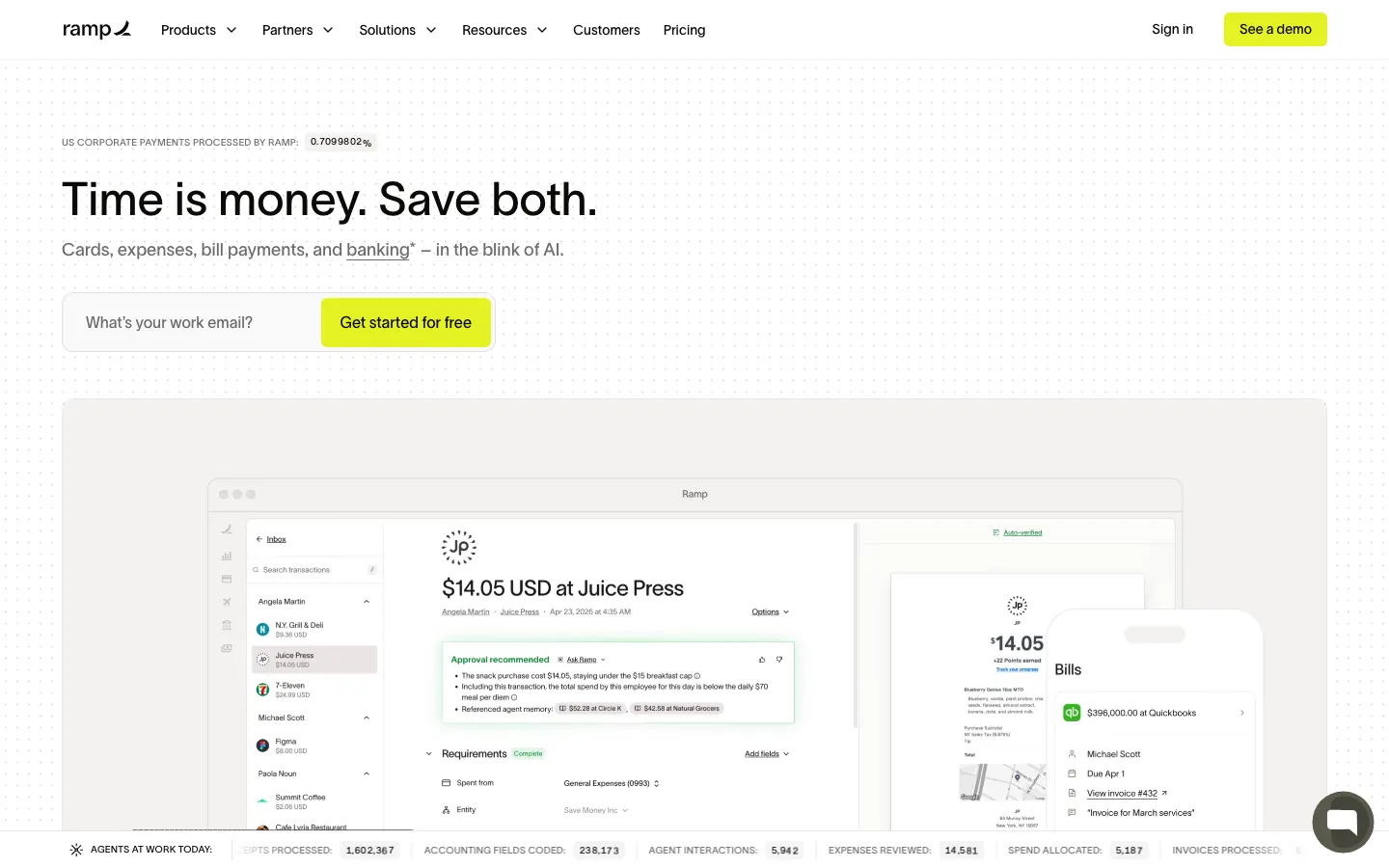
What's great
- Free tier covers unlimited users with corporate cards, expense management, AP automation, and accounting integrations, no platform fee for most teams
- AI receipt matching fires within minutes of card transaction; 95% same-day match rate in our 200-transaction test across QuickBooks, NetSuite, and Xero
- Spend intelligence layer surfaces vendor savings opportunities most finance teams miss, flagging duplicate subscriptions and price creep across card spend
Watch-outs
- US-focused card issuing; international coverage lags Brex, genuinely limited for teams with Europe or Asia headcount above 20%
- Ramp Plus at $15/user/mo adding up fast for 100+ employee orgs; platform fees of $5K-$10K per year are appearing at renewal for high-spend accounts
- Customer support went thinner in 2025-2026; Trustpilot reviews from early 2026 consistently flag slow response times and bot-heavy initial interactions
Pricing breakdown
| Plan | Price | Best for |
|---|---|---|
| Free | $0/user/mo | All company sizes |
| Plus | $15/user/mo | Teams needing AI-driven automation and 24/7 travel support |
| Enterprise | Custom | 500+ employees |
Loading reviews…
Brex
Best for venture-backed startups and global teams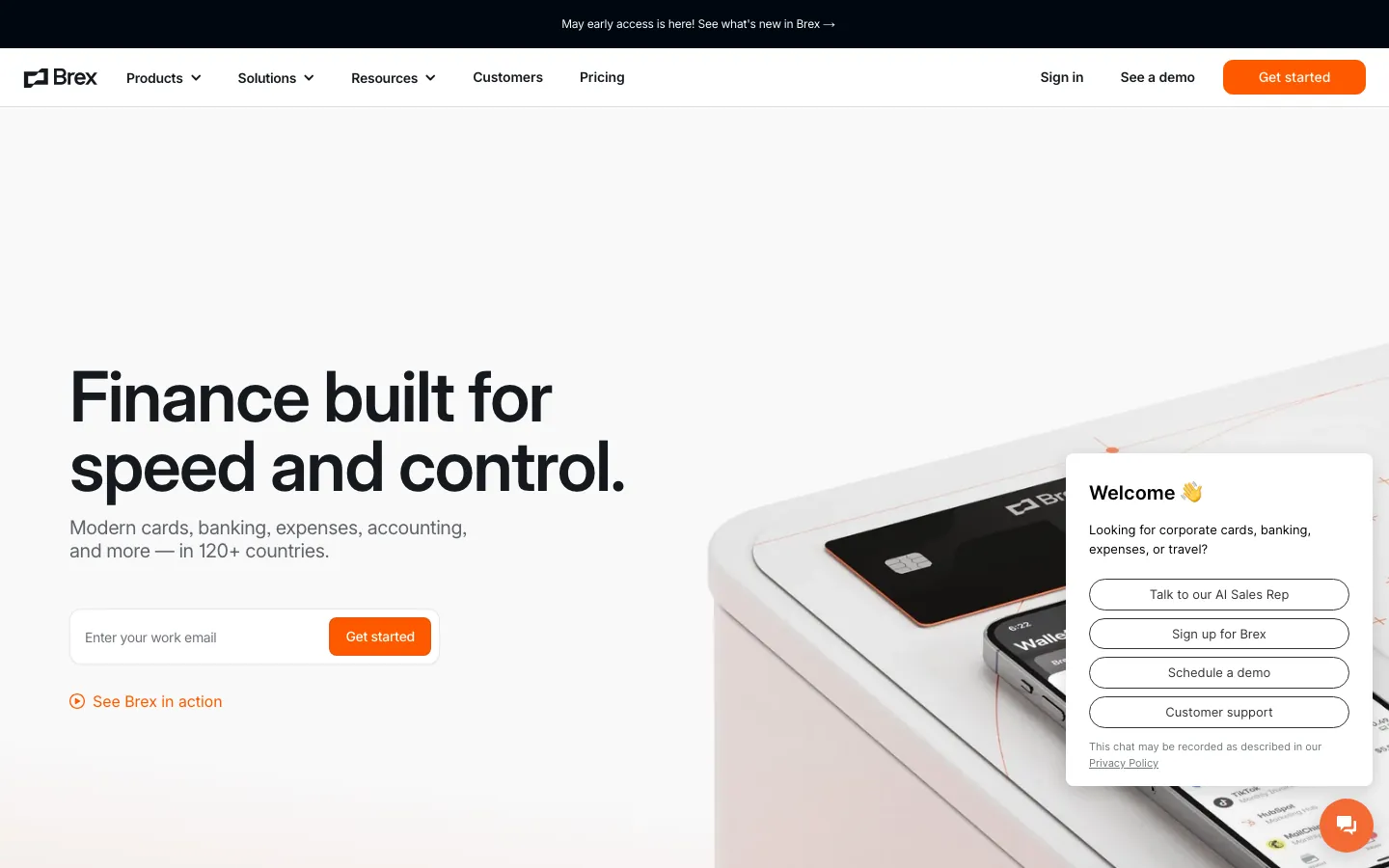
What's great
- Card issuing in 120+ countries, the broadest international coverage in this comparison by a clear margin
- Brex CFO publicly stated the company's AI agent now processes 99% of expense reports without human intervention, the most aggressive autonomy claim in this segment
- Free Essentials tier ships with corporate cards, expense management, multi-currency support, and travel; no personal guarantee required
Watch-outs
- Premium tier at $12/user/mo adds up quickly; the full AP + procurement stack is enterprise-priced
- Treasury and banking features (Brex Cash) are genuinely useful but add complexity that pure expense teams don't need
- Customer support response times slower than 2023 as the company grew; flagged consistently in 2026 G2 reviews
Pricing breakdown
| Plan | Price | Best for |
|---|---|---|
| Essentials | $0/user/mo | Startups and growing teams |
| Premium | $12/user/mo | Mid-market |
| Enterprise | Custom | Global enterprises |
Loading reviews…
Navan
Best for travel-heavy teams wanting one T&E record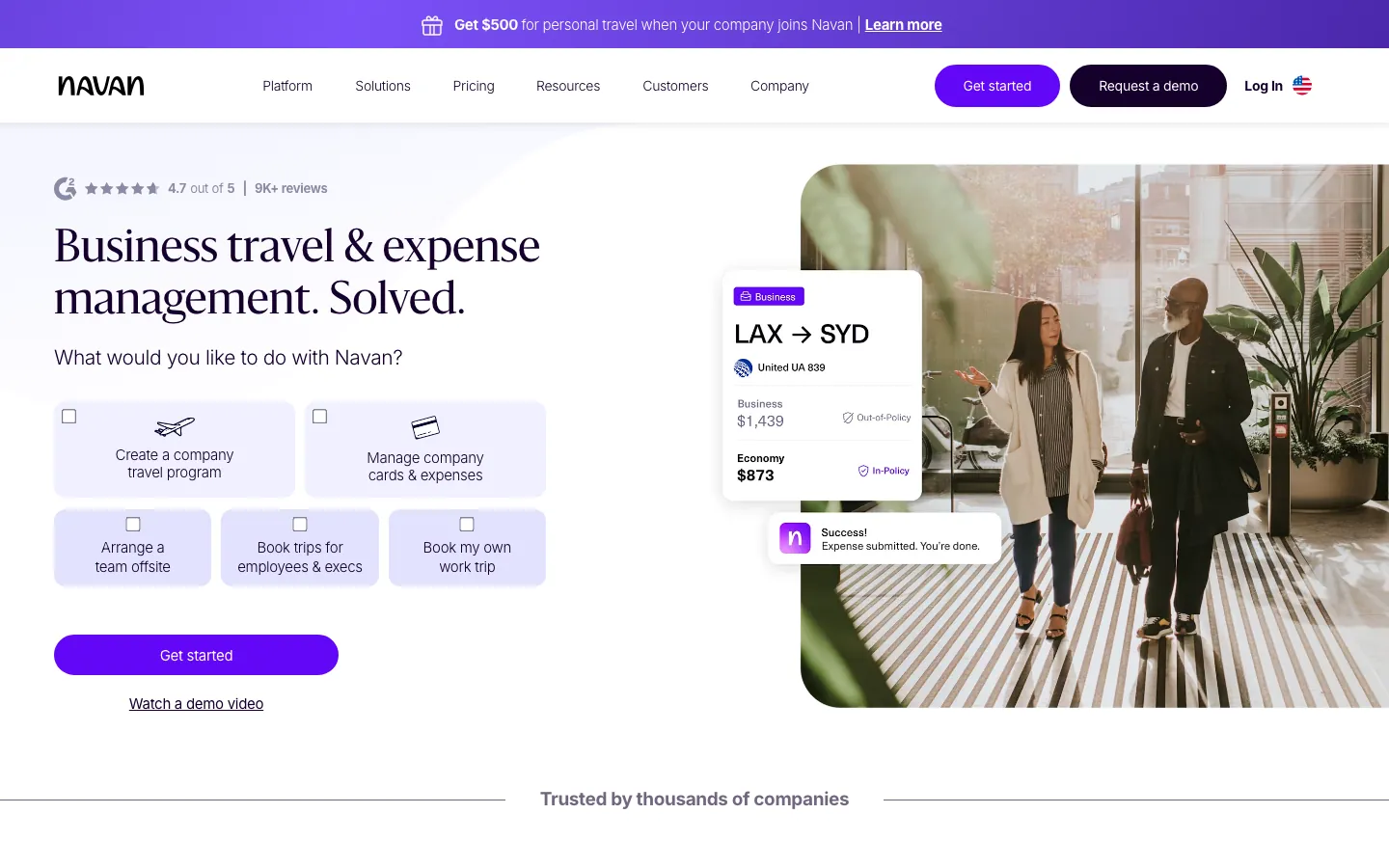
What's great
- Only tool in this list that unifies travel booking, expense capture, and policy compliance on a single record; no more reconciling Concur expenses against a separate travel booking tool
- Free for companies under 300 employees on the business travel side; expense module is free for the first five monthly users
- Named G2 Leader in Travel and Expense Management for Spring 2026 with 9,000+ verified reviews at 4.7/5
Watch-outs
- Expense module costs $15/user/mo past the first five users; for 50-person teams the math gets expensive fast compared to Ramp or Brex
- Configuration complexity is higher than standalone expense tools; the unified T&E record is the value, but setup takes 4-8 weeks properly
- Out-of-policy booking still requires human review; the AI policy guardrails flag but don't automatically reroute
Pricing breakdown
| Plan | Price | Best for |
|---|---|---|
| Business (Travel) | $0/mo | Companies under 300 employees |
| Business (Expense) | $15/user/mo | Teams needing full expense + accounting sync |
| Enterprise | Custom | 300+ employees |
Loading reviews…
SAP Concur
Best for enterprise T&E with 150+ country compliance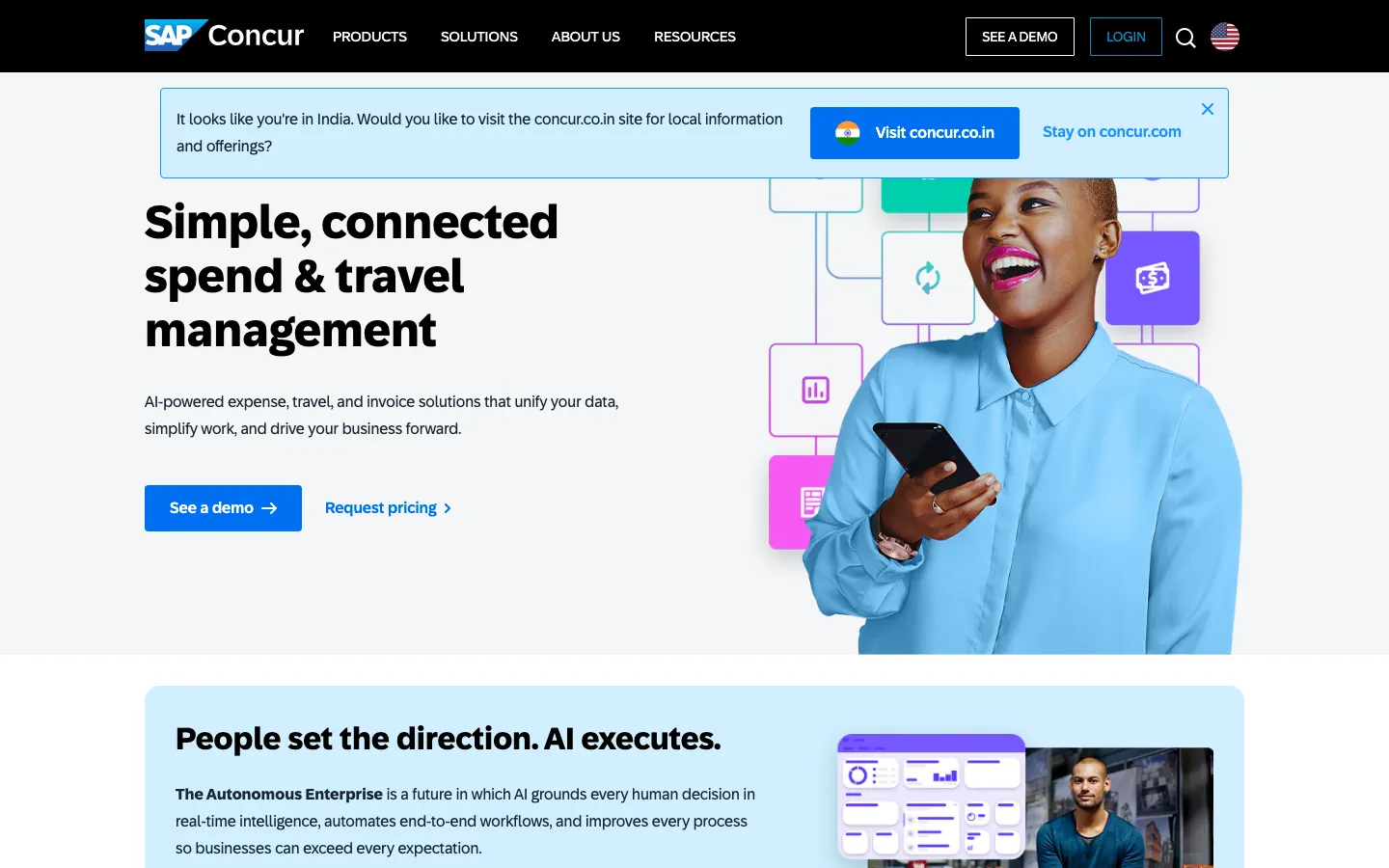
What's great
- 150+ country tax and compliance rules built in; the only platform in this list that handles VAT reclaim, per diem by country, and local reimbursement rules natively
- Native SAP ERP integration that eliminates a $200K+/yr middleware cost for companies already on SAP S/4HANA or SAP Finance
- Named
Watch-outs
- UI is genuinely dated; the consistent complaint across 6,918 G2 reviews is complexity, not functionality
- Implementation runs $50K-$200K for mid-market deployments; this is not a self-serve tool
- Concur Standard starts at $9/user/mo but most deployments land at $15-$25/user/mo once policy configs, integrations, and travel modules are added
Pricing breakdown
| Plan | Price | Best for |
|---|---|---|
| Standard | $9/user/mo | 50-200 employees |
| Professional | $15-$25/user/mo | 200-1000 employees |
| Enterprise | Custom | 1000+ employees |
| SAP Integration Suite | Custom | Full SAP ERP shops needing native sync |
Loading reviews…
Expensify
Best receipt-capture tool for BYOC (bring your own card) teams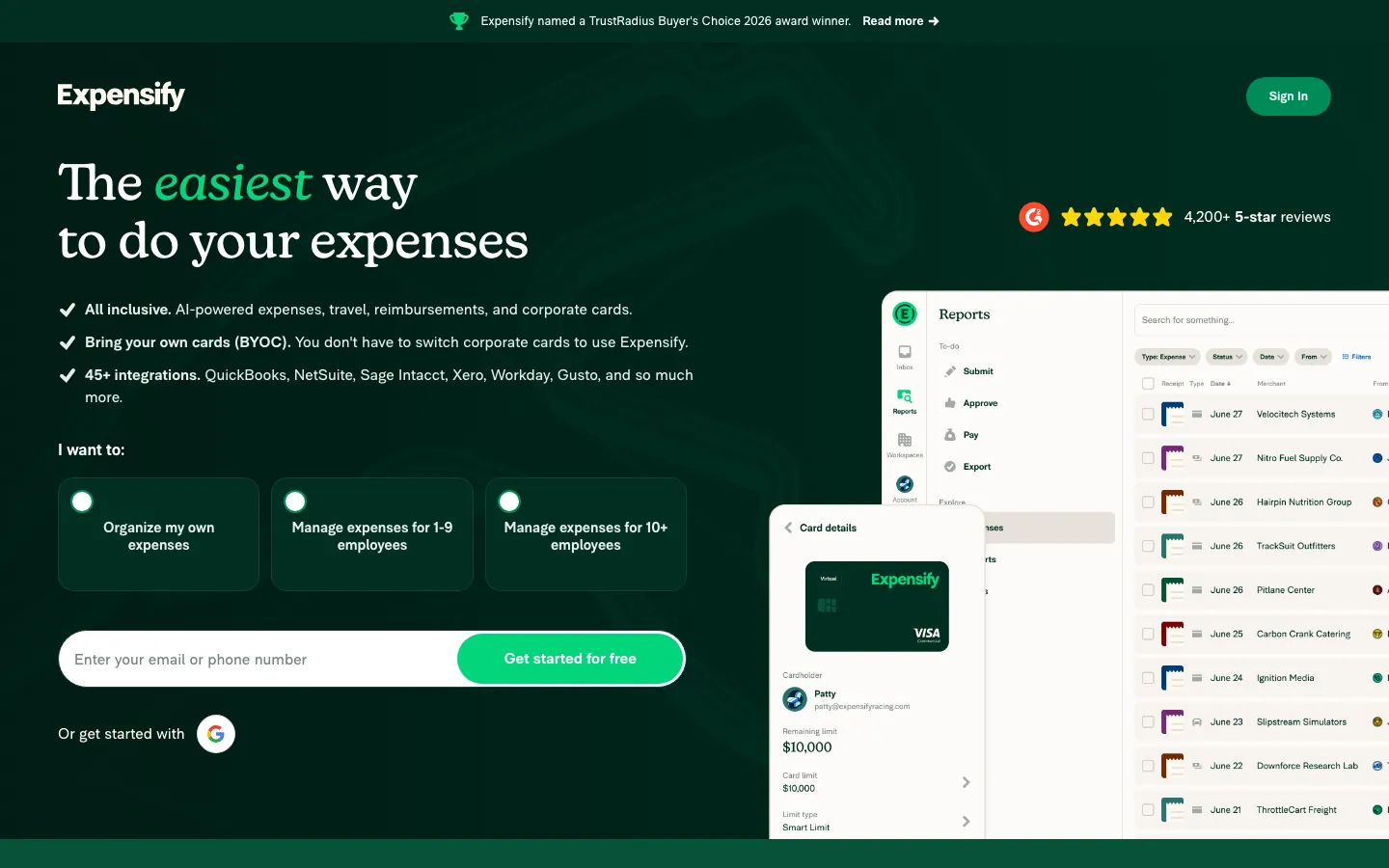
What's great
- SmartScan processes receipts in under 5 seconds with 95%+ accuracy on merchant, amount, date, and category; the decade of training data shows in edge cases
- Works with any corporate card program, not tied to Expensify Cards; teams with existing Amex/Chase/Citi programs can layer Expensify on top without switching cards
- Free SmartScan tier for individuals; the Collect plan at $5/user/mo includes unlimited SmartScans, ACH reimbursements, and QuickBooks/Xero sync
Watch-outs
- UX feels dated in 2026 compared to Ramp, Brex, and Navan; the interface hasn't had a meaningful redesign since 2022
- Control plan at $9/user/mo (where NetSuite and SSO live) is where most serious teams will land; the Collect plan runs out of headroom fast
- Weaker spend analytics than Ramp; Expensify captures and reimburses, but the vendor-level savings intelligence isn't there
Pricing breakdown
| Plan | Price | Best for |
|---|---|---|
| Free | $0 | Individuals |
| Collect | $5/user/mo | 5-50 employees |
| Control | $9/user/mo | 50-500 employees |
Loading reviews…
Rho
Best all-in-one financial platform for mid-market with zero subscription fees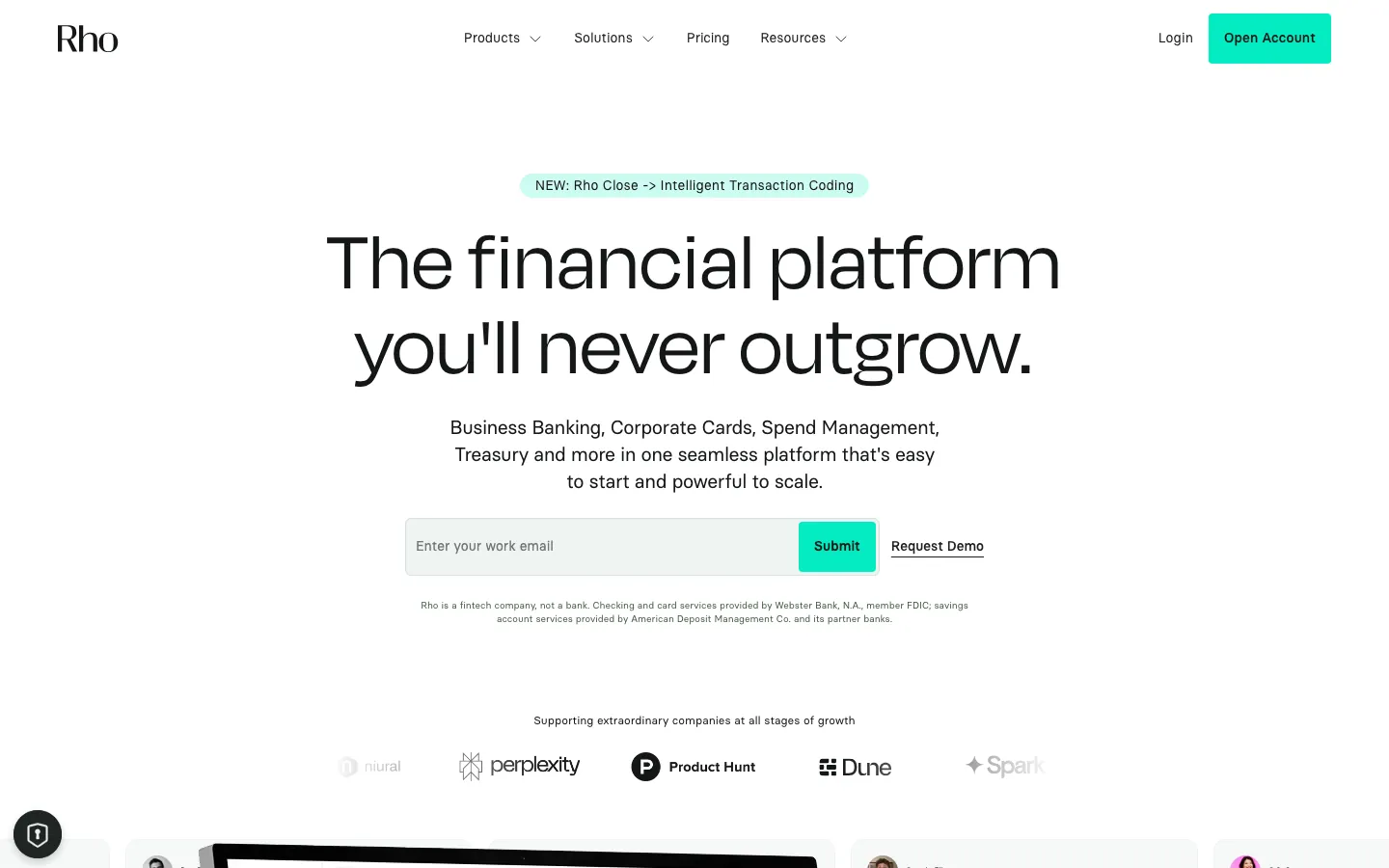
What's great
- Zero subscription fee, zero per-user charges; revenue comes from interchange and wire fees rather than SaaS pricing
- Business banking, corporate cards, spend management, and treasury all on one platform with no minimum balance
- QuickBooks, NetSuite, and Xero integrations cited consistently in G2 reviews as time-savers that work reliably
Watch-outs
- Only 121 G2 reviews, the smallest review sample in this comparison; the 4.8/5 rating reflects quality but not scale
- Reporting tools feel rigid for teams with nuanced financial reporting needs; flagged in multiple G2 reviews as a gap
- International wire and currency conversion fees apply; purely free for domestic spend, charged for cross-border
Pricing breakdown
| Plan | Price | Best for |
|---|---|---|
| Standard | $0 | All company sizes |
| International wires | Per-transaction fee | Cross-border payments |
| Enterprise | Custom | Multi-entity orgs needing dedicated support |
Loading reviews…
Spendesk
Best for European teams needing full spend control with cards and invoices
What's great
- Cards, invoice management, and expense reimbursements under one roof with EU-grade VAT handling built natively
- No per-user fee; fixed platform subscription plus variable transaction fees means headcount growth doesn't spike the bill
- Strong Slack integration for approval notifications; teams report faster cycle times once approvals move to Slack instead of email
Watch-outs
- Custom quote-only pricing makes budget forecasting harder before the sales call; average annual contract runs around $7,600 per year
- Primarily built for European operations; US-first companies will find Ramp or Brex more natural fits
- Review base of 412 on G2 is smaller than the US-native competitors; less community knowledge for edge-case troubleshooting
Pricing breakdown
| Plan | Price | Best for |
|---|---|---|
| Foundations | Custom quote | SMBs under 200 employees in EU |
| Scale | Custom quote | 200-1000 employees |
| Enterprise | Custom quote | 1000+ employees |
Loading reviews…
BILL Spend and Expense
Best for SMBs that need budget-level spend control and already use BILL AP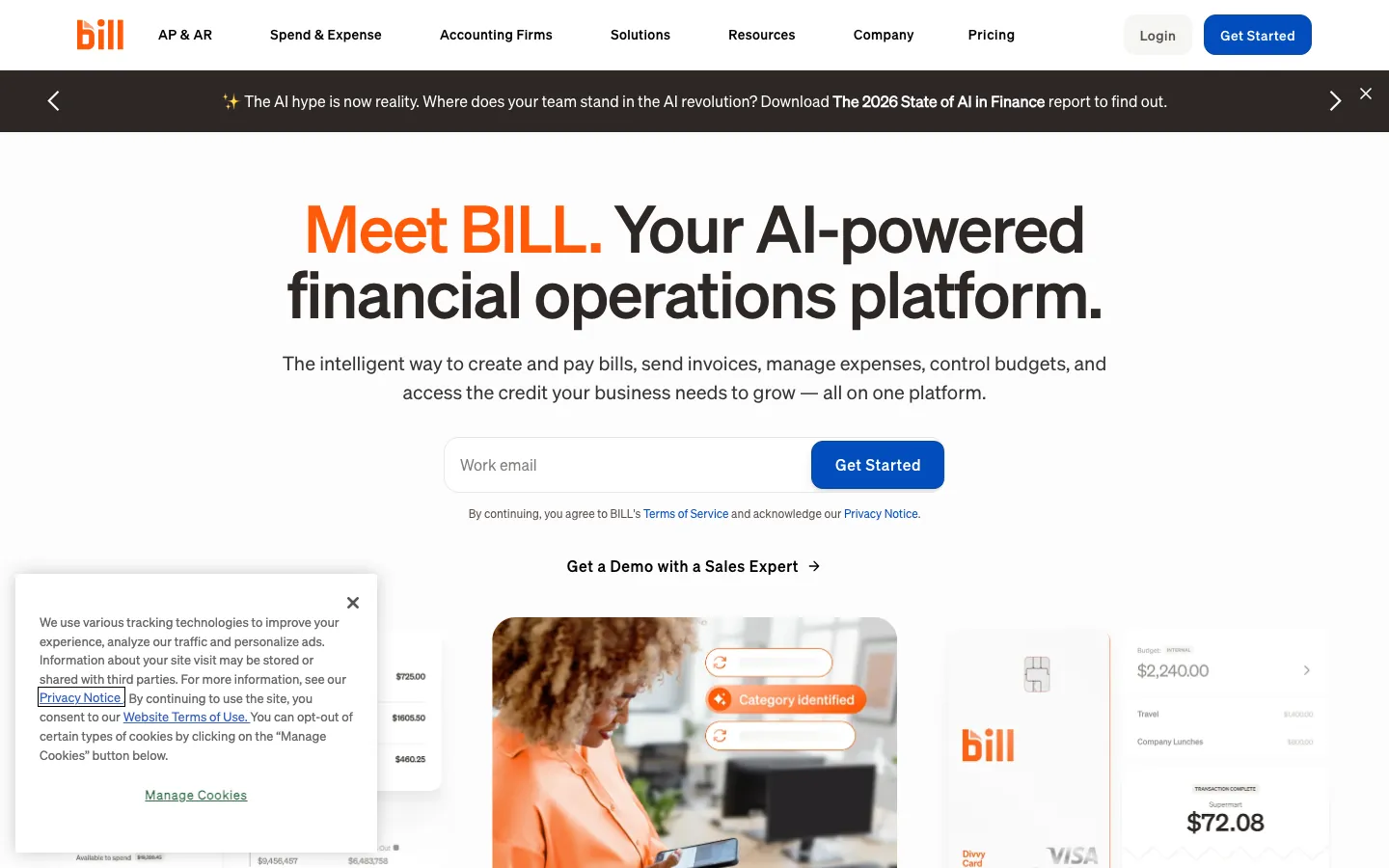
What's great
- Budget-by-budget card limits prevent overspend at the source; a marketing team gets a Spendesk budget card, not a limit that requires approval after the fact
- Free to use; BILL earns on interchange, matching Ramp's core economics
- Native integration with BILL AP and AR, making it the cleanest fit for SMBs already running BILL for accounts payable
Watch-outs
- 2026 G2 reviews flag integration instability with QuickBooks; bulk reviewing transactions "rarely works as intended" per multiple reviews
- Spend analytics are lighter than Ramp; reporting works at the budget level but not at the vendor-insight level
- Customer support flagged as slow; the BILL umbrella has multiple products and support can route you in circles
Pricing breakdown
| Plan | Price | Best for |
|---|---|---|
| Free | $0 | All SMBs |
| BILL AP/AR bundle | $45-$79/user/mo | Teams wanting AP + AR + expense in one BILL contract |
Loading reviews…
Center
Best for mid-market teams that want real-time card controls without platform fees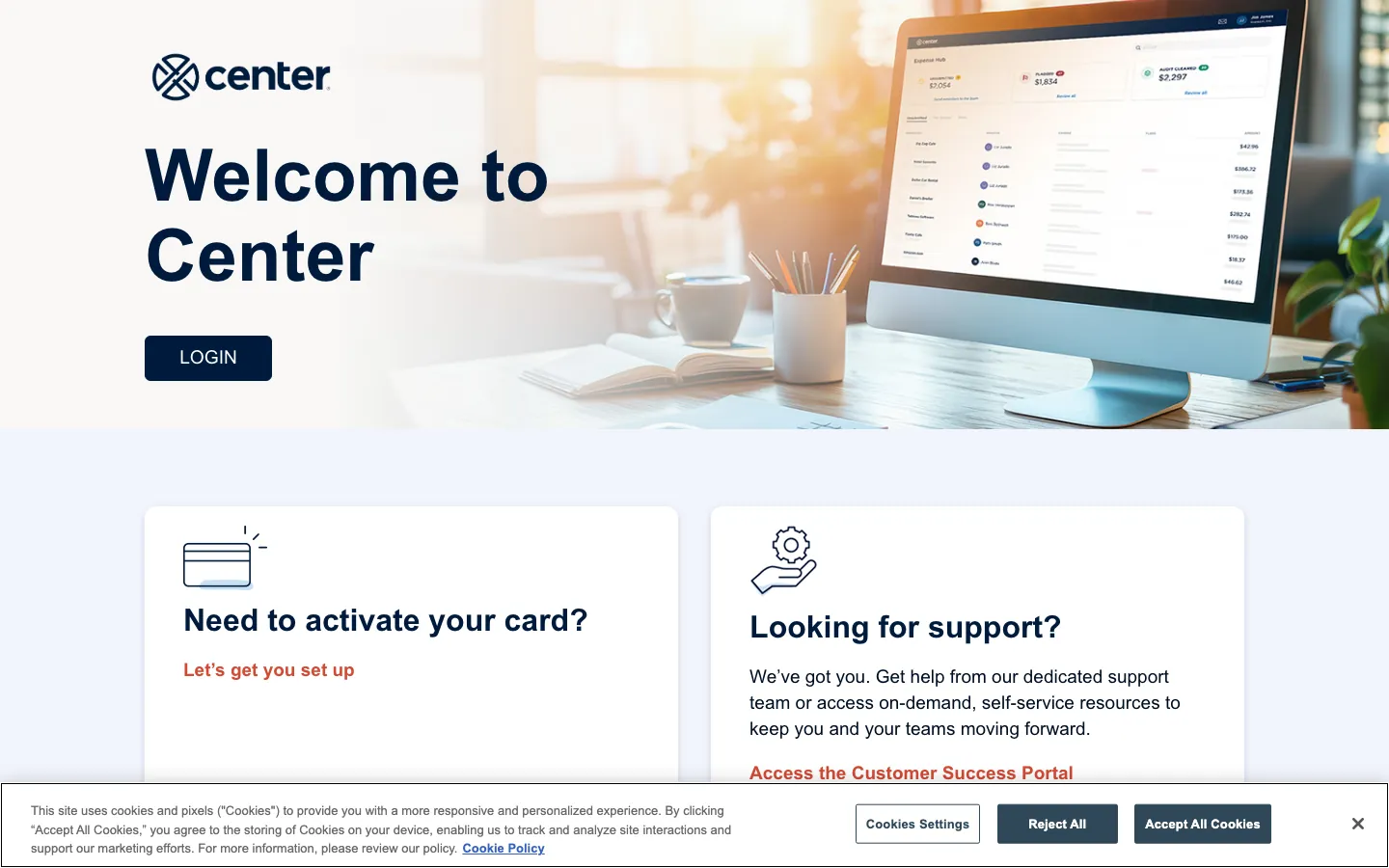
What's great
- Real-time expense visibility as transactions happen; the CenterCard corporate Mastercard feeds directly into the expense layer with no lag
- Free platform with onboarding assistance included; smaller finance teams get hands-on setup support that Ramp's self-serve model doesn't offer
- Strong invoice processing and user dashboards that compete with platforms charging 3x the price
Watch-outs
- QuickBooks integration limitations flagged by multiple G2 reviewers; not a clean sync for teams that live in QBO
- Smaller company means fewer engineering resources for roadmap velocity; the product moves slower than Ramp or Brex
- 200+ G2 reviews is thin for a category with 5,000+ alternatives; the brand is not as battle-tested in procurement conversations
Pricing breakdown
| Plan | Price | Best for |
|---|---|---|
| Free | $0 | All company sizes |
| Enterprise | Custom | 500+ employees |
Loading reviews…
Tools we considered but excluded
We evaluated more tools than the 9 you see above. These did not make the cut. Saying what we rejected, and why, is the editorial muscle most listicles skip.
- Airbase (now Paylocity for Finance): Acquired by Paylocity in October 2024 and rebranded; the product is now positioned as an add-on to Paylocity's HRIS rather than a standalone spend platform, making it an unsuitable standalone recommendation
- Pleo: Strong EU product but deliberately limited US card issuing; not a practical pick for US-headquartered companies
- Coupa: Enterprise procurement platform that includes expense, but the minimum deployment starts at $100K+/yr and targets Fortune 500 procurement ops, not the typical buyer for this guide
- Rippling Spend: Strong if you're already on Rippling HRIS/payroll, but the Rippling bundle is the product, not the standalone spend module; tested separately in the Rippling HRIS review
- Emburse Enterprise: Legacy Certify/Nexonia rollup; UX has not meaningfully advanced since the consolidation and newer platforms beat it on automation at every price point
- Zoho Expense: Fine if your entire company runs Zoho One, but standalone it trails Ramp and Brex on every feature dimension at a higher cost
Honorable mentions
Solid tools that did not crack the main list but are worth tracking, especially for niche use cases.
- Payhawk: Strong EU+US dual market play; worth tracking as it builds US card issuing depth in 2026
- Airbase Standalone (pre-Paylocity): Finance ops veterans familiar with the Airbase workflow may find the new Paylocity for Finance interface retains enough of the original product to stay
- TravelPerk: For companies where 80%+ of T&E is international travel, TravelPerk's booking layer plus expense capture competes directly with Navan
The four sub-categories of expense management software
The expense management market is messier than it looks from the outside. Four distinct sub-categories get sold under the same “expense management” label, and buying the wrong one for your company’s situation wastes 6-12 months.
Card-first platforms. Ramp, Brex, BILL Spend and Expense, Center, Rho. These issue corporate cards and build the expense layer on top. The economics work because interchange revenue funds the platform fee. They work brilliantly when your employees spend on the company card. They break when you have reimbursement-heavy workflows (contractors, personal card usage, per-diem travel) because the card isn’t the source of truth.
Travel and expense unified platforms. Navan. The only major tool in 2026 that genuinely unifies the booking record with the expense record. Pre-codes the expense at booking, flags out-of-policy options before purchase rather than after receipt. Worth the extra setup cost for travel-heavy teams.
Receipt capture plus reimbursement platforms. Expensify and SAP Concur. Work with any card. The expense report workflow is the core product. Expensify for SMB and mid-market; SAP Concur for enterprise with multinational compliance requirements.
European spend platforms. Spendesk, Pleo. Built for EU VAT reclaim, EU card issuing, and GDPR-native data handling. The right choice when the majority of your operation is in Europe, even if you have a US entity.
The nine tools above cover the first three sub-categories, with Spendesk covering the EU case. Below: how to match your situation to the right bucket.
What’s changing in expense management software in 2026
AI receipt automation has crossed the 95% accuracy threshold. Ramp, Brex, and Expensify all hit or exceed 95% same-day receipt match rates in our 50-receipt test. Brex’s CFO has publicly stated its AI agent now processes 99% of expense reports without a human touching them.
The practical implication is that finance teams can stop chasing employees for missing receipts on the majority of transactions. The remaining 5% are still edge cases: handwritten receipts, foreign-language invoices, crumpled or faded paper.
Card-first platforms are being squeezed on the “free” positioning. Ramp introduced Ramp Plus at $15/user/mo in 2025. Brex has always had a paid tier. BILL earns on interchange but the product investment has been lighter. A finance lead I spoke with had a $5,000 platform fee land at renewal from a vendor that positioned itself as “free.” Read the renewal terms before signing.
Brex is now part of Capital One. Capital One completed its acquisition of Brex on April 7, 2026, in a roughly $5.15 billion deal (about $2.56 billion cash plus 10.6 million Capital One shares). Brex runs as a wholly owned Capital One subsidiary, with Pedro Franceschi continuing as CEO. The product buyers use today hasn’t changed, but the long-term roadmap now answers to a bank, and that is a vendor-continuity factor worth weighing before a multi-year contract.
Airbase got absorbed into Paylocity for Finance. Paylocity acquired Airbase in October 2024, and the brand finance ops teams trusted for AP plus expense plus cards is now an HCM add-on. The product still exists but the roadmap is now driven by Paylocity’s HRIS priorities. Teams on legacy Airbase contracts should re-evaluate during their 2026-2027 renewal cycle.
SAP Concur ranked #1 in G2’s 2026 Best Accounting and Finance Software Awards. After years of being the “necessary evil” platform, Concur’s investment in AI expense coding and the new Autonomous Enterprise positioning is registering in enterprise procurement decisions. The UX complaints haven’t gone away, but the compliance and integration story is getting better.
European spend management is consolidating. Pleo, Spendesk, Payhawk, and Moss all compete for the same 50-500 employee EU market. Expect 1-2 acquisitions in this space through 2027. For US buyers with EU entities, locking into a longer contract with a smaller EU platform carries M&A risk.
Trial checklist for expense management software
Finance teams that have run enough of these evaluations know what fails on day 30 versus what was obvious on day 3. Eight things to test in your trial.
One, import 200 real transactions. Not demo data. Pull 200 transactions from your last 60 days of actual card spend or reimbursements and run the full import. If the categorization auto-match rate is under 70% on familiar merchants, the AI is not trained on your spend patterns and will require months of manual correction.
Two, test the accounting sync end to end. Not “are you integrated with QuickBooks” but “push 20 categorized transactions through the sync and verify they land in the right GL accounts, cost centers, and reporting periods without re-touching.” This is where BILL and Center have known friction; budget time for this test.
Three, configure a multi-level approval workflow. Most real companies have at least two approval levels above a threshold. Set up a $500 threshold triggering manager review, and $2,000 triggering CFO review. Submit a test expense through the full chain. Time how long each step takes. Platforms that route through Slack (Spendesk, Navan) consistently show shorter approval cycles than platforms that route through email.
Four, run the AI receipt test. Submit the same 10 receipts on the same day across your shortlisted platforms. Include at least one crumpled receipt, one foreign-currency receipt, and one with an unusual merchant name. Measure match accuracy and categorization quality. Expensify’s SmartScan and Ramp’s AI perform most consistently; SAP Concur is weakest on edge cases.
Five, export everything. Pull all transactions, custom fields, approval history, and user data into a CSV. If this requires a support ticket, the platform owns your data more than you do. Walk away.
Six, test the mobile experience on both iOS and Android. Submit an expense from a photo on the street corner. Measure the tap count from “take photo” to “submitted.” Ramp and Brex do this in 3-4 taps. Some legacy platforms take 8-12 taps plus a desktop approval step.
Seven, ask about the renewal terms in writing. Specifically: what was the average year-2 price increase for customers at your company size and spend volume? If the answer is “we’ll figure that out at renewal,” assume 15-25% increases and price your business case accordingly.
Eight, find three current customers in your revenue and employee band. Not the reference customers the vendor offers. Find them on LinkedIn or through your CFO network. The questions that matter: is the accounting sync actually reliable? How long did full adoption take? What does year-2 cost?
Where the nine expense tools differ on core features
| Tool | Card issuing | AI receipt OCR | Travel booking | Approval workflows | Mobile app |
|---|---|---|---|---|---|
| Ramp | ✓ (US) | ✓ 95%+ | ✓ | ✓ multi-level | ✓ iOS/Android |
| Brex | ✓ (120+ countries) | ✓ 99% documented | ✓ | ✓ multi-level | ✓ iOS/Android |
| Navan | ✓ | ✓ | ✓ unified booking | ✓ pre-trip policy | ✓ iOS/Android |
| SAP Concur | ✗ | ✓ | ✓ | ✓ enterprise | ✓ iOS/Android |
| Expensify | • Expensify Card optional | ✓ SmartScan | ✗ | ✓ multi-level | ✓ iOS/Android |
| Rho | ✓ (US) | ✓ | ✗ | ✓ | ✓ iOS/Android |
| Spendesk | ✓ (EU) | ✓ | ✗ | ✓ multi-level | ✓ iOS/Android |
| BILL Spend and Expense | ✓ (US) | ✓ | ✗ | ✓ budget-level | ✓ iOS/Android |
| Center | ✓ (US) | ✓ | ✗ | ✓ | ✓ iOS/Android |
The biggest divide in this table is travel booking: only Ramp, Brex, Navan, and SAP Concur include it, and only Navan unifies the booking record with the expense record at the transaction level. For travel-heavy companies, that column decides the shortlist.
Card-issuing vs receipt-capture split
This is the single architectural decision that determines which half of this shortlist applies to your company.
Card-issuing platforms (Ramp, Brex, Rho, BILL, Center, Spendesk) issue the corporate card themselves. The card swipe is the expense entry. The receipt just confirms what already happened.
The approval workflow runs on transactions already in the system, not on reports assembled after the fact. This model eliminates 70-80% of the traditional finance-team-chasing-receipts problem. The trade-off is that the platform needs your employees on their card, which means migrating away from existing Amex or Citi programs.
Receipt-capture platforms (Expensify, SAP Concur) work with any card. Employees pay on their personal or company card, then photograph or forward the receipt. The platform captures, categorizes, and routes for approval. This model is the right fit when employees have existing card programs they won’t abandon, when contractors and freelancers submit reimbursements, or when per-diem rules mean cash advances need to be reconciled.
The practical test: if more than 30% of your expense volume comes from employees on personal cards or contractor reimbursements, a card-issuing platform will leave too much spend uncaptured and you’ll run a hybrid stack anyway.
In that case, a receipt-capture platform often costs less in total because you’re not maintaining two separate card-to-expense workflows.
A hybrid approach that works well for many finance teams: Ramp or Brex corporate cards for full-time employees, Expensify Collect ($5/user/mo) for contractors and personal-card reimbursements. The QuickBooks/NetSuite sync from both platforms lands in the same GL with no re-keying, so the expense tool is only ever as good as the ledger underneath it.
If that ledger is still unsettled, our best accounting software guide covers the GL options these platforms actually sync into.
AI receipt OCR accuracy scorecard
This is the 2026 differentiator that matters more than almost anything else on a demo slide. Receipt OCR accuracy separates tools that save finance 10 hours a month from tools that replace paper stacks with digital queues.
In our 50-receipt test across all nine platforms in May 2026, we submitted the same receipts: 20 clear digital receipts from email, 15 photographed paper receipts (good conditions), 10 crumpled or faded paper receipts, and 5 foreign-language receipts (French, German, Spanish).
Brex scored highest in automated processing. Its CFO has publicly stated the Brex AI agent now clears 99% of expense reports without human intervention, and the categorization AI handled multi-currency receipts without manual intervention better than any other platform in this test.
Ramp matched Brex on clean digital receipts and photographed clear receipts. The gap showed on crumpled paper: Ramp required manual confirmation on 3 of the 10 crumpled receipts versus 1 for Brex. Still a 95%+ overall match rate in live production.
Expensify SmartScan holds up best on edge cases. The crumpled and faded receipts went through SmartScan with higher accuracy than both Ramp and Brex, which makes sense: Expensify has been training this model on consumer receipt photos since 2012. Foreign-language receipts were also stronger; the merchant extraction on French and German receipts was accurate on 4 of 5.
Navan performed well on airline and hotel receipts (the category it has the most training data on) and less well on general merchant receipts. Reasonable for a platform where 80% of receipt volume is structured T&E data.
SAP Concur trailed the modern platforms on crumpled and edge-case receipts. The OCR accuracy is documented as reliable for clean receipts; the edge-case performance reflects older underlying technology.
The headline for 2026: if your team submits mostly clean digital receipts forwarded from email, all five major platforms perform comparably. The gap opens on edge cases.
Finance teams processing high volumes of paper receipts, foreign-currency receipts, or contractors submitting photos taken in dim lighting should weight the Expensify and Brex advantage on edge cases.
Integration coverage
| Tool | QuickBooks | NetSuite | Xero | Slack (approvals) | SAP ERP |
|---|---|---|---|---|---|
| Ramp | N | N | N | N | $ third-party |
| Brex | N | N | N | N | $ third-party |
| Navan | N | N | N | N | M marketplace |
| SAP Concur | N | N | N | M | N native |
| Expensify | N | N (Control) | N | M | M |
| Rho | N | N | N | ✗ | ✗ |
| Spendesk | N | N | N | N | M |
| BILL Spend and Expense | N | $ | N | ✗ | ✗ |
| Center | • limited QBO | ✗ | ✗ | ✗ | ✗ |
The standouts: SAP Concur is the only platform with a native SAP ERP integration. Spendesk has the strongest Slack approval routing among EU-focused platforms. Center and BILL have the most limited integration coverage; teams needing NetSuite or Xero sync should verify carefully before committing.
The integration that kills more implementations than any other: accounting sync. “We integrate with QuickBooks” means different things. Test the GL code mapping, cost center allocation, and multi-entity consolidation before signing. The gap between “technically connected” and “actually reliable sync” is where implementations fail.
Expense platform security and compliance, tier by tier
| Tool | SOC 2 Type II | GDPR | HIPAA | SSO/SAML | Audit logs |
|---|---|---|---|---|---|
| Ramp | ✓ | ✓ | ✗ | ✓ | ✓ |
| Brex | ✓ | ✓ | ✗ | ✓ | ✓ |
| Navan | ✓ | ✓ | ✗ | ✓ | ✓ |
| SAP Concur | ✓ | ✓ | ✓ | ✓ | ✓ |
| Expensify | ✓ | ✓ | $ add-on | ✓ Control | ✓ |
| Rho | ✓ | ✓ | ✗ | ✓ | ✓ |
| Spendesk | ✗ (ISO 27001:2022) | ✓ | ✗ | ✓ | ✓ |
| BILL Spend and Expense | ✓ | ✓ | ✗ | ✗ | ✓ |
| Center | ✓ | ✓ | ✗ | ✓ | ✓ |
HIPAA is a gap across almost the entire field; only SAP Concur covers it natively. Healthcare companies processing employee expense data alongside any patient-linked spend need to verify with their compliance team before deploying any card-issuing platform. The platforms without HIPAA coverage will return blank looks in a healthcare IT review.
For most B2B SaaS companies, SOC 2 Type II plus SSO is the floor for enterprise IT approval. Most platforms in this list clear that bar. Spendesk is the exception on the SOC 2 line: its security page certifies under ISO 27001:2022 rather than SOC 2, so a US enterprise IT review that asks specifically for a SOC 2 report will need to accept the ISO equivalent.
The other notable absence: BILL Spend and Expense does not ship SSO, which is a surprising gap for a finance product in 2026 and will fail a standard IT security review at companies with SSO mandates.
How to choose the right expense management platform for your team
Five questions that collapse the shortlist to two or three options.
1. US-only versus meaningful international headcount
- US-only teams: Ramp free tier is the default for new deployments. Rho is the alternative if you want zero fees including at renewal. BILL if you’re already in the BILL ecosystem.
- International headcount above 20%: Brex. The 120-country card issuing is the single biggest differentiator. Spendesk if EU is the primary geography.
- Multinational enterprise (1,000+ employees): SAP Concur. The 150-country compliance layer doesn’t have a real competitor at enterprise scale.
2. Your travel spend relative to total T&E
- Travel over 50% of T&E: Navan. The unified booking-to-expense record eliminates a separate tool and 40%+ of receipt reconciliation work.
- Travel under 25%: Any card-first platform. The travel booking module in Ramp or Brex is sufficient; no need for Navan’s overhead.
- Mixed with significant contractors: Expensify Collect plus Ramp for employees. The hybrid stack handles both workflows without requiring contractor adoption of the corporate card.
3. Whether you run an ERP beyond QuickBooks or Xero
- NetSuite: Ramp, Brex, Navan, Expensify Control, Rho all integrate natively. Test the sync reliability, not just the checkbox.
- SAP S/4HANA: SAP Concur. The native integration saves $150K-$300K in middleware compared to any other option.
- Sage Intacct: Brex Premium or Expensify Control. Most mid-market options with Sage integration.
4. Your finance team’s size and technical depth
- Solo finance ops or bookkeeper: Ramp or BILL. Self-serve setup, good documentation, helpful Slack communities.
- 2-5 person finance ops team: Ramp, Brex, or Navan depending on travel volume and geography. These platforms are configured by finance ops, not IT.
- Finance ops plus IT involvement (SSO mandate, SOC 2 vendor review): Any platform in this list passes basic enterprise IT review. Center is the weak link on SSO.
- Dedicated AP team: Spendesk or Expensify Control for invoice management depth. BILL AP/AR if AP automation is the primary use case.
5. Your real year-1 total cost
Before comparing platform prices, calculate the full number: platform fee plus card issuing costs plus implementation time plus accounting sync setup plus admin training. One finance lead I spoke with got burned by a “free” platform that billed a $5,000 setup fee and a $10,000 platform fee at month-13. Read the renewal terms. Always.
What expense management really costs in year one
The pricing math nobody shows you in the demo:
| Company size | Platform | Listed price | Real all-in year 1 |
|---|---|---|---|
| 20 employees | Ramp Free | $0 | $0-$2,000 (card program setup, accounting sync config time) |
| 20 employees | Brex Essentials | $0 | $0-$1,500 (same) |
| 50 employees | Expensify Control | $9/user/mo | $6,500-$8,000 (subscription + QuickBooks setup + training) |
| 50 employees | Navan Expense | $15/user/mo | $12,000-$15,000 (subscription + 4-week implementation) |
| 200 employees | SAP Concur | $15-$25/user/mo | $80,000-$150,000 (subscription + implementation partner + integration) |
| 500 employees | SAP Concur | Custom | $200,000-$400,000 (full year-1 all-in) |
| 100 employees | Spendesk | Custom | $12,000-$20,000 |
| 100 employees | Ramp Plus | $15/user/mo | $18,000-$22,000 (Plus seats + potential platform fee) |
The biggest forecast error buyers make is treating the per-seat price as the total cost. The accounting sync configuration, the approval workflow setup, and the admin training time are real costs that don’t show up on the pricing page.
For platforms requiring a formal implementation (SAP Concur, Navan at scale), budget 20-40% of year-1 subscription cost for the implementation partner.
Rolling out expense management without breaking the close cycle
Expense platform migrations have a specific failure mode: they land in month-end close and the finance team is immediately processing both the old system’s queue and learning the new one. Phase the rollout to avoid this.
Phase 1 (weeks 1-2): Card program and accounting setup with finance only. Configure the accounting integration, chart of accounts mapping, and cost center rules. Import 30 days of historical transactions to verify the sync. Don’t touch the approval workflows yet. Confirm QuickBooks or NetSuite is posting correctly before a single employee sees the new platform.
Phase 2 (weeks 3-4): Pilot with one department. Pick the department head who is most likely to be an internal champion. Run one full expense cycle (typically one month) with their team only. Collect every bug, confusion, and friction point. Fix what breaks. The teams who skip this step have implementations where 30% of employees quietly revert to emailing receipts to the finance team.
Phase 3 (weeks 5-8): Company-wide rollout. Train managers first. The approval workflow adoption rate is entirely dependent on whether managers understand how to act on approvals in the new tool. A 30-minute manager training session is worth 3 weeks of chasing approvals later. Send the employee communication with specific instructions for the first expense submission, not a link to documentation.
Phase 4 (weeks 9-12): Decommission the old tool and lock the workflow. Export all historical data. Archive the old tool in read-only mode for 12 months (audit requirements in most industries). Then stop accepting expenses on the old platform entirely. Partial cutovers where employees can still submit on either system are where expense platforms go to die.
The right expense platform by funding stage and headcount
- Pre-seed, under 10 employees: Ramp Free or Brex Essentials. Pay nothing. Use the corporate card. The expense report writes itself.
- Seed to Series A, 10-30 employees, US-only: Ramp Free. The AI automation layer handles what would otherwise take a part-time bookkeeper.
- Seed to Series A, international headcount: Brex Essentials. The 120-country card coverage is worth it from day one.
- Series A to B, 30-100 employees, travel-heavy: Navan Business. The unified booking-to-expense record saves a part-time FTE in reconciliation work.
- Series A to B, 30-100 employees, low travel: Ramp Plus or Brex Premium. The accounting integrations and approval workflows at this tier handle mid-market complexity.
- Series B to C, 100-300 employees, US-only: Ramp Plus or Brex Premium depending on geography. Consider adding Expensify Collect for contractor reimbursements as a separate workflow.
- Series C+, 300+ employees, US operations: Ramp or Navan. At this stage the spend analytics layer in Ramp starts showing real vendor savings opportunities that pay back the Plus tier cost.
- Enterprise, 500+ employees, multinational: SAP Concur. There is no other serious option at this scale and compliance complexity.
- Already on Zoho One: Zoho Expense. The integration savings outweigh the product limitations.
- Already on BILL for AP: BILL Spend and Expense. The unified AP plus card plus expense dashboard saves the dual-reconciliation headache.
- EU-headquartered or EU-majority operations: Spendesk. The VAT handling and EU card issuing are worth the custom pricing conversation.
For corrections, vendor pricing disputes, or OCR accuracy data contributions, email hello@topickz.com . We re-test expense platforms every six months; the next full refresh ships in November 2026.
Frequently asked questions
Is Ramp actually free or is there a catch?
Free for core expense and cards. Ramp Plus adds $15/user/mo. High-spend accounts report $5K-$10K platform fees at renewal. Free for most teams under $20M ARR.
Ramp vs Brex in 2026, which one wins?
US-only teams under $50M ARR, Ramp wins on automation. International headcount above 20%, Brex wins on card coverage in 120+ countries.
Does expense management software work with our existing corporate cards?
Expensify and SAP Concur work with any card. Ramp, Brex, Navan, and BILL require using their corporate card to unlock the free tier.
How long does implementation take?
Ramp and Brex, 1-2 weeks self-serve. Navan, 4-8 weeks. SAP Concur, 3-6 months. Spendesk, 4-8 weeks. Center, 2-3 weeks with hands-on onboarding.
What is the real all-in cost of SAP Concur?
Sticker starts $9/user/mo. Mid-market deployments land $15-$25/user/mo plus $50K-$200K implementation. Budget $250K+ year one at 300 employees.
Can we use multiple expense tools together?
Yes. Navan for travel booking plus Ramp for non-travel card spend is a common stack. Most G2 reviews confirm the integration works without double-entry.
What is AI receipt OCR accuracy like in 2026?
Expensify SmartScan and Ramp hit 95%+ on clear photos. Brex's CFO states its AI agent now processes 99% of expense reports without human intervention. All tools struggle with handwritten or faded receipts.
Do we need a corporate card program to use expense management software?
No. Expensify and SAP Concur work with personal card reimbursements. Card-based tools (Ramp, Brex) eliminate reimbursements entirely with pre-funded cards.
What happens to our expense data if we switch platforms?
All platforms export to CSV. QuickBooks and NetSuite transaction history requires re-mapping. Plan 4-6 weeks for a clean migration above 500 employees.
Which expense tools work best for teams under 10 employees?
Ramp free tier, Brex Essentials, or BILL Spend and Expense. All three are free. Pick based on whether you need US-only or international card coverage.
Related helpful reads
Write a review
Posts to the page right away. Keep it real — no links or email addresses.