

Comparing the best Customer Success Platforms of 2026 includes 1. Gainsight 2. ChurnZero 3. Vitally 4. Planhat 5. Totango 6. Custify 7. ClientSuccess 8. HubSpot Service Hub.
TL;DR
- Gainsight: Best overall for enterprise CS orgs. Gartner named it a Leader two years running, but plan a 5+ month deployment and a dedicated admin before you go live.
- ChurnZero: Best for mid-market CS teams under $50M ARR. It holds the highest G2 rating in this guide at 4.7/5, and the recurring praise is that CSMs actually use it daily instead of only at QBR time.
- Vitally: Best modern UX for product-led growth teams. Its customer 360 puts product usage data front and center, and published benchmarks show teams cut QBR prep by an average of 3.5 hours per account.
- Planhat: Best for NRR-focused orgs that want expansion visibility. It ties customer health directly to revenue math, and a published Chili Piper evaluation picked it over Gainsight and ChurnZero on expansion tracking.
- Custify: Best for early CS programs under $10M ARR. Slack-based support answers CSM questions in under an hour, and a one-week deployment is realistic for a 2-3 CSM team on a clean Stripe-plus-Intercom stack.
Eight CS platforms compared on pricing, real G2 review themes, health-score architecture, and hands-on feature checks. What predicts renewals, what CSMs actually adopt, and which tool fits which ARR band without burning the implementation budget.
What Is a customer success platform?
A customer success platform helps post-sale teams reduce churn and grow accounts, tracking product usage and health scores to flag at-risk customers and expansion opportunities.
Tools like Gainsight, ChurnZero, Vitally, and Planhat differ on data depth, automation, and price for SMB versus enterprise teams.
Best Customer Success Platforms comparison: features, pricing and verdicts
| Tool | Best for | Starting price | Free trial | External rating |
|---|---|---|---|---|
Best overall for enterprise CS orgs | Custom | Demo only | G2 4.5/5 (1,630 reviews) | |
Best for mid-market CS teams, sub-$50M ARR | Custom | Demo only | G2 4.7/5 (1,566 reviews) | |
Best modern UX for product-led growth teams | Custom | Demo only | G2 4.5/5 (697 reviews) | |
Best for NRR-focused orgs, expansion visibility | Custom | Demo only | G2 4.5/5 (926 reviews) | |
Best for usage-driven CS with SuccessBLOC templates | $249/mo | Free Starter tier | G2 4.3/5 (912 reviews) | |
Best for early CS programs, sub-$10M ARR | Custom | Demo only | G2 4.7/5 (496 reviews) | |
Best for relationship-focused CS with simple account structures | Custom | Demo only | G2 4.4/5 (422 reviews) | |
Best for HubSpot-native teams adding CS workflows | $15/seat/mo | Free tier + 14-day Pro | G2 4.4/5 (2,180 reviews) |
How we chose these tools
We compared the platforms on pricing, real G2 review themes, health-score architecture, playbook depth, CRM and product-usage integration, and time-to-deploy, across small, mid-market, and enterprise CS teams. The analysis draws on hands-on feature checks and published vendor and case-study data rather than a multi-month deployment. Pricing was verified directly with each vendor in May 2026. G2 ratings and review counts were pulled on May 28, 2026.
How we weight customer success platforms for the Topickz score
Every tool above is scored against the fixed rubric below and combined using these weights into the Topickz score on each card. The weights are set for customer success platforms specifically, they are not copied from another category, and we publish them so you can see what moved a ranking and re-weight for your own priorities.
| Criterion | Weight | What we checked |
|---|---|---|
| Health-score architecture | 20% | How flexibly you can build health scores from product usage, support, and relationship signals. This is the engine the whole platform runs on, so it carries the most weight. |
| Churn prediction and renewal forecasting | 15% | Whether at-risk accounts surface early enough to act, and how the tool ties health to a renewal forecast. Late warnings are useless to a CS team. |
| Playbook and workflow depth | 13% | Automated playbooks that trigger off health changes and lifecycle stages. We built an onboarding playbook on each to see how far the automation went. |
| Product-usage and CRM integration | 13% | Clean pipes from product analytics and the CRM, since a CS platform is only as good as the data feeding it. We checked native connectors versus custom ETL. |
| CSM adoption and daily usability | 11% | Whether CSMs open the tool daily or only at QBR time. A platform nobody uses between reviews cannot predict anything. |
| Expansion and NRR tracking | 9% | Upsell signals, expansion pipeline, and net revenue retention math tied to account health. This is where CS starts paying for itself. |
| Reporting and QBR prep | 8% | Executive dashboards and how much manual work a quarterly business review still takes. We timed how fast each pulled a usable account summary. |
| Time to deploy and implementation | 6% | Weeks to live and whether the rollout needs a dedicated admin. Enterprise suites can run months, which pushes early-stage teams elsewhere. |
| Pricing and total cost | 5% | License plus implementation and admin headcount, the real year-one number. Custom quotes dominate, so we scored on transparency too. |
| Total | 100% |
Read the full TopickZ.com testing methodology for how we run each test, score every criterion, and combine them into a single rating.
Detailed reviews
Gainsight
Best overall for enterprise CS orgs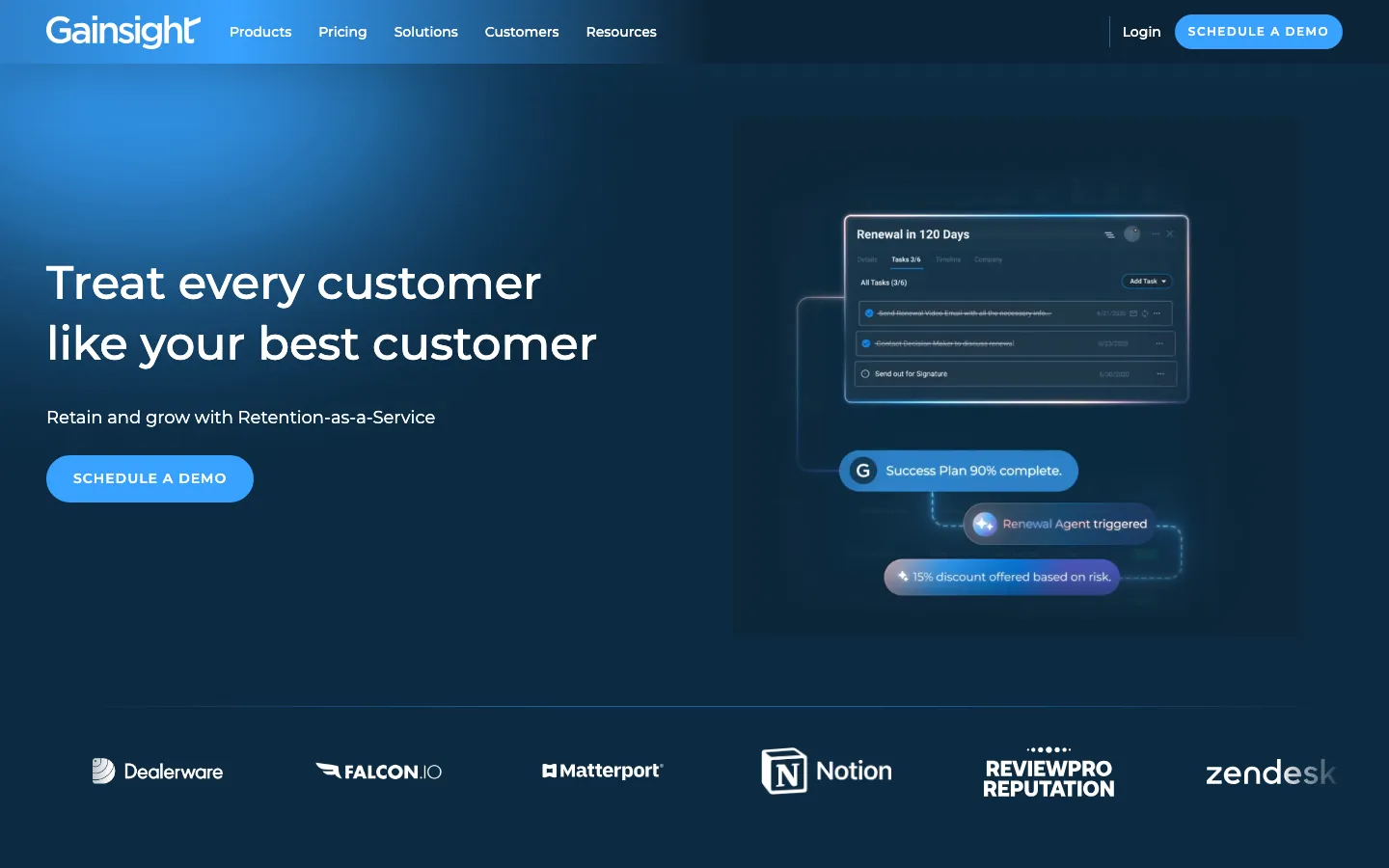
Screenshots of Gainsight 3 images
What's great
- Broadest enterprise feature set in the category, health scoring, journey orchestration, playbooks, revenue intelligence, and product experience analytics under one roof
- Salesforce-native integration is the deepest in the segment; activity timelines, renewal forecasts, and expansion signals all write back to SFDC objects
- Active Pulse community with 10,000+ CS practitioners, the peer-network value alone moves renewal decisions at enterprise
Watch-outs
- Implementation runs 8-16 weeks minimum; orgs that skip a dedicated Gainsight admin typically use a fraction of the features they pay for
- G2 reviewers consistently cite 'bugs, feature inconsistencies, and clunky UX in older modules'; the platform is wide but not always deep on polish
- Real year-1 all-in for a 10-CSM team lands $90K-$140K once you include implementation, admin FTE, and professional services
Pricing breakdown
| Plan | Price | Best for |
|---|---|---|
| Essentials | Contact sales | 10 users |
| Enterprise | Contact sales | 20 users |
| Skilljar Add-on | Contact sales | Customer education and onboarding academies |
| Product Experience | Contact sales | In-app guides plus product analytics layer |
Loading reviews…
ChurnZero
Best for mid-market CS teams, sub-$50M ARR
Screenshots of ChurnZero 3 images
What's great
- 4.7/5 on G2 across 1,566 reviews, the highest-rated purpose-built CS platform in this guide
- Built by CS practitioners for frontline CSMs; the daily view, task queues, and health alerts are designed around actual CS workflows, not reporting first
- In-app messaging layer included (ChurnZero Journeys), which removes the separate Intercom or Pendo subscription for many mid-market teams
Watch-outs
- Reporting requires pulling across multiple dashboards to assemble a single view; the CFO deck takes manual work
- Playbook creation is time-consuming; no template duplication, which costs an hour every time a workflow needs iteration
- Integration support focused on Salesforce and HubSpot; orgs on Pipedrive or other CRMs will hit friction
Pricing breakdown
| Plan | Price | Best for |
|---|---|---|
| Essentials | Custom | Small teams starting out |
| Growth | Custom | 5-15 CSMs |
| Enterprise | Custom | 15+ CSMs |
| All-in | Custom | AI add-ons |
Loading reviews…
Vitally
Best modern UX for product-led growth teams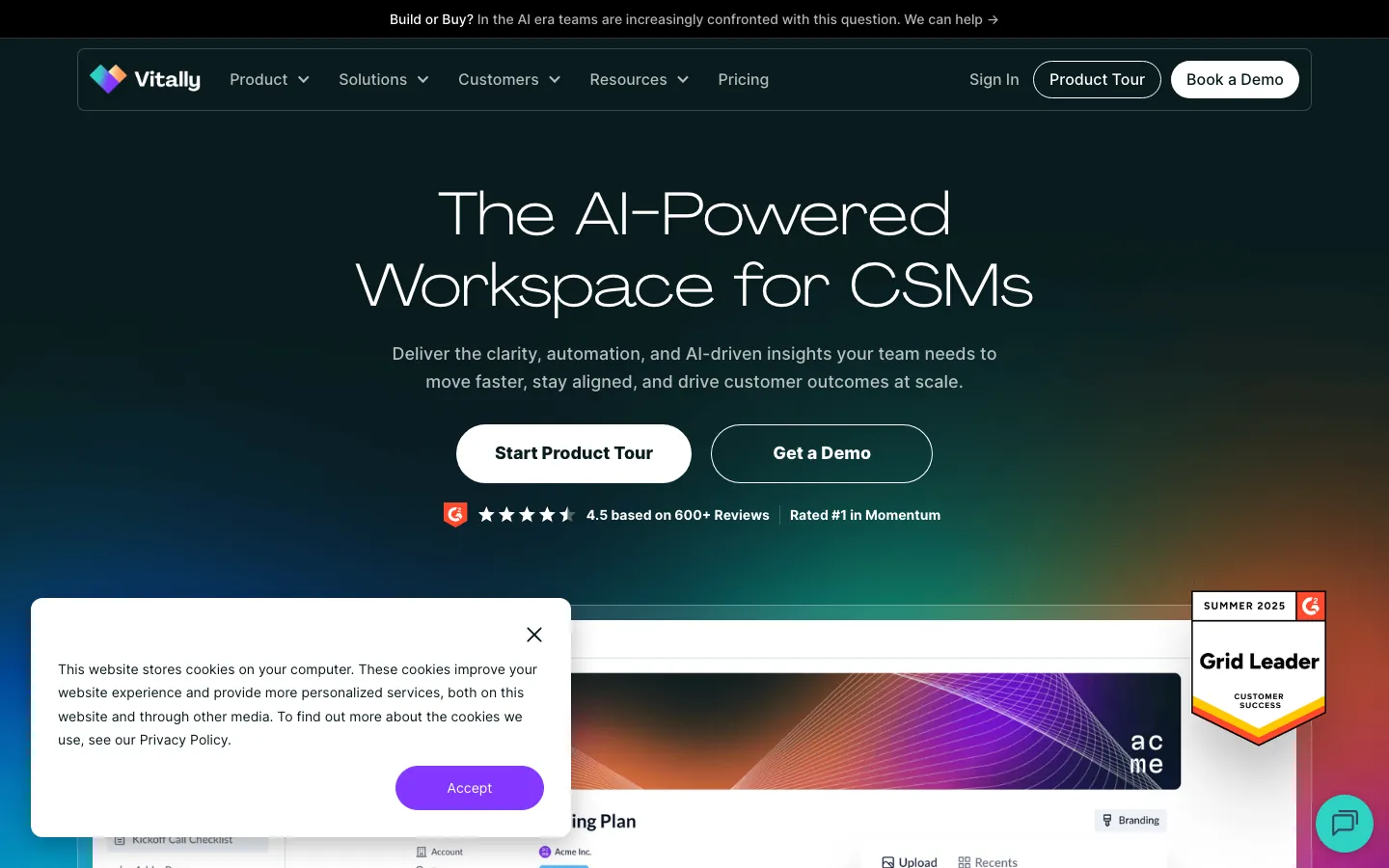
Screenshots of Vitally 3 images
What's great
- Modern consumer-grade UI teams actually want to open every morning; G2 has awarded Vitally 'Best Results' in the CSP category for four consecutive quarters
- 'All Features, All Plans' packaging means zero feature gating; every CSM on any tier gets the same toolset
- Real-time customer 360 view pulling product usage, CRM fields, billing status, and support tickets into one unified workspace
Watch-outs
- AI add-ons are priced above industry norms for the tier; teams that want AI-generated summaries and auto-QBR prep feel the hit
- The Docs feature inside the platform has usability problems that G2 reviewers flag consistently; secondary features feel less polished than the core
- Integration ecosystem is still maturing relative to Gainsight or ChurnZero; edge-case connectors occasionally require custom work
Pricing breakdown
| Plan | Price | Best for |
|---|---|---|
| Tech-Touch | Custom | PLG and digital-touch CS motions |
| Hybrid-Touch | Custom | Mixed high-touch and digital CS |
| High-Touch | Custom | Enterprise one-to-one CS |
| AI Add-on | Custom | Auto-QBR prep |
Loading reviews…
Planhat
Best for NRR-focused orgs, expansion visibility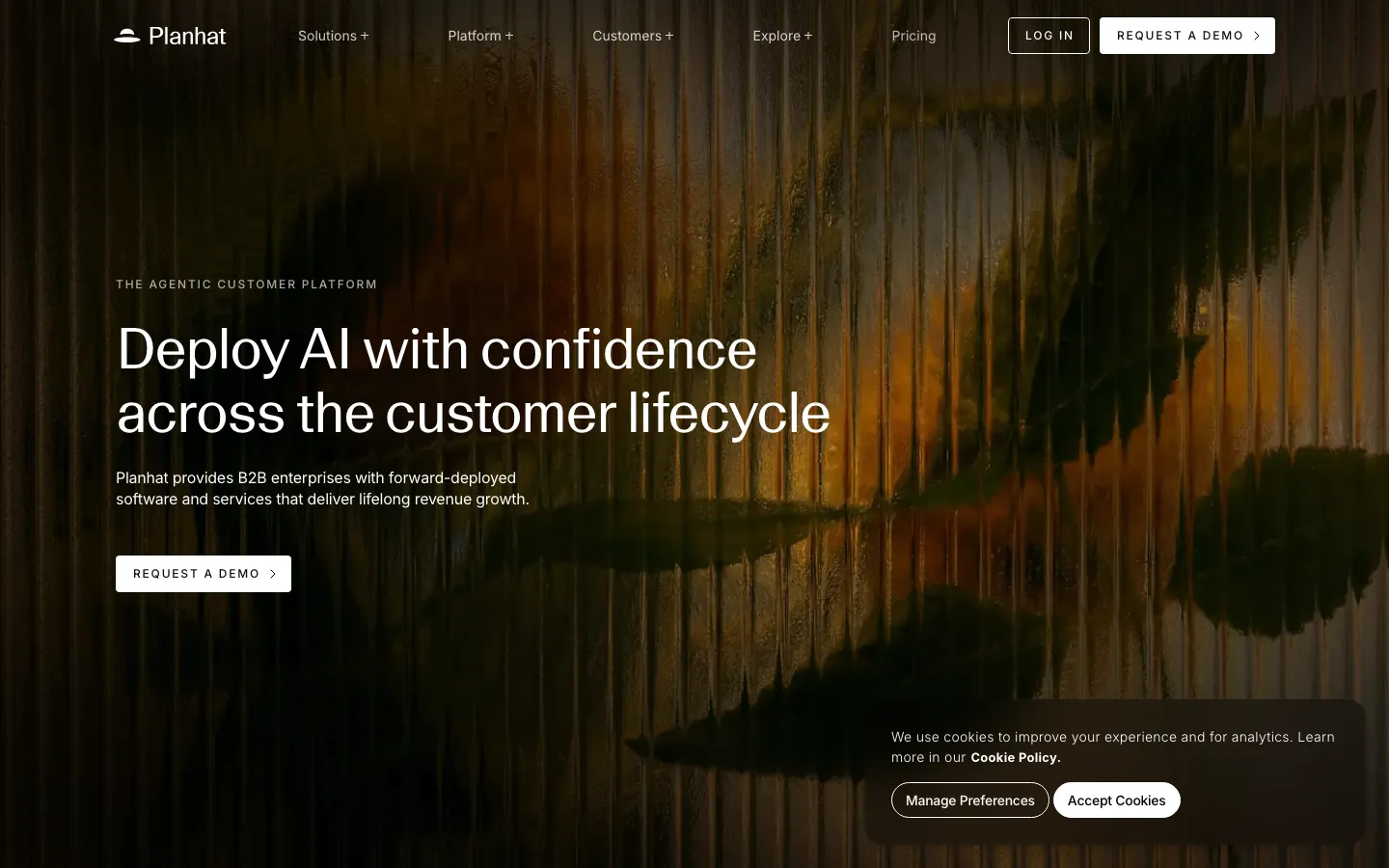
Screenshots of Planhat 3 images
What's great
- Revenue-first data model; Planhat ties customer health directly to ARR, NRR, and expansion opportunity in a way other tools require custom work to achieve
- Custom reporting engine is among the most flexible in the segment; Planhat's renewal forecasting connects to actual contract data without middleware, a reason RevOps teams move to it from Gainsight
- Gartner Magic Quadrant Leader in 2025, a data point that matters for procurement reviews in mid-market and enterprise
Watch-outs
- Data model described by multiple G2 reviewers as 'the most complex I've encountered'; the implementation expects a RevOps or CS Ops partner, not just a project manager
- Documentation lags the product; several G2 reviews in 2025-2026 flag that docs still reference the old UI after major updates
- Integration reliability issues surface at the tail of the connector list; the core Salesforce and HubSpot connections are solid, but third-tier connectors have known bugs
Pricing breakdown
| Plan | Price | Best for |
|---|---|---|
| CRM tier | Custom | Sales and account management overlay |
| CSP tier | Custom | Core customer success workflows |
| PSA tier | Custom | Professional services tracking |
| Full Platform | Custom | CS plus RevOps plus services in one |
Loading reviews…
Totango
Best for usage-driven CS with SuccessBLOC templates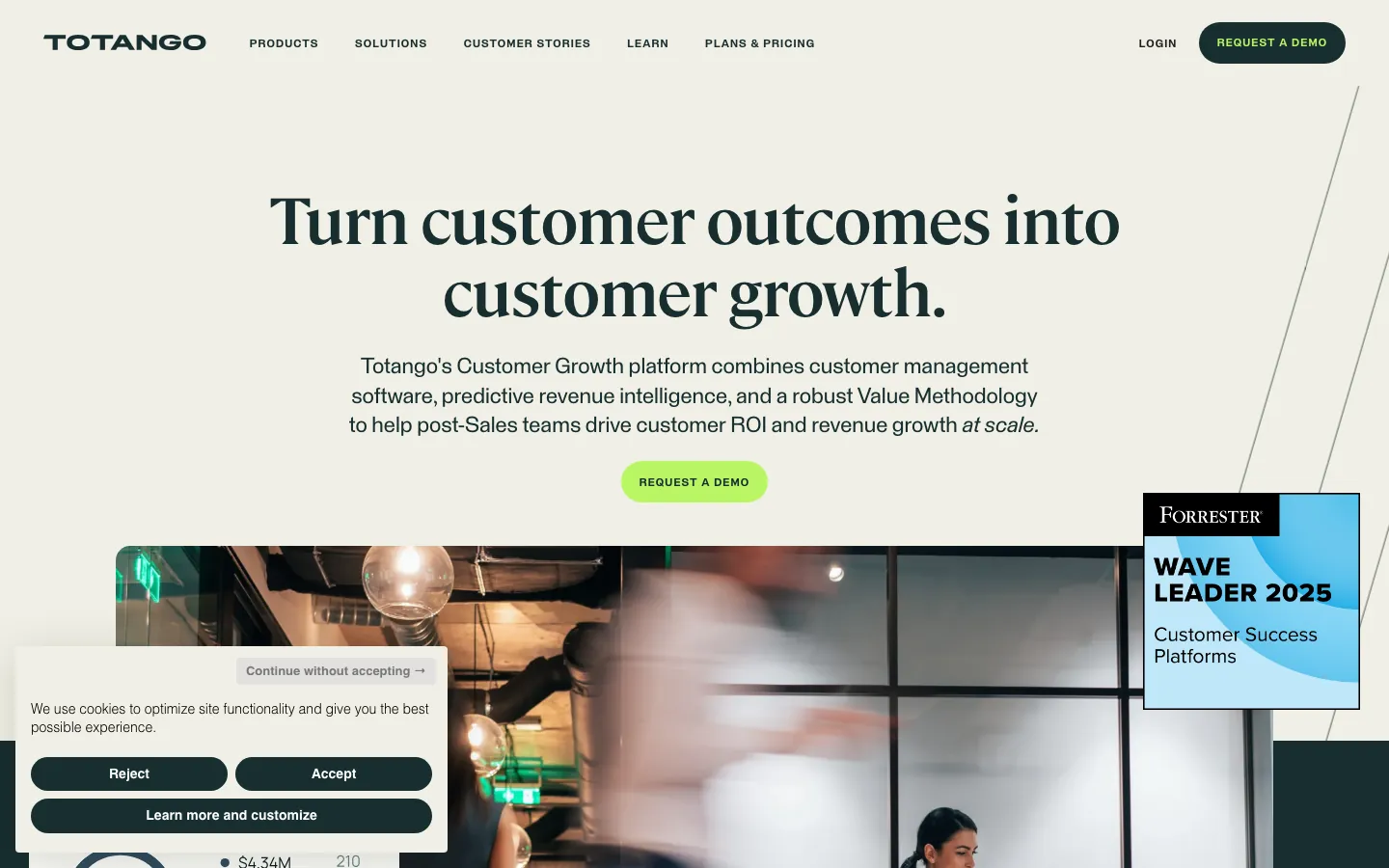
Screenshots of Totango 3 images
What's great
- SuccessBLOC pre-built templates cut initial configuration time in half; onboarding, QBR, renewal, and expansion playbooks come ready to deploy
- Only platform in this guide with a free Starter tier (2 users, 100 accounts), letting teams validate workflows before paying
- Now includes Catalyst (acquired in 2023), adding customer growth intelligence and expansion signal detection to the core CS workflows
Watch-outs
- Data inconsistencies between filter views and account-level data surface in G2 reviews from 2025-2026; plan to validate health-score outputs against raw data during implementation
- No real-time notifications; Totango runs on daily digest summaries by default, which frustrates CSMs tracking high-risk accounts in active save plays
- Complex parent-child account hierarchies hit walls; enterprise orgs with multi-product customers report missing hierarchy support
Pricing breakdown
| Plan | Price | Best for |
|---|---|---|
| Starter (free) | $0 | 2 users |
| Enterprise | $249/mo | 10 users |
| Premier | Contact sales | 20 users |
| Unison AI | Contact sales | Custom AI churn models |
Loading reviews…
Custify
Best for early CS programs, sub-$10M ARR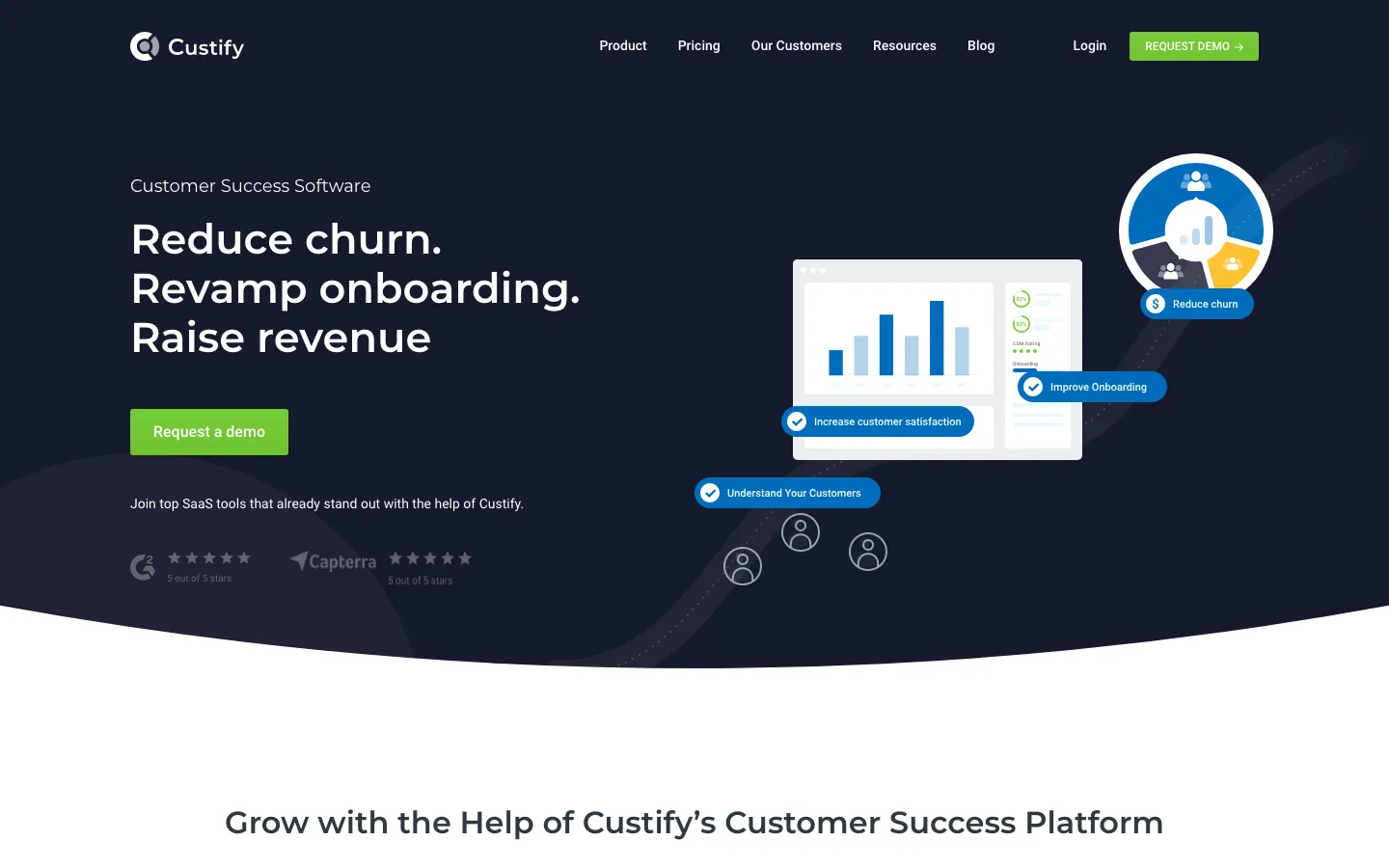
Screenshots of Custify 3 images
What's great
- 4.7/5 on G2, tied with ChurnZero for highest rating in this guide; the review base is smaller but satisfaction is genuinely high
- Slack-based customer support makes the platform feel like a partnership rather than a ticket queue; teams report getting CSM questions answered in under an hour
- One-week deployment is achievable for a 2-3 CSM team on a clean Stripe plus Intercom integration
Watch-outs
- Outgrows around 20-25 CSMs; reporting and workflow complexity start hitting platform limits that require custom workarounds
- Email module sends only; replies and forwards require switching to a native email client, which breaks the single-pane-of-glass experience
- Analytics depth is lighter than Planhat or Gainsight; the CFO who wants cohort retention charts will be frustrated
Pricing breakdown
| Plan | Price | Best for |
|---|---|---|
| Starter | Custom | 1-2 CSMs |
| Growth | Custom | 3-8 CSMs |
| Enterprise | Custom | 8+ CSMs |
| Add-on | Custom | NPS/CSAT survey campaigns |
Loading reviews…
ClientSuccess
Best for relationship-focused CS with simple account structures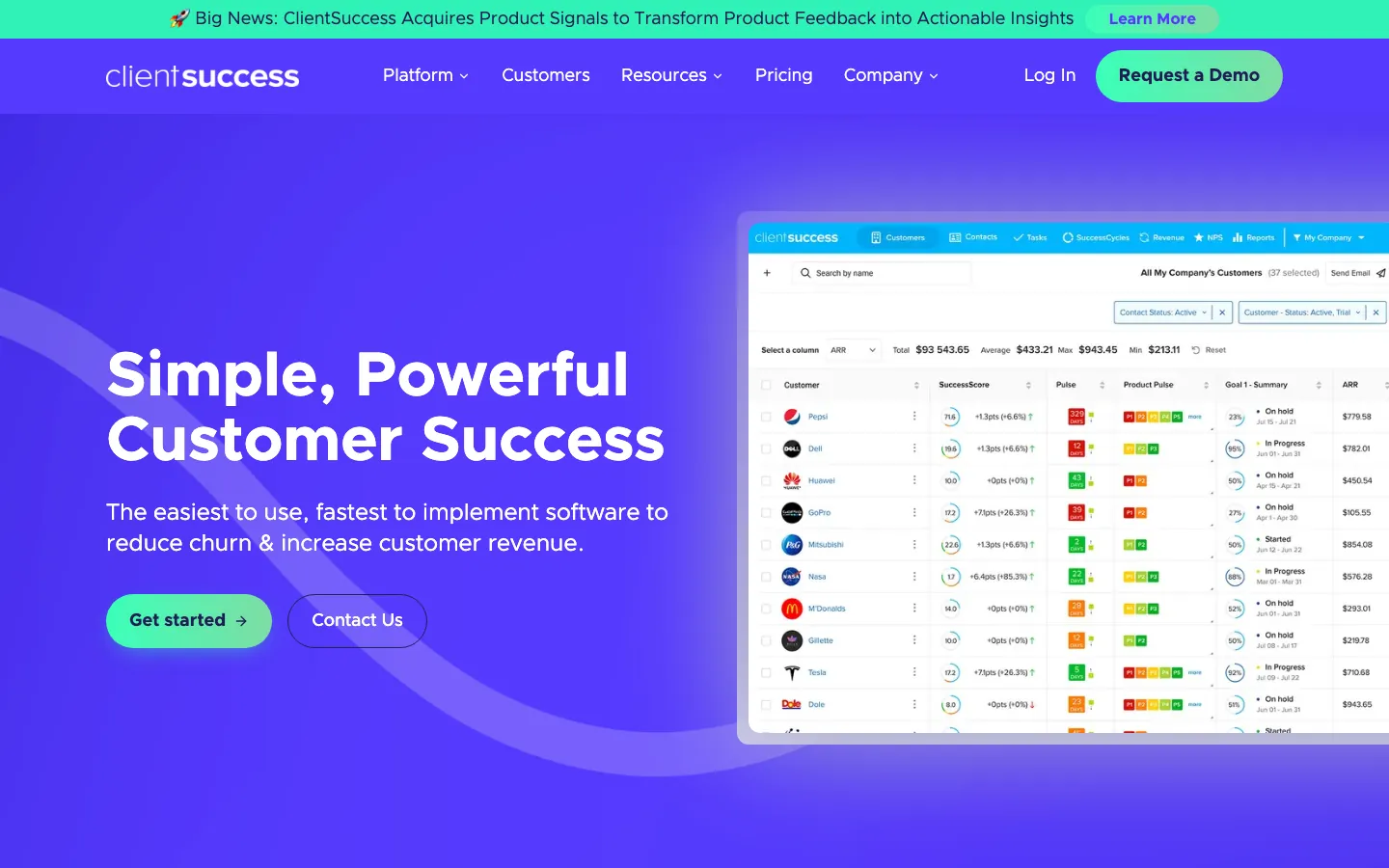
Screenshots of ClientSuccess 3 images
What's great
- Clean visually appealing interface CSMs enjoy using; onboarding is fast because the UX is intuitive rather than feature-dense
- Gmail integration provides inline communication tracking; emails to customers log automatically without manual effort
- 'Pulse' qualitative health score system lets CSMs capture sentiment nuance that pure data-driven scores miss
Watch-outs
- Limited feature depth; teams consistently upgrade to Gainsight or ChurnZero once account complexity outpaces what ClientSuccess can model
- Support consistency has been a G2 complaint in recent reviews; multiple accounts report high CSM turnover at the vendor level
- No bulk CSV upload for historical data; relies on support tickets for data imports, which slows migration and frustrates RevOps
Pricing breakdown
| Plan | Price | Best for |
|---|---|---|
| Startup | Custom | Up to 10 licenses |
| Growth | Custom | Up to 50 licenses |
| Enterprise | Custom | Unlimited licenses and customers |
| Add-on | Custom | Custom dashboards |
Loading reviews…
HubSpot Service Hub
Best for HubSpot-native teams adding CS workflows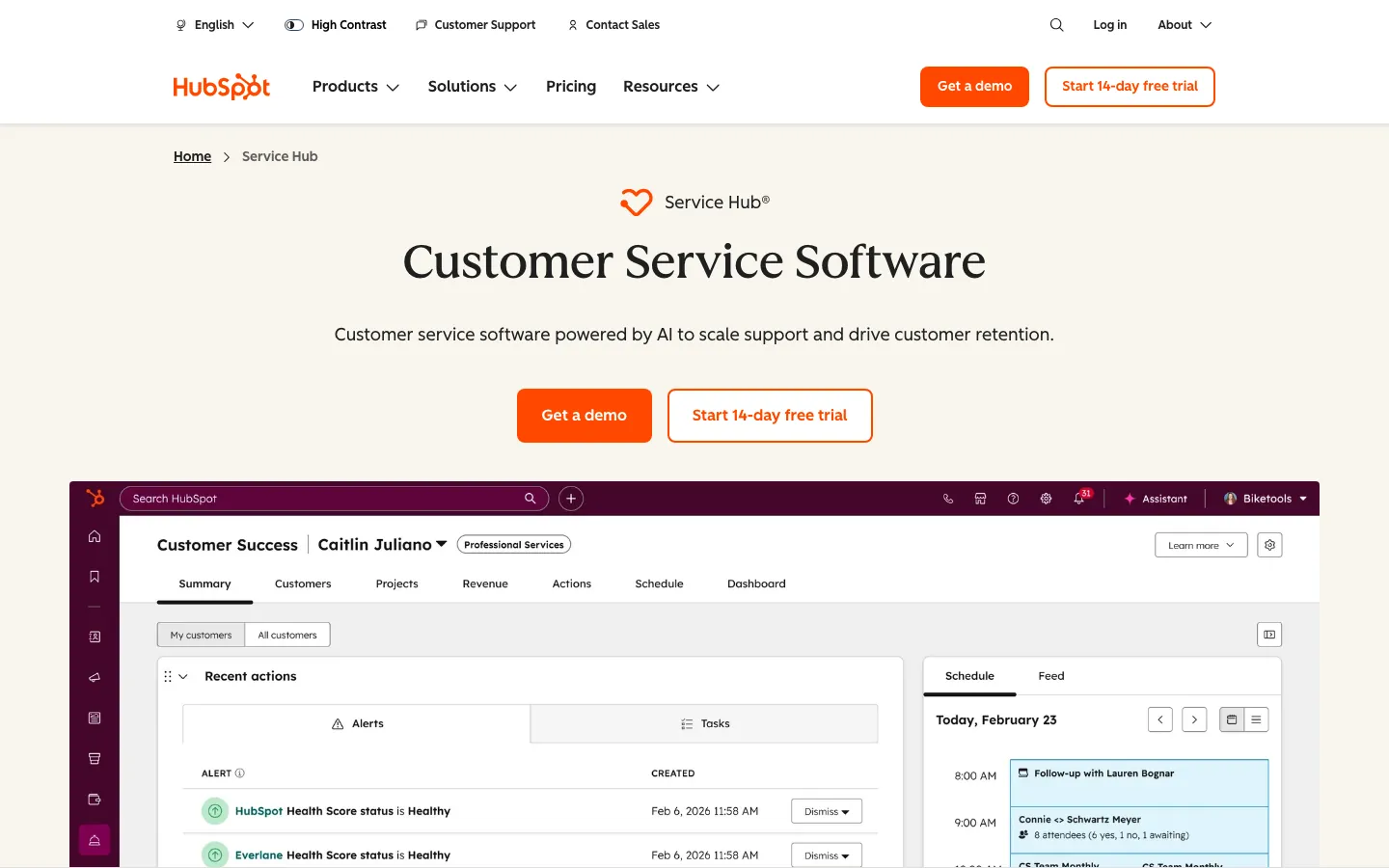
Screenshots of HubSpot Service Hub 3 images
What's great
- Full native CRM integration; the customer record in Service Hub is the same object as the deal in Sales Hub, no sync middleware or field mapping required
- Customer Success Workspace launched in 2025 adds health scoring, playbook-style task lists, and renewal tracking directly into the HubSpot interface
- Honest transparent pricing: Starter at $15/seat/mo, Pro at $90/seat/mo, no hidden platform fees at the base tier
Watch-outs
- Feature depth is lighter than dedicated CS platforms; health scoring logic is simpler, playbooks lack the conditional branching of Gainsight or ChurnZero
- Pro tier pricing climbs fast at scale; 15 CSMs on Pro runs $1,350/mo before onboarding fees, more expensive than ChurnZero at the same seat count
- G2 reviewers call the ticketing UI 'messy and unintuitive'; HubSpot's strength is the CRM layer, not the service tooling
Pricing breakdown
| Plan | Price | Best for |
|---|---|---|
| Free | $0 | Basic ticketing and knowledge base |
| Starter | $15/seat/mo | Small teams |
| Professional | $90/seat/mo + $1.5K onboarding | CS Workspace |
| Enterprise | $150/seat/mo + $3.5K onboarding | 15+ CSMs |
What reviewers say about HubSpot Service Hub
Recurring themes across ~13,800 G2 reviews (4.4/5) and ~12,000 Capterra reviews (4.5/5), 2024-2026.
What reviewers praise
- Reviewers consistently call the interface the easiest to learn in the category; new reps are productive in days, not weeks.
- The free tier comes up again and again as genuinely usable, unlimited contacts and basic CRM at no cost, which is rare in this segment.
- Sales and marketing living in one platform is the most-cited reason teams pick it, with clean handoff between Marketing Hub and Sales Hub.
- The App Marketplace breadth (1,500+ integrations) is praised for connecting to almost any stack without custom work.
- Reporting and dashboards get strong marks for being readable and configurable without an admin or a consultant.
What reviewers fault
- The upgrade cliff is the single most common gripe: jumping from Starter to Professional roughly 5x's the per-seat cost and many features sit behind it.
- Marketing Hub's $890/mo flat Professional pricing surprises buyers who only saw per-seat numbers in the demo.
- Mandatory onboarding fees ($1,500 Pro, $3,500 Enterprise) are repeatedly flagged as an unexpected year-one cost.
- Contact-tier pricing means marketing costs scale with your database, and reviewers say cleanup is painful once you're locked in.
- Support quality on lower tiers draws complaints; several reviewers say real help requires a paid tier or a partner agency.
Loading reviews…
Tools we considered but excluded
We evaluated more tools than the 8 you see above. These did not make the cut. Saying what we rejected, and why, is the editorial muscle most listicles skip.
- Catalyst: Acquired by Totango in 2023 and merged into the platform; no longer a standalone product
- Pendo: Product analytics and in-app guides are its core, the CS overlay is thin and best used as a Gainsight or Vitally integration rather than a standalone CS platform
- Staircase AI by Gainsight: An intelligent layer on top of existing CS platforms, not a standalone CSP; great add-on but doesn't replace the platforms in this list
- Intercom: In-app messaging and support platform that overlaps with CS but lacks health scoring, renewal forecasting, and CSM workflow tooling
- Freshdesk Customer Success: Freshworks CS module is lightweight and works best as a Freshdesk add-on; standalone against ChurnZero or Custify it falls short on depth
- Salesforce Success Cloud: Requires Salesforce admin investment that the mid-market CS teams in this guide rarely have; AppExchange CS solutions exist but add complexity
Honorable mentions
Solid tools that did not crack the main list but are worth tracking, especially for niche use cases.
- Velaris: 4.6/5 on G2 with AI-generated summaries and automated enrichment; worth watching for Series B teams wanting a modern alternative to ChurnZero
- Hook: Predictive analytics-first approach for data-driven CS teams; minimal configuration makes it interesting for PLG orgs with strong data infrastructure
- Staircase AI by Gainsight: If you're already on Gainsight or Vitally, the AI signal layer reduces manual health-score maintenance meaningfully
The five segments of the customer success platform market
The customer success platform market looks deceptively uniform on the surface; every vendor sells “health scoring, playbooks, and renewal management.” The actual differences are in architecture, deployment weight, and who on the team drives adoption day-to-day.
Four practical sub-categories explain why teams end up on very different tools despite similar job descriptions.
Enterprise CS platforms. Gainsight and Planhat sit here. Wide feature sets, Salesforce-deep integrations, implementation projects that run a full quarter. The right pick when CS Ops is a function, not a side job.
Mid-market CS platforms. ChurnZero and Vitally are the best current representatives. Fast enough to deploy in 4-8 weeks, deep enough to run a 10-CSM team for two or three years before hitting platform limits. The right pick for $10M-$75M ARR SaaS with a serious CS program.
Early-stage CS tools. Custify and ClientSuccess. Two CSMs, a few hundred accounts, and a team that needs to get operational in days, not quarters. The right pick before CS Ops is a job title.
CRM-overlay CS. HubSpot Service Hub. The right pick when your team already runs HubSpot and you want to avoid the overhead of a second platform, even if that means lighter depth. The same Service Hub anchors our customer service software roundup , since it doubles as a support desk for the ticket side of the post-sale relationship.
Usage-data-first CS. Totango, and to some degree Vitally. Built around product usage signals as the primary health input rather than CSM-entered data. The right pick for PLG companies and product-led B2B where usage predicts renewal better than any qualitative CSM assessment.
The eight tools in this guide cover all five segments. The section order below goes data-first because shortlist-phase CS buyers need the feature and compliance tables before they read the narrative.
Where the eight CS platforms differ on core features
Five capabilities buyers ask about most, across all eight platforms.
| Tool | Health Scoring | Playbook Automation | In-App Messaging | NRR Forecasting | Free/Trial |
|---|---|---|---|---|---|
| Gainsight | ✓ multi-signal | ✓ advanced | $ add-on | ✓ | Demo only |
| ChurnZero | ✓ ChurnScore | ✓ Journeys | ✓ included | • limited | Demo only |
| Vitally | ✓ multi-source | ✓ | $ add-on | • | Demo only |
| Planhat | ✓ custom model | ✓ | • | ✓ deep | Demo only |
| Totango | ✓ SuccessBLOC | ✓ templates | ✓ | • | ✓ Free tier |
| Custify | ✓ | ✓ | ✓ | ✗ | Demo only |
| ClientSuccess | ✓ Pulse | • limited | ✗ | ✗ | Demo only |
| HubSpot Service Hub | • basic | • limited | ✓ | ✗ | ✓ Free + trial |
ChurnZero’s in-app messaging being included rather than an add-on is the most underrated item in this table; it removes a separate Intercom or Pendo line item for many mid-market teams. Gainsight’s NRR forecasting depth sits alone at the top. Totango and HubSpot are the only two tools with self-serve entry points.
CS platform security and compliance, tier by tier
Enterprise IT will ask every one of these questions before signing. CS platforms hold customer PII, product usage data, and financial information, so the bar is high.
| Tool | SOC 2 Type II | GDPR | HIPAA | SSO/SAML | Audit Logs |
|---|---|---|---|---|---|
| Gainsight | ✓ | ✓ | ✓ | ✓ all tiers | ✓ |
| ChurnZero | ✓ | ✓ | $ available | Enterprise | ✓ |
| Vitally | ✓ | ✓ | • check vendor | Enterprise | ✓ |
| Planhat | ✓ | ✓ | • check vendor | ✓ all tiers | ✓ |
| Totango | ✓ | ✓ | ✗ | Enterprise | ✓ |
| Custify | ✓ | ✓ | ✗ | Enterprise | • limited |
| ClientSuccess | ✓ | ✓ | ✗ | Enterprise | • limited |
| HubSpot Service Hub | ✓ | ✓ | $ add-on | Enterprise | Enterprise |
Gainsight and Planhat are the cleanest enterprise IT passes. HIPAA coverage is rare in this category; if you’re in healthcare SaaS, Gainsight is effectively the only enterprise CS option. Custify and ClientSuccess are solid for SOC 2 and GDPR but are not the right call for regulated-industry customers.
Integration depth across the CS stack
The five integrations that decide whether a CS platform fits your actual workflow.
| Tool | Salesforce | HubSpot CRM | Slack | Billing (Stripe/Chargebee) | Product Usage API |
|---|---|---|---|---|---|
| Gainsight | N native | M | N | N | N |
| ChurnZero | N native | N | N | N | N |
| Vitally | N native | N | N | N | N |
| Planhat | N native | N | N | N | N |
| Totango | N native | M | N | N | N |
| Custify | N native | N | N | N | N |
| ClientSuccess | N native | M | M | M | M |
| HubSpot Service Hub | M | N native | N | M | ✗ |
N = native first-party. M = marketplace or third-party. All eight tools have native Salesforce connectors (ClientSuccess’s is lighter).
The gap that surprises teams most is product usage data; every tool claims it but ChurnZero, Vitally, and Planhat have the deepest API coverage for pulling raw event data into health scores without a data warehouse intermediary.
HubSpot Service Hub has no native product-usage-API layer; that’s the clearest argument for a dedicated CS platform once your team matures.
Health-score architecture
This is the section nobody puts in a demo deck but it’s the one decision that decides whether your health scores predict renewals 90 days out or just describe what already happened.
Every CS platform supports health scoring, but the underlying architecture varies in ways that matter. There are three patterns.
Rule-based scoring. A weighted average of inputs you define: product logins (weight 30%), support tickets open (weight -20%), NPS score (weight 25%), and so on. Easy to understand, easy to explain to a board. Gainsight, ChurnZero, and Custify all support this. The limitation is that the weights are your guess; you’re mapping assumptions, not data.
Machine-learning scoring. The platform trains a model on your historical renewals and churn events and surfaces probability scores. Gainsight’s Adoption Explorer and ChurnZero’s predictive ChurnScore both do this once you have enough history. You need 12-18 months of data and at least 30-40 churn events for the model to produce meaningful predictions. Below that, it’s a dressed-up average.
Usage-signal-first scoring. Totango and Vitally are built around this approach. Rather than starting with a blank health card, the platform ingests raw product-event data and surfaces the signals most correlated with renewal in your specific product. Requires a product instrumentation investment upfront; pays back in health scores that CSMs trust rather than debate.
The teams whose health scores actually change behavior at renewal time are usually the ones who built their model in the third pattern. The rule-based approach gets teams productive quickly. The ML approach needs 18 months. The usage-signal approach needs a working Segment or Rudderstack pipeline.
Pick the scoring architecture before picking the vendor. The right tool for rule-based is different from the right tool for usage-first.
Onboarding-to-CS handoff
This is the silent process gap that burns more retention than bad health scoring. The handoff from the Sales or Onboarding team to the CSM is where the customer experience breaks, and most CS platforms are complicit in keeping it broken.
The typical failure pattern looks like this: deal closes in Salesforce, gets marked as Closed Won, and someone creates a CS account record by hand. The CSM gets an email with a PDF of the contract.
They don’t know which features were promised during the sales cycle, which pain points drove the deal, or what the customer said their first-year success definition is. Three months later, the QBR is awkward because neither party is sure what was agreed.
Here is what good looks like. Three things need to flow from Sales to CS automatically: the pain points from the opportunity notes, the success criteria from the deal, and the implementation milestones from the onboarding project. Most CS platforms require you to build this handoff manually.
Gainsight and ChurnZero both support automated handoff workflows that pull from Salesforce opportunity fields and trigger a CSM onboarding playbook the moment a contract is countersigned.
Planhat goes a step further; its contract object ties directly to the customer’s NRR motion so the CSM sees at account creation what the renewal math looks like if the customer achieves their stated goals versus falls short.
This single architectural decision is what turns CSM “I didn’t know what they bought” complaints from a recurring issue into a rare exception.
ClientSuccess and Custify do not have automated handoff workflows built in. The handoff is a manual task. For small teams, that’s fine. For any team running more than 30 new customers a quarter, manual handoffs don’t scale and the CS platform choice should reflect that.
If your current CS platform is three months old and the CS team still calls the handoff “terrible,” the problem is almost never the tool. It is a missing Salesforce field, a missing handoff playbook, or a VP of Sales who hasn’t agreed to the process. Fix those first; then the tool will work.
Selection criteria, what to test in your CS platform trial
The pattern of which CS platform trials succeed and which stall is predictable. Eight specific things to test before signing.
One, import 200 real accounts on day one. Not demo data. Take actual customer records with product usage, support ticket history, and billing status. Run the import including custom fields and health-score inputs. If the import takes more than a half-day of work, the day-to-day CSM experience will be worse. Custify handles this in under 90 minutes; Gainsight can stretch to a week if you have complex field mapping.
Two, build a health score against real data. Take your three most important health signals, configure them in the trial environment, and compare the output score to what you already know about three actual accounts, one healthy, one at risk, one recently churned. If the tool’s score matches your intuition on all three, the model is calibrated. If it doesn’t, the weights are wrong or the signal data is bad. This test takes two hours and tells you everything.
Three, time the CSM’s daily workflow. Starting from a blank morning, how many clicks does it take to see today’s tasks, identify the three riskiest accounts, and add a note from a call? Count the clicks. The difference between ChurnZero and a legacy tool can be 8 clicks versus 28. Multiply by five CSMs over a year and that’s hundreds of hours of labor.
Four, run a QBR prep cycle end-to-end. Pick one real account and generate a QBR deck from the platform. Every serious CS tool has a QBR view or export. The test is how much the CSM had to manually add versus what the platform produced. Vitally and Gainsight produce 70-80% of a usable QBR; Custify gets you 40-50%.
Five, test the CRM sync. Send a note from the CS platform and verify it appears on the Salesforce account record. Add a contract field in Salesforce and verify it propagates to the health score. If either sync is asynchronous (hourly batch), confirm the delay is acceptable. Real-time sync matters for save-play motions.
Six, ask about retention of historical data. If you’re migrating from another tool, ask the vendor exactly what data you can import from the old platform. Most migrations lose activity history; plan to keep read-only access to the old system for 12 months.
Seven, request renewal-pricing terms in writing. Ask: what did your average mid-market customer pay in year two versus year one? If the rep won’t give a real range, assume 15-20% uplift. Negotiate a cap before contract.
Eight, find three current customers in your ARR band and call them. Not the references the vendor offers. LinkedIn works. Ask: would you buy this again at full price? The answer gives you what G2 reviews can’t.
How to choose the right customer success platform for your team
Five questions, in order. Answer them and the shortlist shrinks to two tools.
1. CSM headcount, today and in 12 months
- 1-3 CSMs. Custify or ClientSuccess. Don’t buy more platform than the team can use.
- 4-15 CSMs. ChurnZero or Vitally. Both deploy in a reasonable timeline and won’t require a CS Ops hire to run.
- 15-30 CSMs. Gainsight or Planhat. You need the depth and you can justify the implementation project.
- 30+ CSMs. Gainsight. The ecosystem, admin community, and Salesforce integration depth has no equal at this scale.
2. Your primary health-signal source
If your health data lives primarily in Salesforce or HubSpot CRM, any tool in this list works. If your best renewal signals are product usage events in Segment, Amplitude, or Mixpanel, push toward Vitally, Totango, or ChurnZero; their usage-data ingestion is meaningfully better than Gainsight’s at mid-market price points.
3. High-touch, digital-touch, or both
High-touch only: ClientSuccess, ChurnZero, and Gainsight all work well. Digital-touch or hybrid: ChurnZero (Journeys), Totango (SuccessBLOCs), or Vitally (automation). Pure digital-touch at scale with PLG: Totango or Vitally.
4. Your CRM of record
- Salesforce. Any tool in this list has a native connector. Gainsight’s is the deepest.
- HubSpot. ChurnZero, Vitally, Planhat, and HubSpot Service Hub all have first-party integrations. Gainsight’s HubSpot connector lags its Salesforce connector by a version.
- Other CRM. Custify and Vitally have the most flexible connectors for non-Salesforce and non-HubSpot stacks.
5. Acceptable time to go live
- Need to be live in under 2 weeks. Custify or HubSpot Service Hub.
- 4-6 weeks is fine. ChurnZero or Vitally.
- 8-16 weeks is acceptable with dedicated resources. Gainsight or Planhat.
- “We’re flexible.” Run all your finalist trials simultaneously against real data. Decide on CSM satisfaction at day 10.
What a CS platform really costs in year one
CS platforms are sold with custom pricing, which means the list price you see in a blog post is usually the starting point for negotiation, not the final number. Here’s the real math.
| Segment | Published start | Real year-1 all-in |
|---|---|---|
| Custify (2 CSMs, 200 accounts) | ~$500-$1,000/mo | $8,000-$14,000 |
| ClientSuccess Startup | Custom | $12,000-$20,000 |
| Totango Enterprise | $249/mo (2 users) | $6,000-$15,000 |
| ChurnZero (8 CSMs) | Custom | $25,000-$45,000 |
| Vitally (8 CSMs) | Custom | $20,000-$40,000 |
| Planhat (10 CSMs) | Custom | $40,000-$70,000 |
| Gainsight Enterprise (10 CSMs) | Custom | $90,000-$140,000 |
| HubSpot Service Hub Pro (10 seats) | $90/seat/mo | $12,000-$16,500 |
The “real year-1 all-in” includes implementation and configuration services, any professional services for data migration, onboarding fees, and the first-year CSM (yours, not theirs) dedicated to the rollout. The biggest forecast error most CS leaders make is treating the license cost as the full budget.
Implementation for Gainsight alone runs $15,000-$40,000 at a professional services partner. Plan for it in Q4 budget approval, not as a surprise in Q1.
CS platform rollout without breaking CS motions
Most CS platform implementations go sideways not because the tool is wrong, but because the rollout displaces the workflows that were keeping renewals together.
Phase 1 (weeks 1-2): Configuration with two people. Your CS lead and one ops-oriented person. Build health scores against three real accounts, configure the first playbook against one actual workflow (onboarding, QBR, or renewal), and define the field mapping to your CRM. Don’t try to model every motion in week one.
Phase 2 (weeks 3-4): Pilot with two CSMs on live accounts. Your highest-performing CSM and your most process-oriented CSM. Run 15-20 real accounts end-to-end. Fix what breaks. Build a Loom of the five most common CSM tasks. The teams that skip this phase have platforms that go unused by month three.
Phase 3 (weeks 5-8): Full CSM team migration. 30-minute onboarding per CSM. Emphasis on the daily workflow, not the advanced features. The advanced features come later; the daily workflow determines adoption.
Phase 4 (weeks 9-12): Decommission the old tool and lock the schema. Export all historical data. Keep read-only access for 12 months. Lock the custom-field schema; adding new fields post-launch creates CSM confusion and empty data columns.
The consistent failure mode is teams that migrate all accounts on day one without a pilot. The platform is live, the CSMs are overwhelmed, and someone reinstates the spreadsheet by week four. Pilot first, always.
What’s changing in customer success software in 2026
AI is moving from feature to architecture. The platforms shipping AI as a summarization button in 2024 are now restructuring the product around AI agents that auto-update health scores, draft QBR slides, and flag at-risk accounts before the CSM opens their morning queue. ChurnZero’s AI launch in late 2025 and Gainsight’s Copilot rollout both represent this shift from AI as a nice-to-have to AI as the main workflow driver.
Digital-touch CS is becoming the default for sub-$5K ACV accounts. The economics don’t support human CSM coverage below a certain ACV, and every platform in this list now ships journey automation tools that let a single CSM manage 200+ accounts through automated check-ins, usage-triggered alerts, and self-service portals. ChurnZero’s Journeys and Totango’s SuccessBLOC templates are the most mature implementations.
CS platforms are absorbing product analytics. The line between CS platform and product analytics tool is blurring. Gainsight PX, Vitally’s usage ingestion, and Totango’s event-based health scoring are all moving in the direction of owning the product-data layer that used to belong to Amplitude or Mixpanel. For CS teams, this means one fewer vendor. For product teams, it means a new stakeholder claiming budget ownership.
Totango-Catalyst integration matures. The 2023 acquisition of Catalyst gave Totango an expansion-signal layer it was missing. Through 2026, the combined platform is shipping deeper NRR forecasting that narrows the gap with Planhat on the revenue-intelligence side.
Pricing pressure is compressing the mid-market. ChurnZero, Vitally, and Planhat are all fighting for the same $20M-$75M ARR SaaS sweet spot. Buyers in that range have real negotiating power in 2026; multi-year discounts of 15-25% are available if you ask before the end-of-quarter push.
The right CS platform by funding stage and ARR band
- Pre-seed and seed, 1-2 CSMs under $3M ARR: A structured Notion workspace or Airtable. Spending on a CS platform this early is a distraction.
- Seed to Series A, 2-4 CSMs, $3M-$10M ARR: Custify. Honest pricing, one-week deployment, and Slack-based support that punches above its weight.
- Series A, 4-10 CSMs, $10M-$30M ARR: ChurnZero or Vitally. ChurnZero if your CRM is Salesforce and you need in-app messaging. Vitally if your CS leader cares about platform UX and your data infrastructure supports API-driven health scoring.
- Series B, 10-20 CSMs, $30M-$75M ARR: ChurnZero, Vitally, or Planhat. Planhat if NRR reporting is a board-level agenda item.
- Series C+, 20+ CSMs, $75M+ ARR: Gainsight. The implementation cost is real, but the platform depth and admin community have no peer at this scale.
- PLG-heavy motion at any stage: Totango or Vitally. The usage-data ingestion is the deciding factor.
- Already deep in HubSpot: HubSpot Service Hub. Don’t add a second platform until the CS team hits 10+ CSMs and needs playbook depth Service Hub doesn’t provide.
- European or multi-region teams with data residency requirements: Planhat. Built with European data compliance as a first-class concern.
- High-touch relationship CS with simple account structures: ClientSuccess. The Gmail integration and Pulse system fit exactly this motion.
If your shortlist is still three tools after reading this, run 14-day trials against real data simultaneously. Decide on CSM satisfaction at day 10, not on the demo deck. The right platform is the one your CSMs open first thing every morning without being reminded.
For corrections, vendor pricing updates, or methodology questions, email hello@topickz.com . We re-test the full shortlist every six months; the next refresh ships in November 2026.
Frequently asked questions
When should we buy a dedicated CS platform?
Once you have 3 CSMs and $5M ARR, or when renewals start surprising you. Below that, Notion or Airtable covers most needs at zero cost.
How long does CS platform implementation take?
Custify and ClientSuccess deploy in 1-2 weeks. ChurnZero and Vitally take 4-8 weeks. Gainsight and Planhat run 8-16 weeks minimum.
Do CS platforms actually reduce churn?
Yes, when paired with real CSM workflows. Health scoring plus playbook discipline typically drops gross churn 1-3 points in year one.
Gainsight vs ChurnZero, which one wins?
Gainsight for 10+ CSMs with CS Ops support at $50M+ ARR. ChurnZero for 3-15 CSMs, faster deployment, and mid-market fit. Stage drives the decision.
What does a CS platform actually cost all-in?
Custify starts around $1K/mo. ChurnZero runs $12K-$40K/yr. Gainsight all-in lands $90K-$140K for 10 CSMs including implementation.
Can HubSpot Service Hub replace a dedicated CS platform?
For sub-10-CSM teams already on HubSpot CRM, yes. Past that, ChurnZero or Vitally win on depth and CSM workflow tooling.
What is a customer health score and how do we build one?
A weighted composite of product usage, support tickets, NPS, billing health, and engagement. Start with 3-5 signals before expanding.
Should CS own renewals or should sales own them?
Above $50K ACV, sales usually does. Below that, CS. The split that breaks things is shared ownership without a named DRI.
How do CS platforms integrate with CRMs?
All 8 tools have native Salesforce connectors. Vitally, Planhat, and ChurnZero also support HubSpot natively. Most sync bidirectionally via webhooks.
Which CS platform has the best free tier or trial?
Totango is the only platform with a genuine free tier (2 users, 100 accounts). HubSpot Service Hub has a free tier for basic ticketing only.
Related helpful reads
Write a review
Posts to the page right away. Keep it real — no links or email addresses.