
Best CRM software for 1-10 employees (1-5 reps)?
- HubSpot Sales Hub
The Free tier covers unlimited contacts and 5 deal pipelines at $0, built for under-5-rep teams. Upgrade to Starter at $20/seat/mo once you add reps.
- Pipedrive
Essential tier at $14/user/mo is scoped for 1-5 reps. Reps are active by day 3 of the trial, no ramp-up needed at this size.
- Less Annoying CRM
Flat $15/user/mo at any team size, every feature included from rep one. No tier to outgrow into.
Best CRM software for 11-50 employees (10-50 reps)?
- HubSpot Sales Hub
Professional tier ($100/seat/mo) is built for 15-50 reps with sequences. Overall best pick for sub-200-rep teams per our testing.
- Pipedrive
Professional tier ($59/user/mo) covers 15-30 reps, the range where most Series A to B sales-led teams sit.
- Zoho CRM
Professional tier ($23/user/mo) fits 15-50 reps with workflow automation included, the most features per dollar in this range.
Best CRM software for 51-200 employees (50-200 reps)?
- HubSpot Sales Hub
Enterprise tier ($150/seat/mo) is built for 50+ reps and multi-team setups. Still the overall pick through 200 reps.
- Salesforce Sales Cloud
Enterprise tier ($175/user/mo) is scoped for 50-300 reps with custom workflows, the point where Salesforce's customization starts paying off.
- Zoho CRM
Enterprise tier ($40/user/mo) covers 50-150 reps with multi-currency support, the budget option at this size.
Best CRM software for 201-1,000 employees (200-500 reps)?
- Salesforce Sales Cloud
Rated best enterprise CRM for 200+ reps in our testing. Unmatched customization, though real year-1 cost runs 3-5x the sticker price once you add an admin and implementation partner.
- Microsoft Dynamics 365 Sales
Sales Enterprise tier ($105/user/mo) is built for 100-500 reps. The right call if you're already a Microsoft 365 shop with an Enterprise Agreement.
- NetSuite CRM
Built for ERP-connected mid-market companies running CRM and ERP on one platform, with partner-led implementation typically $10K-$80K one-time.
Best CRM software for 1,000+ employees?
- Salesforce Sales Cloud
Unlimited / Agentforce 1 tier ($350-$550/user/mo) is scoped for 300+ reps or AI-native orgs. The default enterprise pick once you're past 500 reps.
- Microsoft Dynamics 365 Sales
Sales + Copilot tier runs on custom EA pricing for 1,000+ rep, multi-org enterprises already standardized on Microsoft 365.
Think your brand belongs on this list? Email hello@topickz.com for an editorial review.
Comparing the best CRM Software of 2026 includes 1. HubSpot Sales Hub 2. Pipedrive 3. Salesforce Sales Cloud 4. Close 5. Freshsales 6. Zoho CRM 7. Copper CRM 8. Monday Sales CRM 9. Microsoft Dynamics 365 Sales 10. Attio 11. Salesflare 12. Less Annoying CRM 13. Nutshell 14. Capsule CRM 15. Streak CRM 16. Salesmate 17. OnePageCRM 18. EngageBay 19. GoHighLevel 20. NetSuite CRM.
TL;DR
- HubSpot Sales Hub: Best overall for sub-200-rep teams. You get the most generous free tier in the segment, but watch the Marketing Hub Pro cliff at $890/mo flat.
- Pipedrive: Best for sub-30-rep teams. Your reps are active by day 3 of the trial, and the tier pricing you see published is what you pay.
- Salesforce Sales Cloud: Best enterprise CRM for 200+ reps. Customization is unmatched, but your real year-1 cost lands at 3-5x the sticker price.
- Close: Best for outbound-heavy teams. It is the only CRM here with a native Power Dialer, SMS, and email cadences, and its 4.7/5 across 2,040 G2 reviews is the highest rating in this guide.
- Freshsales: Best AI-bundled budget pick. Freddy AI ships included at $9/user/mo, the cheapest AI-bundled CRM in the segment, though the Pro tier jumps 4x to $39.
Twenty CRMs compared on pricing, real review themes, and feature depth. What scales, what choked, what costs 3x its sticker price after the first renewal, and the pick for your team size, motion, and ecosystem.
What Is CRM software?
CRM software helps sales and marketing teams manage contacts, track deals, and automate follow-ups, centralizing every customer interaction so nothing falls through the cracks.
Tools like HubSpot, Pipedrive, Salesforce, and Close differ on automation, customization, reporting, and total cost as your team scales.
Best CRM Software comparison: features, pricing and verdicts
| Tool | Best for | Starting price | Free trial | External rating |
|---|---|---|---|---|
Best overall for sub-200-rep teams | $20/seat/mo | Free + 14-day Pro | G2 4.4/5 (13,808 reviews) | |
Best for sub-30-rep teams, pipeline-first | $14/user/mo | 14-day, no card | G2 4.3/5 (3,047 reviews) | |
Best enterprise CRM (200+ reps) | $25/user/mo | 30-day trial | G2 4.4/5 (25,792 reviews) | |
Best for outbound-heavy teams | $9/user/mo | 14-day free | G2 4.7/5 (2,040 reviews) | |
Best AI-bundled budget pick | $9/user/mo | Free 3 users + 21-day | G2 4.5/5 (1,233 reviews) | |
Best value for SMBs, most features per dollar | $14/user/mo | Free 3 users + 15-day | G2 4.1/5 (2,928 reviews) | |
Best for Google Workspace shops | $9/seat/mo | 14-day free | G2 4.5/5 (1,157 reviews) | |
Best for cross-functional visual teams | $12/user/mo | 14-day free | G2 4.6/5 (1,165 reviews) | |
Best for Microsoft 365 enterprise shops | $65/user/mo | 30-day trial | G2 3.8/5 (1,618 reviews) | |
Best modern CRM for data-driven startups | $29/user/mo | Free up to 3 users | G2 4.3/5 (448 reviews) | |
For B2B teams who hate CRM data entry | $29/user/mo | 30-day free, no card | G2 4.8/5 (298 reviews) | |
For service businesses on a flat-rate budget | $15/user/mo | 30-day free, no card | G2 4.9/5 (662 reviews) | |
For small businesses needing reporting depth | $13/user/mo | 14-day free, no card | G2 4.3/5 (1,427 reviews) | |
For relationship-led sales teams | $18/user/mo | 14-day free | G2 4.7/5 (491 reviews) | |
For Gmail-native sales pipelines | $49/user/mo | Free personal plan | G2 4.5/5 (265 reviews) | |
For growing teams needing built-in calling | $23/user/mo | 15-day free | G2 4.7/5 (114 reviews) | |
For follow-up-heavy outbound teams | $9.95/user/mo | 21-day free, no card | G2 4.7/5 (259 reviews) | |
For HubSpot alternatives at half the price | $11.04/user/mo | Free up to 250 contacts | G2 4.6/5 (683 reviews) | |
For digital agencies and white-label SaaS | $97/mo flat | 14-day free | G2 4.6/5 (638 reviews) | |
For ERP-connected mid-market companies | $129/user/mo | Demo only | G2 4.1/5 (4,775 reviews) |
How we chose these tools
We compared each CRM on published pricing across tiers, the recurring themes in real G2 and Capterra reviews, and hands-on feature checks for the workflows that matter to a growing sales org, lead import, sequencing, integrations, mobile, reporting depth, and data portability via CSV export. We weighed each tool against three rough team profiles, under 30 reps, 30-100 reps, and 200+ reps, to flag where it fits and where it stops scaling. Pricing was verified directly with each vendor in May 2026. All G2 and Capterra ratings cited were pulled on May 28, 2026.
How we weight crm software for the Topickz score
Every tool above is scored against the fixed rubric below and combined using these weights into the Topickz score on each card. The weights are set for crm software specifically, they are not copied from another category, and we publish them so you can see what moved a ranking and re-weight for your own priorities.
| Criterion | Weight | What we checked |
|---|---|---|
| Sales workflow depth | 25% | Lead import, pipeline setup, sequencing and cadences, and how much of a rep's actual day the CRM handles versus punts to another tool. |
| Pricing and total cost | 20% | Per-seat cost by tier, the upgrade cliffs nobody sees in the demo, and the real year-one total once onboarding fees and mandatory add-ons land. |
| Ease of use | 15% | How fast a rep is active in the trial, UI clarity under a full pipeline, and the training load for a new hire in week one. |
| Integrations | 15% | Native email, calendar, and stack connections versus marketplace or Zapier-only links, plus how far the API actually gets you. |
| Reporting and forecasting | 10% | Dashboard flexibility, forecast tooling a sales manager trusts, and how much of it sits behind the next paywall. |
| Scalability | 10% | Whether it holds from 30 reps to 200-plus without a rebuild, custom objects, sandboxes, and real admin controls. |
| Security | 5% | SOC 2, GDPR, SSO/SAML, and audit logs for sales orgs that answer to a security review. |
| Total | 100% |
Read the full TopickZ.com testing methodology for how we run each test, score every criterion, and combine them into a single rating.
Detailed reviews
HubSpot Sales Hub
Best overall for sub-200-rep teams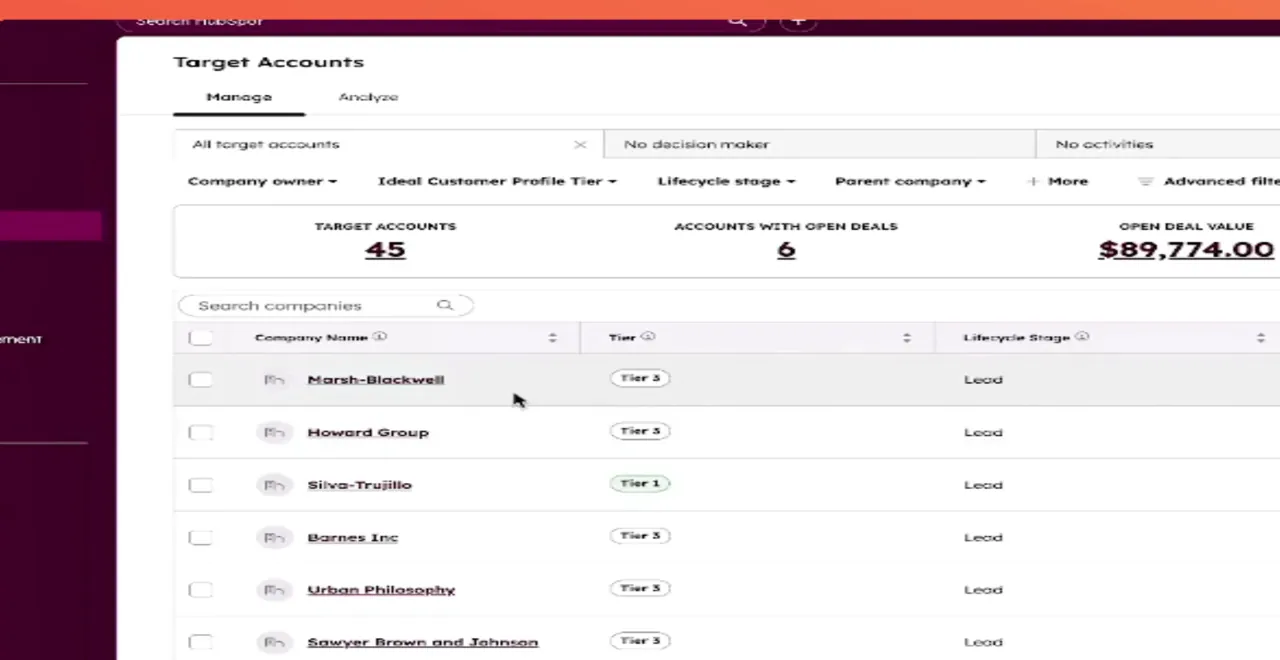
Screenshots of HubSpot Sales Hub 4 images
What's great
- Most generous free tier in the segment (unlimited contacts, 5 deal pipelines, basic sequences)
- Cleanest sales-marketing alignment when paired with Marketing Hub, beats anything Salesforce ships
- 1,500+ integrations across the HubSpot App Marketplace, broadest in CRM
Watch-outs
- Marketing Hub Professional jumps to $890/mo flat (not per-seat), the biggest pricing cliff in segment
- Sales sequences gated behind Pro at $100/seat, Kixie analysis pegs a 5-rep Pro upgrade at $6,500 year-1 with the mandatory $1,500 onboarding fee
- Operations Hub (now Data Hub) Pro adds $720-$800/mo flat for sync features other CRMs include
Pricing breakdown
| Plan | Price | Best for |
|---|---|---|
| Free | $0 | Under 5 reps |
| Starter | $20/seat/mo | 5-15 rep teams |
| Professional | $100/seat/mo + $1.5K onboarding | 15-50 reps with sequences |
| Enterprise | $150/seat/mo + $3.5K onboarding | 50+ reps |
Security & compliance
| Standard | Availability |
|---|---|
| SOC 2 Type II | Yes |
| GDPR | Yes |
| HIPAA | $ add-on |
| SSO / SAML | Enterprise |
| Audit logs | Enterprise |
HubSpot Sales Hub compliance summary: SOC 2 Type II is yes, GDPR is yes, HIPAA is $ add-on, SSO/SAML is enterprise, and audit logs is enterprise.
Key integrations
| Integration | Type |
|---|---|
| Gmail | Native integration |
| Outlook | Native integration |
| Slack | Native integration |
| LinkedIn Sales Navigator | Marketplace add-on |
| Outreach / Salesloft | Marketplace add-on |
HubSpot Sales Hub integration summary: Gmail is native integration, Outlook is native integration, Slack is native integration, LinkedIn Sales Navigator is marketplace add-on, and Outreach or Salesloft is marketplace add-on.
Feature availability
| Feature | Status |
|---|---|
| Free tier | ✓ unlimited contacts |
| AI | Breeze, limited |
| Custom objects | Enterprise |
| Dialer | $ add-on |
| Sandbox | Enterprise |
HubSpot Sales Hub feature availability summary: Free tier (✓ unlimited contacts), AI (Breeze, limited), Custom objects (Enterprise), Dialer ($ add-on), and Sandbox (Enterprise).
What reviewers say about HubSpot Sales Hub
Recurring themes across ~13,800 G2 reviews (4.4/5) and ~12,000 Capterra reviews (4.5/5), 2024-2026.
What reviewers praise
- Reviewers consistently call the interface the easiest to learn in the category; new reps are productive in days, not weeks.
- The free tier comes up again and again as genuinely usable, unlimited contacts and basic CRM at no cost, which is rare in this segment.
- Sales and marketing living in one platform is the most-cited reason teams pick it, with clean handoff between Marketing Hub and Sales Hub.
- The App Marketplace breadth (1,500+ integrations) is praised for connecting to almost any stack without custom work.
- Reporting and dashboards get strong marks for being readable and configurable without an admin or a consultant.
What reviewers fault
- The upgrade cliff is the single most common gripe: jumping from Starter to Professional roughly 5x's the per-seat cost and many features sit behind it.
- Marketing Hub's $890/mo flat Professional pricing surprises buyers who only saw per-seat numbers in the demo.
- Mandatory onboarding fees ($1,500 Pro, $3,500 Enterprise) are repeatedly flagged as an unexpected year-one cost.
- Contact-tier pricing means marketing costs scale with your database, and reviewers say cleanup is painful once you're locked in.
- Support quality on lower tiers draws complaints; several reviewers say real help requires a paid tier or a partner agency.
Loading reviews…
Pipedrive
Best for sub-30-rep teams, pipeline-first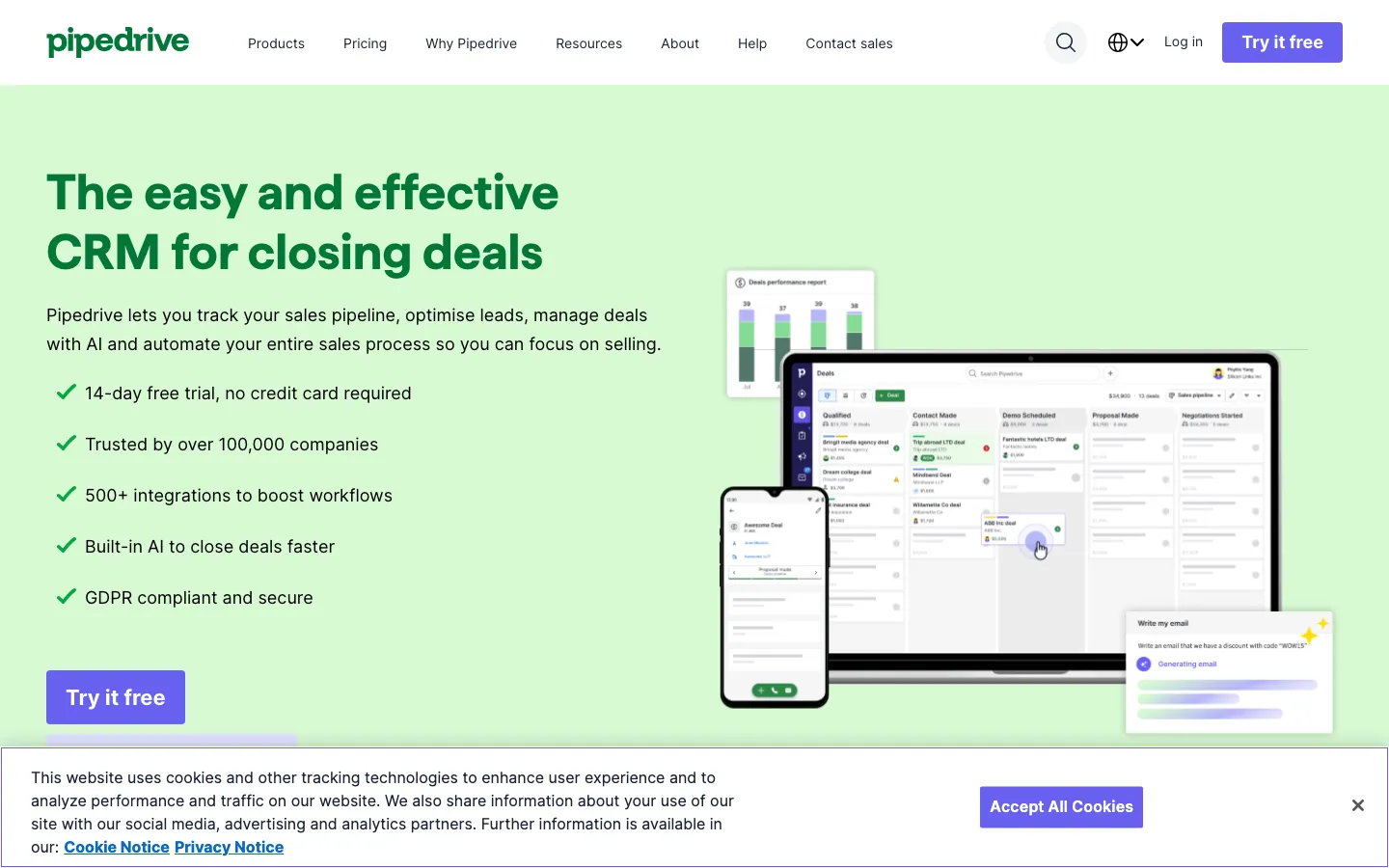
Screenshots of Pipedrive 4 images
What's great
- Fastest onboarding in the segment, we saw reps active by day 3 of the trial
- Visual pipeline-first interface that doesn't need training, the design is the documentation
- Honest tier pricing, what you see in the published comparison is what you pay
Watch-outs
- Lighter reporting than HubSpot or Salesforce, no cohort or DEI analysis
- Marketing automation is bolted on via LeadBooster add-on, not native
- Custom-field limits and reporting gaps surface past 50 reps
Pricing breakdown
| Plan | Price | Best for |
|---|---|---|
| Essential | $14/user/mo | Solo founders |
| Advanced | $29/user/mo | 5-15 rep teams with sequences |
| Professional | $59/user/mo | 15-30 reps |
| Power + Enterprise | $69-$99/user/mo | 30-50 reps |
Security & compliance
| Standard | Availability |
|---|---|
| SOC 2 Type II | Yes |
| GDPR | Yes |
| HIPAA | No |
| SSO / SAML | Enterprise |
| Audit logs | Advanced+ |
Pipedrive compliance summary: SOC 2 Type II is yes, GDPR is yes, HIPAA is no, SSO/SAML is enterprise, and audit logs is advanced+.
Key integrations
| Integration | Type |
|---|---|
| Gmail | Native integration |
| Outlook | Native integration |
| Slack | Native integration |
| LinkedIn Sales Navigator | Marketplace add-on |
| Outreach / Salesloft | Marketplace add-on |
Pipedrive integration summary: Gmail is native integration, Outlook is native integration, Slack is native integration, LinkedIn Sales Navigator is marketplace add-on, and Outreach or Salesloft is marketplace add-on.
Feature availability
| Feature | Status |
|---|---|
| Free tier | ✗ trial only |
| AI | $ LeadBooster |
| Custom objects | Pro+ |
| Dialer | $ add-on |
| Sandbox | Enterprise |
Pipedrive feature availability summary: Free tier (✗ trial only), AI ($ LeadBooster), Custom objects (Pro+), Dialer ($ add-on), and Sandbox (Enterprise).
What reviewers say about Pipedrive
Recurring themes across ~3,000 G2 reviews (4.3/5) and ~3,000 Capterra reviews (4.5/5), 2024-2026.
What reviewers praise
- The visual drag-and-drop pipeline is the standout; reviewers say it makes deal stages obvious at a glance and is the reason they switched.
- Fast setup and a short learning curve come up repeatedly, small teams report being live in an afternoon without onboarding.
- Pricing is seen as fair and transparent for pure sales teams, with the value strongest at the lower tiers.
- Activity-based selling and reminders keep reps on top of follow-ups, a workflow reviewers say actually changes behavior.
- Email sync and the mobile app get good marks for keeping deals updated on the move.
What reviewers fault
- Reporting and analytics are called shallow versus HubSpot or Salesforce once a team needs more than basic dashboards.
- Useful features (automation, email tools, extra pipelines) are gated to higher tiers, so the real cost climbs above the advertised entry price.
- Support is frequently described as slow or email-only, with no phone help on lower plans.
- It's built for sales first, so reviewers needing marketing automation or service features say they outgrow it.
- Add-on costs (LeadBooster, Smart Docs, extra contacts) stack up and surprise teams budgeting from the base seat price.
Loading reviews…
Salesforce Sales Cloud
Best enterprise CRM (200+ reps)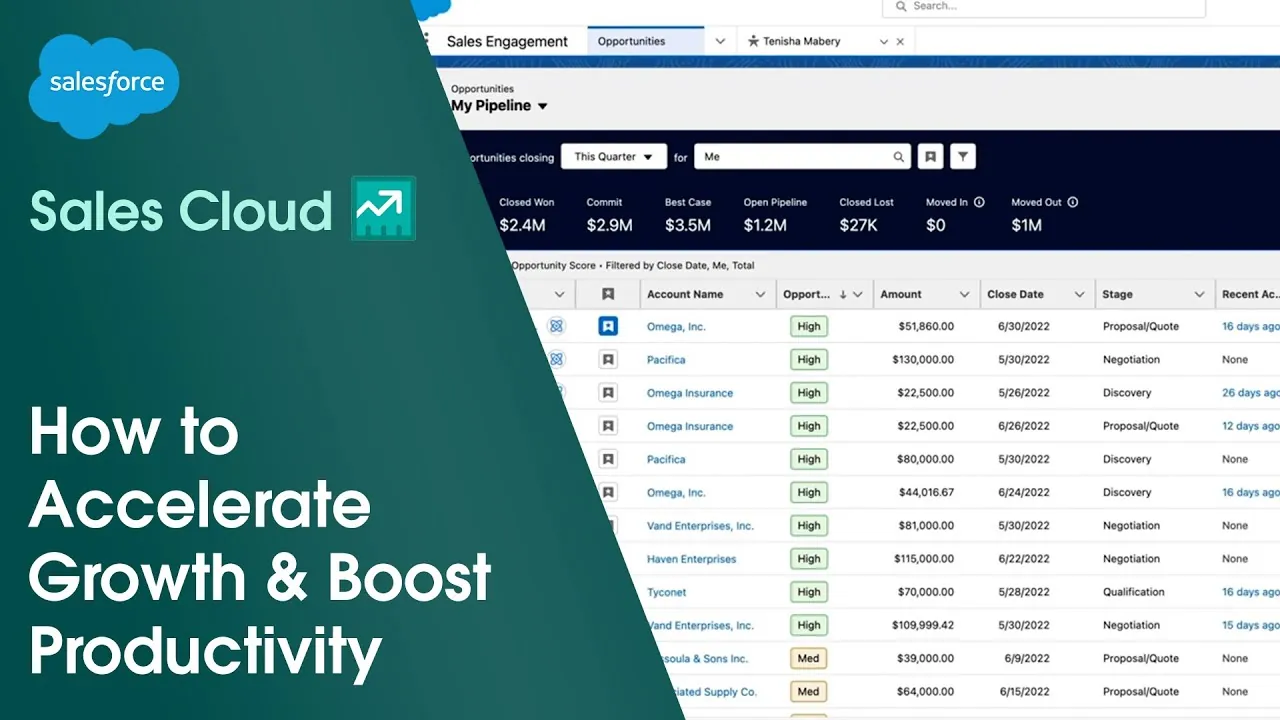
Screenshots of Salesforce Sales Cloud 4 images
What's great
- Most customizable platform in segment, 20.7% global CRM market share for a reason
- Strongest ecosystem, the marketplace rebranded to AgentExchange in 2026 and now ships 10,000+ apps plus 1,000+ prebuilt agents
- Enterprise reporting depth nobody matches, multi-org, complex territory, custom-object math
Watch-outs
- Real year-1 cost is 3-5x sticker once you add the dedicated admin ($120K+/yr), implementation partner, and AppExchange tooling
- Agentforce 1 premium tier sits at $550/user/mo; published Salesforce Ben surveys show 50% of practitioners still call Agentforce "hype, not delivery" in 2026
- Starter Suite at $25 looks competitive but is feature-thin, almost every team lands on Pro ($100) or Enterprise ($175) within 6 months
Pricing breakdown
| Plan | Price | Best for |
|---|---|---|
| Starter Suite | $25/user/mo | Under 10 reps |
| Pro Suite | $100/user/mo | 10-50 reps with reporting needs |
| Enterprise | $175/user/mo | 50-300 reps |
| Unlimited / Agentforce 1 | $350-$550/user/mo | 300+ reps or AI-native |
Security & compliance
| Standard | Availability |
|---|---|
| SOC 2 Type II | Yes |
| GDPR | Yes |
| HIPAA | Yes |
| SSO / SAML | ✓ all tiers |
| Audit logs | Yes |
Salesforce Sales Cloud compliance summary: SOC 2 Type II is yes, GDPR is yes, HIPAA is yes, SSO/SAML is ✓ all tiers, and audit logs is yes.
Key integrations
| Integration | Type |
|---|---|
| Gmail | Native integration |
| Outlook | Native integration |
| Slack | Native integration |
| LinkedIn Sales Navigator | Native integration |
| Outreach / Salesloft | Native integration |
Salesforce Sales Cloud integration summary: Gmail is native integration, Outlook is native integration, Slack is native integration, LinkedIn Sales Navigator is native integration, and Outreach or Salesloft is native integration.
Feature availability
| Feature | Status |
|---|---|
| Free tier | ✗ 30-day trial |
| AI | $ Einstein add-on |
| Custom objects | ✓ all tiers |
| Dialer | $ add-on |
| Sandbox | ✓ all tiers |
Salesforce Sales Cloud feature availability summary: Free tier (✗ 30-day trial), AI ($ Einstein add-on), Custom objects (✓ all tiers), Dialer ($ add-on), and Sandbox (✓ all tiers).
What reviewers say about Salesforce Sales Cloud
Recurring themes across ~25,800 G2 reviews (4.4/5) and ~18,000 Capterra reviews (4.4/5), 2024-2026.
What reviewers praise
- Customization is the most-cited strength; reviewers say you can model almost any sales process and Salesforce will bend to it.
- The AppExchange ecosystem and integration depth are seen as unmatched, nearly every tool a team uses connects.
- It scales with the enterprise, reviewers running large, multi-team orgs say nothing else handles their complexity.
- Reporting and forecasting are praised as powerful and granular once configured by someone who knows the platform.
- Einstein AI and automation features draw positive mentions for surfacing next steps and cutting manual data entry.
What reviewers fault
- Complexity is the dominant complaint, reviewers say it needs a dedicated admin or paid consultant to set up and maintain.
- Total cost is repeatedly flagged: per-seat pricing plus add-ons, sandboxes, and implementation make it the most expensive option.
- The learning curve is steep and reps resist adoption without serious training, a recurring theme in negative reviews.
- The interface feels dated and cluttered to many reviewers compared with newer, lighter CRMs.
- Support is criticized as slow or tiered behind premium plans, with basic support seen as inadequate for the price.
Loading reviews…
Close
Best for outbound-heavy teams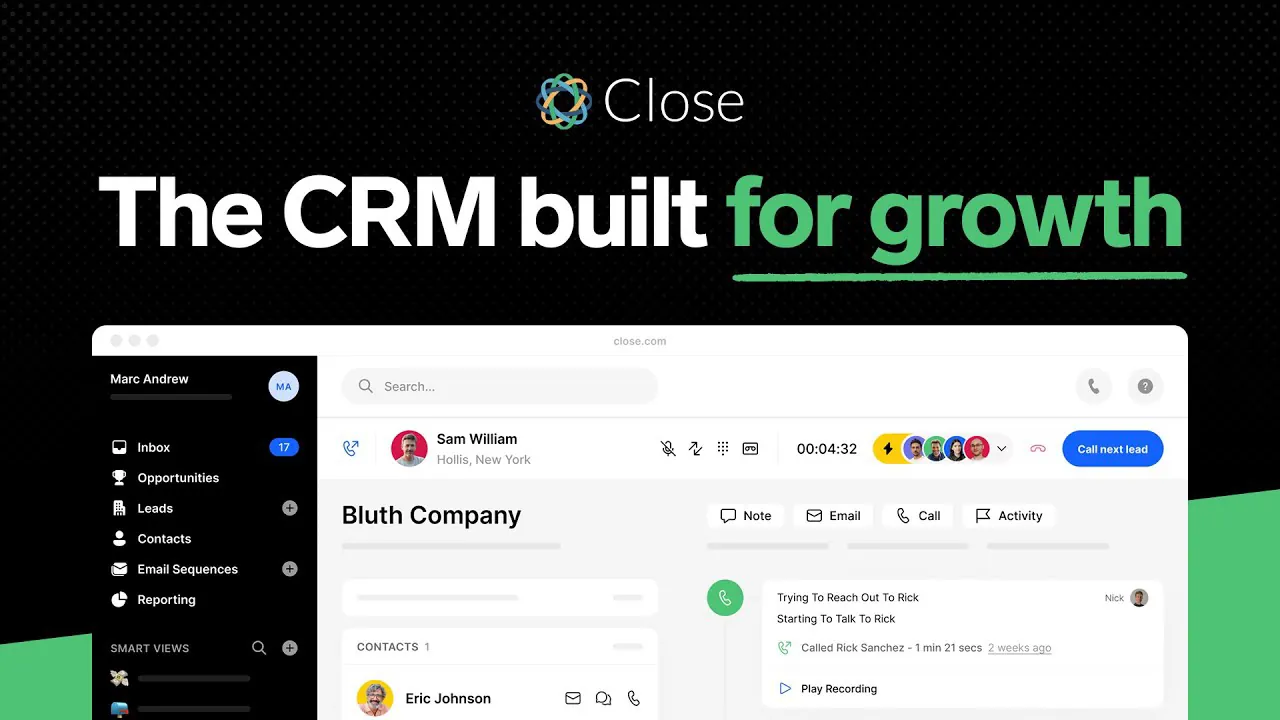
Screenshots of Close 4 images
What's great
- Only CRM in this list with native Power Dialer + SMS + email cadences; reps don't tab-switch
- 4.7/5 on G2 across 2,037 reviews, the highest-rated CRM in this shortlist by a clear margin
- Customer.io's marketing-ops director on record, "our sales team stays in Close, that's where they live, that's where they work"
Watch-outs
- Less useful for inbound-led teams, the calling investment doesn't pay back if reps don't dial
- Marketing automation is minimal, pair with HubSpot Marketing or Customer.io if you need nurture sequences
- Growth tier at $99/user/mo (where the Power Dialer lives) is materially more expensive than Pipedrive Pro
Pricing breakdown
| Plan | Price | Best for |
|---|---|---|
| Solo | $9/user/mo | 1-2 reps testing outbound |
| Essentials | $35/user/mo | 3-10 outbound reps |
| Growth | $99/user/mo | Power Dialer + 10-25 reps |
| Scale | $139/user/mo | Predictive Dialer + 25+ reps |
Security & compliance
| Standard | Availability |
|---|---|
| SOC 2 Type II | Yes |
| GDPR | Yes |
| HIPAA | No |
| SSO / SAML | Scale |
| Audit logs | Scale |
Close compliance summary: SOC 2 Type II is yes, GDPR is yes, HIPAA is no, SSO/SAML is scale, and audit logs is scale.
Key integrations
| Integration | Type |
|---|---|
| Gmail | Native integration |
| Outlook | Native integration |
| Slack | Native integration |
| LinkedIn Sales Navigator | Marketplace add-on |
| Outreach / Salesloft | Marketplace add-on |
Close integration summary: Gmail is native integration, Outlook is native integration, Slack is native integration, LinkedIn Sales Navigator is marketplace add-on, and Outreach or Salesloft is marketplace add-on.
Feature availability
| Feature | Status |
|---|---|
| Free tier | ✗ 14-day trial |
| AI | ✓ email rewrite |
| Custom objects | • limited |
| Dialer | ✓ Growth+ |
| Sandbox | • limited |
Close feature availability summary: Free tier (✗ 14-day trial), AI (✓ email rewrite), Custom objects (• limited), Dialer (✓ Growth+), and Sandbox (• limited).
What reviewers say about Close
Recurring themes across ~2,000 G2 reviews (4.7/5), 2024-2026.
What reviewers praise
- The native Power Dialer is the most-cited reason teams buy Close, eliminating the need for a separate VoIP tool and letting reps call from inside the CRM without tab-switching.
- Setup speed is a consistent win: most reviewers report email sync and first live call working within one hour of signup, compared to days or weeks for alternatives.
- Smart Views (dynamic saved filters) are praised by sales ops reviewers for letting reps work prioritized lead lists without any manual queue-building.
- All calls, emails, and SMS log automatically to the lead record in a single chronological feed, which reviewers credit for cutting manual data entry to near zero.
- The unified Leads inbox model is frequently called out by phone-first teams as simpler to manage daily than tools that split contacts, companies, and deals into separate objects.
What reviewers fault
- Calling and SMS usage fees ($0.02/min and $0.01/message) billed separately catch high-volume teams off guard, with real per-rep costs reaching $150-250/month on top of the seat fee.
- Workflow automation and multi-step sequences are locked to the Growth ($99/user/month) and Scale ($139/user/month) plans, making the cheaper tiers feel too limited for most sales teams.
- Pipeline reporting struggles when deals skip or reverse stages, forcing sales ops teams to export data to external BI tools for anything beyond basic funnel views.
- The Leads-only data model (no separate Contacts, Companies, or Deals objects) creates friction for teams migrating from Salesforce or HubSpot who expect a standard object hierarchy.
- The mobile app is consistently flagged as significantly weaker than the desktop experience, with reviewers citing clunky navigation and missing dialer reliability on mobile.
Loading reviews…
Freshsales
Best AI-bundled budget pick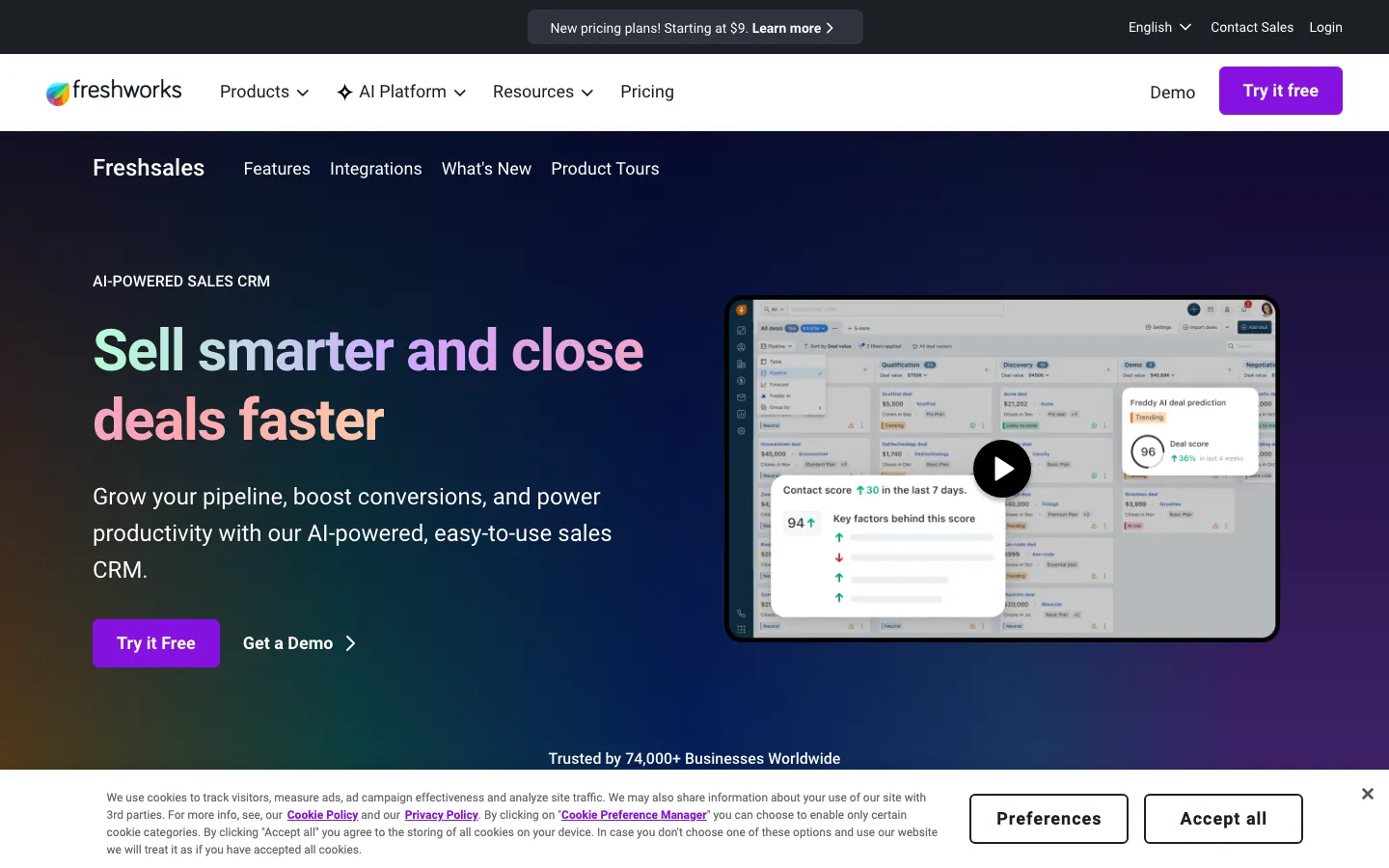
Screenshots of Freshsales 4 images
What's great
- Freddy AI included at $9/user/mo, the cheapest AI-bundled CRM in segment
- Omnichannel built in (email, phone, chat, WhatsApp), no add-on subscriptions or per-channel fees
- Free tier covers 3 users with full feature access; under-3-rep teams pay zero
Watch-outs
- Pro tier jumps 4x to $39/user/mo, which is where most teams will actually land
- Smaller integration ecosystem (~150 apps) than HubSpot's 1,500+ or Salesforce's 5,000+
- Reporting templates feel template-driven; less customization than Pipedrive at the same tier
Pricing breakdown
| Plan | Price | Best for |
|---|---|---|
| Free | $0 | Up to 3 users |
| Growth | $9/user/mo | 3-10 reps with Freddy AI |
| Pro | $39/user/mo | 10-50 reps |
| Enterprise | $59/user/mo | 50+ reps |
Security & compliance
| Standard | Availability |
|---|---|
| SOC 2 Type II | Yes |
| GDPR | Yes |
| HIPAA | $ available |
| SSO / SAML | Pro+ |
| Audit logs | Enterprise |
Freshsales compliance summary: SOC 2 Type II is yes, GDPR is yes, HIPAA is $ available, SSO/SAML is pro+, and audit logs is enterprise.
Key integrations
| Integration | Type |
|---|---|
| Gmail | Native integration |
| Outlook | Native integration |
| Slack | Native integration |
| LinkedIn Sales Navigator | Marketplace add-on |
| Outreach / Salesloft | Marketplace add-on |
Freshsales integration summary: Gmail is native integration, Outlook is native integration, Slack is native integration, LinkedIn Sales Navigator is marketplace add-on, and Outreach or Salesloft is marketplace add-on.
Feature availability
| Feature | Status |
|---|---|
| Free tier | ✓ 3 users free |
| AI | ✓ Freddy bundled |
| Custom objects | Pro+ |
| Dialer | $ phone add-on |
| Sandbox | Enterprise |
Freshsales feature availability summary: Free tier (✓ 3 users free), AI (✓ Freddy bundled), Custom objects (Pro+), Dialer ($ phone add-on), and Sandbox (Enterprise).
What reviewers say about Freshsales
Recurring themes across ~1,200 G2 reviews (4.5/5) and Capterra reviews (4.5/5), 2024-2026.
What reviewers praise
- Setup speed is the most consistent praise: reviewers describe going from signup to a working pipeline in under an hour, with drag-and-drop kanban deals and pre-built templates available immediately.
- Built-in phone with click-to-call, automatic call logging, recording, and voicemail drop is repeatedly cited as the reason small sales teams avoid paying for a separate dialer.
- Freddy AI lead scoring gets genuine positive mentions for helping reps focus on high-intent accounts rather than working the list in raw chronological order.
- The pricing is frequently compared favorably to HubSpot and Salesforce, with the Pro plan at $39/user/month covering features that cost twice as much elsewhere.
- Customer support responsiveness is a notable differentiator in reviews, with teams on paid plans consistently describing helpful, quick answers relative to other CRM vendors.
What reviewers fault
- Custom reporting is a recurring frustration: reviewers consistently export to Google Sheets for anything beyond basic dashboards because the built-in report builder lacks cross-object views and calculated fields.
- Freddy AI Copilot moved to a paid add-on ($29/user/month, billed annually) after originally being bundled, and reviewers who upgraded expecting it included describe this as an unwelcome surprise.
- The cheapest plans support only a single sales pipeline, which blocks any team selling more than one product line or managing separate deal flows without upgrading.
- The mobile app covers contact lookups and basic deal updates but consistently falls short for field sales teams who need the full desktop feature set on the road.
- Data enrichment accuracy for non-US companies is flagged as weak by reviewers with international books of business, with auto-populated company and contact data requiring frequent manual correction.
Loading reviews…
Zoho CRM
Best value for SMBs, most features per dollar
Screenshots of Zoho CRM 4 images
What's great
- Cheapest serious option in the comparison, under $15/user/mo gets you most SMB features
- Zia AI bundled at the Standard tier, no add-on, with a documented 8.4% to 14.1% conversion lift case study
- Broad Zoho One ecosystem; Books, Desk, Mail, and Inventory all share contact records
Watch-outs
- UX is dated and slower; one published review notes "the interface feels difficult, unintuitive, and cluttered"
- Zia AI needs 75+ converted leads before scoring kicks in, 60-90 days of data ramp before first useful predictions
- Mobile experience is uneven; the iPad app is the weakest in the comparison set
Pricing breakdown
| Plan | Price | Best for |
|---|---|---|
| Free | $0 | Up to 3 users |
| Standard | $14/user/mo | 3-15 reps |
| Professional | $23/user/mo | 15-50 reps with workflow automation |
| Enterprise | $40/user/mo | 50-150 reps |
Security & compliance
| Standard | Availability |
|---|---|
| SOC 2 Type II | Yes |
| GDPR | Yes |
| HIPAA | $ available |
| SSO / SAML | Enterprise |
| Audit logs | Enterprise |
Zoho CRM compliance summary: SOC 2 Type II is yes, GDPR is yes, HIPAA is $ available, SSO/SAML is enterprise, and audit logs is enterprise.
Key integrations
| Integration | Type |
|---|---|
| Gmail | Native integration |
| Outlook | Native integration |
| Slack | Native integration |
| LinkedIn Sales Navigator | Marketplace add-on |
| Outreach / Salesloft | Marketplace add-on |
Zoho CRM integration summary: Gmail is native integration, Outlook is native integration, Slack is native integration, LinkedIn Sales Navigator is marketplace add-on, and Outreach or Salesloft is marketplace add-on.
Feature availability
| Feature | Status |
|---|---|
| Free tier | ✓ 3 users free |
| AI | ✓ Zia bundled |
| Custom objects | Enterprise |
| Dialer | $ add-on |
| Sandbox | Enterprise |
Zoho CRM feature availability summary: Free tier (✓ 3 users free), AI (✓ Zia bundled), Custom objects (Enterprise), Dialer ($ add-on), and Sandbox (Enterprise).
What reviewers say about Zoho CRM
Recurring themes across ~2,900 G2 reviews (4.1/5) and Capterra reviews (4.3/5), 2024-2026.
What reviewers praise
- Price-to-feature ratio is the most repeated compliment: reviewers say Zoho delivers lead scoring, workflow automation, and multi-currency support at a fraction of the cost of HubSpot or Salesforce.
- Depth of the Zoho ecosystem is consistently praised by teams already using Zoho Books, Zoho Desk, or Zoho Campaigns, who describe the cross-app data flow as a genuine alternative to buying multiple point solutions.
- The Canvas drag-and-drop UI builder, added in recent years, appears in newer positive reviews as a meaningful upgrade, letting non-technical admins redesign the record layout without code.
- Workflow automation breadth gets strong marks, with reviewers pointing to multi-condition rules, scheduled actions, and blueprint approval processes as features competitors lock behind enterprise tiers.
- Lead management tools including assignment rules, scoring, and conversion tracking are frequently cited as thorough and configurable for teams with defined sales processes.
What reviewers fault
- Customer support is the single most common complaint across G2 and Capterra, with reviewers on standard plans describing slow ticket responses, inconsistent answers, and difficulty escalating urgent issues.
- The learning curve is steep enough that multiple reviewers recommend hiring a Zoho consultant for initial setup, especially for automation, Deluge scripting, and module customization.
- The mobile app has reliability problems that appear consistently in recent reviews, including bugs that prevent notes from displaying, missed call logs, and crashes under poor connectivity.
- Integration with non-Zoho tools is frequently described as more friction than the docs suggest, with third-party connectors requiring Zapier workarounds or custom API work for stable two-way sync.
- The interface, despite recent improvements, is still called cluttered and overwhelming by first-time CRM buyers, and the density of settings can make routine tasks harder to find than in leaner tools.
Loading reviews…
Copper CRM
Best for Google Workspace shops
Screenshots of Copper CRM 4 images
What's great
- Native Google Workspace sync; Gmail auto-populates contacts, reps don't manually create records
- Cleanest Chrome extension in the segment; most CRMs feel bolted onto Gmail, Copper feels designed for it
- Honest tier pricing; published prices match what teams actually pay on renewal
Watch-outs
- Less useful if your team isn't on Google Workspace; Outlook integration is meaningfully weaker
- Customization layer is shallower than HubSpot or Pipedrive
- Smaller community; fewer Stack Overflow and Reddit answers when you hit edge cases
Pricing breakdown
| Plan | Price | Best for |
|---|---|---|
| Starter | $9/seat/mo | 1-3 reps |
| Basic | $23/seat/mo | 3-10 reps with pipeline reporting |
| Professional | $59/seat/mo | 10-25 reps |
| Business | $99/seat/mo | 25+ reps |
Security & compliance
| Standard | Availability |
|---|---|
| SOC 2 Type II | Yes |
| GDPR | Yes |
| HIPAA | No |
| SSO / SAML | Business |
| Audit logs | • limited |
Copper CRM compliance summary: SOC 2 Type II is yes, GDPR is yes, HIPAA is no, SSO/SAML is business, and audit logs is • limited.
Key integrations
| Integration | Type |
|---|---|
| Gmail | Native integration |
| Outlook | Marketplace add-on |
| Slack | Native integration |
| LinkedIn Sales Navigator | Marketplace add-on |
| Outreach / Salesloft | Marketplace add-on |
Copper CRM integration summary: Gmail is native integration, Outlook is marketplace add-on, Slack is native integration, LinkedIn Sales Navigator is marketplace add-on, and Outreach or Salesloft is marketplace add-on.
Feature availability
| Feature | Status |
|---|---|
| Free tier | ✗ 14-day trial |
| AI | • limited |
| Custom objects | • limited |
| Dialer | ✗ |
| Sandbox | • limited |
Copper CRM feature availability summary: Free tier (✗ 14-day trial), AI (• limited), Custom objects (• limited), Dialer (✗), and Sandbox (• limited).
What reviewers say about Copper CRM
Recurring themes across ~1,150 G2 reviews (4.5/5) and Capterra reviews (4.4/5), 2024-2026.
What reviewers praise
- The Google Workspace integration is the defining strength in nearly every positive review: emails, calendar events, and files sync automatically to contact and deal records without any manual logging.
- Ease of setup is a consistent theme, with small teams describing a productive CRM in days rather than weeks and citing the Chrome extension as the reason reps never have to leave Gmail to manage deals.
- The visual pipeline is praised for clarity, with drag-and-drop deal stages and a clean interface that new reps understand without formal training.
- Customer support responsiveness gets positive mentions, including a pattern of same-day replies to negative Trustpilot reviews and onboarding calls with real humans walking through report and workflow setup.
- For agencies and professional services firms, the relationship-centric contact model (shared contacts across opportunities) is cited as a better fit than the account-and-lead hierarchy of Salesforce-style CRMs.
What reviewers fault
- The Starter plan at $9/user/month is widely considered too limited for real use, and the jump to the Professional plan at $59/user/month (a 156% increase) regularly surprises buyers post-trial.
- Email automation for drip sequences is a consistent pain point, with reviewers describing the sequencing tools as basic and hard to configure compared to purpose-built outreach tools.
- Reporting requires exporting to Google Sheets or Excel for anything beyond pipeline snapshots, as the built-in reports lack the filtering flexibility and calculated fields that growing teams need.
- Email sync reliability has recurring complaints, with reviewers noting that emails occasionally attach to the wrong opportunity or fail to sync at all, requiring manual cleanup.
- The platform is explicitly designed around Google Workspace, and reviewers who switched to Microsoft 365 or mixed email environments report that the tool's core value disappears without Gmail as the anchor.
Loading reviews…
Monday Sales CRM
Best for cross-functional visual teams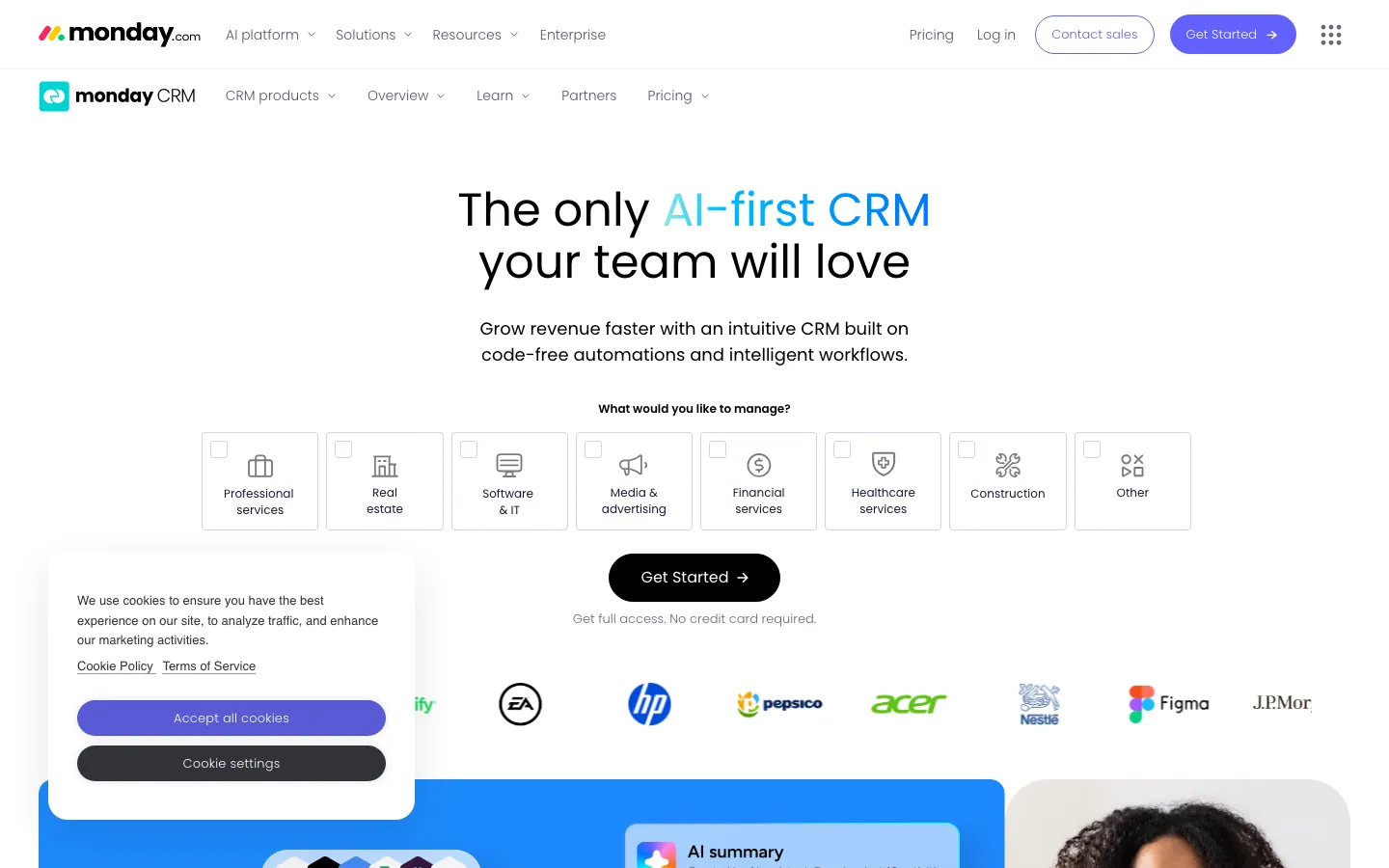
Screenshots of Monday Sales CRM 4 images
What's great
- Visual board interface; deals look like project cards, not table rows; popular with non-sales stakeholders
- Cross-functional visibility; the same workspace runs sales, marketing campaigns, and customer onboarding
- 200+ integrations and a clean automation builder; non-technical ops can build flows
Watch-outs
- 3-seat minimum on every paid tier; expensive for solo founders or 1-2 person teams
- Reporting is shallow vs Pipedrive or HubSpot; dashboards are visual, not analytical
- The board interface gets clumsy at 500+ open deals; not the right pick for high-velocity SDR teams
Pricing breakdown
| Plan | Price | Best for |
|---|---|---|
| Basic | $12/user/mo | 3-10 reps with simple pipeline |
| Standard | $17/user/mo | 10-25 reps with automation |
| Pro | $28/user/mo | 25-50 reps with forecasting |
| Enterprise | Custom quote | 50+ reps |
Security & compliance
| Standard | Availability |
|---|---|
| SOC 2 Type II | Yes |
| GDPR | Yes |
| HIPAA | Enterprise |
| SSO / SAML | Enterprise |
| Audit logs | Enterprise |
Monday Sales CRM compliance summary: SOC 2 Type II is yes, GDPR is yes, HIPAA is enterprise, SSO/SAML is enterprise, and audit logs is enterprise.
Key integrations
| Integration | Type |
|---|---|
| Gmail | Native integration |
| Outlook | Native integration |
| Slack | Native integration |
| LinkedIn Sales Navigator | Marketplace add-on |
| Outreach / Salesloft | Limited |
Monday Sales CRM integration summary: Gmail is native integration, Outlook is native integration, Slack is native integration, LinkedIn Sales Navigator is marketplace add-on, and Outreach or Salesloft is limited.
Feature availability
| Feature | Status |
|---|---|
| Free tier | ✗ 14-day trial |
| AI | ✓ summarization |
| Custom objects | • limited |
| Dialer | ✗ |
| Sandbox | Pro+ |
Monday Sales CRM feature availability summary: Free tier (✗ 14-day trial), AI (✓ summarization), Custom objects (• limited), Dialer (✗), and Sandbox (Pro+).
What reviewers say about Monday Sales CRM
Recurring themes across ~1,150 G2 reviews (4.6/5) and Capterra reviews, 2024-2026.
What reviewers praise
- The visual board-based pipeline is the most praised feature, with reviewers describing the drag-and-drop deal management as fast to learn and easy to adapt to any sales workflow without technical help.
- No-code automation builder gets consistent marks for letting non-technical users set up lead routing, stage-change notifications, and follow-up reminders without writing a single line of code.
- The handoff between sales and post-sale delivery is a recurring differentiator in reviews, with teams that use monday.com for project management citing the ability to convert a won deal into a project board as uniquely valuable.
- Integration breadth with Gmail, Slack, and tools like QuickBooks is frequently cited, and the native app marketplace is described as wide enough that most teams can avoid custom integration work.
- Templates for common sales workflows let new teams get a working CRM up and running quickly, with reviewers noting that the starting boards are practical rather than just placeholder examples.
What reviewers fault
- The three-seat minimum is a consistent frustration for solo operators and two-person teams who describe paying for unused seats as an arbitrary barrier with no workaround.
- Email functionality is a recurring complaint, with reviewers calling the native email composer clunky and noting that writing outbound emails inside monday CRM requires awkward workarounds compared to tools with native inbox integration.
- Automation limits are strictly plan-gated: the Basic plan has no automations, Standard allows only 250 actions per month, and teams with active pipelines say 250 runs out within days on any real sales motion.
- Sales forecasting and pipeline analytics are flagged as shallow compared to dedicated CRM tools, with advanced dashboards locked to the Pro plan and even those described as less flexible than Salesforce or HubSpot reporting.
- Unexpected price increases have appeared in multiple reviews, with users on legacy plans reporting that renewals came in higher than the rate at signup without clear advance notice.
Loading reviews…
Microsoft Dynamics 365 Sales
Best for Microsoft 365 enterprise shops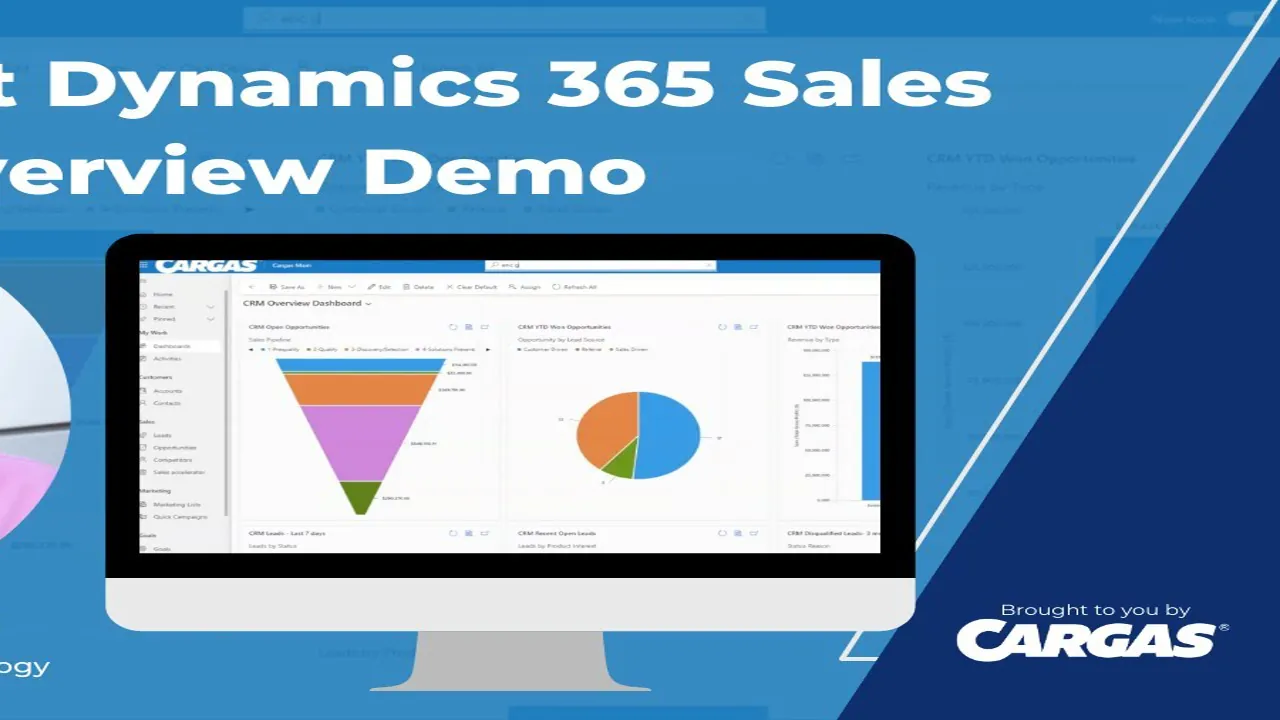
Screenshots of Microsoft Dynamics 365 Sales 4 images
What's great
- Deep Teams + Outlook + Power Platform integration; emails and meetings auto-log without effort
- Enterprise Agreement bundle discounts can drop per-seat cost 30-50% for Microsoft-already shops
- Power Platform unlock; low-code automation and reporting that other CRMs charge $30K+/yr for
Watch-outs
- 3.8/5 G2 across 1,618 reviews, the lowest score in this shortlist; UX is the consistent complaint
- $65/user/mo Pro tier is mid-market priced for a tool that competes feature-for-feature with Pipedrive at $14
- Implementation is slow; published case studies show 4-6 months for a clean rollout
Pricing breakdown
| Plan | Price | Best for |
|---|---|---|
| Sales Professional | $65/user/mo | 25-100 reps in Microsoft shops |
| Sales Enterprise | $105/user/mo | 100-500 reps with custom workflows |
| Sales Premium | $150/user/mo (10-user min) | 500+ reps + AI insights |
| Sales + Copilot | Custom EA pricing | 1000+ rep |
Security & compliance
| Standard | Availability |
|---|---|
| SOC 2 Type II | Yes |
| GDPR | Yes |
| HIPAA | Yes |
| SSO / SAML | ✓ all tiers |
| Audit logs | Yes |
Microsoft Dynamics 365 Sales compliance summary: SOC 2 Type II is yes, GDPR is yes, HIPAA is yes, SSO/SAML is ✓ all tiers, and audit logs is yes.
Key integrations
| Integration | Type |
|---|---|
| Gmail | Marketplace add-on |
| Outlook | Native integration |
| Slack | Native integration |
| LinkedIn Sales Navigator | Native integration |
| Outreach / Salesloft | Marketplace add-on |
Microsoft Dynamics 365 Sales integration summary: Gmail is marketplace add-on, Outlook is native integration, Slack is native integration, LinkedIn Sales Navigator is native integration, and Outreach or Salesloft is marketplace add-on.
Feature availability
| Feature | Status |
|---|---|
| Free tier | ✗ 30-day trial |
| AI | $ Copilot add-on |
| Custom objects | ✓ all tiers |
| Dialer | • limited |
| Sandbox | ✓ all tiers |
Microsoft Dynamics 365 Sales feature availability summary: Free tier (✗ 30-day trial), AI ($ Copilot add-on), Custom objects (✓ all tiers), Dialer (• limited), and Sandbox (✓ all tiers).
What reviewers say about Microsoft Dynamics 365 Sales
Recurring themes across ~1,600 G2 reviews (3.8/5) and Capterra reviews (3.8/5), 2024-2026.
What reviewers praise
- Teams already running on Microsoft 365 cite Outlook, Teams, and SharePoint integration as genuinely native rather than bolted on, with shared contact records and email threads surfacing in the CRM without any sync setup.
- Copilot AI features (included at no extra cost as of October 2025) are praised in newer reviews for summarizing calls, drafting follow-up emails, and surfacing next-step recommendations directly inside the sales workflow.
- The modular structure is frequently cited as a strength by enterprise buyers who want to start with Sales and layer in Customer Service, Field Service, or Finance modules later without switching platforms.
- Power BI integration is called out by sales ops reviewers as one of the best native reporting connections in the CRM market, with deep data access and customizable dashboards for teams willing to invest in the setup.
- Scalability and permissions depth are consistently praised by larger organizations, with granular role-based access controls and territory management features that smaller CRMs do not offer.
What reviewers fault
- The learning curve is the most repeated complaint across all review platforms, with new users describing the navigation as complex and non-intuitive, particularly those coming from HubSpot or Salesforce.
- Implementation costs consistently exceed expectations: reviewers and consultants cite a $2-5 services spend for every $1 in license cost, with a mid-market Sales-only rollout running $15,000-60,000 in implementation fees before anyone opens a deal record.
- The interface is regularly described as busy and cluttered, with too many menu layers between common tasks like creating a contact, logging a call, or updating an opportunity stage.
- Third-party integrations outside the Microsoft ecosystem are flagged as unreliable, with reviewers noting that security policy restrictions and connector limitations make non-Microsoft tool connections fragile compared to HubSpot or Salesforce alternatives.
- Module silos are a recurring complaint: Sales, Marketing, and Customer Service modules do not share data natively by default, and connecting them requires additional configuration or separate add-on licenses that catch buyers off guard.
Loading reviews…
Attio
Best modern CRM for data-driven startups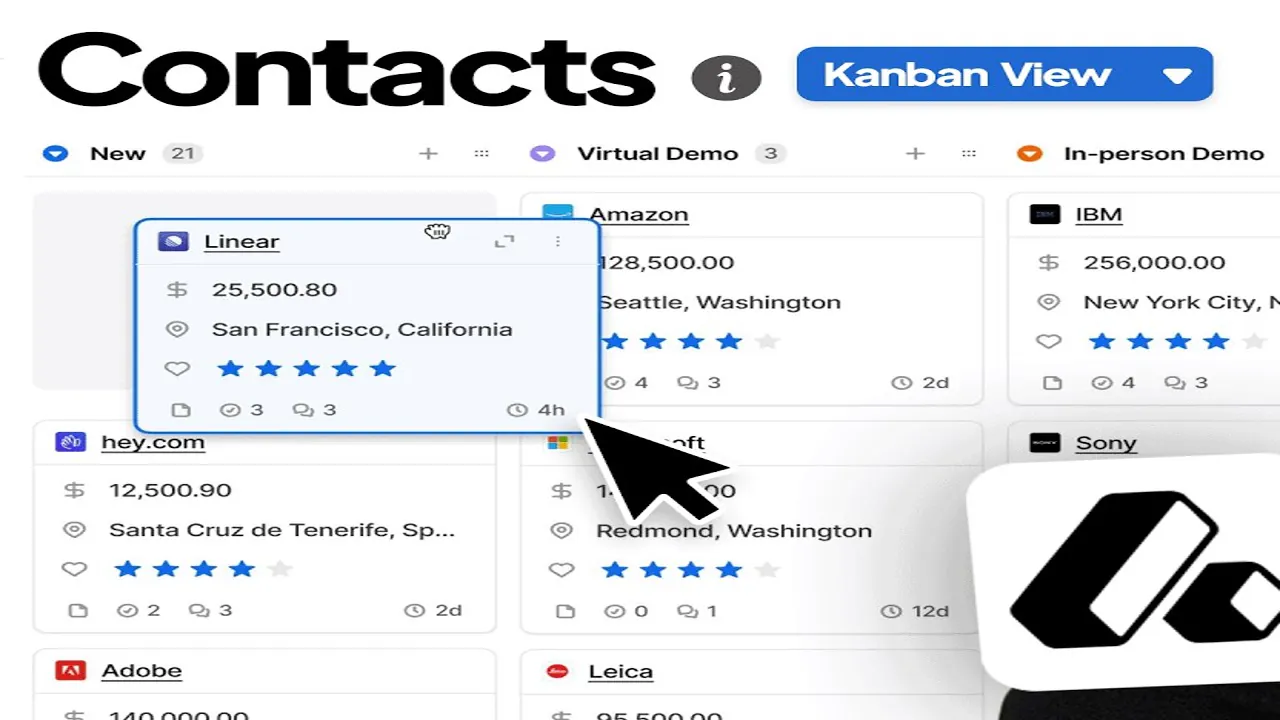
Screenshots of Attio 4 images
What's great
- Most flexible data model in the category; you can define any object type (Investors, Partners, Portfolio Co) without a developer
- Ask Attio AI interface in 2026 release lets reps query the full CRM in plain English and update records via MCP-connected AI tools
- Setup is fast in practice, signup-to-working-CRM in under 30 minutes and the first custom object takes well under an hour to configure
Watch-outs
- No unified inbox; you open individual contact records to see email threads, which creates friction on high-volume teams
- Automation credit model bites fast; heavy workflows burn through the 1,500/mo workspace credits in two weeks, add-on credits at $120/mo extra
- Support response runs 12-24 hours on paid plans; when a sync issue blocks your pipeline, that lag is painful
Pricing breakdown
| Plan | Price | Best for |
|---|---|---|
| Free | $0 | Up to 3 users |
| Plus | $29/user/mo | 3-15 reps |
| Pro | $69/user/mo | 15-50 reps |
| Enterprise | Custom | 50+ reps |
Security & compliance
| Standard | Availability |
|---|---|
| SOC 2 Type II | Yes |
| GDPR | Yes |
| HIPAA | No |
| SSO / SAML | Pro+ |
| Audit logs | Pro+ |
Attio compliance summary: SOC 2 Type II is yes, GDPR is yes, HIPAA is no, SSO/SAML is pro+, and audit logs is pro+.
Key integrations
| Integration | Type |
|---|---|
| Gmail | Native integration |
| Outlook | Native integration |
| Slack | Native integration |
| LinkedIn Sales Navigator | Marketplace add-on |
| Outreach / Salesloft | Marketplace add-on |
Attio integration summary: Gmail is native integration, Outlook is native integration, Slack is native integration, LinkedIn Sales Navigator is marketplace add-on, and Outreach or Salesloft is marketplace add-on.
Feature availability
| Feature | Status |
|---|---|
| Free tier | ✓ 3 users free |
| AI | ✓ Ask Attio + MCP |
| Custom objects | ✓ all tiers |
| Dialer | ✗ |
| Sandbox | • limited |
Attio feature availability summary: Free tier (✓ 3 users free), AI (✓ Ask Attio + MCP), Custom objects (✓ all tiers), Dialer (✗), and Sandbox (• limited).
What reviewers say about Attio
Recurring themes across ~448 G2 reviews (4.3/5) and third-party review aggregators (Stacksync, Authencio, TrustRadius), 2024-2026.
What reviewers praise
- The relational data model is the top-cited strength: teams build custom objects and relationship hierarchies that match how their business actually works, not how a legacy CRM expects it to work.
- The Notion-style interface draws consistent praise for looking modern and loading fast, with new team members up to speed in hours rather than days.
- Continuous automatic data enrichment keeps contact and company records current without manual CSV uploads or scheduled re-imports.
- Native AI attributes and workflow steps are embedded at the data layer, not bolted on as an afterthought, which reviewers single out as a meaningful difference from older platforms.
- A genuinely usable free tier for up to 3 seats and transparent per-user pricing on paid plans avoids the hidden enterprise-tier lock-in that frustrates buyers on competing tools.
What reviewers fault
- Native connector coverage is patchy: teams running ERPs, databases, or niche SaaS tools regularly hit gaps and end up writing custom API code or routing through Zapier.
- Paid plans are annual-only with no month-to-month option, which is a recurring friction point for startups that want to try before committing a year of budget.
- Reporting is consistently flagged as underpowered: built-in sales metrics for pipeline velocity, forecast accuracy, and rep activity are missing or require workarounds.
- Setting up a non-standard data structure demands upfront planning, and poorly designed object relationships become hard to untangle once real data is in.
- The app marketplace is much smaller than HubSpot or Salesforce, so teams with existing niche tooling often find no native integration exists and must build their own.
Loading reviews…
More top-rated CRM Software worth checking out
Highly rated CRM Software that didn't crack our top 10 but are still strong contenders, especially for specific use cases and team sizes.
Salesflare
For B2B teams who hate CRM data entry
Standout: Auto-populates contact records from email signatures, LinkedIn, and company websites; G2 reviewers report 40% less CRM admin time
What reviewers say ★ 4.8 · 298
Praised
- Automatic contact and company enrichment is the most praised feature by volume: the CRM fills itself in from email and calendar activity so reps spend almost no time on manual data entry.
- The LinkedIn browser extension, which shows whether a person already exists in your CRM and lets you add them with one click, gets repeated call-outs from B2B sales teams.
- Email tracking and the conversation timeline are consistently cited as genuinely useful, giving reps full context on a thread without digging through a shared inbox.
- Customer support responsiveness earns some of the strongest marks of any CRM in this tier, with multiple reviewers noting that product feedback has actually been acted on.
- Value for money at the Growth tier comes up again and again, with reviewers calling it fairly priced relative to the time it saves on admin work.
Faulted
- No free tier exists, and even the entry-level plan costs $35 per user per month, which stings for solo operators or very early-stage teams weighing it against free alternatives.
- The platform is built around company-first B2B workflows, so reviewers doing B2C or managing individual consumers hit mandatory company-name fields and data enrichment that does not fit their model.
- Email workflow builder, custom dashboards, and user permissions are all gated behind the Pro or Enterprise tier, making the base plan feel limited for teams that need more control.
- No native phone dialer is a consistent gap for outbound-heavy teams; getting calling into the workflow requires a third-party integration and adds cost.
- Customization ceiling is lower than competitors: reviewers who want highly tailored pipeline stages, complex field logic, or white-label reporting find Salesflare runs out of flexibility before they do.
Less Annoying CRM
For service businesses on a flat-rate budget
Standout: Single price, $15/user/mo, no tiers, no contracts, no feature gates; every user gets everything
What reviewers say ★ 4.9 · 662
Praised
- Ease of use is the single most consistent theme across all platforms: non-technical staff report being fully operational within hours, with no training sessions or admin setup required.
- Human customer support with same-day response times is cited in a disproportionate share of positive reviews, with users specifically contrasting it against the bot-first support they got from larger CRMs.
- Flat pricing at $15 per user per month with no hidden tiers, no annual lock-in, and no onboarding fees is praised constantly, especially by teams burned by HubSpot or Salesforce upgrade surprises.
- The contact and pipeline workspace stays clean and uncluttered, which reviewers say makes daily use fast even for team members who resist adopting new software.
- Small business owners frequently mention that it replaced a messy spreadsheet setup without forcing them to learn CRM theory or hire a consultant to configure it.
Faulted
- Integration coverage is the most repeated criticism: native connections for QuickBooks, FreshBooks, Trello, and several other small-business staples are absent, requiring manual data transfer.
- MailChimp integration specifically is flagged as unreliable by multiple reviewers, with sync errors that require workarounds and manual list management.
- There is no native mobile app, only a mobile-optimized web view, which frustrates field sales and service teams who need quick offline access to contacts.
- Reporting stays basic: no revenue forecasting, no funnel-stage conversion rates, and no custom report builder, which teams feel as a ceiling once they pass 50 active deals.
- Automation is essentially absent: the platform tracks contacts and tasks well but does not send sequences, trigger follow-ups, or run any workflow logic without a third-party connector.
Nutshell
For small businesses needing reporting depth
Standout: Every plan includes unlimited contacts, unlimited data storage, and live human support at no extra cost
What reviewers say ★ 4.3 · 1,427
Praised
- Ease of use leads all praise categories by volume (379 G2 mentions): the pipeline view is visual and immediately actionable, and reviewers say a full setup takes under a day for most teams.
- Free live human support on every plan without a paid upgrade requirement is called out as a genuine differentiator, particularly by teams who had to pay for support on HubSpot or Zoho.
- Unlimited contacts and storage across all tiers removes a common growth ceiling that users on competing tools hit and resent paying to unlock.
- AI features including call transcription, video notetaker integration, and a native MCP server for ChatGPT and Claude add-ons are praised as useful capabilities at a mid-market price.
- Free data migration and onboarding assistance is repeatedly mentioned as reducing the switching cost, especially for teams moving off spreadsheets or a legacy CRM.
Faulted
- Reporting is the top complaint by review volume (145+ mentions): filtering and customization options in the report builder are thin, and pulling decision-quality data often requires exporting to a spreadsheet.
- Duplicate contacts accumulate over time and the deduplication tools are manual, creating data hygiene work that grows proportionally with team size.
- The mobile app lacks push notifications and integrated calling, which limits usefulness for field sales reps who rely on their phone between desk sessions.
- Workflow customization hits a ceiling that frustrates power users: complex multi-stage sequences, conditional branching, and territory management are not available at most tiers.
- English-only interface and support locks out international or multilingual teams, a gap that reviewers from Europe and Latin America note explicitly.
Capsule CRM
For relationship-led sales teams
Standout: Clean, minimal UI with a shallow learning curve; 85% of G2 reviews are five-star, 13% four-star, essentially zero negatives
What reviewers say ★ 4.7 · 491
Praised
- The clean, uncluttered interface is the top-cited strength, with reviewers consistently saying it strikes the right balance between having enough features and not overwhelming users.
- Contact and organization management gets strong marks for replacing spreadsheet chaos: teams say centralizing emails, notes, and tasks on a single contact record is where Capsule earns its keep.
- Google Workspace integration is praised as tight and reliable, with Gmail, Google Calendar, and Google Contacts all working without friction for teams already in that ecosystem.
- Competitive entry-level pricing and a functional free plan for up to 2 users make it a low-risk starting point for micro-businesses and freelancers.
- The Projects feature, which lets teams run basic task-board workflows inside the CRM, gets repeated mentions as a useful way to manage post-sale or service delivery work.
Faulted
- No two-way email sync on any plan is the most consistent friction point: users must BCC a dropbox address to log emails, which breaks down in practice and misses inbound replies.
- Email sequences and bulk campaigns require the separate Transpond add-on or a Mailchimp connection, making email marketing a bolt-on cost rather than a native capability.
- No phone or live chat support on any tier frustrates buyers who encounter setup issues, as all help goes through email tickets with no guaranteed response time.
- Reporting is minimal on lower plans, and the advanced analytics reviewers want, such as pipeline conversion rates and rep activity breakdowns, require upgrading past the entry tiers.
- The AI tooling feels underpowered compared to 2025-era competitors: reviewers note that Capsule lacks the AI-assisted data entry, deal summaries, and enrichment that are becoming standard elsewhere.
Streak CRM
For Gmail-native sales pipelines
Standout: CRM lives entirely inside Gmail as a Chrome extension; zero context-switching, deals show up as inbox rows
What reviewers say ★ 4.5 · 265
Praised
- Living inside Gmail is the defining advantage and the most praised attribute: pipelines, contact records, and deal data appear in a sidebar without any context switching or tab management.
- The free email power tools including read receipts, mail merge (50 per day), thread splitting, and snippet shortcuts are available even on lower tiers and are praised as genuinely useful.
- Unlimited records on every paid plan means growing teams do not hit a contact or deal cap that triggers an upgrade conversation mid-year.
- The AI Co-Pilot feature, which populates deal fields by reading email thread content, is consistently called out as a real time-saver for teams managing high inbox volume.
- For solo operators and very small teams doing email-centric relationship management, reviewers say the setup is near-instant and the daily friction is essentially zero.
Faulted
- The platform is hard-locked to Google Workspace: a single team member on Outlook or Safari makes Streak impractical, and there is no meaningful mobile experience outside Chrome on Android.
- Removing the free CRM tier and the Solo plan pushed entry-level pricing to $49 per month, which triggered a wave of Reddit complaints from users who felt they lost access to a tool they had built into their workflow.
- Email open-tracking counts inflate when tracked pixels are forwarded or copied into signatures, making engagement metrics unreliable, a known limitation the support team acknowledges.
- Automation stays basic: Streak can create tasks, update box fields, and send notifications, but cannot run the kind of multi-step conditional sequences that a dedicated sales automation tool handles.
- Scaling past 10 to 15 users surfaces hard limits: role-based permissions are Enterprise-only, there is no global activity feed, and teams have reported reps emailing the same prospect with no collision detection.
Salesmate
For growing teams needing built-in calling
Standout: Built-in calling and SMS on the Basic plan ($23/user/mo); no separate Twilio setup, no per-call fees for US/Canada local numbers
What reviewers say ★ 4.7 · 114
Praised
- The interface keeps all contact and deal context on a single page, which reviewers credit for cutting onboarding time compared to heavier CRMs like Salesforce or Zoho.
- Built-in VoIP calling and two-way texting are included at the platform level, removing the need for a separate telephony subscription for most small sales teams.
- Price-to-feature ratio gets consistent praise, with plans starting around $29 per user per month and live chat support available on every paid tier.
- Email tracking, bulk sending, and automated follow-up reminders are called out as genuinely productivity-boosting, not just checkbox features.
- Live chat support quality receives strong marks, with multiple reviewers specifically mentioning screen-sharing assistance and fast resolution times.
Faulted
- The integration marketplace is thin, roughly 46 direct connectors, so teams relying on tools outside Salesforce, Slack, or Mailchimp will hit gaps quickly.
- Advanced features like email sequences, product catalogs, and the Sandy AI assistant are all locked behind the Pro or Business tier, which pushes the real cost per seat to $49-$79 per month.
- Mobile app functionality consistently trails the web version, with several features missing entirely from the iOS and Android clients.
- Workflow automation has a real learning curve, and reviewers note that building multi-step sequences takes significant trial and error before it reliably fires.
- Support quality is uneven, with some reviewers reporting responsive live chat and others citing email tickets going unanswered or staff unable to resolve technical issues.
OnePageCRM
For follow-up-heavy outbound teams
Standout: Action Stream model forces a next action on every contact; reps never have a "cold" contact sitting in the CRM without a follow-up date
What reviewers say ★ 4.7 · 259
Praised
- The 'Next Action' system is the most-cited differentiator: every contact requires a scheduled follow-up step, so leads almost never fall through the cracks the way they do in a standard list-view CRM.
- Reviewers consistently call the interface the simplest in the small-team CRM category, with new users productive in a day or two and zero configuration required to start tracking deals.
- Customer support is praised for feeling like a dedicated IT team for small businesses, with fast responses and a willingness to walk users through setup problems one-on-one.
- The mobile app gets positive marks for on-the-go contact management and automatic call logging, which most small-team CRMs do poorly.
- Affordability comes up repeatedly, with reviewers noting the per-user cost is well below Salesforce or HubSpot for teams that just need clean pipeline and follow-up tracking.
Faulted
- Search across large contact databases is weak, and users managing thousands of records report it becomes slow and imprecise as the database grows.
- Email sync is unreliable for some users, requiring BCC workarounds to reliably capture correspondence rather than native two-way sync.
- Mass email and bulk outreach capabilities are absent, meaning the tool does not work as a standalone email campaign platform without connecting a separate tool.
- Associating one contact with multiple companies is clunky or unsupported, which frustrates users in consulting or agency contexts where contacts wear multiple hats.
- Reporting and analytics are basic, and reviewers who need pipeline forecasting, team performance dashboards, or activity metrics consistently say they have to export to spreadsheets.
EngageBay
For HubSpot alternatives at half the price
Standout: All-in-one CRM plus marketing automation plus helpdesk under one subscription; avoids the HubSpot hub-stacking trap
What reviewers say ★ 4.6 · 683
Praised
- Price is the single most-cited reason for choosing EngageBay: the all-in-one suite (CRM, marketing automation, and help desk) costs a fraction of HubSpot, with the most expensive plan around $99 per user per month.
- Live chat support is consistently rated as a standout, with reviewers noting fast response times and access to real agents rather than bot queues, which is unusual at this price point.
- The CRM, email automation, and support ticketing sharing a single customer record is praised as genuinely useful, not just marketing copy, because form fills update contact records and trigger automations without any manual plumbing.
- The free-forever plan covers CRM, email marketing, and landing pages for up to 250 contacts, which reviewers call one of the most functional free tiers in the SMB segment.
- Continuous platform updates without extra charges are specifically praised, with users noting features added over the past year at no price increase.
Faulted
- Reporting and analytics fall short for growth-stage teams: reviewers consistently note there is no deep segmentation, predictive analytics, or sales forecasting comparable to what HubSpot or Salesforce offer.
- Email deliverability has recurring complaints, including daily send limits on lower plans (around 100 emails per day on some tiers) and broadcast delays that disrupt time-sensitive campaign sends.
- The mobile app is significantly weaker than the desktop version, with multiple features missing and no parity roadmap visible to users.
- Third-party integrations are limited to roughly 30 native connectors, requiring Zapier for most stack connections, and reviewers note that adds cost and fragility.
- The platform can feel buggy under load, with intermittent slow page loads and occasional glitches during bulk actions that erode trust in automation reliability.
GoHighLevel
For digital agencies and white-label SaaS
Standout: Flat $97/mo Starter plan covers unlimited client sub-accounts; agencies can white-label the full CRM to each client
What reviewers say ★ 4.6 · 638
Praised
- Tool consolidation is the most-cited reason agencies choose it: reviewers report replacing 8 to 12 separate subscriptions (funnel builder, email platform, SMS tool, calendar scheduler, reputation manager) and saving $200-$500 per month in aggregate.
- The white-label SaaS mode on the $497/month plan lets agencies resell the platform under their own brand, turning a software expense into a recurring revenue line that competitors do not offer.
- Multi-channel automation covering email, SMS, WhatsApp, and voice drops in unified workflows gets praise from agency users who previously needed separate tools for each channel.
- Customer support is rated highly across platforms, with reviewers consistently noting fast live chat responses and an active community in the official Facebook group.
- Rapid and frequent feature releases are called out positively, with new AI capabilities (conversation bots, voice agents, content AI) shipping monthly based on visible user feedback.
Faulted
- The learning curve is the top complaint on every review platform, with new users reporting 2 to 4 weeks before feeling comfortable and several months to master the full workflow and funnel builder.
- SMS and voice functionality runs through a separate Twilio account with per-message fees outside the base subscription, a billing reality that catches users off guard after signup.
- The interface is widely described as cluttered and inconsistent, with key settings buried in sub-menus that lack logical grouping, especially compared to newer SaaS products.
- Email deliverability requires manual SPF, DKIM, and sending domain setup; users who skip this step report inbox placement problems that the platform does not flag proactively during onboarding.
- The mobile app is significantly limited compared to the desktop experience, missing workflow management and funnel-building tools that agency operators need when away from a computer.
NetSuite CRM
For ERP-connected mid-market companies
Standout: CRM, ERP, financials, and inventory share a single data model; no integration layer, no sync lag between sales orders and CRM records
What reviewers say ★ 4.1 · 4,775
Praised
- The ERP-native CRM is the core selling point: sales data, order history, fulfillment status, and revenue recognition all live in one database with no middleware, which eliminates reconciliation work that standalone CRM integrations require.
- Multi-entity and multi-currency support via OneWorld is praised by businesses operating across subsidiaries or countries, where the alternative is running separate systems per entity.
- Real-time financial visibility from anywhere on a cloud platform gets repeated positive mention, especially from teams that previously ran on-premise ERP systems.
- Customization flexibility is recognized at enterprise scale, with administrators noting the platform adapts to non-standard business processes through SuiteScript and custom records.
- Consolidated reporting across sales, inventory, and finance in a single dashboard is valued by operations and finance teams who previously extracted data from multiple systems.
Faulted
- Renewal price shock is among the most common complaints: initial discounts expire and users report annual cost increases of 40 to 50 percent, with the Advanced Customer Support add-on alone running $24,000 per year for some accounts.
- Support quality scores lower than most enterprise peers, with G2 reviewers citing ticket escalation delays spanning weeks, frequent account manager turnover, and unresolved bugs that sit open for extended periods.
- The CRM module itself is considered secondary to the ERP core, and reviewers with complex sales processes frequently run Salesforce in parallel for pipeline management while using NetSuite only for post-sale operations.
- The interface is consistently described as dated and dense, with a 'Learning Curve' tag appearing over 380 times in G2 sentiment data and usability scores trailing Sage Intacct and Dynamics 365 BC.
- Year-one implementation costs range from $50,000 to over $200,000 when consultant fees are included, and 31 percent of implementations run longer than planned due to scope creep and SuiteSuccess methodology rigidity.
Tools we considered but excluded
We evaluated more tools than the 20 you see above. These did not make the cut. Saying what we rejected, and why, is the editorial muscle most listicles skip.
- Insightly: UX has not been updated meaningfully since 2022, no AI investment, falling behind on integrations
- ActiveCampaign CRM: Better as a marketing automation tool; the CRM module is shallow versus Pipedrive or Freshsales at the same price point
- Apptivo: Too generalist, tries to be CRM, helpdesk, project management, and invoicing in one tool; loses to specialists
- SugarCRM: Mostly used by IT-led mid-market shops on multi-year contracts; not a comparable buy for most readers of this guide
- Keap: G2 rating of 3.8/5 from only 13 reviews is too thin to verify; pricing at $249/mo flat + mandatory $500 onboarding favors solo founder edge case not the B2B teams this guide targets
- Apptivo: Too many modules spread too thin; purpose-built CRMs in this guide beat it at every price point
Honorable mentions
Solid tools that did not crack the main list but are worth tracking, especially for niche use cases.
- Salesflare: LinkedIn auto-enrichment is genuinely useful for outbound SDR teams under 15 reps; underrated niche pick
- Less Annoying CRM: At $15/user/mo with no tiering games, the best pick for 3-person service businesses that just need a contact database with reminders
- Keap: For solo founders or sub-5-rep shops where marketing automation and CRM need to be the same tool; the only "all in one" CRM at SMB price point
The five buckets of CRM software
The CRM market splits into five practical buckets that get confused with each other. This guide tests across all five, so the right pick depends on what you actually need.
Core CRM. The pipeline manager. HubSpot Sales Hub, Salesforce Sales Cloud, Pipedrive, Zoho CRM, Copper, Monday Sales CRM, Dynamics 365 Sales. Every B2B SaaS sales team needs one of these. Teams selling into named accounts should also read our B2B CRM breakdown , which re-scores these same tools on multi-stakeholder deals.
Outbound-specialized CRM. Built around calling and SMS. Close is the standout; Salesloft and Outreach pair with a primary CRM but aren’t full CRMs themselves. If your reps live on the phone, this is the bucket to look at first.
AI-bundled CRM. Tools that ship AI lead scoring, summarization, and email drafting in the price. Freshsales (Freddy), Zoho (Zia), HubSpot Breeze. The ones that charge for AI as a per-seat add-on are Salesforce Einstein and Microsoft Copilot for Sales.
Google Workspace native CRM. Copper sits alone here. If Gmail is your team’s system of record and you don’t want a CRM that fights the email client, this is the pick.
Enterprise CRM. Salesforce, Microsoft Dynamics 365. Past 200 reps with complex territory rules, custom objects, or compliance requirements, the others stop scaling.
The nine tools above cover all five buckets. Below, how to actually choose.
Selection criteria, what to test in your CRM trial
We’ve sat in on 50+ CRM evaluations across partner sales teams. The pattern of which trials succeed and which stall is consistent. Eight specific things to test before you commit.
If you also have to defend this purchase to a CFO, read the companion guide to evaluating CRM software . It has the weighted scorecard, the real 3-year cost math, the security gate, and the one-page summary that gets budget approved, plus a free downloadable scorecard.
One, import 500 real leads on day one. Not demo data. Take an actual lead list, even a stale one, and run the full import including custom fields, dedupe, and assignment rules. If the import takes more than 2 hours of work, the day-to-day rep experience will be worse. Pipedrive handles this in under 30 minutes; HubSpot in about 45; Salesforce can stretch to 4-6 hours if you have any custom-field validation rules.
Two, time the rep’s clicks per deal. Take a fresh lead, qualify it, log a call, send an email, advance it through three pipeline stages, and close it as won. Count the clicks. The difference between a good and a great CRM is often 12 clicks vs 28 across the full lifecycle. Multiply by 500 deals a year per rep and that’s actual hours of selling time.
Three, run a calibration meeting with three managers. Have three sales managers independently forecast the same five deals, then meet to reconcile. The platforms with strong forecasting and probability views (HubSpot Sales Hub, Salesforce, Pipedrive Pro) make this a 20-minute meeting. The weaker ones turn it into a 90-minute argument.
Four, export the entire dataset. Try to pull every contact, deal, and activity from the last 90 days into a CSV with all custom fields. If this requires a support ticket or a “talk to your CSM” call, the platform’s data is not actually yours. Walk away from any contract that doesn’t pass this test.
Five, test the mobile experience for one full week. Make every rep use the mobile app for one week instead of desktop. Track the friction. Pipedrive’s mobile is the best in the comparison; Zoho’s iPad app is the weakest. The mobile UX matters more than vendors’ demo decks suggest; field sales teams live in it.
Six, plug in the three real integrations you need. Not the showcase ones. Whatever your stack actually requires, accounting, marketing automation, communication, scheduling. The “1,500+ integrations” claim is true; the question is whether the three you need actually work without a Zapier middleman. Test end-to-end; integration brittleness is the #1 cause of CRM contract regret in our partner data.
Seven, ask about renewal pricing in writing. Year-one pricing is the marketing pitch. Ask the rep: what did your average customer pay in year two and year three? If they can’t give a real range, assume 7-15% increases. Negotiate uplift caps into the contract upfront; vendors will cap at 0-3% if you ask before signing the first contract.
Eight, talk to three current customers in your size band. Not the references the vendor offers. Find them on LinkedIn or via your network. Ask the unfiltered question, “Would you buy this again at full price knowing what you know now?” The answer tells you more than any G2 review.
How to choose the right CRM for your team
Five questions, in order. Answer them and the shortlist collapses to two or three real options.
1. Rep headcount in 12 months
- Under 10 reps. Pipedrive Essential ($14) or HubSpot Free. Don’t overbuy; you’ll outgrow the wrong choice but you won’t outgrow either of these. Smaller teams can weigh these against our CRM picks for small businesses , scored on setup time and price.
- 10-30 reps. Pipedrive Advanced ($29), HubSpot Sales Hub Starter ($20), or Freshsales Growth ($9). All three will keep you healthy for 18 months.
- 30-100 reps. HubSpot Sales Hub Pro ($100) or Pipedrive Power ($69). This is the band where structured forecasting and reporting start paying back.
- 100-300 reps. Salesforce Sales Cloud Pro or HubSpot Enterprise. Plan for a dedicated admin.
- 300+ reps. Salesforce or Microsoft Dynamics 365 with EA bundling. Nothing else handles the complexity.
2. Marketing automation as a core need
If yes, HubSpot Sales Hub plus Marketing Hub is the cleanest story; the data model is shared. Watch the Marketing Hub Pro cliff at $890/mo flat. If marketing automation runs in a separate tool (Customer.io, ActiveCampaign, Marketo), then Pipedrive, Close, or Salesforce all work fine; pick on the sales side, not the marketing side.
If your motion targets a defined list of named accounts rather than inbound leads, the campaign side usually belongs in a dedicated account-based marketing platform that syncs back to whichever CRM you land on.
3. Outbound dialing as a share of the motion
If reps make 30+ calls a day, Close is the only CRM in this list with native Power Dialer at the right price point. The integration story between a non-Close CRM and Salesloft or Outreach is real, but reps will quietly prefer Close once they try both.
If outbound is 20% of motion or less, any of the other eight tools work; don’t over-rotate on the dialer story.
4. The ecosystem you already run in
- Google Workspace. Copper or HubSpot. Copper auto-populates contacts from Gmail; HubSpot’s Gmail extension is solid. Skip Microsoft-native tools.
- Microsoft 365 with Enterprise Agreement. Dynamics 365 Sales. The EA discount math makes it cheaper than the sticker price suggests.
- Zoho One. Zoho CRM, obviously. The integration savings make it the right pick even if the UX is dated.
- Standalone / mixed stack. HubSpot or Salesforce, the ecosystems are large enough to bridge any other tool.
5. Team tolerance for a long implementation
Pipedrive, Close, and HubSpot Sales Hub Starter all let you start selling within a week. Salesforce, Dynamics 365, and HubSpot Enterprise expect a 6-12 week implementation. If the answer is “we need to start selling in two weeks,” the choice narrows to four tools, not nine.
What’s changing in CRM software in 2026
HubSpot’s pricing model is shifting toward flat-per-month adjacent hubs. Operations Hub became Data Hub in early 2026; Pro tier is $720-$800/mo flat (not per-seat). Marketing Hub Pro at $890/mo flat is the more painful cliff for most buyers; the per-seat math of Sales Hub doesn’t predict it. Read the full pricing tree before signing; HubSpot’s free data enrichment ended in March 2025 and is now metered through Breeze Intelligence credits.
Salesforce Agentforce is being positioned as the AI future, but the practitioner reality is mixed. Salesforce Ben’s 2026 reader poll showed 50% of admins still call it “hype.” The base Enterprise tier is $175/user/mo; Agentforce add-on lands around $125/user/mo on top; Agentforce 1 at $550/user/mo is the all-included tier most teams will not adopt for another 18 months.
Salesforce’s own helpdesk resolved 1M+ requests via Agentforce with a 5-7% human escalation rate, the proof point is real, but it’s run by people who built the platform.
Zoho passed one million customers in February 2026. Zia AI gets cheaper-per-call than any other bundled CRM AI. The published case study (a software company going from 8.4% to 14.1% conversion rate post-Zia activation) is one of the few real-world AI uplift numbers in the segment. The catch is the 60-90 day data ramp; Zia needs 75+ converted leads to start delivering useful scores.
Salesforce overhauled its partner program in March 2026, going from four tiers to two. The analyst nickname is “the great thinning”; smaller implementation partners are getting squeezed out. For Salesforce buyers, this means partner selection now matters more; the price gap between a Summit-tier partner and a Select-tier partner can be 40-60% on implementation cost.
Best-of-breed stacks are giving way to platform consolidation. Through 2025, sales-engagement tools (Outreach, Salesloft) and marketing-automation tools (Marketo, Customer.io) were typically separate purchases. By mid-2026, HubSpot’s all-in-one story and Salesforce’s Marketing Cloud + Sales Cloud + Agentforce bundle are pulling more buyers toward platform plays. The trade-off is real: less best-in-class, more integration certainty.
The CRM pick by company stage
- Pre-seed and seed, under 5 reps: HubSpot Free or Freshsales Free. Pay nothing, ship the work.
- Seed to Series A, 5-15 reps: Pipedrive Essential ($14) or HubSpot Starter ($20). Whichever your sales lead prefers; the choice doesn’t really matter at this stage.
- Series A to B, 15-50 reps, marketing-led motion: HubSpot Sales Hub Pro plus Marketing Hub. Budget for the $890/mo Marketing Hub Pro cliff before you cross it.
- Series A to B, 15-50 reps, sales-led motion: Pipedrive Pro ($59) or Close Growth ($99) if reps are dialing. Cleaner than HubSpot at this stage.
- Series B to C, 50-150 reps: HubSpot Sales Hub Enterprise or Salesforce Pro Suite. Hire the admin before the contract starts, not after.
- Series C+, 150-500 reps: Salesforce Enterprise. Plan $400K-$700K year-one all-in.
- Enterprise, 500+ reps: Salesforce Enterprise or Unlimited, or Dynamics 365 if you’re Microsoft-heavy with EA bundling.
- Google Workspace shops at any stage: Copper as the contender; HubSpot still wins above 20 reps but Copper is the lowest-friction sub-20.
- Outbound-heavy at any stage: Close. Nothing else in this list ships native Power Dialer at the right price.
- Already on Zoho One: Zoho CRM. The ecosystem savings outweigh the dated UX.
If your shortlist is still three tools after this guide, run the 14-day trials in parallel with the same five reps on each. Decide on click-count and rep satisfaction at day 10, not on the demo deck.
For corrections, vendor disputes, or feedback on this methodology, email hello@topickz.com . We re-test the full shortlist every six months; the next refresh ships in November 2026.
Frequently asked questions
How much should a CRM actually cost per rep in 2026?
SMB to mid-market lands $40-$120/rep/mo. Enterprise hits $250+/rep with admin and partners. Year-1 all-in runs 1.5-3x sticker once onboarding lands.
HubSpot vs Salesforce in 2026, which one wins?
Under 100 reps, HubSpot wins on time-to-value. Past 200 reps with complex territory rules, Salesforce is the only option. Middle band depends on admin staffing.
Does AI in CRM actually work yet, or is it hype?
Mostly hype. HubSpot Breeze works for summarization. Salesforce Agentforce rated "hype" by 50% of admins. Zoho Zia needs 75+ converted leads to ramp.
How long does CRM migration take?
6-12 weeks for under 100K records. Larger orgs need a full quarter. Expect to lose 20-40% of historical activity logs; export raw before kicking off.
What's the biggest hidden cost in CRM contracts?
Three traps, onboarding fees ($1.5K-$80K), HubSpot contact-tier escalators that fire on list growth, and 5-10% annual uplifts. Negotiate uplift caps upfront.
Can we use a spreadsheet instead of a CRM?
Under 5 reps, sometimes. Past that, 2-4 hrs/rep/week on admin costs more than Pipedrive Essential, and lost-deal math flips it faster than admin time does.
Pipedrive vs HubSpot for sub-50-rep teams, which one wins?
Pipedrive if reps source their own deals and you want predictable pricing. HubSpot if marketing leads sales, but watch the $890/mo Marketing Hub Pro cliff.
What CRM do unicorn SaaS companies actually use?
HubSpot from seed to ~200 employees, then a Salesforce migration budgeted at $250K-$500K once they hit Series C and start hiring enterprise AEs.
How do we know our CRM implementation has gone sideways?
Four signs, reps in CRM under 30 min/day by week 8, managers exporting to Excel for forecasts, hiring managers not logging in, three+ reps in personal Sheets.
Does CRM data ownership matter and how do we test it?
Yes. Try exporting every contact, deal, and activity from 90 days into a CSV with all custom fields. If it needs a support ticket, the data isn't really yours.
What is the best CRM for a 10-person sales team?
Pipedrive Essential at $14/user/mo. It handles pipeline management without the overhead HubSpot's free tier starts adding once you need sequences. Close Solo is the alternative if your reps make a lot of calls. Both scale to 30 reps without a painful migration.
What is the best CRM for a 50-person company?
HubSpot Sales Hub Starter covers most 50-person teams at $20/user/mo. Pipedrive Professional is the alternative if your team is sales-led and doesn't need marketing automation. Both handle the deal volume a 50-person org runs without needing a CRM admin.
What CRM is best for a 200 to 500 person company?
HubSpot Sales Hub Pro for teams with both sales and marketing using one platform. Salesforce for teams where complex territory rules, custom approval workflows, or enterprise integrations are already showing up. The operational cost of Salesforce only makes sense past 200 reps with a dedicated admin.
What CRM is best for SaaS companies in 2026?
HubSpot from seed to around 200 employees because the sales-marketing data model fits the PLG and outbound motions SaaS runs. Salesforce once the team hits 200 reps and needs deal desk workflows. Attio is the pick for SaaS companies with non-standard data models (usage data, product-led signals) they want inside the CRM.
What is the best CRM for real estate companies?
Zoho CRM handles real estate workflows (property tracking, lead routing, follow-up sequences) well at a price that fits most agencies. Pipedrive is the other common choice for smaller real estate teams. Salesforce with a real estate vertical app is the enterprise option.
What CRM do healthcare companies use?
Salesforce Health Cloud for enterprise healthcare networks. HubSpot for healthcare SaaS vendors selling into health systems. Freshsales for smaller healthcare practices that need HIPAA-friendly CRM at a lower price point. Always confirm HIPAA BAA availability before signing any CRM for healthcare.
What is the best CRM for agencies and consulting firms?
Copper for agencies already running on Google Workspace, it lives inside Gmail with no tab-switching. HubSpot for agencies managing retainer clients with marketing deliverables tied to deals. Monday Sales CRM works well for agencies that already use Monday for project management.
What CRM works best for manufacturing or industrial B2B companies?
Zoho CRM handles long B2B sales cycles, multi-contact accounts, and distributor management well for manufacturing. Salesforce is the enterprise pick for manufacturers with complex configure-price-quote workflows. Both handle the 6-18 month deal cycles manufacturing deals typically run.
What is the best CRM for a fintech or financial services company?
Salesforce is the most common in regulated fintech because of its audit trail, SSO, and compliance posture. HubSpot works for fintech startups that are not yet in a regulated product category. Confirm your compliance requirements before signing any CRM in financial services.
What CRM do e-commerce companies use?
E-commerce companies typically use a separate CDP or marketing platform rather than a traditional CRM. For B2B e-commerce or wholesale, HubSpot and Pipedrive both handle the account-and-contact model well. For direct-to-consumer, look at Klaviyo or Drip instead of a traditional sales CRM.
Related helpful reads
Write a review
Posts to the page right away. Keep it real — no links or email addresses.