
Comparing the best CDP Platforms of 2026 includes 1. Segment (Twilio) 2. Hightouch 3. Tealium 4. RudderStack 5. mParticle (by Rokt) 6. Census (Fivetran Activations) 7. BlueConic 8. Adobe Real-Time CDP 9. Treasure Data 10. ActionIQ.
TL;DR
- Segment (Twilio): Best overall packaged CDP. You get 550+ integrations and a real-time Live Debugger on the $120/mo Team tier, though the MTU pricing cliff bites once you pass 1M MTUs.
- Hightouch: Best warehouse-native composable CDP. Pick it if Snowflake, BigQuery, or Databricks is already your source of truth, since there is no data copy or second storage bill, and AI Decisioning runs lifecycle campaigns without SQL.
- Tealium: Best enterprise packaged CDP. It folds tag management, AudienceStream, and EventStream into one platform, and its 2024 Gartner Magic Quadrant Leader placement plus a Strong Performer slot in the 2024 Forrester Wave shorten the security and compliance review your procurement team runs.
- RudderStack: Best open-source, self-hosted CDP. The open-source core means no data ever leaves your cloud boundary, and at $220/mo for 1M events it undercuts Segment's $600-900/mo at comparable volume.
- mParticle (by Rokt): Best CDP for mobile-heavy consumer products. When your app lives on iOS and Android, you get purpose-built SDKs and IDSync, the strongest cross-device identity resolution in the packaged CDP category.
The CDP category split in two in 2025 and most buyers still haven't caught up. Packaged CDPs (Segment, Tealium, mParticle, Adobe) do everything in one box. Warehouse-native tools (Hightouch, RudderStack, Census) treat your Snowflake or BigQuery as the source of truth and sync outward. The wrong architecture is a 12-month migration, so this guide compares both patterns on what actually ships.
What Is a CDP (customer data platform)?
A customer data platform helps marketing and data teams unify customer data from every source into one profile, then activate it across ads, email, and analytics.
Tools like Segment, Hightouch, Tealium, and RudderStack differ on whether they store or route data, identity resolution, and warehouse-native design.
Best CDP Platforms comparison: features, pricing and verdicts
| Tool | Best for | Starting price | Free trial | External rating |
|---|---|---|---|---|
Best overall packaged CDP, broadest integration catalog | $120/mo | Free Developer tier | G2 4.5/5 (565 reviews) | |
Best warehouse-native composable CDP | Free | Free tier + demo | G2 4.6/5 (392 reviews) | |
Best enterprise packaged CDP, strongest tag management | Custom | Demo only | G2 4.3/5 (474 reviews) | |
Best open-source and self-hosted CDP | $0 (OSS) | Free tier + free OSS | G2 4.7/5 (52 reviews) | |
Best CDP for mobile-heavy and multi-platform consumer products | Custom | Demo only | G2 4.4/5 (175 reviews) | |
Best for revenue ops and CRM sync from warehouse | Free | Free tier | G2 4.5/5 (339 reviews) | |
Best marketer-operated CDP, no SQL required | Custom | Demo only | G2 4.1/5 (19 reviews) | |
Best for Adobe Experience Cloud shops | Custom | Demo only | G2 4.1/5 (165 reviews) | |
Best CDP for Fortune 1000 manufacturing and retail | Custom | POC engagement | G2 4.5/5 (164 reviews) | |
Best composable CDP for enterprise media and financial services | Custom | Demo only | G2 4.1/5 (45 reviews) |
How we chose these tools
We compared these CDPs on architecture (packaged vs warehouse-native), integration catalog breadth, identity-resolution depth, schema governance, and total cost across event-volume bands. The assessment draws on documented product capabilities, recurring themes across real G2 and Capterra reviews, and vendor pricing plus Vendr marketplace data. Pricing was verified on vendor pages in May 2026. G2 ratings and review counts were pulled on May 28, 2026.
How we weight cdp platforms for the Topickz score
Every tool above is scored against the fixed rubric below and combined using these weights into the Topickz score on each card. The weights are set for cdp platforms specifically, they are not copied from another category, and we publish them so you can see what moved a ranking and re-weight for your own priorities.
| Criterion | Weight | What we checked |
|---|---|---|
| Identity resolution and profile unification | 20% | The reason a CDP exists: stitching events and traits from every source into one accurate customer profile. We weighted cross-device matching and anonymous-to-known resolution above almost everything else. |
| Architecture fit (packaged vs warehouse-native) | 16% | Whether the platform stores your data or reads it from Snowflake or BigQuery as the source of truth. Picking the wrong pattern is a year-long migration, so architecture sat right behind identity. |
| Integration catalog breadth | 14% | How many sources and destinations connect out of the box. A thin catalog means custom pipeline work, so we counted real, maintained connectors, not a logo wall. |
| Schema governance and data quality | 12% | Tools to enforce a tracking plan, catch schema drift, and block bad events before they poison downstream systems. Data teams feel the absence of this fast. |
| Total cost across event-volume bands | 12% | What the bill looks like at 1M, 10M, and higher event or MTU volumes, including the pricing cliffs buyers hit at scale. We used vendor pricing and marketplace contract data. |
| Activation and audience syncs | 9% | How cleanly built audiences push to ads, email, and analytics, and whether reverse-ETL is native or bolted on. |
| Real-time processing | 7% | Whether events flow in real time or batch, which decides the live personalization and triggered messaging you can actually run. |
| Privacy and compliance controls | 6% | Consent handling, data residency, and deletion workflows for GDPR and similar rules. Heavier weight for regulated buyers. |
| Setup and engineering lift | 4% | How much developer time the first useful deployment takes. Warehouse-native tools trade setup effort for lower long-run cost, and we noted that split. |
| Total | 100% |
Read the full TopickZ.com testing methodology for how we run each test, score every criterion, and combine them into a single rating.
Detailed reviews
Segment (Twilio)
Best overall packaged CDP, broadest integration catalog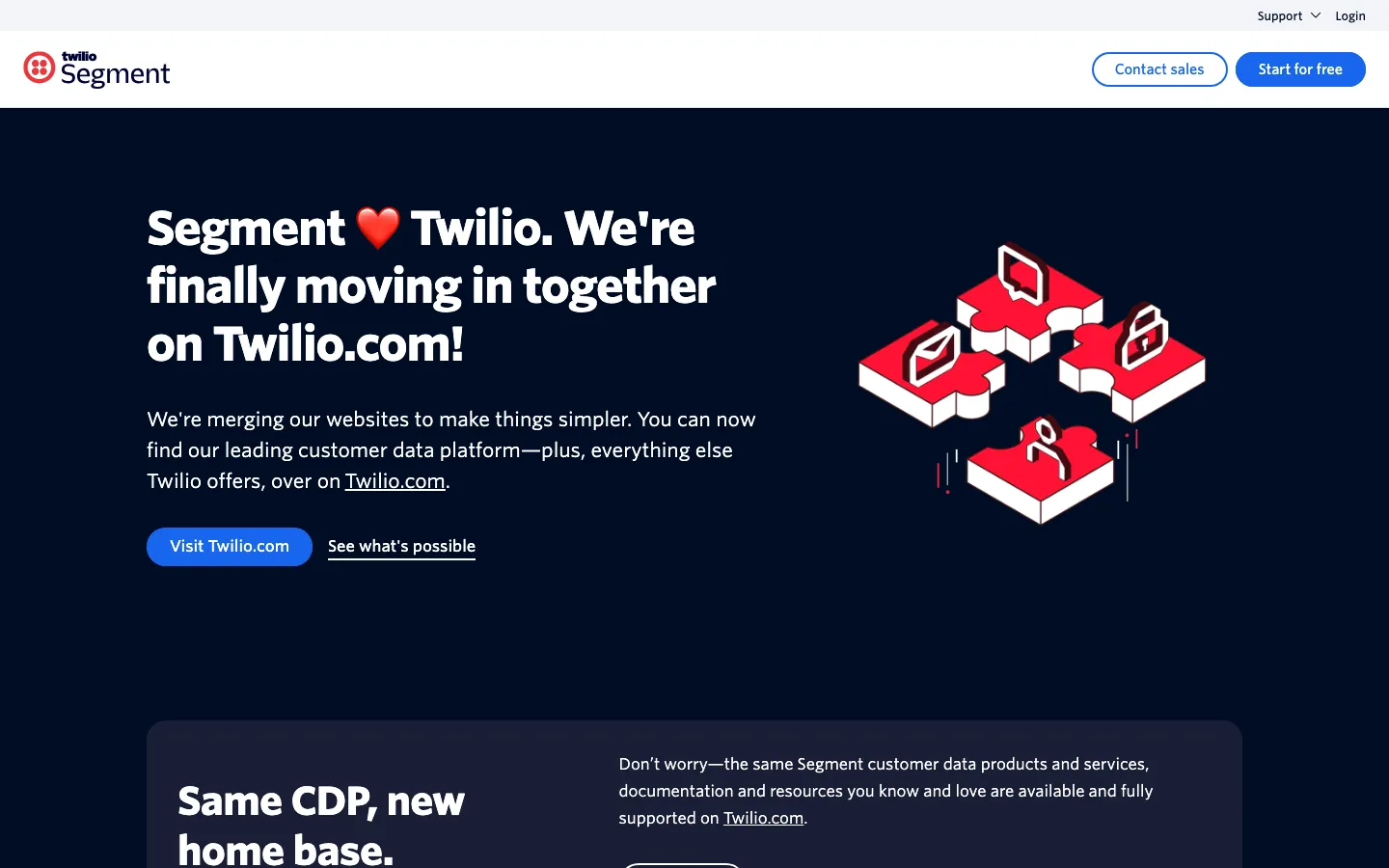
Screenshots of Segment (Twilio) 3 images
What's great
- 550+ integrations, the largest destination catalog in the CDP segment by a wide margin
- Live Debugger shows event streams in real time; data engineers catch schema drift in minutes not days
- Protocols (data governance) ships at Business tier with schema enforcement and violation alerting
- Vendr marketplace data shows median Segment Business contract at $42K/yr, useful negotiation floor; see [Vendr pricing benchmark](https://www.vendr.com/marketplace/twilio-segment)
Watch-outs
- MTU-based pricing grows unpredictably; 100K MTUs hits roughly $600/mo, 1M MTUs lands $3,500-5,000/mo on Business tier
- Identity resolution (Unify) is gated behind Business tier and custom pricing; not accessible on Team at $120/mo
- Twilio merger has shifted roadmap toward comms + data bundle; CDP-specialist features have slowed versus 2023 pace
Segment is the safe starting point for any team that doesn’t already have a mature data warehouse. 565 G2 reviews average 4.5/5; the consistent praise is around the integration breadth and the live debugger, the consistent gripe is the MTU pricing cliff.
Segment.com now redirects to Twilio.com as of early 2026, part of a full brand merge. The CDP.com vendor comparison puts Segment’s integration count ahead of every other packaged CDP.
The common refrain among existing customers is that they will not leave Segment until the migration cost stops looking bigger than the annual bill. For teams under 500K MTUs, the Team tier at $120/mo is a real product. Past 1M MTUs, the math tips toward RudderStack or Hightouch.
Pricing breakdown
| Plan | Price | Best for |
|---|---|---|
| Free (Developer) | $0 | Evaluations |
| Team | $120/mo | Growing startups |
| Business | Custom | Mid-market |
| Enterprise | Custom | 1M+ MTUs |
What reviewers say about Segment (Twilio)
Recurring themes across ~566 G2 reviews (4.5/5), plus Capterra and TrustRadius reviews, 2024-2026.
What reviewers praise
- The 300+ pre-built source and destination connectors let teams instrument tracking once and fan the same events out to every downstream tool without rebuilding pipelines.
- A single analytics.js SDK spec plus the Protocols tracking plan keep event schemas consistent across web, mobile, and server collection.
- The live Source debugger shows events landing in real time, which reviewers say cuts the time to validate a new integration.
- Connections and Reverse ETL cover both event streaming and warehouse sync in one platform, so most stacks avoid a second pipeline tool.
What reviewers fault
- MTU (monthly tracked user) pricing scales painfully, and the jump from the Team tier to the Business tier is repeatedly called steep.
- Governance features like Protocols, Functions, and historical replay sit behind the Business tier, which frustrates smaller teams.
- Support on lower tiers is slow, and deep pipeline debugging often needs paid support or an outside implementation partner.
- Since the Twilio acquisition several reviewers feel roadmap momentum slowed, and Engage (Personas) is a separate, costly add-on.
Loading reviews…
Hightouch
Best warehouse-native composable CDP
Screenshots of Hightouch 3 images
What's great
- Warehouse-native architecture means your Snowflake or BigQuery is the source of truth; no data copy, no second storage bill
- AI Decisioning layer added in late 2025 lets marketers run lifecycle campaigns directly from warehouse models without SQL
- 250+ destination connectors with sync-based pricing (pay per active sync, not per MTU or profile count)
Watch-outs
- Requires an existing data warehouse with mature dbt models; not viable for teams without a data engineer
- Growth plan starts at $1,000/mo; the jump from Free (2 syncs) to production is steep
- Younger ecosystem than Segment; some niche connectors require custom work or a Zapier bridge
Hightouch is the pick for any team that has already invested in Snowflake, BigQuery, or Databricks and wants to activate that data without building a second data silo. 392 G2 reviews average 4.6/5; TrustRadius puts it at 9.1/10.
The Hightouch vs Census comparison published March 2026 notes that Hightouch now positions itself as a full composable CDP, not just a reverse ETL tool.
That’s accurate; the AI Decisioning layer and Customer Studio mean you can run full audience-triggered campaigns from a warehouse model. Census was acquired by Fivetran in May 2025, which makes Hightouch the cleaner independent bet in this architecture. For teams without a warehouse, this is the wrong starting point.
Pricing breakdown
| Plan | Price | Best for |
|---|---|---|
| Free | $0 | Up to 2 active syncs |
| Growth | $1 | Production syncs |
| Business | Custom | Advanced AI Decisioning + Customer Studio |
| Enterprise | Custom | SSO |
What reviewers say about Hightouch
Recurring themes across ~392 G2 reviews (4.6/5), plus TrustRadius and Gartner Peer Insights reviews, 2024-2026.
What reviewers praise
- Reverse ETL from Snowflake, BigQuery, and Databricks to 200+ destinations is the standout, syncing Salesforce, HubSpot, and ad platforms straight from the warehouse.
- The SQL-based audience builder lets data teams define a model once and have marketers reuse it, with no second copy of the data to maintain.
- Support responsiveness in Slack comes up constantly, with engineers answering setup and sync questions quickly.
- The composable, warehouse-native approach lets teams get activation without standing up a heavy standalone CDP.
What reviewers fault
- Costs climb as the number of destinations and sync frequency grow, and per-destination pricing adds up faster than teams expect.
- Non-technical users still hit a SQL wall, so audience work stays dependent on the data team even with the Audiences UI.
- A few connectors lag on niche destinations or specific object fields, forcing manual workarounds.
- Sync-error monitoring can be opaque when a destination API rate-limits, making failed rows harder to trace.
Loading reviews…
Tealium
Best enterprise packaged CDP, strongest tag management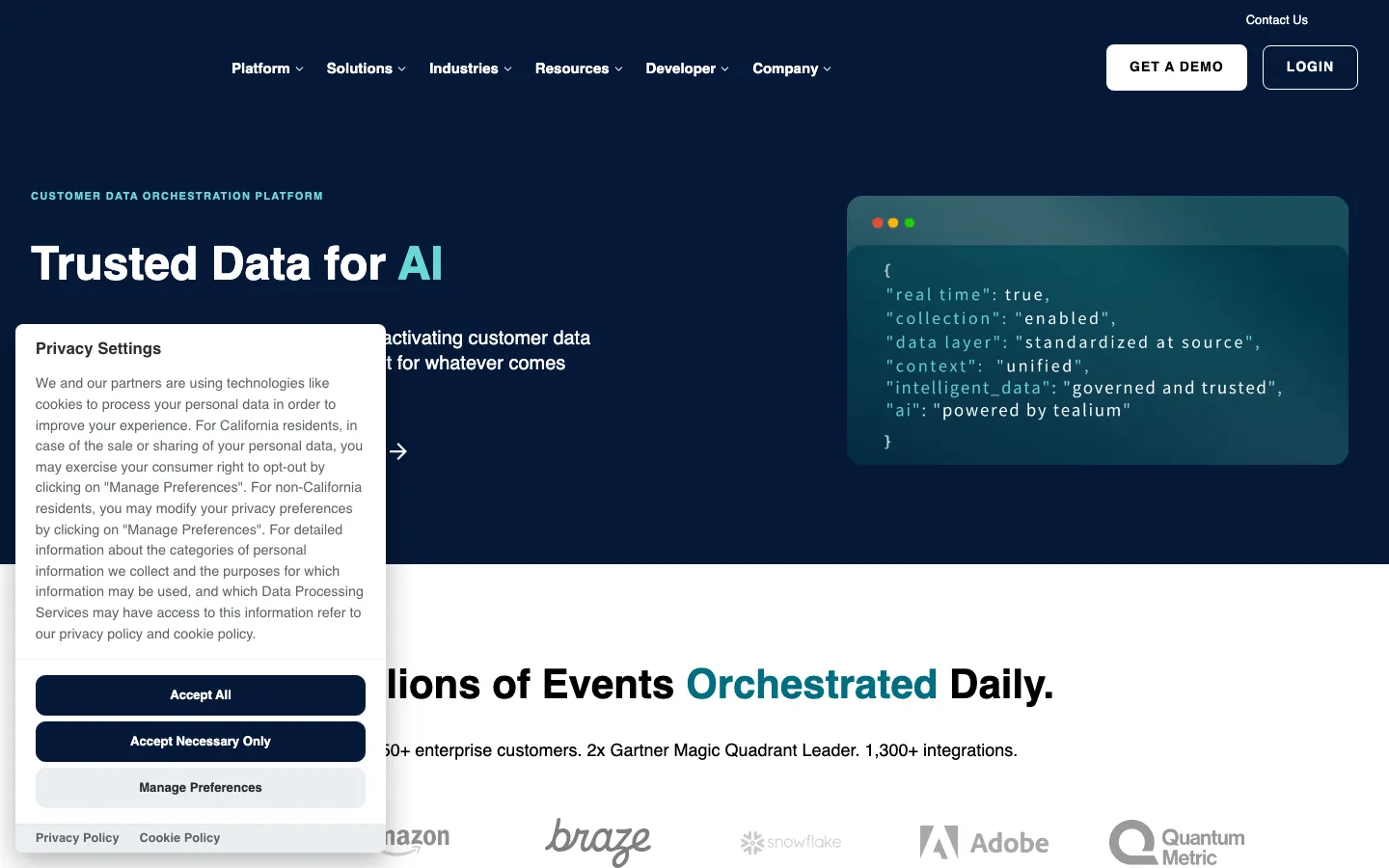
Screenshots of Tealium 3 images
What's great
- Named a Leader in the 2024 Gartner Magic Quadrant for CDPs and a Strong Performer in the 2024 Forrester Wave for B2C CDPs; covered by both major analyst firms in the same year
- Tag management (iQ) plus AudienceStream plus EventStream in one platform; competitors require separate tools for each layer
- 1,300+ turnkey integrations including the largest martech connectors (Adobe, Braze, Salesforce, Quantum Metric), highest count in packaged CDPs
- Cited as a [Strong Performer in the 2024 Forrester Wave for B2C CDPs](https://tealium.com/press-releases/2024-forrester-wave/), on top of its 2024 Gartner Magic Quadrant Leader placement; two analyst data points on enterprise suitability
Watch-outs
- Learning curve is steep; G2 reviews consistently flag implementation complexity and the 6-12 week onboarding timeline
- Event-based pricing scales in ways that surprise teams; a sudden campaign push that doubles event volume can spike the bill materially
- No transparent pricing; expect a 90-day procurement cycle for mid-market and a 6-month cycle for enterprise
Tealium wins when the buying team includes both IT and marketing and both groups need something they trust. The 2024 Gartner Magic Quadrant Leader placement, plus a Strong Performer slot in the 2024 Forrester Wave, matters in enterprise procurement; analyst coverage shortens the security and compliance review.
474 G2 reviews average 4.3/5, lower than Segment but reflective of a more complex tool. Clients include Microsoft, Hyatt, and Gap, per Tealium’s own case study library .
Enterprises at high event volumes often choose Tealium specifically because their IT team needs audit-trail depth that packaged competitors did not offer at the time. The sticker shock is real, but for orgs with a compliance mandate, the TCO math often lands within 15-20% of Segment Business tier once implementation resources are counted.
Pricing breakdown
| Plan | Price | Best for |
|---|---|---|
| AudienceStream | Custom | Mid-market |
| Customer Data Hub | Custom | Enterprise |
| Enterprise Suite | Custom ($50K-$500K/yr) | Fortune 1000 |
| POC Engagement | Custom | Pre-purchase proof of concept |
What reviewers say about Tealium
Recurring themes across ~479 G2 reviews (4.3/5), plus TrustRadius and Gartner Peer Insights reviews, 2024-2026.
What reviewers praise
- iQ Tag Management is mature, and the 1,300+ vendor and tag integration marketplace goes deep enough for large enterprise martech stacks.
- Server-side EventStream plus AudienceStream give real-time visitor stitching and audience activation across channels.
- Being vendor-neutral, it works across whatever analytics and ad stack a team already runs rather than locking them in.
- Onboarding and CSM engagement get good marks for an enterprise tool, with hands-on help during rollout.
What reviewers fault
- The learning curve is steep, and the dense UI means non-technical marketers need training or a dedicated Tealium admin.
- Implementation runs long and often needs professional services, so time to first value is slow.
- Pricing is enterprise-opaque and sits on the higher end, which reviewers say is hard to forecast.
- Parts of the documentation have gaps and some legacy screens feel dated.
Loading reviews…
RudderStack
Best open-source and self-hosted CDP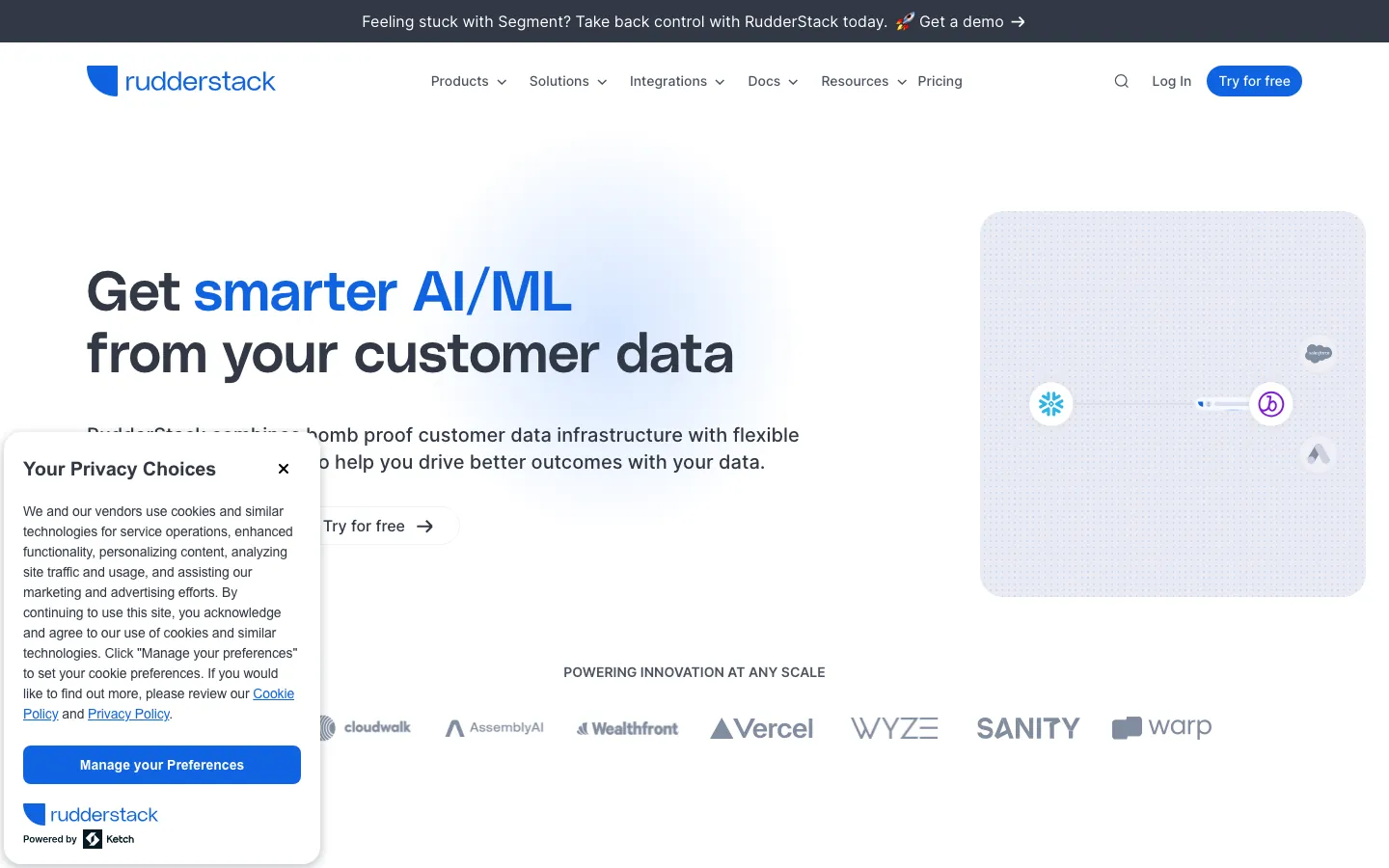
Screenshots of RudderStack 3 images
What's great
- Open-source core means full code visibility, self-host on your own infra, no data ever leaves your cloud boundary
- $220/mo for 1M events/month vs Segment's $600-900/mo at comparable volume; the cost comparison on [Volument's head-to-head](https://volument.com/blog/rudderstack-vs-segment-cdp-pricing-features-and-open-source/) is stark
- Warehouse-native event storage means raw events land in your Snowflake or Redshift automatically, no separate export step
Watch-outs
- UX is more developer-centric than Segment; non-technical marketers will need data team support for most flows
- Integration catalog (200+ destinations) is solid but behind Segment's 550+; some niche marketing tools need custom setup
- Smaller community than Segment; fewer Stack Overflow threads and public runbooks when you hit edge cases
RudderStack is the cost-first pick for engineering-led teams that want Segment’s event-streaming model without the MTU pricing tax. 52 G2 reviews average 4.7/5; the consistent theme is ‘we migrated from Segment and cut our CDP bill by 50-80%.’ The open-source architecture is the real differentiator.
Your data never touches RudderStack’s infrastructure unless you choose the managed cloud tier. CDP.com’s RudderStack profile notes the warehouse-native event storage as the clearest technical differentiator versus Segment.
Best for Series A-B SaaS teams with at least one data engineer who is comfortable with YAML-based source configuration. Not the right pick for marketing teams who expect a Segment-style no-code UI for audience building.
Pricing breakdown
| Plan | Price | Best for |
|---|---|---|
| Free | $0 | Up to 250K events/mo |
| Starter | $220/mo | 1M events/mo |
| Growth | Custom | High-volume |
| Enterprise | Custom | HIPAA |
What reviewers say about RudderStack
Recurring themes across ~51 G2 reviews (4.7/5), plus TrustRadius and Gartner Peer Insights reviews, 2024-2026.
What reviewers praise
- The warehouse-native event pipeline appeals to engineering teams who want data landing in Snowflake or BigQuery first, before any downstream tool.
- Open-source roots and a self-host option give teams more control and lower cost than Segment at high event volume.
- The Segment-compatible API and well-rated SDK docs make migrating off Segment a low-friction path.
What reviewers fault
- The UI and non-technical usability lag, since the product is built for engineers rather than marketers.
- A few destinations and transformations feel less polished than Segment's, with occasional connector bugs.
- The ecosystem and community are smaller than Segment's, so teams own more of the debugging themselves.
Loading reviews…
mParticle (by Rokt)
Best CDP for mobile-heavy and multi-platform consumer products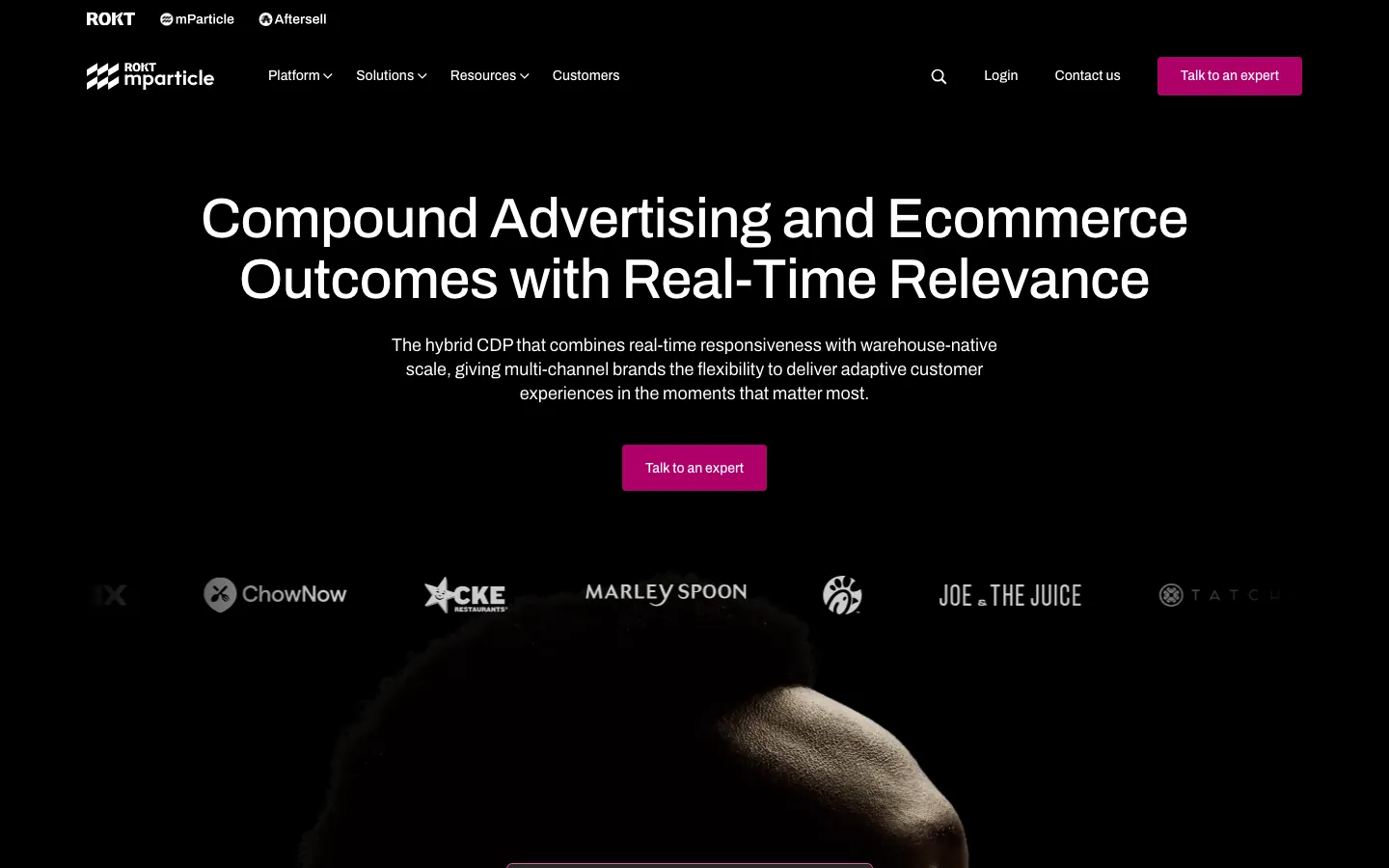
Screenshots of mParticle (by Rokt) 3 images
What's great
- Purpose-built iOS and Android SDKs with battle-tested reliability at consumer scale (300M+ profiles reported by major clients)
- IDSync (identity resolution) handles the cross-device complexity of mobile + web + in-store better than any other packaged CDP
- Data Planning enforces schema contracts at the SDK level, catching bad events before they pollute the warehouse
Watch-outs
- Acquired by Rokt in January 2025 for $300M; product roadmap direction under new ownership is still uncertain as of mid-2026
- Pricing is entirely custom, entirely opaque; expect $30K/yr floor for any serious deployment
- Web-first SaaS teams with minimal mobile surface area will find Segment cheaper and almost as capable
mParticle is the right CDP when your product lives primarily on iOS and Android and your data team needs SDK-level guarantees on event quality. 175 G2 reviews average 4.4/5.
The Rokt acquisition in January 2025 for $300M is the main watch item; mParticle’s own announcements position the integration with Rokt’s ecommerce AI as a new category, but buyers evaluating a 3-year CDP contract should pressure-test roadmap continuity in the negotiation.
Improvado’s mParticle competitor breakdown places IDSync as the strongest cross-device identity implementation in the mid-market packaged CDP category. For mobile-first consumer apps at Series B and beyond, this is the product with the most mature SDK primitives.
For web-first B2B SaaS at under 5M MTUs, Segment or RudderStack will cover 90% of the same use cases at a lower price.
Pricing breakdown
| Plan | Price | Best for |
|---|---|---|
| Growth | Custom | Series B mobile apps |
| Enterprise | Custom (~$30K-$150K/yr) | 10M+ MTUs |
| Enterprise+ | Custom | 100M+ profiles |
| Cortex AI | Custom add-on | ML-based audience predictions |
What reviewers say about mParticle (by Rokt)
Recurring themes across ~175 G2 reviews (4.4/5), plus TrustRadius and Gartner Peer Insights reviews, 2024-2026.
What reviewers praise
- Mobile and SDK-first data collection is the strength, and reviewers running app-heavy, high-volume consumer products call the event capture reliable.
- The rules engine and data-quality filters catch malformed events before they reach downstream tools, which keeps activation data clean.
- IDSync identity resolution stitches users across devices well for cross-platform apps.
- The integration catalog for mobile attribution and marketing tools is broad enough to cover most consumer stacks.
What reviewers fault
- Enterprise, event-volume-based pricing runs high, and costs surprise teams once traffic scales.
- Setup is heavy and needs engineering involvement to implement the SDK and rules correctly.
- The reporting and parts of the UI are seen as less intuitive, with some features buried.
- The Rokt acquisition raised roadmap and direction questions for a few longtime reviewers.
Loading reviews…
Census (Fivetran Activations)
Best for revenue ops and CRM sync from warehouse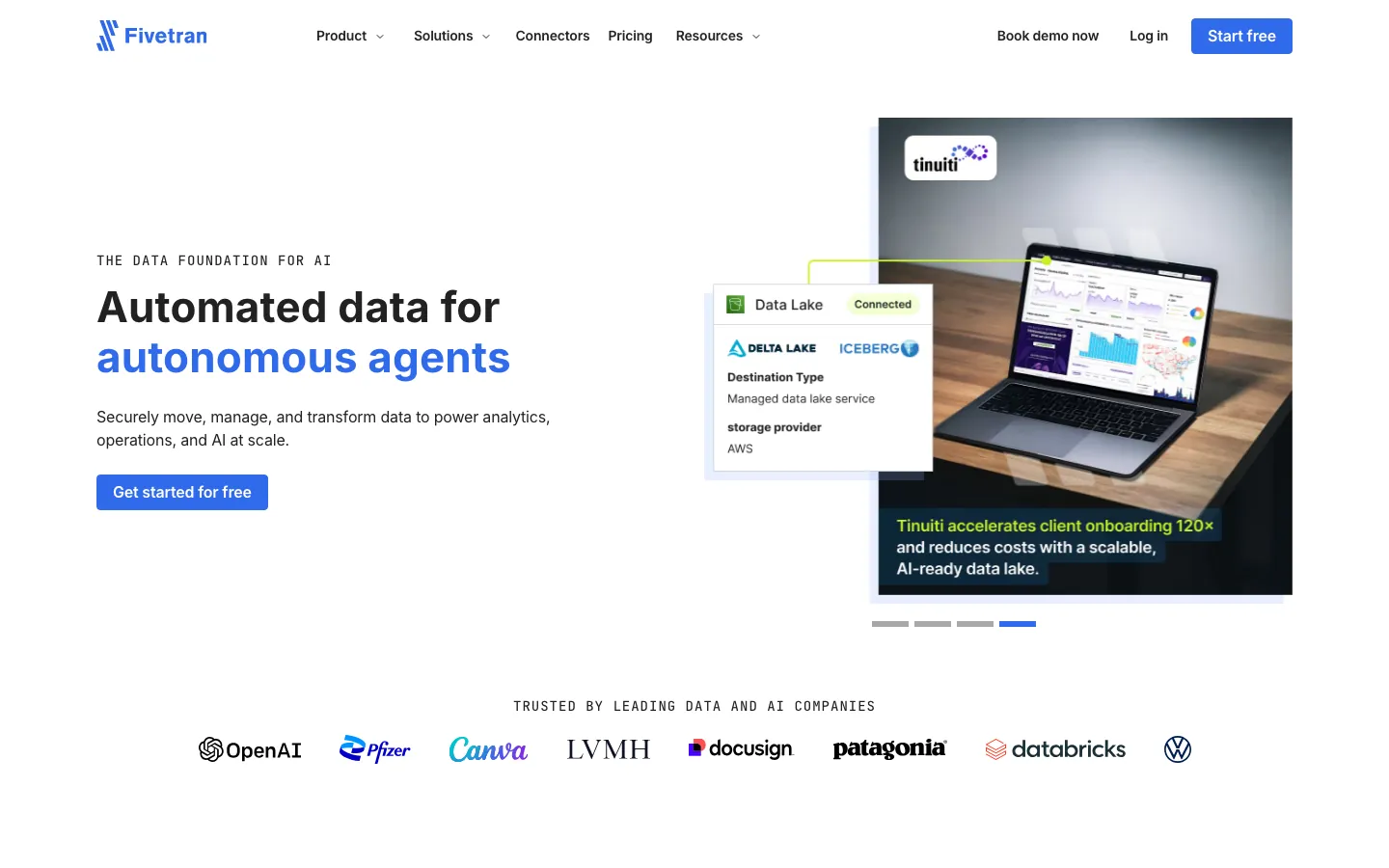
Screenshots of Census (Fivetran Activations) 3 images
What's great
- Revenue ops use case (syncing warehouse models to Salesforce, HubSpot, Marketo) is the clearest and fastest to deploy in this category
- 200+ destination connectors with a UI that RevOps and marketing ops teams can manage without SQL
- Observable syncs with row-level error reporting; broken syncs are visible before they corrupt CRM data
- Sync observability scores highest in the category per [Integrate.io's Census review](https://www.integrate.io/blog/census-review/); row-level error visibility is rare in reverse ETL tools
Watch-outs
- Fivetran acquired Census in May 2025; billing now migrates to Fivetran's MAR-based consumption model, which has proven unpredictable for teams with high-update-frequency syncs
- Product-led growth and advertising use cases are thinner than Hightouch's feature set
- The acquisition creates uncertainty about long-term Census branding and standalone product roadmap
Census built its reputation as the cleanest reverse ETL tool for revenue ops, and that reputation holds. 339 G2 reviews average 4.5/5; the consistent praise is fast time-to-value and the UI that RevOps leads can actually operate.
The Fivetran acquisition in May 2025 is the main complication: Census is now ‘Fivetran Activations’ for new contracts, and the MAR-based billing model has surprised some teams. For CRM enrichment and marketing ops sync use cases, Census/Activations is still excellent.
For buyers evaluating a multi-year data activation platform, the acquisition risk tilts the decision toward Hightouch as the independent alternative.
Pricing breakdown
| Plan | Price | Best for |
|---|---|---|
| Free | $0 | Up to 3 syncs |
| Core | Via Fivetran MAR pricing | 5-20 active syncs |
| Platform | Custom | Advanced observability + audience features |
| Enterprise | Custom | SOC 2 |
What reviewers say about Census (Fivetran Activations)
Recurring themes across ~339 G2 reviews (4.5/5), plus TrustRadius reviews, 2024-2026.
What reviewers praise
- Reverse ETL setup is quick, syncing warehouse models to Salesforce, HubSpot, and ad platforms with minimal configuration.
- The dbt and Git integration and version-controlled syncs fit analytics-engineering workflows that already live in the warehouse.
- Sync logs and observability make it easy to see exactly what synced and what errored on each run.
- Support is responsive, with reviewers noting fast help on mapping and connector questions.
What reviewers fault
- After the May 2025 Fivetran acquisition the product folded into Fivetran Activations, and reviewers flag uncertainty about the standalone roadmap.
- Pricing scales with synced fields and records, so active syncs can get expensive at volume.
- Some destinations have field-mapping limits that need manual workarounds.
- Non-technical users still depend on the data team to build the underlying models.
Loading reviews…
BlueConic
Best marketer-operated CDP, no SQL required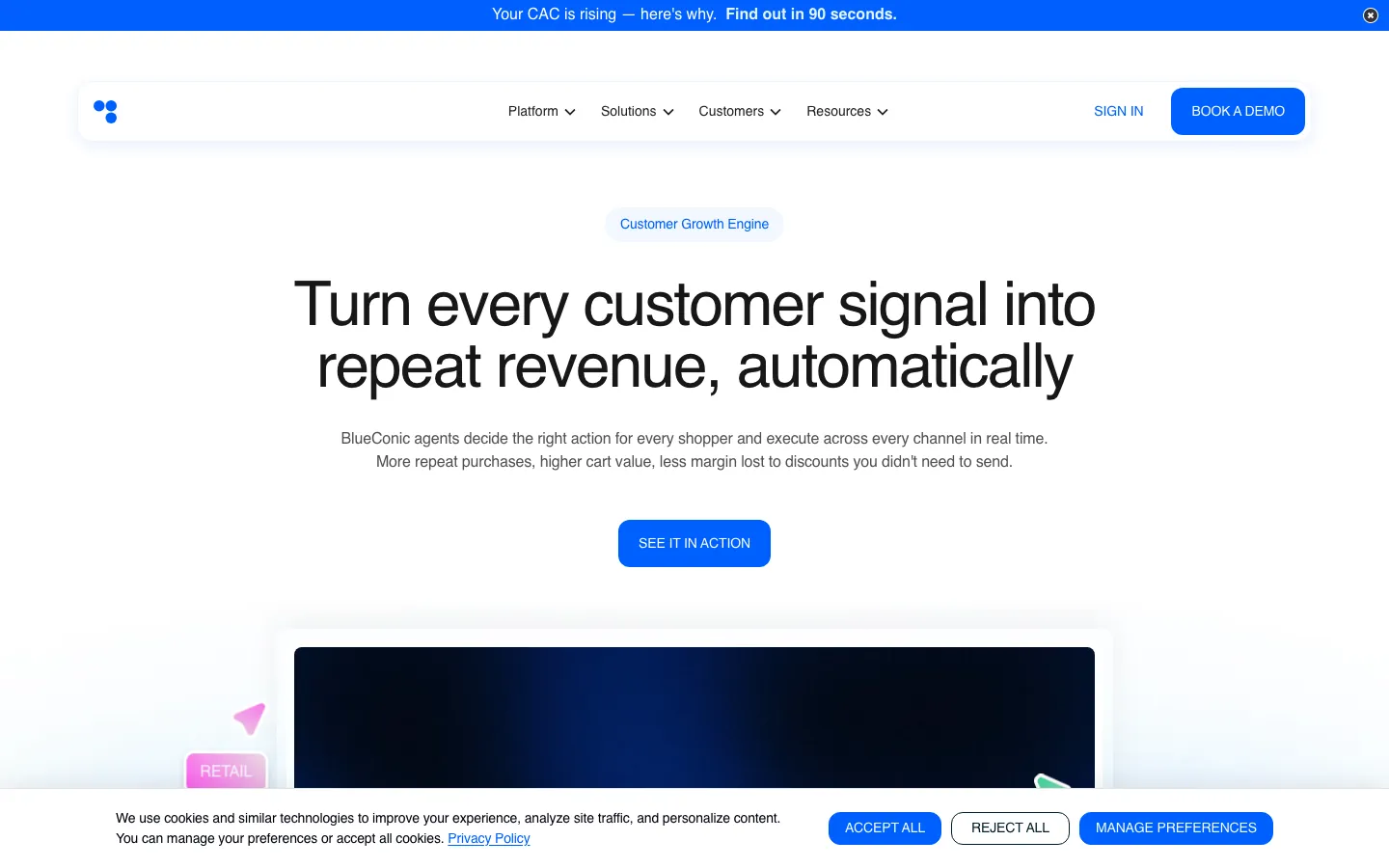
Screenshots of BlueConic 3 images
What's great
- Marketers can build segments, run A/B tests, and trigger activations without a SQL query or a data engineering ticket
- Profile unification across anonymous and known visitors ships without custom development; the UI handles the rules visually
- Support team is consistently cited in G2 reviews as a co-development partner, not a ticket queue
- [Gartner Peer Insights CDP reviews](https://www.gartner.com/reviews/product/blueconic-cdp) consistently rate BlueConic above 4.5/5; buyers are concentrated enterprise marketing teams, not product managers
Watch-outs
- Only 19 G2 reviews; the small review footprint makes it harder to validate claims at scale
- Ecosystem depth is narrower than Segment or Tealium; fewer out-of-box connectors for niche martech
- Requires publisher-level data volumes (millions of cookies) to unlock the full audience modeling value
BlueConic is the pure-play CDP most accessible to a marketing team that doesn’t have a data engineer on call. Unlike every other tool in this list, a senior digital marketer can operate BlueConic’s segmentation and activation without SQL.
The 19 G2 reviews that exist average 4.1/5, with every reviewer citing the support team as a genuine partner. The CDP.com BlueConic profile positions it squarely in the ‘marketer-operated’ segment, distinct from the data-engineer-operated tools.
Best for media companies, publishers, and retail brands where the marketing team owns customer data operations. For engineering-led SaaS teams, Segment or RudderStack is a better fit.
Pricing breakdown
| Plan | Price | Best for |
|---|---|---|
| Mid-market | Custom | 1M-10M profiles |
| Enterprise | Custom | 10M-100M profiles |
| Enterprise Plus | Custom | 100M+ profiles |
| POC | Custom | Pre-purchase pilot |
What reviewers say about BlueConic
Recurring themes across public G2, TrustRadius, and Gartner Peer Insights reviews, 2024-2026. The G2 review pool is thin (roughly 15 reviews), so no headline rating is shown.
What reviewers praise
- The marketer-first, no-code segmentation lets marketing teams build and unify audiences without leaning on engineering for every change.
- Profile unification plus on-site personalization and 100+ pre-built connectors come in one platform aimed at the marketer, not the data engineer.
- Onboarding and hands-on support get consistent praise from the smaller review base.
What reviewers fault
- The installed base and ecosystem are much smaller than Segment or Adobe, so community answers and third-party expertise are harder to find.
- Pricing is quote-only and reviewers describe it as not cheap for the segment it targets.
- Some advanced configuration and integrations still need technical help despite the no-code framing.
Loading reviews…
Adobe Real-Time CDP
Best for Adobe Experience Cloud shops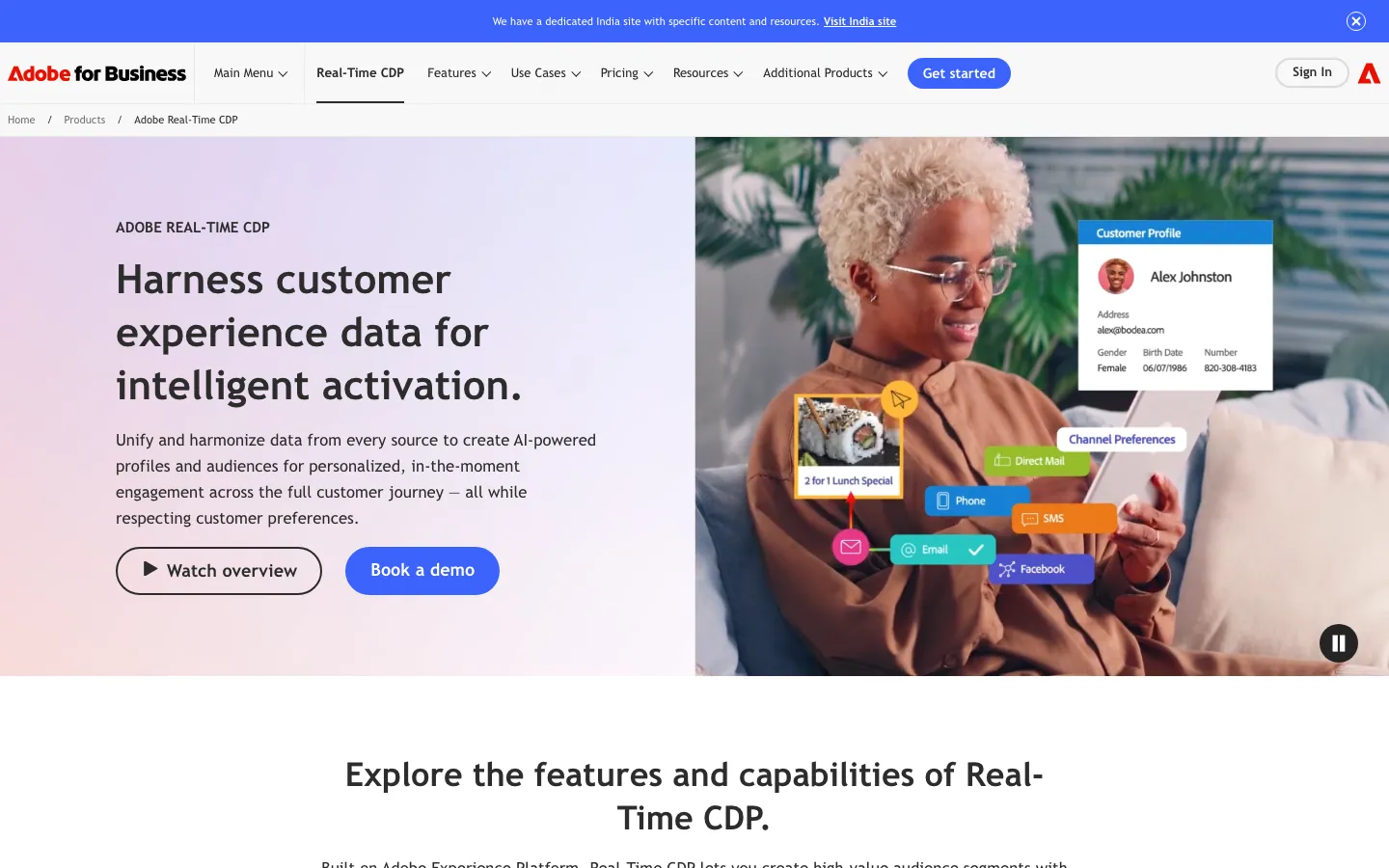
Screenshots of Adobe Real-Time CDP 3 images
What's great
- Deepest native integration with Adobe Experience Platform, Analytics, Journey Optimizer, and Target; data flows without custom ETL
- Real-time profile streaming across B2C, B2B, and B2P editions; the B2P edition is unique to Adobe in this market
- Enterprise-grade identity graph handles pseudonymous + known profiles at scale; confirmed at Fortune 500 deployments
- [Adobe earned 28 G2 Best Software recognitions in 2026](https://business.adobe.com/blog/adobe-earns-28-recognitions-g2-best-software-awards-2026), including multiple Experience Platform categories beyond CDP alone
Watch-outs
- 4.2/5 on G2, the lowest score in this guide; implementation complexity and time-to-value are the recurring complaints
- Pricing requires a sales engagement; expect $75K-$300K/yr depending on profile volume and AEP applications licensed
- Teams not already in the Adobe ecosystem face a steep migration cost and a 6-12 month implementation timeline
Adobe Real-Time CDP is the right answer when your company has already committed to Adobe Experience Platform. 165 G2 reviews average 4.1/5, the lowest score in this guide, reflecting a product built for enterprise scale rather than ease of use.
The CDP.com Adobe profile notes that zero-copy integration with external data lakes is available through Federated Audience Composition but is less flexible than pure composable CDP approaches.
Adobe earned 28 G2 Best Software recognitions in 2026, but the CDP product specifically still draws complaints about implementation timeline and professional services dependency. For any team outside the Adobe ecosystem, every other tool in this guide is a faster path to value.
Pricing breakdown
| Plan | Price | Best for |
|---|---|---|
| B2C Edition | Custom | Consumer brands |
| B2B Edition | Custom | Account-based marketing |
| B2P Edition | Custom | Companies serving both B2C and B2B segments |
| Prime + Ultimate | Custom ($75K-$300K+/yr) | Full AEP deployment |
Loading reviews…
Treasure Data
Best CDP for Fortune 1000 manufacturing and retail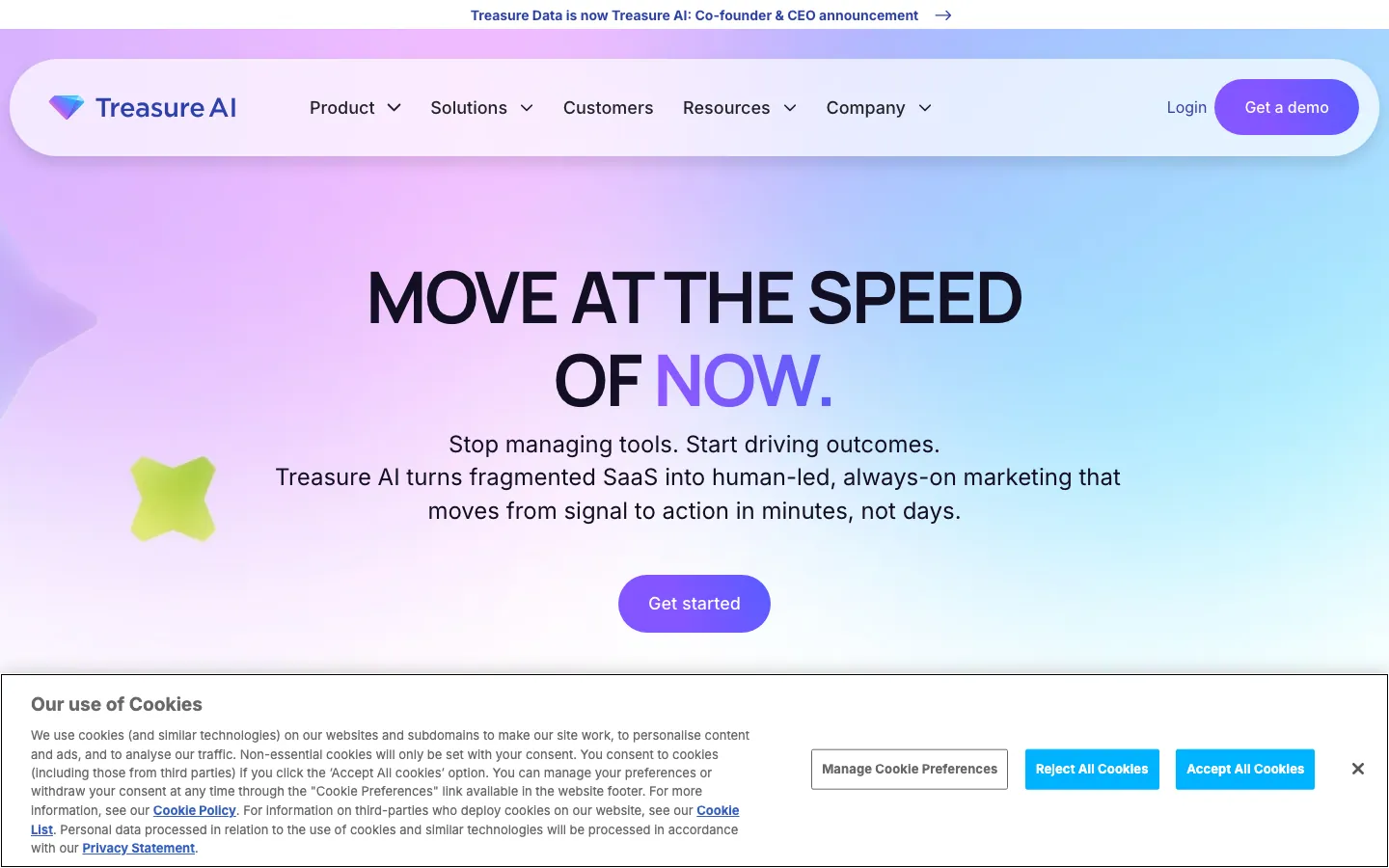
Screenshots of Treasure Data 3 images
What's great
- No-compute pricing model decouples cost from query volume; run unlimited segmentations without per-query bills
- Server-side data processing with AI modeling depth that handles in-store, online, and mobile channels in one identity graph
- Named a Leader in both the 2024 Gartner Magic Quadrant and the 2024 Forrester Wave for B2C CDPs, one of the few vendors to land Leader status in both that year
- [Gartner Peer Insights CDP ratings](https://www.gartner.com/reviews/product/treasure-data-cdp) put Treasure Data at 4.7/5 across enterprise deployments, one of the highest sustained scores in the category
Watch-outs
- Only 164 G2 reviews; review count reflects the enterprise-only focus, fewer customers but larger deployments
- Not a realistic evaluation for companies under $100M revenue; the POC engagement process alone takes 4-6 weeks
- US-based data teams often find the Japan-originated enterprise culture in support and account management to be slower-moving than Tealium or Adobe counterparts
Treasure Data is the CDP for companies where ’enterprise’ means Global 2000, not Series C. 164 G2 reviews at 4.5/5 is a strong score given the complexity of the deployments. The no-compute pricing model is genuinely differentiated.
When your data team runs 10,000 segmentation queries a month, paying per-query adds up fast. CDP.com’s vendor comparison places Treasure Data alongside Tealium and Salesforce Data Cloud as the enterprise Leaders.
Best for manufacturing, automotive, and large retail brands with omnichannel identity complexity (in-store + app + loyalty programs). For sub-$100M companies, the procurement cycle alone makes this the wrong choice.
Pricing breakdown
| Plan | Price | Best for |
|---|---|---|
| Enterprise | Custom | 50M-500M profiles |
| Enterprise Plus | Custom | Full AI modeling + unlimited queries |
| POC | Paid pilot | Pre-purchase proof of concept |
| Global Expansion | Custom | Multi-region data residency |
What reviewers say about Treasure Data
Recurring themes across ~164 G2 reviews (4.5/5), plus TrustRadius and Gartner Peer Insights reviews, 2024-2026.
What reviewers praise
- The platform ingests and unifies very large data volumes, which enterprise consumer brands cite as the reason they picked it over lighter CDPs.
- Flexible SQL (Presto) plus Treasure Workflow let data teams build custom pipelines and transformations rather than being boxed into presets.
- Identity stitching across sources is strong for enterprises consolidating fragmented first-party data.
- CSM support and professional services get good marks during and after implementation.
What reviewers fault
- Getting value requires real SQL and technical skill, so it is not friendly to marketers out of the box.
- Implementation is heavy and long, and most teams need vendor services to stand it up.
- Parts of the UI feel dated compared with newer CDPs.
- Pricing is enterprise-opaque and lands on the high side, which reviewers say complicates budgeting.
Loading reviews…
ActionIQ
Best composable CDP for enterprise media and financial services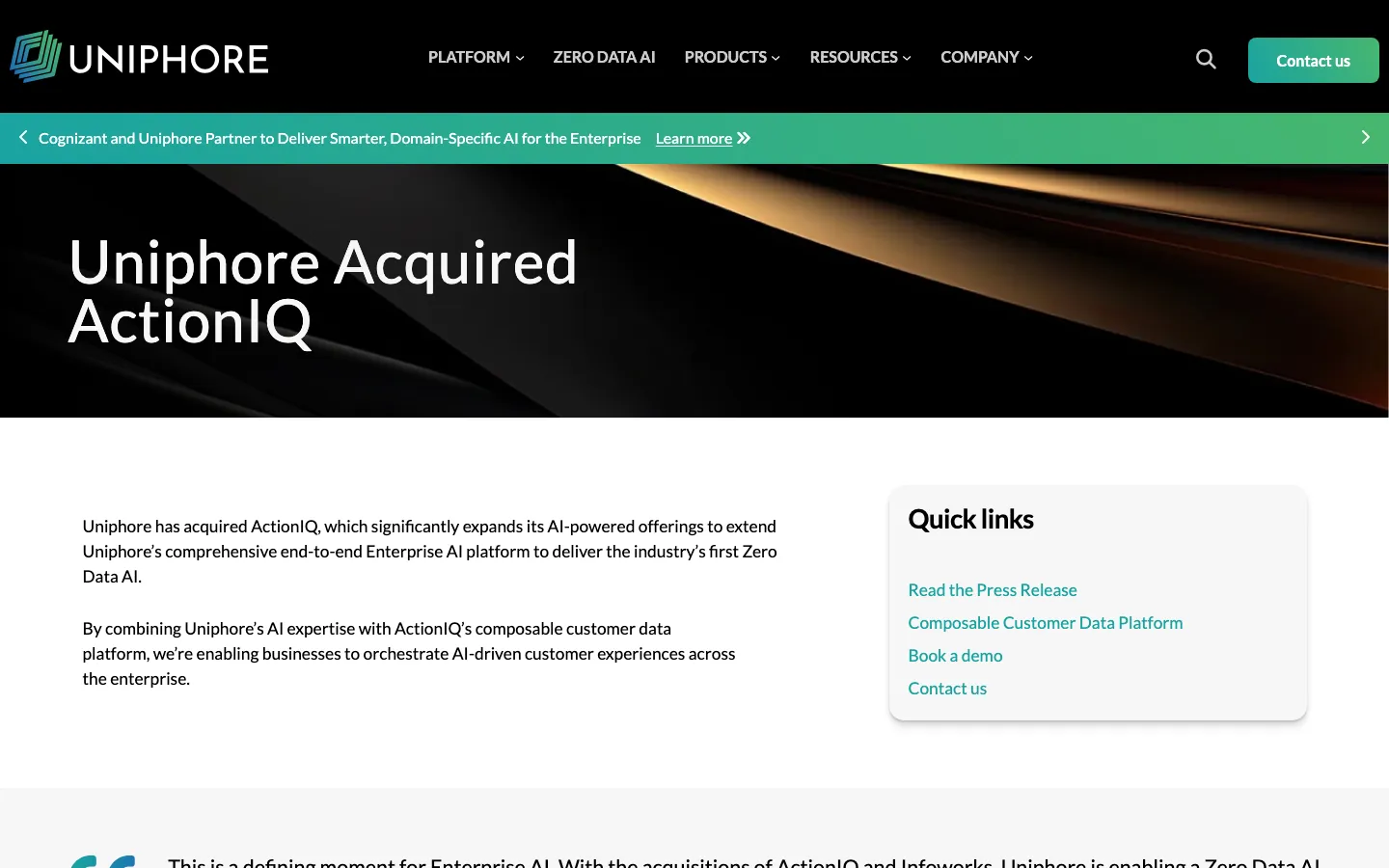
What's great
- Composable architecture means ActionIQ federates over your existing data stores without requiring a full data migration
- Strong in regulated industries; HIPAA, SOC 2, and financial-services compliance frameworks built in, not bolted on
- Audience orchestration across 50+ activation channels with frequency capping and suppression logic built natively
- Composable CDP architecture, where each CDP function can come from a different vendor or in-house tool instead of one packaged suite, as [CDP.com lays out](https://cdp.com/articles/what-is-composable-cdp/); ActionIQ is one of the earliest enterprise implementations
Watch-outs
- Acquired by Uniphore in December 2024; product roadmap and go-to-market have shifted toward Uniphore's enterprise AI positioning
- Only 45 G2 reviews; enterprise tools at this price point rarely accumulate the review counts of self-serve tools
- Requires significant professional services engagement; not a self-serve evaluation path
ActionIQ built its name in enterprise media and financial services where the data governance requirements make most CDPs non-starters. 45 G2 reviews at 4.1/5 reflects the enterprise concentration.
The Uniphore acquisition in December 2024 combined ActionIQ’s composable CDP with Uniphore’s AI platform; the ActionIQ press positioning frames it as ’the industry’s first Zero Data AI.’ That’s marketing language, but the underlying composable architecture is real and has been validated in financial services deployments.
The audience orchestration depth is genuinely better than most CDPs for regulated-industry use cases. For anyone outside enterprise media, financial services, or telco, Tealium or Adobe is a more natural fit.
Pricing breakdown
| Plan | Price | Best for |
|---|---|---|
| Enterprise | Custom | Media |
| Enterprise AI | Custom | Uniphore AI + ActionIQ composable CDP |
| Regulated Industry | Custom | HIPAA + SOC 2 compliance mandates |
| POC | Custom | Pre-purchase pilot engagement |
What reviewers say about ActionIQ
Recurring themes across ~45 G2 reviews (4.1/5), plus Gartner Peer Insights reviews, 2024-2026.
What reviewers praise
- The composable, enterprise-grade audience builder runs on top of the existing warehouse, so large brands avoid copying all their data into a new store.
- It handles big, complex enterprise data sets that lighter CDPs struggle with.
- The query engine and segmentation are flexible enough for sophisticated audience logic.
What reviewers fault
- Enterprise complexity means setup takes real technical work and a meaningful ramp before teams see value.
- Pricing is enterprise-only and high, which puts it out of reach for mid-market buyers.
- The Uniphore acquisition raised roadmap and direction questions among some reviewers.
- The ecosystem is smaller than the market leaders and a few UI areas feel rough.
Loading reviews…
Tools we considered but excluded
We evaluated more tools than the 10 you see above. These did not make the cut. Saying what we rejected, and why, is the editorial muscle most listicles skip.
- Salesforce Data Cloud: Primarily evaluated as a Salesforce ecosystem extension rather than a standalone CDP buy; bundled pricing through Sales/Marketing Cloud makes standalone comparison misleading for most readers
- Oracle Unity CDP: Oracle's focus has shifted to AI-led CX cloud bundles; Unity CDP as a standalone product is increasingly hard to evaluate separately from the Oracle stack
- Lytics: Strong for publishers and media companies but review footprint (under 30 G2 reviews) and specialist vertical focus mean it doesn't compete across the broad readership of this guide
- Listrak: Retail and hospitality vertical CDP with good reviews but too narrow in scope; Blueprint-level integration with email/SMS only, not a full-stack CDP
- Amperity: Strong for retail and hospitality identity resolution but enterprise-only, complex procurement, and outside the scope of teams under 50M+ customer profiles
- Simon Data: Outbound-focused CDP that lives between marketing automation and CDP; the review footprint is too small to validate claims at the scale this guide needs
Honorable mentions
Solid tools that did not crack the main list but are worth tracking, especially for niche use cases.
- PostHog: Open-source product analytics with a CDP-adjacent event pipeline; strong for early-stage product teams that want Segment-like tracking without the bill
- Rudderstack Cloud (Warehouse-native): Worth re-evaluating at 18 months if you start on RudderStack OSS and want to graduate to managed cloud without switching vendors
- GrowthLoop: Warehouse-native activation tool built on top of BigQuery specifically; a strong niche pick for Google Cloud-committed enterprise teams
The four CDP architectures buyers confuse
The CDP market in 2026 is not one market. It is at least three, and buying the wrong architecture costs a year of migration time and often $100K+ in switching costs.
Packaged CDPs. One platform handles data collection, identity resolution, audience building, and activation. Segment, mParticle, Tealium, Adobe Real-Time CDP, BlueConic, and Treasure Data all sit here. You pay for the bundle. The benefit is speed to value; the risk is MTU-based or profile-based pricing that scales faster than your budget.
Warehouse-native CDPs (reverse ETL). Your data warehouse is the source of truth. You model customer data there using dbt or raw SQL, then use a tool like Hightouch, RudderStack, or Census to sync that data to operational tools: Salesforce, HubSpot, your ABM platform , Braze, Meta Ads. No second data silo.
The benefit is cost efficiency and data ownership. The risk is that you need a data engineer to set it up and maintain the models. These warehouse-native tools are the developer-friendly CDPs in this guide, and they also tend to be the best CDP solutions for mid-market ecommerce brands that already own a Snowflake or BigQuery warehouse.
Open-source / self-hosted CDPs. RudderStack ships as open-source. PostHog does too (honorable mention). You run them on your infrastructure, you own the data entirely, no MTU bill ever. The cost is engineering time to operate and scale.
Enterprise packaged CDPs. Tealium, Adobe, Treasure Data, and ActionIQ serve Global 2000 customers with contracts starting at $50K-$75K/yr. The buying process is a 3-6 month procurement cycle. The review counts on G2 are smaller because enterprise customers don’t fill out review forms; they send legal to negotiate NDAs.
Composable CDPs. A newer framing (mostly pushed by Hightouch and Census) where you assemble CDP capabilities from best-of-breed components: a warehouse for storage, a transformation layer (dbt), and an activation layer (Hightouch or Census). No single vendor owns the full stack.
This guide tests all five categories across the 10 tools above. Below: the 2026 trends reshaping which architecture wins.
What’s changing in CDP software in 2026
The warehouse-native pattern won the architectural debate. Through 2023, packaged CDPs pitched “one platform for everything.” By 2026, most data-mature teams have a Snowflake or BigQuery and are asking why they’re paying $5,000/mo for Segment to store data they already have.
Hightouch and RudderStack both reported accelerating mid-market migrations from Segment in late 2025. The packaged-CDP vendors are responding: Segment launched Destinations Actions for direct warehouse write-backs, and Tealium added warehouse connectors in their 2025 roadmap.
Identity resolution is the hidden differentiator. Every CDP says it does identity resolution. The gap between “we link emails to cookies” and “we resolve the same person across seven touchpoints including in-store loyalty, a mobile app, and three web domains” is enormous. mParticle’s IDSync and Tealium’s AudienceStream are the packaged-CDP leaders here.
For warehouse-native teams, identity resolution becomes a dbt model problem, which is either an advantage (you own the logic) or a burden (you have to build it).
Fivetran’s Census acquisition changed the reverse ETL landscape. Census was the leading reverse ETL tool alongside Hightouch. Fivetran acquired it in May 2025 and folded it into Fivetran Activations with MAR-based billing. Teams that built their RevOps workflows on Census are now evaluating whether to stay on the Fivetran path or migrate to Hightouch. This is the biggest near-term vendor-risk story in the CDP space.
AI Decisioning is being layered onto every CDP. Hightouch launched AI Decisioning in late 2025. Tealium has embedded predictive models into AudienceStream. mParticle’s Cortex ML layer has been live since 2024. The practical impact for most teams in 2026 is limited; the tooling is real but requires mature training data (typically 12+ months of clean event history) before the AI outputs are trustworthy.
Enterprise CDPs are consolidating through acquisition. Uniphore acquired ActionIQ. Rokt acquired mParticle. The CDP Institute counted 19 CDP vendor acquisitions or closures in 2025 alone. For buyers considering a 3-year contract with any mid-size CDP vendor, the acquisition risk deserves a dedicated line in the evaluation criteria.
Selection criteria, what to test in your CDP trial
The CDP demo is always good. The questions below are what separate the purchase that works from the one that turns into a 9-month implementation project.
One, connect a real source on day one. Don’t use demo data. Take your actual website’s JavaScript snippet or your iOS app and point it at the CDP. If the first real event takes more than 30 minutes to show up in the debugger, that’s a data point. Segment’s live debugger shows events in under 5 seconds. Some enterprise CDPs take 10-15 minutes for first event confirmation.
Two, break an event schema deliberately. Change a property name that downstream tools depend on. See what happens. Does the CDP alert you? Does it fail silently? Protocols (Segment Business), Tealium’s validation, and mParticle’s Data Planning all catch this. Basic tiers of most tools don’t.
Three, test identity resolution with a real anonymous-to-known journey. Create an anonymous session, add a product to a cart, then register with an email. Does the CDP correctly merge the anonymous profile with the known profile? Does it retroactively attribute the pre-registration events to the new profile? This is where most CDPs claim capability but only 3-4 actually deliver it cleanly.
Four, run an audience sync to your CRM and your ad platform simultaneously. Most CDP demos show one activation. Real workflows sync to Salesforce and Meta Ads at the same time, with suppression logic so users who converted in Salesforce are excluded from Meta retargeting within 24 hours. Test this end-to-end before signing.
Five, ask for the MTU or event count for three of their current customers at your size. Not theoretical pricing. Actual billing from companies your size. Then model what your year-2 bill looks like at 2x your current MAU. This is where most CDP purchases go wrong.
Six, export your full dataset. Every contact, every event, every audience segment, in a format you can reload elsewhere. If this requires a support ticket or a “contact your CSM” call, the data isn’t really yours. Walk away from any contract that fails this test.
Seven, run the schema change test again, but with real downstream consumers. Change an event property that Braze or your email tool relies on. Does the CDP surface the downstream impact before you deploy? Segment Protocols does this. Most tools don’t.
Eight, talk to three current customers without the vendor on the call. Find them on LinkedIn. Ask: would you buy this again at full price, knowing what you know now? The unfiltered version of that answer is worth more than any G2 review.
Where the CDP platforms differ on core features
| Tool | Real-time streaming | Identity resolution | Warehouse sync | No-code audience builder | Free tier |
|---|---|---|---|---|---|
| Segment (Twilio) | ✓ | Business+ only | ✓ (Destinations) | ✓ Team+ | ✓ (1K MTU) |
| Hightouch | ✓ | • (warehouse model) | ✓ native | ✓ (Growth+) | ✓ (2 syncs) |
| Tealium | ✓ | ✓ | ✓ (2025 add) | ✓ | ✗ |
| RudderStack | ✓ | • (warehouse model) | ✓ native | • (dev-friendly) | ✓ (250K events) |
| mParticle | ✓ | ✓ (IDSync) | ✓ | ✓ | ✗ |
| Census | ✓ (batch + streaming) | • (warehouse model) | ✓ native | ✓ | ✓ (3 syncs) |
| BlueConic | ✓ | ✓ | • (limited) | ✓ (marketer UI) | ✗ |
| Adobe Real-Time CDP | ✓ | ✓ | • (Federated) | ✓ | ✗ |
| Treasure Data | ✓ | ✓ | ✓ | ✓ | ✗ |
| ActionIQ | ✓ | ✓ | ✓ (composable) | ✓ | ✗ |
The three tools with genuine free tiers for evaluation are Segment (1K MTU), RudderStack (250K events), and Hightouch/Census (sync-count limits). Every enterprise tool is demo-only. For teams evaluating without a vendor engagement, start with Segment Free or RudderStack Free.
Integration depth across the CDP stack
| Tool | Snowflake / BigQuery | Salesforce | Meta Ads | Braze | Segment-compatible |
|---|---|---|---|---|---|
| Segment (Twilio) | N (Connections) | N | N | N | N (native) |
| Hightouch | N (source) | N | N | N | N (as destination) |
| Tealium | N (2025) | N | N | N | N |
| RudderStack | N (warehouse-native) | N | N | N | N (Segment-compatible API) |
| mParticle | N | N | N | N | M (via partner) |
| Census | N (source) | N | N | N | M (via partner) |
| BlueConic | • (limited export) | N | N | N | ✗ |
| Adobe Real-Time CDP | • (Federated Audience) | N | N | N | ✗ |
| Treasure Data | N | N | N | M | ✗ |
| ActionIQ | N (composable) | N | N | N | ✗ |
RudderStack’s Segment-compatible SDK is the most underrated item in this table. If you already have Segment instrumentation, you can point the same SDK at RudderStack without re-instrumenting your app. That makes RudderStack the lowest-friction cost-reduction migration in the segment.
CDP security and compliance, tier by tier
| Tool | SOC 2 Type II | GDPR | HIPAA | SSO / SAML | Audit logs |
|---|---|---|---|---|---|
| Segment (Twilio) | ✓ | ✓ | $ (Business+) | Business+ | Business+ |
| Hightouch | ✓ | ✓ | Enterprise | Enterprise | Enterprise |
| Tealium | ✓ | ✓ | ✓ | ✓ | ✓ |
| RudderStack | ✓ | ✓ | Enterprise | Enterprise | Enterprise |
| mParticle | ✓ | ✓ | $ (add-on) | ✓ | ✓ |
| Census | ✓ | ✓ | Enterprise | Enterprise | Enterprise |
| BlueConic | ✓ | ✓ | • (limited) | Enterprise | Enterprise |
| Adobe Real-Time CDP | ✓ | ✓ | ✓ | ✓ | ✓ |
| Treasure Data | ✓ | ✓ | ✓ | ✓ | ✓ |
| ActionIQ | ✓ | ✓ | ✓ | ✓ | ✓ |
The tools that clear enterprise IT review without procurement friction are Tealium, Adobe, Treasure Data, and ActionIQ. All four carry SOC 2 Type II, GDPR, HIPAA, SSO, and audit logs as standard contract items. Segment Business and mParticle Enterprise both add HIPAA as a contractual supplement rather than a default.
For healthcare or financial services buyers, confirm the HIPAA Business Associate Agreement scope before any contract is signed.
Warehouse-native vs packaged CDP
This is the central decision in CDP buying in 2026, and CMOs often get it wrong because they ask their martech stack manager instead of their data team.
A packaged CDP (Segment, Tealium, mParticle, Adobe, BlueConic, Treasure Data) is a complete platform. You send events to it, it stores them, resolves identities, builds audiences, and activates to your destinations. You pay for the storage and compute that happens inside the CDP.
The advantage is speed: you can have a working CDP in 4-8 weeks without any data warehouse work. The disadvantage is that you’re paying twice for data you already store (or will store) in Snowflake.
A warehouse-native CDP (Hightouch, RudderStack cloud, Census) treats your warehouse as the source of truth. Customer data is modeled in Snowflake or BigQuery using dbt or raw SQL. The activation tool reads those models and syncs them to downstream tools. You pay only for the sync compute, not for storing data in a second location.
The disadvantage is that you need a data warehouse with clean models and a data engineer who maintains them.
Either way, a CDP is an activation layer, not a reporting one. The dashboards and ad-hoc analysis your team runs on that same warehouse data belong in a dedicated BI tool ; the CDP moves audiences, it does not replace your analytics stack.
The common tipping point: teams under 500K MAU with no data warehouse almost always choose packaged. Teams above 1M MAU with an existing Snowflake instance increasingly choose warehouse-native, because at that scale the packaged CDP bill is $40K-$100K/yr and the warehouse-native path costs $12K-$25K/yr for comparable activation.
The migration story is consistent above 1M MAU: teams cross a high MTU threshold on a packaged CDP, run a parallel test with a warehouse-native tool, and move once the annual bill and the data-team firefighting both drop.
Identity resolution depth
Identity resolution is the feature that gets the least attention in CDP demos and causes the most pain 6 months post-implementation. Every CDP claims to do it. The gap between claiming it and actually doing it at scale is significant.
What “identity resolution” actually means. At its core, it is stitching together a single customer profile from multiple identifiers: an anonymous cookie ID from a first website visit, an email from a sign-up, a phone number from a checkout, a loyalty card ID from an in-store transaction, and a device ID from a mobile app. The hard part is not the merging.
The hard part is handling conflicts (two emails pointing to the same phone number, a shared device with multiple users, a customer who uses different emails for personal and work purchases).
The tools that do this well. mParticle’s IDSync is the most mature implementation for mobile-heavy products. The SDK captures device IDs before the user signs in and resolves them post-login with configurable priority rules. Tealium’s AudienceStream handles the multi-touchpoint enterprise case cleanly; their documentation on visitor stitching is among the most detailed in the category. Treasure Data’s approach is strongest for retail use cases with in-store loyalty data.
The tools that do this adequately. Segment’s Unify (Business tier only) handles standard web and mobile identity resolution. It works well for the common case of anonymous-to-known web journeys but requires custom instrumentation for cross-device and in-store scenarios.
The warehouse-native approach. Hightouch and RudderStack don’t ship identity resolution as a built-in feature. Instead, the identity graph lives in your data warehouse as a dbt model. You write the resolution logic. This is more powerful for complex cases because you can encode any business rule you want. It is also more work: teams typically spend weeks building the identity graph model in dbt before Hightouch can activate it correctly.
The single thing to test in your trial for identity resolution: take a real user, simulate them browsing anonymously, add to cart, sign up, and purchase from a different device. Then check whether the CDP shows a single profile with all four touchpoints, or four separate profiles with two of them correctly merged.
The answer will tell you more than any demo script.
How to choose the right CDP for your team
Five questions, in order.
1. Clean customer data already in a warehouse
If yes, start with Hightouch or RudderStack. The economics and the architecture are both better once a warehouse exists. If no, start with Segment Free or RudderStack Free and evaluate whether you need the warehouse-native path at 12-month review.
2. Monthly active users and tracked-event volume
- Under 100K MAU. Segment Team ($120/mo) or RudderStack Free. Don’t overbuy.
- 100K-1M MAU. Segment Team approaching the growth ceiling. Model the Business tier cost, then run Hightouch in parallel. Decision depends on whether you have a data warehouse.
- 1M-10M MAU. Warehouse-native economics start winning clearly. RudderStack Starter ($220/mo for 1M events) vs Segment Business ($3,500-5,000/mo at 1M MTUs) is a $45K/yr decision.
- 10M+ MAU. Enterprise CDP territory. Tealium, mParticle, Adobe, Treasure Data, or Hightouch Enterprise. Budget $50K-$500K/yr.
3. Who operates the CDP day-to-day
Marketing team without SQL access: BlueConic or Tealium (packaged, marketer UI). Data engineering team: RudderStack, Hightouch, or Census (warehouse-native, code-first). Marketing ops with SQL: any of the above, but Segment or Hightouch are the fastest to learn.
4. The compliance requirement
Healthcare or financial services: Tealium, Adobe, Treasure Data, or ActionIQ as the default. All four carry HIPAA out of the box and have established data processing agreements with legal teams. Standard commercial: Segment Business, RudderStack Enterprise, or mParticle Enterprise all cover GDPR and SOC 2.
Early-stage with no compliance requirement: Segment Free or RudderStack Free.
5. Your existing data ecosystem
Already in Adobe Experience Cloud: Adobe Real-Time CDP is the path of least resistance, the integration savings are real. Already on Snowflake or BigQuery with dbt: Hightouch is the first evaluation. Already using Fivetran for ingestion: Census (now Fivetran Activations) has a natural fit, but evaluate Hightouch as the independent alternative.
No existing ecosystem: Segment Team is the starting point.
What a CDP really costs in year one
Real all-in costs versus sticker price, based on May 2026 contract data and Vendr marketplace benchmarks:
| Segment | Sticker price | Real all-in (year 1) |
|---|---|---|
| Segment Team (10K MTU) | $1,440/yr | $1,500-$2,000 |
| Segment Business (100K MTU) | ~$7,200/yr | $12,000-$25,000 |
| Segment Business (1M MTU) | ~$42,000-$60,000/yr | $55,000-$90,000 |
| RudderStack Starter (1M events) | $2,640/yr | $3,500-$5,000 |
| Hightouch Growth | ~$12,000/yr | $18,000-$30,000 |
| Tealium (mid-market) | Custom | $50,000-$120,000 |
| mParticle Enterprise | Custom | $30,000-$150,000 |
| Adobe Real-Time CDP | Custom | $75,000-$300,000 |
| Treasure Data | Custom | $100,000-$500,000 |
The biggest single forecast error I see: buyers model year-1 MTU/event count without accounting for growth. A team at 200K MAU who signs a Segment Business contract at 200K MTU pricing is often at 600K MAU by month 14. The Segment bill triples. Model 2.5-3x current MAU for the year-2 scenario before signing any MTU-based contract.
This is not a vendor-blame situation; it’s a math problem that buyers routinely skip.
Rolling out CDP infrastructure without poisoning your data
Most CDP implementations fail not because the tool is wrong, but because the event instrumentation is wrong and nobody catches it for 4 months.
Phase 1 (weeks 1-2): Instrument three sources cleanly. Website, mobile app, and your backend server. Do not instrument everything at once. Pick the three highest-traffic sources and build the event taxonomy (event names, property names, types) in a shared document before touching any SDK. The teams that skip this document spend 3 months renaming events after launch.
Phase 2 (weeks 3-5): Validate identity resolution with 1,000 real journeys. Take 1,000 real users from your analytics tool. Trace their journeys through the CDP. Confirm the identity resolution output matches your expected profile count. If the CDP is showing 1,400 profiles for 1,000 users, something in the merge logic is wrong. Fix it before building audiences.
Phase 3 (weeks 6-9): Build and test three destination syncs. Your CRM, your email/lifecycle tool, and your main paid ad platform. Run each sync in shadow mode (no real sends) for one week before activating. Shadow mode is what catches a sync sending to unsubscribed profiles because the suppression logic was not configured correctly, before any real send goes out.
Phase 4 (weeks 10-12): Decommission old instrumentation and lock the schema. This is the hardest phase. Old Segment snippets, old pixel fires, old custom analytics implementations all keep running unless you explicitly shut them down. Double-event counting is the most common CDP data quality problem 6 months post-launch. Lock the event schema in Protocols, Data Planning, or your dbt model after week 12. Schema drift is the #1 cause of CDP data-quality regression.
The CDP pick by company stage
- Pre-seed and seed, under 50K MAU: Segment Free or RudderStack Free. Pay nothing, instrument your core events, build the habit of clean data.
- Seed to Series A, 50K-200K MAU: Segment Team ($120/mo) or RudderStack Starter ($220/mo). Pick based on whether you want no-code UI (Segment) or warehouse-native architecture (RudderStack).
- Series A to B, 200K-1M MAU, no warehouse: Segment Business. Budget $12K-$30K/yr all-in. Model the MTU growth.
- Series A to B, 200K-1M MAU, with Snowflake or BigQuery: Hightouch Growth ($1,000/mo). The warehouse-native economics are clearly better at this MAU range.
- Series B to C, 1M-5M MAU: Run the warehouse-native math explicitly. At 2M MAU, Segment Business is $50K-$90K/yr. RudderStack or Hightouch is $12K-$30K/yr. The delta funds two data engineers.
- Series C+, 5M-20M MAU: Hightouch Enterprise or Tealium depending on compliance requirements. Tealium wins for any team in regulated industries or with enterprise-tier compliance mandates.
- Enterprise, 20M+ MAU or Global 2000: Tealium, mParticle, Adobe Real-Time CDP, or Treasure Data. Budget $100K-$500K/yr. Expect a 6-month procurement cycle.
- Already in Adobe ecosystem: Adobe Real-Time CDP. The integration savings and the shared profile model are worth the implementation cost.
- Revenue ops sync as the primary use case: Census (Fivetran Activations) or Hightouch. Both sync warehouse models to Salesforce and Marketo cleanly. Hightouch is the independent-vendor pick.
- Financial services or healthcare: ActionIQ or Tealium. Both have established DPA templates and HIPAA BAA processes that make procurement faster.
- Mobile-first consumer apps: mParticle. The IDSync and the iOS/Android SDK quality are not matched by any other tool in this guide.
For corrections, vendor disputes, or data-point updates, email hello@topickz.com . We re-test the full shortlist every six months; the next CDP refresh ships in November 2026.
Frequently asked questions
Packaged CDP vs warehouse-native CDP, which architecture wins in 2026?
Depends on data maturity. Under 500K MTUs with no warehouse: packaged (Segment). With Snowflake or BigQuery and a data engineer: warehouse-native (Hightouch, RudderStack).
How much does a CDP actually cost per year in 2026?
SMB (under 500K MTUs): $1,400-$7,000/yr on Segment Team. Mid-market: $25K-$100K/yr. Enterprise: $100K-$500K+/yr. Model 3x MTU growth into year-2 budget.
Does a CDP replace a data warehouse?
No. A CDP handles real-time event streaming and identity resolution. Your warehouse handles batch analytics and dbt modeling. Modern stacks use both together.
How long does CDP implementation take?
Self-serve (Segment, RudderStack): 4-8 weeks for initial sources and destinations. Enterprise (Tealium, Adobe): 3-6 months. True data-quality maturity takes 12-18 months.
What is identity resolution and why does it matter?
It links anonymous (cookie), email, phone, and device IDs to one profile. Without it, you send the same ad to the same person 6 times across different devices.
Segment vs RudderStack in 2026, which one wins?
Segment wins on integration breadth (550+ vs 200+) and no-code UX. RudderStack wins on cost (50-80% cheaper at 1M+ events) and data ownership. Engineering teams lean RudderStack.
What happens to Census after the Fivetran acquisition?
Census is now Fivetran Activations. Legacy contracts persist; new buyers evaluate as part of Fivetran. Hightouch is the independent alternative if vendor lock-in is a concern.
Do we need a CDP if we already have Snowflake and Fivetran?
You need an activation layer. Hightouch or Census syncs your warehouse models to CRM and ad platforms. That is the warehouse-native CDP pattern, not a separate product.
What's the biggest mistake teams make when buying a CDP?
Buying packaged CDP at MTU scale where warehouse-native costs 60-80% less. Model 24-month MTU growth before signing any MTU-based contract.
Which CDPs pass enterprise IT security review?
Tealium, Adobe, Treasure Data, and ActionIQ all have SOC 2 Type II, GDPR, and SSO out of the box. Segment Business and mParticle add HIPAA as a contractual add-on.
Related helpful reads
Write a review
Posts to the page right away. Keep it real — no links or email addresses.