
Comparing the best ATS Software of 2026 includes 1. Greenhouse 2. Ashby 3. Workable 4. Lever 5. Pinpoint 6. Manatal 7. JazzHR 8. Zoho Recruit.
TL;DR
- Greenhouse: Best overall for structured hiring at scale. You get the deepest scorecards and DEI reporting in the segment, which is why hiring boards trust its time-to-fill data.
- Ashby: Best modern UX and analytics for growth-stage companies. It puts sourcing, ATS, scheduling, and analytics on one platform, so you drop the separate Gem and Calendly layers, and recruiters finish in fewer clicks than on anything else here.
- Workable: Best for SMB teams that want pricing without a sales call. The $299/mo Standard plan is published up front with unlimited jobs, and you can be live in days instead of after a procurement cycle.
- Pinpoint: Best for multi-stream hiring. You can run an executive search and a high-volume campaign in the same system without warping the workflow for either, and its 4.8/5 is the highest satisfaction score here.
- Manatal: Best budget pick with AI candidate scoring. At $15/user/mo it is the cheapest fully-featured ATS here, and the AI scoring speeds up your first-pass resume screening instead of just padding the marketing.
Nine in-house ATSes compared across hiring stages, from a 12-person startup filling 4 roles to a 400-person company running 60 concurrent requisitions. What scales, what slows teams down, which candidate portals leak applications, and the pick at each company stage.
What Is an applicant tracking system?
An applicant tracking system helps recruiting teams manage job postings, applications, and candidate pipelines in one place, automating screening, scheduling, and hiring-team collaboration.
Tools like Greenhouse, Ashby, Workable, and Lever differ on automation depth, reporting, and price as you scale headcount.
Best ATS Software comparison: features, pricing and verdicts
| Tool | Best for | Starting price | Free trial | External rating |
|---|---|---|---|---|
Best overall ATS for structured hiring at scale | ~$6K/yr | Demo only | G2 4.4/5 (3,897 reviews) | |
Best modern UX and built-in analytics for growth-stage companies | ~$400/mo | Demo only | G2 4.7/5 (107 reviews) | |
Best for SMB and mid-market teams that want pricing without a sales call | $299/mo | 15-day free trial | G2 4.4/5 (702 reviews) | |
Best CRM-style ATS for high-touch and executive sourcing | ~$12K/yr | Demo only | G2 4.3/5 (2,102 reviews) | |
Best for multi-stream hiring, runs executive and high-volume side by side | ~$600/mo | Demo only | G2 4.8/5 (116 reviews) | |
Best budget ATS with AI candidate scoring that actually works | $15/user/mo | 14-day free trial | Capterra 4.6/5 (139 reviews) | |
Best flat-rate ATS for small businesses under 100 employees | $83/mo | 21-day free trial | G2 4.4/5 (500 reviews) | |
Best for teams already running on the Zoho ecosystem | $25/user/mo | 15-day free trial | G2 4.4/5 (1,357 reviews) |
How we chose these tools
We compared these applicant tracking systems on published vendor pricing, real G2 and Capterra review themes, and a feature and compliance check covering scorecards and structured hiring, candidate-facing application flows, HRIS integrations, and reporting depth. Pricing was verified directly on vendor pages in May 2026. All G2 ratings cited were pulled on May 28, 2026.
How we weight ats software for the Topickz score
Every tool above is scored against the fixed rubric below and combined using these weights into the Topickz score on each card. The weights are set for ats software specifically, they are not copied from another category, and we publish them so you can see what moved a ranking and re-weight for your own priorities.
| Criterion | Weight | What we checked |
|---|---|---|
| Pipeline and sourcing workflow | 20% | How candidates move from source to hire without falling through cracks. Ashby's one-platform sourcing plus tracking scored well; systems that leak applications did not. |
| Structured hiring | 16% | Scorecards, interview kits, and calibration flows that keep hiring consistent. Greenhouse still leads this and the gap is real. |
| Candidate application experience | 12% | A clumsy apply flow drops good candidates. We tested the candidate-facing portal on each system, including mobile. |
| HRIS and integration depth | 11% | Native connections to the HRIS, background check, and scheduling tools around the ATS. We counted real integrations, not a logo wall. |
| Reporting and DEI analytics | 10% | Time-to-fill, source-of-hire, and DEI cohort reporting a leadership team will actually trust without a spreadsheet rebuild. |
| Pricing and total cost | 10% | Published pricing was verified on vendor pages in May 2026, from Manatal at $15/user/mo up to roughly $6K/yr and beyond. Sales-gated tiers were noted. |
| Compliance posture | 8% | EEOC reporting, SOC 2, GDPR, and audit logs. Hiring data is sensitive and regulators care. |
| Review signal | 7% | G2 ratings were pulled on May 28, 2026, cross-checked against Capterra review themes. |
| Support and setup | 6% | How long configuration really takes and how good the onboarding help is for a first-time admin. |
| Total | 100% |
Read the full TopickZ.com testing methodology for how we run each test, score every criterion, and combine them into a single rating.
Detailed reviews
Greenhouse
Best overall ATS for structured hiring at scale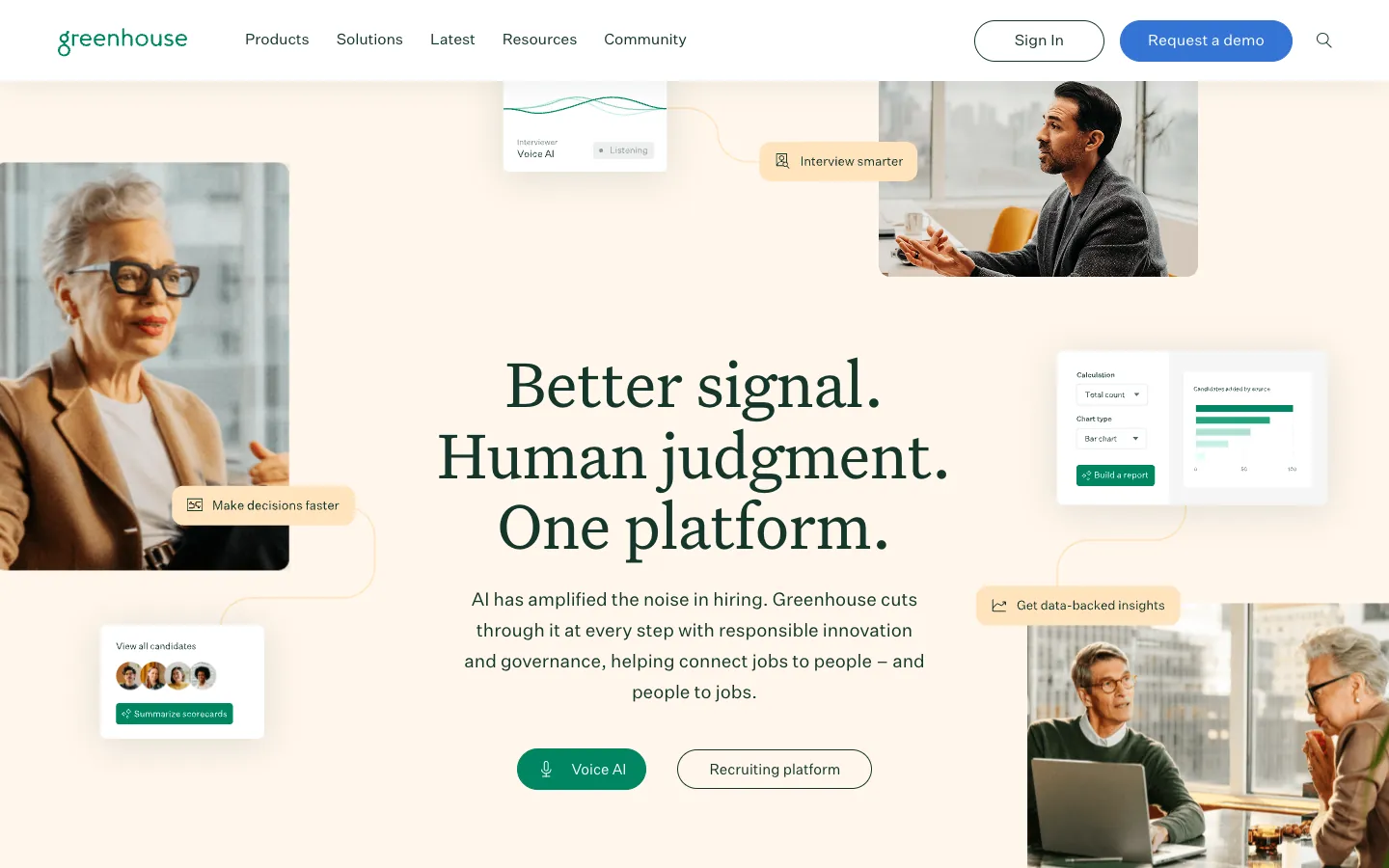
Screenshots of Greenhouse 3 images
What's great
- Most mature structured-hiring workflows in the segment, scorecards, interview kits, and calibration flows that Ashby and Workable still can't fully match
- 400+ integrations work cleanly out of the box, DocuSign, Slack, Zoom, Workday, BambooHR, and every major HRIS all have native connections
- DEI reporting and time-to-fill cohort analysis executive leadership actually trusts, no manual spreadsheet reconciliation required
Watch-outs
- Custom pricing only, floor sits around $6K/yr for small teams, mid-market contracts land $20K-$40K/yr before any negotiation
- Setup realistically takes 12-16 hours to configure properly, not a same-week deploy for a lean TA team
- UI is showing age versus Ashby on clicks-per-task, inline editing is absent in places where modern tools handle it
Pricing breakdown
| Plan | Price | Best for |
|---|---|---|
| Core | ~$6K/yr | Under 50 employees |
| Plus | ~$15K/yr | 50-250 employees |
| Pro | ~$30K/yr | 250-1 |
| Enterprise | Custom | 1 |
What reviewers say about Greenhouse
Recurring themes across ~3,897 G2 reviews (4.4/5), plus Capterra and SelectSoftware feedback, 2024-2026.
What reviewers praise
- Structured hiring is the recurring standout: reviewers say defining scorecards, interview kits, and role requirements before a job goes live keeps hiring panels consistent and reduces gut-feel decisions.
- The integration library, 500-plus pre-built connectors to HRIS, background-check, and assessment tools, is cited repeatedly as letting teams slot Greenhouse into an existing stack without custom work.
- Reporting and DEI analytics draw consistent praise, with reviewers calling the pipeline and diversity dashboards best-in-class among ATS platforms they have used.
- Collaboration features get named often, with hiring managers and interviewers able to leave structured feedback and coordinate in one place rather than over email threads.
- Onboarding and implementation support are frequently described as thorough, which reviewers credit for getting large recruiting teams live on a standardized process.
What reviewers fault
- Pricing is the most common complaint, and it is quote-only. Startups and small teams repeatedly say Greenhouse is too expensive for their hiring volume and get steered toward cheaper tools.
- Reviewers describe the interface as click-heavy, with simple actions taking too many steps and the layout feeling clunky once workflows get complex.
- The learning curve is steep for new users, and several note that meaningful configuration changes require admin access or vendor support rather than self-serve setup.
- Reporting flexibility is a recurring gripe despite the strong dashboards, with custom reports and date-range handling called harder than they should be without extra setup.
- The upfront configuration burden is real, and reviewers warn that getting full value out of Greenhouse takes deliberate planning, not a quick turn-on.
Loading reviews…
Ashby
Best modern UX and built-in analytics for growth-stage companies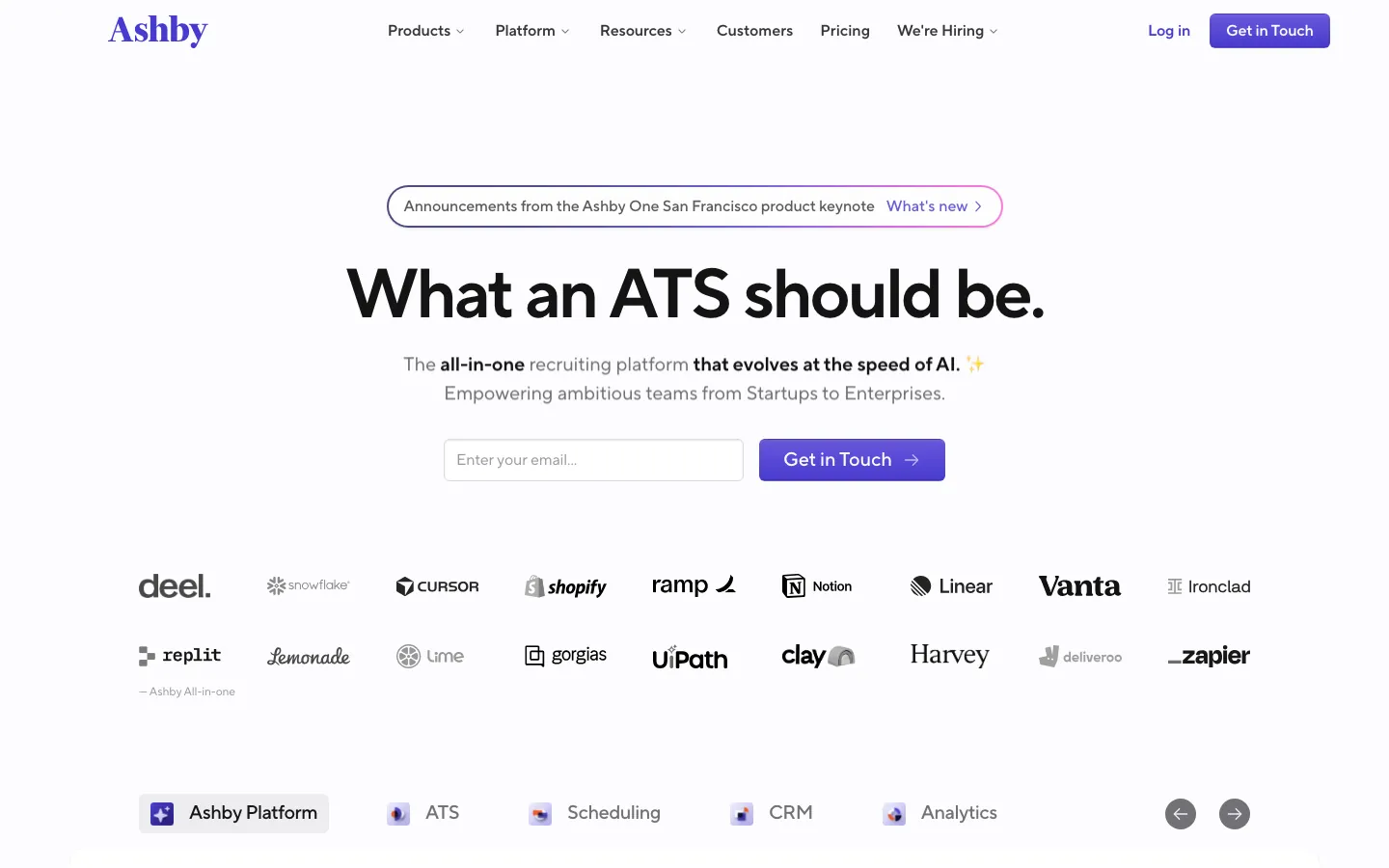
Screenshots of Ashby 2 images
What's great
- Cleanest UX in the segment by a clear margin; recruiters genuinely finish their work in fewer clicks than on most other tools in this guide
- Built-in sourcing, ATS, scheduling, and analytics on one platform; no separate Gem subscription or Calendly layer needed
- Modern API and webhooks that wire into your data warehouse without a professional services engagement
Watch-outs
- Review count on G2 is still low at 110 reviews compared to Greenhouse's 3,897; trust the product, but calibrate the review sample
- Pricing requires a sales conversation; the Foundations plan starts around $400/mo, mid-market contracts land $30K-$70K/yr
- Ecosystem younger than Greenhouse; some legacy HRIS connections require custom middleware where Greenhouse has native connectors
Pricing breakdown
| Plan | Price | Best for |
|---|---|---|
| Foundations | ~$400/mo | Up to 100 employees |
| Growth | ~$30K/yr | 100-300 employees |
| Scale | ~$70K/yr | 300-500 employees |
| Enterprise | Custom | 500+ employees |
What reviewers say about Ashby
Recurring themes across ~107 G2 reviews (4.7/5), a smaller but consistent review base, plus Dover and iSmartRecruit feedback, 2024-2026.
What reviewers praise
- The all-in-one consolidation is the recurring headline: reviewers say Ashby replaces separate ATS, CRM, and scheduling tools in one workflow, and several credit it with cutting real cost out of their recruiting stack.
- BI-grade analytics get named more than any other feature, with reviewers building highly customized funnel, source, and quality-of-hire reports without exporting to an outside tool.
- Reviewers consistently call day-to-day recruiting tasks fast and efficient once configured, with referrals and pipeline movement singled out as smooth.
- AI features including interview recording are highlighted, with candidate opt-out and recordings used as a feedback resource for interviewers.
What reviewers fault
- The learning curve is the dominant complaint. The advanced reporting and automation that reviewers love also take real time to master, especially for teams new to data-driven recruiting.
- The deep configurability can feel over-engineered for simple hiring needs, and reviewers describe the UI as click-heavy in places.
- A subset of reviewers on the entry Foundations plan note that key automations and offer-letter flexibility are gated behind higher tiers.
- Ashby fits growth-stage teams running structured hiring with a dedicated recruiter, and reviewers with lighter or occasional hiring say the power is more than they need.
Loading reviews…
Workable
Best for SMB and mid-market teams that want pricing without a sales call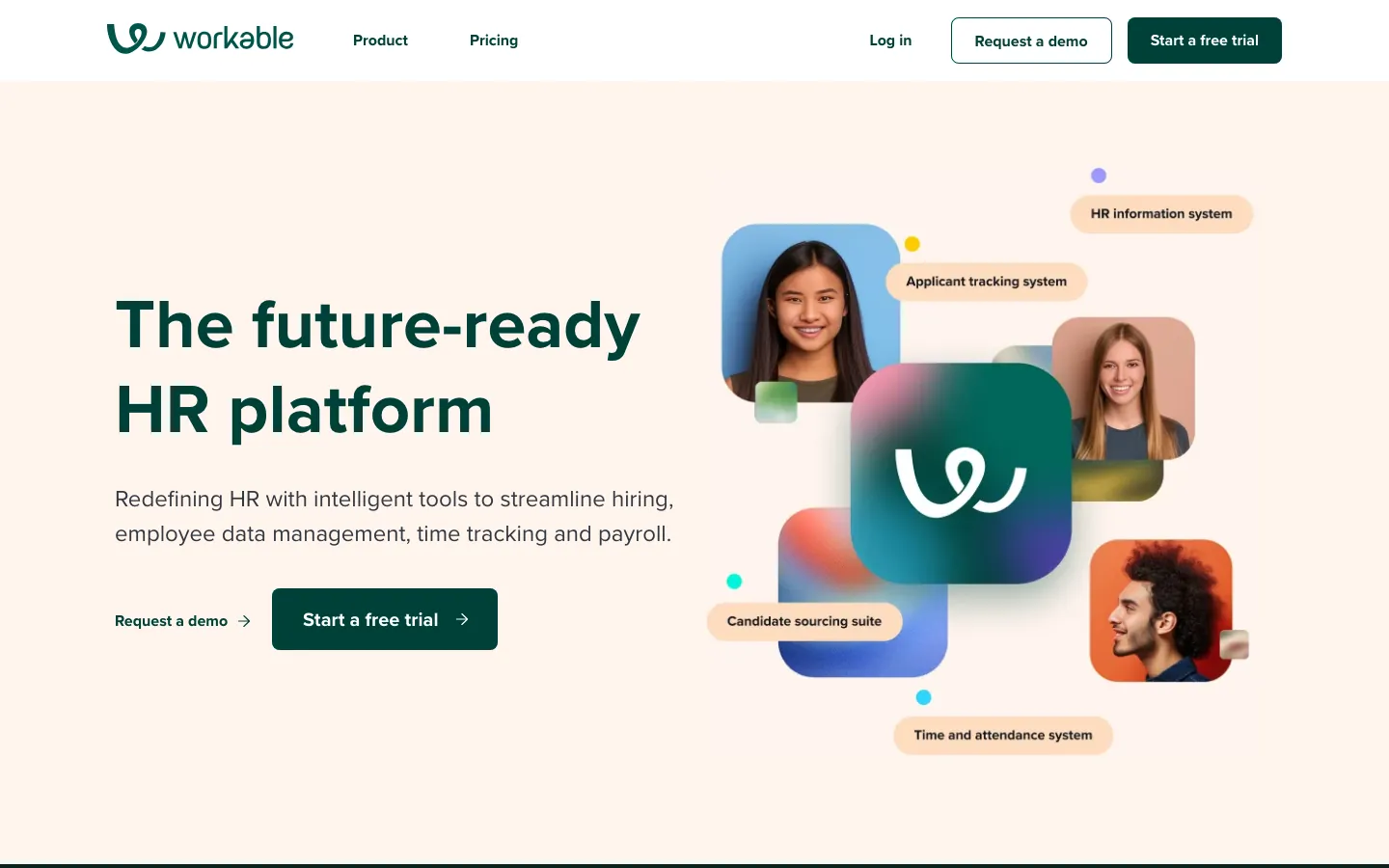
Screenshots of Workable 3 images
What's great
- Only serious ATS in this guide you can evaluate, price, and purchase without a sales call; $299/mo published, no demo required
- Deploys in days; in our SMB test scenario the team went live in a single sprint, the fastest in the group
- AI-powered candidate sourcing built in; one-click sourcing across aggregated profiles that actually surfaces non-LinkedIn candidates
Watch-outs
- Removed the Starter plan in 2025; $299/mo entry is now the floor even for small teams with 2-3 active jobs
- Scorecard and structured-hiring depth is lighter than Greenhouse or Ashby; past 50 hires per year the reporting gaps show
- AI candidate matching is more keyword-based than the marketing implies; works for first-pass, not for ranking nuanced candidates
Pricing breakdown
| Plan | Price | Best for |
|---|---|---|
| Standard | $299/mo | SMBs under 200 employees |
| Premier | $599/mo | Mid-market |
| Enterprise | $719/mo | 1 |
| Add-ons | $89-$109/mo each | Texting or video interviews on Standard |
What reviewers say about Workable
Recurring themes across ~702 G2 reviews (4.4/5), plus Capterra and SoftwareFinder feedback, 2024-2026.
What reviewers praise
- Ease of use is the recurring praise, with reviewers saying the clean interface is intuitive even for hiring managers who have never touched an ATS before.
- Speed of deployment gets named often: reviewers describe going from purchase to first job posted faster than with other ATS platforms they evaluated.
- Job-posting distribution and candidate sourcing draw consistent praise, including the AI recruiter that scans a large candidate database and surfaces matches beyond keyword search.
- Slack and collaboration integrations are called out repeatedly for pushing real-time application and candidate updates to the team instead of siloing them in the ATS.
- Candidate tracking and pipeline transparency are cited as strengths, with reviewers saying it is easy to see where every applicant sits and keep hiring teams aligned.
What reviewers fault
- Pricing is a leading complaint, and reviewers note the removal of the cheaper starter plan roughly doubled the entry cost for small and small-mid teams.
- Paid add-ons compound the cost, with reviewers flagging that video interviews and SMS texting are billed on top of the base plan and inflate the real monthly bill well above the advertised price.
- Automations are described as half-finished by several reviewers, who note they trigger on stages but not on disposition reasons, so some intended workflows cannot be built.
- Reporting and some integrations are called constrained, and reviewers say bulk operations can feel sluggish.
- AI sourcing quality is mixed: reviewers say results are solid for common roles but broad and noisy for niche, specialized, or non-English-market positions, requiring heavy manual filtering.
Loading reviews…
Lever
Best CRM-style ATS for high-touch and executive sourcing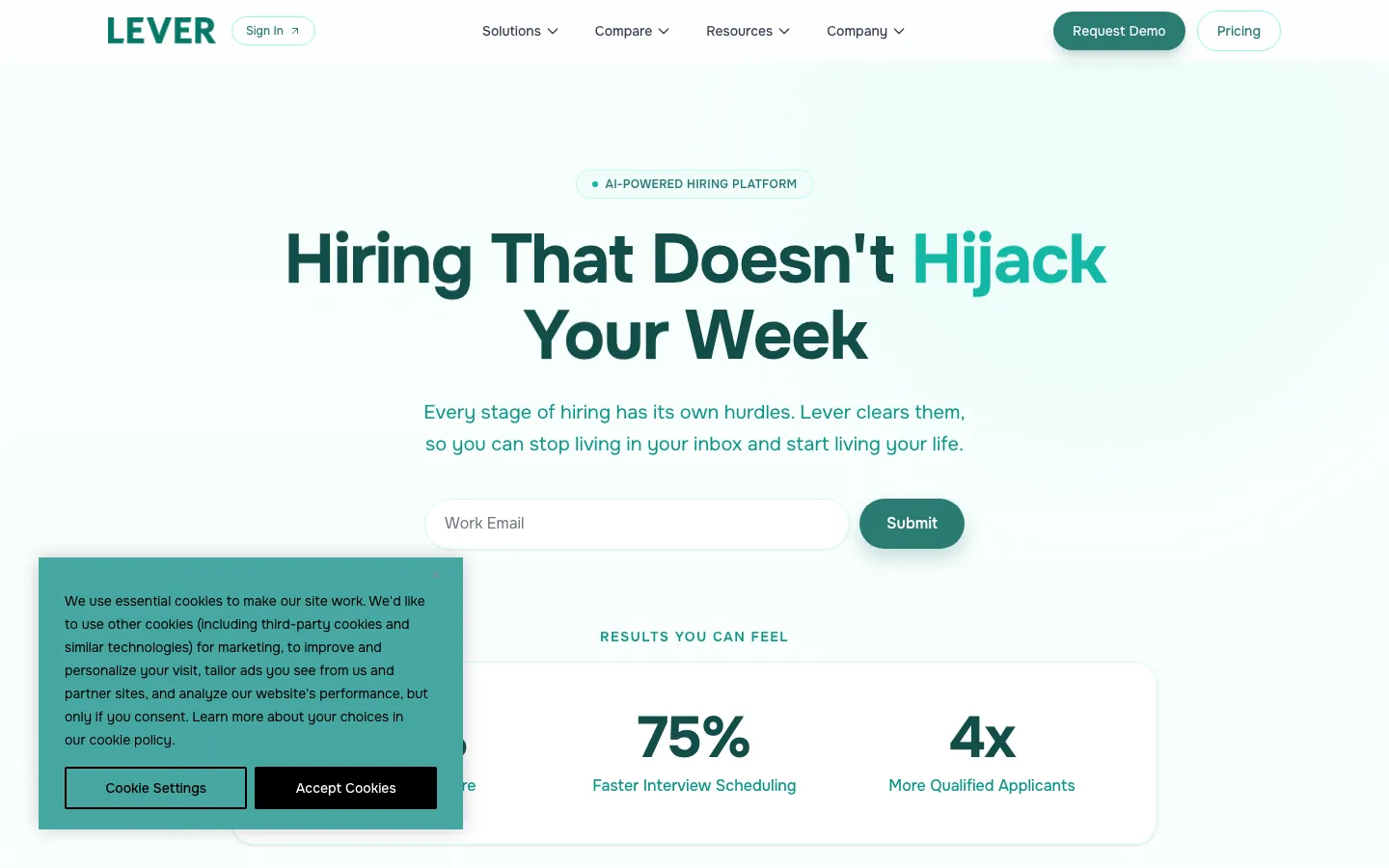
Screenshots of Lever 3 images
What's great
- Best-in-class CRM layer for nurturing passive candidates over 3-12 months, which is the only way senior IC and executive hiring actually works
- Campaign and nurture sequences that other pure ATSes don't ship out of the box; useful for competitive talent markets
- 4.3/5 across 2,102 G2 reviews; users consistently cite the intuitive UI and hiring manager adoption as the standouts
Watch-outs
- Less powerful at high-volume ATS work than Workable or Greenhouse; the CRM strength is also the workflow limitation
- Product roadmap has visibly slowed since the Employ acquisition in 2022; feature velocity is down versus Ashby
- Real contract costs land around $15K/yr median across 300+ Vendr buyer transactions, plus $3K-$15K implementation
Pricing breakdown
| Plan | Price | Best for |
|---|---|---|
| LeverTRM | ~$12K/yr (200-emp) | Mid-market sourcing-led hiring teams |
| LeverTRM (500-emp) | ~$37K/yr | Scaling companies 300-600 employees |
| LeverTRM Enterprise | ~$63K/yr | 1 |
| Implementation | $3K-$15K | Required for all new contracts |
What reviewers say about Lever
Recurring themes across ~2,102 G2 reviews (4.3/5), plus Capterra, SelectSoftware, and Outsail feedback, 2024-2026.
What reviewers praise
- The native CRM is the recurring differentiator, with reviewers noting Lever was built with candidate relationship management as a core concept rather than a bolt-on, so nurture campaigns and persistent profiles feel integrated.
- Reviewers repeatedly call the platform intuitive and easy to learn, including for occasional users like hiring managers who do not live in the tool daily.
- Search, talent-fit matching, and pipeline staging get named as strengths that keep candidates and open roles moving.
- DEI tracking and collaborative candidate management are cited by reviewers as reasons mid-sized teams standardize on Lever.
- The clean, straightforward layout draws consistent praise for making day-to-day sourcing and pipeline work fast to navigate.
What reviewers fault
- Opaque, quote-only pricing is one of the most common complaints, and reviewers say it makes getting comparable quotes slow.
- Advanced reporting is gated behind higher tiers and extra cost, and reviewers describe the newer analytics layout as harder to use in practice than expected.
- Customization is called more rigid than competitors like Greenhouse, with reviewers wanting more flexibility to tailor workflows.
- Reviewers flag weak onboarding functionality and high fees for API access as gaps in the platform.
- Support quality comes up as a concern, with several reviewers attributing slower or less consistent support to turnover following the company's acquisition.
Loading reviews…
Pinpoint
Best for multi-stream hiring, runs executive and high-volume side by side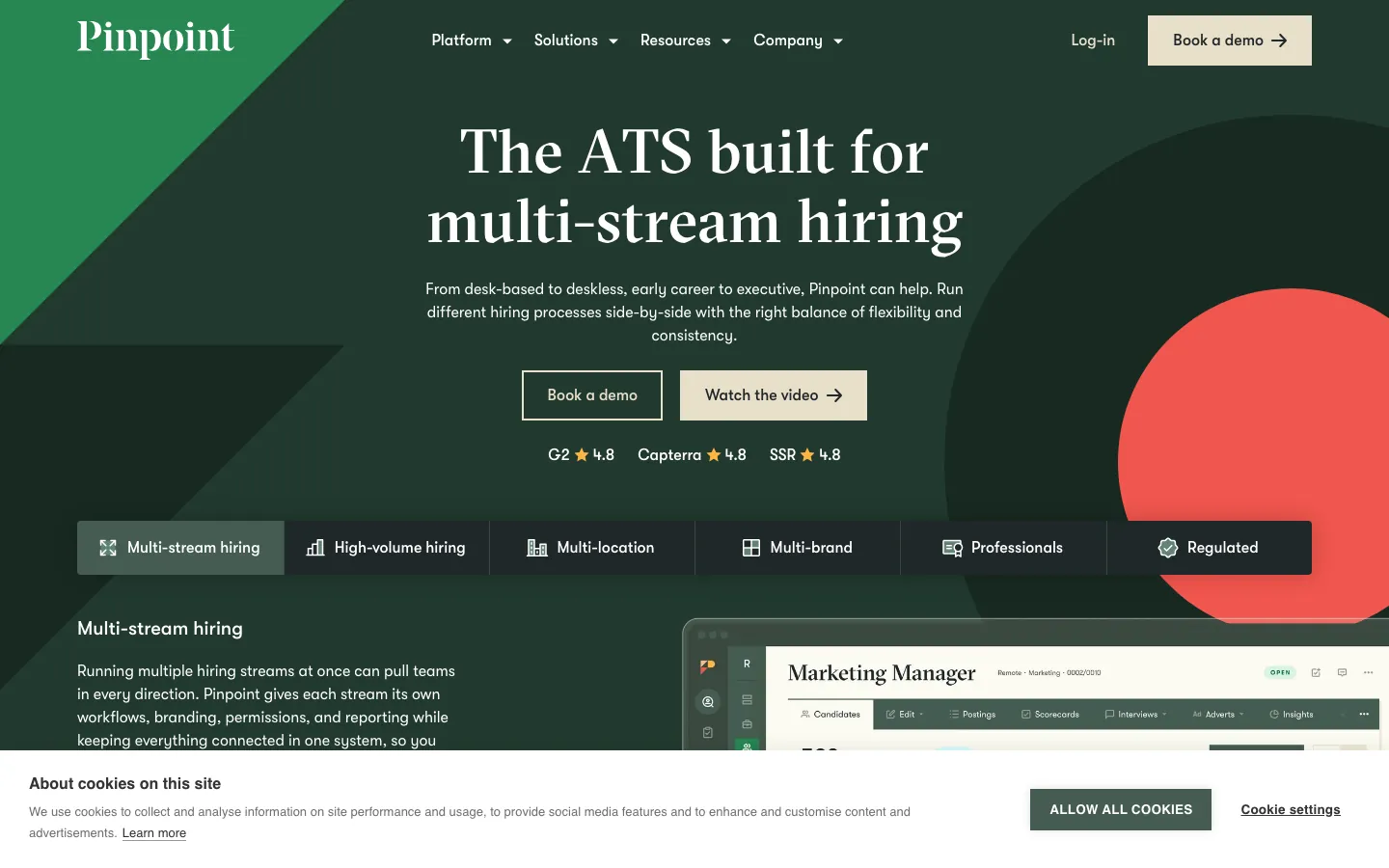
Screenshots of Pinpoint 3 images
What's great
- Genuinely handles multiple hiring streams at once; executive searches run alongside high-volume roles without forcing one pipeline structure on both
- Candidate-facing application flows that are among the cleanest in the segment, with markedly lower application drop-off than weaker tools
- 4.8/5 on G2 and 4.7/5 on Capterra; the highest satisfaction scores in this guide from a platform with real deployment volume
Watch-outs
- Pricing is quote-only, no public rate card; Growth plans start around $600-$800/mo based on buyer-reported data
- Review count still low at 116 G2 reviews; satisfaction is real but the sample is thin compared to Greenhouse or Lever
- US support is strong, but the company is UK-headquartered and some enterprise buyers flag support-hour overlap as a friction point
Pricing breakdown
| Plan | Price | Best for |
|---|---|---|
| Growth | ~$600/mo | Under 200 employees |
| Plus | ~$1 | 200-500 employees |
| Enterprise | Custom | 500+ employees |
| Onboarding module | Add-on | Post-offer onboarding workflows |
What reviewers say about Pinpoint
Recurring themes across ~116 G2 reviews (4.8/5), a smaller but consistent review base, plus Capterra and SoftwareAdvice feedback, 2024-2026.
What reviewers praise
- Ease of use is the recurring headline, with reviewers on both G2 and Capterra calling the interface intuitive and simple to manage for hiring managers and candidates alike.
- Customer support is named as a standout, with reviewers repeatedly describing the team as responsive and hands-on during setup and daily use.
- Automated emails and templates get credited with cutting admin time across the hiring process, from job posting through scheduling.
- The included onboarding portal is called out as a differentiator, with reviewers noting it came bundled rather than as a paid add-on and improved their new-hire experience.
What reviewers fault
- Reporting depth is the most common complaint, with reviewers saying analytics and data-export capabilities could be stronger for deeper hiring analysis.
- Admin setup has a learning curve, and reviewers note the flexibility is great once configured but getting there takes time and patience.
- Some reviewers say basic functions are missing and that requested improvements take a long time to ship.
- Customization and the mobile experience draw milder recurring criticism, with reviewers wanting more room to tailor the platform and a more polished mobile interface.
Loading reviews…
Manatal
Best budget ATS with AI candidate scoring that actually works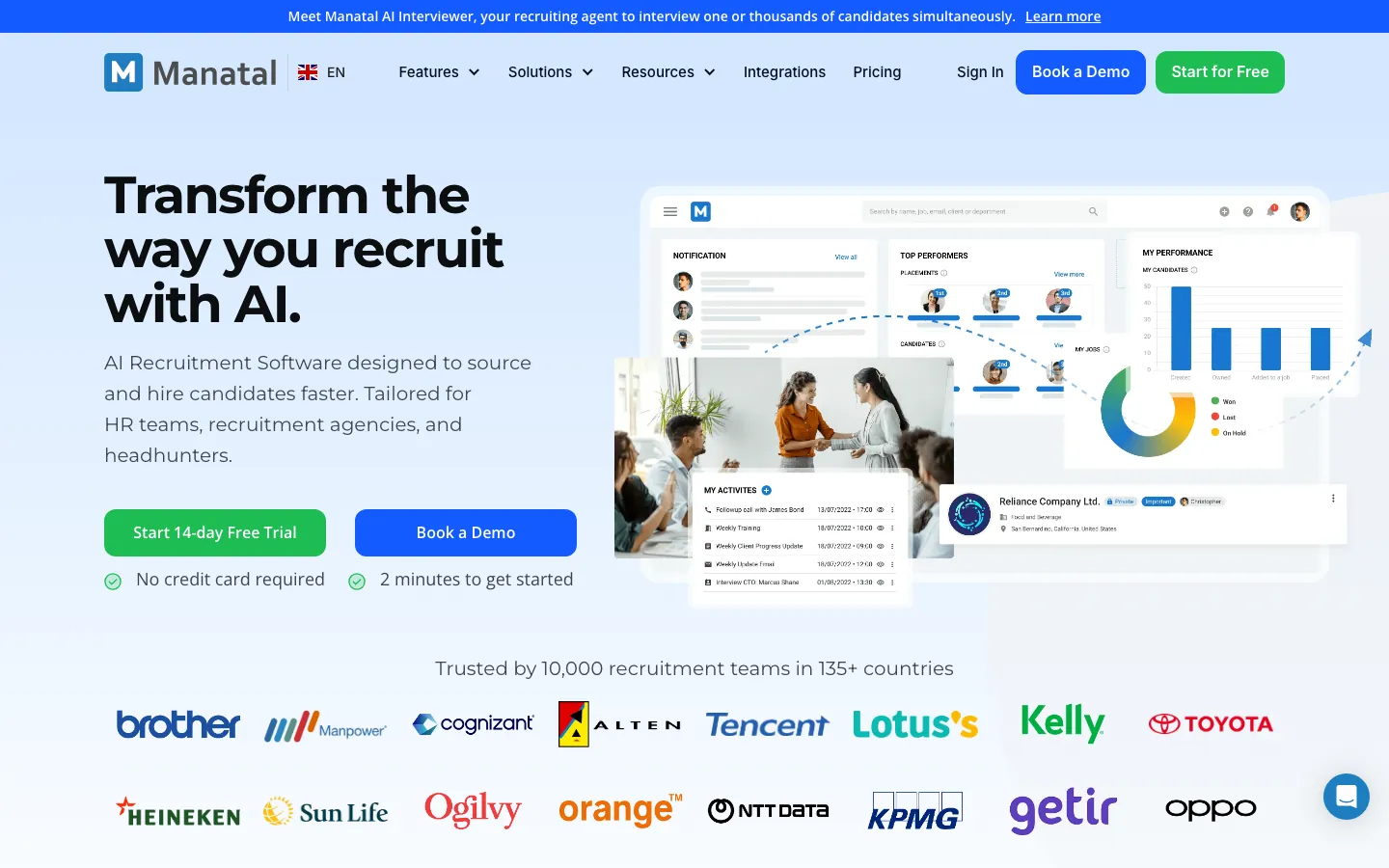
Screenshots of Manatal 3 images
What's great
- Cheapest fully-featured ATS in this guide at $15/user/mo annually; the Professional plan covers up to 15 active jobs and 10,000 candidates
- AI candidate scoring pulls from resume data plus social media enrichment; genuinely useful as a first-pass filter, not just marketing copy
- Multi-language interface covering 12+ languages; the strongest ATS in this list for global teams hiring across Asia and EMEA
Watch-outs
- Cap of 15 active jobs on the $15/mo Professional plan; teams with more than 15 concurrent reqs need the $35/user/mo Enterprise tier
- Reporting is shallow compared to Greenhouse or Ashby; the dashboards cover pipeline metrics but not cohort or source-of-hire analysis
- Support response times can stretch past 24 hours on standard plans, which is a friction point for small teams who need fast answers
Pricing breakdown
| Plan | Price | Best for |
|---|---|---|
| Professional | $15/user/mo | Small teams |
| Enterprise | $35/user/mo | SMBs needing unlimited jobs + automation |
| Enterprise Plus | $55/user/mo | SSO + API access + priority support |
| Custom | Quote | Recruiting agencies + large enterprise deployments |
What reviewers say about Manatal
Recurring themes across ~141 Capterra reviews (4.6/5) and TrustRadius reviewer feedback, 2024-2026.
What reviewers praise
- Value for money is the most repeated praise, with reviewers consistently saying the per-seat pricing is meaningfully cheaper than enterprise ATS alternatives.
- The Kanban pipeline view for candidate management is called out repeatedly for making it easy to visualize hiring stages at a glance.
- LinkedIn and Gmail integrations receive consistent commendation for connecting sourcing and outreach without needing to leave the platform.
- Fast onboarding and minimal training requirements come up across reviews, with teams reporting quick adoption without a formal rollout process.
- Customer support responsiveness gets strong marks at the initial setup stage, with reviewers noting multiple available contact channels.
What reviewers fault
- Job board posting integration has persistent technical issues, with reviewers reporting location field recognition failures even after support intervention.
- Resume parsing quality draws complaints for not reliably separating first and last name fields, requiring manual cleanup on imported profiles.
- Boolean search functionality is called limited compared to enterprise-grade alternatives, making deep database filtering difficult for senior sourcers.
- Reporting and analytics are described as basic, lacking the depth needed for mid-market teams that want recruiter productivity or pipeline conversion data.
- Some reviewers experienced sudden account deactivations without written notice, with support unable to explain the reason, creating trust concerns.
Loading reviews…
JazzHR
Best flat-rate ATS for small businesses under 100 employees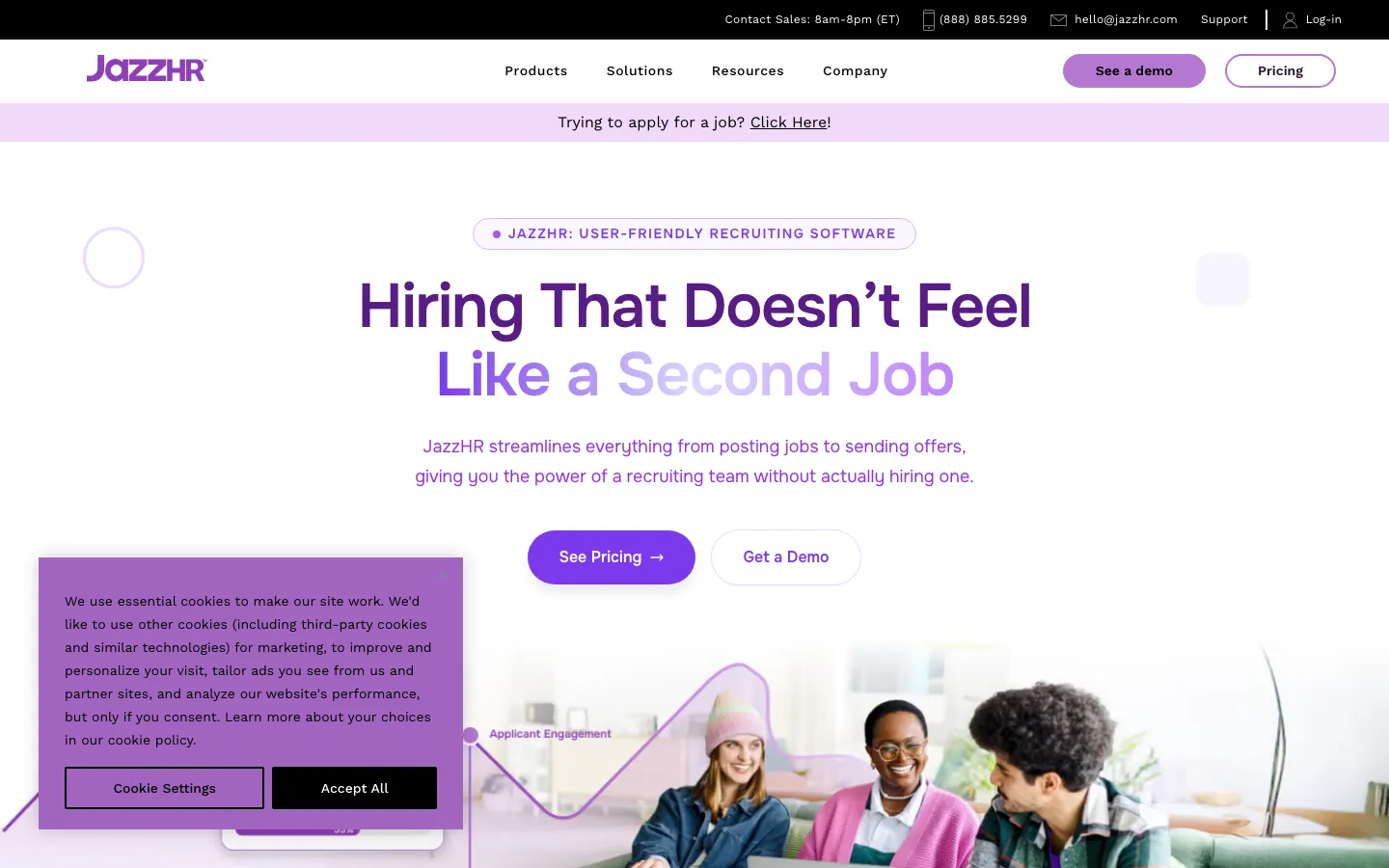
Screenshots of JazzHR 3 images
What's great
- Flat-rate per-company billing instead of per-seat; a 10-recruiter team pays the same as a 2-recruiter team at the same tier
- Hero plan at $1K/yr ($83/mo) covers the basics for a small company that doesn't want per-user math getting complicated
- Clean job-board posting integrations out of the box; posts to 15+ boards from a single submission in the platform
Watch-outs
- Companies typically outgrow JazzHR around 100 employees or when hiring starts requiring structured scorecards and DEI reporting
- Less candidate-experience polish than Pinpoint or Ashby; application flows are functional but not designed for drop-off optimization
- Feature investment has been modest since the acquisition by Employ; Ashby and Pinpoint are shipping faster on the roadmap
Pricing breakdown
| Plan | Price | Best for |
|---|---|---|
| Hero | $83/mo ($1K/yr) | Under 20 roles/yr |
| Plus | $290/mo ($3.5K/yr) | Growing companies 20-60 roles/yr |
| Pro | $459/mo ($5.5K/yr) | Under 100 employees |
| Note | Flat per company | Not per-seat; scales without per-user cost increases |
What reviewers say about JazzHR
Recurring themes across ~500 G2 reviews (4.4/5), plus Capterra and PerformanceReviewsSoftware feedback, 2024-2026.
What reviewers praise
- Flat-rate pricing is the recurring favorite, with reviewers noting JazzHR charges a flat monthly fee with unlimited users while competitors bill per seat or per recruiter.
- The interface is called user-friendly and easy to navigate, with a dashboard that gives a clear view of postings, applications, and candidate status.
- The core applicant tracking is described as solid, with reviewers saying resumes, notes, and interview feedback are easy to store and share across the hiring team.
- Built-in EEO and OFCCP reporting on all plans is named as a real convenience for federal contractors and teams that need compliance reporting out of the box.
What reviewers fault
- Support access is a leading complaint, with reviewers saying meaningful customer service and account help sit behind an extra fee and lower tiers are pointed to self-serve resources.
- Reporting is repeatedly called weak, with few standard report options and reviewers finding custom reports difficult to build.
- Billing and cancellation terms draw recurring frustration, with reviewers describing a rep-gated cancellation process, a hibernation upsell, and notice timing that pushes out the earliest cancel date.
- Reviewers say JazzHR fits small to mid-size teams and that companies with high-volume hiring or advanced sourcing needs eventually outgrow it.
- A subset of reviewers report account security incidents, including fraudulent job-posting charges, and unsatisfying resolution of those disputes.
Loading reviews…
Zoho Recruit
Best for teams already running on the Zoho ecosystem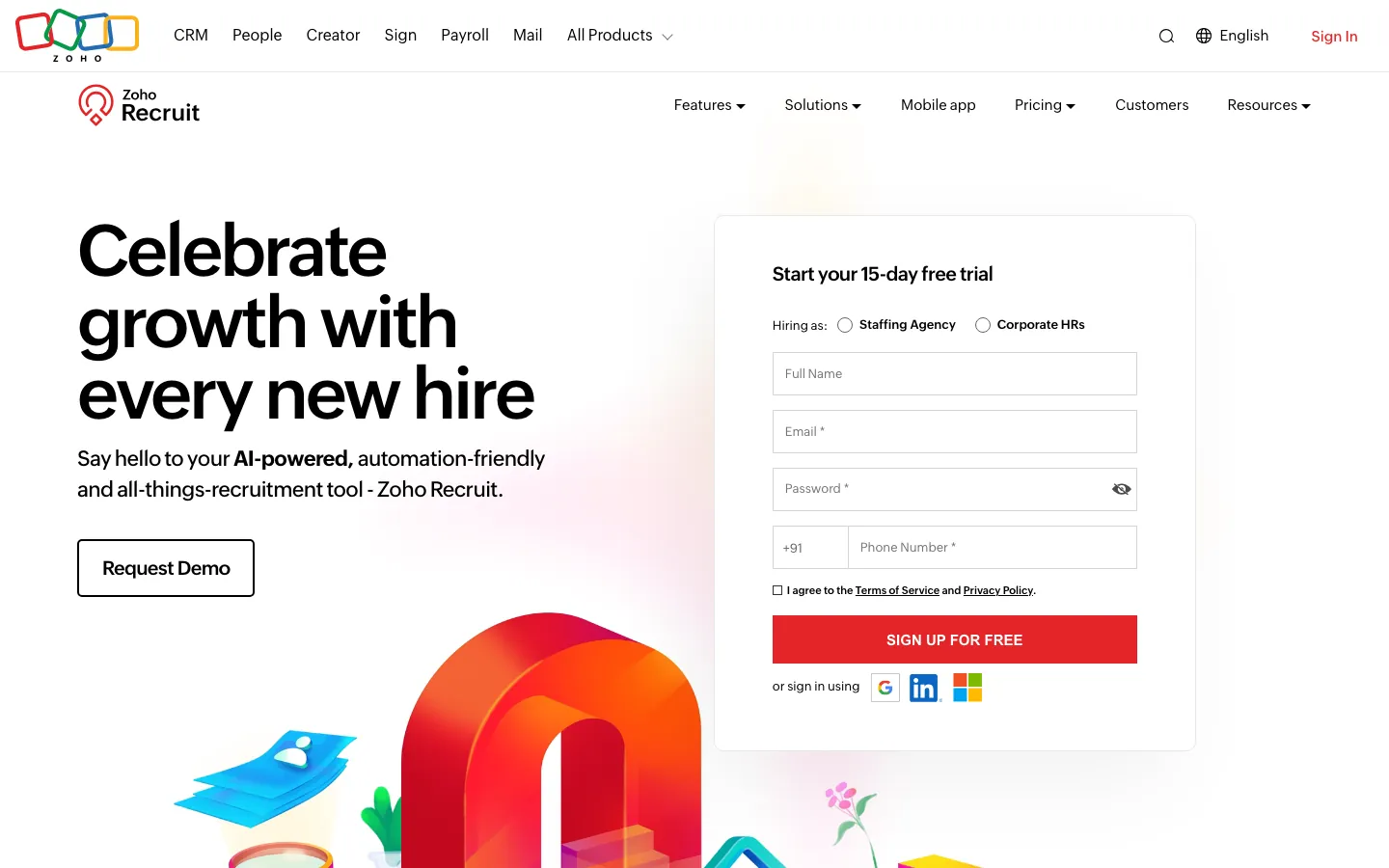
Screenshots of Zoho Recruit 3 images
What's great
- Native integration with Zoho CRM, Zoho People, and Zoho Books; the shared contact record alone saves 1-2 hours per hire in manual data entry
- Free tier covers 1 active job per recruiter and handles basic candidate management for micro-teams
- Both in-house and staffing agency editions in one product; useful for hybrid teams that do some agency work alongside corporate recruiting
Watch-outs
- UI is a generation behind Ashby and Pinpoint; the interface is form-heavy and the pipeline visualization is weaker than the modern tools
- AI matching and scoring features lag behind Manatal at half the price; Zoho's AI investment is concentrated in CRM, not Recruit
- Best when you're already a Zoho One shop; as a standalone ATS against Workable or JazzHR, the UX trade-off is harder to justify
Pricing breakdown
| Plan | Price | Best for |
|---|---|---|
| Free | $0 | 1 active job per recruiter |
| Standard | $25/user/mo | 10 active jobs |
| Enterprise | $50/user/mo | 20 active jobs + AI matching + automation |
| Enterprise Plus (Agency) | $75/user/mo | Hybrid in-house/agency teams |
What reviewers say about Zoho Recruit
Recurring themes across ~2,900 G2 reviews (4.1/5) and Capterra reviews (4.3/5), 2024-2026.
What reviewers praise
- Price-to-feature ratio is the most repeated compliment: reviewers say Zoho delivers lead scoring, workflow automation, and multi-currency support at a fraction of the cost of HubSpot or Salesforce.
- Depth of the Zoho ecosystem is consistently praised by teams already using Zoho Books, Zoho Desk, or Zoho Campaigns, who describe the cross-app data flow as a genuine alternative to buying multiple point solutions.
- The Canvas drag-and-drop UI builder, added in recent years, appears in newer positive reviews as a meaningful upgrade, letting non-technical admins redesign the record layout without code.
- Workflow automation breadth gets strong marks, with reviewers pointing to multi-condition rules, scheduled actions, and blueprint approval processes as features competitors lock behind enterprise tiers.
- Lead management tools including assignment rules, scoring, and conversion tracking are frequently cited as thorough and configurable for teams with defined sales processes.
What reviewers fault
- Customer support is the single most common complaint across G2 and Capterra, with reviewers on standard plans describing slow ticket responses, inconsistent answers, and difficulty escalating urgent issues.
- The learning curve is steep enough that multiple reviewers recommend hiring a Zoho consultant for initial setup, especially for automation, Deluge scripting, and module customization.
- The mobile app has reliability problems that appear consistently in recent reviews, including bugs that prevent notes from displaying, missed call logs, and crashes under poor connectivity.
- Integration with non-Zoho tools is frequently described as more friction than the docs suggest, with third-party connectors requiring Zapier workarounds or custom API work for stable two-way sync.
- The interface, despite recent improvements, is still called cluttered and overwhelming by first-time CRM buyers, and the density of settings can make routine tasks harder to find than in leaner tools.
Loading reviews…
Tools we considered but excluded
We evaluated more tools than the 9 you see above. These did not make the cut. Saying what we rejected, and why, is the editorial muscle most listicles skip.
- iCIMS: Enterprise-only pricing at $6-$9 per employee per month; $55K-$140K/yr floor puts it out of range for the in-house mid-market reader this guide targets
- Workday Recruiting: Part of a full HRIS platform buy, not a standalone ATS; relevant for 1,000+ employee orgs already committed to Workday HCM
- SmartRecruiters: Strong product but pricing opacity and enterprise-first motion make evaluation harder for the sub-500-employee buyer; Pin.com comparisons put enterprise entry at $30K+/yr
- Recruitee (now Tellent Recruitee): Rebranded as Tellent Recruitee in 2022/2023 under the Tellent group; solid for collaborative hiring under 60 roles/yr but Pinpoint and Workable cover this segment better in 2026
- Breezy HR: Good UX for under-20-role-per-year teams but the platform has seen limited feature investment since 2023; JazzHR and Manatal both edge it out at the same price point
Honorable mentions
Solid tools that did not crack the main list but are worth tracking, especially for niche use cases.
- Rippling Recruiting: If you're already on Rippling HRIS the ATS module is a natural add-on; the unified employee record from candidate to hire to payroll is genuinely useful, but it's not a standalone ATS buy
- Dover: Completely free ATS with AI-powered applicant scoring and one-click job board posting; worth knowing for seed-stage startups that want zero-cost infrastructure before they're ready to spend on Manatal or Workable
- Comeet: Merged with Spark Hire in 2023; the collaborative hiring workflow is strong for under-200-employee companies where cross-functional interviewers drive most of the process
The five in-house ATS categories these 9 systems fall into
The ATS market has two separate problems buyers mix up. This guide focuses entirely on in-house applicant tracking, not the broader recruiting stack that includes sourcing platforms, video-interview tools, or background-check providers.
Core ATS. The candidate pipeline manager. Greenhouse, Workable, Lever, Pinpoint, JazzHR, Zoho Recruit. Every hiring team that runs more than 15 roles per year needs one of these. The question is which one fits the stage and hiring motion.
ATS plus analytics. Ashby and Pinpoint both collapse the ATS plus reporting into a single product. Greenhouse at the Pro tier does too. If your TA lead is asking “which source produces 12-month retainers?”, this is the segment to evaluate rather than buying a separate BI layer.
ATS plus sourcing CRM. Lever is the standout here. The product is built equally around nurturing passive candidates and processing applicants. If 40%+ of your hires come from sourced outreach rather than inbound applications, Lever’s CRM layer earns its contract over a pure ATS.
Budget ATS with AI. Manatal ships AI candidate scoring at $15/user/mo. No other tool in this guide matches that price-to-AI-feature ratio. For lean teams that can’t justify Ashby or Greenhouse, Manatal is the right entry point.
Ecosystem ATS. Zoho Recruit for Zoho One shops. Rippling Recruiting for Rippling HRIS shops. The integration savings are real and the standalone UX cost is worth paying if you’re already committed to the parent platform.
The nine tools above cover all five categories. Each one is an in-house ATS; this guide does not cover staffing agency software or enterprise HRIS-embedded recruiting modules like Workday Recruiting or SAP SuccessFactors.
Where the 9 ATS platforms differ on core features
Five features buyers ask about most in nearly every ATS evaluation. Cells use: ✓ (built in), ✗ (not available), • (limited), $ (paid add-on), or a tier name.
| ATS | Structured scorecards | DEI reporting | AI candidate scoring | Native HRIS sync | Candidate self-scheduling |
|---|---|---|---|---|---|
| Greenhouse | ✓ Plus+ | ✓ Plus+ | ✓ Pro+ | ✓ All tiers | ✓ All tiers |
| Ashby | ✓ All tiers | ✓ Growth+ | ✓ All tiers | ✓ All tiers | ✓ All tiers |
| Workable | • Standard | ✗ | ✓ Standard | ✓ All tiers | $ add-on |
| Lever | ✓ All tiers | • limited | ✓ All tiers | ✓ All tiers | ✓ All tiers |
| Pinpoint | ✓ All tiers | ✓ Plus+ | ✓ All tiers | ✓ All tiers | ✓ All tiers |
| Manatal | • limited | ✗ | ✓ All tiers | M marketplace | ✓ All tiers |
| JazzHR | • Plus+ | ✗ | • limited | M marketplace | $ add-on |
| Zoho Recruit | ✓ Enterprise | ✗ | ✓ Enterprise | ✓ Zoho only | ✓ Enterprise |
Greenhouse and Ashby dominate on scorecard and DEI depth. Manatal is the only tool that ships real AI scoring at the entry tier. Workable’s lack of DEI reporting is the most common reason hiring teams switch away once their board starts asking diversity questions.
JazzHR and Zoho Recruit both require paid tiers before structured scorecards arrive.
ATS compliance and security, tool by tool
Enterprise IT will ask for all five of these before signing. Check the columns before you get two weeks into an evaluation.
| ATS | SOC 2 Type II | GDPR | HIPAA | SSO/SAML | Audit logs |
|---|---|---|---|---|---|
| Greenhouse | ✓ | ✓ | ✗ | ✓ All tiers | ✓ All tiers |
| Ashby | ✓ | ✓ | ✗ | ✓ Growth+ | ✓ Growth+ |
| Workable | ✓ | ✓ | ✗ | Premier+ | Premier+ |
| Lever | ✓ | ✓ | ✗ | ✓ All tiers | ✓ All tiers |
| Pinpoint | ✓ | ✓ | ✗ | ✓ Plus+ | ✓ Plus+ |
| Manatal | ✓ | ✓ | ✗ | Enterprise Plus | Enterprise Plus |
| JazzHR | ✓ | ✓ | ✗ | Pro only | Pro only |
| Zoho Recruit | ✓ | ✓ | ✗ | Enterprise | Enterprise |
None of the tools in this guide publicly list HIPAA on their security pages, so healthcare and life sciences buyers who need a signed BAA should confirm that directly with the vendor’s legal team before signing.
Greenhouse leans furthest into certifications, its trust page lists SOC 1 and SOC 2 Type II, ISO 27001, ISO 27701, ISO 42001, GDPR, CCPA/CPRA, and PCI DSS, but HIPAA is not among them. The rest cover SOC 2 Type II and GDPR, which handles the majority of US B2B SaaS companies.
SSO gates are the quiet budget trap; Workable requires Premier at $599/mo before you get SSO, which matters if IT won’t approve a tool without it.
Integration depth across the ATS stack
The five integrations that come up in nearly every ATS procurement checklist. N = native first-party, M = marketplace/third-party, $ = paid add-on, • = Zapier only, ✗ = no path.
| ATS | Slack | Workday/HRIS | LinkedIn Recruiter | DocuSign/offers | Zoom/scheduling |
|---|---|---|---|---|---|
| Greenhouse | N | N | N | N | N |
| Ashby | N | N | N | N | N |
| Workable | N | N | M | M | N |
| Lever | N | N | N | N | N |
| Pinpoint | N | N | M | N | N |
| Manatal | N | M | M | M | N |
| JazzHR | N | M | M | M | N |
| Zoho Recruit | N | N (Zoho only) | M | M | N |
Greenhouse and Ashby have the deepest native integration story in this comparison. Lever’s LinkedIn Recruiter integration is one of the cleanest for passive sourcing workflows. Manatal and JazzHR both rely on marketplace or Zapier for HRIS and DocuSign, which means more manual setup and more fragility on the offer-to-hire handoff.
That last step, getting the signed offer into your HRIS without re-keying data, is where most integration failures actually live.
Selection criteria, what to test in your ATS trial
The hiring teams that run the best evaluations follow a consistent pattern. Eight specific things to test before you commit.
One, configure a real role on day one. Skip the demo data. Take an actual open requisition, build the stages, set up the scorecard, and route it to a real hiring manager. Half of “the demo was great” evaluations turn into “the implementation was painful” because demos hide configuration depth. How long this takes is itself the test.
Two, time recruiter clicks per candidate. Take one candidate from sourced all the way through to offered. Count every click. The difference between a good and great ATS is often 9 clicks versus 23 across the full lifecycle. Multiply by 400 candidates a year per recruiter and you’re looking at real hours of lost capacity.
Three, run a calibration meeting. Have three interviewers score the same candidate independently, then convene to reconcile. The platforms with strong scorecard and calibration views (Greenhouse, Ashby) turn this into a 15-minute meeting. The weaker ones turn it into a 60-minute argument with no structured output.
Four, apply as a candidate. Go through your own application form end to end. Time it. Count the screens. The platforms with friction-heavy candidate forms lose 18-35% of applicants mid-application. Pinpoint and Ashby run 4-8% drop-off. That gap is filled offers walking away.
Five, export the dataset. Pull every candidate from the last 30 days into a CSV with all custom fields. If this requires a support ticket or a “talk to your CSM” call, the platform’s data is not really yours. Walk away from any contract that fails this test.
Six, run an integration end-to-end. Send a test candidate from the ATS through to your HRIS and your e-signature tool. If anything breaks, fix it during the trial, not after the contract is signed. Most “integration available” claims are technically true but operationally fragile on the offer-to-hire handoff.
Seven, ask about renewal pricing in writing. Year-one pricing is the marketing pitch. Ask: what did your average customer pay in year two? If they can’t give a range, assume 8-15% increases annually. Greenhouse and Lever both run 8-12% historical uplift. Negotiate caps upfront, in writing.
Eight, talk to three current customers in your size band. Not the references the vendor offers. Find them through LinkedIn or your network. Ask whether they’d buy the tool again at full price knowing what they know now. The answer is more reliable than any G2 review summary.
Matching the ATS to your stage
Five questions that narrow the shortlist from nine to two or three real options.
1. How many roles you fill next year
- Under 20 roles. A structured spreadsheet with consistent scorecards often outperforms a poorly-configured ATS. If you’re committed to a platform, Dover (free) or Manatal ($15/user/mo) are the right entries.
- 20-50 roles. Workable, JazzHR, or Zoho Recruit. Stay simple. You don’t need Greenhouse depth yet and the configuration overhead isn’t worth it.
- 50-200 roles. Pinpoint, Workable Premier, or Lever. This is the band where structured hiring starts paying back in time-to-fill consistency.
- 200+ roles. Greenhouse, Ashby, or Lever with a dedicated TA Ops person. At this volume, reporting accuracy and DEI consistency become board-level concerns, not just recruiter preferences.
2. Whether hiring-manager adoption is a known problem
High HM adoption rates come from tools with low-friction review interfaces. Greenhouse and Ashby both optimize for the HM experience; scorecards are fast to complete, feedback flows back to the recruiter without Slack chasing.
If your hiring managers routinely ghost on feedback requests, pick an ATS where the HM-facing interface is a first-class design concern rather than an afterthought.
3. How much of your hiring comes from sourced outreach
If 40%+ of fills come from sourced rather than inbound, Lever’s CRM layer is the right call. The nurture sequences and passive candidate tracking change what recruiters can do with long-horizon roles. If the motion is primarily inbound-plus-screen, any of the other eight tools works; don’t over-rotate on the sourcing story.
4. The ecosystem you are already in
- Zoho One. Zoho Recruit. The integration savings outweigh the UX cost.
- Rippling. Rippling Recruiting module. The unified employee record from candidate to payroll is worth more than switching to a better standalone ATS.
- Modern tech stack (Slack, Notion, Linear, Google Workspace). Ashby or Greenhouse; both integrate cleanly into the tools Series A/B companies already run.
- Microsoft 365 / enterprise compliance requirement. Greenhouse is the safer pick for audit trail and SSO coverage.
5. How fast the team needs to go live
Workable, JazzHR, and Manatal all let you start processing candidates within a week. Greenhouse, Ashby, and Lever expect 4-8 weeks of configuration before full deployment. If the answer is “we need to fill three roles this month,” the shortlist is three tools, not nine.
Migration playbook
ATS data is some of the stickiest in the HR stack. Candidate records, interview notes, scorecard responses, offer history, and DEI audit trails all live in the old system.
A common migration mistake in Lever-to-Greenhouse switches is teams losing months of interview notes because the export format from the old system never mapped cleanly to the new schema.
Budget the data cleanup before you budget the new contract. Lost interview history is the regret that comes up most, ahead of price or features.
The SelectSoftware Reviews ATS buyer guide , built from 120+ systems evaluated since 2018, is a useful second read before you commit to a switch.
Before you sign the new contract. Export everything from your current ATS in CSV format: candidate records, custom fields, interview feedback, offer history, and any DEI survey responses. Most platforms let you do this from the admin panel. If yours requires a support ticket, that itself is a red flag worth noting. Do this export before the migration clock starts, not after.
What you will lose. Plan to lose 20-40% of historical interview notes and scorecard responses. Most ATSes store these in proprietary formats that don’t map cleanly to new schemas. The decision is whether to invest 40-80 hours cleaning and reconciling historical data or to accept the loss and keep a read-only archive in the old system for 12 months. Most teams choose the archive route.
The HRIS handoff is where most migrations break. The offer-to-hire record sync between your ATS and your HR system of record (BambooHR, Rippling, Workday, Gusto, ADP) is the most fragile integration in the stack. Every HRIS uses a different employee ID format, and if those IDs don’t match the new ATS’s expectation, you get duplicate records or orphaned new-hire onboarding. Test this integration end-to-end with five real candidates before cutover.
Give yourself 12 weeks. Under 500 employees, plan for a 12-week migration. Weeks 1-4: data export, schema mapping, integration setup, and parallel testing. Weeks 5-8: pilot with one job family and a subset of hiring managers. Weeks 9-12: full cutover with read-only access preserved in the old system. Teams that rush to 6 weeks reliably hit data loss or integration failures in month two.
Candidate experience scorecard
The candidate-facing side of ATS selection is the most consistently underweighted factor in ATS evaluations. Most teams spend 80% of their evaluation time on recruiter UX and 5% on what the candidate actually sees.
Research from Pinpoint on drop-off rates puts that allocation backwards; the numbers don’t support it.
Application drop-off rates vary widely across the tools in this guide, per third-party published benchmarks . The cleanest candidate flows (Pinpoint, Ashby) lose far fewer applicants mid-form than the tools with friction-heavy default setups (JazzHR, Zoho Recruit).
Drop-off is not a small problem. For a company receiving 200 applications per role with a 25% drop-off rate, 50 candidates who started the application are not reaching the recruiter’s queue. Across 20 roles per year that’s 1,000 lost applicants. Some percentage of those are the candidates you actually wanted.
The three things that drive drop-off most: form length (anything over 8 fields on the first screen loses candidates), mobile optimization (candidates apply from phones; test on iOS and Android), and the speed of the acknowledgment email (candidates apply to multiple companies; the first real response wins the attention).
Pinpoint and Ashby are the only two tools in this guide that treat all three as first-class design problems rather than configuration options.
What’s changing in ATS software in 2026
AI candidate scoring has crossed the threshold from experimental to reliable. Manatal , Ashby, and Greenhouse Smart Sourcer all ship matching that’s meaningfully better than keyword search for first-pass ranking.
Teams deploying these tools, or a dedicated AI resume-screening layer bolted onto the ATS, can meaningfully cut first-pass screening time per recruiter. The important caveat: none of these tools are reliable for final-stage evaluation. Use AI for ranking, not for deciding.
Candidate experience is becoming a real purchasing wedge. Pinpoint’s growth in the mid-market is largely attributable to this. Workable and Greenhouse are both running UX redesigns in their candidate-facing flows that are shipping through 2026. Companies that ignored drop-off rates two years ago are now measuring it because competitive talent markets make every lost applicant expensive.
ATS pricing is trending up across the segment. Greenhouse and Lever both raised list prices in late 2025. Workable removed its Starter plan in 2025, raising the floor from $169/mo to $299/mo. Expect 8-15% annual increases on renewal. The exception is Manatal, which has held its $15/user/mo Professional pricing; the budget end of the market is more competitive.
Multi-stream hiring is emerging as a real capability gap. Most ATSes are built around a single pipeline model. Pinpoint’s multi-stream architecture, where executive searches and high-volume roles run with genuinely separate workflows in one system, is the feature that will matter most to mid-market companies running diverse hiring programs simultaneously.
Ashby’s product velocity is the most watched story in the segment. The company shipped sourcing, scheduling, and CRM features in 2025 that competitors took years longer to build. Ashby’s own switching-customer page shows a steady stream of Greenhouse and Lever migrations, which is how the competitive pressure shows up in practice rather than in any public corporate filing.
For Series B+ tech companies evaluating in the second half of 2026, this is the tool to watch.
What ATS software really costs in year one
What you actually pay in year one versus what’s on the pricing page.
| Team profile | Listed / sticker price | Real all-in year 1 |
|---|---|---|
| Manatal, 3 users | $15/user/mo ($540/yr) | $600-$900 (minor setup) |
| JazzHR Hero, 10 roles/yr | $83/mo ($1K/yr) | $1,200-$1,800 |
| Workable Standard | $299/mo ($3.6K/yr) | $4,500-$7,000 |
| Workable Premier | $599/mo ($7.2K/yr) | $8,500-$11,000 |
| Lever, 200-person company | ~$12K/yr | $18,000-$27,000 (impl + training) |
| Pinpoint Growth | ~$600/mo ($7.2K/yr) | $10,000-$15,000 |
| Greenhouse Plus | ~$15K/yr | $22,000-$35,000 (impl + CSM) |
| Ashby Growth | ~$30K/yr | $40,000-$55,000 |
Implementation fees run $3K-$15K across the custom-priced tools and are rarely optional. Annual uplift on renewal averages 8-12% for Greenhouse and Lever; Workable and Pinpoint are closer to 5-8%. The single most common forecast error: assuming implementation is included in the contract.
Vendr’s 2025 ATS contract data confirms it never is at the $15K+ tier.
The ATS pick for each company stage
- Pre-seed, under 10 hires per year: Dover (free) or Manatal ($15/user/mo). Don’t over-invest in ATS infrastructure before you’ve established a repeatable hiring motion.
- Seed to Series A, 10-30 hires per year: Workable Standard ($299/mo) or JazzHR Plus ($290/mo). Both deploy in under a week and don’t require a sales cycle.
- Series A to B, 30-80 hires per year, inbound-led: Workable Premier or Pinpoint Growth. Pinpoint wins if candidate experience is a stated priority for the leadership team.
- Series A to B, 30-80 hires per year, sourcing-led: Lever. The CRM layer earns its cost at this volume if 40%+ of fills come from outreach.
- Series B to C, 80-200 hires per year, tech company: Ashby. The analytics and UX combination is worth the contract once you have a full TA team that will actually use the reporting.
- Series B to C, 80-200 hires per year, traditional industry: Greenhouse Plus. The structured workflow depth and compliance audit trail matter more than UX modernity in regulated environments.
- Series C and beyond, 200+ hires per year: Greenhouse Pro or Ashby Scale. Hire a TA Ops person before the contract starts, not after.
- Already on Zoho One: Zoho Recruit. The ecosystem integration is worth paying the UX cost.
- Small business under 100 employees, tight budget: JazzHR Pro flat-rate billing.
If your shortlist is still two tools after this guide, run the 14-day or 15-day trials in parallel with the same hiring manager on both. Decide at day 10 based on HM adoption and recruiter click counts, not on the sales deck.
For corrections, vendor disputes, or updated pricing information, email hello@topickz.com . We re-test the full ATS shortlist every six months; the next refresh ships November 2026.
Frequently asked questions
What does ATS software actually cost for a 100-person company?
Workable runs $299-$599/mo. Greenhouse lands $12K-$20K/yr. Lever is ~$12K/yr. Manatal is $15/user/mo. Add 20-30% for implementation and onboarding.
Greenhouse vs Ashby in 2026, which one wins?
Series B+ tech teams pick Ashby for UX and analytics. Enterprise and regulated companies pick Greenhouse for compliance depth and audit trail. Stage decides.
When should we move off spreadsheets to an ATS?
At 20+ roles/year, when hiring managers stop logging feedback, or when you can't answer time-to-fill by source without a manual spreadsheet export.
How long does ATS migration take?
Six to twelve weeks for under 500-employee teams. Plan to lose 20-40% of historical interview notes. Export raw data before starting any migration.
Does AI in ATS software actually work in 2026?
For first-pass ranking and scoring, yes. Manatal, Ashby, and Greenhouse Smart Sourcer all work. For interview evaluation decisions, avoid; EEOC risk is real.
What is the candidate experience score and why does it matter?
Application drop-off rate. Weak ATSes lose 18-35% of applicants mid-form. Pinpoint and Ashby run 4-8%. That gap directly affects offer acceptance rates.
Workable vs JazzHR for a 50-person company?
JazzHR if budget is tight and you want flat-rate billing. Workable if you need AI sourcing and plan to scale past 100 employees within 18 months.
What integrations should an ATS have on day one?
Slack for hiring-manager notifications, your HRIS for offer-to-hire handoff, DocuSign or HelloSign for offers, and Zoom or Google Meet for scheduling.
Can we negotiate ATS pricing?
Yes. Lever and Greenhouse both discount 15-25% with multi-year commits. Negotiate annual uplift caps to 3-5% before signing. Get it in writing.
What is the biggest hidden cost in ATS contracts?
Implementation fees ($3K-$15K), annual renewal increases of 8-15%, and recruiter training time. Budget 30-50% above sticker for year-one all-in cost.
What is the best ATS for a startup with 20 to 50 employees?
Manatal at $15/user/mo. It has AI scoring, 2,500+ job board integrations, and zero implementation cost. Workable is the step up when you need structured scorecards and DEI reporting but want to stay under $500/mo.
What ATS do companies with 100 to 500 employees use?
Greenhouse and Lever dominate this band. Greenhouse for structured interview depth and compliance. Lever if 40%+ of hires come from sourced outreach rather than inbound, its CRM layer earns the contract. Ashby is the fastest-growing alternative for engineering-led companies that want deep analytics.
What is the best ATS for a 1,000 person company?
Greenhouse at the Pro tier handles compliance, structured hiring, and HRIS integrations at that scale. Lever is the alternative for companies where sourcing pipelines matter as much as applicant processing. Workday Recruiting if the company is already on Workday HCM.
What is the best ATS for healthcare companies?
Greenhouse for hospital systems and regulated healthcare that need structured interviews and audit trails. Pinpoint for NHS-style public sector hiring with GDPR compliance. Workday Recruiting for large health networks already on Workday. Paradox for high-volume frontline nursing and CNA roles where speed-to-screen is the only metric that matters.
What ATS do tech companies and SaaS startups use?
Ashby is the fastest-growing ATS in tech in 2026, strong analytics and clean UX. Greenhouse is the established standard at Series B and beyond. Lever for companies where recruiter sourcing is as important as processing inbound. Manatal at the pre-Series A stage before headcount justifies Greenhouse pricing.
What is the best ATS for staffing agencies?
Zoho Recruit has the strongest agency-specific features: client portal, consultant placement tracking, and contractor billing hooks. Bullhorn is the enterprise agency ATS but starts at enterprise pricing. JazzHR works for small independent agencies that just need a simple applicant flow.
What is the best ATS for manufacturing and logistics companies?
Workable handles the high-volume hourly and shift hiring that manufacturing runs. Pinpoint suits mid-market manufacturing with compliance and DEI reporting needs. Manatal is the budget pick for smaller manufacturers hiring regionally without a dedicated HR team.
What is the best cheap ATS for a small business with under 25 employees?
JazzHR at flat-rate pricing starting around $99/mo. No per-seat fees and no minimum headcount. Manatal at $15/user/mo is the alternative if AI candidate scoring matters more than a flat bill.
What ATS works best for remote-first companies hiring globally?
Greenhouse and Workable both handle multi-region job posting, GDPR, and timezone-distributed hiring workflows. Pinpoint has strong UK and EU compliance posture for remote-first European teams. Manatal covers 160+ countries through its job board integrations for leaner remote teams.
What is the best ATS for Indian companies hiring for US or global roles?
Manatal is the most accessible, $15/user/mo, covers global job boards, and has no geo-restrictions. Greenhouse and Lever are the US-market standards an Indian SaaS company would want to show US investors during due diligence. Both signal hiring process maturity.
Related helpful reads
Write a review
Posts to the page right away. Keep it real — no links or email addresses.