
Comparing the best ABM Platforms of 2026 includes 1. 6sense Revenue AI 2. Demandbase One 3. Bombora Company Surge 4. RollWorks (AdRoll ABM) 5. Foundry ABM 6. Mutiny 7. Influ2 8. MadKudu 9. Pathmonk.
TL;DR
- 6sense Revenue AI: Best for enterprise ABM with predictive intent. The predictive buying-stage model surfaces target accounts before your competitors spot them, and it is worth negotiating a two-year contract cap before you sign.
- Demandbase One: Best for enterprise marketing-led ABM with native DSP. The native B2B DSP runs your programmatic display ads inside the product with no separate ad-tech stack, and the $65K median is worth it once you are past $50M ARR.
- Bombora Company Surge: Best intent data layer for the full ABM stack. The consent-based data co-op is the moat, feeding Salesforce, HubSpot, and the major ABM platforms as a shared signal layer that lands cleaner than scraped alternatives.
- RollWorks (AdRoll ABM): Best for mid-market teams on a real budget. You get the only major ABM platform with public entry pricing, starting around $1K/mo, and it launches in days rather than the quarter-long rollouts at 6sense or Demandbase.
- Mutiny: Best for B2B website personalization that converts named accounts. It changes your headline, CTA, and case studies for a named account without pulling in engineering, and it holds a 4.7/5 on G2.
Nine ABM platforms compared on what produces real pipeline vs. what produces attribution theater, the intent data quality gaps nobody puts in the demo, and the pick for every stage from Series A to enterprise.
What Is an ABM platform?
ABM platforms help B2B marketing and sales teams target named accounts, identifying buying intent and coordinating ads, outreach, and content around the companies most likely to convert.
Platforms like 6sense, Demandbase, Bombora, and RollWorks differ on intent-data depth, advertising reach, and how tightly they sync with your CRM.
Best ABM Platforms comparison: features, pricing and verdicts
| Tool | Best for | Starting price | Free trial | External rating |
|---|---|---|---|---|
Best for enterprise ABM with predictive intent | Custom (~$60K/yr) | Demo only | G2 4.3/5 (1,430 reviews) | |
Best for enterprise marketing-led ABM with native DSP | Custom (~$65K/yr) | Demo only | G2 4.4/5 (1,947 reviews) | |
Best intent data layer for the full ABM stack | Custom (~$30K/yr min) | Demo only | G2 4.4/5 (157 reviews) | |
Best for mid-market teams on a real budget | ~$1K/mo | Demo only | G2 4.3/5 (650 reviews) | |
Best for multi-channel ABM with proprietary tech media intent | Custom (~$55K/yr) | Demo only | G2 4.2/5 (205 reviews) | |
Best for B2B website personalization that converts named accounts | Custom (~$38K/yr) | Demo only | G2 4.7/5 (32 reviews) | |
Best for person-based B2B advertising to specific decision-makers | Custom (~$60K/yr) | Demo only | G2 4.6/5 (158 reviews) | |
Best predictive scoring for PLG and product-led ABM motions | $1K/mo | Demo only | G2 4.5/5 (46 reviews) | |
Best entry-level website intent and conversion layer | $450/mo | Demo only | G2 5.0/5 (1 reviews) |
How we chose these tools
We compared the nine platforms on intent data quality, account identification, CRM and MAP integration depth, ad-channel reach, attribution honesty, and total cost. The assessment draws on documented product capabilities, recurring themes across real G2 and Capterra reviews, vendor pricing and contract data via Vendr, and B2B revenue-team community discussion. G2 and Capterra ratings were pulled on May 28, 2026. Pricing was verified directly with each vendor or via Vendr contract data in May 2026.
How we weight abm platforms for the Topickz score
Every tool above is scored against the fixed rubric below and combined using these weights into the Topickz score on each card. The weights are set for abm platforms specifically, they are not copied from another category, and we publish them so you can see what moved a ranking and re-weight for your own priorities.
| Criterion | Weight | What we checked |
|---|---|---|
| Intent data quality | 24% | We weighted where the buying signals come from and how clean they land. Proprietary networks and consent-based co-ops scored higher than resold or scraped feeds, and we checked whether the vendor shows signal source and freshness instead of a black-box number. |
| Account identification and match rate | 18% | How many of your target accounts the platform can actually resolve from anonymous traffic and firmographic matching. We looked at documented match rates and how the tool treats accounts that never fill a form. |
| CRM and MAP integration depth | 15% | Two-way sync with Salesforce and HubSpot, and how tightly segments push into your MAP without a middleware layer. Shallow one-way exports lost points. |
| Ad-channel reach and activation | 13% | Whether display, LinkedIn, and connected-TV audiences fire from inside the platform or need a bolted-on ad stack. Native DSP reach counted for more than a thin retargeting pixel. |
| Attribution honesty | 12% | We checked whether reporting ties spend to real pipeline and revenue, or leans on influenced-account vanity metrics. Models that inflate credit got marked down. |
| Pricing and contract terms | 12% | Entry cost, the jump between tiers, and the renewal traps buyers hit. We used documented vendor pricing and marketplace contract data where public numbers were hidden. |
| Reporting and pipeline measurement | 6% | Dashboards a RevOps lead can run a QBR from, with account-stage movement and campaign-to-pipeline views built in. |
| Total | 100% |
Read the full TopickZ.com testing methodology for how we run each test, score every criterion, and combine them into a single rating.
Detailed reviews
6sense Revenue AI
Best for enterprise ABM with predictive intent
What's great
- Predictive buying-stage model that maps accounts across Awareness, Consideration, Decision, and Purchase; no other ABM platform ships this out of the box at scale
- Intent data drawn from 35+ billion weekly signals across a 6sense proprietary network, not just Bombora resold
- Account-level orchestration fires Salesforce tasks, ad audiences, and email segments from a single segment trigger, reducing RevOps manual work by 3-5 hours per campaign build
Watch-outs
- Growth tier starts around $60K/yr; verified Reddit buyers reported $120K year-one quotes with a mandatory two-year commitment
- Intent scores are directional, not a crystal ball; one G2 reviewer noted 'persona targeting is shockingly limiting with no true role or title-based matching' at account level
- UI is clunky and data refreshes lag; reviewers flag slow segment loads on large target lists
Pricing breakdown
| Plan | Price | Best for |
|---|---|---|
| Free | $0 | 50 monthly credits |
| Team | ~$15K-$20K/yr | Foundational intent signals |
| Growth | ~$60K/yr | Predictive AI |
| Enterprise | ~$100K+/yr | Custom AI models |
What reviewers say about 6sense Revenue AI
Recurring themes across ~1,430 G2 reviews (4.3/5), 2024-2026.
What reviewers praise
- AI-powered buying stage prediction (Awareness, Consideration, Decision, Purchase) consistently earns praise for helping BDR teams prioritize outreach instead of spray-and-pray prospecting.
- Intent signal processing across 500B+ data points lets marketing teams identify accounts researching competitors or related keywords before those accounts ever fill out a form.
- Native ad retargeting syncs identified accounts to LinkedIn, Google, and programmatic networks without a separate DSP, which reviewers call a genuine workflow saver.
- The scoring model improves over time by learning from closed-won data, so teams with 12 months of history report noticeably better account prioritization than in their first quarter.
- Customer success and onboarding teams draw consistent praise, particularly at enterprise tier where CSMs help configure orchestration rules and intent topic mapping.
What reviewers fault
- Pricing is fully custom and quote-only, with Team plans typically running $30,000-$50,000 per year and Enterprise exceeding $100,000, which locks out most companies below $10M ARR.
- The predictive scoring model operates as a black box, and reviewers repeatedly cite frustration that exclusion logic only supports single conditions with no OR/AND rule builder.
- Setup takes months, not weeks, and realizing full platform value requires dedicated RevOps staff, clean CRM data, and an ICP definition completed before go-live.
- Contact-level data accuracy, particularly direct-dial coverage and international contacts outside North America, gets flagged as inconsistent across multiple review cohorts.
- Account-level intent identification via IP-to-company mapping does not reveal which individual at the account is researching, leaving SDRs to guess who to call within a flagged company.
Loading reviews…
Demandbase One
Best for enterprise marketing-led ABM with native DSP
What's great
- The only ABM platform with a native B2B demand-side platform (DSP) for programmatic advertising; targeted display runs inside the product, not via a separate ad tech stack
- Deep Salesforce integration goes beyond basic field sync; account engagement scores update pipeline stages, opportunity scores, and SDR task queues in real time
- Strongest analytics layer in the segment for multi-product, multi-region ABM programs; CMOs at $200M+ ARR companies build their board decks from it
Watch-outs
- $65K median annual contract per Vendr data; setup is complex and Demandbase themselves recommend an 8-12 week onboarding with dedicated internal resources
- Pricing is entirely opaque with no published tier; prospects enter a full sales cycle before seeing a number, which is the single most-cited complaint in G2 reviews
- One well-circulated Reddit thread on r/marketing noted 'I have never seen Demandbase implemented well, it usually results of management pushing you on wild goose chases outside your ICP'
Pricing breakdown
| Plan | Price | Best for |
|---|---|---|
| Professional | ~$18K-$30K/yr | SMB and early ABM programs |
| Enterprise | ~$65K-$100K/yr | Multi-product B2B |
| Elite | ~$100K-$300K+/yr | Full-suite |
| Custom | $300K+/yr | Global enterprise |
What reviewers say about Demandbase One
Recurring themes across ~1,947 G2 reviews (4.4/5) and TrustRadius verified reviews, 2024-2026.
What reviewers praise
- Combining firmographic, technographic, and intent data in one account view is the most-cited reason teams choose Demandbase over point solutions, reducing the number of tabs open in a typical research session.
- The native B2B DSP for display advertising sets Demandbase apart from competitors who require a third-party ad network, and reviewers value having pipeline influence measurement inside the same platform.
- Deep bidirectional Salesforce integration, including intent scores, account journey stages, and custom field syncing, earns specific praise from RevOps admins who have used less integrated alternatives.
- Dedicated Customer Success Managers receive consistently high marks, with reviewers noting that CSM guidance is what separates a functional deployment from one that stalls after onboarding.
- Real-time account identification and measurement reporting are called out as genuinely useful for marketing leaders who need to show pipeline influence in monthly board reviews.
What reviewers fault
- Pricing has no published rate card and typically ranges from $18,000 to $300,000 per year depending on modules, with reviewers describing the buying process as a six-week exercise before any number appears.
- The platform identifies visiting companies but not specific individuals, so SDRs still need a separate contact database to know who to call at an account flagged as in-market.
- Several modules, including buying group dashboards, personalized advertising, and certain data enrichment features, carry add-on fees that are not apparent during the initial demo or proposal.
- UX consistency across modules is a recurring complaint, with features acquired through Engagio, DemandGraph, and InsideView still feeling like separate products rather than a unified interface.
- Non-power users describe feeling overwhelmed by the feature surface; smaller marketing teams without a dedicated ABM manager often underutilize the platform significantly after the first 90 days.
Loading reviews…
Bombora Company Surge
Best intent data layer for the full ABM stack
What's great
- Largest consent-based B2B data cooperative in the industry: 5,000+ publisher websites sharing anonymized signals, 17.6 billion monthly interactions across nearly 4.8 million unique domains
- GDPR and CCPA compliant by design because the co-op model relies on explicit publisher consent rather than scraped or bidstream data
- 20,100+ B2B topic categories for precise surge detection; feeds directly into Salesforce, HubSpot, Marketo, Pardot, and LinkedIn Ads without a Zapier layer
Watch-outs
- Company-level only: you know Acme Corp is surging on 'cloud security' but not which person, making it less actionable than contact-level intent from Influ2 or G2 Buyer Intent
- Weekly refresh cycle misses real-time signals; one G2 reviewer flagged 'competitors that update daily catch intent shifts Bombora misses on slow accounts'
- Starts at $30K/yr minimum and is an intelligence layer only; you need $40K-$170K of additional ABM tooling to actually act on the data
Pricing breakdown
| Plan | Price | Best for |
|---|---|---|
| Starter | ~$30K/yr | Single data feed into CRM or MAP |
| Growth | ~$50K-$75K/yr | Multi-channel intent feeds |
| Enterprise | ~$100K+/yr | Custom models |
| API / Co-op Partner | Custom | Platforms and data resellers |
What reviewers say about Bombora Company Surge
Recurring themes across ~157 G2 reviews (4.4/5), 2024-2026.
What reviewers praise
- The 5,000+ publisher co-op data model, which collects consent-based intent signals rather than using bidstream scraping, is cited by compliance-sensitive teams in regulated industries as a meaningful differentiator.
- Coverage across 13,000+ B2B topic categories gives RevOps teams the granularity to build very specific surge segments rather than relying on broad keyword clusters.
- Native integrations with Salesforce, HubSpot, Marketo, and LinkedIn Ads let teams pipe surge scores directly into existing workflows without custom engineering work.
- Surge scoring methodology, which compares current research volume against historical account baselines to flag genuine interest shifts rather than routine browsing, draws praise from data-literate reviewers.
- Partnership ecosystem depth is well-regarded; Bombora intent data feeds into 6sense, Demandbase, RollWorks, and other ABM platforms, so buyers who already use those tools often get Bombora signals without a direct contract.
What reviewers fault
- Data refreshes run weekly by default, which means SDR teams may learn an account is surging days after that account has already shortlisted competitors and moved toward a decision.
- Account-level intent only; no person-level signal means a surge report tells you a company is researching but not which individual, requiring a separate enrichment vendor to build a contact list for outreach.
- Independent accuracy testing has found roughly 1 in 5 Bombora signals does not reflect genuine purchase intent, and reviewers flag false positives that waste SDR cycles on accounts with no real near-term buying motion.
- Pricing starts at approximately $30,000 per year with annual contracts only and no self-serve trial, creating a high barrier for teams that want to validate data quality before committing.
- Bombora provides no execution tooling; reaching out to a surging account, running ads, personalizing a website, or queuing an email sequence all require separate platforms, making total stack cost substantially higher.
Loading reviews…
RollWorks (AdRoll ABM)
Best for mid-market teams on a real budget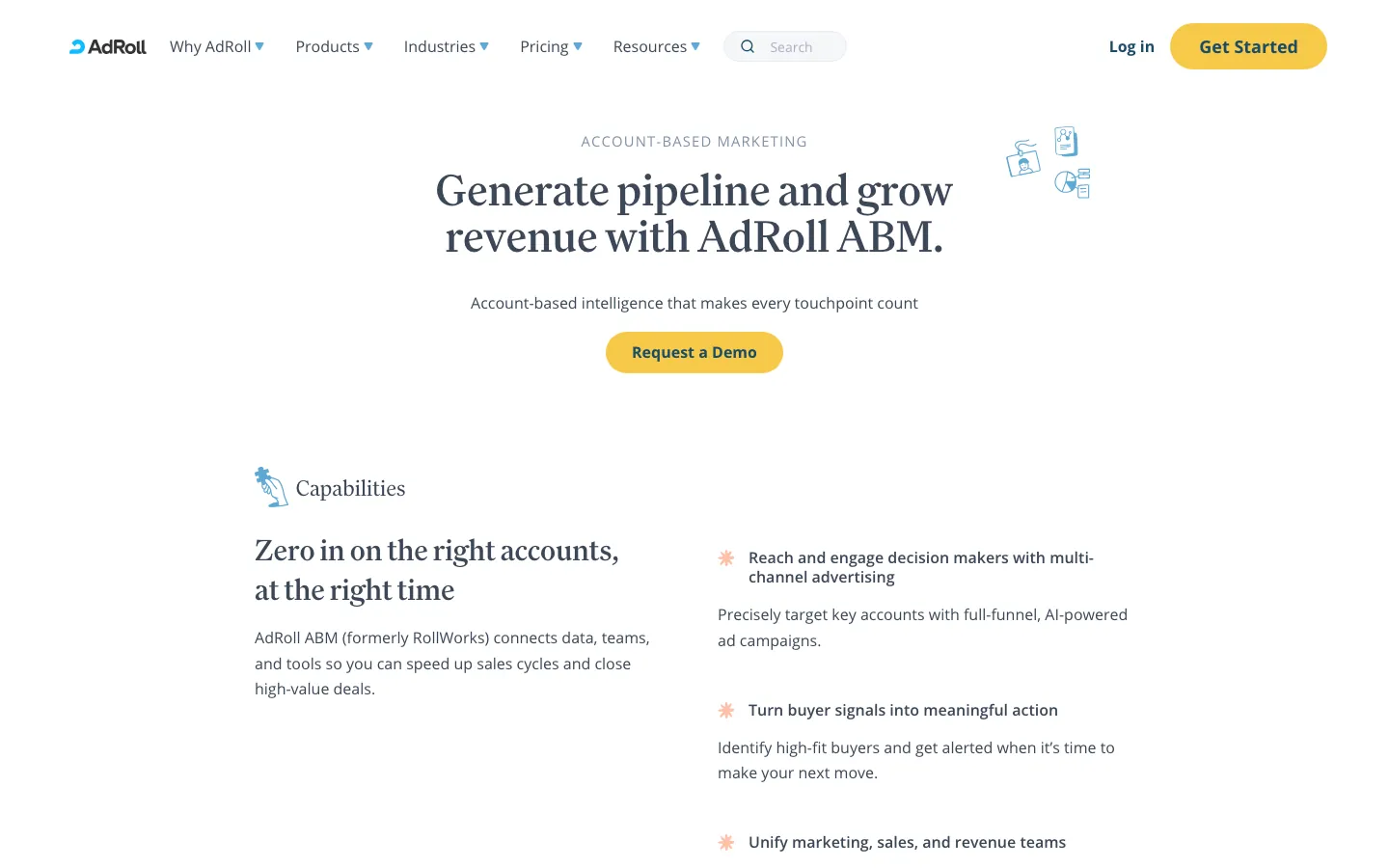
What's great
- The only major ABM platform with publicly accessible entry pricing; basic account targeting starts around $1K/mo, making it the only realistic option for companies under $5M ARR
- Full ABM capabilities land in the $12K-$50K/yr range, a fraction of 6sense or Demandbase; monthly contracts available on lower tiers (rare in the category)
- Intent data engine pulls from Bombora and G2 without requiring separate contracts; the bundling saves $30K-$50K/yr vs buying Bombora standalone
Watch-outs
- Rebranded from RollWorks to AdRoll ABM in August 2025, creating brand confusion and some integration documentation gaps during transition
- Intent depth is shallower than 6sense; the Bombora data is the same source but without 6sense's proprietary network layered on top, signal quality diverges on mid-market accounts
- Reporting customization is limited; teams running complex attribution models will hit walls that Demandbase or 6sense handle natively
Pricing breakdown
| Plan | Price | Best for |
|---|---|---|
| Starter | ~$1K/mo | Under 50 target accounts |
| Standard | ~$2K-$3K/mo | 50-150 accounts |
| Professional | ~$4K-$5K/mo | 150-500 accounts |
| Enterprise | Custom | 500+ accounts |
What reviewers say about RollWorks (AdRoll ABM)
Recurring themes across ~650 G2 reviews (4.3/5) and Capterra verified reviews, 2024-2026.
What reviewers praise
- The built-in AdRoll display infrastructure eliminates the need for a separate DSP; account identification, ad serving, and attribution all live under one login, which lean marketing teams flag as a practical time saver.
- HubSpot native integration is called out as the deepest in the ABM category, with real-time account syncing, contact-level data flow, and Slack alerts for high-intent account visits working without custom configuration.
- Faster time-to-first-campaign than 6sense or Demandbase comes up repeatedly; reviewers describe running an account-targeted display campaign within days of signing, not months.
- Clean dashboard and readable reporting earn praise from non-technical marketers who manage campaigns without a dedicated analyst or RevOps resource.
- Visitor de-anonymization, sales activation Salesforce and HubSpot syncing, and multi-touch attribution are bundled in one package, replacing what previously required four separate point solutions.
What reviewers fault
- Pricing is fully opaque with no published rate cards; entry-level ABM tiers start around $10,000 per year but Advanced tiers exceed $75,000, and every prospect must run through a full demo cycle to get a number.
- Accessing ABM features requires committing to AdRoll display ad spend alongside the SaaS fee, which teams without active display budgets describe as a forced multi-product purchase.
- Account scoring is rules-based rather than AI-driven, and reviewers who moved from 6sense note the absence of a predictive model that improves over time from historical closed-won data.
- No website personalization module means teams targeting account-specific landing page experiences must add a separate tool such as Mutiny or Intellimize, adding cost and complexity.
- Annual contract requirement with no monthly option creates commitment risk for teams still validating ABM as a channel, and reviewers note the platform provides limited trial value beyond the Chrome extension.
Loading reviews…
Foundry ABM
Best for multi-channel ABM with proprietary tech media intent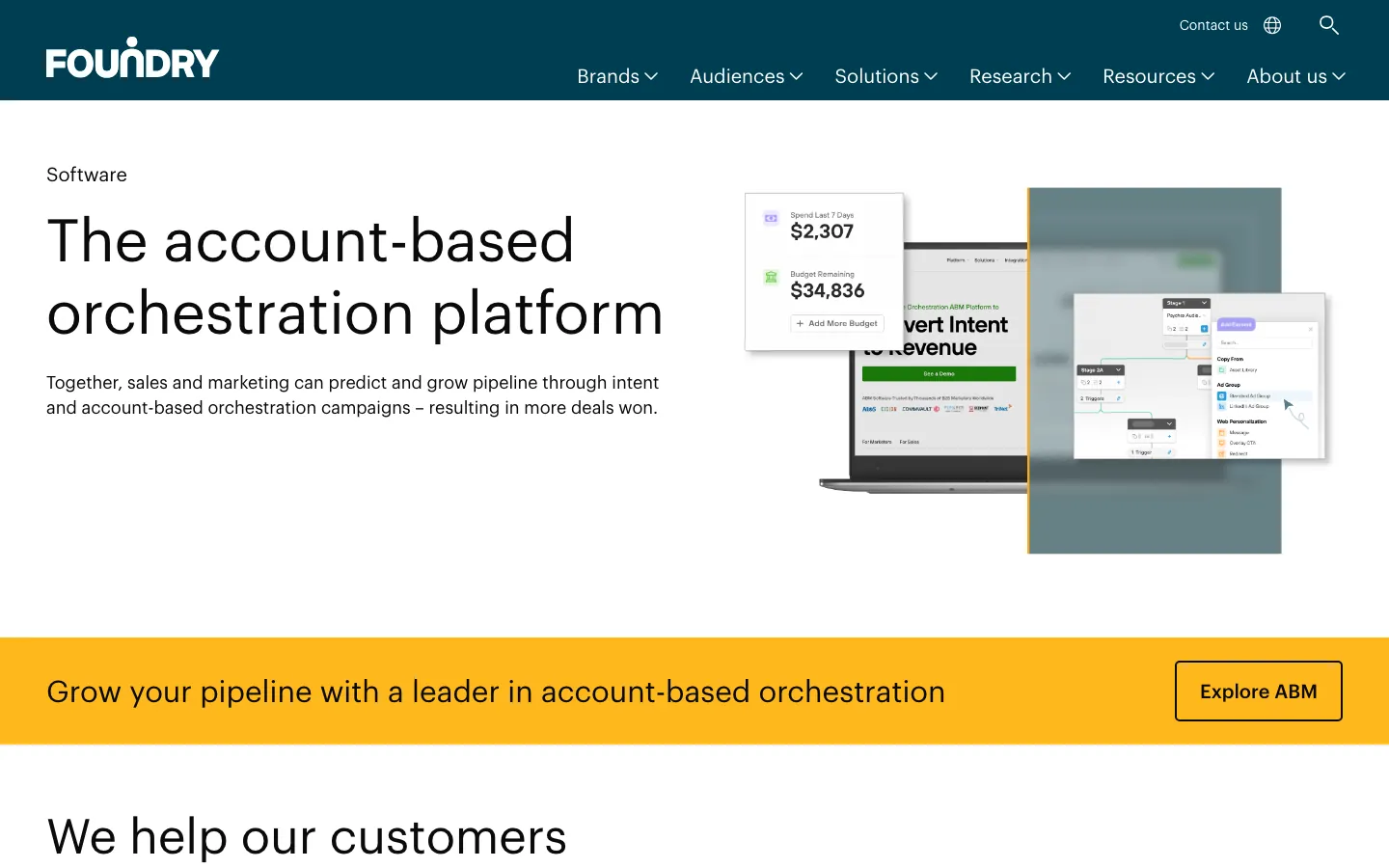
What's great
- IDG/Foundry runs 140+ B2B tech media properties (CIO.com, PCWorld, Computerworld, InfoWorld), giving Foundry ABM access to first-party intent from IT decision-makers that third-party co-ops cannot replicate
- Full-stack orchestration: account-based advertising, web personalization, and sales activation in one platform without separate vendor contracts
- Consistent G2 praise for implementation support; client success teams are named in multiple reviews, which is rare in enterprise ABM
Watch-outs
- Steeper learning curve per G2 reviewers; teams with under six months of ABM experience struggle with the orchestration configuration
- Intent data is strongest for technology verticals (IT, software, infrastructure) and thinner for verticals outside the IDG media footprint (healthcare, financial services, retail)
- Pricing starts around $55K/yr and requires a sales conversation; no self-serve trial or published tier structure
Pricing breakdown
| Plan | Price | Best for |
|---|---|---|
| Core | ~$30K-$55K/yr | Single-channel ABM |
| Growth | ~$55K-$100K/yr | Multi-channel orchestration |
| Enterprise | ~$100K+/yr | Full-stack |
| Custom | Quote | Global programs |
What reviewers say about Foundry ABM
Recurring themes across ~205 G2 reviews (4.2/5) and TrustRadius verified reviews, 2024-2026.
What reviewers praise
- Access to Foundry's own tech-media editorial properties and event audience data gives B2B technology marketers a first-party intent signal that pure software ABM vendors cannot replicate.
- Full-funnel capabilities including advertising, web personalization, sales activation, and measurement sit inside one platform, replacing the multi-vendor stack many mid-market teams were running before.
- Display advertising gets the highest individual feature ratings from reviewers, with several citing ad execution quality and audience reach as the primary reason they renewed over competitors.
- Salesforce, HubSpot, Salesloft, and Google Analytics integrations are described as solid and well-documented, with implementation typically handled by the Foundry onboarding team rather than the customer's engineers.
- Pricing that bundles advertising, intent data, and personalization is flagged by reviewers as more cost-effective than assembling equivalent capabilities from separate vendors at enterprise tier.
What reviewers fault
- The platform does not provide contact-level data, so sales teams cannot pull direct-dial numbers or verified emails from inside Foundry and need a separate data enrichment vendor for outreach.
- Multiple intent data sources within Foundry do not all integrate into CRM and BDR platforms simultaneously, requiring manual export steps to surface signals in Salesforce or Outreach alongside campaign activity.
- The interface can feel cluttered, and reviewers note that advanced reporting features require extra clicks, dedicated training, and in some cases backend support from the Foundry team to configure.
- Campaigns targeting small account lists of under 50 accounts produce thin performance data, with several reviewers noting the platform works best when targeting hundreds of accounts rather than tightly defined short lists.
- Custom deliverables negotiated at contract signing have taken longer to stand up than originally scoped, and reviewers say turnaround time for campaign creative and setup support can be slower than expected.
Loading reviews…
Mutiny
Best for B2B website personalization that converts named accounts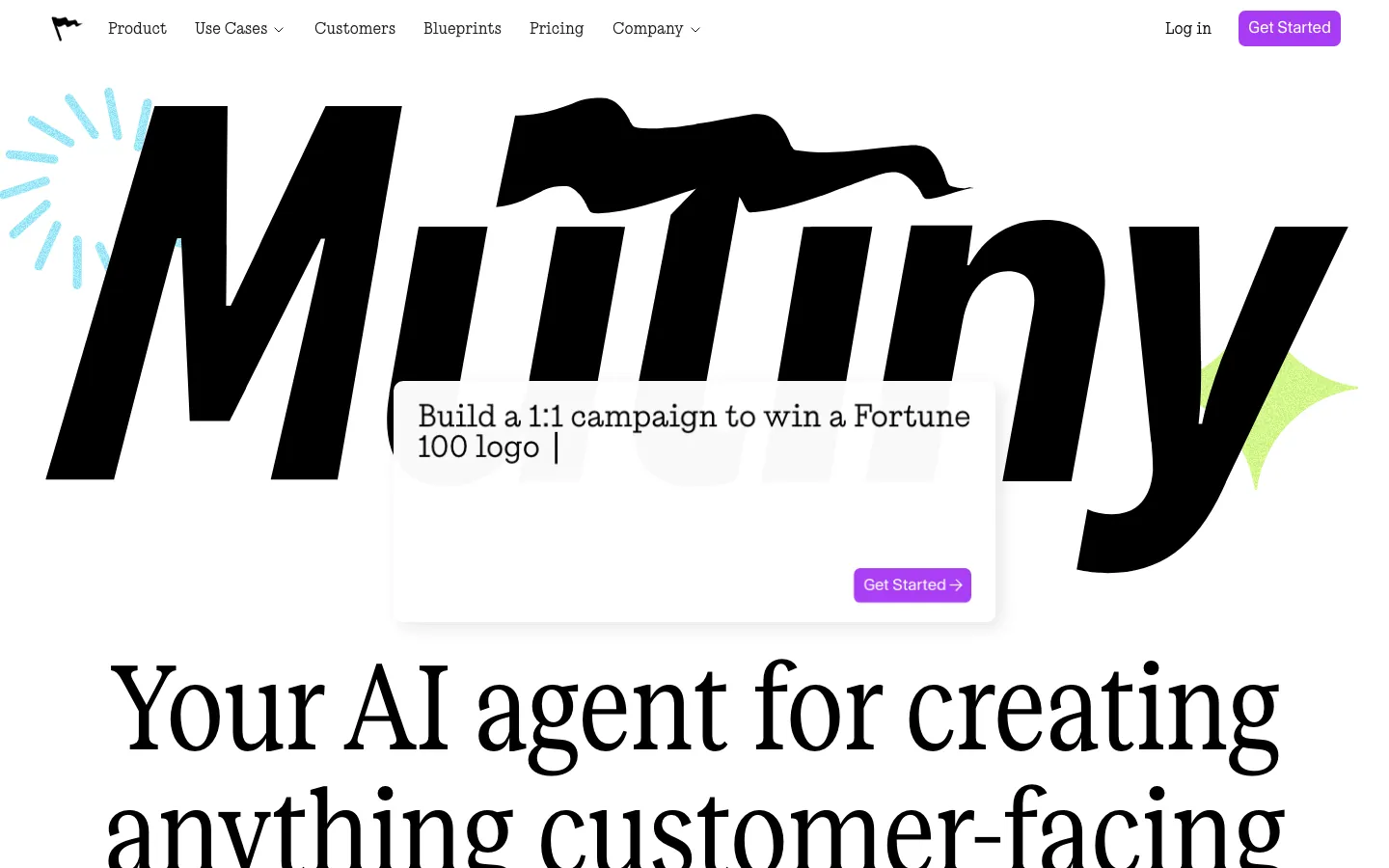
What's great
- Named-account web personalization that fires automatically when a target account lands on your site; changes headline, CTA, and case studies without engineering involvement
- Notion reported a 60% increase in paid-ad conversion rates after implementing Mutiny personalization, one of the few verified performance numbers in the ABM category
- Median contract sits at $37,800/yr per Vendr data; cheaper than Demandbase or 6sense for the personalization use case alone
Watch-outs
- G2 review pool is thin at 32 reviews, making statistical confidence on satisfaction claims lower than other tools in this list
- Without Clearbit, 6sense, or Bombora feeding it account data, Mutiny's personalization is limited to IP-identified visitors; anonymous traffic gets generic experiences
- Primarily a website personalization tool; it does not deanonymize visitors, run ad campaigns, or provide an intent data feed
Pricing breakdown
| Plan | Price | Best for |
|---|---|---|
| Growth | ~$25K-$40K/yr | Mid-market |
| Scale | ~$40K-$80K/yr | Series B/C |
| Enterprise | $80K+/yr | 500+ accounts |
| Custom | Quote | High-volume enterprises with complex personalization rules |
What reviewers say about Mutiny
Recurring themes across ~32 G2 reviews (4.7/5) and Capterra reviews, 2024-2026.
What reviewers praise
- The no-code visual editor is consistently called the most polished in the B2B personalization category, letting marketers build and publish account-specific page variants without opening an engineering ticket.
- Firmographic and intent-based segmentation logic is built natively for B2B use cases, including vertical-specific pages and account-tier personalization, rather than adapted from a B2C experimentation tool.
- Slack notifications alerting sales reps to high-intent account visits in real time are described as a behavioral change trigger that noticeably speeds up follow-up response on warm accounts.
- Customer success engagement gets near-perfect marks across both G2 and Capterra, with CSMs actively helping teams design experiments rather than just answering support tickets.
- Integration with data enrichment providers including Clearbit, 6sense, Demandbase, ZoomInfo, and G2 buyer intent feeds is clean and well-documented, letting teams activate existing signals without rebuilding audience logic.
What reviewers fault
- A/B testing depth is limited relative to dedicated experimentation tools; click-level tracking on individual buttons or div elements is not available natively, requiring teams to layer Optimizely or VWO on top for granular tests.
- Pricing at approximately $38,000 per year median before enrichment costs puts the platform well outside reach for most companies below $5M ARR, and concurrent-experience caps can trigger mid-contract renegotiations.
- First meaningful conversion lift typically takes two to four quarters to materialize, and teams that expect a six-week ROI proof point consistently report being disappointed in year one.
- Reporting dashboards are described as functional but shallow, with limited ability to slice performance data by custom dimensions or export in formats suitable for executive presentations.
- Visitor identification is lighter than dedicated de-anonymization tools like RB2B or Warmly, and teams that need to identify anonymous visitors at the person level must add a separate product alongside Mutiny.
Loading reviews…
Influ2
Best for person-based B2B advertising to specific decision-makers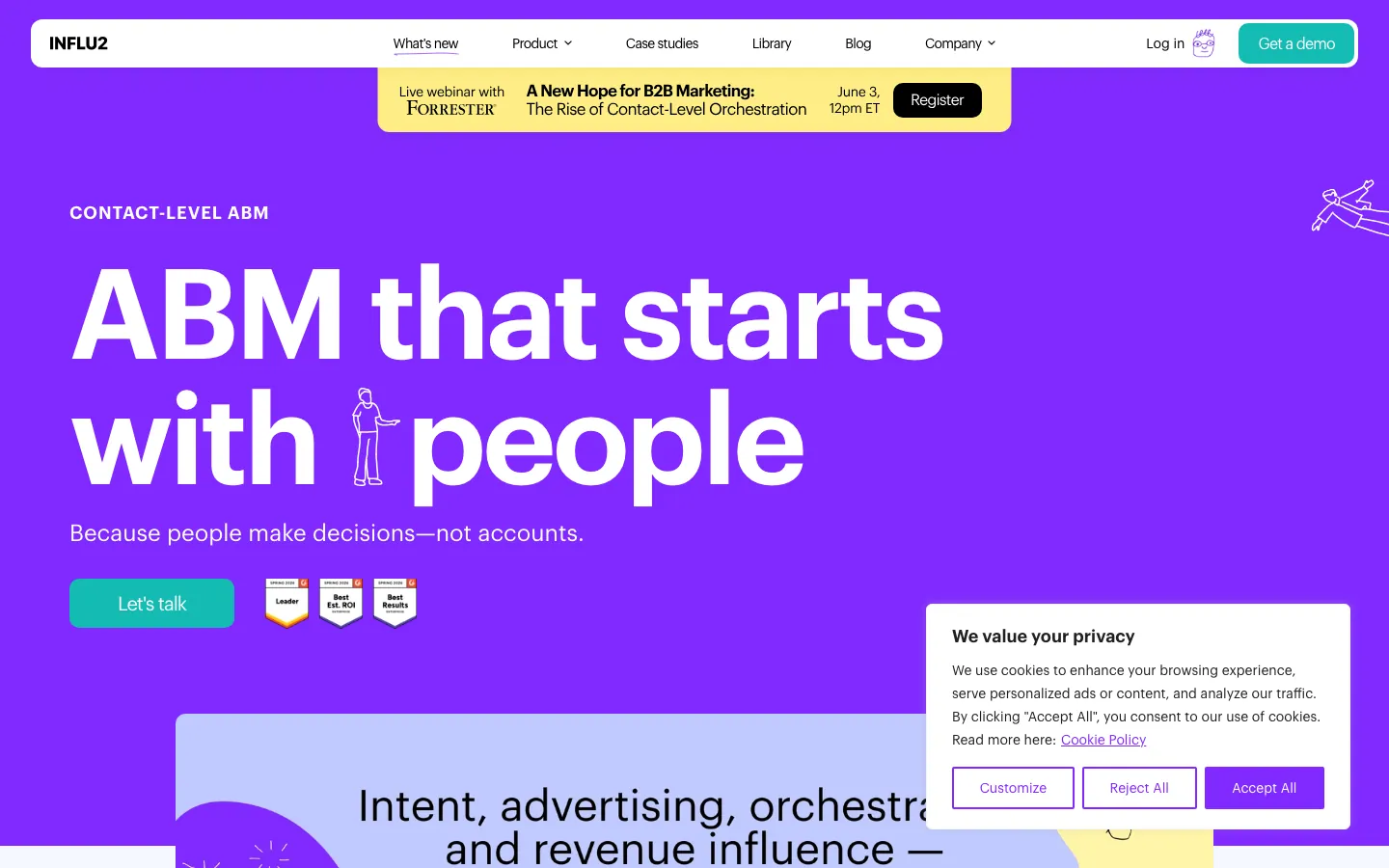
What's great
- Person-based advertising reaches specific job titles and named contacts rather than anonymous account IPs; Influ2 launched contact-level GTM orchestration in May 2026 and took the same 'contact-level orchestration' theme to the Forrester B2B Summit North America in April 2026 as the next ABM frontier
- Charges per engaged contact at roughly $5 per credit, making it more cost-predictable than impression-based platforms; teams with small, high-value target lists see stronger ROI math
- Customer support is the standout differentiator; 23 G2 reviews specifically mention hands-on account teams that feel like extensions of the marketing org
Watch-outs
- Exclusively a person-based advertising platform; it does not deanonymize site visitors, provide intent data, run web personalization, or offer account list-building tools
- Median contract is $60K/yr per Vendr data, reaching $102K on the high end; the ROI math only works when your ACV is above $30K-$50K
- Reporting capabilities drew repeated criticism in G2 reviews for limited customization and an inability to cut attribution data in ways complex multi-touch models require
Pricing breakdown
| Plan | Price | Best for |
|---|---|---|
| Starter | ~$34K/yr | Under 100 named contacts |
| Growth | ~$60K/yr | 100-300 named contacts |
| Scale | ~$100K/yr | 300-500 contacts |
| Enterprise | Custom | 500+ contacts |
What reviewers say about Influ2
Recurring themes across ~158 G2 reviews (4.6/5) and TrustRadius verified reviews, 2024-2026.
What reviewers praise
- Person-based ad targeting at the named contact level, rather than the account level, is the defining differentiator reviewers cite; marketers can serve ads to specific decision-makers by name and track individual engagement.
- Visibility into which individual contacts clicked an ad, viewed which content, and how many times is consistently called the most actionable signal in the platform, enabling sales reps to prioritize by actual buying behavior.
- Customer support receives the highest individual category score on G2, with 23 mentions; reviewers describe account teams as proactive partners who help configure campaigns rather than reactive ticket-closers.
- Salesforce and HubSpot integrations are described as clean and fast to implement, with full deployment typically taking around one month rather than the multi-quarter timelines common with broader ABM platforms.
- Waste reduction on ad spend is a recurring theme; reviewers describe eliminating irrelevant impressions served to non-decision-makers and redirecting that budget to verified buying committee members.
What reviewers fault
- Cost per engaged contact is flagged as high, with some reviewers citing $5 per contact reached, and the value equation weakens for teams targeting accounts with deal sizes below $50,000 where volume cannot offset the per-contact rate.
- The platform does not include a built-in B2B contact database; marketers must source and verify their own contact lists through a separate provider such as Apollo, ZoomInfo, or Cognism before Influ2 can serve ads to those individuals.
- Scaling to broad brand awareness campaigns is difficult because the precision-first model limits reach; reviewers needing high impression volume for awareness objectives find the model constraining.
- Reporting and analytics customization is limited, with reviewers wanting more flexible options for slicing ROI data, attributing pipeline influence, and benchmarking performance against LinkedIn or Google in a single dashboard.
- Ad creative personalization depth is described as limited, with some reviewers noting inadequate match rates when serving dynamic creative to specific contact segments at scale.
Loading reviews…
MadKudu
Best predictive scoring for PLG and product-led ABM motions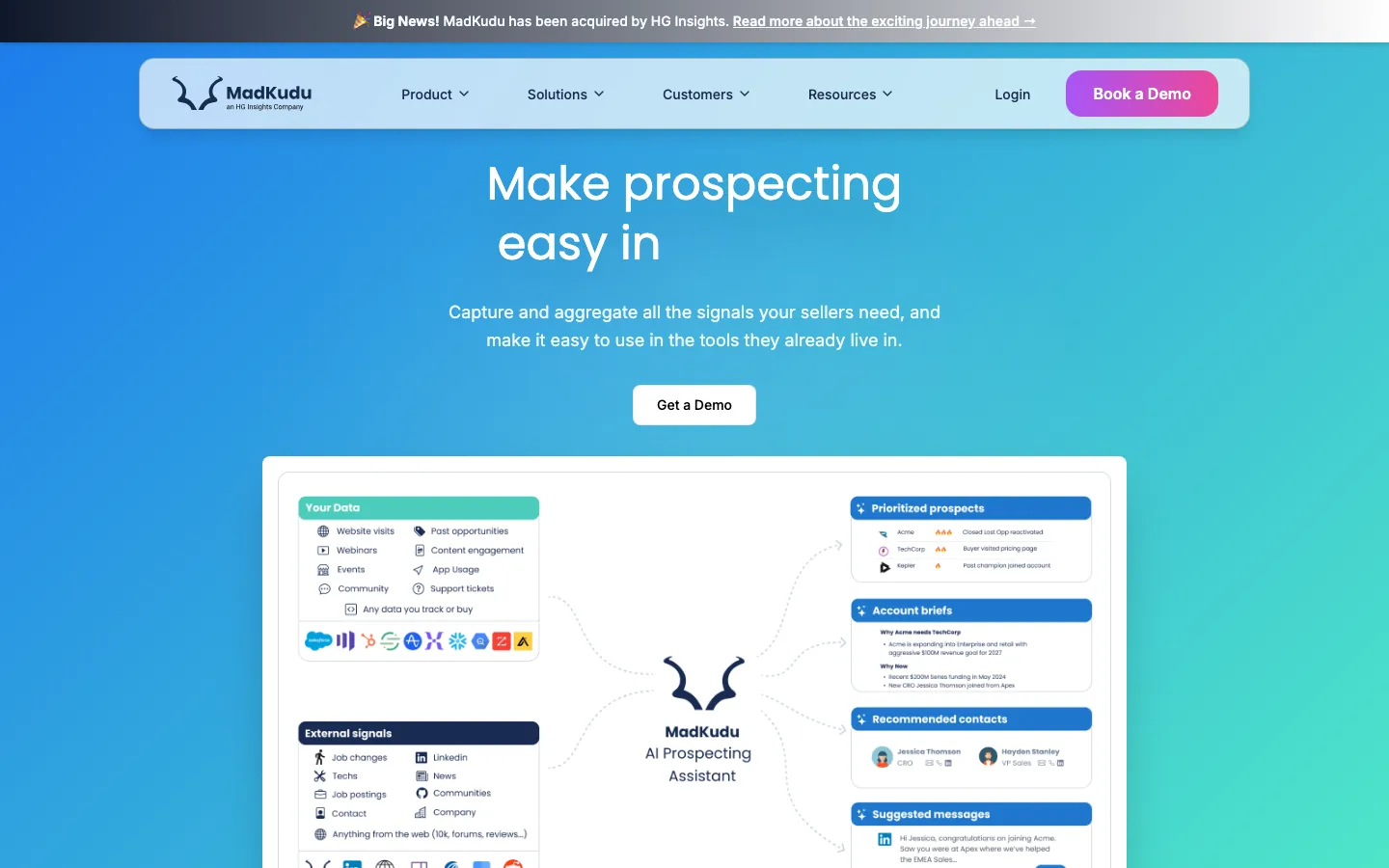
What's great
- ML scoring models trained on your historical conversion data produce account and contact scores that improve over time as more conversions land; most intent platforms use static models
- Deep integrations with Salesforce, HubSpot, Marketo, Segment, Amplitude, and Mixpanel; PLG companies can pipe product usage signals directly into the scoring model
- Acquisition by HG Insights (announced August 2025) brings additional firmographic enrichment data into the scoring engine; roadmap direction is toward broader GTM signal coverage
Watch-outs
- Scoring only: MadKudu does not provide a contact database, run ad campaigns, send emails, or orchestrate any outbound workflow; it is a signal layer that feeds other tools
- Requires substantial product usage data before the ML models deliver reliable scores; under 200 monthly signups, the scoring isn't statistically meaningful
- Growth plan at $24K/yr ($2K/mo) and Pro at $30K+/yr feel steep relative to scope; all-in-one GTM platforms like Apollo.io ship basic lead scoring for $1K-$2K/mo with a full contact database included
Pricing breakdown
| Plan | Price | Best for |
|---|---|---|
| Starter | ~$1K/mo | Teams testing PLG scoring |
| Growth | $24K/yr (~$2K/mo) | Series A/B PLG |
| Pro | $30K+/yr | 10+ sales reps |
| Enterprise | Custom | High-volume PLG |
What reviewers say about MadKudu
Recurring themes across ~46 G2 reviews (4.5/5) and TrustRadius verified reviews, 2024-2026.
What reviewers praise
- Predictive scoring accuracy for PLG companies with sufficient historical product usage data is the most-cited praise; reviewers report the model correctly identifies their highest-converting opportunities at a rate that justifies replacing manual scoring.
- AI-assisted lead grade explainers, added in 2025, show reps exactly why a lead scored high by surfacing the specific signals, such as team invite count, API usage, and ICP firmographic match, that drove the prediction.
- Deep multi-source signal ingestion, pulling from product usage, CRM history, LinkedIn activity, job change data, and GitHub signals, is praised for producing a richer score than rule-based tools trained on form fills alone.
- Customer success responsiveness draws consistent positive mention, with reviewers specifically noting that the team helps optimize model weights over time and has a track record of shipping feature requests into the product.
- Sales prioritization quality means reps spend less time on low-fit leads; one reviewer cited saving significant headcount cost by relying on model output to guide outbound sequencing rather than manual list-building.
What reviewers fault
- Scoring is reactive rather than prospective; the platform only scores leads already in your CRM and cannot surface accounts outside your database that are showing buying signals such as hiring for relevant roles or raising funding.
- The interface requires workarounds to surface top prospects without manual filtering, and bulk scoring operations are described as cumbersome when merging outputs with existing spreadsheets or sequencing tools.
- Pricing at approximately $2,000 per month for the Growth plan means customers are paying for machine-learning accuracy on exactly one function, with no contact database, no outreach sequencing, and no ad activation included.
- Dashboard customization is limited, with reviewers wanting more granular control over signal weighting and the ability to build custom scoring dimensions without involving the MadKudu team.
- MadKudu was acquired by HG Insights in August 2025, and while the product continues to operate, some reviewers raised concerns about roadmap continuity and whether the standalone scoring focus will persist post-acquisition.
Loading reviews…
Pathmonk
Best entry-level website intent and conversion layer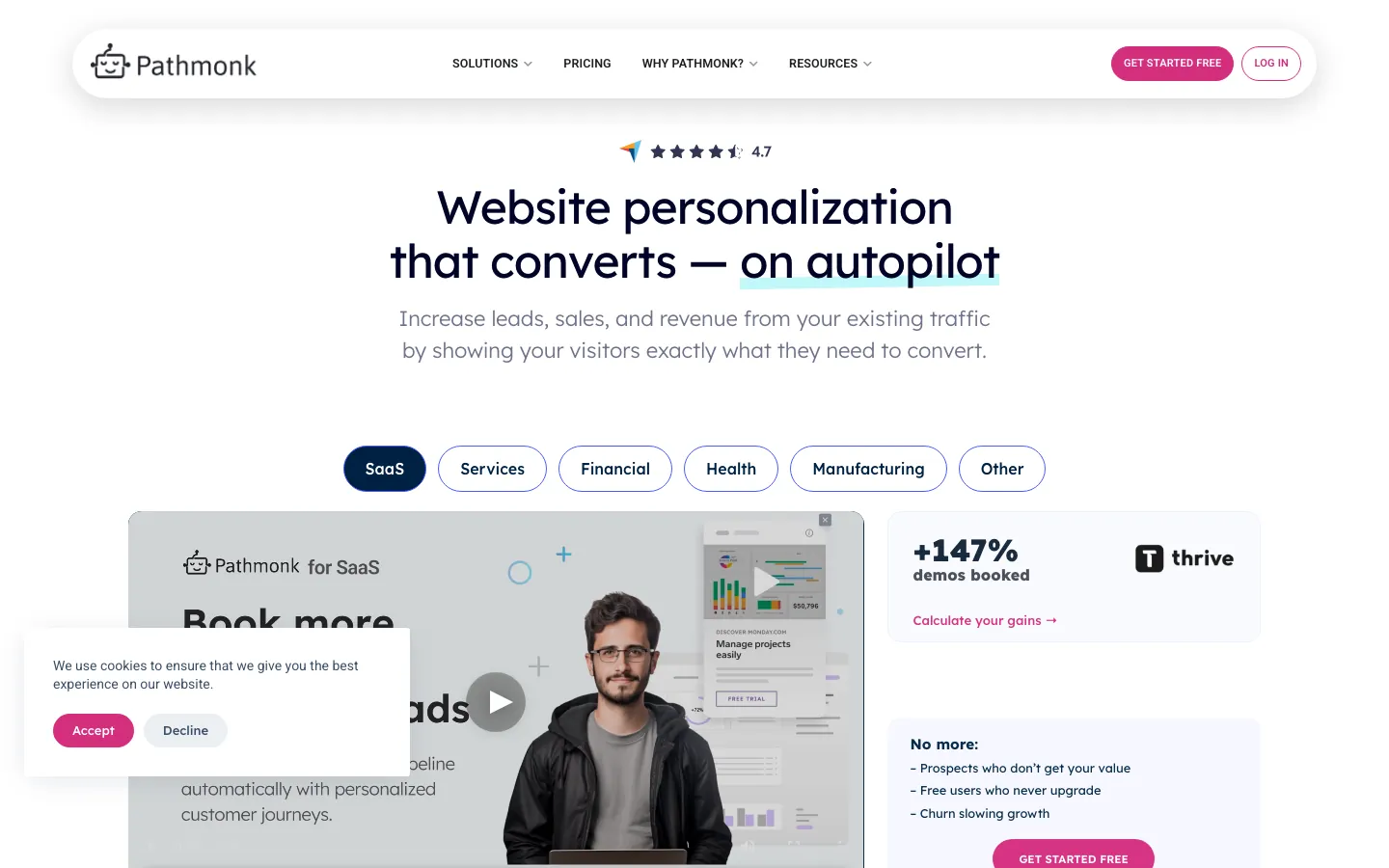
What's great
- Transparent public pricing starting at $450/mo; the only tool on this list with a published price below $1K/mo for a working ABM-adjacent intent layer
- 20% A/B lift guarantee; if Pathmonk does not improve conversion rates by 20% in an agreed window, the vendor issues a full refund
- Cookieless retargeting and AI personalization bundled at the entry tier; no add-ons required for core functionality
Watch-outs
- G2 review pool of just 1 is thin; statistical confidence on satisfaction data is effectively nil, lean on Capterra and GetApp instead
- Intent signals are first-party only (your own website traffic); it does not tap third-party co-op data like Bombora or publisher networks like Foundry
- 20K pageview minimum to start; brands with under 10K monthly visitors will not see meaningful personalization lift from sample sizes that small
Pricing breakdown
| Plan | Price | Best for |
|---|---|---|
| Growth | $450/mo | 20K monthly pageviews |
| Scale | Custom | 100K+ pageviews |
| Enterprise | Custom | 99.9% SLA |
| API | Custom | Platforms and agencies building on Pathmonk signals |
What reviewers say about Pathmonk
Recurring themes across ~40 Capterra reviews (4.7/5) and available G2 data (1 review, 5.0/5), 2024-2026.
What reviewers praise
- Setup consistently described as fast and requiring no developer involvement; reviewers get the snippet live in under a day.
- Micro-experiences drive measurable conversion lifts, with multiple reviewers citing 15-30% increases in lead capture from existing traffic.
- Real-time visitor intent data showing which pages visitors engage with and where they drop off is the most-praised analytical output.
- Customer success team gets strong marks for being proactive, communicative, and responsive during and after onboarding.
- Native integrations with HubSpot, Salesforce, and Slack connect intent signals directly to existing GTM workflows without custom dev.
What reviewers fault
- Micro-experience design customization is limited; reviewers want more control over visual styling so widgets blend with their brand.
- Reporting depth is thin, with users wanting granular breakdowns of individual micro-experience performance and visitor source data.
- Traffic-based pricing model draws complaints from teams whose traffic fluctuates, as costs can spike unpredictably month to month.
- Dashboard and admin interface needs polish; described as functional but requiring time to get comfortable with before it feels intuitive.
- Billing disputes surfaced in reviews, including at least one case of unexpected charges continuing after a cancellation request.
Loading reviews…
Tools we considered but excluded
We evaluated more tools than the 9 you see above. These did not make the cut. Saying what we rejected, and why, is the editorial muscle most listicles skip.
- Terminus (now ABX by DemandScience): Merged into DemandScience in November 2024 and rebranded as ABX by DemandScience; the platform is mid-transition and pricing/product stability is uncertain until the integration completes
- Madison Logic: Strong content-syndication ABM tool but narrower than the full-platform picks; best as a supplement to a primary ABM platform rather than a stand-alone choice
- Intentsify: Solid intent data activation layer but smaller publisher co-op than Bombora and thinner integrations ecosystem; better suited as a Bombora alternative than a primary ABM platform
- HubSpot ABM: ABM features bundled into Marketing Hub Enterprise at $3,600/mo flat; functional for sub-100-account programs but intent data is shallow vs. the dedicated platforms here
- Clearbit (now HubSpot Data Enrichment): Acquired by HubSpot in 2023 and being merged into the HubSpot data layer; no longer a standalone ABM platform
- Qualified: Strong pipeline automation and conversational ABM for Salesforce shops, but the use case (converting inbound site visitors) is narrower than the full ABM platforms in this list
Honorable mentions
Solid tools that did not crack the main list but are worth tracking, especially for niche use cases.
- G2 Buyer Intent: Identifies specific companies and job titles browsing G2 review pages; complements Bombora cleanly and starts at $10K-$20K/yr, worth tracking as a high-signal first-party data source
- HockeyStack: Pipeline attribution and ABM analytics that connects ad spend to pipeline to revenue in one model; rising fast in the RevOps community as Demandbase attribution alternatives
- Abmatic AI: Emerging challenger positioning directly against 6sense, Demandbase, and Terminus on price; watch for a 2026-2027 G2 review base that validates the intent data quality claims
The five sub-categories of ABM software
The ABM software market is fragmented in ways that confuse even experienced RevOps buyers. Five distinct sub-categories exist, and the most common buying mistake is treating them as interchangeable.
Full-stack ABM platforms. These bundle intent data, account scoring, advertising orchestration, web personalization, and pipeline attribution into one contract. 6sense Revenue AI, Demandbase One, and Foundry ABM fall here. They require 8-16 weeks to implement properly and $60K+ annually before ad spend. The payback is real at $50M+ ARR with a dedicated marketing ops function.
Intent data providers. Bombora Company Surge sits in this bucket. These are intelligence layers that feed signals into your existing stack. They do not run campaigns, fire ads, or personalize your site. You buy them to improve the scoring quality of the platforms you already own.
ABM advertising platforms. RollWorks (now AdRoll ABM) and Influ2 focus on targeted B2B advertising. RollWorks targets at the account level by IP; Influ2 targets specific contacts by name and job title. Both produce measurable ad engagement without requiring the full-stack implementation overhead.
Website personalization tools. Mutiny and Pathmonk show different site experiences to named accounts or inbound intent signals. Neither runs ads or provides intent data. Both produce measurable conversion lift faster than full-stack platforms.
Predictive scoring engines. MadKudu is the standout here. It ingests product usage signals and CRM conversion history to score accounts and contacts. No ads, no personalization, just better signals for the tools that already execute.
Most mature ABM programs use three or four tools across these sub-categories. The stacks that work: a full-stack platform (6sense or Demandbase) plus a personalization layer (Mutiny) plus a scoring engine for PLG signals (MadKudu).
The stacks that waste budget: buying full-stack at $100K before sales and marketing agree on what an in-market account even means.
2026 market shifts in ABM software
Intent data consolidation is accelerating. Bombora remains the dominant third-party co-op data source, but 6sense’s proprietary network and G2 Buyer Intent are eroding Bombora’s market share at the top and bottom of the market respectively. In three years, intent data may be a commodity feature bundled into every ABM platform at no incremental cost.
Terminus merged into DemandScience in November 2024. The combined entity is now called ABX by DemandScience. The transition has been messy; Terminus.com still shows the old brand as of May 2026 and the G2 review pool is split between two product listings. This is not necessarily a death sentence for the platform but it is a real procurement risk for teams mid-evaluation.
Person-level targeting is the next frontier. The category has spent five years on account-level signals. Influ2 pioneered person-based advertising; Forrester dedicated a Q2 2026 research track to ‘contact-level ABM orchestration.’ Expect 6sense and Demandbase to push contact-level targeting into their 2026-2027 roadmaps as a response.
AI-generated microsites are changing the personalization category. Mutiny launched AI-generated 1:1 campaign pages in late 2025; Qualified followed with similar tooling. What took a content team three days now takes 20 minutes. The ROI math on named-account personalization improves materially when content creation cost drops by 90%.
Mid-market pricing pressure is real. The $60K-$100K ABM platform floor is increasingly difficult to justify for Series A/B companies. RollWorks, Pathmonk, and MadKudu all attract budget from teams that looked at 6sense quotes and walked away. Expect 6sense and Demandbase to introduce SMB-priced entry tiers in the next 12-18 months to stop the leakage.
Selection criteria, what to test in your ABM platform trial
Every ABM vendor demo looks roughly the same: beautiful heatmaps, confident pipeline attribution, and an account list that appears to be in-market just in time for your Q3 plan. What the demos skip is the hard part. Eight things to test before signing.
One, run your own account list through the intent engine. Pull your existing customer list, your best-fit ICP accounts, and 20 accounts that went dark after a strong sales conversation. Upload them and check their intent scores. If your closed-won customers are not showing strong historical signals and your dark accounts show no buying-stage patterns, the model has limited value for your specific ICP.
Two, test account identification accuracy on your website traffic. Put a 30-day window of real inbound traffic through the deanonymization layer. Compare the IP-to-account matches against your known customer and prospect list. Ask the vendor: what percentage of your inbound traffic do we identify at the account level? Best platforms hit 25-40% on mid-market B2B traffic. Below 15% and the personalization and targeting use cases become statistically thin.
Three, map the integration path to your actual CRM and MAP. Not the showcase integrations. Your specific Salesforce configuration, your Marketo instance (or whichever marketing automation platform you run), your data warehouse. ABM platforms are only as useful as the data that flows in and out of them. If the connection requires a middleware tool or a custom API build, factor three to four weeks of engineering time into the implementation estimate.
Four, measure actual time-to-live for a production campaign. Ask the CSM: walk me through going from contract signature to a live ad campaign targeting 50 specific accounts in your system. Time the answer. The platforms that routinely hit eight weeks to a live campaign are not the right fit for a marketing team that needs to show results in a quarter. RollWorks and Pathmonk routinely go live in under two weeks; 6sense and Demandbase average six to twelve.
Five, test the reporting against how your CFO thinks. Pull the pipeline attribution report. Map it to deals that closed in the last 90 days and check how many the platform claimed credit for. If the ABM platform claims it influenced more than 80% of closed revenue, the attribution model is overcounting. The platforms with honest reporting (6sense, Demandbase advanced tier, HockeyStack) show a tighter, more defensible number.
Six, ask for three customer references in your company size band. Not the names the vendor offers. Find them via LinkedIn or your network. Ask the unfiltered question: would you sign this contract again at full price knowing what you know now? The answer split between enterprise reference customers and mid-market customers is usually the biggest signal about fit.
Seven, validate the intent data quality on a topic that matters for your ICP. If you sell DevSecOps tools, pick ‘container security’ as a Bombora or 6sense topic and run 90 days of surge data. Cross-reference the surging accounts against your own outbound sequence engagement and CRM data. A 6sense practitioner noted on G2 that ‘intent data is directional, not a crystal ball.’ Verify before you architect a pipeline model around it.
Eight, negotiate contract terms before the first demo ends. ABM platforms sell on multi-year contracts. The first renewal is where the real math lives: ask what average customers paid in year two and year three. If the rep cannot give a range, assume 15-25% annual increases. Cap language is negotiable at almost every vendor in this list; get it in writing before signing.
Where the nine ABM platforms differ on core use cases
| Tool | Account intent data | Web personalization | Account advertising | Contact-level targeting | Native attribution |
|---|---|---|---|---|---|
| 6sense Revenue AI | ✓ proprietary | ✓ | ✓ | • limited | ✓ |
| Demandbase One | ✓ via Bombora | ✓ | ✓ native DSP | • limited | ✓ |
| Bombora | ✓ co-op data | ✗ | ✗ | ✗ | ✗ |
| RollWorks (AdRoll ABM) | ✓ via Bombora + G2 | ✗ | ✓ | ✗ | • limited |
| Foundry ABM | ✓ IDG media network | ✓ | ✓ | ✗ | ✓ |
| Mutiny | ✓ via 6sense/Clearbit | ✓ | ✗ | ✗ | • limited |
| Influ2 | ✗ | ✗ | ✓ | ✓ | • limited |
| MadKudu | ✓ ML-based scoring | ✗ | ✗ | ✓ scoring | ✗ |
| Pathmonk | ✓ first-party only | ✓ | ✗ | ✗ | ✗ |
The standout split: 6sense and Demandbase are the only tools that cover all five use cases in a single contract. Every other tool in this list does one or two things well and requires a complementary platform to close the gaps.
The practical consequence is that most ABM programs need two to three contracts minimum; the “$60K ABM platform” often becomes $120K-$180K when the personalization layer, intent data, and scoring engine are added.
Integration depth across the ABM stack
| Tool | Salesforce | HubSpot | Marketo | LinkedIn Ads | Outreach/Salesloft |
|---|---|---|---|---|---|
| 6sense Revenue AI | N | N | N | N | N |
| Demandbase One | N | N | N | N | N |
| Bombora | N | N | N | N | M |
| RollWorks (AdRoll ABM) | N | N | M | N | M |
| Foundry ABM | N | N | N | N | M |
| Mutiny | N | N | M | M | • |
| Influ2 | N | N | M | N | N |
| MadKudu | N | N | N | ✗ | M |
| Pathmonk | M | M | ✗ | ✗ | ✗ |
6sense and Demandbase have the strongest native integration story: both write directly to Salesforce opportunities, update campaign member statuses in Marketo, and fire LinkedIn Matched Audiences from within the platform. Pathmonk sits at the other end; most of its integrations route through Zapier or a lightweight webhook.
For teams running Salesforce and Marketo as their CRM and MAP stack, 6sense, Demandbase, Foundry, and Influ2 all support bidirectional native syncs that eliminate manual export-import cycles.
ABM platform security and compliance, tool by tool
| Tool | SOC 2 Type II | GDPR | HIPAA | SSO/SAML | Audit logs |
|---|---|---|---|---|---|
| 6sense Revenue AI | ✓ | ✓ | • on request | ✓ | ✓ |
| Demandbase One | ✓ | ✓ | • on request | ✓ | ✓ |
| Bombora | ✓ | ✓ by design | ✗ | ✓ | ✓ |
| RollWorks (AdRoll ABM) | ✓ | ✓ | ✗ | ✓ | • limited |
| Foundry ABM | ✓ | ✓ | ✗ | ✓ | ✓ |
| Mutiny | ✓ | ✓ | ✗ | ✓ | • limited |
| Influ2 | ✓ | ✓ | ✗ | ✓ | • limited |
| MadKudu | ✓ | ✓ | ✗ | ✓ | • limited |
| Pathmonk | ✓ | ✓ | ✗ | M | ✗ |
For enterprise IT review, 6sense and Demandbase pass with the fewest escalations. Bombora’s GDPR posture is the strongest in the category because the co-op model uses publisher-level consent rather than inferred tracking; EU data teams routinely clear it faster than any other intent tool.
HIPAA coverage is rare across the category; if you’re selling into healthcare, run a specific vendor assessment before relying on any of these tools for patient-adjacent account targeting.
Picking the right ABM platform for your team
Five questions that collapse the shortlist.
1. Your ARR and marketing ops headcount
Sub-$5M ARR or no dedicated marketing ops: use RollWorks for account-targeted advertising and Pathmonk for site conversion. Full-stack platforms will consume more time than they return.
$5M-$50M ARR with one marketing ops person: Foundry ABM or RollWorks Professional. Both deploy in under four weeks and produce pipeline-attributable results within a quarter.
$50M-$200M ARR with a RevOps function: 6sense or Demandbase. The implementation overhead pays back once you have enough accounts, enough pipeline, and enough data to train the scoring models.
$200M+ ARR: Demandbase for marketing-led programs, 6sense for sales and marketing jointly running ABM with shared account scoring.
2. Third-party co-op intent vs your own website signal
If your target accounts are primarily reachable through tech media consumption (reading CIO.com, InfoWorld, Computerworld), Foundry ABM has a data advantage. If your ICP reads general B2B content, Bombora’s 5,000-publisher co-op is the broader signal source.
If your best signal is your own website traffic and product usage, Pathmonk and MadKudu are closer to the real intent.
3. Account-level vs contact-level targeting
Every platform except Influ2 and MadKudu works at account level. For enterprise deals with long buying committees, contact-level targeting (reaching the CFO and CTO simultaneously with different messages) is worth the Influ2 price premium. For transactional B2B with a single economic buyer, account-level targeting is sufficient.
4. What your sales team actually wants
RevOps leaders tend to converge on the same point: ABM fails when marketing runs it in isolation. Before selecting a platform, run a 30-minute discovery with your head of sales. If they cannot name five accounts they want marketing to help them access, the ABM motion is not ready.
If they can name 50 accounts with specific contact targets, you have the pipeline to justify 6sense or Demandbase.
5. How fast you need results
Board meeting in 60 days: Pathmonk (conversion lift) or RollWorks (ad engagement). Both show measurable numbers before quarter end.
Annual planning cycle: 6sense, Demandbase, or Foundry. All three require a quarter to configure before they generate attributable pipeline.
What an ABM platform really costs in year one
The gap between the listed entry price and what year one actually costs is the most consistent budget surprise in this category.
| Platform | Listed entry price | Real year-1 all-in |
|---|---|---|
| 6sense (Growth tier) | ~$60K/yr | $85K-$120K (seats, overage, RevOps staffing) |
| Demandbase (Enterprise) | ~$65K/yr | $90K-$130K (implementation, onboarding, admin) |
| Bombora (Starter) | ~$30K/yr | $75K-$120K (requires ABM execution stack on top) |
| RollWorks (Professional) | ~$48K/yr | $60K-$90K (platform + ad spend budget) |
| Foundry ABM (Core) | ~$55K/yr | $70K-$100K (onboarding, content production) |
| Mutiny (Growth) | ~$38K/yr | $50K-$70K (content ops, 6sense data feed) |
| Influ2 (Growth) | ~$60K/yr | $75K-$95K (ad spend layered on platform fee) |
| MadKudu (Growth) | ~$24K/yr | $30K-$45K (scoring only, execution tools additional) |
| Pathmonk (Growth) | ~$5.4K/yr | $8K-$15K (conversion ops, analytics setup) |
The single biggest forecast error is treating ad spend as separate from the ABM budget. Most ABM advertising platforms require $3K-$15K/mo in media budget on top of software fees. At $10K/mo in ad spend, that is $120K/yr in non-software cost that does not appear on any vendor pricing page. Build this into the budget conversation before procurement sign-off.
ABM-to-pipeline attribution playbook
Attribution is where ABM programs most often fail. A program can run for months before the board asks a simple question: ‘What pipeline did this create?’ The answer gets uncomfortable when the attribution model was wrong from day one.
Stage 1 (weeks 1-2): Define what ABM influence means for your team. Influenced pipeline (account was in a campaign when an opportunity was created) is very different from attributed pipeline (last-touch or multi-touch model showing ABM as a direct driver). Both are valid; they require different data models and produce very different numbers. Decide before deployment, not after.
Stage 2 (weeks 3-6): Tag every target account in CRM before campaign launch. This sounds obvious and is routinely skipped. If you cannot tie a Salesforce account record to an ABM campaign member record before the campaign starts, you cannot prove ABM influence after the campaign ends. Six sense and Demandbase both write campaign member data back to Salesforce natively; use this, do not export to a spreadsheet.
Stage 3 (weeks 7-12): Set up a control group. Take 25% of your target account list and do not run ABM campaigns against them. Same ICP, same segment, no ABM touchpoints. After 90 days, compare time-to-first-meeting and pipeline creation rates between the treated group and the control group. This is the only way to separate ABM impact from general market seasonality or sales activity.
Stage 4 (ongoing): Report on account engagement velocity, not just pipeline value. Pipeline attribution takes six months to twelve months to accumulate at deal cycle lengths above 60 days.
Engagement velocity (accounts moving from Awareness to Consideration in 6sense, engagement score increases in Demandbase) is a leading indicator that shows program health before the pipeline numbers are meaningful. Report on both; use velocity for weekly ops cadences, use pipeline for quarterly business reviews.
The teams that get ABM attribution right share one characteristic: they defined the measurement model before signing the platform contract.
Intent data quality scorecard
Not all intent data is the same. The difference between Bombora Company Surge and a scraped bidstream is enormous in practice, but every vendor describes their data as ‘high-quality, consent-based signals.’ Here is how to score them before buying.
Source model. Publisher co-op (Bombora, Foundry) means sites explicitly share anonymized reader data. Proprietary network (6sense) means signals from a publisher network the vendor built directly. Bidstream (some smaller vendors) means buying raw ad exchange signals, which carry no consent guarantee and produce more noise. Ask every vendor directly: what percentage of your intent data comes from a consent-based publisher co-op vs. bidstream sources?
Topic taxonomy depth. Bombora offers 20,100+ B2B topics. Foundry’s IDG network is narrower but richer in technology verticals. G2 Buyer Intent covers product review browsing.
Test whether the topics relevant to your ICP (your specific product category and adjacent pain points) have enough signal volume to produce statistically meaningful surge scores.
Request a 90-day signal history for three of your top target accounts and manually validate whether the surge timing correlates with events you know happened (a sales conversation, a competitor evaluation, a contract renewal window).
Refresh cadence. Weekly refresh (Bombora baseline) misses real-time buying triggers. Daily refresh (6sense, Demandbase) catches accounts that spike and drop within a week. If your sales cycle is under 30 days, daily refresh is worth the premium. If your deal cycle is six months, weekly is sufficient.
Account match rate. Ask the vendor: what percentage of accounts in my CRM do you have intent coverage for? Coverage below 50% of your named accounts means the tool will produce blind spots in your ABM program. Get a data coverage report for your target account list before signing a contract.
Overlap with your own first-party data. Run 90 days of closed-won accounts through the intent engine and check their historical scores. If 6sense or Bombora shows high surge activity 60-90 days before your deals closed, the data is predictive for your ICP. If the surge patterns do not correlate with your actual buying cycle, the third-party intent is not the right signal for your specific market.
Rolling out ABM without blowing the quarter
The implementations that fail all share a common shape: full platform contracted in January, campaign launch targeted for February, pipeline pressure by March.
Nothing is configured correctly by February, the campaign launches with bad account lists, the pipeline metrics look like noise, and the platform gets blamed for a program that was never set up to succeed.
Phase 1 (weeks 1-2): Account list lock and CRM tagging. Before touching the platform, align sales and marketing on exactly 50-150 named accounts. Not 1,000 accounts. Fifty. Tag them in Salesforce with a custom field: ‘ABM Tier 1 Target.’ This is the foundation everything else builds on. If this step takes longer than two weeks, the program is not ready.
Phase 2 (weeks 3-6): Platform configuration and intent baseline. Connect CRM, MAP, and advertising accounts. Pull 90 days of historical intent data for the target accounts. Build three segments: accounts showing active buying signals, accounts showing early awareness, accounts showing no signal. This is the first output the sales team will trust.
Phase 3 (weeks 7-10): First campaign launch and weekly sales sync. Launch a single ad campaign targeting the active-buying-signal segment. Set up a weekly 30-minute sync between the marketing campaign manager and the sales reps owning those accounts. Share account engagement data in that meeting, not in a dashboard the reps will never open. The weekly sync is where ABM either gains adoption or dies.
Phase 4 (weeks 11-16): Expand and measure. Add personalization (Mutiny) or contact-level targeting (Influ2) based on early engagement data. Run the control group comparison. Build the attribution model that will go into the quarterly business review. At week 16, you have enough data to make a real go/no-go decision on expanding the program or adjusting the ICP.
The ABM platform pick for each funding stage
- Pre-Series A, under 3 marketing people: Pathmonk for site conversion, no full ABM platform needed yet.
- Seed to Series A, $1M-$10M ARR: RollWorks Starter or Standard ($12K-$36K/yr). Real ABM advertising without enterprise procurement.
- Series A to B, $10M-$30M ARR, sales-led motion: Foundry ABM or RollWorks Professional. Multi-channel orchestration at a price that does not require a CFO approval cycle.
- Series A to B, PLG motion: MadKudu ($24K/yr) for scoring plus Pathmonk for site conversion. Intent data is your own product usage data; third-party co-ops add limited value here.
- Series B to C, $30M-$100M ARR: 6sense Growth tier. The predictive model starts paying back when you have 200+ accounts in the pipeline and a RevOps owner to configure orchestrations.
- Series C+, $100M-$500M ARR: 6sense Enterprise or Demandbase One. The difference is motion: 6sense for sales and marketing running ABM jointly, Demandbase for marketing-led programs with a strong display advertising component.
- Enterprise, $500M+ ARR: Demandbase Elite or 6sense Enterprise with Bombora as the supplemental intent layer feeding tools 6sense does not natively integrate.
- Technology companies targeting IT buyers: Foundry ABM as the primary platform; the IDG media network data advantage is real in this vertical.
- High-ACV deals with long buying committees: Influ2 as a complement to your primary ABM platform; contact-level advertising reaches the full buying committee simultaneously.
- Website conversion as the primary lever: Mutiny. The fastest payback in this list once named-account traffic exceeds 30% of inbound.
If your shortlist is still two or three tools, map the vendor to the question you are actually trying to answer: ‘Who is in-market right now?’ (6sense, Bombora), ‘How do I reach them?’ (Demandbase DSP, RollWorks, Influ2), or ‘How do I convert them when they arrive?’ (Mutiny, Pathmonk). The answer determines the tool.
For corrections, updated pricing, or vendor disputes, email hello@topickz.com . We re-test the ABM platform shortlist every six months; the next refresh ships in November 2026.
Frequently asked questions
What does ABM platform cost in 2026?
Entry-level tools like RollWorks start at $12K/yr. Mid-market platforms run $30K-$65K. Enterprise (6sense, Demandbase) ranges $60K-$300K+. Ad spend is separate.
Is ABM worth it for sub-$10M ARR companies?
Usually no. ABM platforms cost $30K-$200K/yr and need a RevOps owner. Under 5 sales reps, outbound sequences produce better ROI with less complexity.
6sense vs Demandbase in 2026, which one wins?
6sense wins on predictive intent depth. Demandbase wins on native DSP and marketing analytics. Budget is similar; pick based on motion, not vendor preference.
How long until ABM shows pipeline impact?
90-120 days for engagement lift. Full pipeline impact takes 6-9 months. Faster results usually reflect existing demand relabeled, not net-new accounts.
Do we need Bombora if we already have 6sense?
No. 6sense has its own proprietary intent network. Bombora adds value when feeding CRM, MAP, or tools that do not have native 6sense integration.
What is the difference between ABM platform and intent data provider?
Intent data (Bombora, G2) is the signal layer. ABM platforms (6sense, Demandbase) consume signals and run ads, emails, and sales plays. You need both.
Should ABM live under marketing or RevOps?
RevOps if you have one. Marketing if not. Worst outcome is ABM under demand gen; cadence and attribution metrics are different enough the program gets misused.
How many target accounts should our ABM program have?
Start with 50-150. Past 500 accounts you are no longer doing real ABM. Tight ICP fit and named-account coverage beat breadth every time in the first year.
Can we run ABM without a dedicated ops person?
RollWorks, Pathmonk, and Mutiny work for two-person teams. 6sense and Demandbase both require a dedicated RevOps or marketing ops hire before contract signing.
What is the biggest ABM mistake in 2026?
Buying a $60K platform without sales-marketing alignment. ABM fails at the handoff. Align on account lists and weekly syncs before the platform goes live.
Related helpful reads
Write a review
Posts to the page right away. Keep it real — no links or email addresses.